CHEM 103
CHAPTER 8
ACID
Produces H+
BASIC
Opposite from acid
Produces OH-
VS
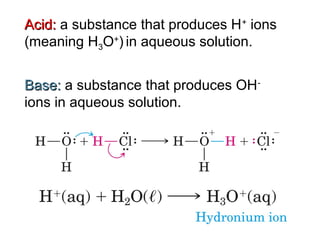
Acid:Acid: a substance that produces H+
ions
(meaning H3O+
) in aqueous solution.
Base:Base: a substance that produces OH-
ions in aqueous solution.
The Hydronium Ion
yogur
t
Tartaric acid
Acid Basic
HOW DO WE FIND OUT IF IT IS AN ACID ?
1930 1990
Marble statue of George Washington in NY
Trees damaged by acid rain in the
Great Smoky Mountains
ACID RAIN
Hydrangeas grown on acidic soil
are blue
Hydrangeas grown on neutral or
basic soil are pink
ACID BASIC
Cabbage juice contains a
natural indicator of acidity
Acid:Acid: a substance that produces H+
ions (meaning H3O+
)in aqueous
solution.
Base:Base: a substance that produces OH-
ions in aqueous solution.
This definition of an acid is a slight modification of the original Arrhenius definition (1884),
which was that an acid produces H+
in aqueous solution
Strong acid:Strong acid: dissociates and reacts completely with water to form H3O+
ions.
Strong base:Strong base: dissociates and reacts completely with water to form OH-
ions.
Many bases like KOH, NaOH, Mg(OH)2, and Ca(OH)2] disassociate in
water producing OH-
ions (basic solution):
Other bases produce OH-
by reacting with water molecules, here shown
for ammonia:
Weak acid:Weak acid: a substance that dissociates partially in water
to produce H3O+
ions.
acetic acid: 4 out every 1000 molecules are converted to acetate ions
Weak base:Weak base: a substance that produces OH-
ions in water in
a reversible reaction.
ammonia, for example, is a weak base:
1. strong acid
2. strong base
3. weak acid
4. weak base
NH3 is classified as a:
Brønsted-Lowery Bases
A base is any substance that can accept a
proton from some other source.
Brønsted-Lowery Acids
An acid is any substance that can donate a
proton to some other substance.
Acids are proton donors and bases are proton acceptors. An acid-
base (neutralization) reaction is a proton transfer reaction.
HCl + NaOH H2O + NaCl
(strong acid) (strong base) (dissociated in water)
A neutralization reaction between a strong acid an a strong base usually
produces water (depending on what the acid and the base are).
In a neutralization reaction hydrochloric acid
(HCl) will react with each of the following
reactants to produce water, except:
1. NaOH
2. Ba(OH)2
3. Mg (magnesium metal)
4. LiOH
Equilibrium/Ionization Constants
When a weak acid, HA, dissolves in water
the equilibrium constant expression, Keq, for this ionization is:
Water is the solvent and its concentration changes very little when we add HA,
we treat [H2O] as a constant equal to 1000 g/L or 55.5 mol/L. We combine the
two constants to give the acid ionization constant, Ka:
pKa = -log Ka
Note the inverse relationship between values of Ka and pKa. The weaker the
acid, the smaller its Ka, but the larger its pKa.
What is the pKa of nitrous acid, if it has a
Ka of 4.0 x 10⁻⁴
?
1. -3.4
2. 3.4
3. -4.0
4. 4.0
1 x 10⁷
1 x 10³
1 x 10⁸
1 x 10²
A FEW IMPORTANT FACTS
1. An acid and bases can be positively charged, neutral,
or negatively charged (see table)
2. Acids are classified a monoprotic, diprotic, or triprotic
depending on the number of protons each may give up
ie HCl (gives only one away), H2CO3 (can give 2), and
H3PO4 (can give 3).
3. Several molecules/ions can either accept or donate a
H+
(they can function as acid or base) and are called
amphiproticamphiprotic. ie H2PO4
-
4. A Brønsted-Lowry acid always contains a hydrogen atom
to give away, but not all hydrogen containing compounds
are acids, i.e. CH4 contains hydrogens but does not give
any one away!!!
5. There is an inverse relationship between the strength of
an acid and the strength of its conjugate base (see
table).
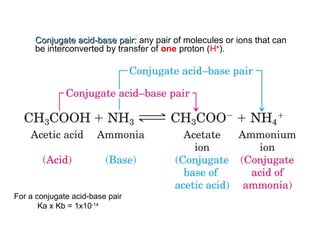
Conjugate acid-base pair:Conjugate acid-base pair: any pair of molecules or ions that can
be interconverted by transfer of one proton (H+
).
For a conjugate acid-base pair
Ka x Kb = 1x10-14
Acid-Base Equilibria
But what if the base is not water? How can we determine
whether the equilibrium lies to the left or the right?
To predict the position of an acid-base equilibrium :
Identify the stronger acid and the weaker acid.
Identify the stronger base and the weaker base
(the stronger acid gives the weaker conjugate base, and the weaker acid
gives the stronger conjugate base).
The equilibrium position always favors formation of the weaker acid
and weaker base. At equilibrium the major species present are the
weaker acid and the weaker base.
Ka = 1.8 x 10⁻⁵
Ka = 5.6 x 10⁻¹⁰
Kb = 1.8 x 10⁻⁵
Kb = 5.6 x 10⁻¹⁰
For a conjugate acid-base pair
Ka x Kb = 1x10-14
1.
2.
3.
4.
For the following reaction, equilibrium lies to the
_______ and _______ is the stronger acid.
C6H5OH + H2PO4
-
= H3PO4 + C6H5O-
Self-Ionization of Water
14-
3
2
2
10x1.0
]][[][
=
== −+
w
w
K
OHOHOHKK
Compare to [H2O] = 55.5 mol/L
-log[1.0 x 10⁻⁷
] = 7= pH water
The product of [H3O+
] and [OH-
] in any aqueous solution is
equal to 1.0 x 10⁻¹⁴
.
If we add 0.010 mol of HCl to 1.00 liter of pure water, in
this solution [H3O+
] = 0.010 or 1.0 x 10⁻²
. This means that
the concentration of hydroxide ion is:
wKOHOH ==−+ -14
3 10x1.0]][[
pH and pOH
Because hydronium ion concentrations for most solutions
are numbers with negative exponents, we express these
concentrations as pH:
pH = -log [H3O+
]
Acidic solution:Acidic solution: pH < 7.0.
Basic solution:Basic solution: pH > 7.0.
Neutral solution:Neutral solution: pH = 7.0.
if we know the pH of an aqueous solution, we can easily
calculate its pOH:
pOH = -log[OH-
]
the ion product of water, Kw, is 1.0 x 10⁻¹⁴
taking the logarithm of this equation gives:
pH + pOH = 14
1. acidic.
2. basic.
3. neutral.
4. radioactive.
If a solution has a [OH-
] of 4.87 x 10⁻⁹
M, then the
solution is classified as:
Acid-Base Titrations
AAnalytical procedure in which a solution of known concentration reacts
in a known stoichiometry with a substance whose concentration is to be
determined.
HI + KOH → H2O + K+
+ I-
M = ? 0.138 M.
19.4 mL 39.2 mL
M0.279
Liters0.0194
mole5.41x10
MolarityHI
HofmolesOHofmolesKOHofmoles
KOHofmole.41x105
ml1000
liter1
x39.2mLx
liter
moles
138.0
3
3
==
==
=
−
−
pH Buffers
A pH buffer solution resists change in pH
when limited amounts of acid or base are
added to it.
Buffers consist of approximately equal molar
amounts of a weak acid and a salt of the
conjugate base.
CH3
–COOH  H+
+ CH3-COO-
 
CH3
-COONa → Na+
+ CH3-COO-
BUFFER SYSTEM
http://www.mhhe.com/physsci/chemistry/essentialchemistry/flash/buffer12.swf
Weak acid
Salt of the conjugate base
Blood Buffers
The average pH of human blood is 7.4 any change greater
than 0.10 pH unit in either direction can cause illness.
To maintain this pH, the body uses three buffer systems:
carbonate buffer:carbonate buffer: H2CO3 and its conjugate base, HCO3
-
phosphate buffer:phosphate buffer: H2PO4
-
and its conjugate base, HPO4
2-
proteins:proteins: discussed in Chapter 21.
Henderson-Hasselbalch
A mathematical relationship between pH, pKa of the weak
acid, concentration of HA and its conjugate base A-
Weak acid
concentration
Concentration of
the conjugate base
pH = pKa
+ log
[CO3
2-
]
= - log (4.8e-11) + log
0.310
= 10.16
[HCO3
-
] 0.443
Substituting these values in the equation gives:
A buffer solution is 0.443 M in KHCO3 and 0.310 M in K2CO3.
If Ka for HCO3
-
is 4.8e-11
, what is the pH of this buffer
solution?

Chapter 8

  • 1.
  • 2.
  • 3.
    Acid:Acid: a substancethat produces H+ ions (meaning H3O+ ) in aqueous solution. Base:Base: a substance that produces OH- ions in aqueous solution.
  • 4.
  • 5.
  • 6.
    Acid Basic HOW DOWE FIND OUT IF IT IS AN ACID ?
  • 7.
    1930 1990 Marble statueof George Washington in NY Trees damaged by acid rain in the Great Smoky Mountains ACID RAIN
  • 8.
    Hydrangeas grown onacidic soil are blue Hydrangeas grown on neutral or basic soil are pink
  • 9.
    ACID BASIC Cabbage juicecontains a natural indicator of acidity
  • 10.
    Acid:Acid: a substancethat produces H+ ions (meaning H3O+ )in aqueous solution. Base:Base: a substance that produces OH- ions in aqueous solution. This definition of an acid is a slight modification of the original Arrhenius definition (1884), which was that an acid produces H+ in aqueous solution
  • 11.
    Strong acid:Strong acid:dissociates and reacts completely with water to form H3O+ ions. Strong base:Strong base: dissociates and reacts completely with water to form OH- ions.
  • 12.
    Many bases likeKOH, NaOH, Mg(OH)2, and Ca(OH)2] disassociate in water producing OH- ions (basic solution): Other bases produce OH- by reacting with water molecules, here shown for ammonia:
  • 13.
    Weak acid:Weak acid:a substance that dissociates partially in water to produce H3O+ ions. acetic acid: 4 out every 1000 molecules are converted to acetate ions Weak base:Weak base: a substance that produces OH- ions in water in a reversible reaction. ammonia, for example, is a weak base:
  • 14.
    1. strong acid 2.strong base 3. weak acid 4. weak base NH3 is classified as a:
  • 15.
    Brønsted-Lowery Bases A baseis any substance that can accept a proton from some other source.
  • 16.
    Brønsted-Lowery Acids An acidis any substance that can donate a proton to some other substance.
  • 17.
    Acids are protondonors and bases are proton acceptors. An acid- base (neutralization) reaction is a proton transfer reaction. HCl + NaOH H2O + NaCl (strong acid) (strong base) (dissociated in water) A neutralization reaction between a strong acid an a strong base usually produces water (depending on what the acid and the base are).
  • 18.
    In a neutralizationreaction hydrochloric acid (HCl) will react with each of the following reactants to produce water, except: 1. NaOH 2. Ba(OH)2 3. Mg (magnesium metal) 4. LiOH
  • 19.
    Equilibrium/Ionization Constants When aweak acid, HA, dissolves in water the equilibrium constant expression, Keq, for this ionization is: Water is the solvent and its concentration changes very little when we add HA, we treat [H2O] as a constant equal to 1000 g/L or 55.5 mol/L. We combine the two constants to give the acid ionization constant, Ka:
  • 20.
    pKa = -logKa Note the inverse relationship between values of Ka and pKa. The weaker the acid, the smaller its Ka, but the larger its pKa.
  • 21.
    What is thepKa of nitrous acid, if it has a Ka of 4.0 x 10⁻⁴ ? 1. -3.4 2. 3.4 3. -4.0 4. 4.0
  • 22.
    1 x 10⁷ 1x 10³ 1 x 10⁸ 1 x 10²
  • 23.
    A FEW IMPORTANTFACTS 1. An acid and bases can be positively charged, neutral, or negatively charged (see table) 2. Acids are classified a monoprotic, diprotic, or triprotic depending on the number of protons each may give up ie HCl (gives only one away), H2CO3 (can give 2), and H3PO4 (can give 3). 3. Several molecules/ions can either accept or donate a H+ (they can function as acid or base) and are called amphiproticamphiprotic. ie H2PO4 -
  • 24.
    4. A Brønsted-Lowryacid always contains a hydrogen atom to give away, but not all hydrogen containing compounds are acids, i.e. CH4 contains hydrogens but does not give any one away!!! 5. There is an inverse relationship between the strength of an acid and the strength of its conjugate base (see table).
  • 25.
    Conjugate acid-base pair:Conjugateacid-base pair: any pair of molecules or ions that can be interconverted by transfer of one proton (H+ ). For a conjugate acid-base pair Ka x Kb = 1x10-14
  • 27.
    Acid-Base Equilibria But whatif the base is not water? How can we determine whether the equilibrium lies to the left or the right?
  • 28.
    To predict theposition of an acid-base equilibrium : Identify the stronger acid and the weaker acid. Identify the stronger base and the weaker base (the stronger acid gives the weaker conjugate base, and the weaker acid gives the stronger conjugate base). The equilibrium position always favors formation of the weaker acid and weaker base. At equilibrium the major species present are the weaker acid and the weaker base.
  • 29.
    Ka = 1.8x 10⁻⁵ Ka = 5.6 x 10⁻¹⁰ Kb = 1.8 x 10⁻⁵ Kb = 5.6 x 10⁻¹⁰ For a conjugate acid-base pair Ka x Kb = 1x10-14
  • 30.
    1. 2. 3. 4. For the followingreaction, equilibrium lies to the _______ and _______ is the stronger acid. C6H5OH + H2PO4 - = H3PO4 + C6H5O-
  • 31.
    Self-Ionization of Water 14- 3 2 2 10x1.0 ]][[][ = ==−+ w w K OHOHOHKK Compare to [H2O] = 55.5 mol/L -log[1.0 x 10⁻⁷ ] = 7= pH water
  • 32.
    The product of[H3O+ ] and [OH- ] in any aqueous solution is equal to 1.0 x 10⁻¹⁴ . If we add 0.010 mol of HCl to 1.00 liter of pure water, in this solution [H3O+ ] = 0.010 or 1.0 x 10⁻² . This means that the concentration of hydroxide ion is: wKOHOH ==−+ -14 3 10x1.0]][[
  • 33.
    pH and pOH Becausehydronium ion concentrations for most solutions are numbers with negative exponents, we express these concentrations as pH: pH = -log [H3O+ ] Acidic solution:Acidic solution: pH < 7.0. Basic solution:Basic solution: pH > 7.0. Neutral solution:Neutral solution: pH = 7.0.
  • 35.
    if we knowthe pH of an aqueous solution, we can easily calculate its pOH: pOH = -log[OH- ] the ion product of water, Kw, is 1.0 x 10⁻¹⁴ taking the logarithm of this equation gives: pH + pOH = 14
  • 37.
    1. acidic. 2. basic. 3.neutral. 4. radioactive. If a solution has a [OH- ] of 4.87 x 10⁻⁹ M, then the solution is classified as:
  • 38.
    Acid-Base Titrations AAnalytical procedurein which a solution of known concentration reacts in a known stoichiometry with a substance whose concentration is to be determined. HI + KOH → H2O + K+ + I- M = ? 0.138 M. 19.4 mL 39.2 mL M0.279 Liters0.0194 mole5.41x10 MolarityHI HofmolesOHofmolesKOHofmoles KOHofmole.41x105 ml1000 liter1 x39.2mLx liter moles 138.0 3 3 == == = − −
  • 39.
    pH Buffers A pHbuffer solution resists change in pH when limited amounts of acid or base are added to it. Buffers consist of approximately equal molar amounts of a weak acid and a salt of the conjugate base.
  • 40.
    CH3 –COOH  H+ +CH3-COO-   CH3 -COONa → Na+ + CH3-COO- BUFFER SYSTEM http://www.mhhe.com/physsci/chemistry/essentialchemistry/flash/buffer12.swf Weak acid Salt of the conjugate base
  • 41.
    Blood Buffers The averagepH of human blood is 7.4 any change greater than 0.10 pH unit in either direction can cause illness. To maintain this pH, the body uses three buffer systems: carbonate buffer:carbonate buffer: H2CO3 and its conjugate base, HCO3 - phosphate buffer:phosphate buffer: H2PO4 - and its conjugate base, HPO4 2- proteins:proteins: discussed in Chapter 21.
  • 42.
    Henderson-Hasselbalch A mathematical relationshipbetween pH, pKa of the weak acid, concentration of HA and its conjugate base A- Weak acid concentration Concentration of the conjugate base
  • 43.
    pH = pKa +log [CO3 2- ] = - log (4.8e-11) + log 0.310 = 10.16 [HCO3 - ] 0.443 Substituting these values in the equation gives: A buffer solution is 0.443 M in KHCO3 and 0.310 M in K2CO3. If Ka for HCO3 - is 4.8e-11 , what is the pH of this buffer solution?