CLASSIFICATION OF
ORGANIC COMPOUNDS
Dr. A. Rajasekhar
Reddy
K L COLLEGE OF PHARMACY,
KLEF DEEMED TO BE UNIVERSITY
ORGANIC COMPOUNDS
 The element carbon has the unique property called catenation due
to which it forms covalent bonds with other atoms.
 It also forms covalent bonds with atoms of other elements like
hydrogen, oxygen, nitrogen, sulphur, phosphorus and halogens.
 The resulting compounds are studied under a separate branch of
chemistry called organic chemistry.
 Some basic principles and techniques of analysis required for
understanding the formation and properties of organic compounds.
CARBON
CHEMISTRY
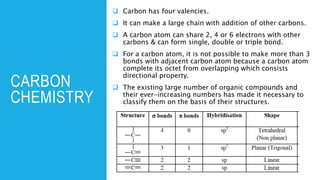
 Carbon has four valencies.
 It can make a large chain with addition of other carbons.
 A carbon atom can share 2, 4 or 6 electrons with other
carbons & can form single, double or triple bond.
 For a carbon atom, it is not possible to make more than 3
bonds with adjacent carbon atom because a carbon atom
complete its octet from overlapping which consists
directional property.
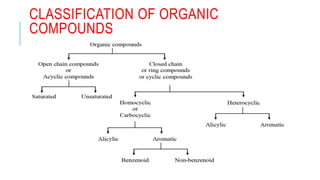
 The existing large number of organic compounds and
their ever-increasing numbers has made it necessary to
classify them on the basis of their structures.
CLASSIFICATION OF ORGANIC
COMPOUNDS
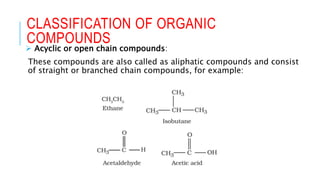
 Acyclic or open chain compounds:
These compounds are also called as aliphatic compounds and consist
of straight or branched chain compounds, for example:
CLASSIFICATION OF ORGANIC
COMPOUNDS
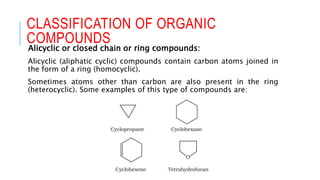
Alicyclic or closed chain or ring compounds:
Alicyclic (aliphatic cyclic) compounds contain carbon atoms joined in
the form of a ring (homocyclic).
Sometimes atoms other than carbon are also present in the ring
(heterocyclic). Some examples of this type of compounds are:
CLASSIFICATION OF ORGANIC
COMPOUNDS
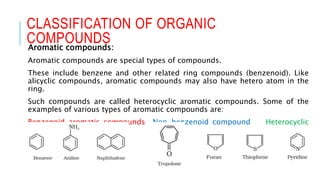
Aromatic compounds:
Aromatic compounds are special types of compounds.
These include benzene and other related ring compounds (benzenoid). Like
alicyclic compounds, aromatic compounds may also have hetero atom in the
ring.
Such compounds are called heterocyclic aromatic compounds. Some of the
examples of various types of aromatic compounds are:
Benzenoid aromatic compounds Non-benzenoid compound Heterocyclic
aromatic compounds
CLASSIFICATION OF ORGANIC
COMPOUNDS
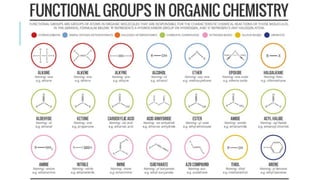
Organic compounds can also be classified on the basis of functional groups,
into families or homologous series.
Functional Group:
The functional group may be defined as an atom or group of atoms joined in
a specific manner which is responsible for the characteristic chemical
properties of the organic compounds.
The examples are hydroxyl group (–OH), aldehyde group (–CHO) and
carboxylic acid group (–COOH) etc.
Homologous Series:
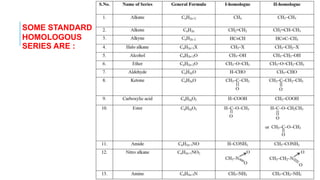
 A group or a series of organic compounds each containing a characteristic
functional group forms a homologous series and the members of the series
are called homologues.
 The members of a homologous series can be represented by general
molecular formula and the successive members differ from each other in
molecular formula by a –CH2 unit.
 There are a number of homologous series of organic compounds. Some of
these are alkanes, alkenes, alkynes, haloalkanes, alkanols, alkanals,
CLASSIFICATION OF ORGANIC
COMPOUNDS
SOME STANDARD
HOMOLOGOUS
SERIES ARE :
Organic Compounds classification

Organic Compounds classification

  • 1.
    CLASSIFICATION OF ORGANIC COMPOUNDS Dr.A. Rajasekhar Reddy K L COLLEGE OF PHARMACY, KLEF DEEMED TO BE UNIVERSITY
  • 2.
    ORGANIC COMPOUNDS  Theelement carbon has the unique property called catenation due to which it forms covalent bonds with other atoms.  It also forms covalent bonds with atoms of other elements like hydrogen, oxygen, nitrogen, sulphur, phosphorus and halogens.  The resulting compounds are studied under a separate branch of chemistry called organic chemistry.  Some basic principles and techniques of analysis required for understanding the formation and properties of organic compounds.
  • 3.
    CARBON CHEMISTRY  Carbon hasfour valencies.  It can make a large chain with addition of other carbons.  A carbon atom can share 2, 4 or 6 electrons with other carbons & can form single, double or triple bond.  For a carbon atom, it is not possible to make more than 3 bonds with adjacent carbon atom because a carbon atom complete its octet from overlapping which consists directional property.  The existing large number of organic compounds and their ever-increasing numbers has made it necessary to classify them on the basis of their structures.
  • 4.
  • 5.
     Acyclic oropen chain compounds: These compounds are also called as aliphatic compounds and consist of straight or branched chain compounds, for example: CLASSIFICATION OF ORGANIC COMPOUNDS
  • 6.
    Alicyclic or closedchain or ring compounds: Alicyclic (aliphatic cyclic) compounds contain carbon atoms joined in the form of a ring (homocyclic). Sometimes atoms other than carbon are also present in the ring (heterocyclic). Some examples of this type of compounds are: CLASSIFICATION OF ORGANIC COMPOUNDS
  • 7.
    Aromatic compounds: Aromatic compoundsare special types of compounds. These include benzene and other related ring compounds (benzenoid). Like alicyclic compounds, aromatic compounds may also have hetero atom in the ring. Such compounds are called heterocyclic aromatic compounds. Some of the examples of various types of aromatic compounds are: Benzenoid aromatic compounds Non-benzenoid compound Heterocyclic aromatic compounds CLASSIFICATION OF ORGANIC COMPOUNDS
  • 8.
    Organic compounds canalso be classified on the basis of functional groups, into families or homologous series. Functional Group: The functional group may be defined as an atom or group of atoms joined in a specific manner which is responsible for the characteristic chemical properties of the organic compounds. The examples are hydroxyl group (–OH), aldehyde group (–CHO) and carboxylic acid group (–COOH) etc. Homologous Series:  A group or a series of organic compounds each containing a characteristic functional group forms a homologous series and the members of the series are called homologues.  The members of a homologous series can be represented by general molecular formula and the successive members differ from each other in molecular formula by a –CH2 unit.  There are a number of homologous series of organic compounds. Some of these are alkanes, alkenes, alkynes, haloalkanes, alkanols, alkanals, CLASSIFICATION OF ORGANIC COMPOUNDS
  • 9.