Basic Organic Chemistry
Nur Faralina Binti Asrab Ali D20101037415
Wan Norazwani Bt Mahusin D20101037533
Fatin Nasuha
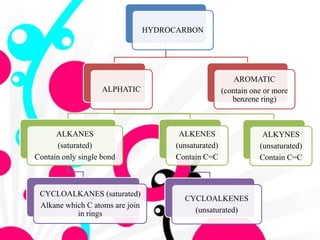
HYDROCARBON
ALPHATIC
ALKANES
(saturated)
Contain only single bond
CYCLOALKANES (saturated)
Alkane which C atoms are join
in rings
ALKENES
(unsaturated)
Contain C=C
CYCLOALKENES
(unsaturated)
ALKYNES
(unsaturated)
Contain C=C
AROMATIC
(contain one or more
benzene ring)
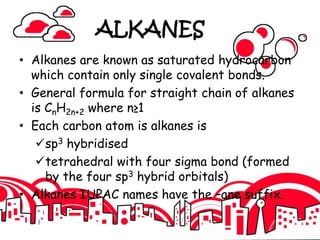
ALKANES
• Alkanes are known as saturated hydrocarbon
which contain only single covalent bonds.
• General formula for straight chain of alkanes
is CnH2n+2 where n≥1
• Each carbon atom is alkanes is
sp3 hybridised
tetrahedral with four sigma bond (formed
by the four sp3 hybrid orbitals)
• Alkanes IUPAC names have the –ane suffix.
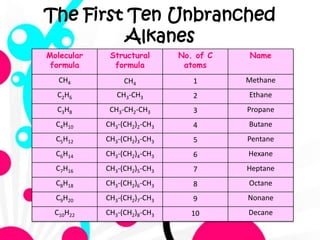
The First Ten Unbranched
Alkanes
Molecular
formula
Structural
formula
No. of C
atoms
Name
CH4 CH4 1 Methane
C2H6 CH3-CH3 2 Ethane
C3H8 CH3-CH2-CH3 3 Propane
C4H10 CH3-(CH2)2-CH3 4 Butane
C5H12 CH3-(CH2)3-CH3 5 Pentane
C6H14 CH3-(CH2)4-CH3 6 Hexane
C7H16 CH3-(CH2)5-CH3 7 Heptane
C8H18 CH3-(CH2)6-CH3 8 Octane
C9H20 CH3-(CH2)7-CH3 9 Nonane
C10H22 CH3-(CH2)8-CH3 10 Decane
• Starting from C4H10 onwards, the
alkanes show the phenomenon of chain
isomerism
• They can exist as linear or branched
alkanes.
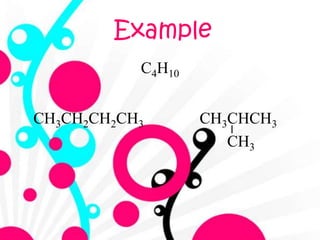
Example
C4H10
CH3CH2CH2CH3 CH3CHCH3
CH3
IUPAC NOMENCLATURE
• IUPAC-International Union of Pure and
Applied Chemistry
• Branched-chain alkanes are named
according to the following rules:
STEP 1
• Choose the longest continuous chain of carbon
atoms; this chain determines the parent name
for alkanes.
STEP 2
• Number the longest chain beginning with the
end of the chain nearer the substituent.
STEP 3
• Use rule number 2 to locate the position of the
substituent.
• The position and the name of the substituent
must be written in front of the parent chain.
STEP 4
–If two or more substituent are
present, give each substituent a number
corresponding to its location on the longest
chain.
The substituent should be listed alphabetically
In alphabetizing, the prefixes di, tri, tetra, sec-, tert-
are ignored except iso and neo
STEP 5
• If two substituent are present on
the same carbon atom, use that
number twice.
STEP 6
• If two or more identical substituent are
present, use prefixes di-(two identical
substituent), tri-(three identical
substituent), tetra-(four identical
substituent).
• Commas are used to separate numbers
from each other.
STEP 7
• If there are two chains of equal
length as the parent chain, choose
the chain with the greater
number of substituent.
STEP 8
• If branching occurs at an equal distance
from either end of the longest
chain, choose the name that gives the
lower number at the first point of
difference.
Cycloalkanes
?
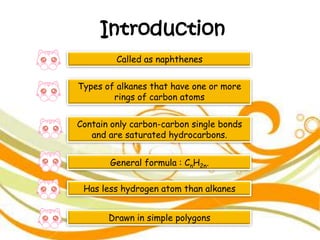
Introduction
Called as naphthenes
Types of alkanes that have one or more
rings of carbon atoms
Contain only carbon-carbon single bonds
and are saturated hydrocarbons.
General formula : CnH2n.
Has less hydrogen atom than alkanes
Drawn in simple polygons
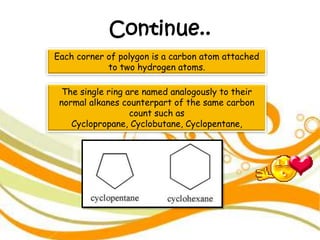
Continue..
Each corner of polygon is a carbon atom attached
to two hydrogen atoms.
The single ring are named analogously to their
normal alkanes counterpart of the same carbon
count such as
Cyclopropane, Cyclobutane, Cyclopentane,
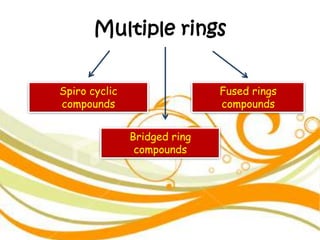
Multiple rings
Spiro cyclic
compounds
Fused rings
compounds
Bridged ring
compounds
Continue..
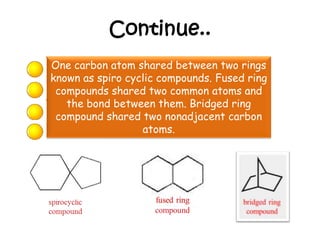
One carbon atom shared between two rings
known as spiro cyclic compounds. Fused ring
compounds shared two common atoms and
the bond between them. Bridged ring
compound shared two nonadjacent carbon
atoms.
Naming Cycloalkanes
 Cycloalkanes are named according to
the IUPAC system by using the prefix
cyclo-.
 There are only two steps:
1) Find the parent.
2)Number of substituent and write the
name.
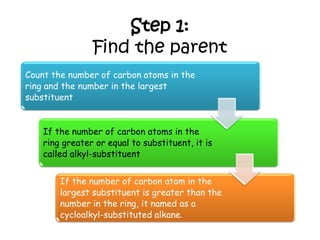
Step 1:
Find the parent
Count the number of carbon atoms in the
ring and the number in the largest
substituent
If the number of carbon atoms in the
ring greater or equal to substituent, it is
called alkyl-substituent
If the number of carbon atom in the
largest substituent is greater than the
number in the ring, it named as a
cycloalkyl-substituted alkane.
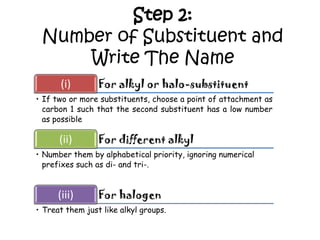
Step 2:
Number of Substituent and
Write The Name
For alkyl or halo-substituent(i)
• If two or more substituents, choose a point of attachment as
carbon 1 such that the second substituent has a low number
as possible
For different alkyl(ii)
• Number them by alphabetical priority, ignoring numerical
prefixes such as di- and tri-.
For halogen(iii)
• Treat them just like alkyl groups.
PHYSICAL PROPERTIES OF ALKANES
• Different physical properties
of alkanes is resulting from
different range of molecular
weight( different of c )
• On this subtopic we will cover
about
 boiling point
Melting point
solubilty
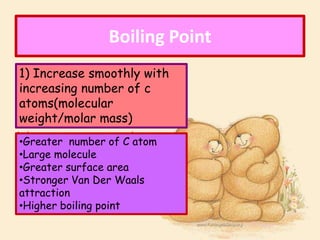
Boiling Point
1) Increase smoothly with
increasing number of c
atoms(molecular
weight/molar mass)
•Greater number of C atom
•Large molecule
•Greater surface area
•Stronger Van Der Waals
attraction
•Higher boiling point
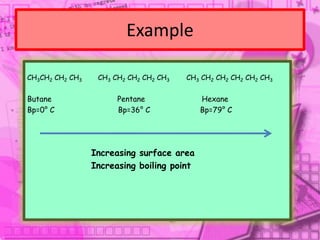
Example
CH3CH2 CH2 CH3 CH3 CH2 CH2 CH2 CH3 CH3 CH2 CH2 CH2 CH2 CH3
Butane Pentane Hexane
Bp=0° C Bp=36° C Bp=79° C
Increasing surface area
Increasing boiling point
Effect of Chain Branching
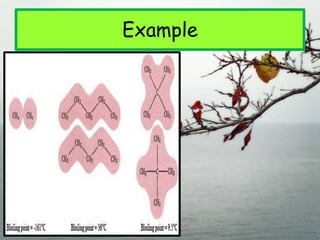
2) Branching of alkane
chain lowers boiling point
 More branches
Molecular shapebecomes
more compact
Surface area reduced
Weaker Van Der Waals
attraction
Lower boiling point
Example
Straight with Cycloalkane
• When compairing at the same number of
C, cycloalkanes has slightly higher boiling
point than alkanes.
Compairing Boiling Points to More
Polar Compounds
•Alkanes have low boiling points compared to
more polar compounds of comparable size
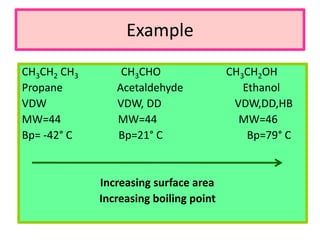
Example
CH3CH2 CH3 CH3CHO CH3CH2OH
Propane Acetaldehyde Ethanol
VDW VDW, DD VDW,DD,HB
MW=44 MW=44 MW=46
Bp= -42° C Bp=21° C Bp=79° C
Increasing surface area
Increasing boiling point
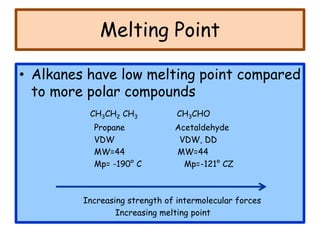
Melting Point
• Alkanes have low melting point compared
to more polar compounds
CH3CH2 CH3 CH3CHO
Propane Acetaldehyde
VDW VDW, DD
MW=44 MW=44
Mp= -190° C Mp=-121° CZ
Increasing strength of intermolecular forces
Increasing melting point
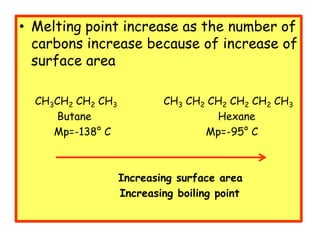
• Melting point increase as the number of
carbons increase because of increase of
surface area
CH3CH2 CH2 CH3 CH3 CH2 CH2 CH2 CH2 CH3
Butane Hexane
Mp=-138° C Mp=-95° C
Increasing surface area
Increasing boiling point
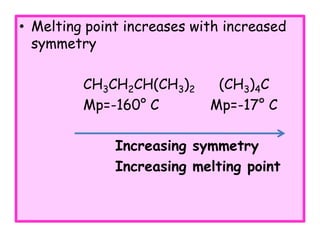
• Melting point increases with increased
symmetry
CH3CH2CH(CH3)2 (CH3)4C
Mp=-160° C Mp=-17° C
Increasing symmetry
Increasing melting point
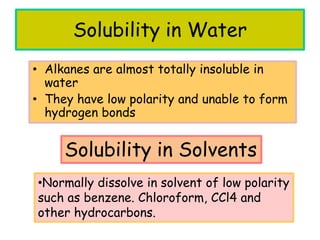
Solubility in Water
• Alkanes are almost totally insoluble in
water
• They have low polarity and unable to form
hydrogen bonds
Solubility in Solvents
•Normally dissolve in solvent of low polarity
such as benzene. Chloroform, CCl4 and
other hydrocarbons.


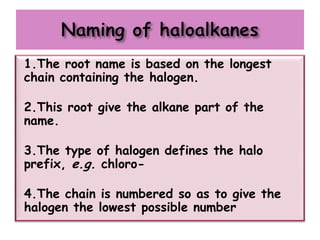
1.The root name is based on the longest
chain containing the halogen.
2.This root give the alkane part of the
name.
3.The type of halogen defines the halo
prefix, e.g. chloro-
4.The chain is numbered so as to give the
halogen the lowest possible number
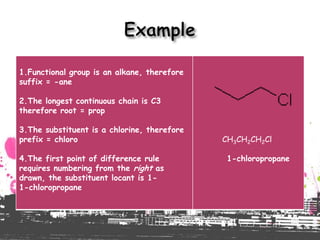
1.Functional group is an alkane, therefore
suffix = -ane
2.The longest continuous chain is C3
therefore root = prop
3.The substituent is a chlorine, therefore
prefix = chloro
4.The first point of difference rule
requires numbering from the right as
drawn, the substituent locant is 1-
1-chloropropane
CH3CH2CH2Cl
1-chloropropane

Alkane Slide

  • 1.
    Basic Organic Chemistry NurFaralina Binti Asrab Ali D20101037415 Wan Norazwani Bt Mahusin D20101037533 Fatin Nasuha
  • 2.
    HYDROCARBON ALPHATIC ALKANES (saturated) Contain only singlebond CYCLOALKANES (saturated) Alkane which C atoms are join in rings ALKENES (unsaturated) Contain C=C CYCLOALKENES (unsaturated) ALKYNES (unsaturated) Contain C=C AROMATIC (contain one or more benzene ring)
  • 3.
    ALKANES • Alkanes areknown as saturated hydrocarbon which contain only single covalent bonds. • General formula for straight chain of alkanes is CnH2n+2 where n≥1 • Each carbon atom is alkanes is sp3 hybridised tetrahedral with four sigma bond (formed by the four sp3 hybrid orbitals) • Alkanes IUPAC names have the –ane suffix.
  • 4.
    The First TenUnbranched Alkanes Molecular formula Structural formula No. of C atoms Name CH4 CH4 1 Methane C2H6 CH3-CH3 2 Ethane C3H8 CH3-CH2-CH3 3 Propane C4H10 CH3-(CH2)2-CH3 4 Butane C5H12 CH3-(CH2)3-CH3 5 Pentane C6H14 CH3-(CH2)4-CH3 6 Hexane C7H16 CH3-(CH2)5-CH3 7 Heptane C8H18 CH3-(CH2)6-CH3 8 Octane C9H20 CH3-(CH2)7-CH3 9 Nonane C10H22 CH3-(CH2)8-CH3 10 Decane
  • 5.
    • Starting fromC4H10 onwards, the alkanes show the phenomenon of chain isomerism • They can exist as linear or branched alkanes.
  • 6.
  • 7.
    IUPAC NOMENCLATURE • IUPAC-InternationalUnion of Pure and Applied Chemistry • Branched-chain alkanes are named according to the following rules:
  • 8.
    STEP 1 • Choosethe longest continuous chain of carbon atoms; this chain determines the parent name for alkanes.
  • 9.
    STEP 2 • Numberthe longest chain beginning with the end of the chain nearer the substituent.
  • 10.
    STEP 3 • Userule number 2 to locate the position of the substituent. • The position and the name of the substituent must be written in front of the parent chain.
  • 11.
    STEP 4 –If twoor more substituent are present, give each substituent a number corresponding to its location on the longest chain. The substituent should be listed alphabetically In alphabetizing, the prefixes di, tri, tetra, sec-, tert- are ignored except iso and neo
  • 12.
    STEP 5 • Iftwo substituent are present on the same carbon atom, use that number twice.
  • 13.
    STEP 6 • Iftwo or more identical substituent are present, use prefixes di-(two identical substituent), tri-(three identical substituent), tetra-(four identical substituent). • Commas are used to separate numbers from each other.
  • 14.
    STEP 7 • Ifthere are two chains of equal length as the parent chain, choose the chain with the greater number of substituent.
  • 15.
    STEP 8 • Ifbranching occurs at an equal distance from either end of the longest chain, choose the name that gives the lower number at the first point of difference.
  • 16.
  • 17.
    Introduction Called as naphthenes Typesof alkanes that have one or more rings of carbon atoms Contain only carbon-carbon single bonds and are saturated hydrocarbons. General formula : CnH2n. Has less hydrogen atom than alkanes Drawn in simple polygons
  • 18.
    Continue.. Each corner ofpolygon is a carbon atom attached to two hydrogen atoms. The single ring are named analogously to their normal alkanes counterpart of the same carbon count such as Cyclopropane, Cyclobutane, Cyclopentane,
  • 19.
    Multiple rings Spiro cyclic compounds Fusedrings compounds Bridged ring compounds
  • 20.
    Continue.. One carbon atomshared between two rings known as spiro cyclic compounds. Fused ring compounds shared two common atoms and the bond between them. Bridged ring compound shared two nonadjacent carbon atoms.
  • 21.
    Naming Cycloalkanes  Cycloalkanesare named according to the IUPAC system by using the prefix cyclo-.  There are only two steps: 1) Find the parent. 2)Number of substituent and write the name.
  • 22.
    Step 1: Find theparent Count the number of carbon atoms in the ring and the number in the largest substituent If the number of carbon atoms in the ring greater or equal to substituent, it is called alkyl-substituent If the number of carbon atom in the largest substituent is greater than the number in the ring, it named as a cycloalkyl-substituted alkane.
  • 23.
    Step 2: Number ofSubstituent and Write The Name For alkyl or halo-substituent(i) • If two or more substituents, choose a point of attachment as carbon 1 such that the second substituent has a low number as possible For different alkyl(ii) • Number them by alphabetical priority, ignoring numerical prefixes such as di- and tri-. For halogen(iii) • Treat them just like alkyl groups.
  • 24.
    PHYSICAL PROPERTIES OFALKANES • Different physical properties of alkanes is resulting from different range of molecular weight( different of c ) • On this subtopic we will cover about  boiling point Melting point solubilty
  • 25.
    Boiling Point 1) Increasesmoothly with increasing number of c atoms(molecular weight/molar mass) •Greater number of C atom •Large molecule •Greater surface area •Stronger Van Der Waals attraction •Higher boiling point
  • 26.
    Example CH3CH2 CH2 CH3CH3 CH2 CH2 CH2 CH3 CH3 CH2 CH2 CH2 CH2 CH3 Butane Pentane Hexane Bp=0° C Bp=36° C Bp=79° C Increasing surface area Increasing boiling point
  • 27.
    Effect of ChainBranching 2) Branching of alkane chain lowers boiling point  More branches Molecular shapebecomes more compact Surface area reduced Weaker Van Der Waals attraction Lower boiling point
  • 28.
  • 29.
    Straight with Cycloalkane •When compairing at the same number of C, cycloalkanes has slightly higher boiling point than alkanes. Compairing Boiling Points to More Polar Compounds •Alkanes have low boiling points compared to more polar compounds of comparable size
  • 30.
    Example CH3CH2 CH3 CH3CHOCH3CH2OH Propane Acetaldehyde Ethanol VDW VDW, DD VDW,DD,HB MW=44 MW=44 MW=46 Bp= -42° C Bp=21° C Bp=79° C Increasing surface area Increasing boiling point
  • 31.
    Melting Point • Alkaneshave low melting point compared to more polar compounds CH3CH2 CH3 CH3CHO Propane Acetaldehyde VDW VDW, DD MW=44 MW=44 Mp= -190° C Mp=-121° CZ Increasing strength of intermolecular forces Increasing melting point
  • 32.
    • Melting pointincrease as the number of carbons increase because of increase of surface area CH3CH2 CH2 CH3 CH3 CH2 CH2 CH2 CH2 CH3 Butane Hexane Mp=-138° C Mp=-95° C Increasing surface area Increasing boiling point
  • 33.
    • Melting pointincreases with increased symmetry CH3CH2CH(CH3)2 (CH3)4C Mp=-160° C Mp=-17° C Increasing symmetry Increasing melting point
  • 34.
    Solubility in Water •Alkanes are almost totally insoluble in water • They have low polarity and unable to form hydrogen bonds Solubility in Solvents •Normally dissolve in solvent of low polarity such as benzene. Chloroform, CCl4 and other hydrocarbons.
  • 36.
  • 37.
  • 41.
    1.The root nameis based on the longest chain containing the halogen. 2.This root give the alkane part of the name. 3.The type of halogen defines the halo prefix, e.g. chloro- 4.The chain is numbered so as to give the halogen the lowest possible number
  • 42.
    1.Functional group isan alkane, therefore suffix = -ane 2.The longest continuous chain is C3 therefore root = prop 3.The substituent is a chlorine, therefore prefix = chloro 4.The first point of difference rule requires numbering from the right as drawn, the substituent locant is 1- 1-chloropropane CH3CH2CH2Cl 1-chloropropane