Chapter 2
Families of Organic Compounds
• Organic compounds can be grouped into families by
their common structural features
• We shall survey the nature of the compounds in a
tour of the families in this course
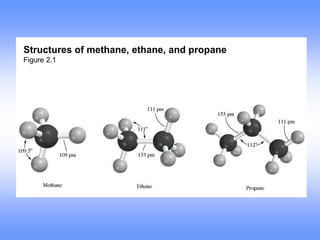
• This chapter deals with alkanes, compounds that
contain only carbons and hydrogens, all connected
exclusively by single bonds
Structures of methane, ethane, and propane
Figure 2.1
3.1 Functional Groups
• Functional group - collection of atoms at a site
within a molecule with a common bonding
pattern
• The group reacts in a typical way, generally
independent of the rest of the molecule
• For example, the double bonds in simple and
complex alkenes react with bromine in the same
way (See Figure 3.1)
Survey of Functional Groups
• Table 3.1 lists a wide variety of functional groups that
you should recognize
• As you learn about them in each chapter it will be easier
to recognize them
• The functional groups affect the reactions, structure, and
physical properties of every compound in which they
occur
Types of Functional Groups:
Multiple Carbon–Carbon Bonds
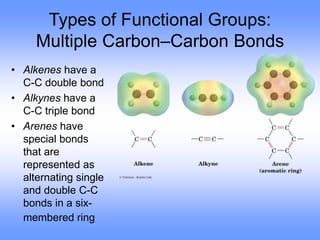
• Alkenes have a
C-C double bond
• Alkynes have a
C-C triple bond
• Arenes have
special bonds
that are
represented as
alternating single
and double C-C
bonds in a six-
membered ring
Functional Groups with Carbon Singly
Bonded to an Electronegative Atom
• Alkyl halide: C bonded to halogen (C-X)
• Alcohol: C bonded O of a hydroxyl group (C OH)
• Ether: Two C’s bonded to the same O (C O C)
• Amine: C bonded to N (C N)
• Thiol: C bonded to SH group (C SH)
• Sulfide: Two C’s bonded to same S (C S C)
• Bonds are polar, with partial positive charge on C (+)
and partial negative charge () on electronegative atom
Groups with a Carbon–Oxygen Double Bond
(Carbonyl Groups)
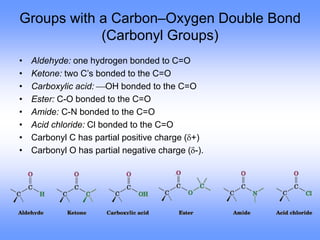
• Aldehyde: one hydrogen bonded to C=O
• Ketone: two C’s bonded to the C=O
• Carboxylic acid: OH bonded to the C=O
• Ester: C-O bonded to the C=O
• Amide: C-N bonded to the C=O
• Acid chloride: Cl bonded to the C=O
• Carbonyl C has partial positive charge (+)
• Carbonyl O has partial negative charge (-).
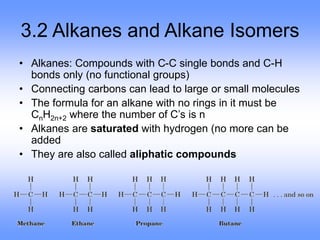
3.2 Alkanes and Alkane Isomers
• Alkanes: Compounds with C-C single bonds and C-H
bonds only (no functional groups)
• Connecting carbons can lead to large or small molecules
• The formula for an alkane with no rings in it must be
CnH2n+2 where the number of C’s is n
• Alkanes are saturated with hydrogen (no more can be
added
• They are also called aliphatic compounds
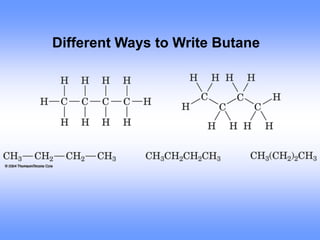
Different Ways to Write Butane
Alkane Isomers
• CH4 = methane, C2H6 = ethane, C3H8= propane
• The molecular formula of an alkane with more than
three carbons can give more than one structural isomer
– C4H10
–C5H12
Constitutional Isomers
• Isomers that differ in how their atoms are arranged in
chains are called constitutional isomers
• Compounds other than alkanes can be constitutional
isomers of one another
• They must have the same molecular formula to be
isomers
Names of Small Hydrocarbons
No. of Carbons Formula Name (CnH2n+2)
1 Methane CH4
2 Ethane C2H6
3 Propane C3H8
4 Butane C4H10
5 Pentane C5H12
6 Hexane C6H14
7 Heptane C7H16
8 Octane C8H18
9 Nonane C9H20
10 Decane C10H22
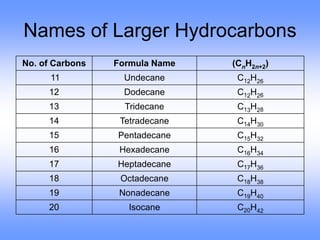
Names of Larger Hydrocarbons
No. of Carbons Formula Name (CnH2n+2)
11 Undecane C12H26
12 Dodecane C12H26
13 Tridecane C13H28
14 Tetradecane C14H30
15 Pentadecane C15H32
16 Hexadecane C16H34
17 Heptadecane C17H36
18 Octadecane C18H38
19 Nonadecane C19H40
20 Isocane C20H42
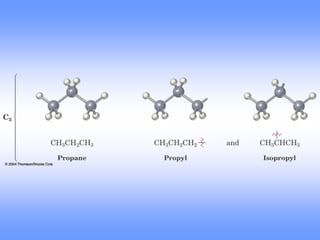
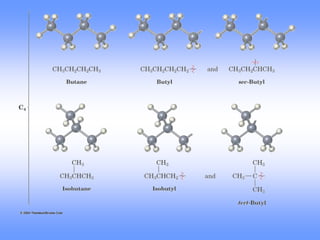
3.3 Alkyl Groups
• Alkyl group – remove one H from an alkane (a part of a
structure)
• General abbreviation “R” (for Radical, an incomplete
species or the “rest” of the molecule)
• Name: replace -ane ending of alkane with -yl ending
– CH3 is “methyl” (from methane)
– CH2CH3 is “ethyl” from ethane
• See Table 3.4 for a list
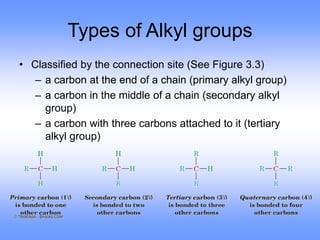
Types of Alkyl groups
• Classified by the connection site (See Figure 3.3)
– a carbon at the end of a chain (primary alkyl group)
– a carbon in the middle of a chain (secondary alkyl
group)
– a carbon with three carbons attached to it (tertiary
alkyl group)
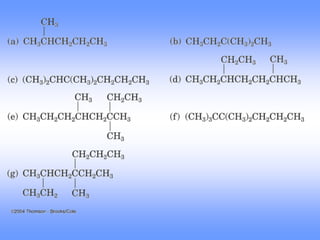
3.4 Naming Alkanes
• Compounds are given systematic names by a process that
uses
– Prefix-Parent-Suffix
• Follows specific rules
– Named as longest possible chain
– Carbons in that chain are numbered in sequence
– substituents are numbered at their point of attachment
– Compound name is one word (German style)
– Complex substituents are named as compounds would be
• See specific examples in text
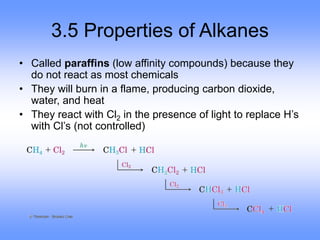
3.5 Properties of Alkanes
• Called paraffins (low affinity compounds) because they
do not react as most chemicals
• They will burn in a flame, producing carbon dioxide,
water, and heat
• They react with Cl2 in the presence of light to replace H’s
with Cl’s (not controlled)
Physical Properties
• Boiling points and melting points increase as size of
alkane increases
• Forces between molecules (temporary dipoles,
dispersion) are weak
3.6 Cycloalkanes
• Cycloalkanes are alkanes that have carbon atoms that
form a ring (called alicyclic compounds)
• Simple cycloalkanes rings of CH2 units, (CH2)n, or
CnH2n
• Structure is shown as a regular polygon with the number
of vertices equal to the number of C’s (a projection of the
actual structure)
cyclopropane
cyclohexane
cyclopentane
cyclobutane
Complex Cycloalkanes
• Naturally occurring materials contain cycloalkane
structures
• Examples: chrysanthemic acid (cyclopropane),
prostaglandins (cyclopentane), steroids (cyclohexanes
and cyclopentane)
Properties of Cycloalkanes
• Melting points are affected by the shapes and the way
that crystals pack so they do not change uniformly
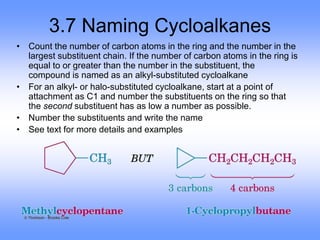
3.7 Naming Cycloalkanes
• Count the number of carbon atoms in the ring and the number in the
largest substituent chain. If the number of carbon atoms in the ring is
equal to or greater than the number in the substituent, the
compound is named as an alkyl-substituted cycloalkane
• For an alkyl- or halo-substituted cycloalkane, start at a point of
attachment as C1 and number the substituents on the ring so that
the second substituent has as low a number as possible.
• Number the substituents and write the name
• See text for more details and examples
3.8 Cis-Trans Isomerism in
Cycloalkanes
• Rotation about C-C bonds in cycloalkanes is limited by
the ring structure
• Rings have two “faces” and substituents are labeled as
to their relative facial positions
• There are two different 1,2-dimethyl-cyclopropane
isomers, one with the two methyls on the same side (cis)
of the ring and one with the methyls on opposite sides
(trans)
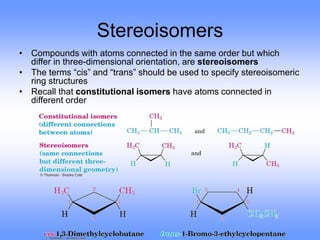
Stereoisomers
• Compounds with atoms connected in the same order but which
differ in three-dimensional orientation, are stereoisomers
• The terms “cis” and “trans” should be used to specify stereoisomeric
ring structures
• Recall that constitutional isomers have atoms connected in
different order

Atkins Chapter2.ppt

  • 1.
  • 2.
    Families of OrganicCompounds • Organic compounds can be grouped into families by their common structural features • We shall survey the nature of the compounds in a tour of the families in this course • This chapter deals with alkanes, compounds that contain only carbons and hydrogens, all connected exclusively by single bonds
  • 3.
    Structures of methane,ethane, and propane Figure 2.1
  • 4.
    3.1 Functional Groups •Functional group - collection of atoms at a site within a molecule with a common bonding pattern • The group reacts in a typical way, generally independent of the rest of the molecule • For example, the double bonds in simple and complex alkenes react with bromine in the same way (See Figure 3.1)
  • 5.
    Survey of FunctionalGroups • Table 3.1 lists a wide variety of functional groups that you should recognize • As you learn about them in each chapter it will be easier to recognize them • The functional groups affect the reactions, structure, and physical properties of every compound in which they occur
  • 6.
    Types of FunctionalGroups: Multiple Carbon–Carbon Bonds • Alkenes have a C-C double bond • Alkynes have a C-C triple bond • Arenes have special bonds that are represented as alternating single and double C-C bonds in a six- membered ring
  • 7.
    Functional Groups withCarbon Singly Bonded to an Electronegative Atom • Alkyl halide: C bonded to halogen (C-X) • Alcohol: C bonded O of a hydroxyl group (C OH) • Ether: Two C’s bonded to the same O (C O C) • Amine: C bonded to N (C N) • Thiol: C bonded to SH group (C SH) • Sulfide: Two C’s bonded to same S (C S C) • Bonds are polar, with partial positive charge on C (+) and partial negative charge () on electronegative atom
  • 8.
    Groups with aCarbon–Oxygen Double Bond (Carbonyl Groups) • Aldehyde: one hydrogen bonded to C=O • Ketone: two C’s bonded to the C=O • Carboxylic acid: OH bonded to the C=O • Ester: C-O bonded to the C=O • Amide: C-N bonded to the C=O • Acid chloride: Cl bonded to the C=O • Carbonyl C has partial positive charge (+) • Carbonyl O has partial negative charge (-).
  • 9.
    3.2 Alkanes andAlkane Isomers • Alkanes: Compounds with C-C single bonds and C-H bonds only (no functional groups) • Connecting carbons can lead to large or small molecules • The formula for an alkane with no rings in it must be CnH2n+2 where the number of C’s is n • Alkanes are saturated with hydrogen (no more can be added • They are also called aliphatic compounds
  • 10.
    Different Ways toWrite Butane
  • 11.
    Alkane Isomers • CH4= methane, C2H6 = ethane, C3H8= propane • The molecular formula of an alkane with more than three carbons can give more than one structural isomer – C4H10 –C5H12
  • 12.
    Constitutional Isomers • Isomersthat differ in how their atoms are arranged in chains are called constitutional isomers • Compounds other than alkanes can be constitutional isomers of one another • They must have the same molecular formula to be isomers
  • 13.
    Names of SmallHydrocarbons No. of Carbons Formula Name (CnH2n+2) 1 Methane CH4 2 Ethane C2H6 3 Propane C3H8 4 Butane C4H10 5 Pentane C5H12 6 Hexane C6H14 7 Heptane C7H16 8 Octane C8H18 9 Nonane C9H20 10 Decane C10H22
  • 14.
    Names of LargerHydrocarbons No. of Carbons Formula Name (CnH2n+2) 11 Undecane C12H26 12 Dodecane C12H26 13 Tridecane C13H28 14 Tetradecane C14H30 15 Pentadecane C15H32 16 Hexadecane C16H34 17 Heptadecane C17H36 18 Octadecane C18H38 19 Nonadecane C19H40 20 Isocane C20H42
  • 15.
    3.3 Alkyl Groups •Alkyl group – remove one H from an alkane (a part of a structure) • General abbreviation “R” (for Radical, an incomplete species or the “rest” of the molecule) • Name: replace -ane ending of alkane with -yl ending – CH3 is “methyl” (from methane) – CH2CH3 is “ethyl” from ethane • See Table 3.4 for a list
  • 18.
    Types of Alkylgroups • Classified by the connection site (See Figure 3.3) – a carbon at the end of a chain (primary alkyl group) – a carbon in the middle of a chain (secondary alkyl group) – a carbon with three carbons attached to it (tertiary alkyl group)
  • 19.
    3.4 Naming Alkanes •Compounds are given systematic names by a process that uses – Prefix-Parent-Suffix • Follows specific rules – Named as longest possible chain – Carbons in that chain are numbered in sequence – substituents are numbered at their point of attachment – Compound name is one word (German style) – Complex substituents are named as compounds would be • See specific examples in text
  • 21.
    3.5 Properties ofAlkanes • Called paraffins (low affinity compounds) because they do not react as most chemicals • They will burn in a flame, producing carbon dioxide, water, and heat • They react with Cl2 in the presence of light to replace H’s with Cl’s (not controlled)
  • 22.
    Physical Properties • Boilingpoints and melting points increase as size of alkane increases • Forces between molecules (temporary dipoles, dispersion) are weak
  • 23.
    3.6 Cycloalkanes • Cycloalkanesare alkanes that have carbon atoms that form a ring (called alicyclic compounds) • Simple cycloalkanes rings of CH2 units, (CH2)n, or CnH2n • Structure is shown as a regular polygon with the number of vertices equal to the number of C’s (a projection of the actual structure) cyclopropane cyclohexane cyclopentane cyclobutane
  • 24.
    Complex Cycloalkanes • Naturallyoccurring materials contain cycloalkane structures • Examples: chrysanthemic acid (cyclopropane), prostaglandins (cyclopentane), steroids (cyclohexanes and cyclopentane)
  • 25.
    Properties of Cycloalkanes •Melting points are affected by the shapes and the way that crystals pack so they do not change uniformly
  • 26.
    3.7 Naming Cycloalkanes •Count the number of carbon atoms in the ring and the number in the largest substituent chain. If the number of carbon atoms in the ring is equal to or greater than the number in the substituent, the compound is named as an alkyl-substituted cycloalkane • For an alkyl- or halo-substituted cycloalkane, start at a point of attachment as C1 and number the substituents on the ring so that the second substituent has as low a number as possible. • Number the substituents and write the name • See text for more details and examples
  • 27.
    3.8 Cis-Trans Isomerismin Cycloalkanes • Rotation about C-C bonds in cycloalkanes is limited by the ring structure • Rings have two “faces” and substituents are labeled as to their relative facial positions • There are two different 1,2-dimethyl-cyclopropane isomers, one with the two methyls on the same side (cis) of the ring and one with the methyls on opposite sides (trans)
  • 28.
    Stereoisomers • Compounds withatoms connected in the same order but which differ in three-dimensional orientation, are stereoisomers • The terms “cis” and “trans” should be used to specify stereoisomeric ring structures • Recall that constitutional isomers have atoms connected in different order