1 
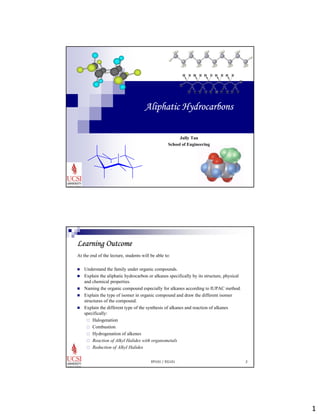
Aliphatic Hydrocarbons 
Jully Tan 
School of Engineering 
Learning Outcome 
At the end of the lecture, students will be able to: 
„ Understand the family under organic compounds. 
„ Explain the aliphatic hydrocarbon or alkanes specifically by its structure, physical 
EP101 / EG101 2 
and chemical properties. 
„ Naming the organic compound especially for alkanes according to IUPAC method. 
„ Explain the type of isomer in organic compound and draw the different isomer 
structures of the compound. 
„ Explain the different type of the synthesis of alkanes and reaction of alkanes 
specifically: 
… Halogenation 
… Combustion 
… Hydrogenation of alkenes 
… Reaction of Alkyl Halides with organometals 
… Reduction of Alkyl Halides
2 
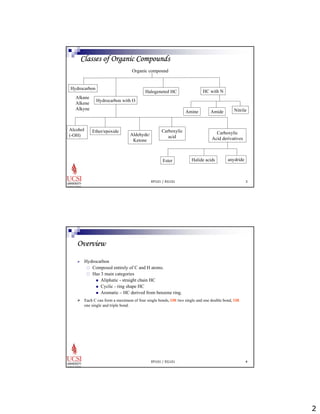
Classes of Organic Compounds 
Organic compound 
Halogeneted HC HC with N 
Amine Amide Nitrile 
EP101 / EG101 3 
Hydrocarbon 
Alkane 
Alkene 
Alkyne 
Hydrocarbon with O 
Alcohol 
(-OH) 
Ether/epoxide 
Aldehyde/ 
Ketone 
Carboxylic 
acid 
Carboxylic 
Acid derivatives 
Ester Halide acids anydride 
EP101 / EG101 4 
Overview 
¾ Hydrocarbon 
… Composed entirely of C and H atoms. 
… Has 3 main categories 
„ Aliphatic - straight chain HC 
„ Cyclic - ring shape HC 
„ Aromatic – HC derived from benzene ring. 
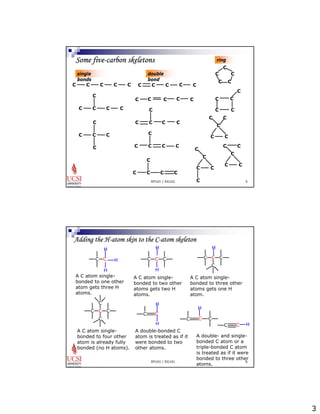
¾ Each C can form a maximum of four single bonds, OR two single and one double bond, OR 
one single and triple bond.
3 
Some five-carbon skeletons 
C 
C 
EP101 / EG101 5 
C C C C C 
C 
C C C C 
C 
C C C 
C 
C C C C C 
C C C C C 
C C C C 
C 
C C C C 
C 
C C 
C C 
C 
C C 
C C 
C C 
C 
C C 
C 
C 
C 
C C 
C C 
C 
C C 
C C C C 
single 
bonds 
double 
bond 
ring 
Adding the H-atom skin to the C-atom skeleton 
C C C 
A C atom single-bonded 
to two other 
atoms gets two H 
atoms. 
H 
C C C 
C 
C H 
H 
C C C 
C C 
H 
C C 
EP101 / EG101 6 
H 
C C 
A C atom single-bonded 
to one other 
atom gets three H 
atoms. 
H 
A C atom single-bonded 
to three other 
atoms gets one H 
atom. 
H 
H H 
C C C 
C 
A C atom single-bonded 
to four other 
atom is already fully 
bonded (no H atoms). 
H 
A double- and single-bonded 
C atom or a 
triple-bonded C atom 
is treated as if it were 
bonded to three other 
atoms. 
A double-bonded C 
atom is treated as if it 
were bonded to two 
other atoms.
4 
EP101 / EG101 7 
EP101 / EG101 8
5 
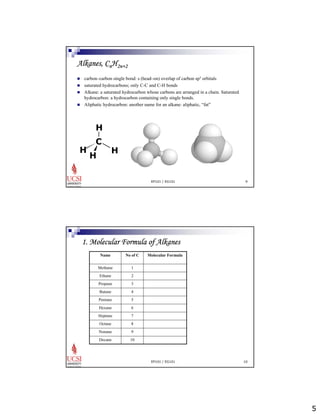
„ carbon–carbon single bond: s (head–on) overlap of carbon sp3 orbitals 
„ saturated hydrocarbons; only C-C and C-H bonds 
„ Alkane: a saturated hydrocarbon whose carbons are arranged in a chain. Saturated 
hydrocarbon: a hydrocarbon containing only single bonds. 
„ Aliphatic hydrocarbon: another name for an alkane: aliphatic, “fat” 
EP101 / EG101 9 
Alkanes, CnH2n+2 
C 
H 
H 
H 
H 
1. Molecular Formula of Alkanes 
Name No of C Molecular Formula 
EP101 / EG101 10 
Methane 1 
Ethane 2 
Propane 3 
Butane 4 
Pentane 5 
Hexane 6 
Heptane 7 
Octane 8 
Nonane 9 
Decane 10
6 
EP101 / EG101 11 
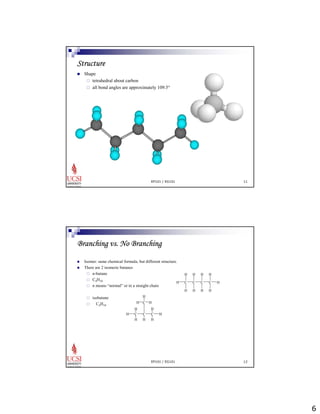
Structure 
„ Shape 
… tetrahedral about carbon 
… all bond angles are approximately 109.5° 
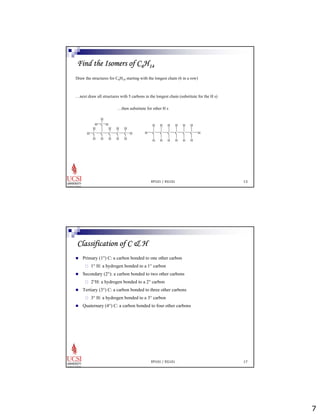
„ Isomer: same chemical formula, but different structure. 
„ There are 2 isomeric butanes 
… n-butane 
… C4H10 
… n means “normal” or in a straight chain 
H 
EP101 / EG101 12 
… isobutane 
… C4H10 
C 
C C C 
H 
H 
H H 
H 
H 
H 
H 
H H 
C C C C H 
H 
H 
H 
H 
H 
H 
H 
H 
Branching vs. No Branching
7 
Find the Isomers of C6H14 
Draw the structures for C6H14 starting with the longest chain (6 in a row) 
…next draw all structures with 5 carbons in the longest chain (substitute for the H s) 
…then substitute for other H s 
H 
H 
H 
H 
H 
C C C C C C H 
H 
H 
H 
H 
H 
EP101 / EG101 13 
H 
H 
H 
C 
C C C C C 
H 
H 
H H 
H 
H 
H 
H 
H 
H 
H 
H 
H H 
EP101 / EG101 17 
Classification of C & H 
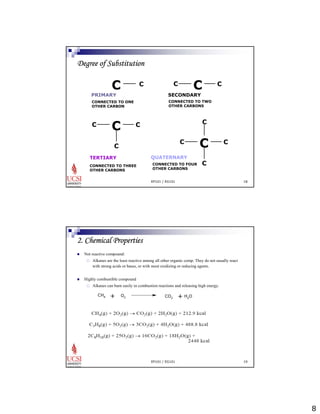
„ Primary (1°) C: a carbon bonded to one other carbon 
… 1° H: a hydrogen bonded to a 1° carbon 
„ Secondary (2°): a carbon bonded to two other carbons 
… 2°H: a hydrogen bonded to a 2° carbon 
„ Tertiary (3°) C: a carbon bonded to three other carbons 
… 3° H: a hydrogen bonded to a 3° carbon 
„ Quaternary (4°) C: a carbon bonded to four other carbons
8 
CONNECTED TO TWO 
OTHER CARBONS 
C 
EP101 / EG101 18 
C C 
PRIMARY 
C C C 
CONNECTED TO ONE 
OTHER CARBON 
C C C 
C C C C 
C 
SECONDARY 
TERTIARY QUATERNARY 
CONNECTED TO THREE 
OTHER CARBONS 
CONNECTED TO FOUR 
OTHER CARBONS 
Degree of Substitution 
EP101 / EG101 19 
2. Chemical Properties 
„ Not reactive compound: 
… Alkanes are the least reactive among all other organic comp. They do not usually react 
with strong acids or bases, or with most oxidizing or reducing agents. 
„ Highly combustible compound 
… Alkanes can burn easily in combustion reactions and releasing high energy. 
CH4 O2 CO2 H O 2 + +
9 
3. Physical Properties, Density & Solubility 
„ Alkanes physical forms as gas, liquid and solid. 
a. Both bp and mp increase with increasing carbon number for straight-chain 
alkanes with formula CnH2n+2 
b. Branching tends to raise the melting point and lower the boiling point. Why?? 
EP101 / EG101 20 
… C1-C4 -Gas 
… C5-C17 -Liquid 
… C18 and above -Solid 
„ Only dissolves in organic solvent, such as benzene, CCl4, but do not dissolve in 
water (hydrophobic). 
„ Alkane is less density than water. (near 0.7 g/mL) 
Why do alkane do 
not dissolve in 
water? 
4. Boiling Point 
Hint: surface area of alkane. 
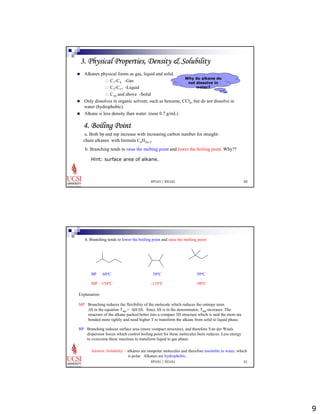
b. Branching tends to lower the boiling point and raise the melting point 
BP 60oC 58oC 50oC 
MP -154oC -135oC -98oC 
Explanation: 
MP Branching reduces the flexibility of the molecule which reduces the entropy term 
ΔS in the equation Tmp= ΔH/ΔS. Since ΔS is in the denominator, Tmp increases. The 
structure of the alkane packed better into a compact 3D structure which is said the atom are 
bonded more tightly and need higher T to transform the alkane from solid to liquid phase. 
BP Branching reduces surface area (more compact structure), and therefore Van der Waals 
dispersion forces which control boiling point for these molecules been reduces. Less energy 
to overcome these reactions to transform liquid to gas phase. 
Answer: Solubility – alkanes are nonpolar molecules and therefore insoluble in water, which 
is polar. Alkanes are hydrophobic. 
EP101 / EG101 21
10 
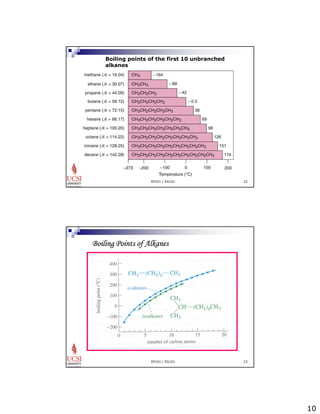
Boiling points of the first 10 unbranched 
alkanes 
EP101 / EG101 22 
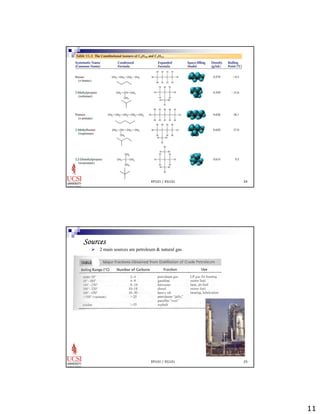
Boiling Points of Alkanes 
EP101 / EG101 23
11 
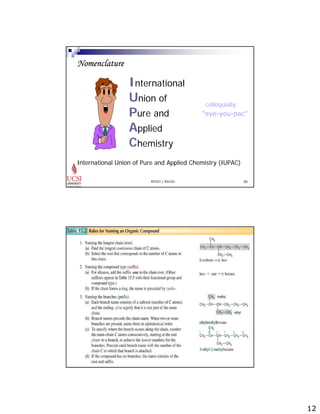
EP101 / EG101 24 
EP101 / EG101 25 
Sources 
¾ 2 main sources are petroleum & natural gas
12 
International 
Union of 
Pure and 
Applied 
Chemistry 
colloquially: 
“eye-you-pac” 
EP101 / EG101 26 
Nomenclature 
International Union of Pure and Applied Chemistry (IUPAC) 
EP101 / EG101 27
13 
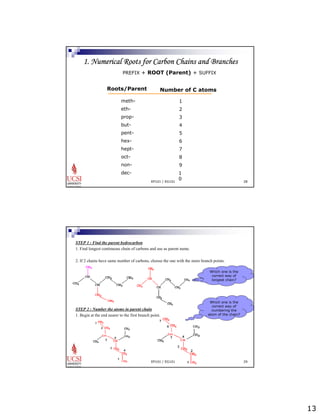
1. Numerical Roots for Carbon Chains and Branches 
PREFIX + ROOT (Parent) + SUFFIX 
Roots/Parent Number of C atoms 
1 
2 
3 
4 
5 
6 
7 
8 
9 
1 
0 
EP101 / EG101 28 
meth-eth-prop-but-hex-pent-hept-oct-non-dec- 
STEP 1 : Find the parent hydrocarbon 
1. Find longest continuous chain of carbons and use as parent name. 
2. If 2 chains have same number of carbons, choose the one with the more branch points. 
STEP 2 : Number the atoms in parent chain 
1. Begin at the end nearer to the first branch point. 
Which one is the 
correct way of 
longest chain? 
Which one is the 
correct way of 
numbering the 
atom of the chain? 
EP101 / EG101 29
14 
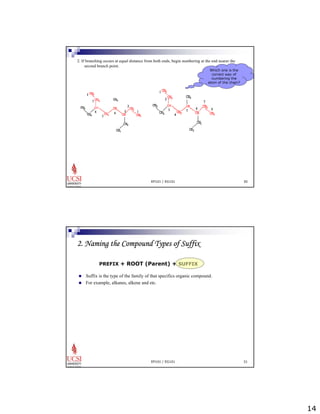
2. If branching occurs at equal distance from both ends, begin numbering at the end nearer the 
EP101 / EG101 30 
second branch point. 
Which one is the 
correct way of 
numbering the 
atom of the chain? 
2. Naming the Compound Types of Suffix 
PREFIX + ROOT (Parent) + SUFFIX 
„ Suffix is the type of the family of that specifics organic compound. 
„ For example, alkanes, alkene and etc. 
EP101 / EG101 31
15 
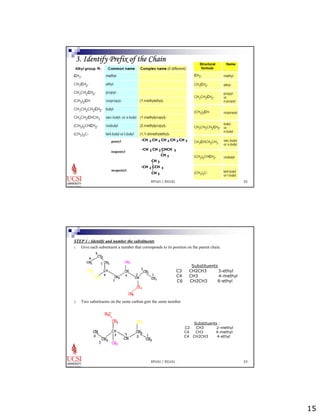
3. Identify Prefix of the Chain 
-CH 2 CH 2 CH 2 CH 2 CH 3 
-CH 2 CH 2 CHCH 3 
CH 3 
CH 3 
pentyl 
-CH 2 CCH 3 neopentyl 
CH 3 
EP101 / EG101 32 
isopentyl 
STEP 1 : Identify and number the substituents 
1. Give each substituent a number that corresponds to its position on the parent chain. 
C3 CH2CH3 3-ethyl 
C4 CH3 4-methyl 
C6 CH2CH3 6-ethyl 
2. Two substituents on the same carbon gets the same number 
Substituents 
Substituents : 
C2 CH3 2-methyl 
C4 CH3 4-methyl 
C4 CH2CH3 4-ethyl 
EP101 / EG101 33
16 
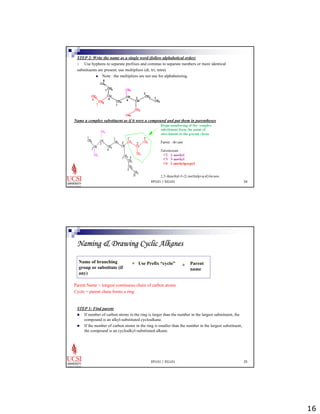
STEP 2: Write the name as a single word (follow alphabetical order) 
1. Use hyphens to separate prefixes and commas to separate numbers or more identical 
substituents are present, use multipliers (di, tri, tetra) 
„ Note : the multipliers are not use for alphabetizing. 
Name a complex substituent as if it were a compound and put them in parentheses 
EP101 / EG101 34 
Naming & Drawing Cyclic Alkanes 
EP101 / EG101 35 
Name of branching 
group or substitute (if 
any) 
Parent 
name 
+ Use Prefix “cyclo” + 
Parent Name = longest continuous chain of carbon atoms 
Cyclo = parent chain forms a ring 
STEP 1: Find parent 
„ If number of carbon atoms in the ring is larger than the number in the largest substituent, the 
compound is an alkyl-substituted cycloalkane. 
„ If the number of carbon atoms in the ring is smaller than the number in the largest substituent, 
the compound is an cycloalkyl-substituted alkane.
17 
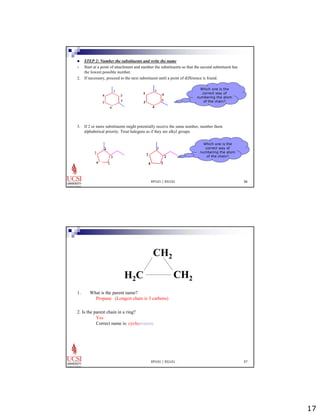
„ STEP 2: Number the substituents and write the name 
1. Start at a point of attachment and number the substituents so that the second substituent has 
EP101 / EG101 36 
the lowest possible number. 
2. If necessary, proceed to the next substituent until a point of difference is found. 
3. If 2 or more substituents might potentially receive the same number, number them 
alphabetical priority. Treat halogens as if they are alkyl groups. 
Which one is the 
correct way of 
numbering the atom 
of the chain? 
Which one is the 
correct way of 
numbering the atom 
of the chain? 
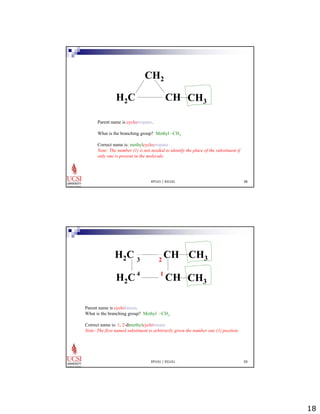
CH2 
H2C CH2 
EP101 / EG101 37 
1. What is the parent name? 
Propane (Longest chain is 3 carbons) 
2. Is the parent chain in a ring? 
Yes 
Correct name is: cyclopropane
18 
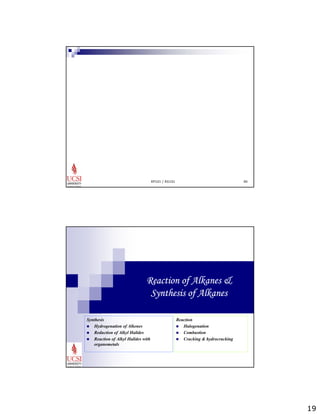
CH2 
H2C CH 
CH3 
Parent name is cyclopropane. 
What is the branching group? Methyl –CH3 
Correct name is: methylcyclopropane 
Note: The number (1) is not needed to identify the place of the substituent if 
only one is present in the molecule. 
EP101 / EG101 38 
CH CH3 
3 2 
4 
1 
H2C CH 
EP101 / EG101 39 
H2C 
CH3 
Parent name is cyclobutane. 
What is the branching group? Methyl –CH3 
Correct name is: 1, 2-dimethylcyclobutane 
Note: The first named substituent is arbitrarily given the number one (1) position
19 
EP101 / EG101 40 
Reaction of Alkanes & 
Synthesis of Alkanes 
Reaction 
„ Halogenation 
„ Combustion 
„ Cracking & hydrocracking 
Synthesis 
„ Hydrogenation of Alkenes 
„ Reduction of Alkyl Halides 
„ Reaction of Alkyl Halides with 
organometals
20 
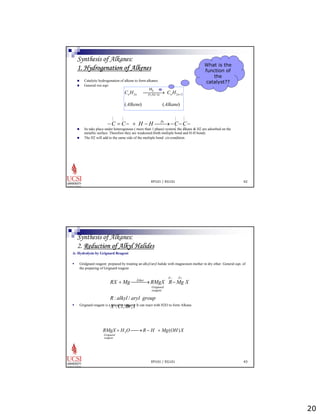
C H C H n n Pt Pd Ni n n+ ⎯⎯⎯⎯→ H2 
2 , / 2 2 
Alkene Alkane 
( ) ( ) 
−C = C− + H − H ⎯⎯Pt→−C−C− 
EP101 / EG101 42 
Synthesis of Alkanes: 
1. Hydrogenation of Alkenes 
„ Catalytic hydrogenation of alkene to form alkanes. 
„ General rxn eqn: 
„ Its take place under heterogenous ( more than 1 phase) system, the alkane & H2 are adsorbed on the 
metallic surface. Therefore they are weakened (both multiple bond and H-H bond). 
„ The H2 will add to the same side of the multiple bond: cis-condition. 
What is the 
function of 
the 
catalyst?? 
Synthesis of Alkanes: 
2. Reduction of Alkyl Halides 
Ether 
δ δ 
RX Mg RMgX R Mg X 
Grignard 
reagent 
R alkyl aryl group 
EP101 / EG101 43 
A: Hydrolysis by Grignard Reagent 
ƒ Gridgnard reagent: prepared by treating an alkyl/aryl halide with magnesium mether in dry ether. General eqn. of 
the preparing of Grignard reagent 
: / 
ƒ Grignard reagent is a XreactCivel : , reBagrenIt. , 
It can react with H2O to form Alkane. 
− + 
+ ⎯⎯⎯→ − 
RMgX + H O ⎯⎯→ R − H + 
Mg ( OH ) X 
2 Grignard 
reagent
21 
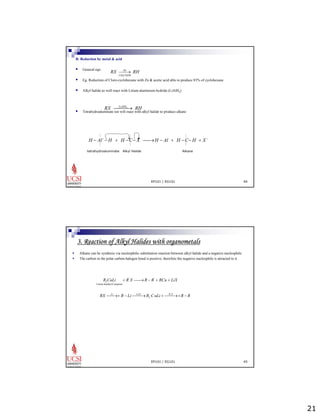
B: Reduction by metal & acid 
ƒ General eqn. 
RX ⎯⎯→ 
Zn 
RH 
CH 3 
COOH 
ƒ Eg. Reduction of Cloro-cyclohexane with Zn & acetic acid able to produce 83% of cyclohexane. 
ƒ Alkyl halide as well react with Litium aluminium hydride (LiAlH4) 
ƒ Tetrahydroaluminate ion will react with alkyl halide to produce alkane 
EP101 / EG101 44 
RX ⎯L⎯iAl⎯H4→ RH 
H − Al−−H + H −C− X ⎯⎯→H − Al + H −C−H + X − 
tetrahydroaluminate Alkyl Halide Alkane 
3. Reaction of Alkyl Halides with organometals 
ƒ Alkane can be synthesis via nucleophilic substitution reaction between alkyl halide and a negative nucleophile. 
ƒ The carbon in the polar carbon-halogen bond is positive, therefore the negative nucleophile is attracted to it. 
R CuLi + R'X ⎯⎯→R − R' + RCu + LiX 
EP101 / EG101 45 
2 
Litium diaalkylCumprum 
RX ⎯⎯Li→+ R − Li⎯C⎯⎯uX→R CuLi +⎯R⎯⎯'X→+R − R 
2
22 
EP101 / EG101 46 
Reaction of Alkane 
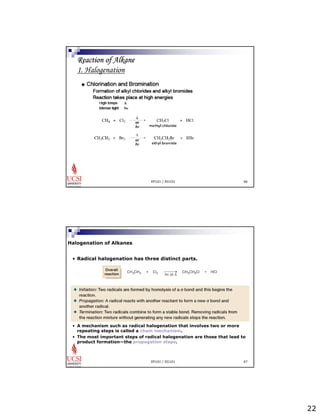
1. Halogenation 
• Radical halogenation has three distinct parts. 
EP101 / EG101 47 
Halogenation of Alkanes 
• A mechanism such as radical halogenation that involves two or more 
repeating steps is called a chain mechanism. 
• The most important steps of radical halogenation are those that lead to 
product formation—the propagation steps.
23 
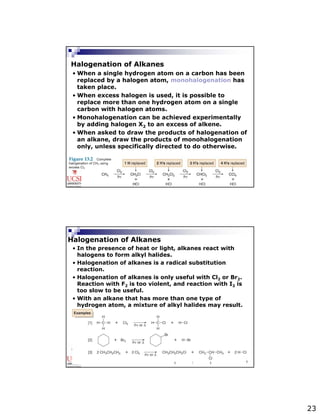
Halogenation of Alkanes 
• When a single hydrogen atom on a carbon has been 
replaced by a halogen atom, monohalogenation has 
taken place. 
• When excess halogen is used, it is possible to 
replace more than one hydrogen atom on a single 
carbon with halogen atoms. 
• Monohalogenation can be achieved experimentally 
by adding halogen X2 to an excess of alkene. 
• When asked to draw the products of halogenation of 
an alkane, draw the products of monohalogenation 
only, unless specifically directed to do otherwise. 
EP101 / EG101 48 
Halogenation of Alkanes 
• In the presence of heat or light, alkanes react with 
halogens to form alkyl halides. 
• Halogenation of alkanes is a radical substitution 
reaction. 
• Halogenation of alkanes is only useful with Cl2 or Br2. 
Reaction with F2 is too violent, and reaction with I2 is 
too slow to be useful. 
• With an alkane that has more than one type of 
hydrogen atom, a mixture of alkyl halides may result. 
EP101 / EG101 49
24 
EP101 / EG101 50 
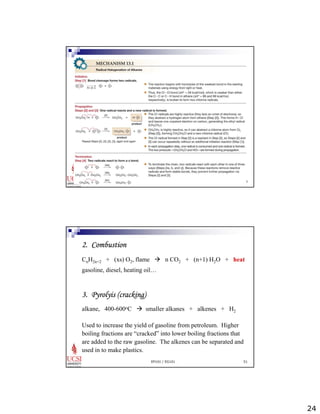
2. Combustion 
CnH2n+2 + (xs) O2, flame Æ n CO2 + (n+1) H2O + heat 
gasoline, diesel, heating oil… 
3. Pyrolyis (cracking) 
alkane, 400-600oC Æ smaller alkanes + alkenes + H2 
Used to increase the yield of gasoline from petroleum. Higher 
boiling fractions are “cracked” into lower boiling fractions that 
are added to the raw gasoline. The alkenes can be separated and 
used in to make plastics. 
EP101 / EG101 51
25 
REVISION CHECK 
What should you be able to do? 
Recall and explain the physical properties of alkanes 
Recall and explain the types of isomerism found in alkanes 
Recall and explain why alkanes undergo chlorination free radical reaction 
Write balanced equations representing the reactions taking place in this 
section 
CAN YOU DO ALL OF THESE? YES 
EP101 / EG101 52 
NO

Aliphatic Hydrocarbons

  • 1.
    1 Aliphatic Hydrocarbons Jully Tan School of Engineering Learning Outcome At the end of the lecture, students will be able to: „ Understand the family under organic compounds. „ Explain the aliphatic hydrocarbon or alkanes specifically by its structure, physical EP101 / EG101 2 and chemical properties. „ Naming the organic compound especially for alkanes according to IUPAC method. „ Explain the type of isomer in organic compound and draw the different isomer structures of the compound. „ Explain the different type of the synthesis of alkanes and reaction of alkanes specifically: … Halogenation … Combustion … Hydrogenation of alkenes … Reaction of Alkyl Halides with organometals … Reduction of Alkyl Halides
  • 2.
    2 Classes ofOrganic Compounds Organic compound Halogeneted HC HC with N Amine Amide Nitrile EP101 / EG101 3 Hydrocarbon Alkane Alkene Alkyne Hydrocarbon with O Alcohol (-OH) Ether/epoxide Aldehyde/ Ketone Carboxylic acid Carboxylic Acid derivatives Ester Halide acids anydride EP101 / EG101 4 Overview ¾ Hydrocarbon … Composed entirely of C and H atoms. … Has 3 main categories „ Aliphatic - straight chain HC „ Cyclic - ring shape HC „ Aromatic – HC derived from benzene ring. ¾ Each C can form a maximum of four single bonds, OR two single and one double bond, OR one single and triple bond.
  • 3.
    3 Some five-carbonskeletons C C EP101 / EG101 5 C C C C C C C C C C C C C C C C C C C C C C C C C C C C C C C C C C C C C C C C C C C C C C C C C C C C C C C C C C C C C C C single bonds double bond ring Adding the H-atom skin to the C-atom skeleton C C C A C atom single-bonded to two other atoms gets two H atoms. H C C C C C H H C C C C C H C C EP101 / EG101 6 H C C A C atom single-bonded to one other atom gets three H atoms. H A C atom single-bonded to three other atoms gets one H atom. H H H C C C C A C atom single-bonded to four other atom is already fully bonded (no H atoms). H A double- and single-bonded C atom or a triple-bonded C atom is treated as if it were bonded to three other atoms. A double-bonded C atom is treated as if it were bonded to two other atoms.
  • 4.
    4 EP101 /EG101 7 EP101 / EG101 8
  • 5.
    5 „ carbon–carbonsingle bond: s (head–on) overlap of carbon sp3 orbitals „ saturated hydrocarbons; only C-C and C-H bonds „ Alkane: a saturated hydrocarbon whose carbons are arranged in a chain. Saturated hydrocarbon: a hydrocarbon containing only single bonds. „ Aliphatic hydrocarbon: another name for an alkane: aliphatic, “fat” EP101 / EG101 9 Alkanes, CnH2n+2 C H H H H 1. Molecular Formula of Alkanes Name No of C Molecular Formula EP101 / EG101 10 Methane 1 Ethane 2 Propane 3 Butane 4 Pentane 5 Hexane 6 Heptane 7 Octane 8 Nonane 9 Decane 10
  • 6.
    6 EP101 /EG101 11 Structure „ Shape … tetrahedral about carbon … all bond angles are approximately 109.5° „ Isomer: same chemical formula, but different structure. „ There are 2 isomeric butanes … n-butane … C4H10 … n means “normal” or in a straight chain H EP101 / EG101 12 … isobutane … C4H10 C C C C H H H H H H H H H H C C C C H H H H H H H H H Branching vs. No Branching
  • 7.
    7 Find theIsomers of C6H14 Draw the structures for C6H14 starting with the longest chain (6 in a row) …next draw all structures with 5 carbons in the longest chain (substitute for the H s) …then substitute for other H s H H H H H C C C C C C H H H H H H EP101 / EG101 13 H H H C C C C C C H H H H H H H H H H H H H H EP101 / EG101 17 Classification of C & H „ Primary (1°) C: a carbon bonded to one other carbon … 1° H: a hydrogen bonded to a 1° carbon „ Secondary (2°): a carbon bonded to two other carbons … 2°H: a hydrogen bonded to a 2° carbon „ Tertiary (3°) C: a carbon bonded to three other carbons … 3° H: a hydrogen bonded to a 3° carbon „ Quaternary (4°) C: a carbon bonded to four other carbons
  • 8.
    8 CONNECTED TOTWO OTHER CARBONS C EP101 / EG101 18 C C PRIMARY C C C CONNECTED TO ONE OTHER CARBON C C C C C C C C SECONDARY TERTIARY QUATERNARY CONNECTED TO THREE OTHER CARBONS CONNECTED TO FOUR OTHER CARBONS Degree of Substitution EP101 / EG101 19 2. Chemical Properties „ Not reactive compound: … Alkanes are the least reactive among all other organic comp. They do not usually react with strong acids or bases, or with most oxidizing or reducing agents. „ Highly combustible compound … Alkanes can burn easily in combustion reactions and releasing high energy. CH4 O2 CO2 H O 2 + +
  • 9.
    9 3. PhysicalProperties, Density & Solubility „ Alkanes physical forms as gas, liquid and solid. a. Both bp and mp increase with increasing carbon number for straight-chain alkanes with formula CnH2n+2 b. Branching tends to raise the melting point and lower the boiling point. Why?? EP101 / EG101 20 … C1-C4 -Gas … C5-C17 -Liquid … C18 and above -Solid „ Only dissolves in organic solvent, such as benzene, CCl4, but do not dissolve in water (hydrophobic). „ Alkane is less density than water. (near 0.7 g/mL) Why do alkane do not dissolve in water? 4. Boiling Point Hint: surface area of alkane. b. Branching tends to lower the boiling point and raise the melting point BP 60oC 58oC 50oC MP -154oC -135oC -98oC Explanation: MP Branching reduces the flexibility of the molecule which reduces the entropy term ΔS in the equation Tmp= ΔH/ΔS. Since ΔS is in the denominator, Tmp increases. The structure of the alkane packed better into a compact 3D structure which is said the atom are bonded more tightly and need higher T to transform the alkane from solid to liquid phase. BP Branching reduces surface area (more compact structure), and therefore Van der Waals dispersion forces which control boiling point for these molecules been reduces. Less energy to overcome these reactions to transform liquid to gas phase. Answer: Solubility – alkanes are nonpolar molecules and therefore insoluble in water, which is polar. Alkanes are hydrophobic. EP101 / EG101 21
  • 10.
    10 Boiling pointsof the first 10 unbranched alkanes EP101 / EG101 22 Boiling Points of Alkanes EP101 / EG101 23
  • 11.
    11 EP101 /EG101 24 EP101 / EG101 25 Sources ¾ 2 main sources are petroleum & natural gas
  • 12.
    12 International Unionof Pure and Applied Chemistry colloquially: “eye-you-pac” EP101 / EG101 26 Nomenclature International Union of Pure and Applied Chemistry (IUPAC) EP101 / EG101 27
  • 13.
    13 1. NumericalRoots for Carbon Chains and Branches PREFIX + ROOT (Parent) + SUFFIX Roots/Parent Number of C atoms 1 2 3 4 5 6 7 8 9 1 0 EP101 / EG101 28 meth-eth-prop-but-hex-pent-hept-oct-non-dec- STEP 1 : Find the parent hydrocarbon 1. Find longest continuous chain of carbons and use as parent name. 2. If 2 chains have same number of carbons, choose the one with the more branch points. STEP 2 : Number the atoms in parent chain 1. Begin at the end nearer to the first branch point. Which one is the correct way of longest chain? Which one is the correct way of numbering the atom of the chain? EP101 / EG101 29
  • 14.
    14 2. Ifbranching occurs at equal distance from both ends, begin numbering at the end nearer the EP101 / EG101 30 second branch point. Which one is the correct way of numbering the atom of the chain? 2. Naming the Compound Types of Suffix PREFIX + ROOT (Parent) + SUFFIX „ Suffix is the type of the family of that specifics organic compound. „ For example, alkanes, alkene and etc. EP101 / EG101 31
  • 15.
    15 3. IdentifyPrefix of the Chain -CH 2 CH 2 CH 2 CH 2 CH 3 -CH 2 CH 2 CHCH 3 CH 3 CH 3 pentyl -CH 2 CCH 3 neopentyl CH 3 EP101 / EG101 32 isopentyl STEP 1 : Identify and number the substituents 1. Give each substituent a number that corresponds to its position on the parent chain. C3 CH2CH3 3-ethyl C4 CH3 4-methyl C6 CH2CH3 6-ethyl 2. Two substituents on the same carbon gets the same number Substituents Substituents : C2 CH3 2-methyl C4 CH3 4-methyl C4 CH2CH3 4-ethyl EP101 / EG101 33
  • 16.
    16 STEP 2:Write the name as a single word (follow alphabetical order) 1. Use hyphens to separate prefixes and commas to separate numbers or more identical substituents are present, use multipliers (di, tri, tetra) „ Note : the multipliers are not use for alphabetizing. Name a complex substituent as if it were a compound and put them in parentheses EP101 / EG101 34 Naming & Drawing Cyclic Alkanes EP101 / EG101 35 Name of branching group or substitute (if any) Parent name + Use Prefix “cyclo” + Parent Name = longest continuous chain of carbon atoms Cyclo = parent chain forms a ring STEP 1: Find parent „ If number of carbon atoms in the ring is larger than the number in the largest substituent, the compound is an alkyl-substituted cycloalkane. „ If the number of carbon atoms in the ring is smaller than the number in the largest substituent, the compound is an cycloalkyl-substituted alkane.
  • 17.
    17 „ STEP2: Number the substituents and write the name 1. Start at a point of attachment and number the substituents so that the second substituent has EP101 / EG101 36 the lowest possible number. 2. If necessary, proceed to the next substituent until a point of difference is found. 3. If 2 or more substituents might potentially receive the same number, number them alphabetical priority. Treat halogens as if they are alkyl groups. Which one is the correct way of numbering the atom of the chain? Which one is the correct way of numbering the atom of the chain? CH2 H2C CH2 EP101 / EG101 37 1. What is the parent name? Propane (Longest chain is 3 carbons) 2. Is the parent chain in a ring? Yes Correct name is: cyclopropane
  • 18.
    18 CH2 H2CCH CH3 Parent name is cyclopropane. What is the branching group? Methyl –CH3 Correct name is: methylcyclopropane Note: The number (1) is not needed to identify the place of the substituent if only one is present in the molecule. EP101 / EG101 38 CH CH3 3 2 4 1 H2C CH EP101 / EG101 39 H2C CH3 Parent name is cyclobutane. What is the branching group? Methyl –CH3 Correct name is: 1, 2-dimethylcyclobutane Note: The first named substituent is arbitrarily given the number one (1) position
  • 19.
    19 EP101 /EG101 40 Reaction of Alkanes & Synthesis of Alkanes Reaction „ Halogenation „ Combustion „ Cracking & hydrocracking Synthesis „ Hydrogenation of Alkenes „ Reduction of Alkyl Halides „ Reaction of Alkyl Halides with organometals
  • 20.
    20 C HC H n n Pt Pd Ni n n+ ⎯⎯⎯⎯→ H2 2 , / 2 2 Alkene Alkane ( ) ( ) −C = C− + H − H ⎯⎯Pt→−C−C− EP101 / EG101 42 Synthesis of Alkanes: 1. Hydrogenation of Alkenes „ Catalytic hydrogenation of alkene to form alkanes. „ General rxn eqn: „ Its take place under heterogenous ( more than 1 phase) system, the alkane & H2 are adsorbed on the metallic surface. Therefore they are weakened (both multiple bond and H-H bond). „ The H2 will add to the same side of the multiple bond: cis-condition. What is the function of the catalyst?? Synthesis of Alkanes: 2. Reduction of Alkyl Halides Ether δ δ RX Mg RMgX R Mg X Grignard reagent R alkyl aryl group EP101 / EG101 43 A: Hydrolysis by Grignard Reagent ƒ Gridgnard reagent: prepared by treating an alkyl/aryl halide with magnesium mether in dry ether. General eqn. of the preparing of Grignard reagent : / ƒ Grignard reagent is a XreactCivel : , reBagrenIt. , It can react with H2O to form Alkane. − + + ⎯⎯⎯→ − RMgX + H O ⎯⎯→ R − H + Mg ( OH ) X 2 Grignard reagent
  • 21.
    21 B: Reductionby metal & acid ƒ General eqn. RX ⎯⎯→ Zn RH CH 3 COOH ƒ Eg. Reduction of Cloro-cyclohexane with Zn & acetic acid able to produce 83% of cyclohexane. ƒ Alkyl halide as well react with Litium aluminium hydride (LiAlH4) ƒ Tetrahydroaluminate ion will react with alkyl halide to produce alkane EP101 / EG101 44 RX ⎯L⎯iAl⎯H4→ RH H − Al−−H + H −C− X ⎯⎯→H − Al + H −C−H + X − tetrahydroaluminate Alkyl Halide Alkane 3. Reaction of Alkyl Halides with organometals ƒ Alkane can be synthesis via nucleophilic substitution reaction between alkyl halide and a negative nucleophile. ƒ The carbon in the polar carbon-halogen bond is positive, therefore the negative nucleophile is attracted to it. R CuLi + R'X ⎯⎯→R − R' + RCu + LiX EP101 / EG101 45 2 Litium diaalkylCumprum RX ⎯⎯Li→+ R − Li⎯C⎯⎯uX→R CuLi +⎯R⎯⎯'X→+R − R 2
  • 22.
    22 EP101 /EG101 46 Reaction of Alkane 1. Halogenation • Radical halogenation has three distinct parts. EP101 / EG101 47 Halogenation of Alkanes • A mechanism such as radical halogenation that involves two or more repeating steps is called a chain mechanism. • The most important steps of radical halogenation are those that lead to product formation—the propagation steps.
  • 23.
    23 Halogenation ofAlkanes • When a single hydrogen atom on a carbon has been replaced by a halogen atom, monohalogenation has taken place. • When excess halogen is used, it is possible to replace more than one hydrogen atom on a single carbon with halogen atoms. • Monohalogenation can be achieved experimentally by adding halogen X2 to an excess of alkene. • When asked to draw the products of halogenation of an alkane, draw the products of monohalogenation only, unless specifically directed to do otherwise. EP101 / EG101 48 Halogenation of Alkanes • In the presence of heat or light, alkanes react with halogens to form alkyl halides. • Halogenation of alkanes is a radical substitution reaction. • Halogenation of alkanes is only useful with Cl2 or Br2. Reaction with F2 is too violent, and reaction with I2 is too slow to be useful. • With an alkane that has more than one type of hydrogen atom, a mixture of alkyl halides may result. EP101 / EG101 49
  • 24.
    24 EP101 /EG101 50 2. Combustion CnH2n+2 + (xs) O2, flame Æ n CO2 + (n+1) H2O + heat gasoline, diesel, heating oil… 3. Pyrolyis (cracking) alkane, 400-600oC Æ smaller alkanes + alkenes + H2 Used to increase the yield of gasoline from petroleum. Higher boiling fractions are “cracked” into lower boiling fractions that are added to the raw gasoline. The alkenes can be separated and used in to make plastics. EP101 / EG101 51
  • 25.
    25 REVISION CHECK What should you be able to do? Recall and explain the physical properties of alkanes Recall and explain the types of isomerism found in alkanes Recall and explain why alkanes undergo chlorination free radical reaction Write balanced equations representing the reactions taking place in this section CAN YOU DO ALL OF THESE? YES EP101 / EG101 52 NO