

Advanced Engineering Mathematics
(2130002)
Guided by :
Asst. Prof. Jaimin Patel
Prepare By :
Name :
Shah Jainam (160410119115)
Shah Prayag (160410119116)
Shah Preet (160410119117)
Shah Rishabh (160410119118)
Shah Saumil (160410119119)
1
Topic : Higher Order Homogeneous
Partial Differential equations & its
applications
2
Higher Order Homogeneous Partial Differential
equations & its applications
A partial differential equation is an equation involving a function of
two or more variables and some of its partial derivatives. Therefore
a partial differential equation contains one dependent variable and
more than one independent variable.
Here z will be taken as the dependent variable and x and y
the independent variable so that .
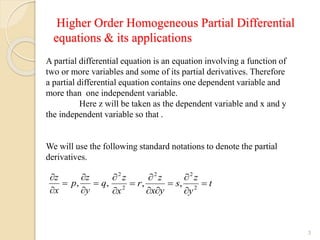
We will use the following standard notations to denote the partial
derivatives.
,, q
y
z
p
x
z






t
y
z
s
yx
z
r
x
z









2
22
2
2
,,
3
Homogeneous Equation
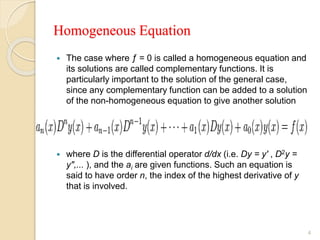
 The case where ƒ = 0 is called a homogeneous equation and
its solutions are called complementary functions. It is
particularly important to the solution of the general case,
since any complementary function can be added to a solution
of the non-homogeneous equation to give another solution
 where D is the differential operator d/dx (i.e. Dy = y' , D2y =
y",... ), and the ai are given functions. Such an equation is
said to have order n, the index of the highest derivative of y
that is involved.
4
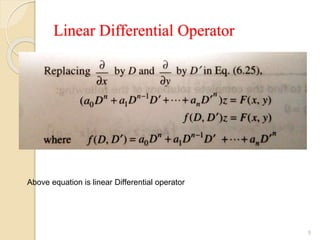
Linear Differential Operator
Above equation is linear Differential operator
5
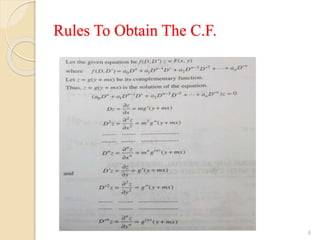
Rules To Obtain The C.F.
6
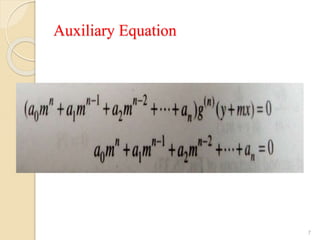
Auxiliary Equation
7
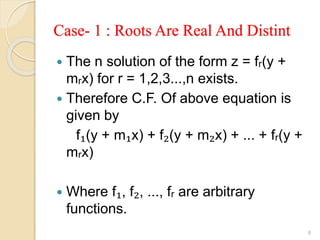
Case- 1 : Roots Are Real And Distint
 The n solution of the form z = fᵣ(y +
mᵣx) for r = 1,2,3...,n exists.
 Therefore C.F. Of above equation is
given by
f₁(y + m₁x) + f₂(y + m₂x) + ... + fᵣ(y +
mᵣx)
 Where f₁, f₂, ..., fᵣ are arbitrary
functions.
8
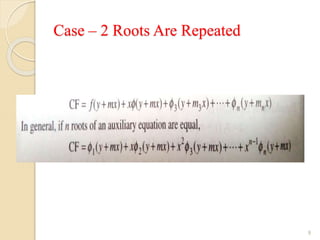
Case – 2 Roots Are Repeated
9
Remark
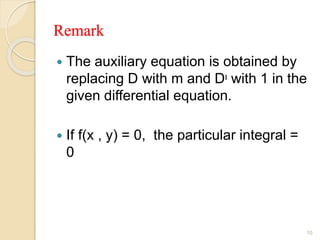
 The auxiliary equation is obtained by
replacing D with m and Dᶦ with 1 in the
given differential equation.
 If f(x , y) = 0, the particular integral =
0
10
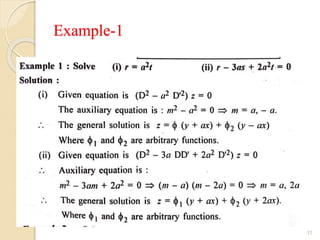
Example-1
11
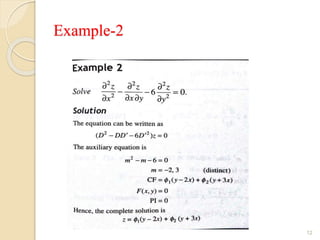
Example-2
12
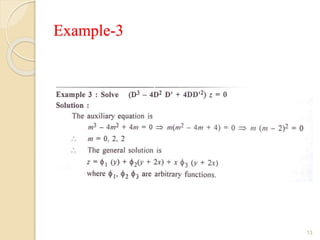
Example-3
13
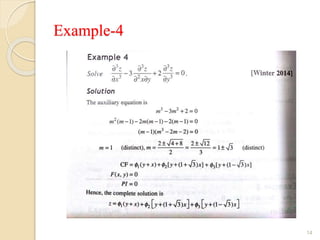
Example-4
14
Applications of Partial
Diffrentiation
15
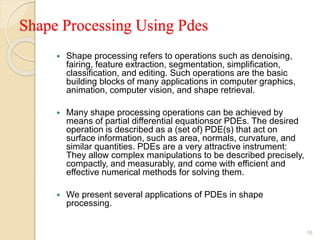
Shape Processing Using Pdes
 Shape processing refers to operations such as denoising,
fairing, feature extraction, segmentation, simplification,
classification, and editing. Such operations are the basic
building blocks of many applications in computer graphics,
animation, computer vision, and shape retrieval.
 Many shape processing operations can be achieved by
means of partial differential equationsor PDEs. The desired
operation is described as a (set of) PDE(s) that act on
surface information, such as area, normals, curvature, and
similar quantities. PDEs are a very attractive instrument:
They allow complex manipulations to be described precisely,
compactly, and measurably, and come with efficient and
effective numerical methods for solving them.
 We present several applications of PDEs in shape
processing.
16
Partial Derivative In Economics
 In economics the demand of quantity and quantity
supplied are affected by several factors such as
selling price, consumer buying power and taxation
which means there are multi variable factors that
affect the demand and supply. In economics marginal
analysis is used to find out or evaluate the change in
value of a function resulting from 1-unit increase in
one of its variables.
 For example Partial derivative is used in marginal
demand to obtain condition for determining whether
two goods are substitute or complimentary. Two goods
are said to be substitute goods if an increase in the
demand for either result in the decrease or the other.
While two goods are said to be complimentary goods
if a decrease of either result in a decrease of the 17
Partial Derivative In Engineering
 In image processing edge detection algorithm is
used which uses partial derivatives to improve
edge detection. Grayscale digital images can be
considered as 2D sampled points of a graph of a
function u(x,y) where the domain of the function is
the area of the image.
18
Reference Sites
 www.wileyplus.com
 www.elsevier.com
 www.sabre.org
19
Thank You...
20

Aem pde 1

  • 1.
    Advanced Engineering Mathematics (2130002) Guidedby : Asst. Prof. Jaimin Patel Prepare By : Name : Shah Jainam (160410119115) Shah Prayag (160410119116) Shah Preet (160410119117) Shah Rishabh (160410119118) Shah Saumil (160410119119) 1
  • 2.
    Topic : HigherOrder Homogeneous Partial Differential equations & its applications 2
  • 3.
    Higher Order HomogeneousPartial Differential equations & its applications A partial differential equation is an equation involving a function of two or more variables and some of its partial derivatives. Therefore a partial differential equation contains one dependent variable and more than one independent variable. Here z will be taken as the dependent variable and x and y the independent variable so that . We will use the following standard notations to denote the partial derivatives. ,, q y z p x z       t y z s yx z r x z          2 22 2 2 ,, 3
  • 4.
    Homogeneous Equation  Thecase where ƒ = 0 is called a homogeneous equation and its solutions are called complementary functions. It is particularly important to the solution of the general case, since any complementary function can be added to a solution of the non-homogeneous equation to give another solution  where D is the differential operator d/dx (i.e. Dy = y' , D2y = y",... ), and the ai are given functions. Such an equation is said to have order n, the index of the highest derivative of y that is involved. 4
  • 5.
    Linear Differential Operator Aboveequation is linear Differential operator 5
  • 6.
    Rules To ObtainThe C.F. 6
  • 7.
  • 8.
    Case- 1 :Roots Are Real And Distint  The n solution of the form z = fᵣ(y + mᵣx) for r = 1,2,3...,n exists.  Therefore C.F. Of above equation is given by f₁(y + m₁x) + f₂(y + m₂x) + ... + fᵣ(y + mᵣx)  Where f₁, f₂, ..., fᵣ are arbitrary functions. 8
  • 9.
    Case – 2Roots Are Repeated 9
  • 10.
    Remark  The auxiliaryequation is obtained by replacing D with m and Dᶦ with 1 in the given differential equation.  If f(x , y) = 0, the particular integral = 0 10
  • 11.
  • 12.
  • 13.
  • 14.
  • 15.
  • 16.
    Shape Processing UsingPdes  Shape processing refers to operations such as denoising, fairing, feature extraction, segmentation, simplification, classification, and editing. Such operations are the basic building blocks of many applications in computer graphics, animation, computer vision, and shape retrieval.  Many shape processing operations can be achieved by means of partial differential equationsor PDEs. The desired operation is described as a (set of) PDE(s) that act on surface information, such as area, normals, curvature, and similar quantities. PDEs are a very attractive instrument: They allow complex manipulations to be described precisely, compactly, and measurably, and come with efficient and effective numerical methods for solving them.  We present several applications of PDEs in shape processing. 16
  • 17.
    Partial Derivative InEconomics  In economics the demand of quantity and quantity supplied are affected by several factors such as selling price, consumer buying power and taxation which means there are multi variable factors that affect the demand and supply. In economics marginal analysis is used to find out or evaluate the change in value of a function resulting from 1-unit increase in one of its variables.  For example Partial derivative is used in marginal demand to obtain condition for determining whether two goods are substitute or complimentary. Two goods are said to be substitute goods if an increase in the demand for either result in the decrease or the other. While two goods are said to be complimentary goods if a decrease of either result in a decrease of the 17
  • 18.
    Partial Derivative InEngineering  In image processing edge detection algorithm is used which uses partial derivatives to improve edge detection. Grayscale digital images can be considered as 2D sampled points of a graph of a function u(x,y) where the domain of the function is the area of the image. 18
  • 19.
    Reference Sites  www.wileyplus.com www.elsevier.com  www.sabre.org 19
  • 20.