Operations on
Continuous-Time SignalsContinuous-Time Signals
David W. Graham
EE 327
Continuous-Time Signals
• Continuous-Time Signals
– Time is a continuous variable
– The signal itself need not be continuous
2
• We will look at several common
continuous-time signals and also
operations that may be performed on them
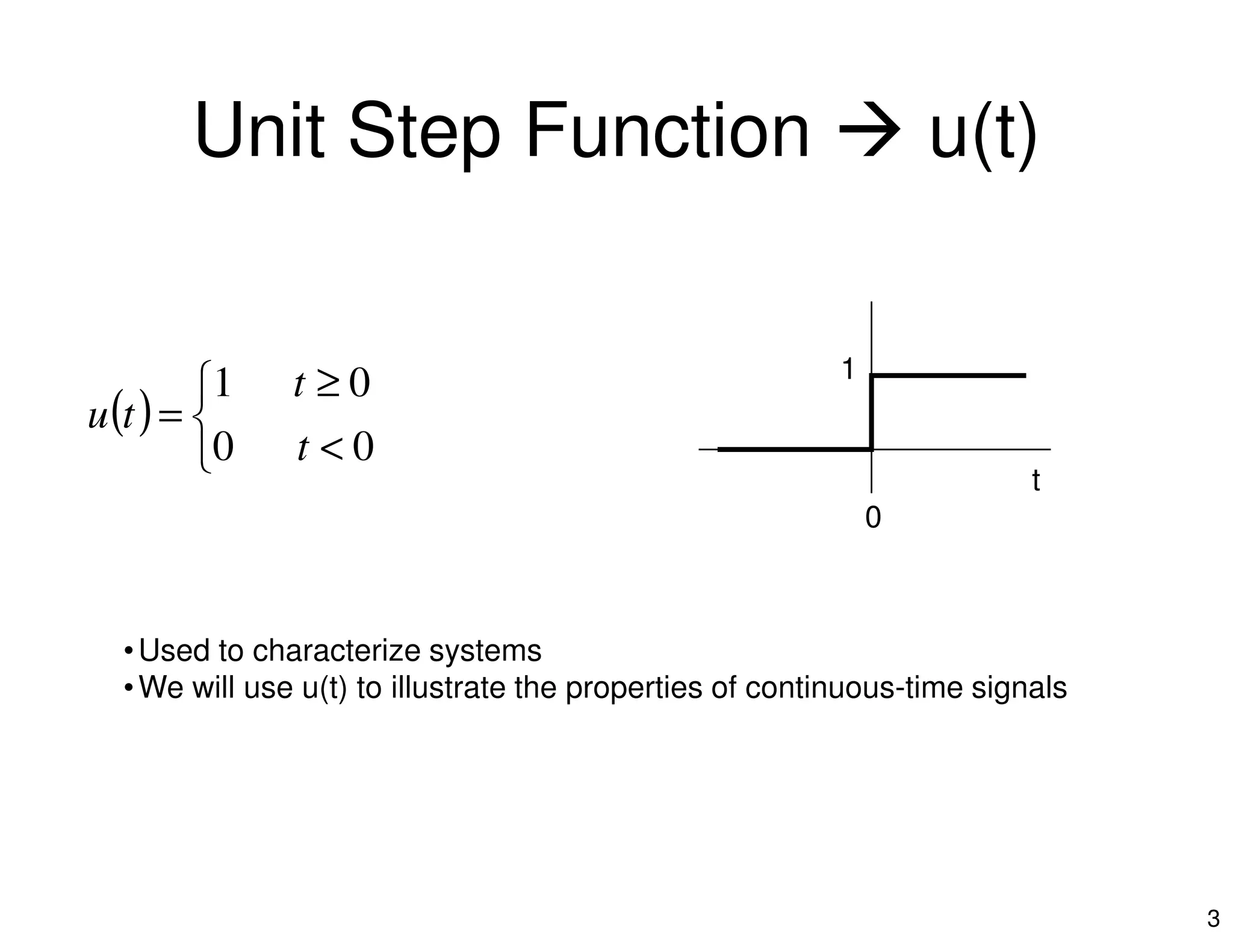
Unit Step Function u(t)
( )



<
≥
=
00
01
t
t
tu
t
1
3

•Used to characterize systems
•We will use u(t) to illustrate the properties of continuous-time signals
t
0
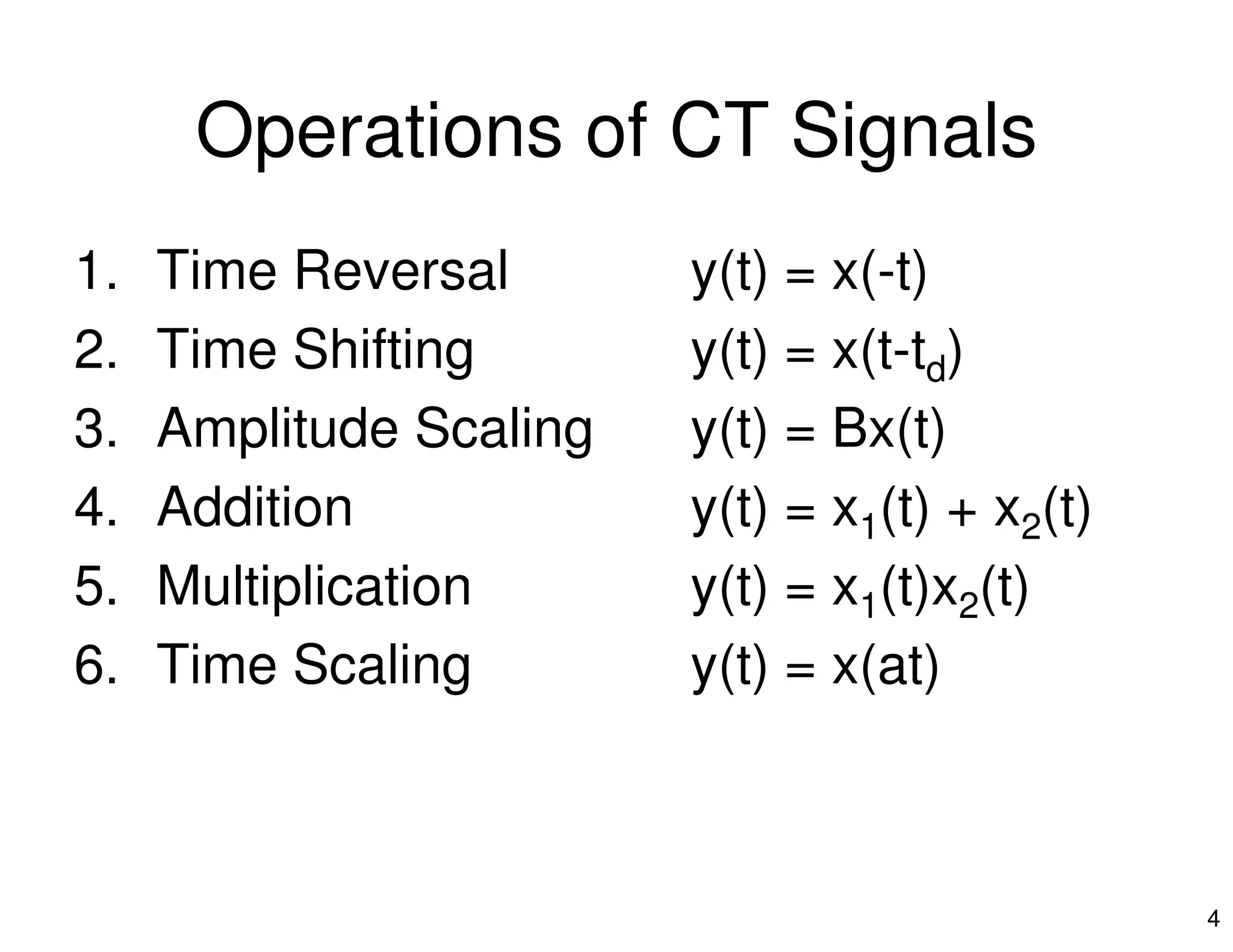
Operations of CT Signals
1. Time Reversal y(t) = x(-t)
2. Time Shifting y(t) = x(t-td)
3. Amplitude Scaling y(t) = Bx(t)
4
4. Addition y(t) = x1(t) + x2(t)
5. Multiplication y(t) = x1(t)x2(t)
6. Time Scaling y(t) = x(at)
1. Time Reversal
• Flips the signal about the y axis
• y(t) = x(-t)
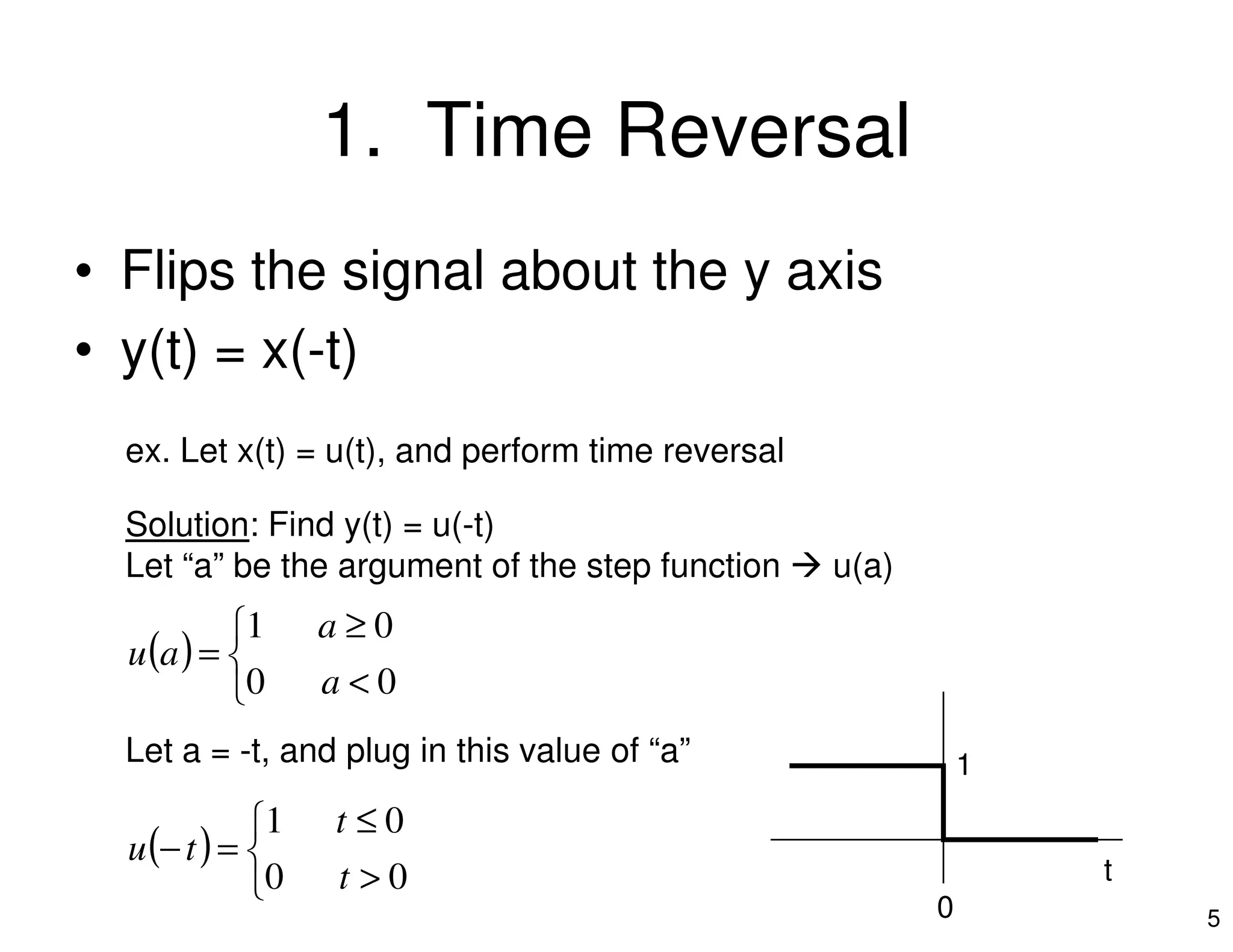
ex. Let x(t) = u(t), and perform time reversal
5
Solution: Find y(t) = u(-t)
Let “a” be the argument of the step function u(a)
( )



<
≥
=
00
01
a
a
au
Let a = -t, and plug in this value of “a”
( )



>
≤
=−
00
01
t
t
tu
t
1
0
2. Time Shifting / Delay
• y(t) = x(t – td)
• Shifts the signal left or right
• Shifts the origin of the signal to td
6
• Rule Set (t – td) = 0 (set the argument equal
to zero)
Then move the origin of x(t) to td
• Effectively, y(t) equals what x(t) was td seconds
ago
2. Time Shifting / Delay
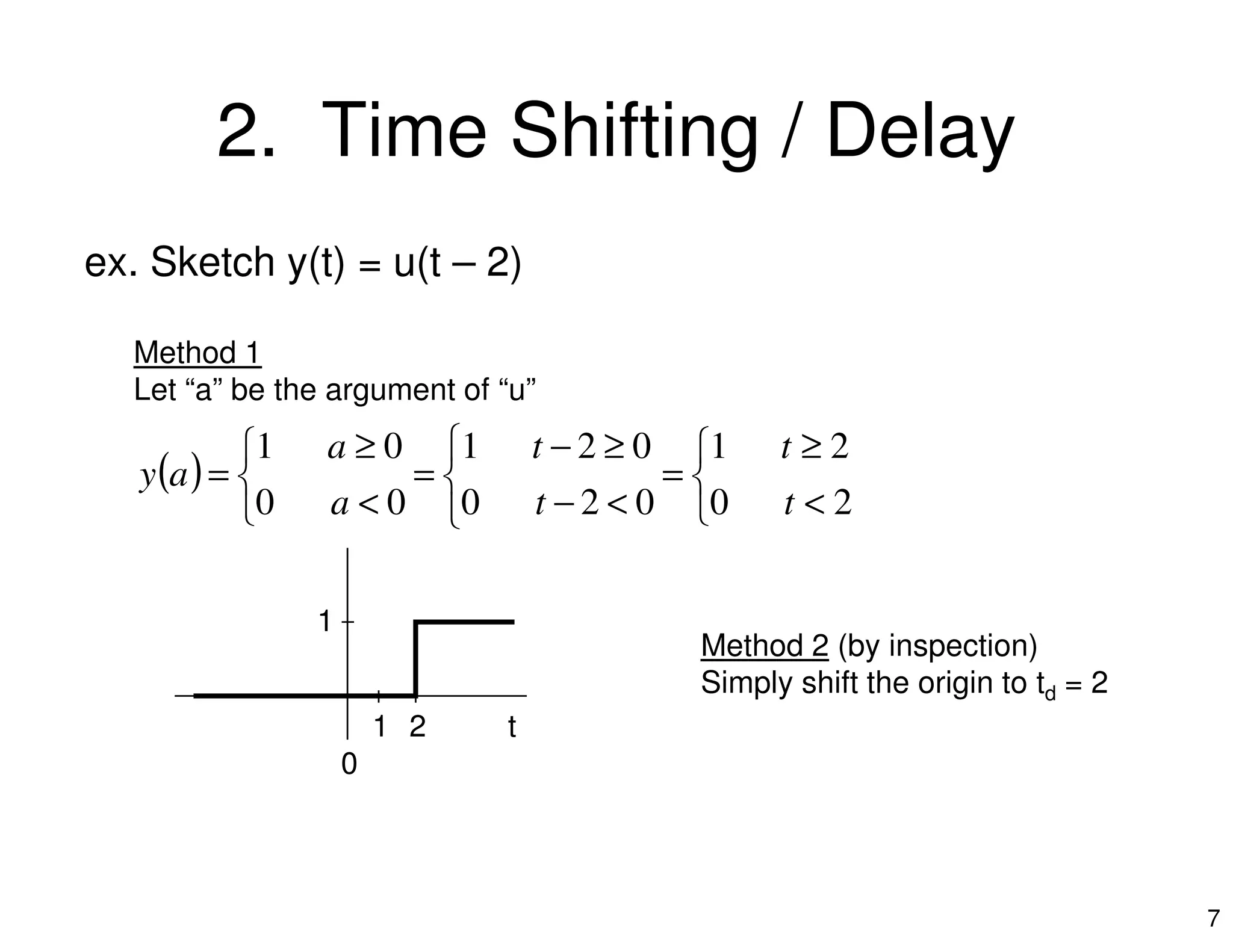
ex. Sketch y(t) = u(t – 2)
Method 1
Let “a” be the argument of “u”
( ) 


 ≥
=
≥−
=
 ≥
=
2102101 tta
ay
7
( )




<
=
<−
=


<
=
2002000 tta
ay
t
1
0
1 2
Method 2 (by inspection)
Simply shift the origin to td = 2
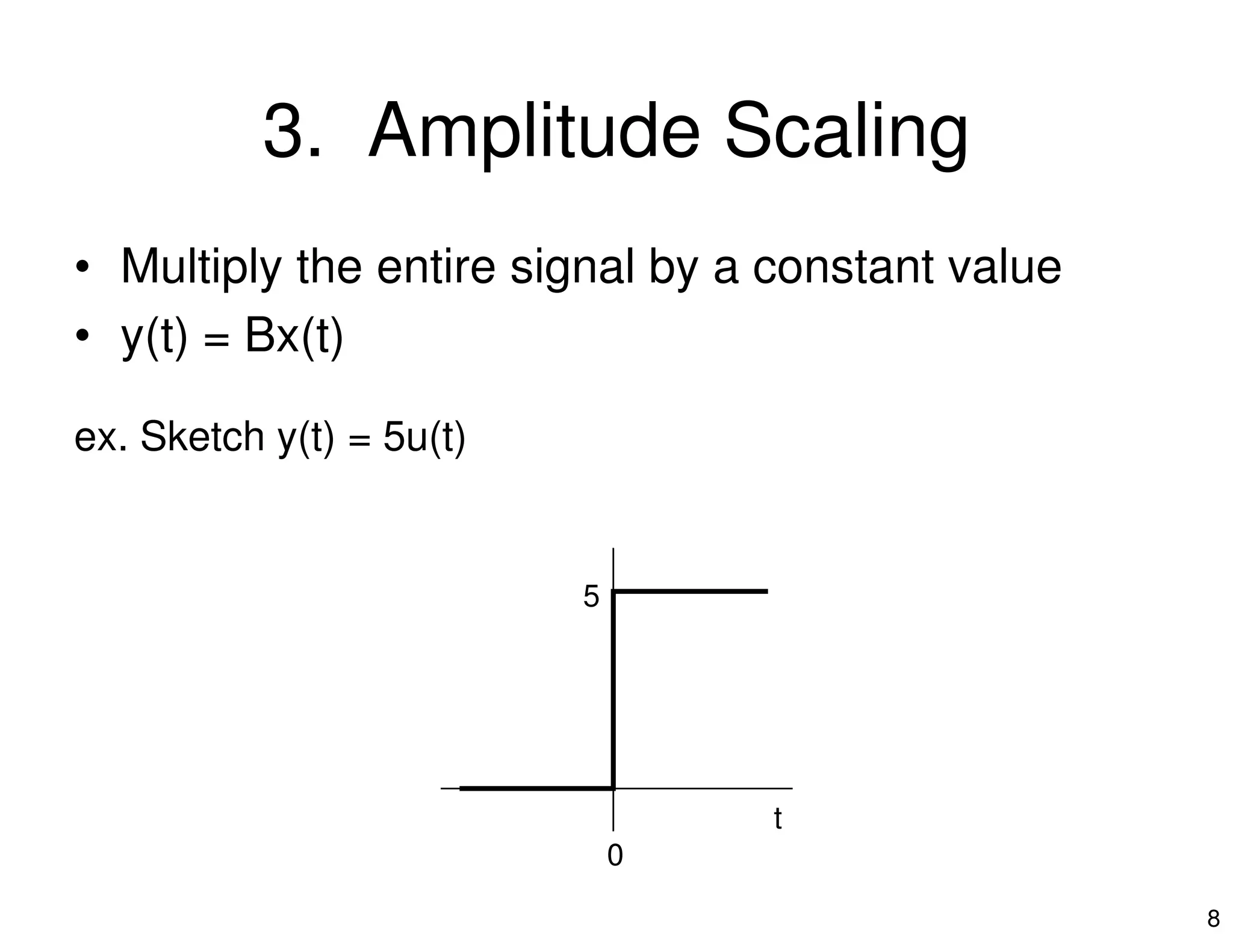
3. Amplitude Scaling
• Multiply the entire signal by a constant value
• y(t) = Bx(t)
ex. Sketch y(t) = 5u(t)
8
t
5
0
4. Addition of Signals
• Point-by-point addition of multiple signals
• Move from left to right (or vice versa), and add
the value of each signal together to achieve the
final signal
• y(t) = x (t) + x (t)
9
• y(t) = x1(t) + x2(t)
• Graphical solution
– Plot each individual portion of the signal (break into
parts)
– Add the signals point by point
4. Addition of Signals
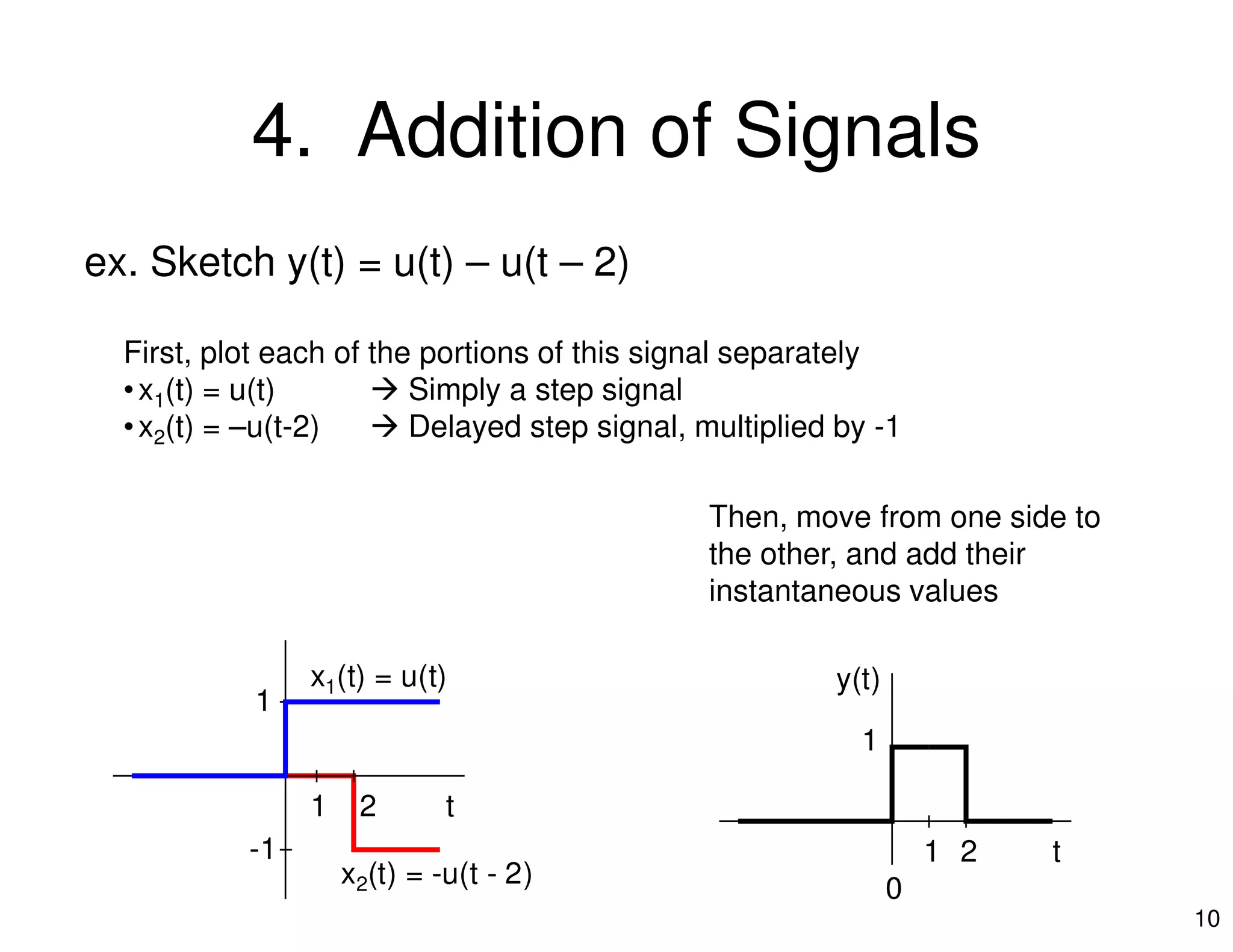
ex. Sketch y(t) = u(t) – u(t – 2)
First, plot each of the portions of this signal separately
•x1(t) = u(t) Simply a step signal
•x2(t) = –u(t-2) Delayed step signal, multiplied by -1
10
t
1
1 2
-1
x1(t) = u(t)
x2(t) = -u(t - 2)
Then, move from one side to
the other, and add their
instantaneous values
t
1
0
1 2
y(t)
5. Multiplication of Signals
• Point-by-point multiplication of the values
of each signal
• y(t) = x1(t)x2(t)
11
• Graphical solution
– Plot each individual portion of the signal
(break into parts)
– Multiply the signals point by point
5. Multiplication of Signals
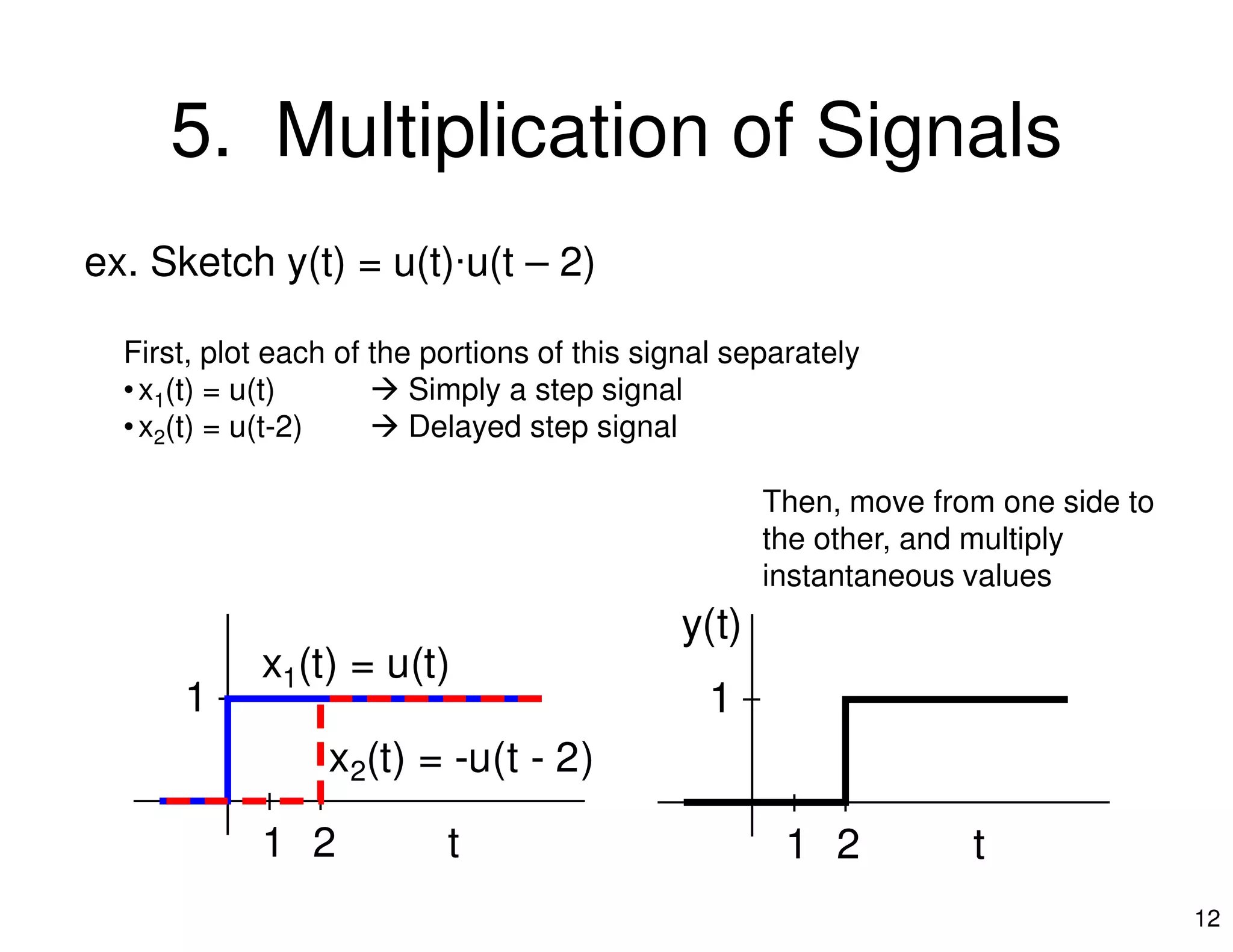
ex. Sketch y(t) = u(t)·u(t – 2)
First, plot each of the portions of this signal separately
•x1(t) = u(t) Simply a step signal
•x2(t) = u(t-2) Delayed step signal
12
t
1
1 2
x1(t) = u(t)
x2(t) = -u(t - 2)
Then, move from one side to
the other, and multiply
instantaneous values
t
1
1 2
y(t)
6. Time Scaling
• Speed up or slow down a signal
• Multiply the time in the argument by a
constant
• y(t) = x(at)
13
• y(t) = x(at)
|a| > 1 Speed up x(t) by a factor of “a”
|a| < 1 Slow down x(t) by a factor of “a”
• Key Replace all instances of “t” with “at”
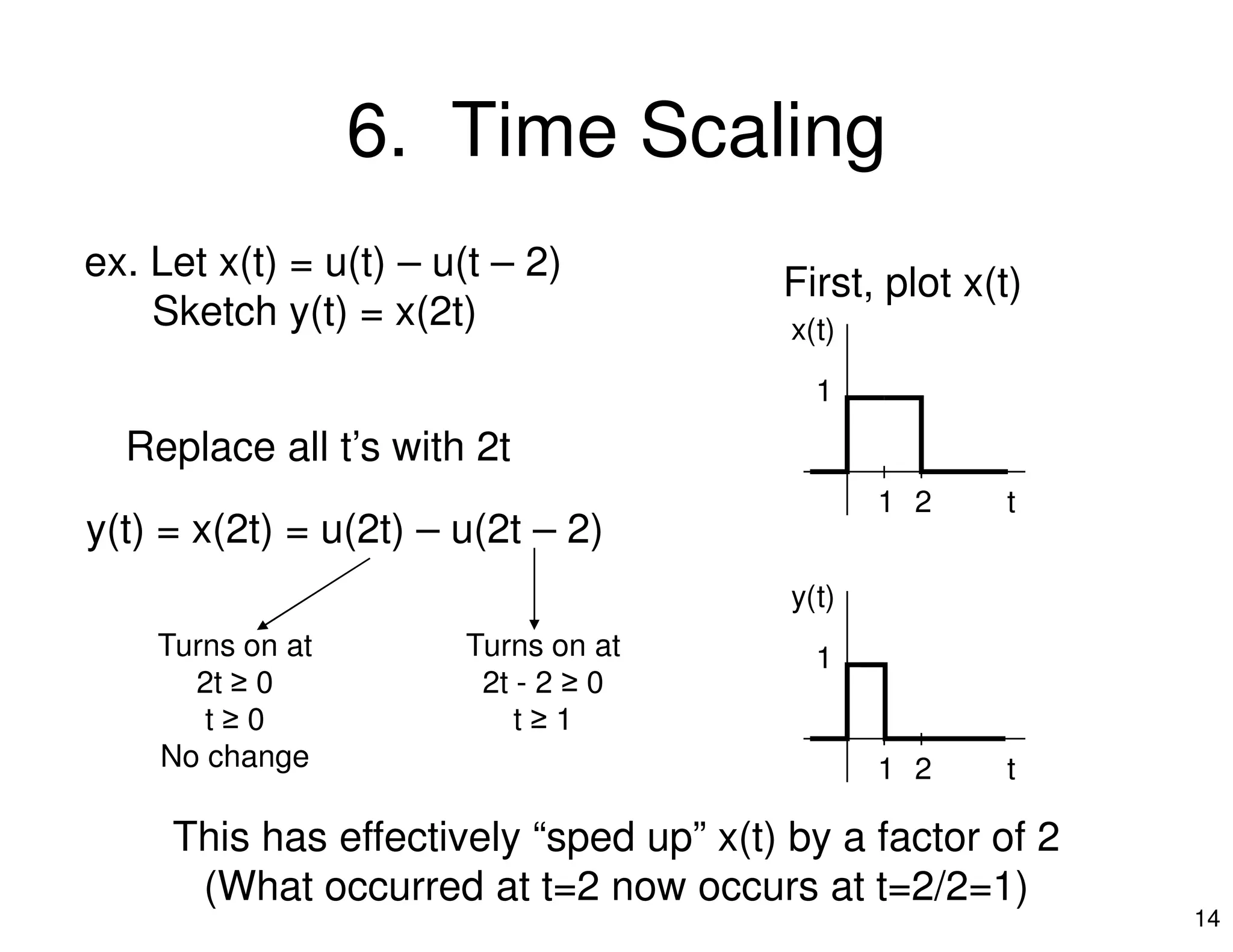
6. Time Scaling
ex. Let x(t) = u(t) – u(t – 2)
Sketch y(t) = x(2t)
1
x(t)
First, plot x(t)
Replace all t’s with 2t
14
t1 2
y(t) = x(2t) = u(2t) – u(2t – 2)
Turns on at
2t ≥ 0
t ≥ 0
No change
Turns on at
2t - 2 ≥ 0
t ≥ 1
t
1
1 2
y(t)
This has effectively “sped up” x(t) by a factor of 2
(What occurred at t=2 now occurs at t=2/2=1)
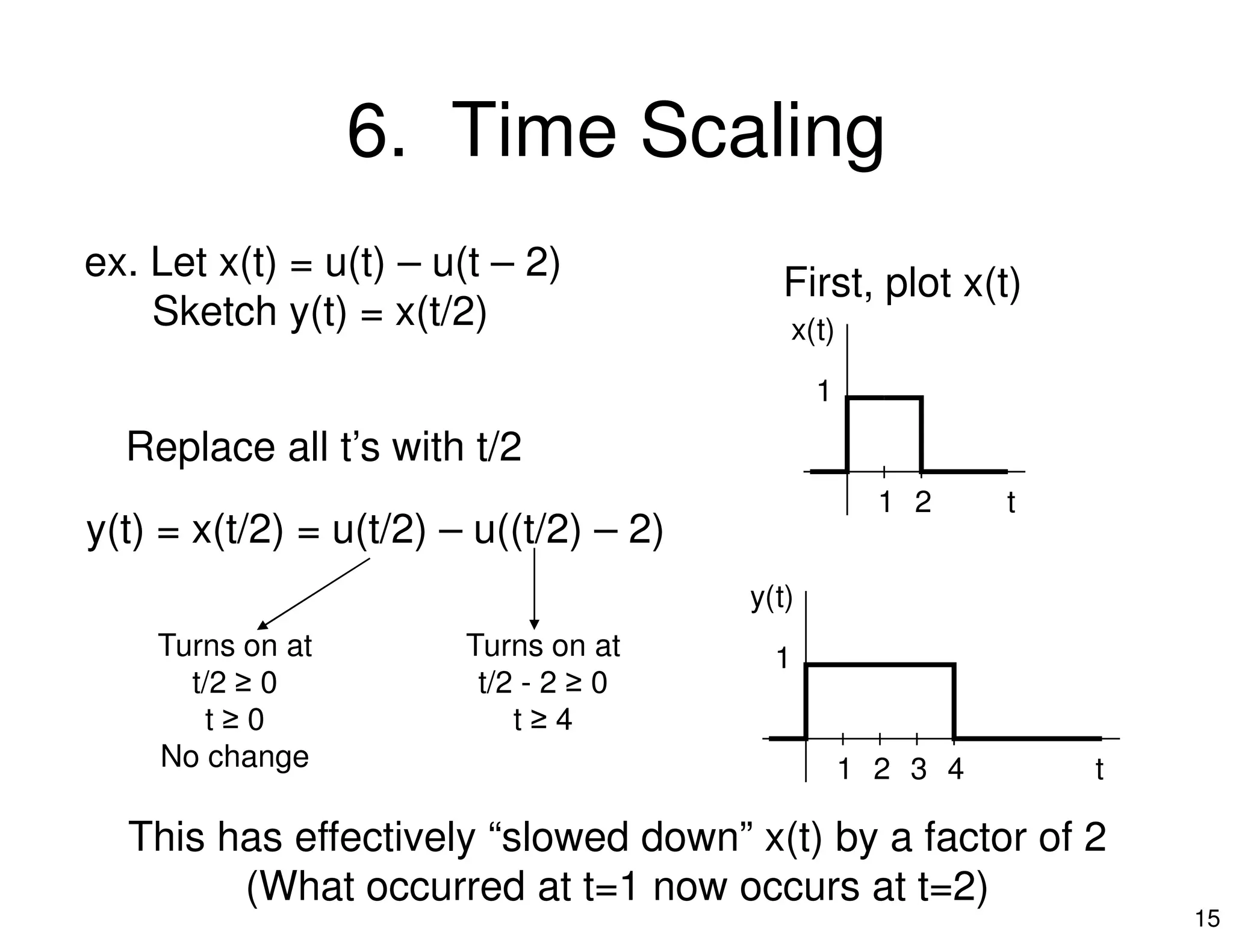
6. Time Scaling
ex. Let x(t) = u(t) – u(t – 2)
Sketch y(t) = x(t/2)
1
x(t)
First, plot x(t)
Replace all t’s with t/2
15
t1 2
y(t) = x(t/2) = u(t/2) – u((t/2) – 2)
Turns on at
t/2 ≥ 0
t ≥ 0
No change
Turns on at
t/2 - 2 ≥ 0
t ≥ 4
This has effectively “slowed down” x(t) by a factor of 2
(What occurred at t=1 now occurs at t=2)
t
1
1 2
y(t)
3 4
Combinations of Operations
• Combinations of operations on signals
– Easier to Determine the final signal in stages
– Create intermediary signals in which one
operation is performed
16
operation is performed
ex. Time Scale and Time Shift
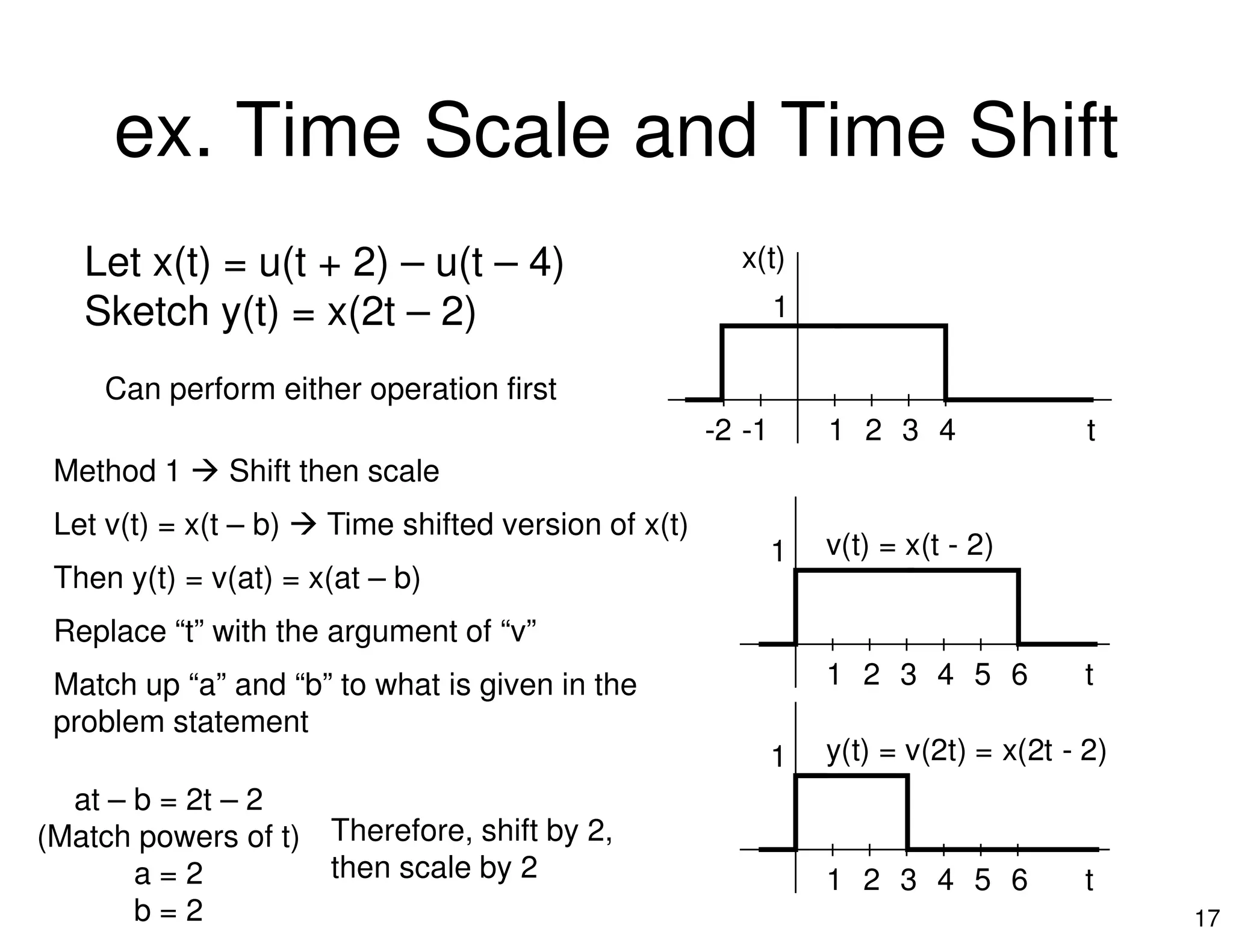
Let x(t) = u(t + 2) – u(t – 4)
Sketch y(t) = x(2t – 2)
t
1
1 2
x(t)
3 4-1-2
Can perform either operation first
Method 1 Shift then scale
17
Method 1 Shift then scale
Let v(t) = x(t – b) Time shifted version of x(t)
Then y(t) = v(at) = x(at – b)
Replace “t” with the argument of “v”
Match up “a” and “b” to what is given in the
problem statement
at – b = 2t – 2
(Match powers of t)
a = 2
b = 2
Therefore, shift by 2,
then scale by 2
t
1
1 2
v(t) = x(t - 2)
3 4 5 6
t
1
1 2
y(t) = v(2t) = x(2t - 2)
3 4 5 6
ex. Time Scale and Time Shift
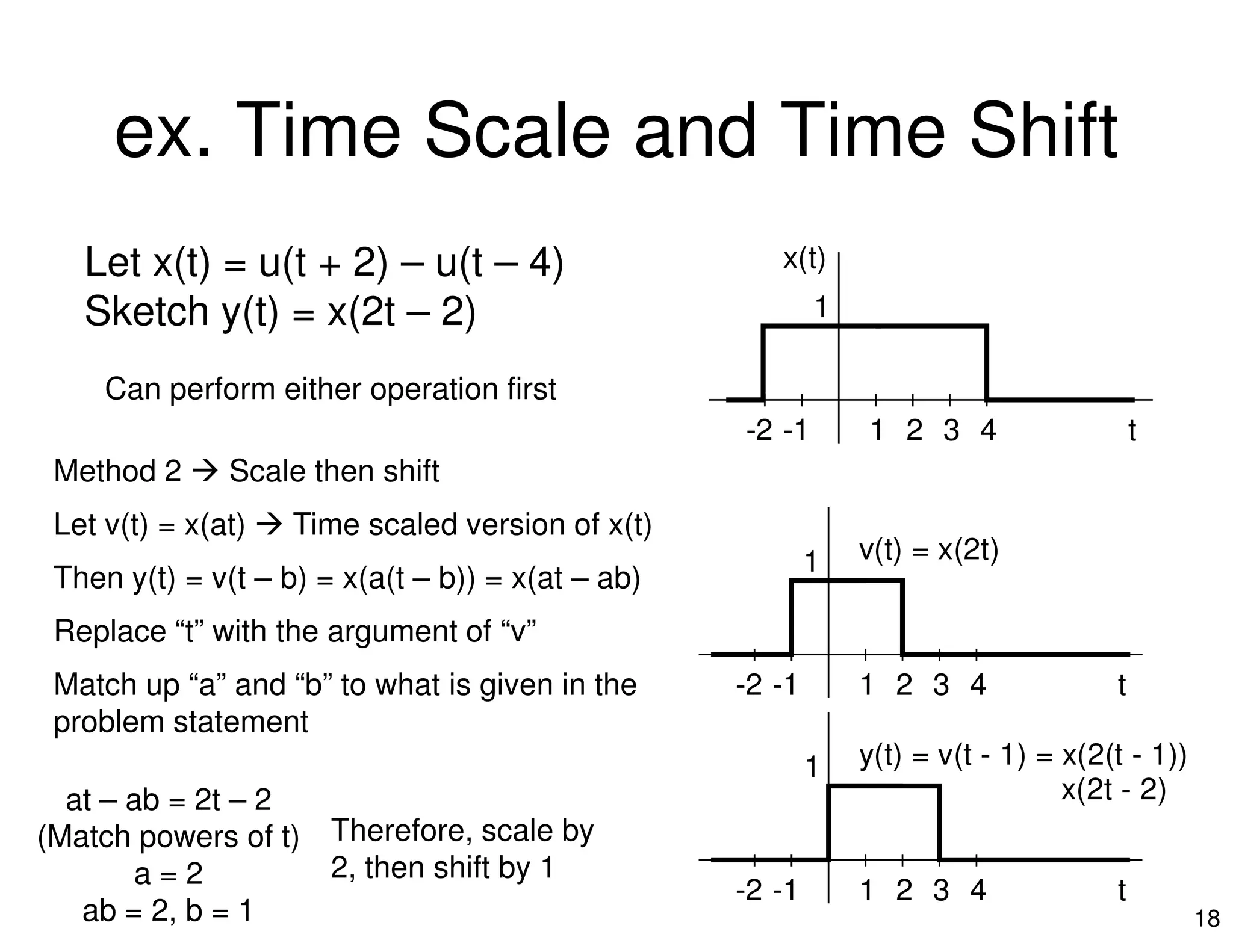
Let x(t) = u(t + 2) – u(t – 4)
Sketch y(t) = x(2t – 2)
t
1
1 2
x(t)
3 4-1-2
Can perform either operation first
Method 2 Scale then shift
18
Method 2 Scale then shift
Let v(t) = x(at) Time scaled version of x(t)
Then y(t) = v(t – b) = x(a(t – b)) = x(at – ab)
Replace “t” with the argument of “v”
Match up “a” and “b” to what is given in the
problem statement
at – ab = 2t – 2
(Match powers of t)
a = 2
ab = 2, b = 1
Therefore, scale by
2, then shift by 1
t
1
1 2
v(t) = x(2t)
3 4-1-2
t
1
1 2
y(t) = v(t - 1) = x(2(t - 1))
x(2t - 2)
3 4-1-2
ex. Time Scale and Time Shift
• Note – The results are the same
• Note – The value of b in Method 2 is a
scaled version of the time delay
– t = 2
19
– td = 2
– Time scale factor = 2
– New scale factor = 2/2 = 1

Ct signal operations

  • 1.
  • 2.
    Continuous-Time Signals • Continuous-TimeSignals – Time is a continuous variable – The signal itself need not be continuous 2 • We will look at several common continuous-time signals and also operations that may be performed on them
  • 3.
    Unit Step Functionu(t) ( )    < ≥ = 00 01 t t tu t 1 3  •Used to characterize systems •We will use u(t) to illustrate the properties of continuous-time signals t 0
  • 4.
    Operations of CTSignals 1. Time Reversal y(t) = x(-t) 2. Time Shifting y(t) = x(t-td) 3. Amplitude Scaling y(t) = Bx(t) 4 4. Addition y(t) = x1(t) + x2(t) 5. Multiplication y(t) = x1(t)x2(t) 6. Time Scaling y(t) = x(at)
  • 5.
    1. Time Reversal •Flips the signal about the y axis • y(t) = x(-t) ex. Let x(t) = u(t), and perform time reversal 5 Solution: Find y(t) = u(-t) Let “a” be the argument of the step function u(a) ( )    < ≥ = 00 01 a a au Let a = -t, and plug in this value of “a” ( )    > ≤ =− 00 01 t t tu t 1 0
  • 6.
    2. Time Shifting/ Delay • y(t) = x(t – td) • Shifts the signal left or right • Shifts the origin of the signal to td 6 • Rule Set (t – td) = 0 (set the argument equal to zero) Then move the origin of x(t) to td • Effectively, y(t) equals what x(t) was td seconds ago
  • 7.
    2. Time Shifting/ Delay ex. Sketch y(t) = u(t – 2) Method 1 Let “a” be the argument of “u” ( )     ≥ = ≥− =  ≥ = 2102101 tta ay 7 ( )     < = <− =   < = 2002000 tta ay t 1 0 1 2 Method 2 (by inspection) Simply shift the origin to td = 2
  • 8.
    3. Amplitude Scaling •Multiply the entire signal by a constant value • y(t) = Bx(t) ex. Sketch y(t) = 5u(t) 8 t 5 0
  • 9.
    4. Addition ofSignals • Point-by-point addition of multiple signals • Move from left to right (or vice versa), and add the value of each signal together to achieve the final signal • y(t) = x (t) + x (t) 9 • y(t) = x1(t) + x2(t) • Graphical solution – Plot each individual portion of the signal (break into parts) – Add the signals point by point
  • 10.
    4. Addition ofSignals ex. Sketch y(t) = u(t) – u(t – 2) First, plot each of the portions of this signal separately •x1(t) = u(t) Simply a step signal •x2(t) = –u(t-2) Delayed step signal, multiplied by -1 10 t 1 1 2 -1 x1(t) = u(t) x2(t) = -u(t - 2) Then, move from one side to the other, and add their instantaneous values t 1 0 1 2 y(t)
  • 11.
    5. Multiplication ofSignals • Point-by-point multiplication of the values of each signal • y(t) = x1(t)x2(t) 11 • Graphical solution – Plot each individual portion of the signal (break into parts) – Multiply the signals point by point
  • 12.
    5. Multiplication ofSignals ex. Sketch y(t) = u(t)·u(t – 2) First, plot each of the portions of this signal separately •x1(t) = u(t) Simply a step signal •x2(t) = u(t-2) Delayed step signal 12 t 1 1 2 x1(t) = u(t) x2(t) = -u(t - 2) Then, move from one side to the other, and multiply instantaneous values t 1 1 2 y(t)
  • 13.
    6. Time Scaling •Speed up or slow down a signal • Multiply the time in the argument by a constant • y(t) = x(at) 13 • y(t) = x(at) |a| > 1 Speed up x(t) by a factor of “a” |a| < 1 Slow down x(t) by a factor of “a” • Key Replace all instances of “t” with “at”
  • 14.
    6. Time Scaling ex.Let x(t) = u(t) – u(t – 2) Sketch y(t) = x(2t) 1 x(t) First, plot x(t) Replace all t’s with 2t 14 t1 2 y(t) = x(2t) = u(2t) – u(2t – 2) Turns on at 2t ≥ 0 t ≥ 0 No change Turns on at 2t - 2 ≥ 0 t ≥ 1 t 1 1 2 y(t) This has effectively “sped up” x(t) by a factor of 2 (What occurred at t=2 now occurs at t=2/2=1)
  • 15.
    6. Time Scaling ex.Let x(t) = u(t) – u(t – 2) Sketch y(t) = x(t/2) 1 x(t) First, plot x(t) Replace all t’s with t/2 15 t1 2 y(t) = x(t/2) = u(t/2) – u((t/2) – 2) Turns on at t/2 ≥ 0 t ≥ 0 No change Turns on at t/2 - 2 ≥ 0 t ≥ 4 This has effectively “slowed down” x(t) by a factor of 2 (What occurred at t=1 now occurs at t=2) t 1 1 2 y(t) 3 4
  • 16.
    Combinations of Operations •Combinations of operations on signals – Easier to Determine the final signal in stages – Create intermediary signals in which one operation is performed 16 operation is performed
  • 17.
    ex. Time Scaleand Time Shift Let x(t) = u(t + 2) – u(t – 4) Sketch y(t) = x(2t – 2) t 1 1 2 x(t) 3 4-1-2 Can perform either operation first Method 1 Shift then scale 17 Method 1 Shift then scale Let v(t) = x(t – b) Time shifted version of x(t) Then y(t) = v(at) = x(at – b) Replace “t” with the argument of “v” Match up “a” and “b” to what is given in the problem statement at – b = 2t – 2 (Match powers of t) a = 2 b = 2 Therefore, shift by 2, then scale by 2 t 1 1 2 v(t) = x(t - 2) 3 4 5 6 t 1 1 2 y(t) = v(2t) = x(2t - 2) 3 4 5 6
  • 18.
    ex. Time Scaleand Time Shift Let x(t) = u(t + 2) – u(t – 4) Sketch y(t) = x(2t – 2) t 1 1 2 x(t) 3 4-1-2 Can perform either operation first Method 2 Scale then shift 18 Method 2 Scale then shift Let v(t) = x(at) Time scaled version of x(t) Then y(t) = v(t – b) = x(a(t – b)) = x(at – ab) Replace “t” with the argument of “v” Match up “a” and “b” to what is given in the problem statement at – ab = 2t – 2 (Match powers of t) a = 2 ab = 2, b = 1 Therefore, scale by 2, then shift by 1 t 1 1 2 v(t) = x(2t) 3 4-1-2 t 1 1 2 y(t) = v(t - 1) = x(2(t - 1)) x(2t - 2) 3 4-1-2
  • 19.
    ex. Time Scaleand Time Shift • Note – The results are the same • Note – The value of b in Method 2 is a scaled version of the time delay – t = 2 19 – td = 2 – Time scale factor = 2 – New scale factor = 2/2 = 1