Subject: Elements of Mechanical
Engneering
Topic: OZONE DEPLETION
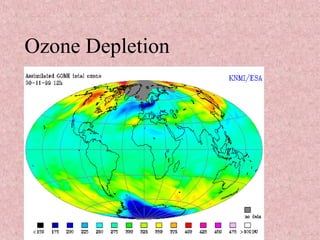
Ozone Depletion
Importance of the ozone layer
 Near ground level (trochosphere) - pollution
 Form photochemical smog and acid rain
 In the stratosphere (15 - 50 km) - ozone layer screen
out harmful Ultra-violet radiation from the sun.
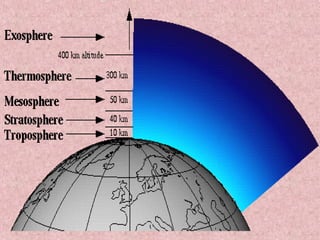
Our atmosphere
 Troposphere:
 The lowest layer (about 15 km from the ground)
 Contains normal air composed of N2, O2, water vapour,
CO2, etc.
 Temperature decreases with altitude
 Stratosphere:
 Above the troposphere
 Temperature increases with altitude
 Contains a lot of ozone (ozone layer):
 Found in the stratosphere between 10 - 50km above the
ground
 Protects us from the harmful effects of UV of certain
wavelengths
 Decrease in ozone concentration  Increase in UV-B
radiation reaching the earth surface
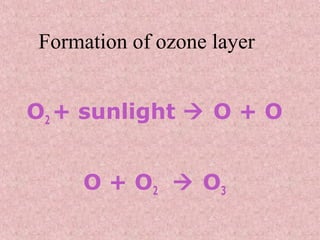
Formation of ozone layer
O2 + sunlight  O + O
O + O2  O3
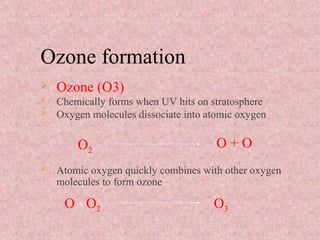
Ozone formation
 Ozone (O3)
 Chemically forms when UV hits on stratosphere
 Oxygen molecules dissociate into atomic oxygen
 Atomic oxygen quickly combines with other oxygen
molecules to form ozone
O2
O + O
O + O2 O3
Ozone formation
 Ozone (O3)
 A pollutant on ground level
 A component of photochemical smog
 Important for our survival
 Absorbs some of the potentially harmful UV radiation
which can cause skin cancer and damage to vegetation
 Split and regenerate repeatedly
 Highest concentration in the upper atmosphere
 Concentration decreases at lower altitudes
Ozone formation
 Ozone (O3)
 Made up of three oxygen atoms
 Occurs naturally as a layer in the stratosphere
 The layer is thinnest around the equator and the
concentration increases towards the poles
 The amount of ozone above a point on the earth’s surface
is measured in Dobson units (DU)
 ~ 260 DU near the Tropics
 higher elsewhere
What is CFCs?
 Chlorofluorocarbons (CFCs)
 Composed of elements chlorine, fluorine, and carbon
 Developed in 1930 by DuPont
 CFCs were welcomed by industries:
 Low toxicity
 Chemical stability
 Cheap
 Usage:
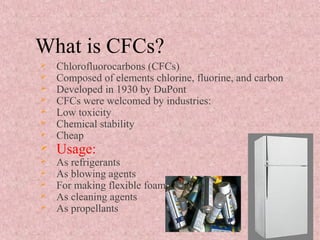
 As refrigerants
 As blowing agents
 For making flexible foam
 As cleaning agents
 As propellants
Present situation
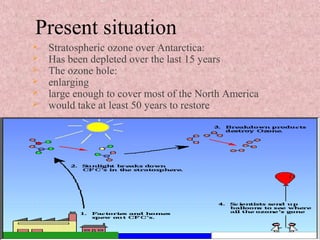
 Stratospheric ozone over Antarctica:
 Has been depleted over the last 15 years
 The ozone hole:
 enlarging
 large enough to cover most of the North America
 would take at least 50 years to restore
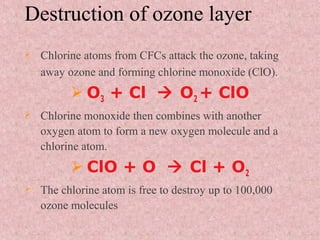
Destruction of ozone layer
 Chlorine atoms from CFCs attack the ozone, taking
away ozone and forming chlorine monoxide (ClO).
 O3 + Cl  O2 + ClO
 Chlorine monoxide then combines with another
oxygen atom to form a new oxygen molecule and a
chlorine atom.
 ClO + O  Cl + O2
 The chlorine atom is free to destroy up to 100,000
ozone molecules
Causes of ozone depletion
 Details are not fully understood
 Catalyzed by halocarbons (carbon compounds
containing fluorine, chlorine, bromine and iodine)
 Examples: CFCs and ClONO2
 Halogen atoms catalyze ozone layer depletion by
destroying ozone molecules and forming oxygen
molecules.
 Much more serious in Antarctica than other regions
on the planet
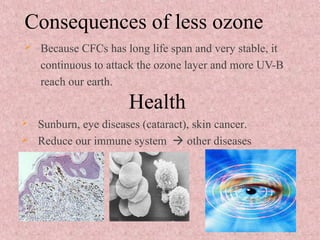
Consequences of less ozone
 Because CFCs has long life span and very stable, it
continuous to attack the ozone layer and more UV-B
reach our earth.
Health
 Sunburn, eye diseases (cataract), skin cancer.
 Reduce our immune system  other diseases
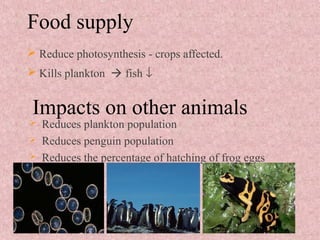
Food supply
 Reduce photosynthesis - crops affected.
 Kills plankton  fish ↓
Impacts on other animals
 Reduces plankton population
 Reduces penguin population
 Reduces the percentage of hatching of frog eggs
THANKING YOU FOR
WATCHING OUR
PRESENTATION

Ozone layer

  • 1.
    Subject: Elements ofMechanical Engneering Topic: OZONE DEPLETION
  • 2.
  • 4.
    Importance of theozone layer  Near ground level (trochosphere) - pollution  Form photochemical smog and acid rain  In the stratosphere (15 - 50 km) - ozone layer screen out harmful Ultra-violet radiation from the sun.
  • 5.
    Our atmosphere  Troposphere: The lowest layer (about 15 km from the ground)  Contains normal air composed of N2, O2, water vapour, CO2, etc.  Temperature decreases with altitude  Stratosphere:  Above the troposphere  Temperature increases with altitude  Contains a lot of ozone (ozone layer):  Found in the stratosphere between 10 - 50km above the ground  Protects us from the harmful effects of UV of certain wavelengths  Decrease in ozone concentration  Increase in UV-B radiation reaching the earth surface
  • 6.
    Formation of ozonelayer O2 + sunlight  O + O O + O2  O3
  • 7.
    Ozone formation  Ozone(O3)  Chemically forms when UV hits on stratosphere  Oxygen molecules dissociate into atomic oxygen  Atomic oxygen quickly combines with other oxygen molecules to form ozone O2 O + O O + O2 O3
  • 8.
    Ozone formation  Ozone(O3)  A pollutant on ground level  A component of photochemical smog  Important for our survival  Absorbs some of the potentially harmful UV radiation which can cause skin cancer and damage to vegetation  Split and regenerate repeatedly  Highest concentration in the upper atmosphere  Concentration decreases at lower altitudes
  • 9.
    Ozone formation  Ozone(O3)  Made up of three oxygen atoms  Occurs naturally as a layer in the stratosphere  The layer is thinnest around the equator and the concentration increases towards the poles  The amount of ozone above a point on the earth’s surface is measured in Dobson units (DU)  ~ 260 DU near the Tropics  higher elsewhere
  • 10.
    What is CFCs? Chlorofluorocarbons (CFCs)  Composed of elements chlorine, fluorine, and carbon  Developed in 1930 by DuPont  CFCs were welcomed by industries:  Low toxicity  Chemical stability  Cheap  Usage:  As refrigerants  As blowing agents  For making flexible foam  As cleaning agents  As propellants
  • 11.
    Present situation  Stratosphericozone over Antarctica:  Has been depleted over the last 15 years  The ozone hole:  enlarging  large enough to cover most of the North America  would take at least 50 years to restore
  • 12.
    Destruction of ozonelayer  Chlorine atoms from CFCs attack the ozone, taking away ozone and forming chlorine monoxide (ClO).  O3 + Cl  O2 + ClO  Chlorine monoxide then combines with another oxygen atom to form a new oxygen molecule and a chlorine atom.  ClO + O  Cl + O2  The chlorine atom is free to destroy up to 100,000 ozone molecules
  • 13.
    Causes of ozonedepletion  Details are not fully understood  Catalyzed by halocarbons (carbon compounds containing fluorine, chlorine, bromine and iodine)  Examples: CFCs and ClONO2  Halogen atoms catalyze ozone layer depletion by destroying ozone molecules and forming oxygen molecules.  Much more serious in Antarctica than other regions on the planet
  • 14.
    Consequences of lessozone  Because CFCs has long life span and very stable, it continuous to attack the ozone layer and more UV-B reach our earth. Health  Sunburn, eye diseases (cataract), skin cancer.  Reduce our immune system  other diseases
  • 15.
    Food supply  Reducephotosynthesis - crops affected.  Kills plankton  fish ↓ Impacts on other animals  Reduces plankton population  Reduces penguin population  Reduces the percentage of hatching of frog eggs
  • 16.
    THANKING YOU FOR WATCHINGOUR PRESENTATION