By
Dr. B.M.B.Krushna
Sr. Asst. Professor
Dept. Of Mathematics
MVGR COLLEGE OF ENGINEERING (A)
1
FIRST ORDER PARTIAL DIFFERENTIAL
EQUATIONS
 A partial differential equation(shortly., PDE) is
an equation for a function which depends on
more than one independent variable which
involves the independent variables, the
function, and partial derivatives of the
function.

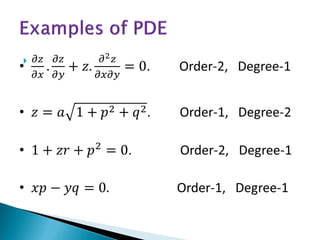
 The order of a PDE is defined as the order of
the highest order derivative occur in the
equation.
 The degree of a PDE is defined as the +ve
integral power to which the highest order
derivative occur in the equation.

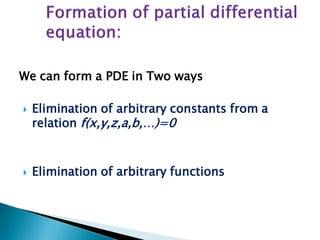
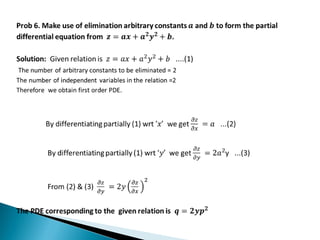
We can form a PDE in Two ways
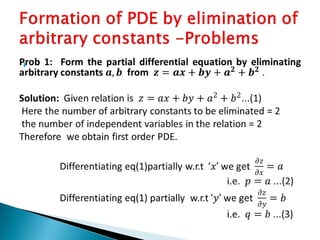
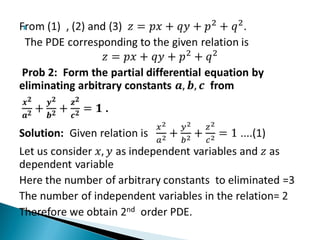
 Elimination of arbitrary constants from a
relation f(x,y,z,a,b,…)=0
 Elimination of arbitrary functions
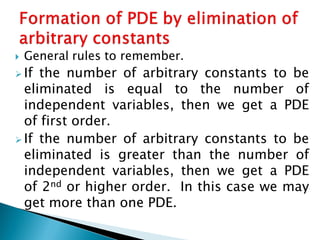
 General rules to remember.
 If the number of arbitrary constants to be
eliminated is equal to the number of
independent variables, then we get a PDE
of first order.
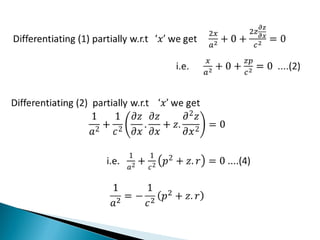
 If the number of arbitrary constants to be
eliminated is greater than the number of
independent variables, then we get a PDE
of 2nd or higher order. In this case we may
get more than one PDE.
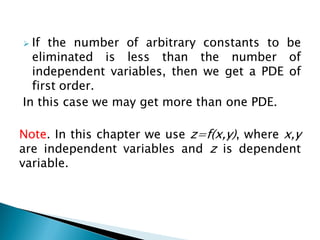
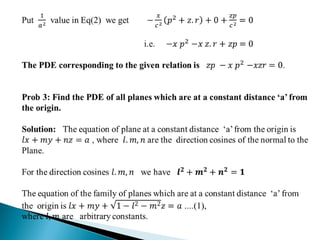
 If the number of arbitrary constants to be
eliminated is less than the number of
independent variables, then we get a PDE of
first order.
In this case we may get more than one PDE.
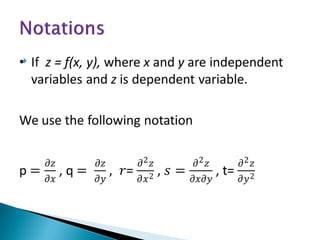
Note. In this chapter we use z=f(x,y), where x,y
are independent variables and z is dependent
variable.




Subscribe to the YouTube
Channel
Mathematics Tutorials
https://www.youtube.com/channel/UCoa1m0ExZ1pRHjNkLfW2qDw?view_as=y
19
20

First order partial differential equations

  • 1.
    By Dr. B.M.B.Krushna Sr. Asst.Professor Dept. Of Mathematics MVGR COLLEGE OF ENGINEERING (A) 1 FIRST ORDER PARTIAL DIFFERENTIAL EQUATIONS
  • 2.
     A partialdifferential equation(shortly., PDE) is an equation for a function which depends on more than one independent variable which involves the independent variables, the function, and partial derivatives of the function.
  • 3.
  • 4.
     The orderof a PDE is defined as the order of the highest order derivative occur in the equation.  The degree of a PDE is defined as the +ve integral power to which the highest order derivative occur in the equation.
  • 5.
  • 6.
    We can forma PDE in Two ways  Elimination of arbitrary constants from a relation f(x,y,z,a,b,…)=0  Elimination of arbitrary functions
  • 7.
     General rulesto remember.  If the number of arbitrary constants to be eliminated is equal to the number of independent variables, then we get a PDE of first order.  If the number of arbitrary constants to be eliminated is greater than the number of independent variables, then we get a PDE of 2nd or higher order. In this case we may get more than one PDE.
  • 8.
     If thenumber of arbitrary constants to be eliminated is less than the number of independent variables, then we get a PDE of first order. In this case we may get more than one PDE. Note. In this chapter we use z=f(x,y), where x,y are independent variables and z is dependent variable.
  • 9.
  • 10.
  • 13.
  • 14.
  • 19.
    Subscribe to theYouTube Channel Mathematics Tutorials https://www.youtube.com/channel/UCoa1m0ExZ1pRHjNkLfW2qDw?view_as=y 19
  • 20.