ACID-BASE BALANCE
Akanksha Dubey
Assistant Professor
Biochemistry Department
Metabolic reactions are influenced by pH (hydrogen ion
concentration)
Any change in pH causes :
Distortion of protein structure
Enzyme activity is affected
Electrolytes can be affected
Hence any change in pH is closely guarded.
pH of Blood(ECF): 7.35-7.45
pH of ICF depends upon tissues
RBC: 7.2, Skeletal Muscle: 6.0
Hence 6.8-7.8 is appropriate for life
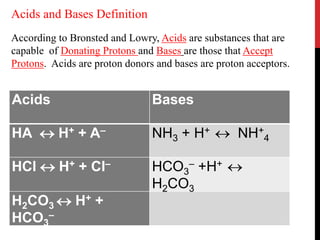
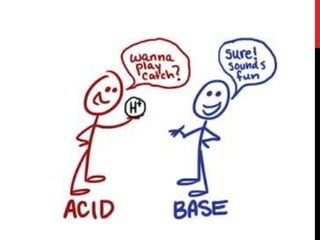
According to Bronsted and Lowry, Acids are substances that are
capable of Donating Protons and Bases are those that Accept
Protons. Acids are proton donors and bases are proton acceptors.
Acids and Bases Definition
Acids Bases
HA  H+ + A– NH3 + H+  NH+
4
HCl  H+ + Cl– HCO3
– +H+ 
H2CO3
H2CO3  H+ +
HCO3
–
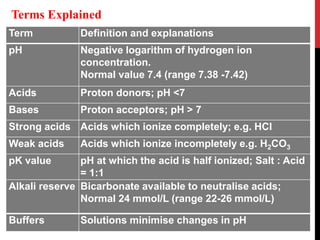
Term Definition and explanations
pH Negative logarithm of hydrogen ion
concentration.
Normal value 7.4 (range 7.38 -7.42)
Acids Proton donors; pH <7
Bases Proton acceptors; pH > 7
Strong acids Acids which ionize completely; e.g. HCl
Weak acids Acids which ionize incompletely e.g. H2CO3
pK value pH at which the acid is half ionized; Salt : Acid
= 1:1
Alkali reserve Bicarbonate available to neutralise acids;
Normal 24 mmol/L (range 22-26 mmol/L)
Buffers Solutions minimise changes in pH
Terms Explained
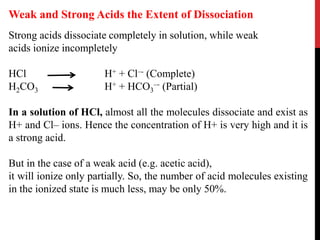
Strong acids dissociate completely in solution, while weak
acids ionize incompletely
HCl H+ + Cl–- (Complete)
H2CO3 H+ + HCO3
–- (Partial)
In a solution of HCl, almost all the molecules dissociate and exist as
H+ and Cl– ions. Hence the concentration of H+ is very high and it is
a strong acid.
But in the case of a weak acid (e.g. acetic acid),
it will ionize only partially. So, the number of acid molecules existing
in the ionized state is much less, may be only 50%.
Weak and Strong Acids the Extent of Dissociation
Dissociation of an acid is a freely reversible reaction. At equilibrium
the ratio between dissociated and undissociated particle is a constant.
Dissociation constant (Ka) of an acid is
[H+] [A–-]
Ka = ––––––––-
[HA]
where [H+] is the concentration of hydrogen ions, [A–] = the
concentration of anions or conjugate base, and [HA] is the
concentration of undissociated molecules.
The pH at which the acid is half ionized is called pKa of an acid
which is constant at a particular temperature and pressure.
Strong acids will have a low pKa and weak acids have a higher pKa.
Dissociation Constant
The acidity of a solution is measured by noting the hydrogen ion
concentration in the solution and obtained by the equation.
[acid] [HA]
[H+] = Ka –––––––– or ––––––
[base] [A––]
where Ka is the dissociation constant.
To make it easier, Sorensen expressed the H+ concentration as the
negative of the logarithm (logarithm to the base 10) of hydrogen ion
concentration, and is designated as the pH. Therefore,
_1_
pH = –log [H+] = log [H+]
Acidity of a Solution and pH
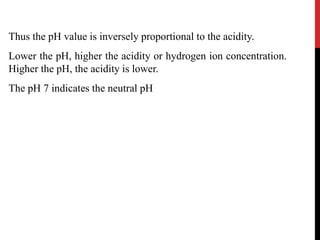
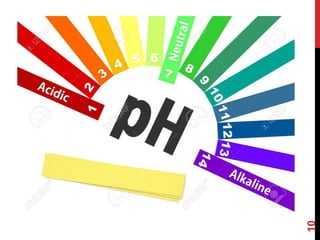
Thus the pH value is inversely proportional to the acidity.
Lower the pH, higher the acidity or hydrogen ion concentration.
Higher the pH, the acidity is lower.
The pH 7 indicates the neutral pH
10
The relationship between pH, pKa, concentration of acid and
conjugate base (or salt) is expressed by the
Henderson-Hasselbalch equation,
[base] [salt]
pH = pKa + log ––––– or pH = pKa + log –––––
[acid] [acid]
When [base] = [acid]; then pH = pKa
Therefore, when the concentrations of base and acid are the same,
then pH is equal to pKa.
The Effect of Salt upon the Dissociation
The pH of a buffer on addition of a known quantity of acid and alkali
can, therefore, be predicted by the equation.
Moreover, the concentration of salt or acid can be found out by
measuring the pH.
The Henderson-Hasselbalch’s equation, therefore, has great practical
application in clinical practice in assessing the acid-base status, and
predicting the limits of the compensation of body buffers.
Clinical Application of Henderson-Hasselbalch’s Equation
Buffers are solutions which can resist changes in pH when acid or
alkali is added.
Buffers are of two types:
a. Mixtures of weak acids with their salt with a strong base or
b. Mixtures of weak bases with their salt with a strong acid.
i. H2CO3 / NaHCO3 (Bicarbonate buffer)
(carbonic acid and sodium bicarbonate)
ii. CH3COOH / CH3COONa (Acetate buffer)
(acetic acid and sodium acetate)
iii. Na2HPO4 / NaH2PO4 (Phosphate buffer)
Buffers
The buffering capacity of a buffer is defined as the ability of
the buffer to resist changes in pH when an acid or base
is added.
Buffer capacity is determined by the actual concentrations of salt and
acid present, as well as by their ratio.
Buffering capacity is the number of grams of strong acid or alkali
which is necessary for a change in pH of one unit of one liter of
buffer solution.
Factors Affecting Buffer Capacity
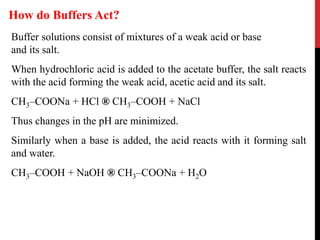
Buffer solutions consist of mixtures of a weak acid or base
and its salt.
When hydrochloric acid is added to the acetate buffer, the salt reacts
with the acid forming the weak acid, acetic acid and its salt.
CH3–COONa + HCl ® CH3–COOH + NaCl
Thus changes in the pH are minimized.
Similarly when a base is added, the acid reacts with it forming salt
and water.
CH3–COOH + NaOH ® CH3–COONa + H2O
How do Buffers Act?
But the pH of the buffer is dependent on the relative
proportion of the salt and acid (Henderson-Hasselbalch's
equation).
The pH of a buffer on addition of a known quantity of acid and
alkali can, therefore, be predicted by the equation.
The Henderson-Hasselbalch's equation therefore, has great
practical application in clinical practice in assessing the acid-
base status, and predicting the limits of the compensation of
body buffers.
The Buffer Capacity is Determined by the Absolute
Concentration of the Salt and Acid
17
Normal pH of plasma is 7.4.
In normal life, the variation of plasma pH is very small.
The pH of plasma is maintained within a narrow range of 7.35 to
7.45.
The pH of the interstitial fluid is generally 0.5 units below that of
the plasma.
Acid-base Balance
If the pH is below 7.38, it is called acidosis. Life is threatened
when the pH is lowered below 7.25.
Acidosis leads to CNS depression and coma. Death occurs
when pH is below 7.0.
When the pH is more than 7.42, it is alkalosis. It is very
dangerous if pH is increased above 7.55.
Alkalosis induces neuromuscular hyperexcitability and tetany.
Death occurs when the pH is above 7.6.
Volatile acid is carbonic acid which is a weak acid.
The metabolism produces nearly 50 mmoles of carbonic
acid per day which is equal to 500 ml of sulphuric acid.
60-80 mEq of fixed acids per day.
Nonvolatile (fixed) acids are lactate, keto acids, sulfuric acid
and phosphoric acid.
1 mol of glucose produces 2 mols of lactic acid.
Volatile and Fixed Acids
The dietary protein content decides the amount of sulfuric and
phosphoric acids.
The sulfoproteins yield sulfuric acid and phosphoproteins and
nucleoproteins produce phosphoric acid.
On an average about 3g of phosphoric acid and about 3g sulfuric
acid are produced per day.
The carbonic acid, being volatile, is eliminated as CO2 by the
lungs.
The fixed acids are buffered and later on the H+ are excreted by
the kidney.
Volatile and Fixed Acids
22
Normal human diet is almost neutral, but H ions are generated
because of various metabolic reactions.
1. Aerobic Metabolism:
Carbon, Hydrogen, Oxygen converted to Water and CO2
(20,000 mmol/day). This CO2 is responsible for generation
of Hydrogen ions
2. Lactic Acid: Anerobic Respiration
3. Phosphoric Acid: via Phospholipids
4. Sulphuric acids: sulphur containing Amino Acids
5. Keto Acids: lipid metabolism (approx 80 mEq/day).
From 2 – 5 are Non-Volatile Acids
 GI secretions are acidic in nature and Non-GI secretions are
alkaline in nature.
23
There are three lines of defence operative in maintaining the blood pH.
HYDROGEN-ION HOMEOSTASIS
I. Buffer systems
II. Respiratory mechanism
III. Renal regulation
 Buffers are the solutions which resist change in pH by the
addition of small amounts of acids or bases. Any substance that
can reversibly bind hydrogen ions can be labelled as a buffer.
 Buffers can neither remove H+ ions from the body nor add them
to it. They can only keep H+ ions in a temporarily suspended
form. The H+ ions have to be ultimately eliminated by the kidneys
BUFFER SYSTEMS
 There are three major buffer systems operative in the human body.
1. Bicarbonate buffer
2. Phosphate buffer
3. Protein buffer
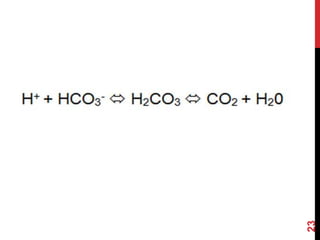
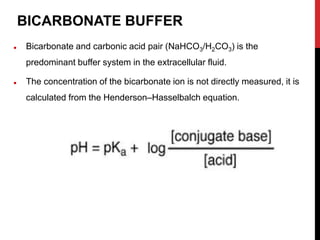
 Bicarbonate and carbonic acid pair (NaHCO3/H2CO3) is the
predominant buffer system in the extracellular fluid.
 The concentration of the bicarbonate ion is not directly measured, it is
calculated from the Henderson–Hasselbalch equation.
BICARBONATE BUFFER
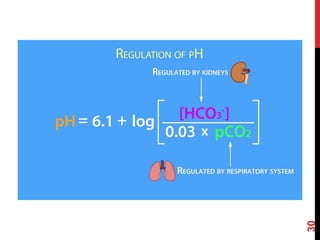
The above equation is popularly known as the Henderson–Hasselbalch
equation and is applicable for any buffer pair.
…Continues)
(Continued…
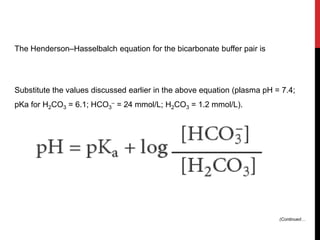
The Henderson–Hasselbalch equation for the bicarbonate buffer pair is
Substitute the values discussed earlier in the above equation (plasma pH = 7.4;
pKa for H2CO3 = 6.1; HCO3
– = 24 mmol/L; H2CO3 = 1.2 mmol/L).
(Continued…
30
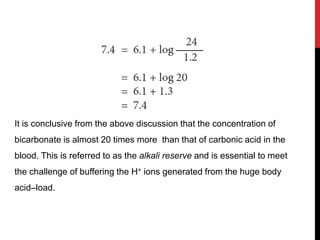
It is conclusive from the above discussion that the concentration of
bicarbonate is almost 20 times more than that of carbonic acid in the
blood. This is referred to as the alkali reserve and is essential to meet
the challenge of buffering the H+ ions generated from the huge body
acid–load.
32
Alkali Reserve:
▪ Plasma Bicarbonate (HCO3– ) represents the alkali
reserve and it has to be sufficiently high to meet the acid
load.
▪ If it was too low to give a ratio of 1, all the HCO3– would
have been exhausted within a very short time; and
buffering will not be effective.
▪ So, under physiological circumstances, the ratio of 20:1
(a high alkali reserve) ensures high buffering efficiency
against acids
33
Phosphate Buffer:
Intracellular Buffer
Na2HPO4 (Disodium Hydrogen Phosphate-
NaH2PO4 (Sodium Dihydrogen Phosphate)
Mostly 5% of total buffering capacity but
effective because pKa is 6.8 hich is close to
pH of blood 7.4.
Base to acid Ratio is 4
34
Protein Buffer:
 albumin and Hemoglobin acts as a buffer
Buffering capacity depends on pKa of amino acids
and their ionizable groups
For eg : Histidine of Hb is having pka of 6.7 which
makes it as a buffer
Buffers have limited pH maintenance because H
ions are not added or removed
35
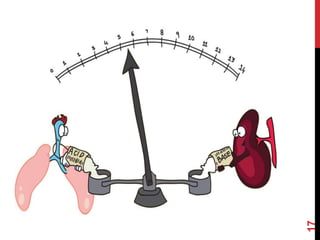
The respiratory system and the kidneys together maintain the body pH.
The respiratory response to the altered plasma pH is very swift (within
minutes) compared to the slow but steady response of the kidneys (hours
to days).
Respiratory system provides a rapid mechanism for the maintenance of
acid-base balance. This is achieved by regulating the concentration of
carbonic acid (H2CO3) in the blood
RESPIRATORY REGULATION OF PH
(Continued…
37
The large volumes of CO2 produced by the cellular metabolic activity
endanger the acid base equilibrium of the body. But in normal
Circumstances all of this CO2 is eliminated from the body in the expired air
via the lungs.
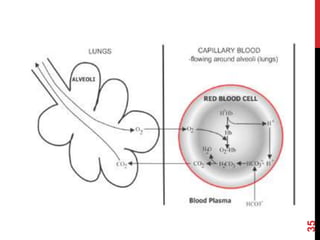
Hemoglobin as a buffer : Haemoglobin of erythrocytes is also important in
the respiratory regulation of pH. At the tissue level, hemoglobin binds to H+
ions and helps to transport CO2 as HCO3 with a minimum change in pH
(referred to as Isohydric transport).
In the lungs, as hemoglobin combines with H+ ions are removed which
combine with HCO3 to form H2CO3 which after dissociates to release CO2
to be exhaled
38
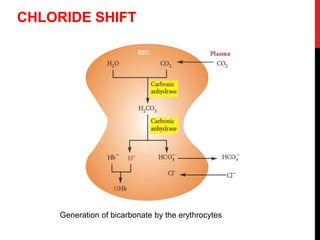
Generation of HCO3 by RBC :
Due to lack of aerobic metabolic pathways, RBC produce very little CO2.
The plasma CO2 diffuses into the RBC along the concentration gradient
where it combines with water to form H2CO3. This reaction is catalysed by
carbonic anhydrase.
In the RBC, H2CO3 dissociates to produce H+ and HCO3 .
The H+ ions are trapped and buffered by hemoglobin. As the
concentration of HCO3 increases in the RBC, it diffuses into plasma along
with the concentration gradient, in exchange for Cl- ions, to maintain
electrical neutrality. This phenomenon, referred to as chloride shift, helps
to generate HCO3
Generation of bicarbonate by the erythrocytes
CHLORIDE SHIFT
RENAL REGULATION OF pH
Regulation of pH by the kidneys is permanent mechanism of
pH balance. The pH of blood is 7.4 and Urine is 6.0 this
explains Kidney acidifies urine to maintain pH.
It excretes Hydrogen ions or retains them, and maintain alkali
reserve of the body.
41
The basic mechanisms of renal regulation of pH include:
1. Reabsorption of bicarbonate
2. Excretion of Fixed Acids
3. Excretion of ammonium ions
4. Excretion of free H+ ions.
REABSORPTION OF BICARBONATE
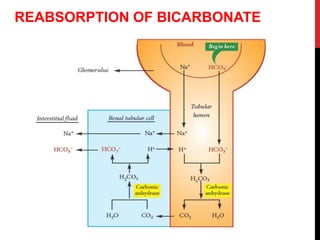
This mechanism is primarily responsible to conserve the blood HCO3,
with a simultaneous excretion of H+ ions. The normal urine is almost free
from HCO3.
43
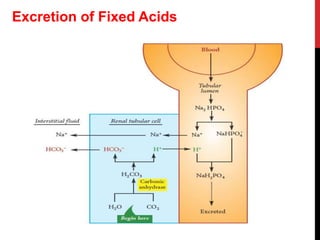
Excretion of Fixed Acids
45
Fixed acids are also excreted in the form of sodium dihydrogen phosphate.
Titratable acidity is a measure of acid excreted into urine by the kidney
which is number of ml of 0.1 N NaOH required to titrate 1 L of urine to pH
7.4.
This can be estimated by titrating urine back to the normal pH of blood.
Titratable acidity reflects the H+ ions excreted into urine which resulted in a
fall of pH from 7.4.
The excreted H+ ions are actually buffered in the urine by phosphate buffer.
H + ion is secreted into the tubular lumen in exchange for Na+ ion.
46
This Na+ is obtained from the base, disodium hydrogen
phosphate (Na2HPO4). The latter in turn combines with H+
to produce the acid, sodium dihydrogen phosphate
(NaH2PO4), in which form the major quantity of titratable
acid in urine is present.
As the tubular fluid moves down the renal tubules/ more and
more H+ ions are added, resulting in the acidification of
urine.
This causes a fall in the pH of urine to as low as 4.5.
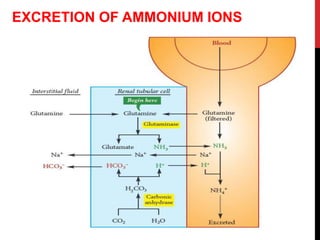
EXCRETION OF AMMONIUM IONS
48
This is another mechanism to buffer H+ ions secreted into the tubular
fluid.
The H+ ion combines with NH3 to form ammonium ion.
The renal tubular cells de-amidate glutamine to glutamate and NH3. This
reaction is catalysed by the enzyme glutaminase
The NH3, liberated in this reaction, diffuses into the tubular lumen where
it
combines with H+ to form NH4.
Ammonium ions cannot diffuse back into tubular cells and, therefore, are
excreted into urine.
NH4 is a major urine acid.
49
50
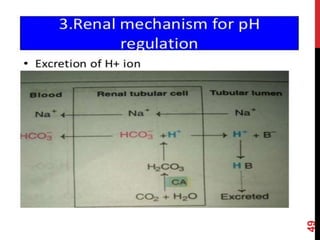
Excretion of H+ ions
Kidney is the only route through which the H+ can be eliminated from the body.
H+ excretion occurs in the PCT( renal tubular cells) and is coupled with the
regeneration of HCO3
-
Carbonic anhydrase catalyses the production of carbonic acid (H2CO3) from CO2
and H2O in the renal tubular cell.
H2CO3 then dissociates to H+ and HCO3
- . The H+ ions are secreted into the
tubular lumen in exchange for Na+.
The Na+ in association with HCO3
- is reabsorbed into the blood.
This is an effective mechanism to eliminate acids (H+) from the body with a
simultaneous generation of HCO3
-.
The H+ combines with a non-carbonate base and is excreted in urine.

Acid base balance-1

  • 1.
    ACID-BASE BALANCE Akanksha Dubey AssistantProfessor Biochemistry Department
  • 2.
    Metabolic reactions areinfluenced by pH (hydrogen ion concentration) Any change in pH causes : Distortion of protein structure Enzyme activity is affected Electrolytes can be affected Hence any change in pH is closely guarded. pH of Blood(ECF): 7.35-7.45 pH of ICF depends upon tissues RBC: 7.2, Skeletal Muscle: 6.0 Hence 6.8-7.8 is appropriate for life
  • 3.
    According to Bronstedand Lowry, Acids are substances that are capable of Donating Protons and Bases are those that Accept Protons. Acids are proton donors and bases are proton acceptors. Acids and Bases Definition Acids Bases HA  H+ + A– NH3 + H+  NH+ 4 HCl  H+ + Cl– HCO3 – +H+  H2CO3 H2CO3  H+ + HCO3 –
  • 5.
    Term Definition andexplanations pH Negative logarithm of hydrogen ion concentration. Normal value 7.4 (range 7.38 -7.42) Acids Proton donors; pH <7 Bases Proton acceptors; pH > 7 Strong acids Acids which ionize completely; e.g. HCl Weak acids Acids which ionize incompletely e.g. H2CO3 pK value pH at which the acid is half ionized; Salt : Acid = 1:1 Alkali reserve Bicarbonate available to neutralise acids; Normal 24 mmol/L (range 22-26 mmol/L) Buffers Solutions minimise changes in pH Terms Explained
  • 6.
    Strong acids dissociatecompletely in solution, while weak acids ionize incompletely HCl H+ + Cl–- (Complete) H2CO3 H+ + HCO3 –- (Partial) In a solution of HCl, almost all the molecules dissociate and exist as H+ and Cl– ions. Hence the concentration of H+ is very high and it is a strong acid. But in the case of a weak acid (e.g. acetic acid), it will ionize only partially. So, the number of acid molecules existing in the ionized state is much less, may be only 50%. Weak and Strong Acids the Extent of Dissociation
  • 7.
    Dissociation of anacid is a freely reversible reaction. At equilibrium the ratio between dissociated and undissociated particle is a constant. Dissociation constant (Ka) of an acid is [H+] [A–-] Ka = ––––––––- [HA] where [H+] is the concentration of hydrogen ions, [A–] = the concentration of anions or conjugate base, and [HA] is the concentration of undissociated molecules. The pH at which the acid is half ionized is called pKa of an acid which is constant at a particular temperature and pressure. Strong acids will have a low pKa and weak acids have a higher pKa. Dissociation Constant
  • 8.
    The acidity ofa solution is measured by noting the hydrogen ion concentration in the solution and obtained by the equation. [acid] [HA] [H+] = Ka –––––––– or –––––– [base] [A––] where Ka is the dissociation constant. To make it easier, Sorensen expressed the H+ concentration as the negative of the logarithm (logarithm to the base 10) of hydrogen ion concentration, and is designated as the pH. Therefore, _1_ pH = –log [H+] = log [H+] Acidity of a Solution and pH
  • 9.
    Thus the pHvalue is inversely proportional to the acidity. Lower the pH, higher the acidity or hydrogen ion concentration. Higher the pH, the acidity is lower. The pH 7 indicates the neutral pH
  • 10.
  • 11.
    The relationship betweenpH, pKa, concentration of acid and conjugate base (or salt) is expressed by the Henderson-Hasselbalch equation, [base] [salt] pH = pKa + log ––––– or pH = pKa + log ––––– [acid] [acid] When [base] = [acid]; then pH = pKa Therefore, when the concentrations of base and acid are the same, then pH is equal to pKa. The Effect of Salt upon the Dissociation
  • 12.
    The pH ofa buffer on addition of a known quantity of acid and alkali can, therefore, be predicted by the equation. Moreover, the concentration of salt or acid can be found out by measuring the pH. The Henderson-Hasselbalch’s equation, therefore, has great practical application in clinical practice in assessing the acid-base status, and predicting the limits of the compensation of body buffers. Clinical Application of Henderson-Hasselbalch’s Equation
  • 13.
    Buffers are solutionswhich can resist changes in pH when acid or alkali is added. Buffers are of two types: a. Mixtures of weak acids with their salt with a strong base or b. Mixtures of weak bases with their salt with a strong acid. i. H2CO3 / NaHCO3 (Bicarbonate buffer) (carbonic acid and sodium bicarbonate) ii. CH3COOH / CH3COONa (Acetate buffer) (acetic acid and sodium acetate) iii. Na2HPO4 / NaH2PO4 (Phosphate buffer) Buffers
  • 14.
    The buffering capacityof a buffer is defined as the ability of the buffer to resist changes in pH when an acid or base is added. Buffer capacity is determined by the actual concentrations of salt and acid present, as well as by their ratio. Buffering capacity is the number of grams of strong acid or alkali which is necessary for a change in pH of one unit of one liter of buffer solution. Factors Affecting Buffer Capacity
  • 15.
    Buffer solutions consistof mixtures of a weak acid or base and its salt. When hydrochloric acid is added to the acetate buffer, the salt reacts with the acid forming the weak acid, acetic acid and its salt. CH3–COONa + HCl ® CH3–COOH + NaCl Thus changes in the pH are minimized. Similarly when a base is added, the acid reacts with it forming salt and water. CH3–COOH + NaOH ® CH3–COONa + H2O How do Buffers Act?
  • 16.
    But the pHof the buffer is dependent on the relative proportion of the salt and acid (Henderson-Hasselbalch's equation). The pH of a buffer on addition of a known quantity of acid and alkali can, therefore, be predicted by the equation. The Henderson-Hasselbalch's equation therefore, has great practical application in clinical practice in assessing the acid- base status, and predicting the limits of the compensation of body buffers. The Buffer Capacity is Determined by the Absolute Concentration of the Salt and Acid
  • 17.
  • 18.
    Normal pH ofplasma is 7.4. In normal life, the variation of plasma pH is very small. The pH of plasma is maintained within a narrow range of 7.35 to 7.45. The pH of the interstitial fluid is generally 0.5 units below that of the plasma. Acid-base Balance
  • 19.
    If the pHis below 7.38, it is called acidosis. Life is threatened when the pH is lowered below 7.25. Acidosis leads to CNS depression and coma. Death occurs when pH is below 7.0. When the pH is more than 7.42, it is alkalosis. It is very dangerous if pH is increased above 7.55. Alkalosis induces neuromuscular hyperexcitability and tetany. Death occurs when the pH is above 7.6.
  • 20.
    Volatile acid iscarbonic acid which is a weak acid. The metabolism produces nearly 50 mmoles of carbonic acid per day which is equal to 500 ml of sulphuric acid. 60-80 mEq of fixed acids per day. Nonvolatile (fixed) acids are lactate, keto acids, sulfuric acid and phosphoric acid. 1 mol of glucose produces 2 mols of lactic acid. Volatile and Fixed Acids
  • 21.
    The dietary proteincontent decides the amount of sulfuric and phosphoric acids. The sulfoproteins yield sulfuric acid and phosphoproteins and nucleoproteins produce phosphoric acid. On an average about 3g of phosphoric acid and about 3g sulfuric acid are produced per day. The carbonic acid, being volatile, is eliminated as CO2 by the lungs. The fixed acids are buffered and later on the H+ are excreted by the kidney. Volatile and Fixed Acids
  • 22.
    22 Normal human dietis almost neutral, but H ions are generated because of various metabolic reactions. 1. Aerobic Metabolism: Carbon, Hydrogen, Oxygen converted to Water and CO2 (20,000 mmol/day). This CO2 is responsible for generation of Hydrogen ions 2. Lactic Acid: Anerobic Respiration 3. Phosphoric Acid: via Phospholipids 4. Sulphuric acids: sulphur containing Amino Acids 5. Keto Acids: lipid metabolism (approx 80 mEq/day). From 2 – 5 are Non-Volatile Acids  GI secretions are acidic in nature and Non-GI secretions are alkaline in nature.
  • 23.
  • 24.
    There are threelines of defence operative in maintaining the blood pH. HYDROGEN-ION HOMEOSTASIS I. Buffer systems II. Respiratory mechanism III. Renal regulation
  • 25.
     Buffers arethe solutions which resist change in pH by the addition of small amounts of acids or bases. Any substance that can reversibly bind hydrogen ions can be labelled as a buffer.  Buffers can neither remove H+ ions from the body nor add them to it. They can only keep H+ ions in a temporarily suspended form. The H+ ions have to be ultimately eliminated by the kidneys BUFFER SYSTEMS
  • 26.
     There arethree major buffer systems operative in the human body. 1. Bicarbonate buffer 2. Phosphate buffer 3. Protein buffer
  • 27.
     Bicarbonate andcarbonic acid pair (NaHCO3/H2CO3) is the predominant buffer system in the extracellular fluid.  The concentration of the bicarbonate ion is not directly measured, it is calculated from the Henderson–Hasselbalch equation. BICARBONATE BUFFER
  • 28.
    The above equationis popularly known as the Henderson–Hasselbalch equation and is applicable for any buffer pair. …Continues) (Continued…
  • 29.
    The Henderson–Hasselbalch equationfor the bicarbonate buffer pair is Substitute the values discussed earlier in the above equation (plasma pH = 7.4; pKa for H2CO3 = 6.1; HCO3 – = 24 mmol/L; H2CO3 = 1.2 mmol/L). (Continued…
  • 30.
  • 31.
    It is conclusivefrom the above discussion that the concentration of bicarbonate is almost 20 times more than that of carbonic acid in the blood. This is referred to as the alkali reserve and is essential to meet the challenge of buffering the H+ ions generated from the huge body acid–load.
  • 32.
    32 Alkali Reserve: ▪ PlasmaBicarbonate (HCO3– ) represents the alkali reserve and it has to be sufficiently high to meet the acid load. ▪ If it was too low to give a ratio of 1, all the HCO3– would have been exhausted within a very short time; and buffering will not be effective. ▪ So, under physiological circumstances, the ratio of 20:1 (a high alkali reserve) ensures high buffering efficiency against acids
  • 33.
    33 Phosphate Buffer: Intracellular Buffer Na2HPO4(Disodium Hydrogen Phosphate- NaH2PO4 (Sodium Dihydrogen Phosphate) Mostly 5% of total buffering capacity but effective because pKa is 6.8 hich is close to pH of blood 7.4. Base to acid Ratio is 4
  • 34.
    34 Protein Buffer:  albuminand Hemoglobin acts as a buffer Buffering capacity depends on pKa of amino acids and their ionizable groups For eg : Histidine of Hb is having pka of 6.7 which makes it as a buffer Buffers have limited pH maintenance because H ions are not added or removed
  • 35.
  • 36.
    The respiratory systemand the kidneys together maintain the body pH. The respiratory response to the altered plasma pH is very swift (within minutes) compared to the slow but steady response of the kidneys (hours to days). Respiratory system provides a rapid mechanism for the maintenance of acid-base balance. This is achieved by regulating the concentration of carbonic acid (H2CO3) in the blood RESPIRATORY REGULATION OF PH (Continued…
  • 37.
    37 The large volumesof CO2 produced by the cellular metabolic activity endanger the acid base equilibrium of the body. But in normal Circumstances all of this CO2 is eliminated from the body in the expired air via the lungs. Hemoglobin as a buffer : Haemoglobin of erythrocytes is also important in the respiratory regulation of pH. At the tissue level, hemoglobin binds to H+ ions and helps to transport CO2 as HCO3 with a minimum change in pH (referred to as Isohydric transport). In the lungs, as hemoglobin combines with H+ ions are removed which combine with HCO3 to form H2CO3 which after dissociates to release CO2 to be exhaled
  • 38.
    38 Generation of HCO3by RBC : Due to lack of aerobic metabolic pathways, RBC produce very little CO2. The plasma CO2 diffuses into the RBC along the concentration gradient where it combines with water to form H2CO3. This reaction is catalysed by carbonic anhydrase. In the RBC, H2CO3 dissociates to produce H+ and HCO3 . The H+ ions are trapped and buffered by hemoglobin. As the concentration of HCO3 increases in the RBC, it diffuses into plasma along with the concentration gradient, in exchange for Cl- ions, to maintain electrical neutrality. This phenomenon, referred to as chloride shift, helps to generate HCO3
  • 39.
    Generation of bicarbonateby the erythrocytes CHLORIDE SHIFT
  • 40.
    RENAL REGULATION OFpH Regulation of pH by the kidneys is permanent mechanism of pH balance. The pH of blood is 7.4 and Urine is 6.0 this explains Kidney acidifies urine to maintain pH. It excretes Hydrogen ions or retains them, and maintain alkali reserve of the body.
  • 41.
    41 The basic mechanismsof renal regulation of pH include: 1. Reabsorption of bicarbonate 2. Excretion of Fixed Acids 3. Excretion of ammonium ions 4. Excretion of free H+ ions.
  • 42.
  • 43.
    This mechanism isprimarily responsible to conserve the blood HCO3, with a simultaneous excretion of H+ ions. The normal urine is almost free from HCO3. 43
  • 44.
  • 45.
    45 Fixed acids arealso excreted in the form of sodium dihydrogen phosphate. Titratable acidity is a measure of acid excreted into urine by the kidney which is number of ml of 0.1 N NaOH required to titrate 1 L of urine to pH 7.4. This can be estimated by titrating urine back to the normal pH of blood. Titratable acidity reflects the H+ ions excreted into urine which resulted in a fall of pH from 7.4. The excreted H+ ions are actually buffered in the urine by phosphate buffer. H + ion is secreted into the tubular lumen in exchange for Na+ ion.
  • 46.
    46 This Na+ isobtained from the base, disodium hydrogen phosphate (Na2HPO4). The latter in turn combines with H+ to produce the acid, sodium dihydrogen phosphate (NaH2PO4), in which form the major quantity of titratable acid in urine is present. As the tubular fluid moves down the renal tubules/ more and more H+ ions are added, resulting in the acidification of urine. This causes a fall in the pH of urine to as low as 4.5.
  • 47.
  • 48.
    48 This is anothermechanism to buffer H+ ions secreted into the tubular fluid. The H+ ion combines with NH3 to form ammonium ion. The renal tubular cells de-amidate glutamine to glutamate and NH3. This reaction is catalysed by the enzyme glutaminase The NH3, liberated in this reaction, diffuses into the tubular lumen where it combines with H+ to form NH4. Ammonium ions cannot diffuse back into tubular cells and, therefore, are excreted into urine. NH4 is a major urine acid.
  • 49.
  • 50.
    50 Excretion of H+ions Kidney is the only route through which the H+ can be eliminated from the body. H+ excretion occurs in the PCT( renal tubular cells) and is coupled with the regeneration of HCO3 - Carbonic anhydrase catalyses the production of carbonic acid (H2CO3) from CO2 and H2O in the renal tubular cell. H2CO3 then dissociates to H+ and HCO3 - . The H+ ions are secreted into the tubular lumen in exchange for Na+. The Na+ in association with HCO3 - is reabsorbed into the blood. This is an effective mechanism to eliminate acids (H+) from the body with a simultaneous generation of HCO3 -. The H+ combines with a non-carbonate base and is excreted in urine.