Acid Base Balance
Akanksha Dubey
Assistant Professor
Biochemistry Department
ANION GAP
● The difference between the sums of the concentrations of the
measured cations (Na+ and K+) and that of measured anions (Cl–
and HCO3
–) is known as the anion gap. Thus, the anion gap
represents unmeasured anions in the plasma. It can be calculated
as follows:
Anion gap (A–) = ([Na+] + [K+]) – ([Cl–] + [HCO3
–])
= (136 + 4)– (100 + 25)
A– = 15 mEq/L
(Continued…
The anion gap in normal health is about 12–18 mEq/L.
The alterations in the anion gap are useful in the clinical
assessment of acid–base disorders.
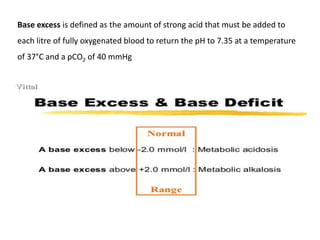
Base excess is defined as the amount of strong acid that must be added to
each litre of fully oxygenated blood to return the pH to 7.35 at a temperature
of 37°C and a pCO2 of 40 mmHg
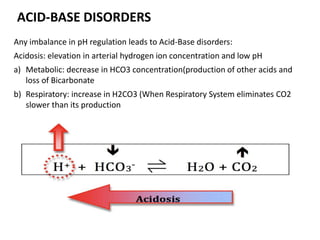
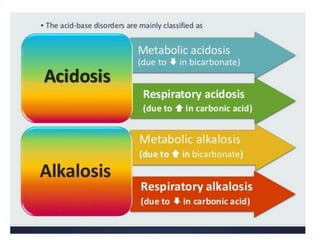
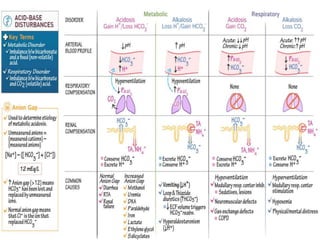
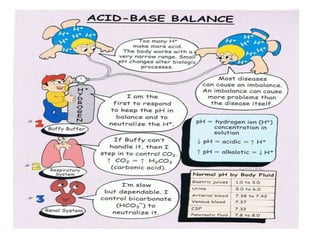
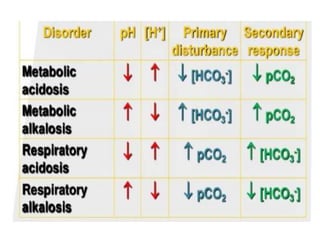
Any imbalance in pH regulation leads to Acid-Base disorders:
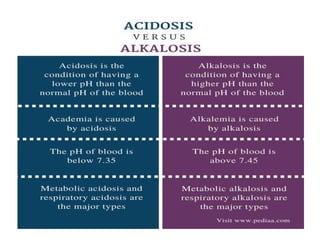
Acidosis: elevation in arterial hydrogen ion concentration and low pH
a) Metabolic: decrease in HCO3 concentration(production of other acids and
loss of Bicarbonate
b) Respiratory: increase in H2CO3 (When Respiratory System eliminates CO2
slower than its production
ACID-BASE DISORDERS
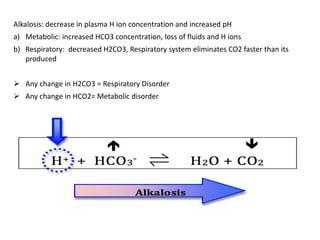
Alkalosis: decrease in plasma H ion concentration and increased pH
a) Metabolic: increased HCO3 concentration, loss of fluids and H ions
b) Respiratory: decreased H2CO3, Respiratory system eliminates CO2 faster than its
produced
 Any change in H2CO3 = Respiratory Disorder
 Any change in HCO2= Metabolic disorder
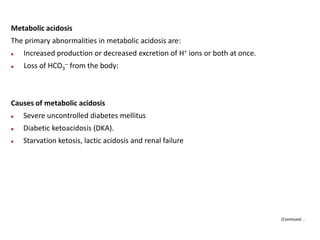
Metabolic acidosis
The primary abnormalities in metabolic acidosis are:
 Increased production or decreased excretion of H+ ions or both at once.
 Loss of HCO3
– from the body:
Causes of metabolic acidosis
 Severe uncontrolled diabetes mellitus
 Diabetic ketoacidosis (DKA).
 Starvation ketosis, lactic acidosis and renal failure
(Continued…
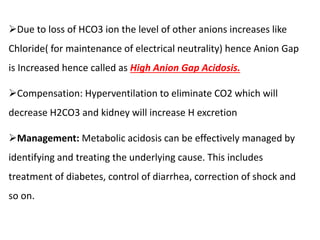
Due to loss of HCO3 ion the level of other anions increases like
Chloride( for maintenance of electrical neutrality) hence Anion Gap
is Increased hence called as High Anion Gap Acidosis.
Compensation: Hyperventilation to eliminate CO2 which will
decrease H2CO3 and kidney will increase H excretion
Management: Metabolic acidosis can be effectively managed by
identifying and treating the underlying cause. This includes
treatment of diabetes, control of diarrhea, correction of shock and
so on.
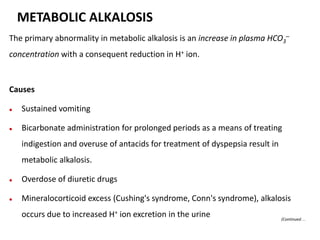
The primary abnormality in metabolic alkalosis is an increase in plasma HCO3
–
concentration with a consequent reduction in H+ ion.
Causes
 Sustained vomiting
 Bicarbonate administration for prolonged periods as a means of treating
indigestion and overuse of antacids for treatment of dyspepsia result in
metabolic alkalosis.
 Overdose of diuretic drugs
 Mineralocorticoid excess (Cushing's syndrome, Conn's syndrome), alkalosis
occurs due to increased H+ ion excretion in the urine
METABOLIC ALKALOSIS
(Continued…
Compensation:
 Renal mechanism for HCO3 excretion and H retention
 Hypoventilation by Respiratory centre
 Principles of management include correcting the underlying
cause, adequate intravenous fluid administration and
replacement of K+ correcting hypokalemia.
Metabolic Alkalosis is associated with Hypokalemia:
Hydrogen ion is conserved and potassium is excreted in
Vomitting.
Urine is acidic despite of alkalosis, becoz in vomiting Fluid loss
and hydrogen ion loss
Occurs that promotes Sodium Reabsorption which must allow
excretion of either H/K as a Positive ion, but K is already lost in
Vomitus hence only Hydrogen ion is left for excretion for
Absorption of Sodium
The primary abnormality in respiratory acidosis is retention of CO2
(Increased H2CO3) due to impaired alveolar ventilation resulting
in a rise in pCO2.
RESPIRATORY ACIDOSIS
(Continued…
Causes
• Airway obstruction and pulmonary disease – chronic obstructive
airway disease (emphysema, bronchitis and so on)
• severe asthma
• Bronchopneumonia
• respiratory distress syndrome (RDS)
• Depression of the respiratory centre by the administration of
overdose of anesthetics, sedatives and narcotics.
 Neuromuscular diseases
 Compensation
 Alkali Reserve is maintained by kidney, Hydrogen ion is
excreted
 Ventilation is increased which lowers pCO2 hence pH
is elevated.
(Continued…
Management involves correction of causative factors.
The general principle of treating respiratory acidosis is to
improve alveolar ventilation and lower the pCO2.
The primary abnormality in respiratory alkalosis is a
decrease in H2CO3 concentration and fall in pCO2
which reduces the ratio of carbonic acid to bicarbonate
resulting in acidosis.
RESPIRATORY ALKALOSIS
(Continued…
Causes
• Hyperventilation (More excretion of CO2 hence low
H2CO3) resulting from hysteria and anxiety states cause
respiratory alkalosis.
 Raised intracranial pressure and brain stem lesions cause
hyperventilation by stimulating the respiratory centre.
 Hypoxia occuring in high altitudes, severe anemic
conditions and pulmonary disease
Renal Mechanism comes to rescue
↓↓
HCO3 excretion is increased becoz HCO3 is normal while
H2CO3 is low, but as acid is low
Bicarbonate is excreted to maintain alkalosis.
Hypoventilation is also promoted but it can lead to
Hypoxia
Principles of management include correcting the
underlying causes, alleviating anxiety. In acute
cases, the patient is subjected to re-breathing into
a closed bag to allow CO2 levels to rise.
Acid-Base Disorder and K level
Acidosis: due to more available H ions retention of K ions
occurs hence Hyperkalemia.
Alkalosis: K ions are excreted due to no H ions hence
hypokalemia.
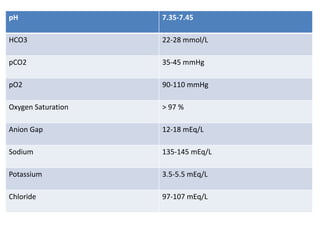
pH 7.35-7.45
HCO3 22-28 mmol/L
pCO2 35-45 mmHg
pO2 90-110 mmHg
Oxygen Saturation > 97 %
Anion Gap 12-18 mEq/L
Sodium 135-145 mEq/L
Potassium 3.5-5.5 mEq/L
Chloride 97-107 mEq/L
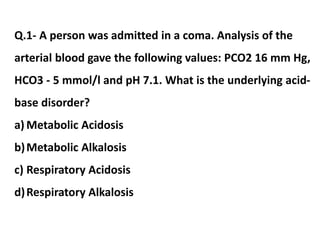
Q.1- A person was admitted in a coma. Analysis of the
arterial blood gave the following values: PCO2 16 mm Hg,
HCO3 - 5 mmol/l and pH 7.1. What is the underlying acid-
base disorder?
a) Metabolic Acidosis
b)Metabolic Alkalosis
c) Respiratory Acidosis
d)Respiratory Alkalosis
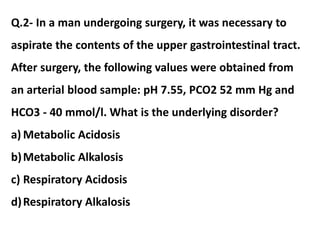
Q.2- In a man undergoing surgery, it was necessary to
aspirate the contents of the upper gastrointestinal tract.
After surgery, the following values were obtained from
an arterial blood sample: pH 7.55, PCO2 52 mm Hg and
HCO3 - 40 mmol/l. What is the underlying disorder?
a) Metabolic Acidosis
b)Metabolic Alkalosis
c) Respiratory Acidosis
d)Respiratory Alkalosis
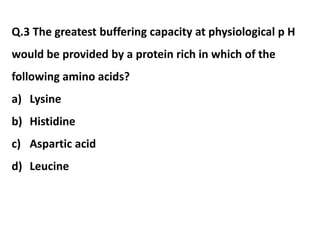
Q.3 The greatest buffering capacity at physiological p H
would be provided by a protein rich in which of the
following amino acids?
a) Lysine
b) Histidine
c) Aspartic acid
d) Leucine
The renal mechanism is faster than the respiratory
mechanism in terms of acid-base balance.
a) True
b) False

Acid base balance-2

  • 1.
    Acid Base Balance AkankshaDubey Assistant Professor Biochemistry Department
  • 3.
    ANION GAP ● Thedifference between the sums of the concentrations of the measured cations (Na+ and K+) and that of measured anions (Cl– and HCO3 –) is known as the anion gap. Thus, the anion gap represents unmeasured anions in the plasma. It can be calculated as follows: Anion gap (A–) = ([Na+] + [K+]) – ([Cl–] + [HCO3 –]) = (136 + 4)– (100 + 25) A– = 15 mEq/L (Continued…
  • 4.
    The anion gapin normal health is about 12–18 mEq/L. The alterations in the anion gap are useful in the clinical assessment of acid–base disorders.
  • 5.
    Base excess isdefined as the amount of strong acid that must be added to each litre of fully oxygenated blood to return the pH to 7.35 at a temperature of 37°C and a pCO2 of 40 mmHg
  • 6.
    Any imbalance inpH regulation leads to Acid-Base disorders: Acidosis: elevation in arterial hydrogen ion concentration and low pH a) Metabolic: decrease in HCO3 concentration(production of other acids and loss of Bicarbonate b) Respiratory: increase in H2CO3 (When Respiratory System eliminates CO2 slower than its production ACID-BASE DISORDERS
  • 7.
    Alkalosis: decrease inplasma H ion concentration and increased pH a) Metabolic: increased HCO3 concentration, loss of fluids and H ions b) Respiratory: decreased H2CO3, Respiratory system eliminates CO2 faster than its produced  Any change in H2CO3 = Respiratory Disorder  Any change in HCO2= Metabolic disorder
  • 10.
    Metabolic acidosis The primaryabnormalities in metabolic acidosis are:  Increased production or decreased excretion of H+ ions or both at once.  Loss of HCO3 – from the body: Causes of metabolic acidosis  Severe uncontrolled diabetes mellitus  Diabetic ketoacidosis (DKA).  Starvation ketosis, lactic acidosis and renal failure (Continued…
  • 11.
    Due to lossof HCO3 ion the level of other anions increases like Chloride( for maintenance of electrical neutrality) hence Anion Gap is Increased hence called as High Anion Gap Acidosis. Compensation: Hyperventilation to eliminate CO2 which will decrease H2CO3 and kidney will increase H excretion Management: Metabolic acidosis can be effectively managed by identifying and treating the underlying cause. This includes treatment of diabetes, control of diarrhea, correction of shock and so on.
  • 12.
    The primary abnormalityin metabolic alkalosis is an increase in plasma HCO3 – concentration with a consequent reduction in H+ ion. Causes  Sustained vomiting  Bicarbonate administration for prolonged periods as a means of treating indigestion and overuse of antacids for treatment of dyspepsia result in metabolic alkalosis.  Overdose of diuretic drugs  Mineralocorticoid excess (Cushing's syndrome, Conn's syndrome), alkalosis occurs due to increased H+ ion excretion in the urine METABOLIC ALKALOSIS (Continued…
  • 13.
    Compensation:  Renal mechanismfor HCO3 excretion and H retention  Hypoventilation by Respiratory centre  Principles of management include correcting the underlying cause, adequate intravenous fluid administration and replacement of K+ correcting hypokalemia.
  • 14.
    Metabolic Alkalosis isassociated with Hypokalemia: Hydrogen ion is conserved and potassium is excreted in Vomitting. Urine is acidic despite of alkalosis, becoz in vomiting Fluid loss and hydrogen ion loss Occurs that promotes Sodium Reabsorption which must allow excretion of either H/K as a Positive ion, but K is already lost in Vomitus hence only Hydrogen ion is left for excretion for Absorption of Sodium
  • 15.
    The primary abnormalityin respiratory acidosis is retention of CO2 (Increased H2CO3) due to impaired alveolar ventilation resulting in a rise in pCO2. RESPIRATORY ACIDOSIS (Continued…
  • 16.
    Causes • Airway obstructionand pulmonary disease – chronic obstructive airway disease (emphysema, bronchitis and so on) • severe asthma • Bronchopneumonia • respiratory distress syndrome (RDS) • Depression of the respiratory centre by the administration of overdose of anesthetics, sedatives and narcotics.  Neuromuscular diseases
  • 17.
     Compensation  AlkaliReserve is maintained by kidney, Hydrogen ion is excreted  Ventilation is increased which lowers pCO2 hence pH is elevated. (Continued…
  • 18.
    Management involves correctionof causative factors. The general principle of treating respiratory acidosis is to improve alveolar ventilation and lower the pCO2.
  • 19.
    The primary abnormalityin respiratory alkalosis is a decrease in H2CO3 concentration and fall in pCO2 which reduces the ratio of carbonic acid to bicarbonate resulting in acidosis. RESPIRATORY ALKALOSIS (Continued…
  • 20.
    Causes • Hyperventilation (Moreexcretion of CO2 hence low H2CO3) resulting from hysteria and anxiety states cause respiratory alkalosis.  Raised intracranial pressure and brain stem lesions cause hyperventilation by stimulating the respiratory centre.  Hypoxia occuring in high altitudes, severe anemic conditions and pulmonary disease
  • 21.
    Renal Mechanism comesto rescue ↓↓ HCO3 excretion is increased becoz HCO3 is normal while H2CO3 is low, but as acid is low Bicarbonate is excreted to maintain alkalosis. Hypoventilation is also promoted but it can lead to Hypoxia
  • 22.
    Principles of managementinclude correcting the underlying causes, alleviating anxiety. In acute cases, the patient is subjected to re-breathing into a closed bag to allow CO2 levels to rise.
  • 23.
    Acid-Base Disorder andK level Acidosis: due to more available H ions retention of K ions occurs hence Hyperkalemia. Alkalosis: K ions are excreted due to no H ions hence hypokalemia.
  • 28.
    pH 7.35-7.45 HCO3 22-28mmol/L pCO2 35-45 mmHg pO2 90-110 mmHg Oxygen Saturation > 97 % Anion Gap 12-18 mEq/L Sodium 135-145 mEq/L Potassium 3.5-5.5 mEq/L Chloride 97-107 mEq/L
  • 30.
    Q.1- A personwas admitted in a coma. Analysis of the arterial blood gave the following values: PCO2 16 mm Hg, HCO3 - 5 mmol/l and pH 7.1. What is the underlying acid- base disorder? a) Metabolic Acidosis b)Metabolic Alkalosis c) Respiratory Acidosis d)Respiratory Alkalosis
  • 31.
    Q.2- In aman undergoing surgery, it was necessary to aspirate the contents of the upper gastrointestinal tract. After surgery, the following values were obtained from an arterial blood sample: pH 7.55, PCO2 52 mm Hg and HCO3 - 40 mmol/l. What is the underlying disorder? a) Metabolic Acidosis b)Metabolic Alkalosis c) Respiratory Acidosis d)Respiratory Alkalosis
  • 32.
    Q.3 The greatestbuffering capacity at physiological p H would be provided by a protein rich in which of the following amino acids? a) Lysine b) Histidine c) Aspartic acid d) Leucine
  • 33.
    The renal mechanismis faster than the respiratory mechanism in terms of acid-base balance. a) True b) False