ACID-BASE
BALANCE
We shall discuss
• Introduction to acids and bases
• Henderson-Hasselbalch equation
• Buffers
• Mechanisms of acid-base balance
(Renal mechanism only briefly)
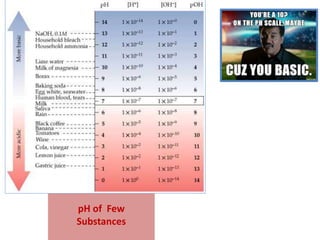
pH
• Potential/Power of hydrogen.
• Sørensen introduced the
concept of pH to measure the
acidity and alkalinity of the
solution.
• Is a negative logarithm of [H+].
pH = 1/ log[H+] = -log[H+]
• Ranges from 0 to 14.
• pH 7 is considered neutral.
Sørensen (1868-1939)
Danish Chemist
pH of Few
Substances
Acids and Bases
• Various concepts.
• Useful for us:
- Arrhenius acids and bases
- Bronsted-Lowry acids and bases
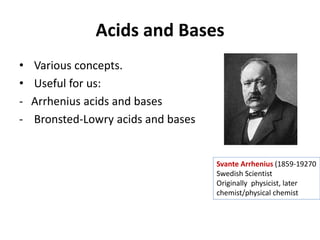
Svante Arrhenius (1859-19270
Swedish Scientist
Originally physicist, later
chemist/physical chemist
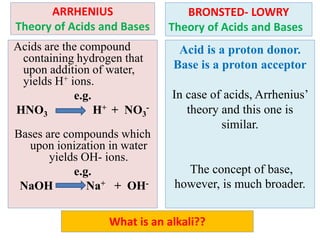
ARRHENIUS
Theory of Acids and Bases
Acids are the compound
containing hydrogen that
upon addition of water,
yields H+ ions.
e.g.
HNO3 H+ + NO3
-
Bases are compounds which
upon ionization in water
yields OH- ions.
e.g.
NaOH Na+ + OH-
BRONSTED- LOWRY
Theory of Acids and Bases
Acid is a proton donor.
Base is a proton acceptor
In case of acids, Arrhenius’
theory and this one is
similar.
The concept of base,
however, is much broader.
What is an alkali??
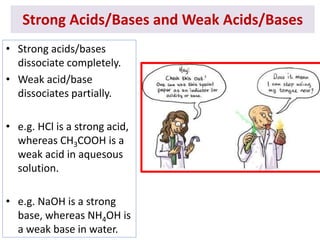
Strong Acids/Bases and Weak Acids/Bases
• Strong acids/bases
dissociate completely.
• Weak acid/base
dissociates partially.
• e.g. HCl is a strong acid,
whereas CH3COOH is a
weak acid in aquesous
solution.
• e.g. NaOH is a strong
base, whereas NH4OH is
a weak base in water.
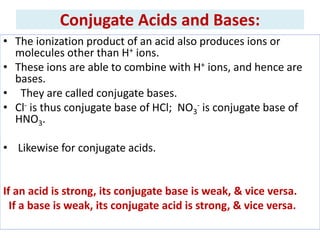
Conjugate Acids and Bases:
• The ionization product of an acid also produces ions or
molecules other than H+ ions.
• These ions are able to combine with H+ ions, and hence are
bases.
• They are called conjugate bases.
• Cl- is thus conjugate base of HCl; NO3
- is conjugate base of
HNO3.
• Likewise for conjugate acids.
If an acid is strong, its conjugate base is weak, & vice versa.
If a base is weak, its conjugate acid is strong, & vice versa.
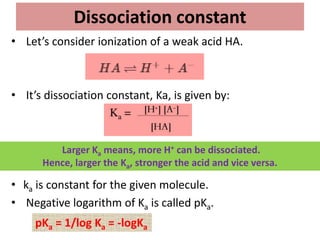
Dissociation constant
• Let’s consider ionization of a weak acid HA.
• It’s dissociation constant, Ka, is given by:
• ka is constant for the given molecule.
• Negative logarithm of Ka is called pKa.
Larger Ka means, more H+ can be dissociated.
Hence, larger the Ka, stronger the acid and vice versa.
pKa = 1/log Ka = -logKa
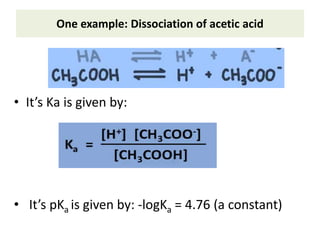
One example: Dissociation of acetic acid
• It’s Ka is given by:
• It’s pKa is given by: -logKa = 4.76 (a constant)
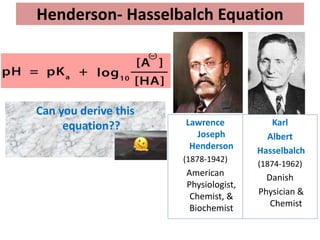
Can you derive this
equation??
Henderson- Hasselbalch Equation
Lawrence
Joseph
Henderson
(1878-1942)
American
Physiologist,
Chemist, &
Biochemist
Karl
Albert
Hasselbalch
(1874-1962)
Danish
Physician &
Chemist
Other forms of Henderson-Hasselbalch equation
e.g. If CH3COOH dissociates to
Ch3COO- and H+,
CH3COO- can combine with Na+ to
form a salt CH3COONa.
Then,
pH = pKa + log [salt] / [Acid]
Similarly,
pH = pKa+ log [salt]/[Base]
New (& more commonly used) definition of pKa
When dissociated [A-]= undissociated [HA],
then pH = pKa.
Therefore:
pKa is that pH where half of the acid (or
ions) exist in dissociated form.
Example of acetic acid again
• At pH 4.76, half of the CH3COOH is
dissociated to CH3COO- and H+
i.e. ([CH3COOH]= [CH3COO-]).
• Below 4.76 (i.e. pH < pKa), acetic
acid does not dissociate much,
- i.e. [CH3COOH]> [CH3COO-].
• Above 4.76 (i.e. pH > pKa), more
than half of acetic acid is
dissociated,
- i.e. [CH3COOH]< [CH3COO-].
pKa = 4.76
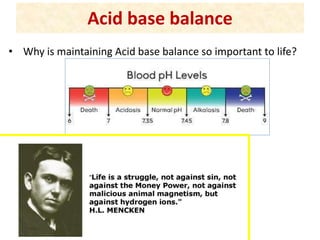
Acid base balance
• Why is maintaining Acid base balance so important to life?
• Cellular & other functions depend on the correct
structural & functional organizations of proteins &
other biomolecules.
• This is dependent on pH & temperature at which they
work optimally.
• Any variations might be fatal.
Importance of Acid-base balance CONT’D
For normal functioning of the body, pH of body
fluids has to be maintained within a narrow range.
Departures from the normal range can cause
serious consequences.
Production of acids is a physiological process
• Carbonic acids (aerobic
glycolysis), lactic acids
(anaerobic glycolysis), sulfuric
acid, phosphoric acid (sulfo-
and phospho-proteins), keto
acids etc are produced on
regular basis.
Volatile acids i.e.
Carbonic acid is produced
around 20,000 meq/day.
Fixed (non-volatile) acids
like lactic and sulfuric
acids are produced around
80 meq/day].
No wonder our urine is acidic (except for pure
vegan diet where production of alkali
overwhelms acid production)
• Since, acids and bases are constantly formed during
metabolic reactions (+ also enter from outside),
AND
• In some pathological conditions, there may be
abnormal losses of acids or bases from the body.
• So, there should be a system to address these issues.
To meet these challenges,
elaborate mechanisms have evolved
to maintain the acid-base balance of the body fluids
Importance of Acid-base balance CONT’D
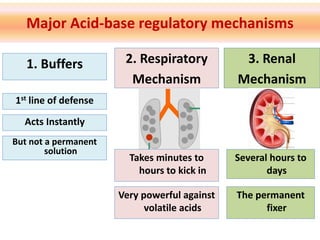
Major Acid-base regulatory mechanisms
1. Buffers 2. Respiratory
Mechanism
3. Renal
Mechanism
Acts Instantly
But not a permanent
solution
Takes minutes to
hours to kick in
Very powerful against
volatile acids
Several hours to
days
The permanent
fixer
1st line of defense
BUFFERS
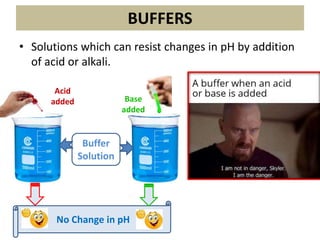
• Solutions which can resist changes in pH by addition
of acid or alkali.
Buffer
Solution
Acid
added Base
added
No Change in pH
Buffers are made up of
Weak acid + Conjugate base (salt of conjugate base)
Or, Vice versa.
For example:
Weak acid = CH3COOH
Conjugate base = CH3COO-
Salt of Conjugate base = CH3COONa
Therefore,
CH3COOH + CH3COO- or, CH3COOH + CH3COONa = BUFFER
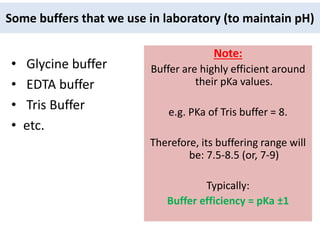
Some buffers that we use in laboratory (to maintain pH)
• Glycine buffer
• EDTA buffer
• Tris Buffer
• etc.
Note:
Buffer are highly efficient around
their pKa values.
e.g. PKa of Tris buffer = 8.
Therefore, its buffering range will
be: 7.5-8.5 (or, 7-9)
Typically:
Buffer efficiency = pKa ±1
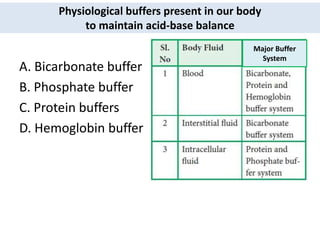
A. Bicarbonate buffer
B. Phosphate buffer
C. Protein buffers
D. Hemoglobin buffer
Physiological buffers present in our body
to maintain acid-base balance
Major Buffer
System
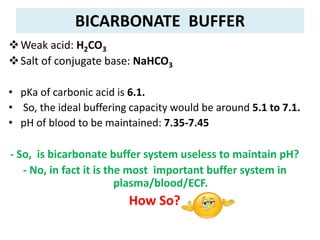
BICARBONATE BUFFER
Weak acid: H2CO3
Salt of conjugate base: NaHCO3
• pKa of carbonic acid is 6.1.
• So, the ideal buffering capacity would be around 5.1 to 7.1.
• pH of blood to be maintained: 7.35-7.45
- So, is bicarbonate buffer system useless to maintain pH?
- No, in fact it is the most important buffer system in
plasma/blood/ECF.
How So?
pKa is not the only factor that determines buffering
capacity...
• To illustrate this, let’s have a look at Henderson-
Hasselbalch equation again:
• In case of bicarbonate buffer:
or
Or, pH = 6.1 + log [NaHCO3]/[H2CO3]
pH = pKa + log [NaHCO3]
[H2CO3]
pH = pKa + log [HCO3
-]
[H2CO3]
• Normal, [NaHCO3] in plasma= 27meq/L
• Normal, [H2CO3] in plasma = 1.35 meq/L
• Therefore,[NaHCO3]/ [H2CO3]= 20.
• Let’s put this value in our earlier equation.
pH = 6.1 + log 20
= 6.1 + 1.3
= 7.4.
Bicarbonate buffer is
therefore
sometimes
referred to as:
Good physiological
buffer
([Salt]/[Acid] = 20),
AND
Weak/Poor chemical
buffer
(pKa = 6.1)
So, although the pKa value of bicarbonate
buffer is not favorable to maintain the pH
between 7.35 & 7.45, its high [Salt]/[Acid]
concentration (= 20), more than
compensates for it to act as a good ECF
buffer.
Practical convention
• It is difficult to measure [H2CO3] in laboratory.
• But pCO2 can be easilymeasured.
• And it has been calculated that:
[H2CO3]= 0.03 X pCO2
• Therefore, we can write the Henderson-Hasselbalch
equation for bicarbonate buffer as:
We shall use this latter equation frequently.
pH = pKa + [HCO3]/0.03 X pCO2
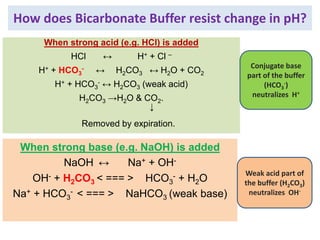
How does Bicarbonate Buffer resist change in pH?
When strong acid (e.g. HCl) is added
HCl ↔ H+ + Cl –
H+ + HCO3
- ↔ H2CO3 ↔ H2O + CO2
H+ + HCO3
- ↔ H2CO3 (weak acid)
H2CO3 →H2O & CO2.
↓
Removed by expiration.
When strong base (e.g. NaOH) is added
NaOH ↔ Na+ + OH-
OH- + H2CO3 < === > HCO3
- + H2O
Na+ + HCO3
- < === > NaHCO3 (weak base)
Conjugate base
part of the buffer
(HCO3
-)
neutralizes H+
Weak acid part of
the buffer (H2CO3)
neutralizes OH-
NEXT
• Phosphate & other buffers
• Respiratory mechanism
• Renal Mechanism (Brief)
PHOSPHATE BUFFER
 Weak Acid: NaH2Po4
 Salt of Conjugate base: Na2HPO4
• Buffer action mainly important intra-cellular.
• Also plays important role in buffering renal tubular fluid.
 pKa = 6.8
 [Salt]/[Acid] = 4:1
Buffering Efficiency in ECF
pKa = 6.8; [Salt]/[Acid] = 4:1
Therefore,
pH = pKa + log [Salt]/[Acid]
= 6.8 + log 4
= 6.8 + 0.6
= 7.4
So, it is still an efficient buffer
despite low [salt]:[Acid]
(compared to bicarbonate
buffer)
Phosphate Buffer is
sometimes called as:
Good Chemical Buffer
(pKa = 6.8),
AND
Poor Physiological Buffer
([Salt]:[Acid] = 4)
Point to note:
In fact, Phosphate buffer is efficient across even wider pH range
• Phosphate buffer has 3 PKa values, as it has 3
dissociable H+ ions.
One of these pKa
value (6.8) and
[Salt]:[Acid] is
suitable for it to
act as biological
buffer
H₃PO₄ H⁺ + H₂PO₄¯ pKₐ = 1.96
H₂PO₄¯ H⁺ + HPO₄¯ ¯ pKₐ = 6.8
HPO₄¯ ¯ H⁺ + PO ₄° pKₐ = 12.4
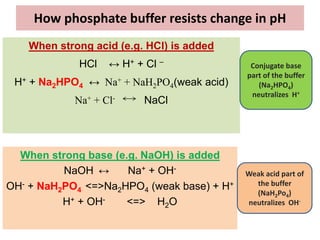
How phosphate buffer resists change in pH
When strong acid (e.g. HCl) is added
HCl ↔ H+ + Cl –
H+ + Na2HPO4 ↔ Na+ + NaH2PO4(weak acid)
Na+ + Cl- NaCl
When strong base (e.g. NaOH) is added
NaOH ↔ Na+ + OH-
OH- + NaH2PO4 <=>Na2HPO4 (weak base) + H+
H+ + OH- <=> H2O
Conjugate base
part of the buffer
(Na2HPO4)
neutralizes H+
Weak acid part of
the buffer
(NaH2Po4)
neutralizes OH-
Assignment
Write short note on Alkali Reserve
Protein Buffers
 Proteins are among the most plentiful buffers in the
body because of their high concentrations, especially
within the cells.
Approximately 60-70% of the total chemical buffering
of the body fluids is inside the cells, and most of this
results from the intracellular proteins.
[In addition to the high concentration of proteins in the
cells, another factor that contributes to their buffering
power is the fact that the pKa of many of these protein
systems are fairly close to 7.4]
Proteins act as buffers because of their
amphoteric nature.
Buffering capacity of protein depends on the
pKₐ value of ionizable side chains.
The amino acid residues having pKₐ close to
7.4 are the most effective in buffering.
The most effective group is histidine
imidazole group.
Proteins especially albumin, account for
about 95% of the non-bicarbonate buffer
value of plasma.
[Each albumin contains 16 histidine residues
which make it an effective buffer]
Assignment:
Name some
important
intracellular
protein
buffers
Hemoglobin Buffer
• Hemoglobin is responsible for 60%
of the buffering capacity of blood.
• The large number of histidine
(36) residues in Hb make it an
effective buffer.
Role of Hb will be discussed in
detail in conjunction with
respiratory mechanisms.
RESPIRATORY MECHANISM
• Responds within minutes.
• Rapid and powerful, especially
against volatile acids.
• Blood pH is adjusted by
changing the rate & depth of
breathing.
• Doesn’t fix non-volatile acids
like lactic acid.
Something about respiratory centre
• Located in medulla oblongata & pons
• Increased pCO₂ is the most important stimulant of the
respiratory centre.
- Increases the rate & depth of the respiration.
- This increases the elimination of CO₂.
• A fall in pH also stimulates the respiratory centre leading to
hyperventillation & increased CO₂ elimination.
• Changes in pO₂ affect the respiratory centre to a lesser extent
(except marked anorexia e.g. at high altitude resulting in
hyperventillation).
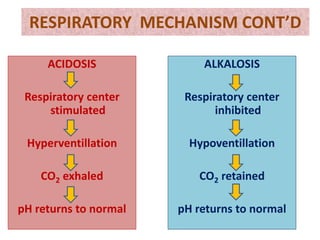
ACIDOSIS
Respiratory center
stimulated
Hyperventillation
CO2 exhaled
pH returns to normal
RESPIRATORY MECHANISM CONT’D
ALKALOSIS
Respiratory center
inhibited
Hypoventillation
CO2 retained
pH returns to normal
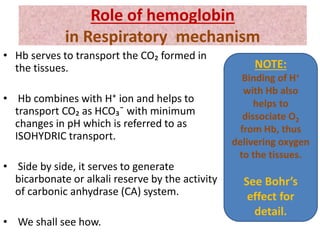
• Hb serves to transport the CO₂ formed in
the tissues.
• Hb combines with H⁺ ion and helps to
transport CO₂ as HCO₃¯ with minimum
changes in pH which is referred to as
ISOHYDRIC transport.
• Side by side, it serves to generate
bicarbonate or alkali reserve by the activity
of carbonic anhydrase (CA) system.
• We shall see how.
Role of hemoglobin
in Respiratory mechanism
NOTE:
Binding of H+
with Hb also
helps to
dissociate O2
from Hb, thus
delivering oxygen
to the tissues.
See Bohr’s
effect for
detail.
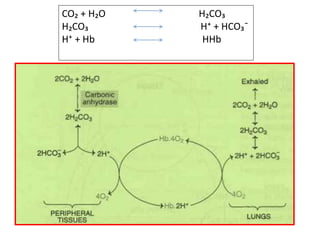
CO₂ + H₂O H₂CO₃
H₂CO₃ H⁺ + HCO₃¯
H⁺ + Hb HHb
Chloride Shift
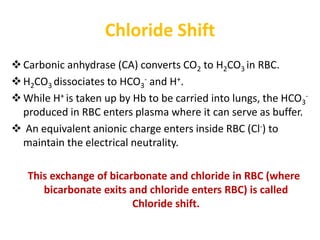
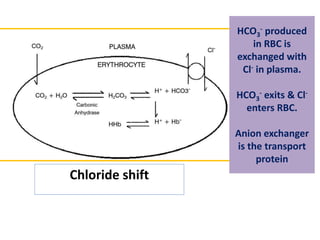
Carbonic anhydrase (CA) converts CO2 to H2CO3 in RBC.
H2CO3 dissociates to HCO3
- and H+.
While H+ is taken up by Hb to be carried into lungs, the HCO3
-
produced in RBC enters plasma where it can serve as buffer.
 An equivalent anionic charge enters inside RBC (Cl-) to
maintain the electrical neutrality.
This exchange of bicarbonate and chloride in RBC (where
bicarbonate exits and chloride enters RBC) is called
Chloride shift.
HCO3
- produced
in RBC is
exchanged with
Cl- in plasma.
HCO3
- exits & Cl-
enters RBC.
Anion exchanger
is the transport
protein
Chloride shift
Reverse Chloride shift
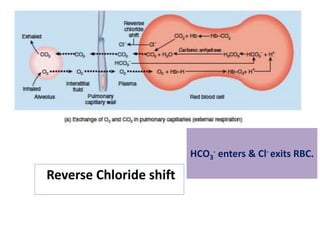
 The blood reaches the lungs.
 Here, bicarbonate enters RBC in exchange for
chloride. (Reverse Chloride shift)
 H+ dissociates from Hb (due to high pO2)
Bicarbonate (HCO3-) combines with H+ to form H2CO3.
 Carbonic anhydrase (CA) converts it to H2O and CO2.
CO2 is exhaled.
Reverse Chloride shift
HCO3
- enters & Cl- exits RBC.
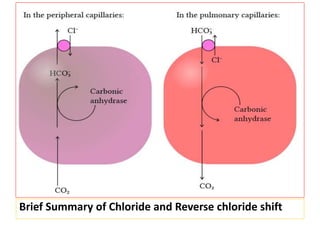
Brief Summary of Chloride and Reverse chloride shift
Renal Mechanism of acid base balance
• Can eliminate large amounts of acid.
• Can also excrete base.
• Can conserve and produce bicarbonate ions.
• Most effective regulator of pH.
If kidneys fail, pH balance fails
Details during Renal system
4 major ways by which the renal regulation operates :
A. Excretion of H⁺ (& production of bicarbonates)
B. Reabsorption of bicarbonate
C. Acidification of monohydrogen phosphate [May also
be called: Excretion of titrable acid]
D. Secretion of ammonia (NH₄⁺ ions)
8
ACID BASE BALANCE UG latest.pptx

ACID BASE BALANCE UG latest.pptx

  • 1.
  • 2.
    We shall discuss •Introduction to acids and bases • Henderson-Hasselbalch equation • Buffers • Mechanisms of acid-base balance (Renal mechanism only briefly)
  • 3.
    pH • Potential/Power ofhydrogen. • Sørensen introduced the concept of pH to measure the acidity and alkalinity of the solution. • Is a negative logarithm of [H+]. pH = 1/ log[H+] = -log[H+] • Ranges from 0 to 14. • pH 7 is considered neutral. Sørensen (1868-1939) Danish Chemist
  • 4.
  • 5.
    Acids and Bases •Various concepts. • Useful for us: - Arrhenius acids and bases - Bronsted-Lowry acids and bases Svante Arrhenius (1859-19270 Swedish Scientist Originally physicist, later chemist/physical chemist
  • 6.
    ARRHENIUS Theory of Acidsand Bases Acids are the compound containing hydrogen that upon addition of water, yields H+ ions. e.g. HNO3 H+ + NO3 - Bases are compounds which upon ionization in water yields OH- ions. e.g. NaOH Na+ + OH- BRONSTED- LOWRY Theory of Acids and Bases Acid is a proton donor. Base is a proton acceptor In case of acids, Arrhenius’ theory and this one is similar. The concept of base, however, is much broader. What is an alkali??
  • 7.
    Strong Acids/Bases andWeak Acids/Bases • Strong acids/bases dissociate completely. • Weak acid/base dissociates partially. • e.g. HCl is a strong acid, whereas CH3COOH is a weak acid in aquesous solution. • e.g. NaOH is a strong base, whereas NH4OH is a weak base in water.
  • 8.
    Conjugate Acids andBases: • The ionization product of an acid also produces ions or molecules other than H+ ions. • These ions are able to combine with H+ ions, and hence are bases. • They are called conjugate bases. • Cl- is thus conjugate base of HCl; NO3 - is conjugate base of HNO3. • Likewise for conjugate acids. If an acid is strong, its conjugate base is weak, & vice versa. If a base is weak, its conjugate acid is strong, & vice versa.
  • 9.
    Dissociation constant • Let’sconsider ionization of a weak acid HA. • It’s dissociation constant, Ka, is given by: • ka is constant for the given molecule. • Negative logarithm of Ka is called pKa. Larger Ka means, more H+ can be dissociated. Hence, larger the Ka, stronger the acid and vice versa. pKa = 1/log Ka = -logKa
  • 10.
    One example: Dissociationof acetic acid • It’s Ka is given by: • It’s pKa is given by: -logKa = 4.76 (a constant)
  • 11.
    Can you derivethis equation?? Henderson- Hasselbalch Equation Lawrence Joseph Henderson (1878-1942) American Physiologist, Chemist, & Biochemist Karl Albert Hasselbalch (1874-1962) Danish Physician & Chemist
  • 12.
    Other forms ofHenderson-Hasselbalch equation e.g. If CH3COOH dissociates to Ch3COO- and H+, CH3COO- can combine with Na+ to form a salt CH3COONa. Then, pH = pKa + log [salt] / [Acid] Similarly, pH = pKa+ log [salt]/[Base]
  • 13.
    New (& morecommonly used) definition of pKa When dissociated [A-]= undissociated [HA], then pH = pKa. Therefore: pKa is that pH where half of the acid (or ions) exist in dissociated form.
  • 14.
    Example of aceticacid again • At pH 4.76, half of the CH3COOH is dissociated to CH3COO- and H+ i.e. ([CH3COOH]= [CH3COO-]). • Below 4.76 (i.e. pH < pKa), acetic acid does not dissociate much, - i.e. [CH3COOH]> [CH3COO-]. • Above 4.76 (i.e. pH > pKa), more than half of acetic acid is dissociated, - i.e. [CH3COOH]< [CH3COO-]. pKa = 4.76
  • 15.
    Acid base balance •Why is maintaining Acid base balance so important to life?
  • 16.
    • Cellular &other functions depend on the correct structural & functional organizations of proteins & other biomolecules. • This is dependent on pH & temperature at which they work optimally. • Any variations might be fatal. Importance of Acid-base balance CONT’D For normal functioning of the body, pH of body fluids has to be maintained within a narrow range. Departures from the normal range can cause serious consequences.
  • 17.
    Production of acidsis a physiological process • Carbonic acids (aerobic glycolysis), lactic acids (anaerobic glycolysis), sulfuric acid, phosphoric acid (sulfo- and phospho-proteins), keto acids etc are produced on regular basis. Volatile acids i.e. Carbonic acid is produced around 20,000 meq/day. Fixed (non-volatile) acids like lactic and sulfuric acids are produced around 80 meq/day]. No wonder our urine is acidic (except for pure vegan diet where production of alkali overwhelms acid production)
  • 18.
    • Since, acidsand bases are constantly formed during metabolic reactions (+ also enter from outside), AND • In some pathological conditions, there may be abnormal losses of acids or bases from the body. • So, there should be a system to address these issues. To meet these challenges, elaborate mechanisms have evolved to maintain the acid-base balance of the body fluids Importance of Acid-base balance CONT’D
  • 19.
    Major Acid-base regulatorymechanisms 1. Buffers 2. Respiratory Mechanism 3. Renal Mechanism Acts Instantly But not a permanent solution Takes minutes to hours to kick in Very powerful against volatile acids Several hours to days The permanent fixer 1st line of defense
  • 20.
    BUFFERS • Solutions whichcan resist changes in pH by addition of acid or alkali. Buffer Solution Acid added Base added No Change in pH
  • 21.
    Buffers are madeup of Weak acid + Conjugate base (salt of conjugate base) Or, Vice versa. For example: Weak acid = CH3COOH Conjugate base = CH3COO- Salt of Conjugate base = CH3COONa Therefore, CH3COOH + CH3COO- or, CH3COOH + CH3COONa = BUFFER
  • 22.
    Some buffers thatwe use in laboratory (to maintain pH) • Glycine buffer • EDTA buffer • Tris Buffer • etc. Note: Buffer are highly efficient around their pKa values. e.g. PKa of Tris buffer = 8. Therefore, its buffering range will be: 7.5-8.5 (or, 7-9) Typically: Buffer efficiency = pKa ±1
  • 23.
    A. Bicarbonate buffer B.Phosphate buffer C. Protein buffers D. Hemoglobin buffer Physiological buffers present in our body to maintain acid-base balance Major Buffer System
  • 24.
    BICARBONATE BUFFER Weak acid:H2CO3 Salt of conjugate base: NaHCO3 • pKa of carbonic acid is 6.1. • So, the ideal buffering capacity would be around 5.1 to 7.1. • pH of blood to be maintained: 7.35-7.45 - So, is bicarbonate buffer system useless to maintain pH? - No, in fact it is the most important buffer system in plasma/blood/ECF. How So?
  • 25.
    pKa is notthe only factor that determines buffering capacity... • To illustrate this, let’s have a look at Henderson- Hasselbalch equation again: • In case of bicarbonate buffer: or Or, pH = 6.1 + log [NaHCO3]/[H2CO3] pH = pKa + log [NaHCO3] [H2CO3] pH = pKa + log [HCO3 -] [H2CO3]
  • 26.
    • Normal, [NaHCO3]in plasma= 27meq/L • Normal, [H2CO3] in plasma = 1.35 meq/L • Therefore,[NaHCO3]/ [H2CO3]= 20. • Let’s put this value in our earlier equation. pH = 6.1 + log 20 = 6.1 + 1.3 = 7.4. Bicarbonate buffer is therefore sometimes referred to as: Good physiological buffer ([Salt]/[Acid] = 20), AND Weak/Poor chemical buffer (pKa = 6.1) So, although the pKa value of bicarbonate buffer is not favorable to maintain the pH between 7.35 & 7.45, its high [Salt]/[Acid] concentration (= 20), more than compensates for it to act as a good ECF buffer.
  • 27.
    Practical convention • Itis difficult to measure [H2CO3] in laboratory. • But pCO2 can be easilymeasured. • And it has been calculated that: [H2CO3]= 0.03 X pCO2 • Therefore, we can write the Henderson-Hasselbalch equation for bicarbonate buffer as: We shall use this latter equation frequently. pH = pKa + [HCO3]/0.03 X pCO2
  • 28.
    How does BicarbonateBuffer resist change in pH? When strong acid (e.g. HCl) is added HCl ↔ H+ + Cl – H+ + HCO3 - ↔ H2CO3 ↔ H2O + CO2 H+ + HCO3 - ↔ H2CO3 (weak acid) H2CO3 →H2O & CO2. ↓ Removed by expiration. When strong base (e.g. NaOH) is added NaOH ↔ Na+ + OH- OH- + H2CO3 < === > HCO3 - + H2O Na+ + HCO3 - < === > NaHCO3 (weak base) Conjugate base part of the buffer (HCO3 -) neutralizes H+ Weak acid part of the buffer (H2CO3) neutralizes OH-
  • 29.
    NEXT • Phosphate &other buffers • Respiratory mechanism • Renal Mechanism (Brief)
  • 30.
    PHOSPHATE BUFFER  WeakAcid: NaH2Po4  Salt of Conjugate base: Na2HPO4 • Buffer action mainly important intra-cellular. • Also plays important role in buffering renal tubular fluid.  pKa = 6.8  [Salt]/[Acid] = 4:1
  • 31.
    Buffering Efficiency inECF pKa = 6.8; [Salt]/[Acid] = 4:1 Therefore, pH = pKa + log [Salt]/[Acid] = 6.8 + log 4 = 6.8 + 0.6 = 7.4 So, it is still an efficient buffer despite low [salt]:[Acid] (compared to bicarbonate buffer) Phosphate Buffer is sometimes called as: Good Chemical Buffer (pKa = 6.8), AND Poor Physiological Buffer ([Salt]:[Acid] = 4)
  • 32.
    Point to note: Infact, Phosphate buffer is efficient across even wider pH range • Phosphate buffer has 3 PKa values, as it has 3 dissociable H+ ions. One of these pKa value (6.8) and [Salt]:[Acid] is suitable for it to act as biological buffer H₃PO₄ H⁺ + H₂PO₄¯ pKₐ = 1.96 H₂PO₄¯ H⁺ + HPO₄¯ ¯ pKₐ = 6.8 HPO₄¯ ¯ H⁺ + PO ₄° pKₐ = 12.4
  • 33.
    How phosphate bufferresists change in pH When strong acid (e.g. HCl) is added HCl ↔ H+ + Cl – H+ + Na2HPO4 ↔ Na+ + NaH2PO4(weak acid) Na+ + Cl- NaCl When strong base (e.g. NaOH) is added NaOH ↔ Na+ + OH- OH- + NaH2PO4 <=>Na2HPO4 (weak base) + H+ H+ + OH- <=> H2O Conjugate base part of the buffer (Na2HPO4) neutralizes H+ Weak acid part of the buffer (NaH2Po4) neutralizes OH-
  • 34.
    Assignment Write short noteon Alkali Reserve
  • 35.
    Protein Buffers  Proteinsare among the most plentiful buffers in the body because of their high concentrations, especially within the cells. Approximately 60-70% of the total chemical buffering of the body fluids is inside the cells, and most of this results from the intracellular proteins. [In addition to the high concentration of proteins in the cells, another factor that contributes to their buffering power is the fact that the pKa of many of these protein systems are fairly close to 7.4]
  • 36.
    Proteins act asbuffers because of their amphoteric nature. Buffering capacity of protein depends on the pKₐ value of ionizable side chains. The amino acid residues having pKₐ close to 7.4 are the most effective in buffering. The most effective group is histidine imidazole group. Proteins especially albumin, account for about 95% of the non-bicarbonate buffer value of plasma. [Each albumin contains 16 histidine residues which make it an effective buffer] Assignment: Name some important intracellular protein buffers
  • 37.
    Hemoglobin Buffer • Hemoglobinis responsible for 60% of the buffering capacity of blood. • The large number of histidine (36) residues in Hb make it an effective buffer. Role of Hb will be discussed in detail in conjunction with respiratory mechanisms.
  • 38.
    RESPIRATORY MECHANISM • Respondswithin minutes. • Rapid and powerful, especially against volatile acids. • Blood pH is adjusted by changing the rate & depth of breathing. • Doesn’t fix non-volatile acids like lactic acid.
  • 39.
    Something about respiratorycentre • Located in medulla oblongata & pons • Increased pCO₂ is the most important stimulant of the respiratory centre. - Increases the rate & depth of the respiration. - This increases the elimination of CO₂. • A fall in pH also stimulates the respiratory centre leading to hyperventillation & increased CO₂ elimination. • Changes in pO₂ affect the respiratory centre to a lesser extent (except marked anorexia e.g. at high altitude resulting in hyperventillation).
  • 40.
    ACIDOSIS Respiratory center stimulated Hyperventillation CO2 exhaled pHreturns to normal RESPIRATORY MECHANISM CONT’D ALKALOSIS Respiratory center inhibited Hypoventillation CO2 retained pH returns to normal
  • 41.
    • Hb servesto transport the CO₂ formed in the tissues. • Hb combines with H⁺ ion and helps to transport CO₂ as HCO₃¯ with minimum changes in pH which is referred to as ISOHYDRIC transport. • Side by side, it serves to generate bicarbonate or alkali reserve by the activity of carbonic anhydrase (CA) system. • We shall see how. Role of hemoglobin in Respiratory mechanism NOTE: Binding of H+ with Hb also helps to dissociate O2 from Hb, thus delivering oxygen to the tissues. See Bohr’s effect for detail.
  • 42.
    CO₂ + H₂OH₂CO₃ H₂CO₃ H⁺ + HCO₃¯ H⁺ + Hb HHb
  • 43.
    Chloride Shift Carbonic anhydrase(CA) converts CO2 to H2CO3 in RBC. H2CO3 dissociates to HCO3 - and H+. While H+ is taken up by Hb to be carried into lungs, the HCO3 - produced in RBC enters plasma where it can serve as buffer.  An equivalent anionic charge enters inside RBC (Cl-) to maintain the electrical neutrality. This exchange of bicarbonate and chloride in RBC (where bicarbonate exits and chloride enters RBC) is called Chloride shift.
  • 44.
    HCO3 - produced in RBCis exchanged with Cl- in plasma. HCO3 - exits & Cl- enters RBC. Anion exchanger is the transport protein Chloride shift
  • 45.
    Reverse Chloride shift The blood reaches the lungs.  Here, bicarbonate enters RBC in exchange for chloride. (Reverse Chloride shift)  H+ dissociates from Hb (due to high pO2) Bicarbonate (HCO3-) combines with H+ to form H2CO3.  Carbonic anhydrase (CA) converts it to H2O and CO2. CO2 is exhaled.
  • 46.
    Reverse Chloride shift HCO3 -enters & Cl- exits RBC.
  • 47.
    Brief Summary ofChloride and Reverse chloride shift
  • 48.
    Renal Mechanism ofacid base balance • Can eliminate large amounts of acid. • Can also excrete base. • Can conserve and produce bicarbonate ions. • Most effective regulator of pH. If kidneys fail, pH balance fails
  • 49.
    Details during Renalsystem 4 major ways by which the renal regulation operates : A. Excretion of H⁺ (& production of bicarbonates) B. Reabsorption of bicarbonate C. Acidification of monohydrogen phosphate [May also be called: Excretion of titrable acid] D. Secretion of ammonia (NH₄⁺ ions) 8