ELISA
Enzyme Linked Immunosorbent Assay
ELISA is used for:
Quantitative Estimation of
Hormones
Amino Acids
Tumour Markers
Growth Factors
Other Biochemical analytes which are present in
small amount in biological fluids
Qualitative Estimation of:
Bacterial/Viral Antigens
Antibodies against microbes
Any other Antigen or Antibodies present
in biological fluid in small amount.
Advantages:
Very small amount(ng to pg) of Antigen or
Antibody can be detected in biological fluid
sample.
Highly economical, sensitive and time effective
method (2-3 hours)
Non-isotopic immunoassay in which labelled
enzyme is used.
More sensitive than RIA with no risk of Radiation
Hazard
Basic Principle:
ELISA is based on Immunochemical principle
of Antigen-Antibody reaction. The specific
interaction between Ag-Ab is used to
detect/quantitate the specific component
of biological fluid, using enzyme labelled
antibodies.
• The substrate which is suitable for enzyme is
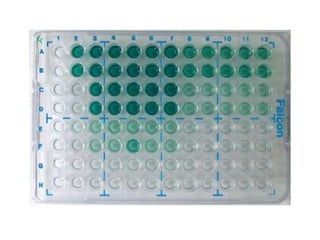
added, coupled with coloured reagent
(Chromogen) which is colourless in
beginning but become coloured during
course of reaction. The intensity of the colour
formed predicts the concentration of
Antigen-Antibody in given biological sample.
Types of ELISA
1. Direct ELISA
2. Indirect ELISA
3. Immunometric/Sandwich ELISA
4. Competitive ELISA
Common terms used in ELISA:
• Enzyme Conjugate: indicator antibodies
For example:
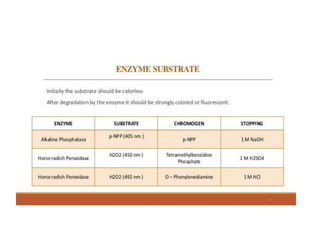
HRP: Horse-Radish Peroxidase
ALP: Alkaline phosphatase
Substrate/Chromogen: indicator in Enzyme
and substrate reaction
Example of substrate:
pNPP: paraNitro phenyl phosphate
Hydrogen peroxide : 0.003-0.015%
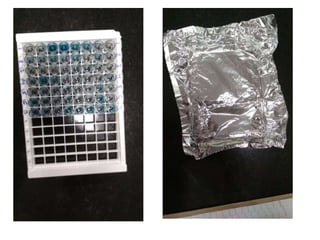
Chromogen: light sensitive hence incubation
always done in dark
For example:
TMB: Tetramethyl benzidine
ABTS: Azino-benthiazoline sulphonic acid
OPD: Ortho-phenylenediamine
dihydrochloride
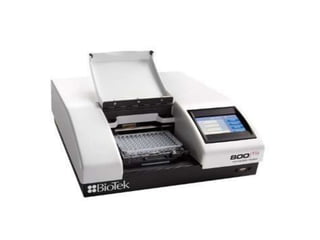
Most common wavelength studied is
450 nm
Other can be 490 nm /405 nm
depends on the kit manufacturer.
Direct ELISA:
This was the ELISA originally developed
by Perlmann and Engvall. Most simplest form of
ELISA.
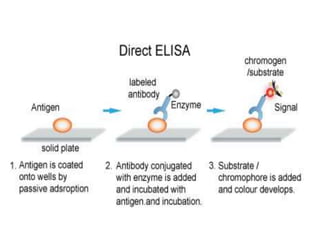
The surface of the microtitre plate is coated
directly with the sample. An enzyme-tagged
antibody (Monoclonal Ab’s) is used for its
detection.
Incubation is done for reaction b/w Ag-Ab which
is followed by washing to remove unbound
antibodies from the medium.
The appropriate substrate is then added to the
medium to develop colour directly proportional
to the amount of antigen present in the sample.
Direct ELISA is suitable for determining the
amount of high molecular weight antigens.
Due to Few steps it is faster than other types of
ELISA.
Indirect ELISA (ELISA for Antibody Detection)
This is useful to detect small quantities of
Antibodies in the patient’s serum
Indirect ELISA is deemed to be highly sensitive
and more flexible than direct ELISA.
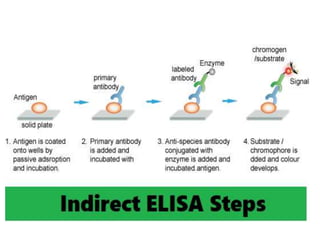
Indirect ELISA is a two-step binding process
involving the use of a primary antibody and a
labelled secondary antibody
In this method, the primary antibody is
incubated with the antigen-coated wells. Next, a
labelled secondary antibody that recognizes the
primary antibody is added.
This secondary antibody is often a polyclonal
anti-species antibody. A wide variety of labelled
secondary antibodies are readily available.
• This method is commonly utilized to
diagnose infection by bacteria, virus, or a
parasite s/a HIV Antibodies
Steps:
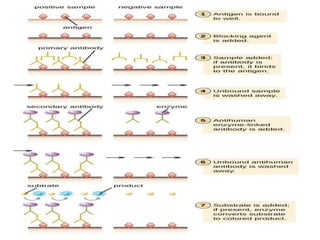
Antigen from HIV is coated in the well of microtitre
plate.
Then patients serum is added and incubated. (if it
contains antibodies for HIV it will get bound to
Antigen and fixed). This antibody for time being can
be called as Ab-1
Washing is done to remove unbound and excess Ab’s
Now second Ab (Ab-2 which is antibody
against antibody of humans) which is
conugated with HRP is added. Substrate and
Chromogen (Hydrogen peroxide-Diamino
benzidine) also added to wells
Incubation and washing done
Development of colour( brown) indicated
presence of Antibodies in patients serum.
Intensity of colour formation is directly
proportional to concentration Antibodies
present.
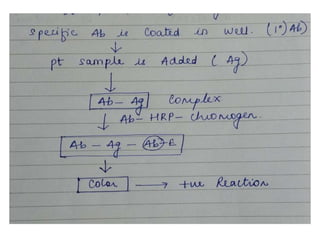
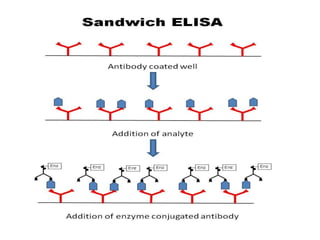
Immunometric/ Sandwich ELISA
Most commonly used ELISA for Antigen
Detection
Two Antibodies are used:
a) One which is coated in well (Ab to target
Analyte)
b) Second conjugated with Enzyme-chromogen
system
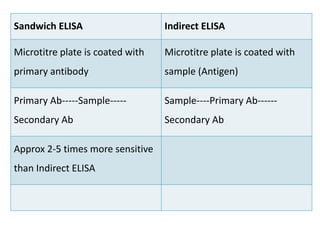
Sandwich ELISA Indirect ELISA
Microtitre plate is coated with
primary antibody
Microtitre plate is coated with
sample (Antigen)
Primary Ab-----Sample-----
Secondary Ab
Sample----Primary Ab------
Secondary Ab
Approx 2-5 times more sensitive
than Indirect ELISA
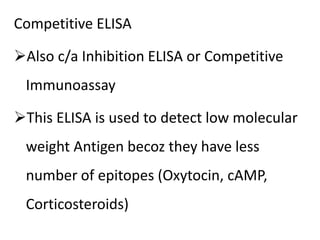
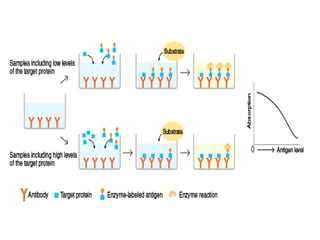
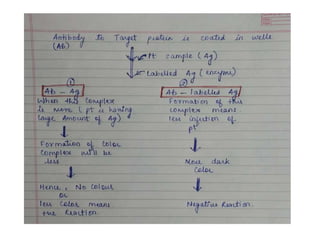
Competitive ELISA
Also c/a Inhibition ELISA or Competitive
Immunoassay
This ELISA is used to detect low molecular
weight Antigen becoz they have less
number of epitopes (Oxytocin, cAMP,
Corticosteroids)
Proteins bound to wells via:
a) Hydrophobic interaction : large molecules
b) Covalent Interactions : small molecules
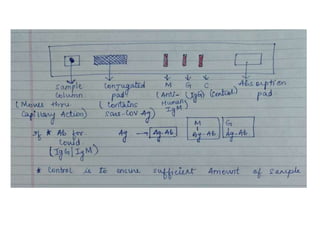
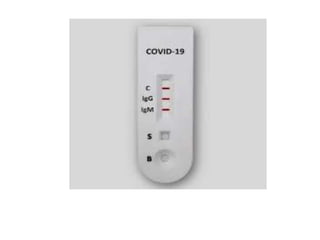
Rapid Covid-19 Antibody Detection
This test detects patient generated Antibodies
against SARS-Cov-2 Virus that causes COVID-19
It detects IgM (First Ab to appear in Covid
Infection)and IgG ( Second to IgM)
This is basically a Lateral flow Immunoassay which
detect presence of Analyte in patient sample
Qualitatively.
Immunoassay and Chromatography together
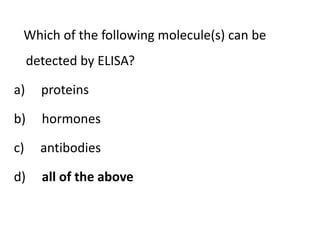
Which of the following molecule(s) can be
detected by ELISA?
a) proteins
b) hormones
c) antibodies
d) all of the above
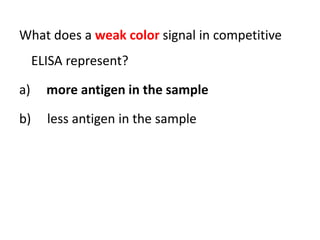
What does a weak color signal in competitive
ELISA represent?
a) more antigen in the sample
b) less antigen in the sample
What is a major advantage of ELISA in comparison
to other biological quantification techniques?
a) detection of a molecule at a low
concentration
b) inexpensive
c) low specificity
d) easily available
ELISA is designed for detecting and quantifying
substances such as peptides, proteins,
antibodies and hormones.
a)True
b)False

Elisa final

  • 3.
    ELISA Enzyme Linked ImmunosorbentAssay ELISA is used for: Quantitative Estimation of Hormones Amino Acids Tumour Markers Growth Factors Other Biochemical analytes which are present in small amount in biological fluids
  • 4.
    Qualitative Estimation of: Bacterial/ViralAntigens Antibodies against microbes Any other Antigen or Antibodies present in biological fluid in small amount.
  • 5.
    Advantages: Very small amount(ngto pg) of Antigen or Antibody can be detected in biological fluid sample. Highly economical, sensitive and time effective method (2-3 hours) Non-isotopic immunoassay in which labelled enzyme is used. More sensitive than RIA with no risk of Radiation Hazard
  • 6.
    Basic Principle: ELISA isbased on Immunochemical principle of Antigen-Antibody reaction. The specific interaction between Ag-Ab is used to detect/quantitate the specific component of biological fluid, using enzyme labelled antibodies.
  • 7.
    • The substratewhich is suitable for enzyme is added, coupled with coloured reagent (Chromogen) which is colourless in beginning but become coloured during course of reaction. The intensity of the colour formed predicts the concentration of Antigen-Antibody in given biological sample.
  • 8.
    Types of ELISA 1.Direct ELISA 2. Indirect ELISA 3. Immunometric/Sandwich ELISA 4. Competitive ELISA
  • 9.
    Common terms usedin ELISA: • Enzyme Conjugate: indicator antibodies For example: HRP: Horse-Radish Peroxidase ALP: Alkaline phosphatase
  • 10.
    Substrate/Chromogen: indicator inEnzyme and substrate reaction Example of substrate: pNPP: paraNitro phenyl phosphate Hydrogen peroxide : 0.003-0.015%
  • 11.
    Chromogen: light sensitivehence incubation always done in dark For example: TMB: Tetramethyl benzidine ABTS: Azino-benthiazoline sulphonic acid OPD: Ortho-phenylenediamine dihydrochloride
  • 12.
    Most common wavelengthstudied is 450 nm Other can be 490 nm /405 nm depends on the kit manufacturer.
  • 15.
    Direct ELISA: This wasthe ELISA originally developed by Perlmann and Engvall. Most simplest form of ELISA. The surface of the microtitre plate is coated directly with the sample. An enzyme-tagged antibody (Monoclonal Ab’s) is used for its detection. Incubation is done for reaction b/w Ag-Ab which is followed by washing to remove unbound antibodies from the medium.
  • 16.
    The appropriate substrateis then added to the medium to develop colour directly proportional to the amount of antigen present in the sample. Direct ELISA is suitable for determining the amount of high molecular weight antigens. Due to Few steps it is faster than other types of ELISA.
  • 18.
    Indirect ELISA (ELISAfor Antibody Detection) This is useful to detect small quantities of Antibodies in the patient’s serum Indirect ELISA is deemed to be highly sensitive and more flexible than direct ELISA. Indirect ELISA is a two-step binding process involving the use of a primary antibody and a labelled secondary antibody
  • 19.
    In this method,the primary antibody is incubated with the antigen-coated wells. Next, a labelled secondary antibody that recognizes the primary antibody is added. This secondary antibody is often a polyclonal anti-species antibody. A wide variety of labelled secondary antibodies are readily available.
  • 20.
    • This methodis commonly utilized to diagnose infection by bacteria, virus, or a parasite s/a HIV Antibodies
  • 21.
    Steps: Antigen from HIVis coated in the well of microtitre plate. Then patients serum is added and incubated. (if it contains antibodies for HIV it will get bound to Antigen and fixed). This antibody for time being can be called as Ab-1 Washing is done to remove unbound and excess Ab’s
  • 22.
    Now second Ab(Ab-2 which is antibody against antibody of humans) which is conugated with HRP is added. Substrate and Chromogen (Hydrogen peroxide-Diamino benzidine) also added to wells Incubation and washing done
  • 23.
    Development of colour(brown) indicated presence of Antibodies in patients serum. Intensity of colour formation is directly proportional to concentration Antibodies present.
  • 30.
    Immunometric/ Sandwich ELISA Mostcommonly used ELISA for Antigen Detection Two Antibodies are used: a) One which is coated in well (Ab to target Analyte) b) Second conjugated with Enzyme-chromogen system
  • 33.
    Sandwich ELISA IndirectELISA Microtitre plate is coated with primary antibody Microtitre plate is coated with sample (Antigen) Primary Ab-----Sample----- Secondary Ab Sample----Primary Ab------ Secondary Ab Approx 2-5 times more sensitive than Indirect ELISA
  • 34.
    Competitive ELISA Also c/aInhibition ELISA or Competitive Immunoassay This ELISA is used to detect low molecular weight Antigen becoz they have less number of epitopes (Oxytocin, cAMP, Corticosteroids)
  • 37.
    Proteins bound towells via: a) Hydrophobic interaction : large molecules b) Covalent Interactions : small molecules
  • 38.
    Rapid Covid-19 AntibodyDetection This test detects patient generated Antibodies against SARS-Cov-2 Virus that causes COVID-19 It detects IgM (First Ab to appear in Covid Infection)and IgG ( Second to IgM) This is basically a Lateral flow Immunoassay which detect presence of Analyte in patient sample Qualitatively. Immunoassay and Chromatography together
  • 41.
    Which of thefollowing molecule(s) can be detected by ELISA? a) proteins b) hormones c) antibodies d) all of the above
  • 42.
    What does aweak color signal in competitive ELISA represent? a) more antigen in the sample b) less antigen in the sample
  • 43.
    What is amajor advantage of ELISA in comparison to other biological quantification techniques? a) detection of a molecule at a low concentration b) inexpensive c) low specificity d) easily available
  • 44.
    ELISA is designedfor detecting and quantifying substances such as peptides, proteins, antibodies and hormones. a)True b)False