MUTATIONS
▪ Mutation results when changes
occur in the nucleotide sequence
of a DNA.
▪ The term mutation refers to the
permanent changes in the DNA
sequence.
▪ Mutations in germ cells are transmitted to the
next progeny and may give rise to inherited
diseases.
▪ Mutations in somatic cells are not transmitted
to the progeny but are important in the
causation of cancers and some congenital
malfunctions.
Causes of Mutations
▪ Errors in replication, If a mismatch base
pair is not corrected during
proofreading and post replication repair
system.
▪ Error due to recombination events.
▪ Spontaneous change in DNA, e.g.
deamination of cytosine to uracil or
spontaneous depurination.
▪ Environmental factors like chemical
mutagens and irradiations, e.g. UV light
or ionizing radiation can alter the
structure of DNA.
Any agent which will increase DNA damage or cell
proliferation can cause increased rate of mutations also.
Such substances are called mutagens.
X-ray, gamma-ray, UV ray etc. are well known
mutagens.
The rate of mutation is proportional to the dose of
irradiation.
Mutagens and Mutagenesis
Figure 21.4: Types of mutation.
Base Substitution or Point Mutation
▪ Point mutation occurs when only
one base in DNA is altered.
▪ Single base change can be of
transition type or transversion type.
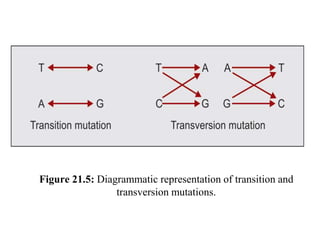
▪ Transition, in which one purine is
replaced by another purine or one
pyrimidine is replaced by another
pyrimidine.
▪ Transversion, in which a purine is
replaced by a pyrimidine or a pyrimidine
is replaced by a purine
Figure 21.5: Diagrammatic representation of transition and
transversion mutations.
1-A. Substitution
Replacement of a purine by another purine ( A to
G or G to A) or pyrimidine by pyrimidine (T to C or
C to T) is called Transition mutation.
If a purine is changed to a pyrimidine (e.g. A to C)
or a pyrimidine to a purine (e.g. T to G), it is called
a transversion.
The point mutation present in DNA is
transcribed and translated, so that the
defective gene produces an abnormal
protein
1-B. Deletion
Deletions may be subclassified into–
i. Large gene deletions, e.g. alpha thalassemia
(entire gene) or hemophilia (partial)
ii. Deletion of a codon, e.g. cystic fibrosis (one
amino acid, 508th phenylalanine is missing in
the CFTR protein.
iii. Deletion of a single base,
which will give rise to frameshift
effect.
1-C. Insertion
Insertions or additions or expansions
are subclassified into–
i. Single base additions, leading to
frameshift effect.
ii. Trinucleotide expansions. In
Huntington's chorea, CAG trinucleotides are
repeated 30 to 300 times. This leads to a
polyglutamine repeat in the protein. The
severity of the disease is increased as the
numbers of repeats are more.
iii. Duplications. In Duchenne
Muscular Dystrophy (DMD) gene is
duplicated in the disease
The effect of point mutation can be:
▪ Silent mutation
▪ Missense mutation
▪ Nonsense mutation
Silent mutation
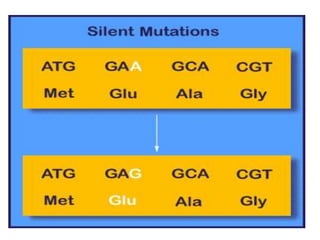
⮚There is no detectable effect.
⮚Leads to the formation of a codon synonym and
no change in the amino acid sequence of the
protein occurs e.g. a codon change from CGA to
CGG does not affect the proteins because both of
these codons specify arginine.
Missense mutation
⮚A different amino acid is incorporated at the
corresponding site in the protein molecule.
⮚Depending upon the location of the mistaken
amino acid in the specific protein, missense
mutation might be acceptable, partially acceptable
or unacceptable with respect to the function of that
protein.
Acceptable missense mutations
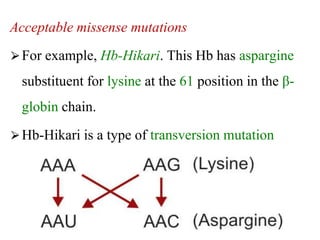
⮚For example, Hb-Hikari. This Hb has aspargine
substituent for lysine at the 61 position in the β-
globin chain.
⮚Hb-Hikari is a type of transversion mutation
Partially acceptable missense mutation
⮚For example, HbS, sickle hemoglobin,
in which the normal amino acid in
position 6 of the β-chain, glutamic acid
has been replaced by valine.
⮚The corresponding transversion might
be either GGA or GAG of glutamic
acid to GUA or GUG of valine.
Unacceptable missense mutation
For example, Hb M (Methemoglobin) in which
normal amino acid in position 58 of α-chain,
histidine has been replaced by tyrosine and non-
functional Hb molecule is generated which cannot
transport oxygen.
Nonsense mutations
⮚Nonsense mutation leads to the
conversion of an amino acid
codon to a stop or nonsense
codon.
⮚Nonsense mutation causes the premature
termination of a polypeptide chain, which is
usually non-functional, e.g. one type of
thalassemia, in which codon 17 of the β-chain
is changed from UGG to UGA and results in
the conversion of a codon tryptophan to a
nonsense codon.
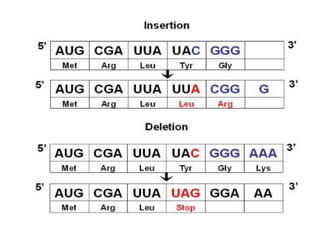
Frame Shift Mutations
Frame shift mutation occurs when there is
insertion or deletion of one or two nucleotides in
DNA, that generates altered mRNAs.
Figure 21.6: Diagrammatic representation of
frame shift mutation.
4. Manifestations of Mutations
4-A. Lethal Mutations
The alteration is incompatible with life
of the cell or the organism.
For example, mutation producing alpha-
4 Hb is lethal, and so the embryo dies
4-B. Silent Mutations
Alteration at an insignificant
region of a protein may not have
any functional effect
4-C. Beneficial Mutations
Although rare, beneficial spontaneous
mutations are the basis of evolution.
Such beneficial mutants are artificially
selected in agriculture. Normal maize is
deficient in tryptophan.
Tryptophan-rich maize varieties are
now available for cultivation.
Microorganisms often have antigenic
mutation. These are beneficial to micro-
organisms (but of course, bad to human
beings).
4-D. Carcinogenic Effect
The mutation may not be lethal, but may alter
the regulatory mechanisms. Such a mutation in
a somatic cell may result in uncontrolled cell
division leading to cancer. Any substance
causing increased rate of mutation can also
increase the probability of cancer. Thus all
carcinogens are mutagens

Mutation.pptx

  • 1.
  • 2.
    ▪ Mutation resultswhen changes occur in the nucleotide sequence of a DNA. ▪ The term mutation refers to the permanent changes in the DNA sequence.
  • 3.
    ▪ Mutations ingerm cells are transmitted to the next progeny and may give rise to inherited diseases. ▪ Mutations in somatic cells are not transmitted to the progeny but are important in the causation of cancers and some congenital malfunctions.
  • 4.
    Causes of Mutations ▪Errors in replication, If a mismatch base pair is not corrected during proofreading and post replication repair system. ▪ Error due to recombination events.
  • 5.
    ▪ Spontaneous changein DNA, e.g. deamination of cytosine to uracil or spontaneous depurination. ▪ Environmental factors like chemical mutagens and irradiations, e.g. UV light or ionizing radiation can alter the structure of DNA.
  • 8.
    Any agent whichwill increase DNA damage or cell proliferation can cause increased rate of mutations also. Such substances are called mutagens. X-ray, gamma-ray, UV ray etc. are well known mutagens. The rate of mutation is proportional to the dose of irradiation. Mutagens and Mutagenesis
  • 9.
    Figure 21.4: Typesof mutation.
  • 10.
    Base Substitution orPoint Mutation ▪ Point mutation occurs when only one base in DNA is altered. ▪ Single base change can be of transition type or transversion type.
  • 11.
    ▪ Transition, inwhich one purine is replaced by another purine or one pyrimidine is replaced by another pyrimidine. ▪ Transversion, in which a purine is replaced by a pyrimidine or a pyrimidine is replaced by a purine
  • 12.
    Figure 21.5: Diagrammaticrepresentation of transition and transversion mutations.
  • 13.
    1-A. Substitution Replacement ofa purine by another purine ( A to G or G to A) or pyrimidine by pyrimidine (T to C or C to T) is called Transition mutation. If a purine is changed to a pyrimidine (e.g. A to C) or a pyrimidine to a purine (e.g. T to G), it is called a transversion.
  • 14.
    The point mutationpresent in DNA is transcribed and translated, so that the defective gene produces an abnormal protein
  • 15.
    1-B. Deletion Deletions maybe subclassified into– i. Large gene deletions, e.g. alpha thalassemia (entire gene) or hemophilia (partial) ii. Deletion of a codon, e.g. cystic fibrosis (one amino acid, 508th phenylalanine is missing in the CFTR protein.
  • 16.
    iii. Deletion ofa single base, which will give rise to frameshift effect.
  • 17.
    1-C. Insertion Insertions oradditions or expansions are subclassified into– i. Single base additions, leading to frameshift effect.
  • 18.
    ii. Trinucleotide expansions.In Huntington's chorea, CAG trinucleotides are repeated 30 to 300 times. This leads to a polyglutamine repeat in the protein. The severity of the disease is increased as the numbers of repeats are more.
  • 19.
    iii. Duplications. InDuchenne Muscular Dystrophy (DMD) gene is duplicated in the disease
  • 20.
    The effect ofpoint mutation can be: ▪ Silent mutation ▪ Missense mutation ▪ Nonsense mutation
  • 21.
    Silent mutation ⮚There isno detectable effect. ⮚Leads to the formation of a codon synonym and no change in the amino acid sequence of the protein occurs e.g. a codon change from CGA to CGG does not affect the proteins because both of these codons specify arginine.
  • 23.
    Missense mutation ⮚A differentamino acid is incorporated at the corresponding site in the protein molecule. ⮚Depending upon the location of the mistaken amino acid in the specific protein, missense mutation might be acceptable, partially acceptable or unacceptable with respect to the function of that protein.
  • 24.
    Acceptable missense mutations ⮚Forexample, Hb-Hikari. This Hb has aspargine substituent for lysine at the 61 position in the β- globin chain. ⮚Hb-Hikari is a type of transversion mutation
  • 25.
    Partially acceptable missensemutation ⮚For example, HbS, sickle hemoglobin, in which the normal amino acid in position 6 of the β-chain, glutamic acid has been replaced by valine.
  • 26.
    ⮚The corresponding transversionmight be either GGA or GAG of glutamic acid to GUA or GUG of valine.
  • 27.
    Unacceptable missense mutation Forexample, Hb M (Methemoglobin) in which normal amino acid in position 58 of α-chain, histidine has been replaced by tyrosine and non- functional Hb molecule is generated which cannot transport oxygen.
  • 28.
    Nonsense mutations ⮚Nonsense mutationleads to the conversion of an amino acid codon to a stop or nonsense codon.
  • 29.
    ⮚Nonsense mutation causesthe premature termination of a polypeptide chain, which is usually non-functional, e.g. one type of thalassemia, in which codon 17 of the β-chain is changed from UGG to UGA and results in the conversion of a codon tryptophan to a nonsense codon.
  • 31.
    Frame Shift Mutations Frameshift mutation occurs when there is insertion or deletion of one or two nucleotides in DNA, that generates altered mRNAs. Figure 21.6: Diagrammatic representation of frame shift mutation.
  • 33.
    4. Manifestations ofMutations 4-A. Lethal Mutations The alteration is incompatible with life of the cell or the organism. For example, mutation producing alpha- 4 Hb is lethal, and so the embryo dies
  • 34.
    4-B. Silent Mutations Alterationat an insignificant region of a protein may not have any functional effect
  • 35.
    4-C. Beneficial Mutations Althoughrare, beneficial spontaneous mutations are the basis of evolution. Such beneficial mutants are artificially selected in agriculture. Normal maize is deficient in tryptophan.
  • 36.
    Tryptophan-rich maize varietiesare now available for cultivation. Microorganisms often have antigenic mutation. These are beneficial to micro- organisms (but of course, bad to human beings).
  • 37.
    4-D. Carcinogenic Effect Themutation may not be lethal, but may alter the regulatory mechanisms. Such a mutation in a somatic cell may result in uncontrolled cell division leading to cancer. Any substance causing increased rate of mutation can also increase the probability of cancer. Thus all carcinogens are mutagens