Acids and Bases
Dr. V. SIVAMURUGAN
Assistant Professor in Chemistry
Pachaiyappa’s College
Chennai- 600 030
E mail: sivaatnus@gmail.com
2
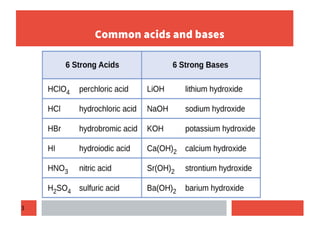
Common acids and bases
3
4
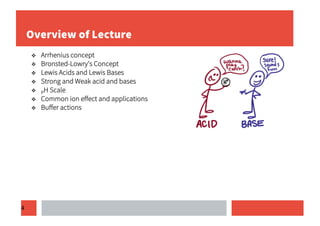
Overview of Lecture
v Arrhenius concept
v Bronsted-Lowry’s Concept
v Lewis Acids and Lewis Bases
v Strong and Weak acid and bases
v PH Scale
v Common ion effect and applications
v Buffer actions
5
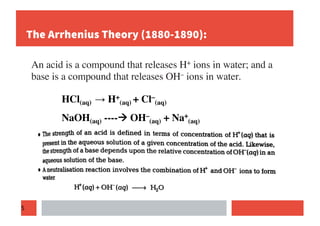
The Arrhenius Theory (1880-1890):
An acid is a compound that releases H+ ions in water; and a
base is a compound that releases OH– ions in water.
HCl(aq) → H+
(aq) + Cl–
(aq)
NaOH(aq) ----à OH–
(aq) + Na+
(aq)
6
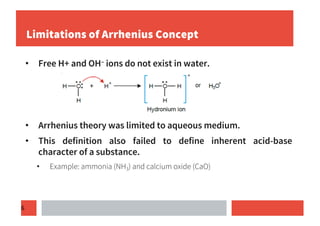
Limitations of Arrhenius Concept
• Free H+ and OH– ions do not exist in water.
• Arrhenius theory was limited to aqueous medium.
• This definition also failed to define inherent acid-base
character of a substance.
• Example: ammonia (NH3) and calcium oxide (CaO)
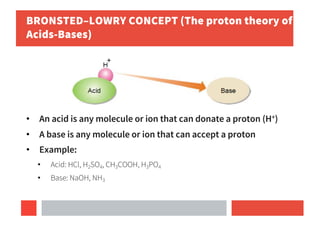
BRONSTED–LOWRY CONCEPT (The proton theory of
Acids-Bases)
• An acid is any molecule or ion that can donate a proton (H+)
• A base is any molecule or ion that can accept a proton
• Example:
• Acid: HCl, H2SO4, CH3COOH, H3PO4
• Base: NaOH, NH3
8
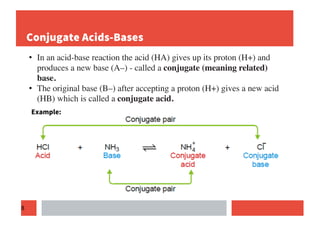
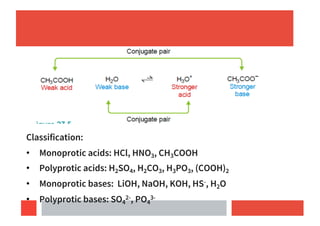
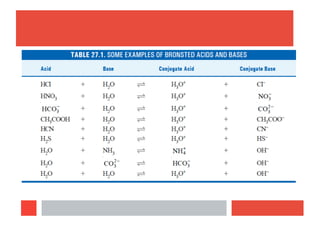
Conjugate Acids-Bases
• In an acid-base reaction the acid (HA) gives up its proton (H+) and
produces a new base (A–) - called a conjugate (meaning related)
base.
• The original base (B–) after accepting a proton (H+) gives a new acid
(HB) which is called a conjugate acid.
Example:
Classification:
• Monoprotic acids: HCl, HNO3, CH3COOH
• Polyprotic acids: H2SO4, H2CO3, H3PO3, (COOH)2
• Monoprotic bases: LiOH, NaOH, KOH, HS-, H2O
• Polyprotic bases: SO4
2-, PO4
3-
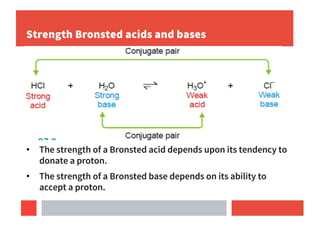
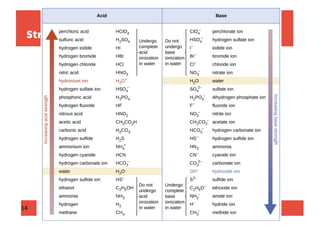
Strength Bronsted acids and bases
• The strength of a Bronsted acid depends upon its tendency to
donate a proton.
• The strength of a Bronsted base depends on its ability to
accept a proton.
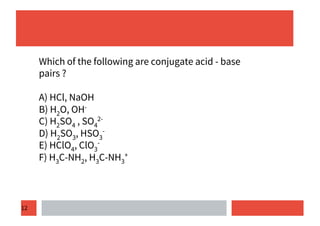
12
Which of the following are conjugate acid - base
pairs ?
A) HCl, NaOH
B) H2O, OH-
C) H2SO4 , SO4
2-
D) H2SO3, HSO3
-
E) HClO4, ClO3
-
F) H3C-NH2, H3C-NH3
+
13
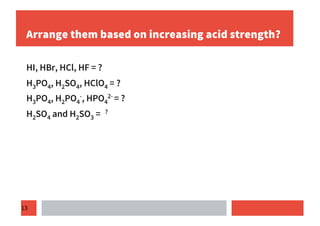
Arrange them based on increasing acid strength?
HI, HBr, HCl, HF = ?
H3PO4, H2SO4, HClO4 = ?
H3PO4, H2PO4
-, HPO4
2- = ?
H2SO4 and H2SO3 = ?
14
Strength of Acids and Bases
15
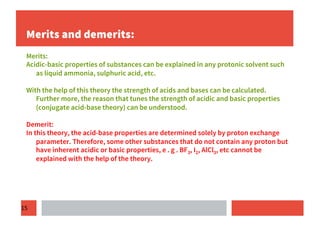
Merits and demerits:
Merits:
Acidic-basic properties of substances can be explained in any protonic solvent such
as liquid ammonia, sulphuric acid, etc.
With the help of this theory the strength of acids and bases can be calculated.
Further more, the reason that tunes the strength of acidic and basic properties
(conjugate acid-base theory) can be understood.
Demerit:
In this theory, the acid-base properties are determined solely by proton exchange
parameter. Therefore, some other substances that do not contain any proton but
have inherent acidic or basic properties, e . g . BF3, I2, AlCl3, etc cannot be
explained with the help of the theory.
16
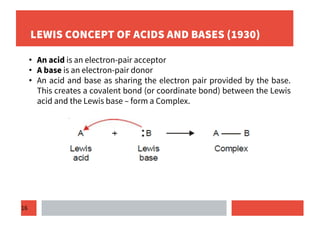
LEWIS CONCEPT OF ACIDS AND BASES (1930)
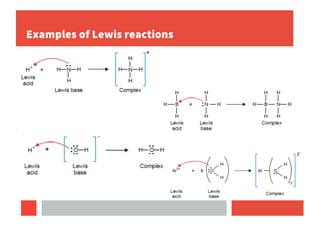
• An acid is an electron-pair acceptor
• A base is an electron-pair donor
• An acid and base as sharing the electron pair provided by the base.
This creates a covalent bond (or coordinate bond) between the Lewis
acid and the Lewis base – form a Complex.
Examples of Lewis reactions
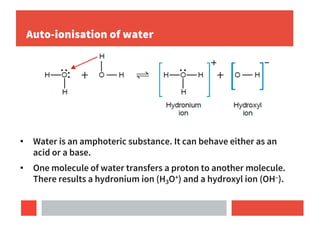
Auto-ionisation of water
• Water is an amphoteric substance. It can behave either as an
acid or a base.
• One molecule of water transfers a proton to another molecule.
There results a hydronium ion (H3O+) and a hydroxyl ion (OH–).
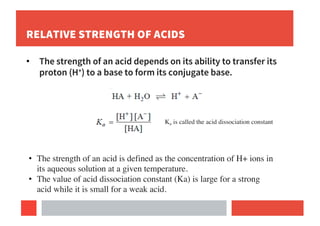
RELATIVE STRENGTH OF ACIDS
• The strength of an acid depends on its ability to transfer its
proton (H+) to a base to form its conjugate base.
Ka is called the acid dissociation constant
• The strength of an acid is defined as the concentration of H+ ions in
its aqueous solution at a given temperature.
• The value of acid dissociation constant (Ka) is large for a strong
acid while it is small for a weak acid.
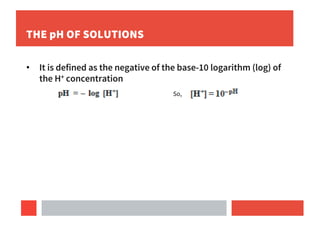
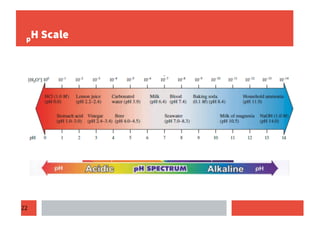
THE pH OF SOLUTIONS
• It is defined as the negative of the base-10 logarithm (log) of
the H+ concentration
So,
21
What is pH scale?
1. Calculate the pH of 0.06 mol/L HCl.
pH = − log[0.06] = 1.22
2. Calculate the pH of 0.02 mol/L H2SO4.
pH = − log0.04 = 1.3979 = ~ 1.4
3. Calculate the pH of NaOH 0.5 mol/L.
pH = 14−(−log0.5) = ~13.7
4. If this solution is diluted 10-fold, what will be the
resulting pH?
pH = ~12.7
22
pH Scale
23
Common Ion effect
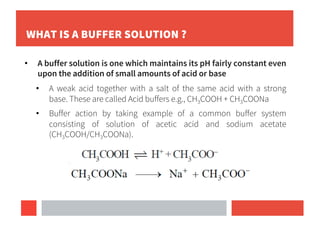
WHAT IS A BUFFER SOLUTION ?
• A buffer solution is one which maintains its pH fairly constant even
upon the addition of small amounts of acid or base
• A weak acid together with a salt of the same acid with a strong
base. These are called Acid buffers e.g., CH3COOH + CH3COONa
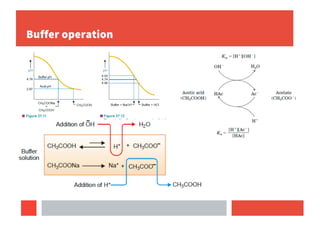
• Buffer action by taking example of a common buffer system
consisting of solution of acetic acid and sodium acetate
(CH3COOH/CH3COONa).
Buffer operation
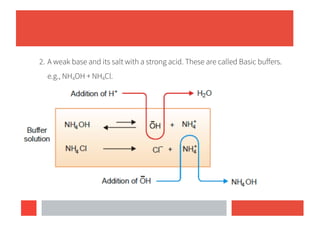
2. A weak base and its salt with a strong acid. These are called Basic buffers.
e.g., NH4OH + NH4Cl.
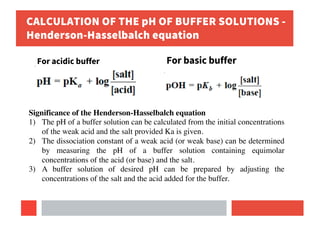
CALCULATION OF THE pH OF BUFFER SOLUTIONS -
Henderson-Hasselbalch equation
For acidic buffer For basic buffer
Significance of the Henderson-Hasselbalch equation
1) The pH of a buffer solution can be calculated from the initial concentrations
of the weak acid and the salt provided Ka is given.
2) The dissociation constant of a weak acid (or weak base) can be determined
by measuring the pH of a buffer solution containing equimolar
concentrations of the acid (or base) and the salt.
3) A buffer solution of desired pH can be prepared by adjusting the
concentrations of the salt and the acid added for the buffer.
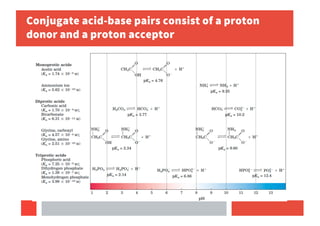
Conjugate acid-base pairs consist of a proton
donor and a proton acceptor
The titration curve of acetic acid
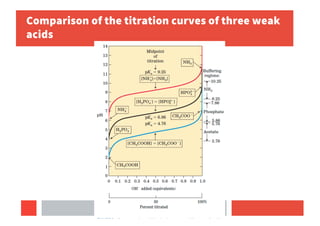
Comparison of the titration curves of three weak
acids
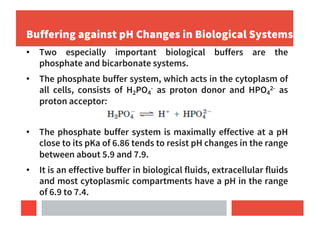
Buffering against pH Changes in Biological Systems
• Two especially important biological buffers are the
phosphate and bicarbonate systems.
• The phosphate buffer system, which acts in the cytoplasm of
all cells, consists of H2PO4
- as proton donor and HPO4
2- as
proton acceptor:
• The phosphate buffer system is maximally effective at a pH
close to its pKa of 6.86 tends to resist pH changes in the range
between about 5.9 and 7.9.
• It is an effective buffer in biological fluids, extracellular fluids
and most cytoplasmic compartments have a pH in the range
of 6.9 to 7.4.
Blood plasma
• Blood plasma is buffered in part by the bicarbonate system,
consisting of carbonic acid (H2CO3) as proton donor and
bicarbonate (HCO3
-) as proton acceptor.
• Carbonic acid (H2CO3), is formed from dissolved carbon
dioxide and water, in a reversible reaction
• Human blood plasma normally has a pH close to 7.4
• In severe uncontrolled diabetes, when an overproduction of
metabolic acids causes acidosis, the pH of the blood can fall
to 6.8 or below, leading to irreparable cell damage and death
Catalytic activity of the enzymes
• Pepsin is a digestive enzyme
secreted into gastric juice
• Trypsin, a digestive enzyme
that acts in the small
intestine
• Alkaline phosphatase of bone
tissue, a hydrolytic enzyme
thought to aid in bone
mineralization.
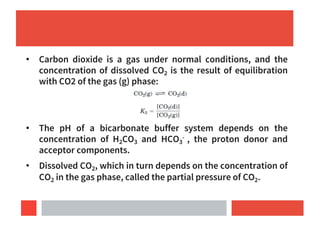
• Carbon dioxide is a gas under normal conditions, and the
concentration of dissolved CO2 is the result of equilibration
with CO2 of the gas (g) phase:
• The pH of a bicarbonate buffer system depends on the
concentration of H2CO3 and HCO3
- , the proton donor and
acceptor components.
• Dissolved CO2, which in turn depends on the concentration of
CO2 in the gas phase, called the partial pressure of CO2.
Reference:
• Essentials of Physical Chemistry, 28/e, Arun Bahl, B S Bahl
and G D Tuli, S. Chand, 2020
• Lehninger PRINCIPLES OF BIOCHEMISTRY, Fourth Edn, David
L. Nelson and Michael M. Cox

Acids and bases 13052020

  • 1.
    Acids and Bases Dr.V. SIVAMURUGAN Assistant Professor in Chemistry Pachaiyappa’s College Chennai- 600 030 E mail: sivaatnus@gmail.com
  • 2.
  • 3.
  • 4.
    4 Overview of Lecture vArrhenius concept v Bronsted-Lowry’s Concept v Lewis Acids and Lewis Bases v Strong and Weak acid and bases v PH Scale v Common ion effect and applications v Buffer actions
  • 5.
    5 The Arrhenius Theory(1880-1890): An acid is a compound that releases H+ ions in water; and a base is a compound that releases OH– ions in water. HCl(aq) → H+ (aq) + Cl– (aq) NaOH(aq) ----à OH– (aq) + Na+ (aq)
  • 6.
    6 Limitations of ArrheniusConcept • Free H+ and OH– ions do not exist in water. • Arrhenius theory was limited to aqueous medium. • This definition also failed to define inherent acid-base character of a substance. • Example: ammonia (NH3) and calcium oxide (CaO)
  • 7.
    BRONSTED–LOWRY CONCEPT (Theproton theory of Acids-Bases) • An acid is any molecule or ion that can donate a proton (H+) • A base is any molecule or ion that can accept a proton • Example: • Acid: HCl, H2SO4, CH3COOH, H3PO4 • Base: NaOH, NH3
  • 8.
    8 Conjugate Acids-Bases • Inan acid-base reaction the acid (HA) gives up its proton (H+) and produces a new base (A–) - called a conjugate (meaning related) base. • The original base (B–) after accepting a proton (H+) gives a new acid (HB) which is called a conjugate acid. Example:
  • 9.
    Classification: • Monoprotic acids:HCl, HNO3, CH3COOH • Polyprotic acids: H2SO4, H2CO3, H3PO3, (COOH)2 • Monoprotic bases: LiOH, NaOH, KOH, HS-, H2O • Polyprotic bases: SO4 2-, PO4 3-
  • 10.
    Strength Bronsted acidsand bases • The strength of a Bronsted acid depends upon its tendency to donate a proton. • The strength of a Bronsted base depends on its ability to accept a proton.
  • 12.
    12 Which of thefollowing are conjugate acid - base pairs ? A) HCl, NaOH B) H2O, OH- C) H2SO4 , SO4 2- D) H2SO3, HSO3 - E) HClO4, ClO3 - F) H3C-NH2, H3C-NH3 +
  • 13.
    13 Arrange them basedon increasing acid strength? HI, HBr, HCl, HF = ? H3PO4, H2SO4, HClO4 = ? H3PO4, H2PO4 -, HPO4 2- = ? H2SO4 and H2SO3 = ?
  • 14.
  • 15.
    15 Merits and demerits: Merits: Acidic-basicproperties of substances can be explained in any protonic solvent such as liquid ammonia, sulphuric acid, etc. With the help of this theory the strength of acids and bases can be calculated. Further more, the reason that tunes the strength of acidic and basic properties (conjugate acid-base theory) can be understood. Demerit: In this theory, the acid-base properties are determined solely by proton exchange parameter. Therefore, some other substances that do not contain any proton but have inherent acidic or basic properties, e . g . BF3, I2, AlCl3, etc cannot be explained with the help of the theory.
  • 16.
    16 LEWIS CONCEPT OFACIDS AND BASES (1930) • An acid is an electron-pair acceptor • A base is an electron-pair donor • An acid and base as sharing the electron pair provided by the base. This creates a covalent bond (or coordinate bond) between the Lewis acid and the Lewis base – form a Complex.
  • 17.
  • 18.
    Auto-ionisation of water •Water is an amphoteric substance. It can behave either as an acid or a base. • One molecule of water transfers a proton to another molecule. There results a hydronium ion (H3O+) and a hydroxyl ion (OH–).
  • 19.
    RELATIVE STRENGTH OFACIDS • The strength of an acid depends on its ability to transfer its proton (H+) to a base to form its conjugate base. Ka is called the acid dissociation constant • The strength of an acid is defined as the concentration of H+ ions in its aqueous solution at a given temperature. • The value of acid dissociation constant (Ka) is large for a strong acid while it is small for a weak acid.
  • 20.
    THE pH OFSOLUTIONS • It is defined as the negative of the base-10 logarithm (log) of the H+ concentration So,
  • 21.
    21 What is pHscale? 1. Calculate the pH of 0.06 mol/L HCl. pH = − log[0.06] = 1.22 2. Calculate the pH of 0.02 mol/L H2SO4. pH = − log0.04 = 1.3979 = ~ 1.4 3. Calculate the pH of NaOH 0.5 mol/L. pH = 14−(−log0.5) = ~13.7 4. If this solution is diluted 10-fold, what will be the resulting pH? pH = ~12.7
  • 22.
  • 23.
  • 24.
    WHAT IS ABUFFER SOLUTION ? • A buffer solution is one which maintains its pH fairly constant even upon the addition of small amounts of acid or base • A weak acid together with a salt of the same acid with a strong base. These are called Acid buffers e.g., CH3COOH + CH3COONa • Buffer action by taking example of a common buffer system consisting of solution of acetic acid and sodium acetate (CH3COOH/CH3COONa).
  • 25.
  • 26.
    2. A weakbase and its salt with a strong acid. These are called Basic buffers. e.g., NH4OH + NH4Cl.
  • 27.
    CALCULATION OF THEpH OF BUFFER SOLUTIONS - Henderson-Hasselbalch equation For acidic buffer For basic buffer Significance of the Henderson-Hasselbalch equation 1) The pH of a buffer solution can be calculated from the initial concentrations of the weak acid and the salt provided Ka is given. 2) The dissociation constant of a weak acid (or weak base) can be determined by measuring the pH of a buffer solution containing equimolar concentrations of the acid (or base) and the salt. 3) A buffer solution of desired pH can be prepared by adjusting the concentrations of the salt and the acid added for the buffer.
  • 28.
    Conjugate acid-base pairsconsist of a proton donor and a proton acceptor
  • 29.
    The titration curveof acetic acid
  • 30.
    Comparison of thetitration curves of three weak acids
  • 31.
    Buffering against pHChanges in Biological Systems • Two especially important biological buffers are the phosphate and bicarbonate systems. • The phosphate buffer system, which acts in the cytoplasm of all cells, consists of H2PO4 - as proton donor and HPO4 2- as proton acceptor: • The phosphate buffer system is maximally effective at a pH close to its pKa of 6.86 tends to resist pH changes in the range between about 5.9 and 7.9. • It is an effective buffer in biological fluids, extracellular fluids and most cytoplasmic compartments have a pH in the range of 6.9 to 7.4.
  • 32.
    Blood plasma • Bloodplasma is buffered in part by the bicarbonate system, consisting of carbonic acid (H2CO3) as proton donor and bicarbonate (HCO3 -) as proton acceptor. • Carbonic acid (H2CO3), is formed from dissolved carbon dioxide and water, in a reversible reaction
  • 33.
    • Human bloodplasma normally has a pH close to 7.4 • In severe uncontrolled diabetes, when an overproduction of metabolic acids causes acidosis, the pH of the blood can fall to 6.8 or below, leading to irreparable cell damage and death
  • 34.
    Catalytic activity ofthe enzymes • Pepsin is a digestive enzyme secreted into gastric juice • Trypsin, a digestive enzyme that acts in the small intestine • Alkaline phosphatase of bone tissue, a hydrolytic enzyme thought to aid in bone mineralization.
  • 35.
    • Carbon dioxideis a gas under normal conditions, and the concentration of dissolved CO2 is the result of equilibration with CO2 of the gas (g) phase: • The pH of a bicarbonate buffer system depends on the concentration of H2CO3 and HCO3 - , the proton donor and acceptor components. • Dissolved CO2, which in turn depends on the concentration of CO2 in the gas phase, called the partial pressure of CO2.
  • 36.
    Reference: • Essentials ofPhysical Chemistry, 28/e, Arun Bahl, B S Bahl and G D Tuli, S. Chand, 2020 • Lehninger PRINCIPLES OF BIOCHEMISTRY, Fourth Edn, David L. Nelson and Michael M. Cox