pH and Buffer
Presented by: Aguilar, Princess Alen
              Bumagat, Giane Carla
              Luis, Ana Patricia
              Villanueva, Christian
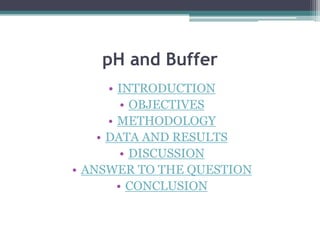
pH and Buffer
      • INTRODUCTION
         • OBJECTIVES
      • METHODOLOGY
    • DATA AND RESULTS
         • DISCUSSION
• ANSWER TO THE QUESTION
        • CONCLUSION
INTRODUCTION
• pH- introduced in 1909     • Buffer- it is an aqueous
  by Sorensen.                 solution consisting of a
      - it is defined as       mixture of a weak acid and
                               its conjugate base or a weak
  negative log of Hydrogen
                               base and its conjugate acid. It
  ion concentration.           can resists pH change.
• There are solutions in       Basically, it is use in keeping
  calculating the pH. Here     the pH at a nearly constant
  are some of them:            value in a wide variety of
a. Calculation of [H-]         chemical applications. In
b. Calculating the base 10     biochemistry, one good
                               example of buffer solution
    log of H-
                               found in nature is blood
c. pH is negative of the       which is present in all
    value found in base 10     living organisms.
    log
OBJECTIVES
• To illustrate the buffering properties of
  phosphates and acetates


• To provide the students a sense of how buffers
  work.
METHODOLOGY
• First, preparation of both the phophate buffer
  which include the KH2PO4 and K2HPO4 . While
  the acetate buffer contains the CH3COOH and
  CH3COOHNa+.
• To be able to get the correct amount of the
  compound needed to be able to prepare a 100 ml
  of each buffer.The solution used is:
 gram= mol x molar weight of the compund
* Mol is obtained by dividing the molarity with the
  Volume in liter needed for the preparation of the
  buffers.
                                              next
METHODOLOGY


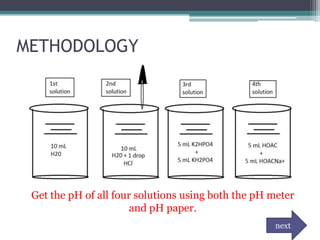
 Get the pH of all four solutions using both the pH meter
                       and pH paper.
                                                    next
METHODOLOGY
DATA AND RESULTS
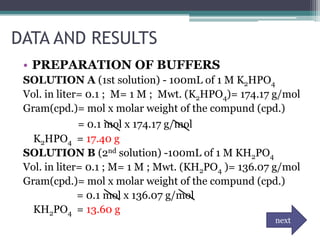
 • PREPARATION OF BUFFERS
 SOLUTION A (1st solution) - 100mL of 1 M K2HPO4
 Vol. in liter= 0.1 ; M= 1 M ; Mwt. (K2HPO4)= 174.17 g/mol
 Gram(cpd.)= mol x molar weight of the compund (cpd.)
              = 0.1 mol x 174.17 g/mol
   K2HPO4 = 17.40 g
 SOLUTION B (2nd solution) -100mL of 1 M KH2PO4
 Vol. in liter= 0.1 ; M= 1 M ; Mwt. (KH2PO4 )= 136.07 g/mol
 Gram(cpd.)= mol x molar weight of the compund (cpd.)
              = 0.1 mol x 136.07 g/mol
   KH2PO4 = 13.60 g
                                                     next
DATA AND RESULTS
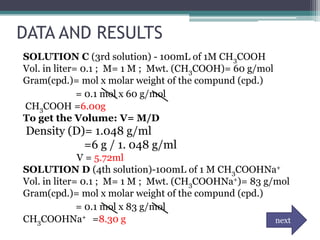
SOLUTION C (3rd solution) - 100mL of 1M CH3COOH
Vol. in liter= 0.1 ; M= 1 M ; Mwt. (CH3COOH)= 60 g/mol
Gram(cpd.)= mol x molar weight of the compund (cpd.)
              = 0.1 mol x 60 g/mol
CH3COOH =6.00g
To get the Volume: V= M/D
 Density (D)= 1.048 g/ml
            =6 g / 1. 048 g/ml
              V = 5.72ml
SOLUTION D (4th solution)-100mL of 1 M CH3COOHNa+
Vol. in liter= 0.1 ; M= 1 M ; Mwt. (CH3COOHNa+)= 83 g/mol
Gram(cpd.)= mol x molar weight of the compund (cpd.)
              = 0.1 mol x 83 g/mol
CH3COOHNa+ =8.30 g                                    next
DATA AND RESULTS
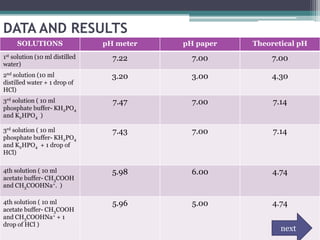
     SOLUTIONS                  pH meter   pH paper   Theoretical pH
1st solution (10 ml distilled     7.22       7.00         7.00
water)
2nd solution (10 ml               3.20       3.00         4.30
distilled water + 1 drop of
HCl)
3rd solution ( 10 ml              7.47       7.00          7.14
phosphate buffer- KH2PO4
and K2HPO4 )

3rd solution ( 10 ml              7.43       7.00          7.14
phosphate buffer- KH2PO4
and K2HPO4 + 1 drop of
HCl)

4th solution ( 10 ml              5.98       6.00          4.74
acetate buffer- CH3COOH
and CH3COOHNa+. )

4th solution ( 10 ml              5.96       5.00          4.74
acetate buffer- CH3COOH
and CH3COOHNa+ + 1
drop of HCl )
                                                             next
DATA AND RESULTS
 •  To get the pH of water:
   Kw= [H+] [OH-]
   pH       = - log [ 1E-7]
      = 7.00
 • To get the pH of water after adding 1 drop of HCl.
   H2O + HCl --------> H3O + Cl
   1 drop = 0.00005L
  [H+]= 1E-7 + 0.00005
   pH       = -log [ 0.00005]
      =4.30
 • To get the pH of the phosphate buffer- 0.005 L K2HPO4 + 00.005 KH2PO4
 Dilution formula: (M1V1)= (M2V2)
 (1mol)(0.005ml)=(?)(0.01ml)
 ?mol= 0.005ml/ 0.01ml
 =0.5M of K2HPO4 and KH2PO4
 • pH= pka + log [salt]/ [acid]
       =7.2E-8 + log [0.5]/[0.5]
       = 7.14
 • To get the pH of the acetate buffer- 0.005 L CH3COOH + 0.005 L CH3COOHNa+
 Dilution formula: (M1V1)= (M2V2)
 (1mol)(0.005ml)=(?)(0.01ml)
 ?mol= 0.005ml/ 0.01ml
 =0.5M of K2HPO4 and KH2PO4
 • pH= pka + log [salt] / [acid]
        =1.8E-5 + log [0.5]/[0.5]
        =4.74
DISCUSSION
• In every experiment with calculations, we should
  have precise and accurate data and values to be able
  to get a correct and successful results. In this
  experiment, we need to have the correct values for
  the volume, molarity of the solution to have the exact
  preparation of the solution and the buffers- both the
  phosphate and acetate buffer.
• In the experiment, we focus on the effect of buffer
  solution. In which buffer is said to be a combination
  of weak acid or weak base and its salt.
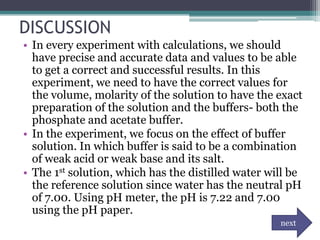
• The 1st solution, which has the distilled water will be
  the reference solution since water has the neutral pH
  of 7.00. Using pH meter, the pH is 7.22 and 7.00
  using the pH paper.
                                                    next
DISCUSSION
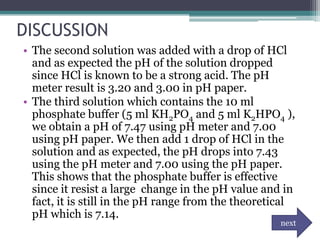
• The second solution was added with a drop of HCl
  and as expected the pH of the solution dropped
  since HCl is known to be a strong acid. The pH
  meter result is 3.20 and 3.00 in pH paper.
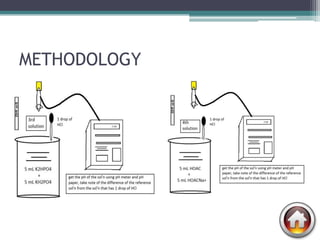
• The third solution which contains the 10 ml
  phosphate buffer (5 ml KH2PO4 and 5 ml K2HPO4 ),
  we obtain a pH of 7.47 using pH meter and 7.00
  using pH paper. We then add 1 drop of HCl in the
  solution and as expected, the pH drops into 7.43
  using the pH meter and 7.00 using the pH paper.
  This shows that the phosphate buffer is effective
  since it resist a large change in the pH value and in
  fact, it is still in the pH range from the theoretical
  pH which is 7.14.
                                                     next
DISCUSSION
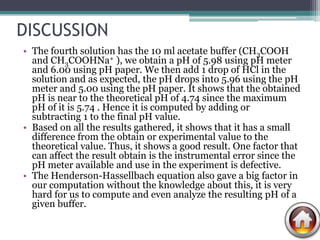
• The fourth solution has the 10 ml acetate buffer (CH3COOH
  and CH3COOHNa+ ), we obtain a pH of 5.98 using pH meter
  and 6.00 using pH paper. We then add 1 drop of HCl in the
  solution and as expected, the pH drops into 5.96 using the pH
  meter and 5.00 using the pH paper. It shows that the obtained
  pH is near to the theoretical pH of 4.74 since the maximum
  pH of it is 5.74 . Hence it is computed by adding or
  subtracting 1 to the final pH value.
• Based on all the results gathered, it shows that it has a small
  difference from the obtain or experimental value to the
  theoretical value. Thus, it shows a good result. One factor that
  can affect the result obtain is the instrumental error since the
  pH meter available and use in the experiment is defective.
• The Henderson-Hassellbach equation also gave a big factor in
  our computation without the knowledge about this, it is very
  hard for us to compute and even analyze the resulting pH of a
  given buffer.
ANSWER TO THE QUESTION
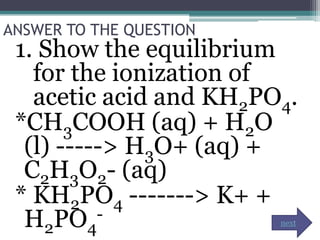
 1. Show the equilibrium
   for the ionization of
   acetic acid and KH2PO4.
 *CH3COOH (aq) + H2O
  (l) -----> H3O+ (aq) +
  C2H3O2- (aq)
 * KH2PO4 -------> K+ +
  H2PO4   -              next
2. Derive Henderson- Hesselbach Equation

      ▫Ka = [H=][A-]
                 [HA]


      ▫-log Ka= -log = [H=][A-]
                                    [HA]
           -log Ka= - log [H] –log [A-]/[HA]

           pKa= pH –log [A]/[HA]
           pH= pka + log [A-]/ [HA]


                                               next
3. An acetate buffer was prepared by mixing 10 mL of 0.1M acetic acid
   and 100 mL of 0.1M sodium acetate. What is the pH of the buffer
   solution.
Dilution formula: (M1V1) = (M2V2)
                        (0.1M acetic acid)(0.01mL)=(?)(0.11mL)
                         ?= 0.001/0.11
                        M=0.009 CH3COOH
                        (0.1M sodium acetate)(0.1mL)=(?)(0.11mL)
                        ?= 0.01/0.11
                        M=0.09 CH3COOHNa+
               pH = pka + log [salt]/[acid]

                        =4.74 + log [0.09]/[0.009]
                        =5.74

4. Can a buffer solution be prepared from a mixture of NaNo3 and
   HNO3? Explain.
   *Technically, from the meaning of buffer it must a combination of
   weak base/acid and its salt, the combination of NaNo3 and HNO3 is
   a strong acid and salt mixture thus it will not form a buffer solution.
CONCLUSION
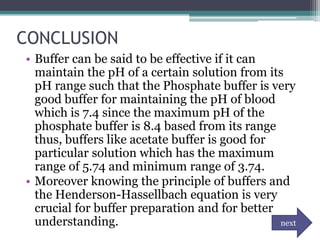
• Buffer can be said to be effective if it can
  maintain the pH of a certain solution from its
  pH range such that the Phosphate buffer is very
  good buffer for maintaining the pH of blood
  which is 7.4 since the maximum pH of the
  phosphate buffer is 8.4 based from its range
  thus, buffers like acetate buffer is good for
  particular solution which has the maximum
  range of 5.74 and minimum range of 3.74.
• Moreover knowing the principle of buffers and
  the Henderson-Hassellbach equation is very
  crucial for buffer preparation and for better
  understanding.                                next
Presented by:   Aguilar, Princess Alen
                Bumagat, Giane Carla
                Luis, Ana Patricia
                Villanueva, Christian

P h and buffer

  • 1.
    pH and Buffer Presentedby: Aguilar, Princess Alen Bumagat, Giane Carla Luis, Ana Patricia Villanueva, Christian
  • 2.
    pH and Buffer • INTRODUCTION • OBJECTIVES • METHODOLOGY • DATA AND RESULTS • DISCUSSION • ANSWER TO THE QUESTION • CONCLUSION
  • 3.
    INTRODUCTION • pH- introducedin 1909 • Buffer- it is an aqueous by Sorensen. solution consisting of a - it is defined as mixture of a weak acid and its conjugate base or a weak negative log of Hydrogen base and its conjugate acid. It ion concentration. can resists pH change. • There are solutions in Basically, it is use in keeping calculating the pH. Here the pH at a nearly constant are some of them: value in a wide variety of a. Calculation of [H-] chemical applications. In b. Calculating the base 10 biochemistry, one good example of buffer solution log of H- found in nature is blood c. pH is negative of the which is present in all value found in base 10 living organisms. log
  • 4.
    OBJECTIVES • To illustratethe buffering properties of phosphates and acetates • To provide the students a sense of how buffers work.
  • 5.
    METHODOLOGY • First, preparationof both the phophate buffer which include the KH2PO4 and K2HPO4 . While the acetate buffer contains the CH3COOH and CH3COOHNa+. • To be able to get the correct amount of the compound needed to be able to prepare a 100 ml of each buffer.The solution used is: gram= mol x molar weight of the compund * Mol is obtained by dividing the molarity with the Volume in liter needed for the preparation of the buffers. next
  • 6.
    METHODOLOGY Get thepH of all four solutions using both the pH meter and pH paper. next
  • 7.
  • 8.
    DATA AND RESULTS • PREPARATION OF BUFFERS SOLUTION A (1st solution) - 100mL of 1 M K2HPO4 Vol. in liter= 0.1 ; M= 1 M ; Mwt. (K2HPO4)= 174.17 g/mol Gram(cpd.)= mol x molar weight of the compund (cpd.) = 0.1 mol x 174.17 g/mol K2HPO4 = 17.40 g SOLUTION B (2nd solution) -100mL of 1 M KH2PO4 Vol. in liter= 0.1 ; M= 1 M ; Mwt. (KH2PO4 )= 136.07 g/mol Gram(cpd.)= mol x molar weight of the compund (cpd.) = 0.1 mol x 136.07 g/mol KH2PO4 = 13.60 g next
  • 9.
    DATA AND RESULTS SOLUTIONC (3rd solution) - 100mL of 1M CH3COOH Vol. in liter= 0.1 ; M= 1 M ; Mwt. (CH3COOH)= 60 g/mol Gram(cpd.)= mol x molar weight of the compund (cpd.) = 0.1 mol x 60 g/mol CH3COOH =6.00g To get the Volume: V= M/D Density (D)= 1.048 g/ml =6 g / 1. 048 g/ml V = 5.72ml SOLUTION D (4th solution)-100mL of 1 M CH3COOHNa+ Vol. in liter= 0.1 ; M= 1 M ; Mwt. (CH3COOHNa+)= 83 g/mol Gram(cpd.)= mol x molar weight of the compund (cpd.) = 0.1 mol x 83 g/mol CH3COOHNa+ =8.30 g next
  • 10.
    DATA AND RESULTS SOLUTIONS pH meter pH paper Theoretical pH 1st solution (10 ml distilled 7.22 7.00 7.00 water) 2nd solution (10 ml 3.20 3.00 4.30 distilled water + 1 drop of HCl) 3rd solution ( 10 ml 7.47 7.00 7.14 phosphate buffer- KH2PO4 and K2HPO4 ) 3rd solution ( 10 ml 7.43 7.00 7.14 phosphate buffer- KH2PO4 and K2HPO4 + 1 drop of HCl) 4th solution ( 10 ml 5.98 6.00 4.74 acetate buffer- CH3COOH and CH3COOHNa+. ) 4th solution ( 10 ml 5.96 5.00 4.74 acetate buffer- CH3COOH and CH3COOHNa+ + 1 drop of HCl ) next
  • 11.
    DATA AND RESULTS • To get the pH of water: Kw= [H+] [OH-] pH = - log [ 1E-7] = 7.00 • To get the pH of water after adding 1 drop of HCl. H2O + HCl --------> H3O + Cl 1 drop = 0.00005L [H+]= 1E-7 + 0.00005 pH = -log [ 0.00005] =4.30 • To get the pH of the phosphate buffer- 0.005 L K2HPO4 + 00.005 KH2PO4 Dilution formula: (M1V1)= (M2V2) (1mol)(0.005ml)=(?)(0.01ml) ?mol= 0.005ml/ 0.01ml =0.5M of K2HPO4 and KH2PO4 • pH= pka + log [salt]/ [acid] =7.2E-8 + log [0.5]/[0.5] = 7.14 • To get the pH of the acetate buffer- 0.005 L CH3COOH + 0.005 L CH3COOHNa+ Dilution formula: (M1V1)= (M2V2) (1mol)(0.005ml)=(?)(0.01ml) ?mol= 0.005ml/ 0.01ml =0.5M of K2HPO4 and KH2PO4 • pH= pka + log [salt] / [acid] =1.8E-5 + log [0.5]/[0.5] =4.74
  • 12.
    DISCUSSION • In everyexperiment with calculations, we should have precise and accurate data and values to be able to get a correct and successful results. In this experiment, we need to have the correct values for the volume, molarity of the solution to have the exact preparation of the solution and the buffers- both the phosphate and acetate buffer. • In the experiment, we focus on the effect of buffer solution. In which buffer is said to be a combination of weak acid or weak base and its salt. • The 1st solution, which has the distilled water will be the reference solution since water has the neutral pH of 7.00. Using pH meter, the pH is 7.22 and 7.00 using the pH paper. next
  • 13.
    DISCUSSION • The secondsolution was added with a drop of HCl and as expected the pH of the solution dropped since HCl is known to be a strong acid. The pH meter result is 3.20 and 3.00 in pH paper. • The third solution which contains the 10 ml phosphate buffer (5 ml KH2PO4 and 5 ml K2HPO4 ), we obtain a pH of 7.47 using pH meter and 7.00 using pH paper. We then add 1 drop of HCl in the solution and as expected, the pH drops into 7.43 using the pH meter and 7.00 using the pH paper. This shows that the phosphate buffer is effective since it resist a large change in the pH value and in fact, it is still in the pH range from the theoretical pH which is 7.14. next
  • 14.
    DISCUSSION • The fourthsolution has the 10 ml acetate buffer (CH3COOH and CH3COOHNa+ ), we obtain a pH of 5.98 using pH meter and 6.00 using pH paper. We then add 1 drop of HCl in the solution and as expected, the pH drops into 5.96 using the pH meter and 5.00 using the pH paper. It shows that the obtained pH is near to the theoretical pH of 4.74 since the maximum pH of it is 5.74 . Hence it is computed by adding or subtracting 1 to the final pH value. • Based on all the results gathered, it shows that it has a small difference from the obtain or experimental value to the theoretical value. Thus, it shows a good result. One factor that can affect the result obtain is the instrumental error since the pH meter available and use in the experiment is defective. • The Henderson-Hassellbach equation also gave a big factor in our computation without the knowledge about this, it is very hard for us to compute and even analyze the resulting pH of a given buffer.
  • 15.
    ANSWER TO THEQUESTION 1. Show the equilibrium for the ionization of acetic acid and KH2PO4. *CH3COOH (aq) + H2O (l) -----> H3O+ (aq) + C2H3O2- (aq) * KH2PO4 -------> K+ + H2PO4 - next
  • 16.
    2. Derive Henderson-Hesselbach Equation ▫Ka = [H=][A-] [HA] ▫-log Ka= -log = [H=][A-] [HA] -log Ka= - log [H] –log [A-]/[HA] pKa= pH –log [A]/[HA] pH= pka + log [A-]/ [HA] next
  • 17.
    3. An acetatebuffer was prepared by mixing 10 mL of 0.1M acetic acid and 100 mL of 0.1M sodium acetate. What is the pH of the buffer solution. Dilution formula: (M1V1) = (M2V2) (0.1M acetic acid)(0.01mL)=(?)(0.11mL) ?= 0.001/0.11 M=0.009 CH3COOH (0.1M sodium acetate)(0.1mL)=(?)(0.11mL) ?= 0.01/0.11 M=0.09 CH3COOHNa+ pH = pka + log [salt]/[acid] =4.74 + log [0.09]/[0.009] =5.74 4. Can a buffer solution be prepared from a mixture of NaNo3 and HNO3? Explain. *Technically, from the meaning of buffer it must a combination of weak base/acid and its salt, the combination of NaNo3 and HNO3 is a strong acid and salt mixture thus it will not form a buffer solution.
  • 18.
    CONCLUSION • Buffer canbe said to be effective if it can maintain the pH of a certain solution from its pH range such that the Phosphate buffer is very good buffer for maintaining the pH of blood which is 7.4 since the maximum pH of the phosphate buffer is 8.4 based from its range thus, buffers like acetate buffer is good for particular solution which has the maximum range of 5.74 and minimum range of 3.74. • Moreover knowing the principle of buffers and the Henderson-Hassellbach equation is very crucial for buffer preparation and for better understanding. next
  • 19.
    Presented by: Aguilar, Princess Alen Bumagat, Giane Carla Luis, Ana Patricia Villanueva, Christian