ACID BASE BALANCE & RELATED DISORDERS
MAHE INSTITUTE OF DENTAL SCIENCES & HOSPITAL
Chalakkara, P.O Palloor, Mahe – 673310
U.T. of Puducherry.ph:0490 2337765
Dr. M. Priyanka
Reader
Department of Biochemistry
ACIDS AND BASES
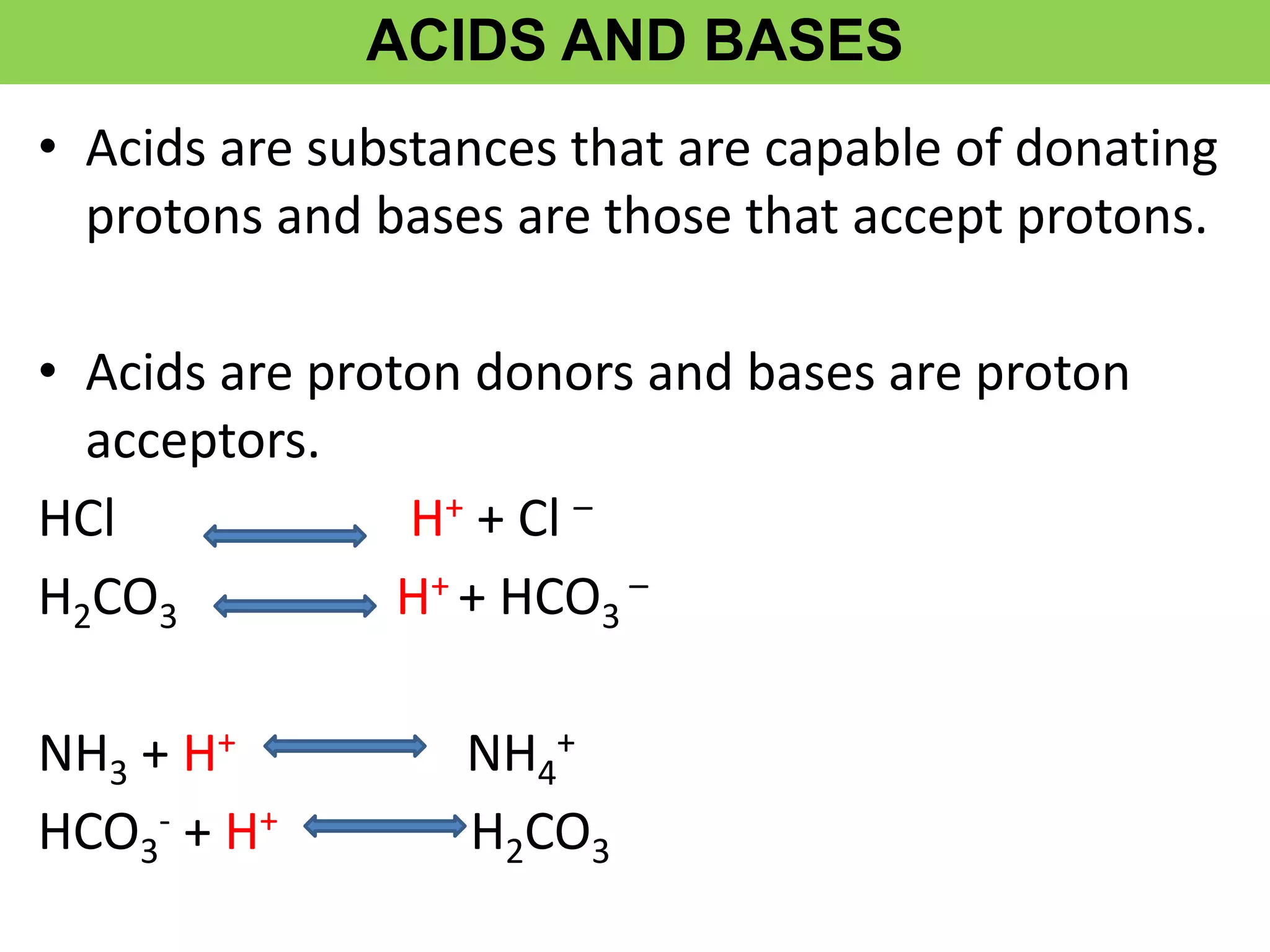
• Acids are substances that are capable of donating
protons and bases are those that accept protons.
• Acids are proton donors and bases are proton
acceptors.
HCl H+ + Cl –
H2CO3 H+ + HCO3
–
NH3 + H+ NH4
+
HCO3
- + H+ H2CO3
CONTD…
• The extent of dissociation decides whether they
are strong acids or weak acids.
• Strong acids dissociate completely in solution,
while weak acids ionize incompletely.
HCl H+ + Cl– (Complete)
H2CO3 H+ + HCO3– (Partial)
CONTD…
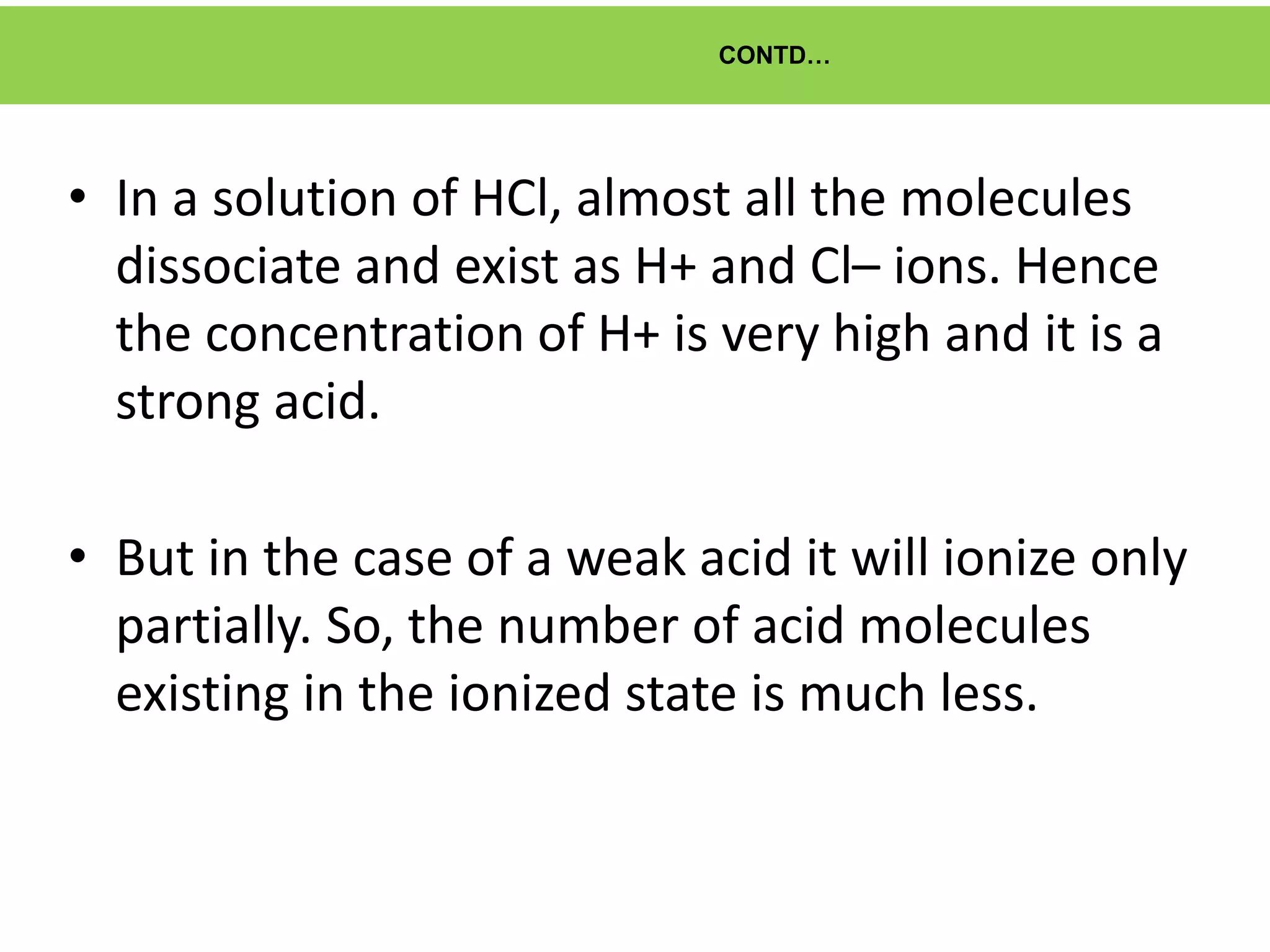
• In a solution of HCl, almost all the molecules
dissociate and exist as H+ and Cl– ions. Hence
the concentration of H+ is very high and it is a
strong acid.
• But in the case of a weak acid it will ionize only
partially. So, the number of acid molecules
existing in the ionized state is much less.
Dissociation Constant
• The dissociation of an acid is a freely reversible reaction, at
equilibrium the ratio between dissociated and undissociated
particle is a constant. The dissociation constant (Ka) of an acid is
given by the formula:
Ka = [H+][A-]
[HA]
• [H+] concentration of hydrogen ions
• [A–] = the concentration of anions or conjugate base
• [HA] is the concentration of undissociated molecules.
• Pka: The PH at which the acid is half ionized is
called Pka of an acid which is constant at a
particular temperature and pressure
• Strong acid- low Pka
• Weak acid – high pka
CONTD…
PH:
• Negative logarithm of hydrogen ion concentration – pH.
pH = –log [H+]
• pH value is inversely proportional to the acidity.
• Lower the pH, higher the acidity or hydrogen ion
concentration while higher the pH, the acidity is lower.
• pH 7 indicates the neutral pH.
Acids produced by the body
Metabolic sources of acids
Classified as
• Respiratory (or volatile) acids
• Metabolic (or fixed) acids.
• Amount of acid excreted per day must equal the amount
produced per day.
• Routes of excretion are: lungs (for CO2,volatile acid) and
kidneys (for the fixed acids).
Respiratory acid or volatile acid
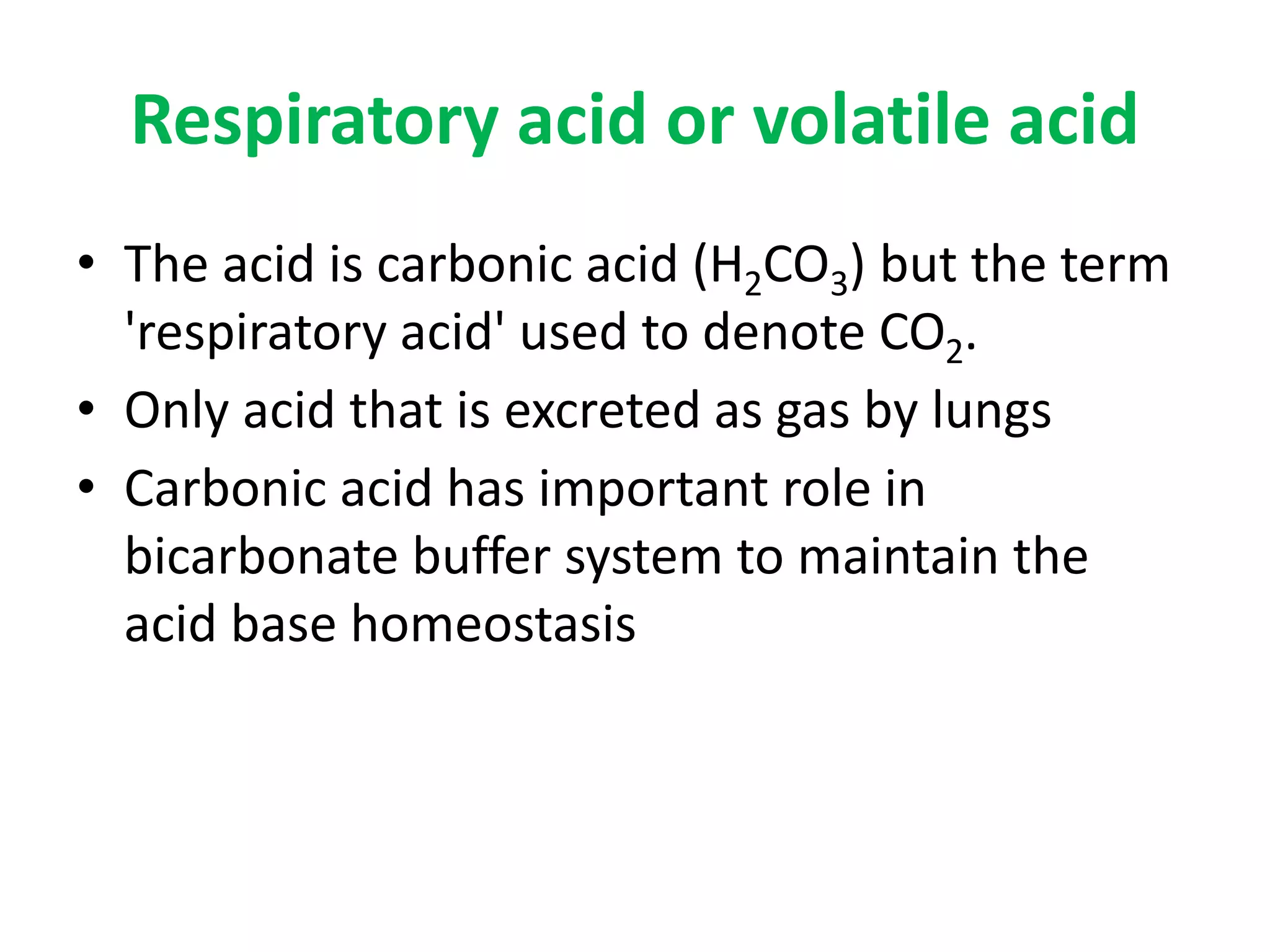
• The acid is carbonic acid (H2CO3) but the term
'respiratory acid' used to denote CO2.
• Only acid that is excreted as gas by lungs
• Carbonic acid has important role in
bicarbonate buffer system to maintain the
acid base homeostasis
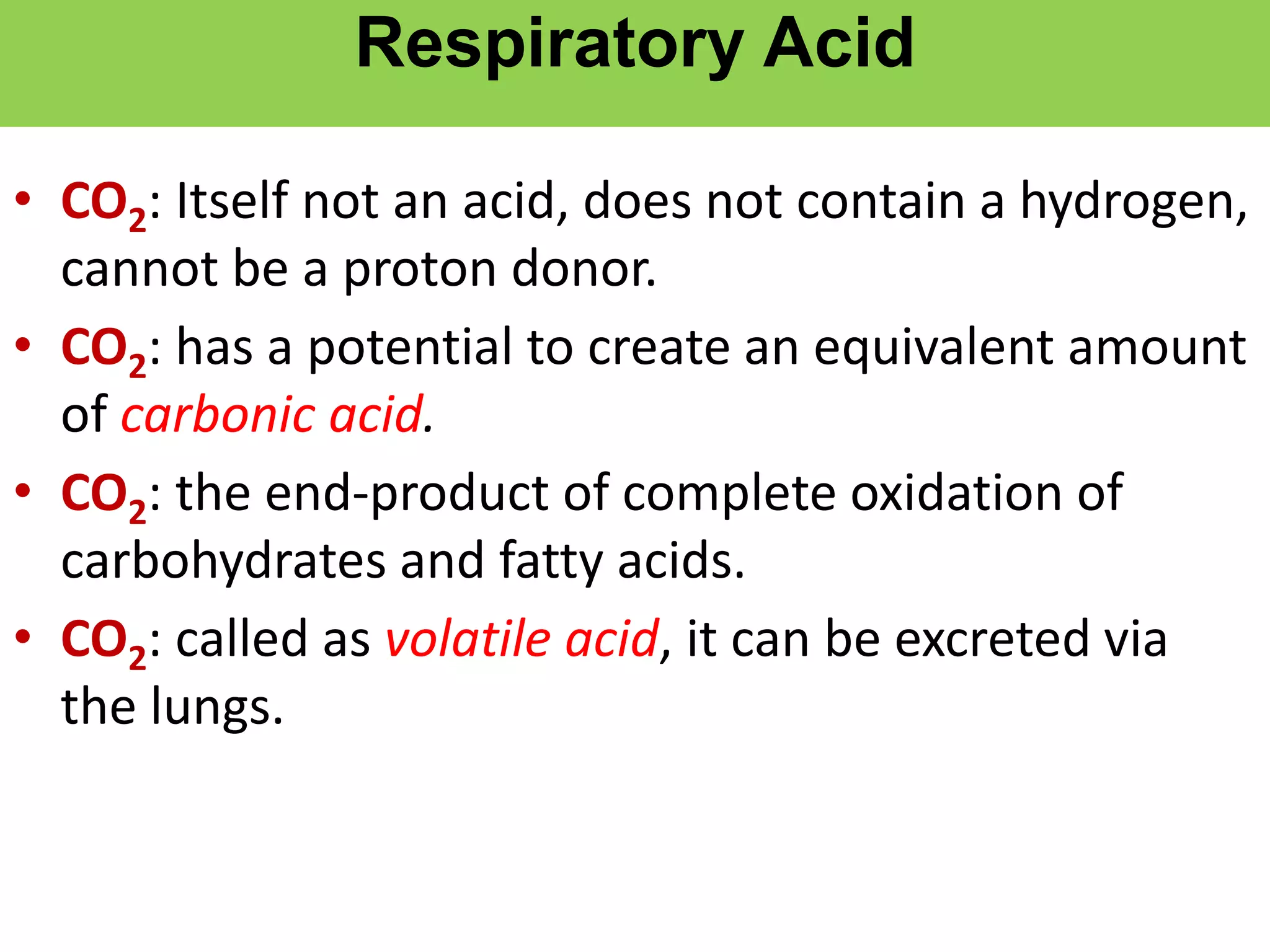
Respiratory Acid
• CO2: Itself not an acid, does not contain a hydrogen,
cannot be a proton donor.
• CO2: has a potential to create an equivalent amount
of carbonic acid.
• CO2: the end-product of complete oxidation of
carbohydrates and fatty acids.
• CO2: called as volatile acid, it can be excreted via
the lungs.
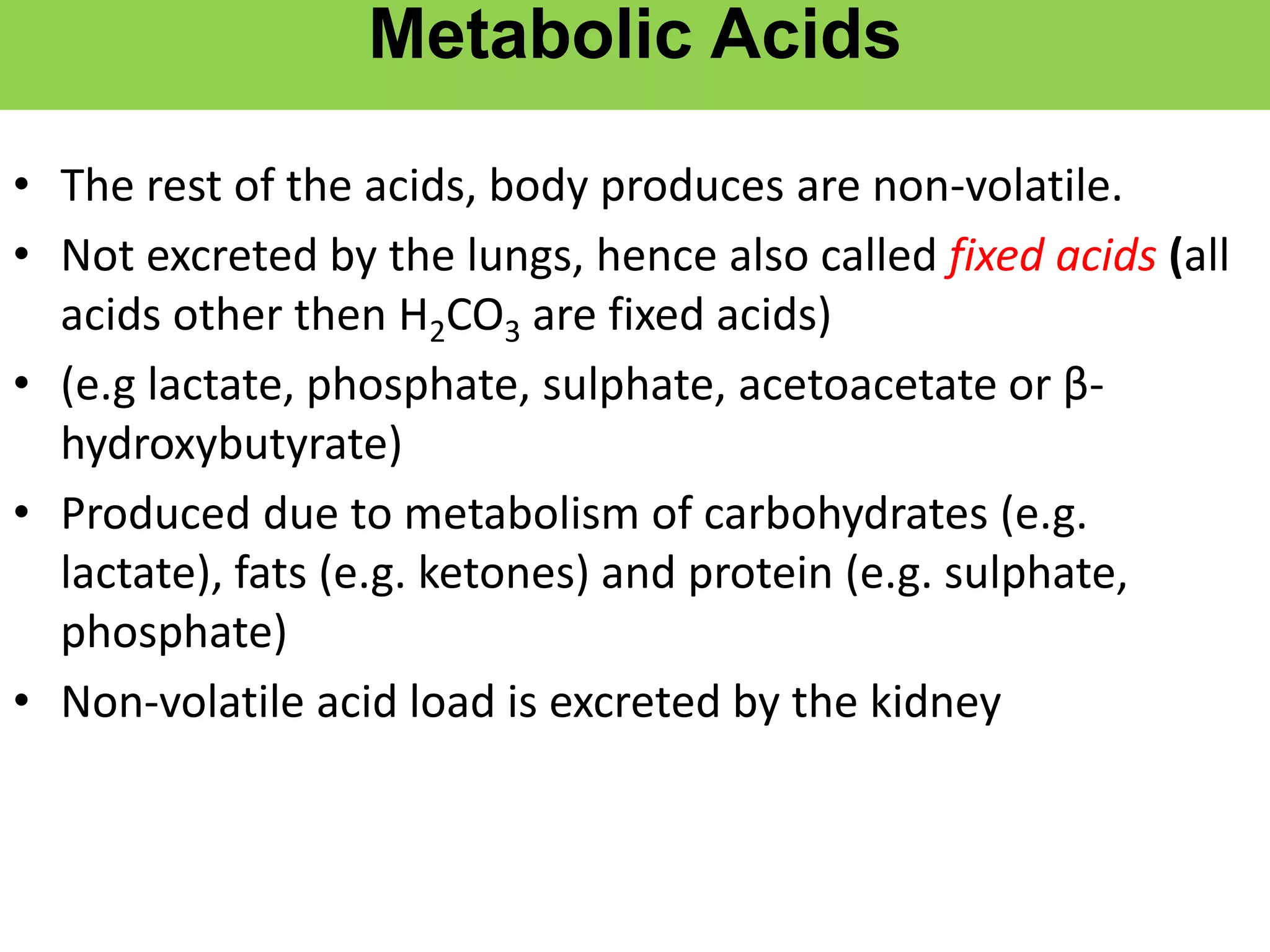
Metabolic Acids
• The rest of the acids, body produces are non-volatile.
• Not excreted by the lungs, hence also called fixed acids (all
acids other then H2CO3 are fixed acids)
• (e.g lactate, phosphate, sulphate, acetoacetate or β-
hydroxybutyrate)
• Produced due to metabolism of carbohydrates (e.g.
lactate), fats (e.g. ketones) and protein (e.g. sulphate,
phosphate)
• Non-volatile acid load is excreted by the kidney
• Metabolic sources of bases:
• Catabolism of few food materials produces
bases
• Eg: citrate salts of fruit juices-bicarbonate
salts
• Deamination of amino acids-ammonia
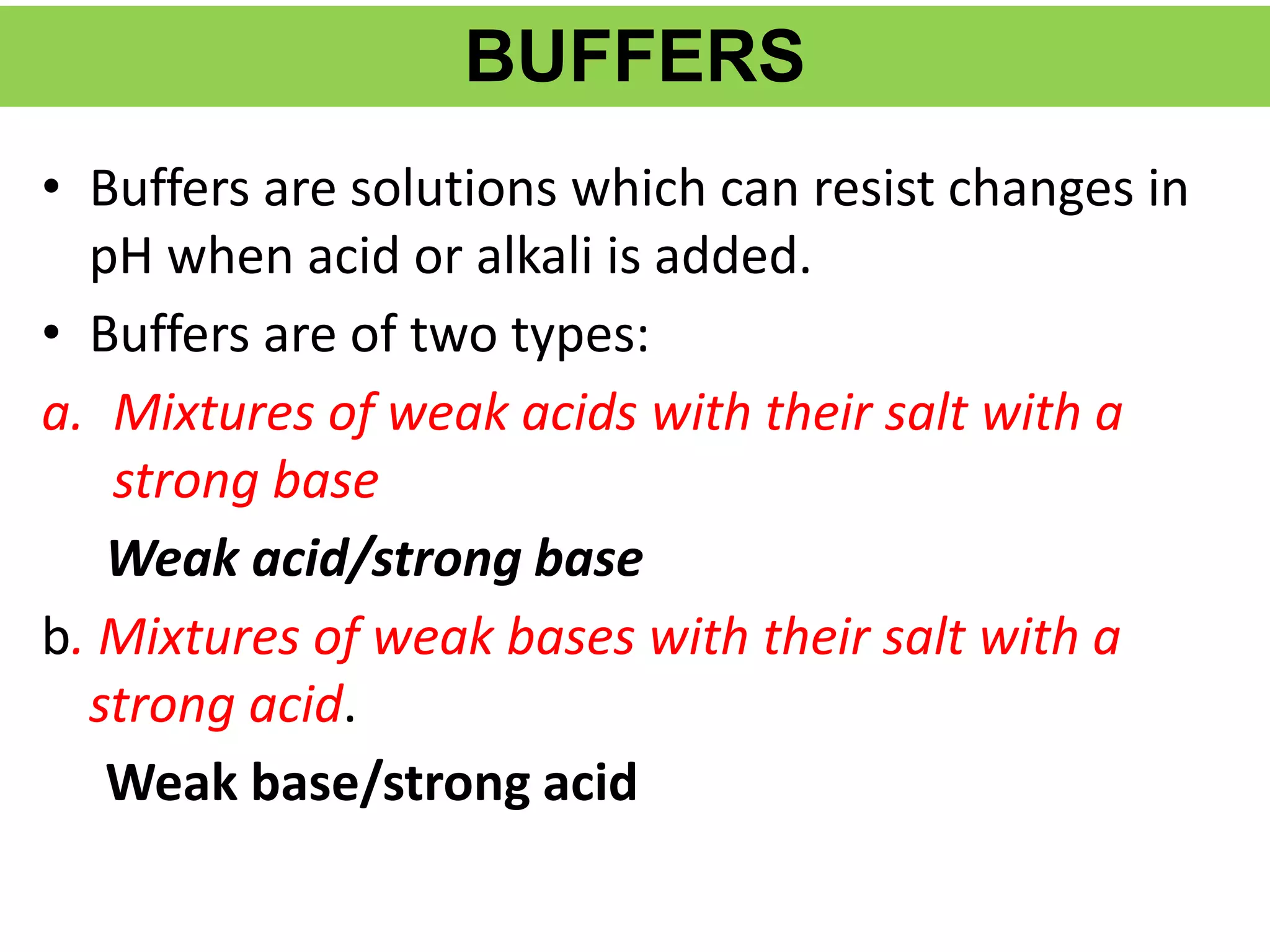
BUFFERS
• Buffers are solutions which can resist changes in
pH when acid or alkali is added.
• Buffers are of two types:
a. Mixtures of weak acids with their salt with a
strong base
Weak acid/strong base
b. Mixtures of weak bases with their salt with a
strong acid.
Weak base/strong acid
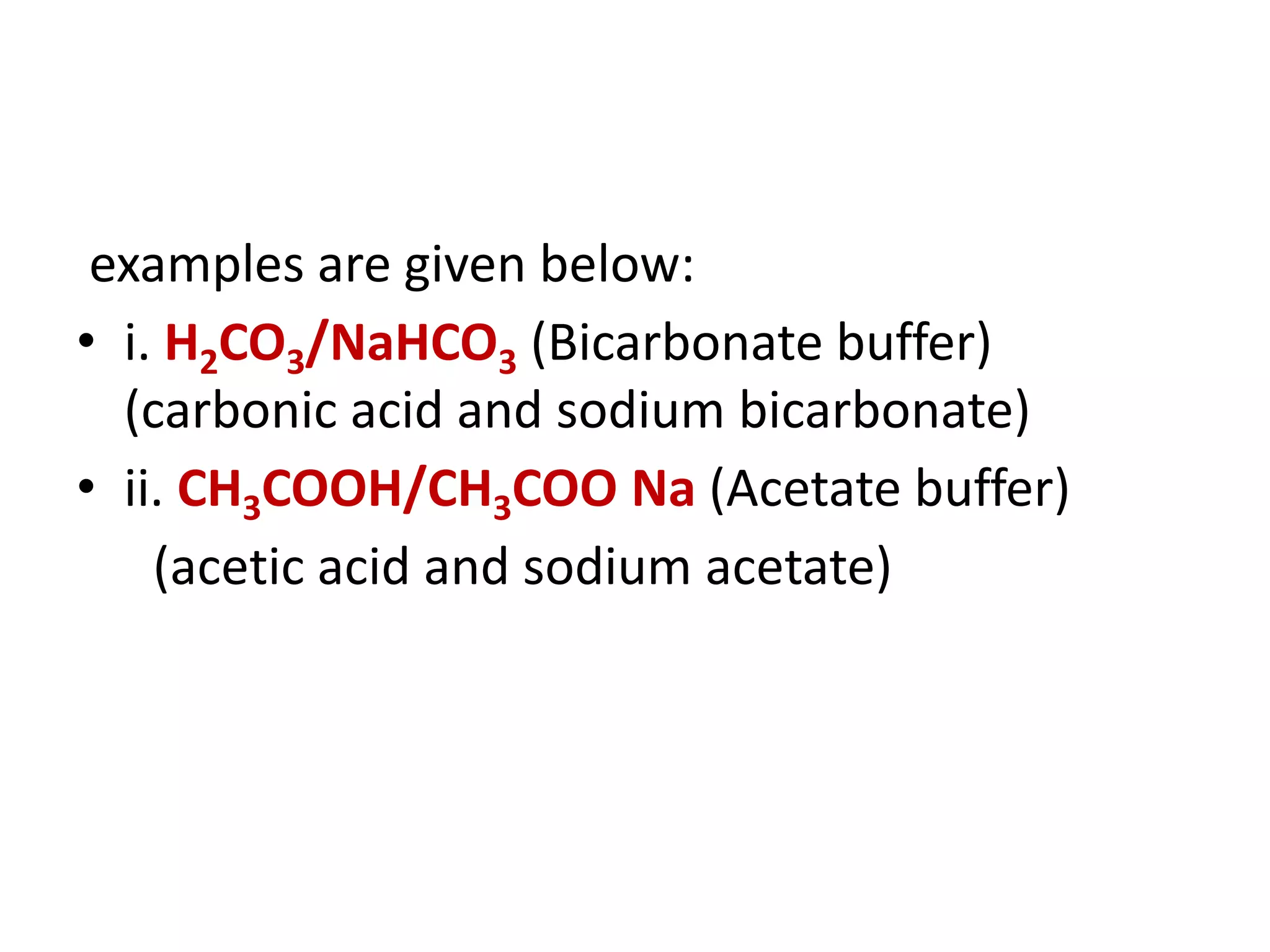
examples are given below:
• i. H2CO3/NaHCO3 (Bicarbonate buffer)
(carbonic acid and sodium bicarbonate)
• ii. CH3COOH/CH3COO Na (Acetate buffer)
(acetic acid and sodium acetate)
How do buffers act:
• CH3COOH + NaoH CH3COONa + H2o
• Weak Acid + base salt + water
• CH3COONa +HCL CH3COOH+ Nacl
• Salt +Acid weak acid + salt
BUFFERING CAPACITY
• The buffering capacity is determined by the
actual concentrations of salt and acid present, as
well as by their ratio.
• The buffering capacity of a buffer is defined as
the ability of the buffer to resist changes in pH
when an acid or base is added.
EFFECTIVE RANGE OF A BUFFER
• A buffer is most effective when the
concentrations of salt and acid are equal or
when pH = pKa.
• The effective range of a buffer is 1 pH unit
higher or lower than pKa.
• Phosphate buffer is effective at a wide range,
because it has 3 pKa values.
ACID-BASE BALANCE
• The pH of plasma is maintained within a narrow range of 7.35 to 7.45
• If the pH is below 7.35, it is called acidosis.
• Life is threatened when the pH is lowered below 7.25.
• Acidosis leads to CNS depression and coma. Death occurs when pH is
below 7.0.
CONTD…
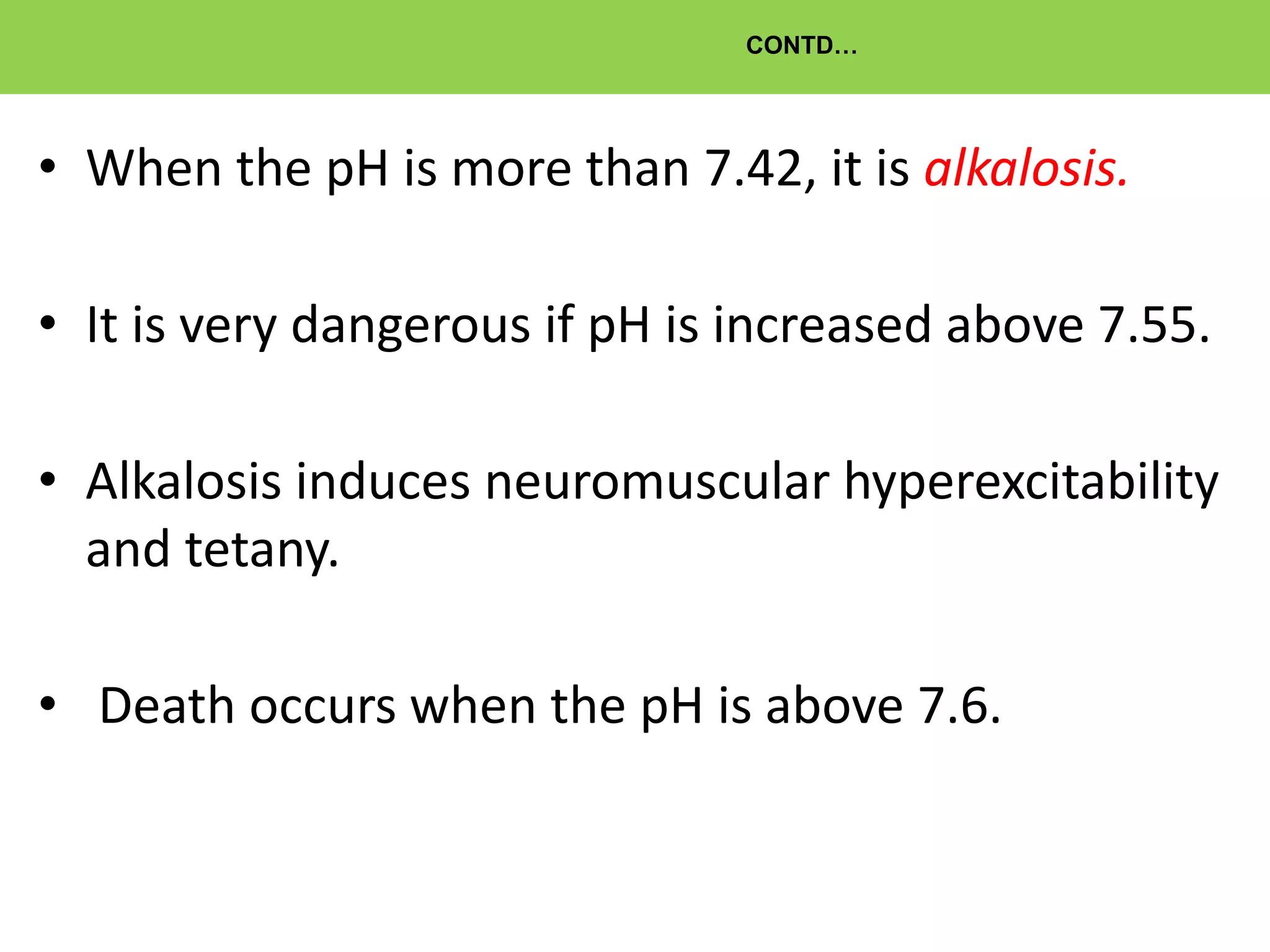
• When the pH is more than 7.42, it is alkalosis.
• It is very dangerous if pH is increased above 7.55.
• Alkalosis induces neuromuscular hyperexcitability
and tetany.
• Death occurs when the pH is above 7.6.
REGULATION
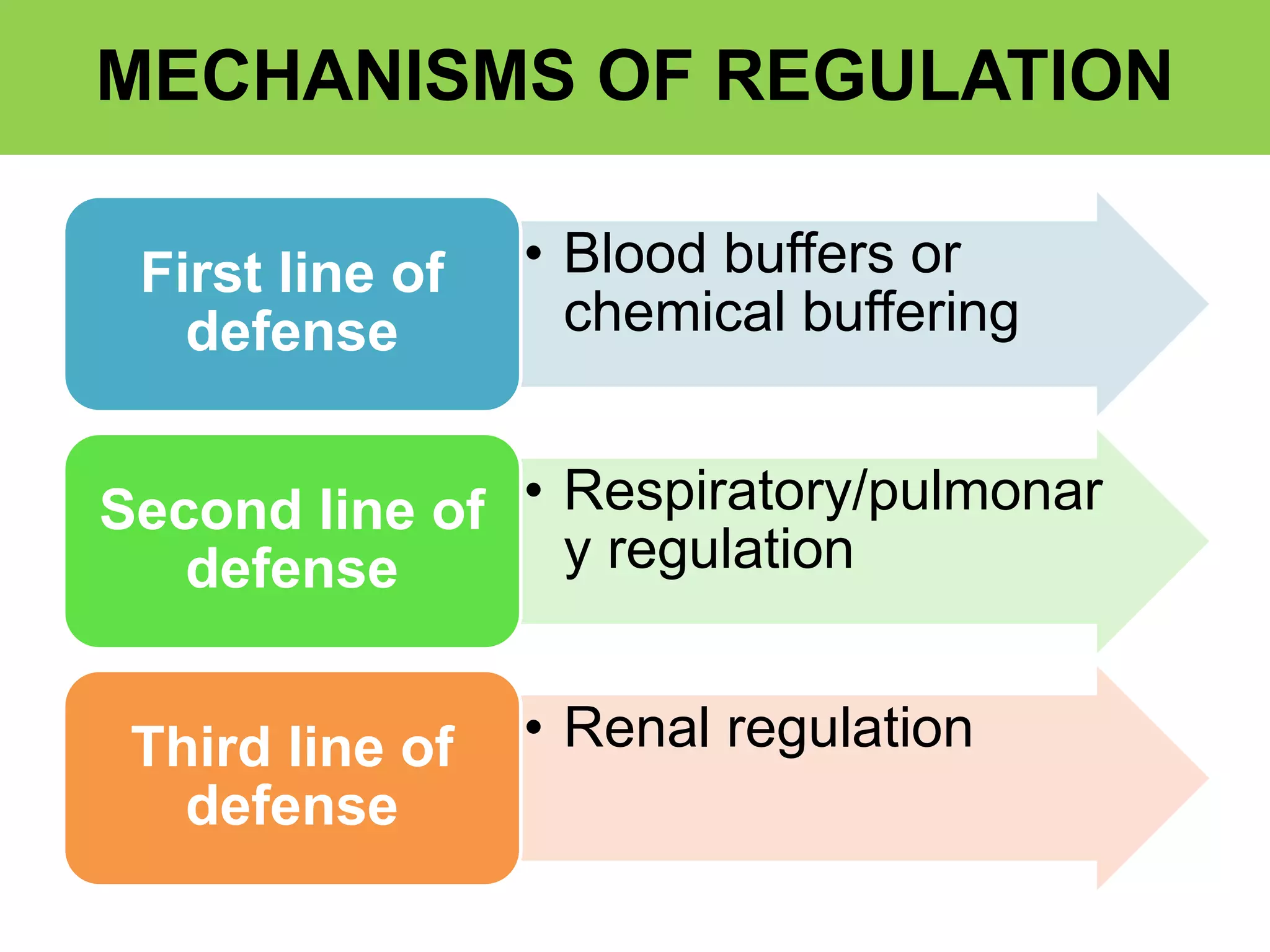
MECHANISMS OF REGULATION
• Blood buffers or
chemical buffering
First line of
defense
• Respiratory/pulmonar
y regulation
Second line of
defense
• Renal regulation
Third line of
defense
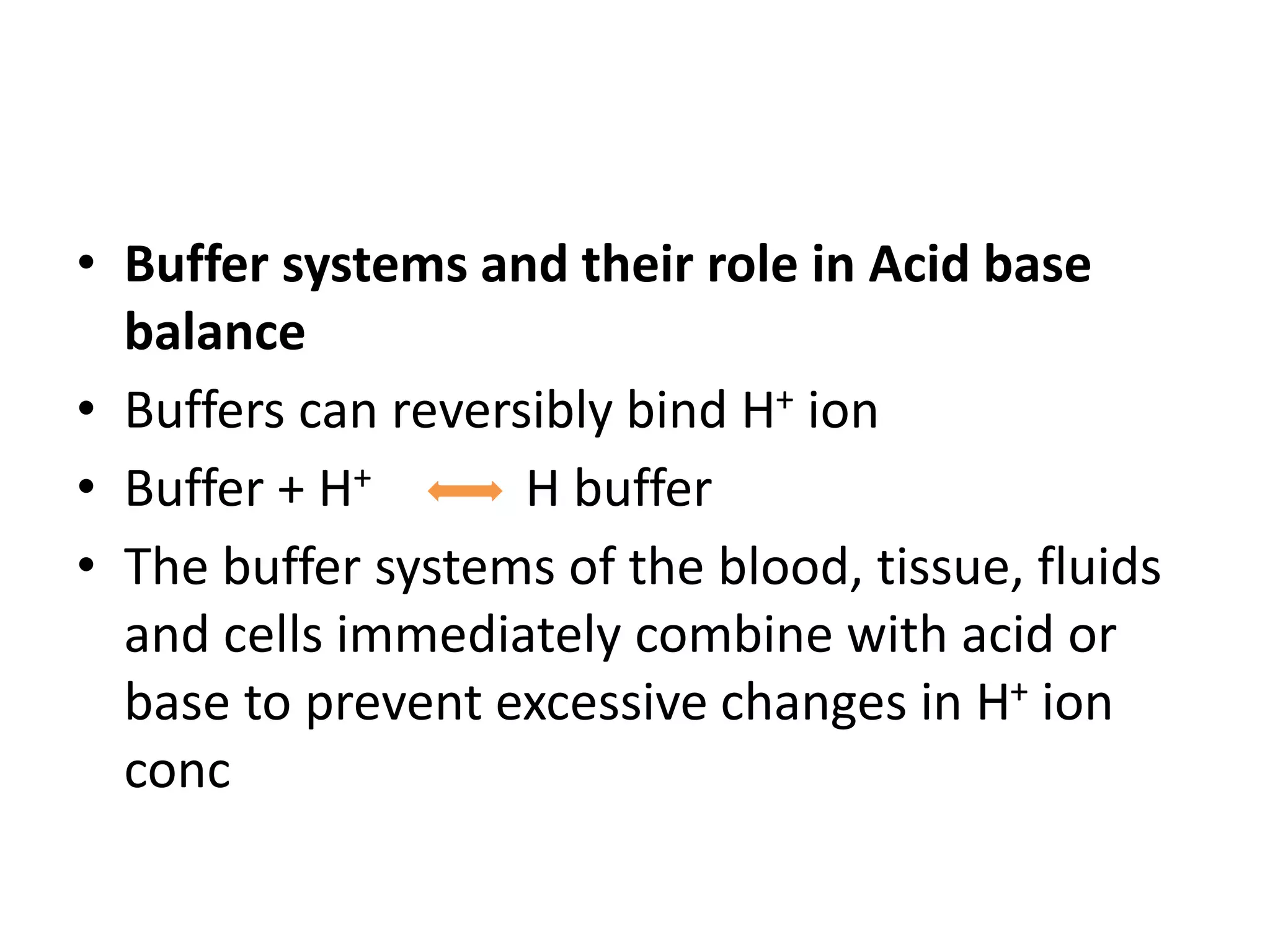
• Buffer systems and their role in Acid base
balance
• Buffers can reversibly bind H+ ion
• Buffer + H+ H buffer
• The buffer systems of the blood, tissue, fluids
and cells immediately combine with acid or
base to prevent excessive changes in H+ ion
conc
BLOOD BUFFERS
BICARBONATE BUFFER SYSTEM
• The most important buffer system in the plasma is the
bicarbonate-carbonic acid system (NaHCO3/H2CO3).
• It accounts for 65% of buffering capacity in plasma and
40% of buffering action in the whole body.
• The base constituent, bicarbonate (HCO3–), is regulated by
the kidney (metabolic component).
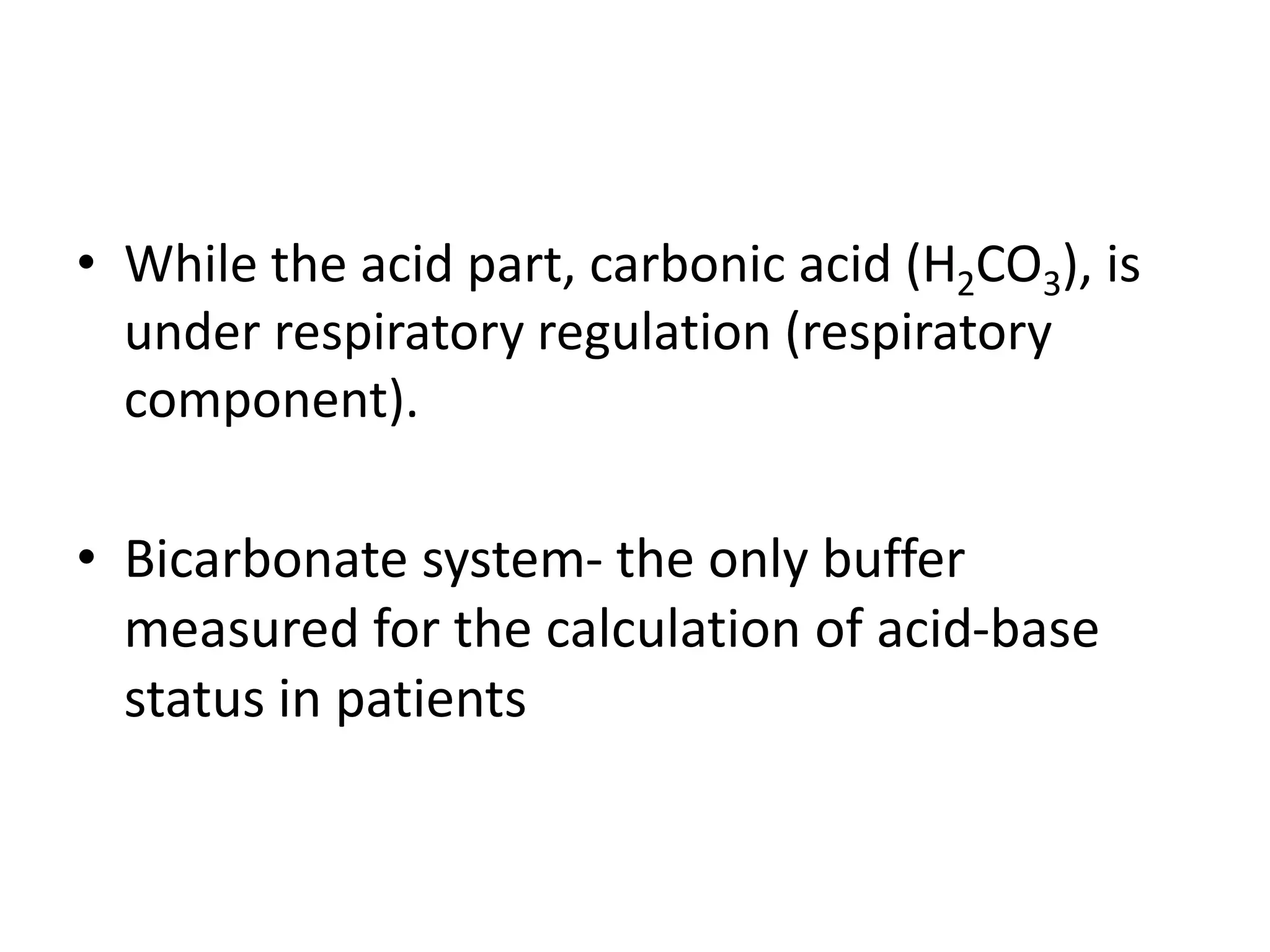
• While the acid part, carbonic acid (H2CO3), is
under respiratory regulation (respiratory
component).
• Bicarbonate system- the only buffer
measured for the calculation of acid-base
status in patients
• The normal bicarbonate level of plasma is 24
mmol/liter
• Normal pCO2 of arterial blood is 40mm of Hg
• Normal H2CO3 is 1.2mmol/L
• PKa of carbonic acid is 6.1
PH = Pka +log [HCO3
-]
H2CO3
• 7.4= 6.1 +log24 =20
1.2
Hence the ratio of HCO3 to H2CO3 at PH 7.4 is 20
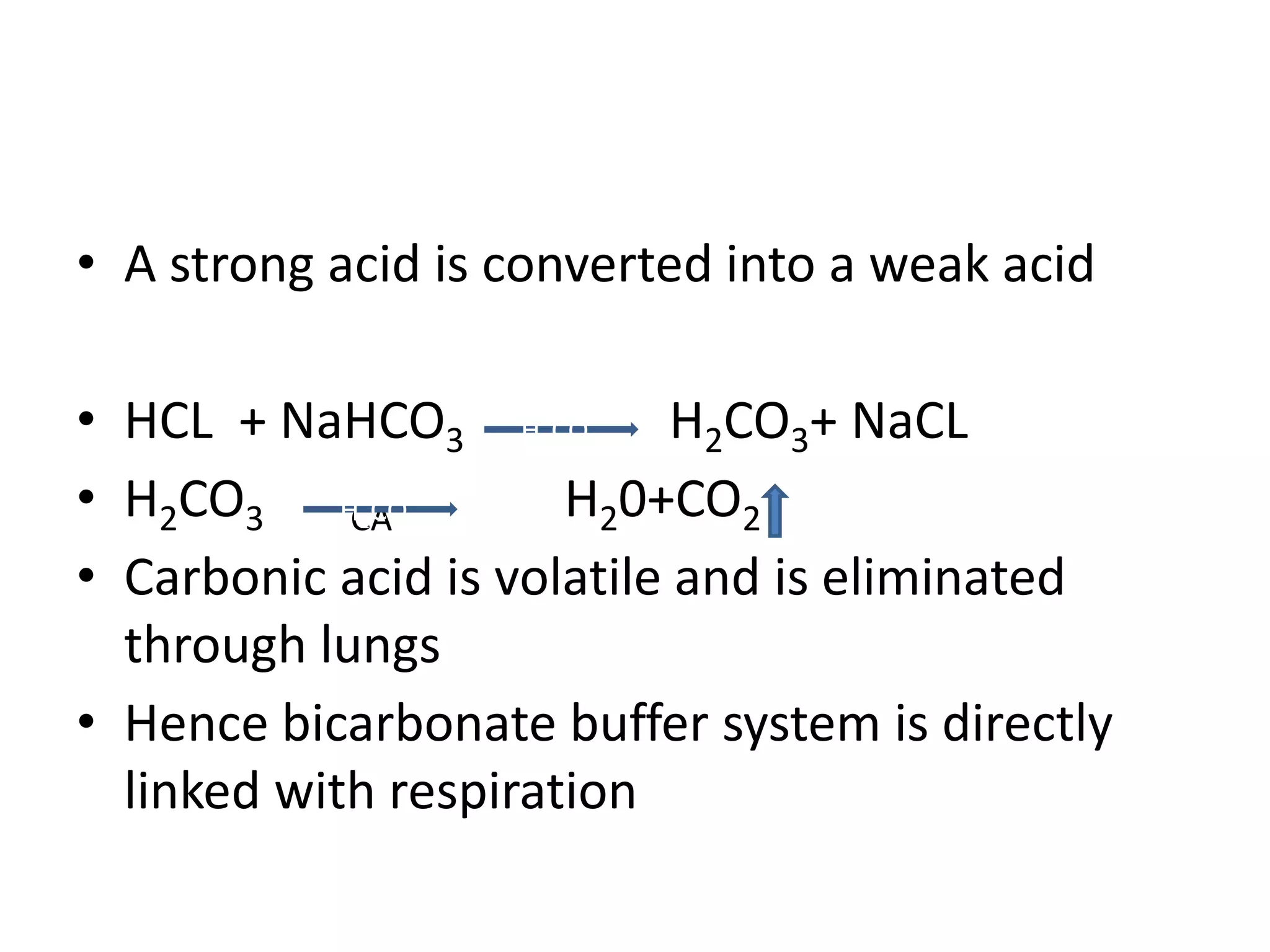
• A strong acid is converted into a weak acid
• HCL + NaHCO3 H2CO3+ NaCL
• H2CO3 CA H20+CO2
• Carbonic acid is volatile and is eliminated
through lungs
• Hence bicarbonate buffer system is directly
linked with respiration
H2CO3
H2CO3
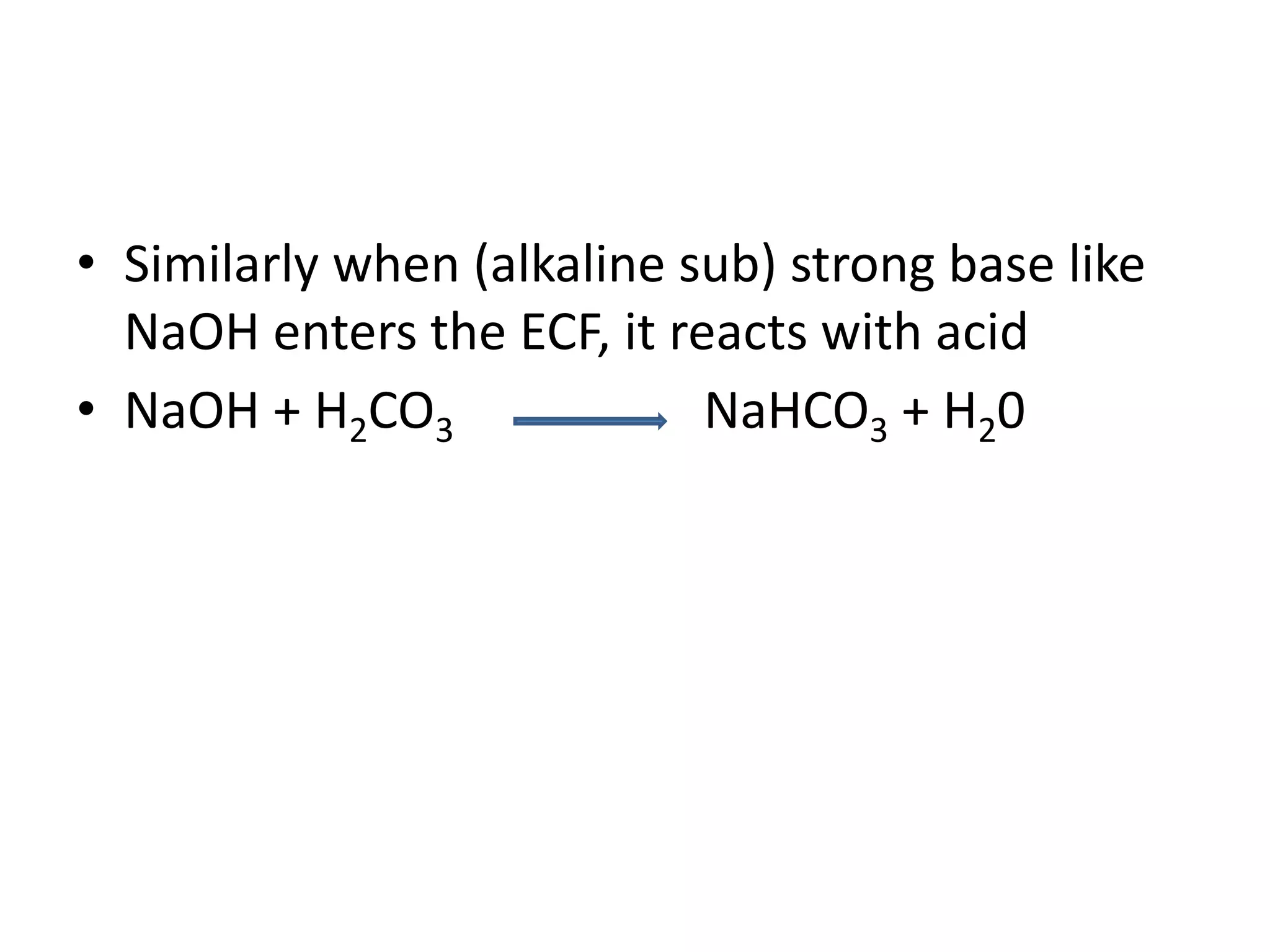
• Similarly when (alkaline sub) strong base like
NaOH enters the ECF, it reacts with acid
• NaOH + H2CO3 NaHCO3 + H20
ALKALI RESERVE
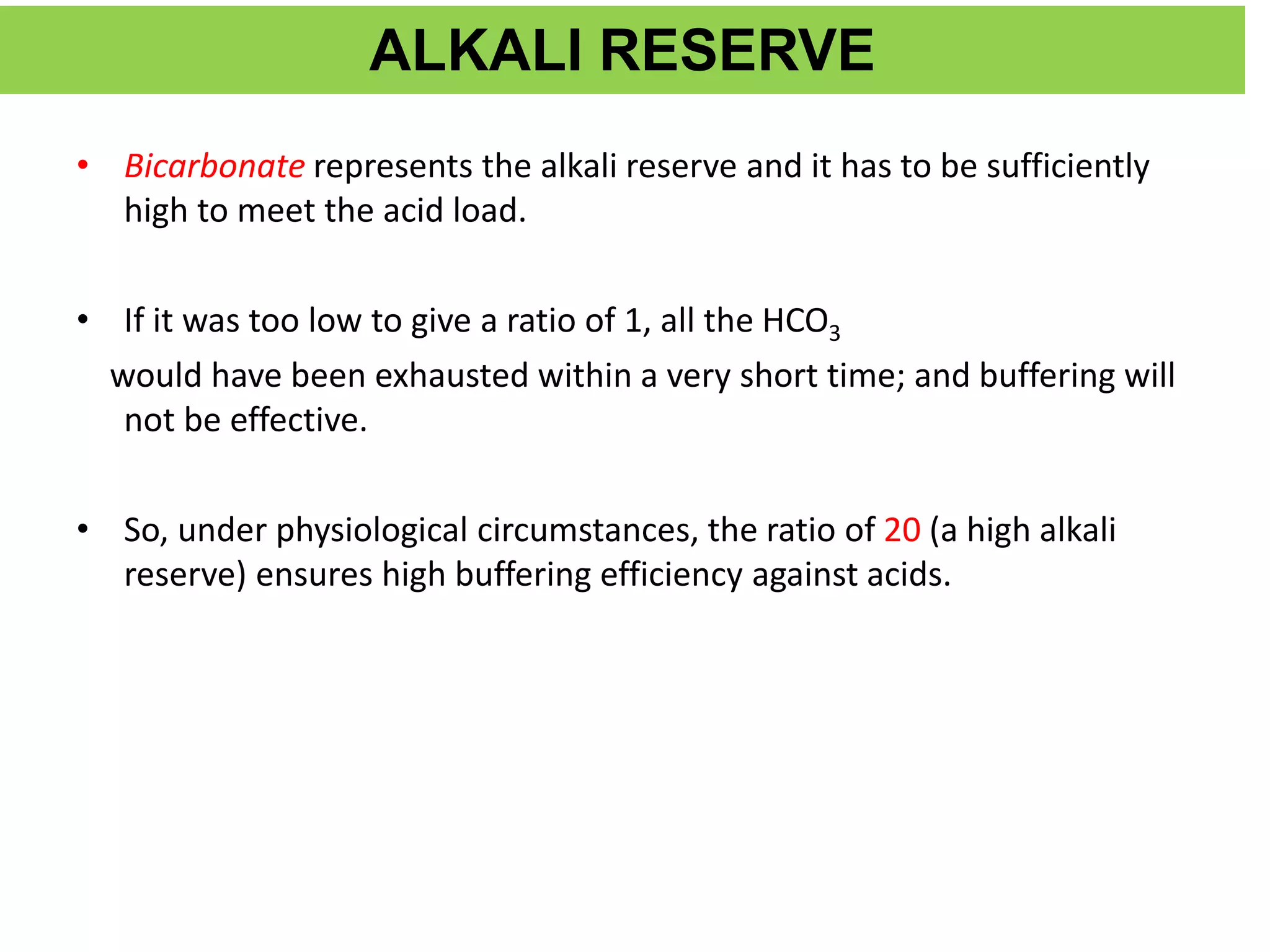
• Bicarbonate represents the alkali reserve and it has to be sufficiently
high to meet the acid load.
• If it was too low to give a ratio of 1, all the HCO3
would have been exhausted within a very short time; and buffering will
not be effective.
• So, under physiological circumstances, the ratio of 20 (a high alkali
reserve) ensures high buffering efficiency against acids.
The bicarbonate buffer is the most
important :
I. Presence of bicarbonate in relatively
high concentration.
II. The components are under
physiological control.
• Bicarbonate buffer – directly linked with respiration.
• Advantages:
• Present in highest concentration.
• Produces volatile CO2.
• Good physiological buffer.
• Disadvantages: It is weak chemical buffer since pKa
is further away from pH 7.4.
PHOSPHATE BUFFER SYSTEM
• It is mainly an intracellular buffer. Its concentration in plasma is very
low.
• The phosphate buffer system is found to be effective at a wide pH
range.
• The pKa value is 6.8
• In the body, Na2HPO4/NaH2PO4 is an effective buffer system, because
its pKa value is nearest to physiological pH.
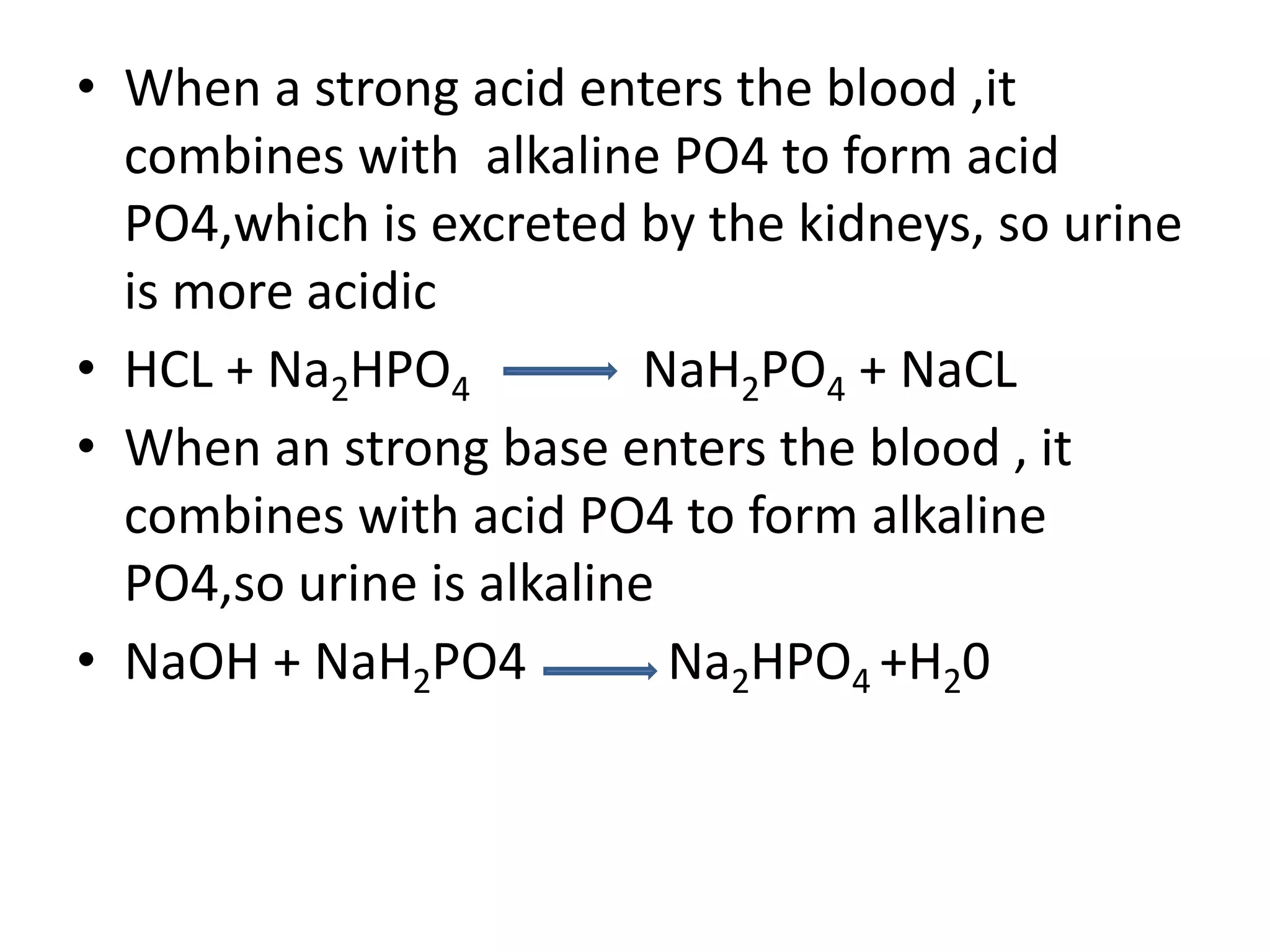
• When a strong acid enters the blood ,it
combines with alkaline PO4 to form acid
PO4,which is excreted by the kidneys, so urine
is more acidic
• HCL + Na2HPO4 NaH2PO4 + NaCL
• When an strong base enters the blood , it
combines with acid PO4 to form alkaline
PO4,so urine is alkaline
• NaOH + NaH2PO4 Na2HPO4 +H20
 Ratio: 4:1 kept constant by kidneys.
 Thus phosphate buffer system is directly linked up with kidneys
• Advantage: It is a good chemical buffer since pKa 6.8 (close to 7.4)
• Disadvantage: Concentration of phosphate buffer system in blood is low = 1 mmol
PROTEIN BUFFER
• Buffering capacity of protein depends on the pKa value of ionizable
side chains.
• The most effective group is histidine imidazole group with a pKa
value of 6.1
• The role of the hemoglobin buffer is considered along with the
respiratory regulation of pH
Relative Capacity of Buffer Systems
Buffers Act Quickly, But Not Permanently
• Buffers can respond immediately to addition of acid or
base, but they do not serve to eliminate the acid from
the body.
• They are also unable to replenish the alkali reserve of the
body.
• For the final elimination of acids, the respiratory and
renal regulations are very essential.
Hb buffer
• Hb Buffer:
First line of defence
• Intracellular buffer in RBC
• Important buffer to transport CO2 and O2
• Work effectively with the bicarbonate buffer
system
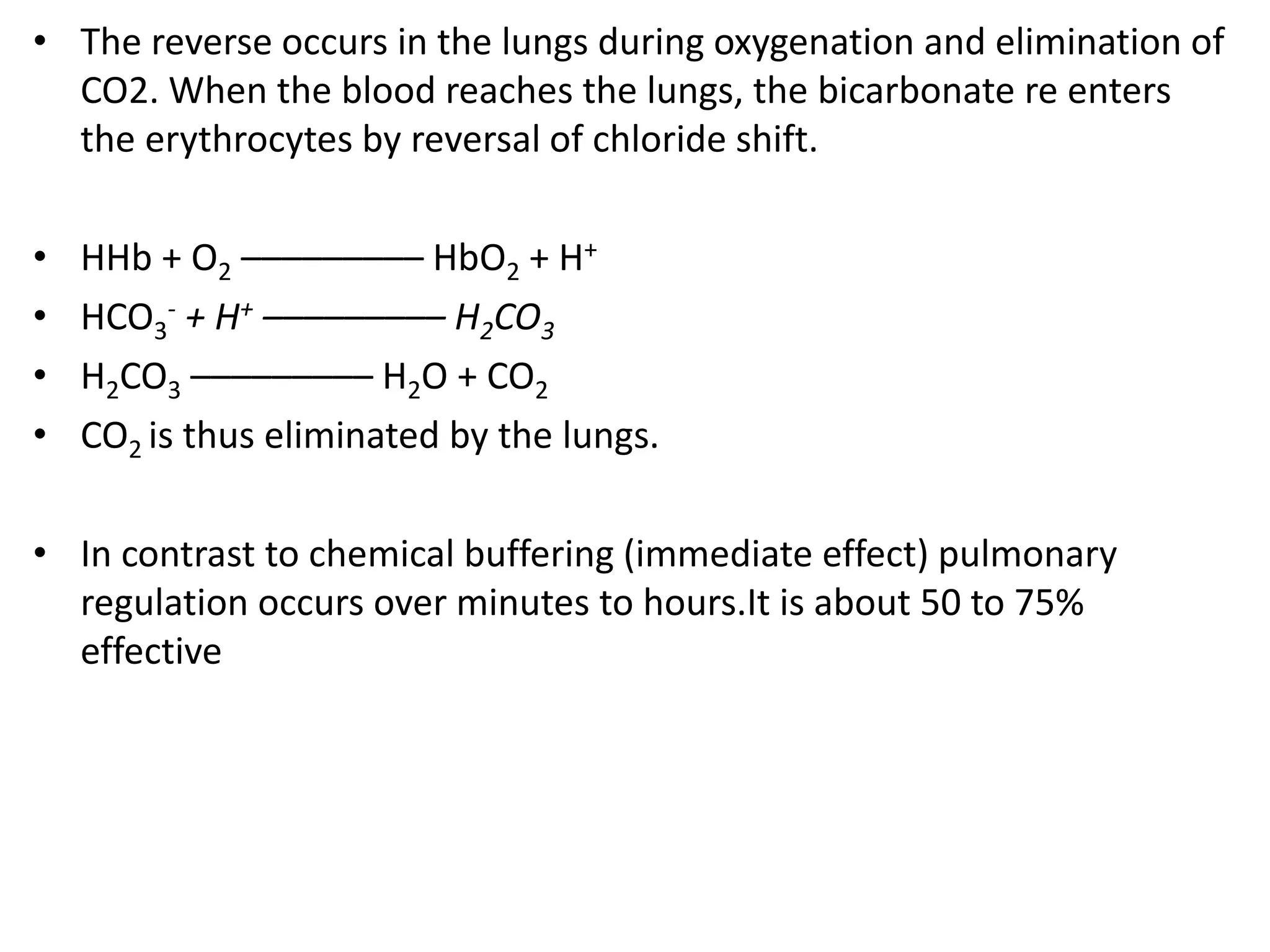
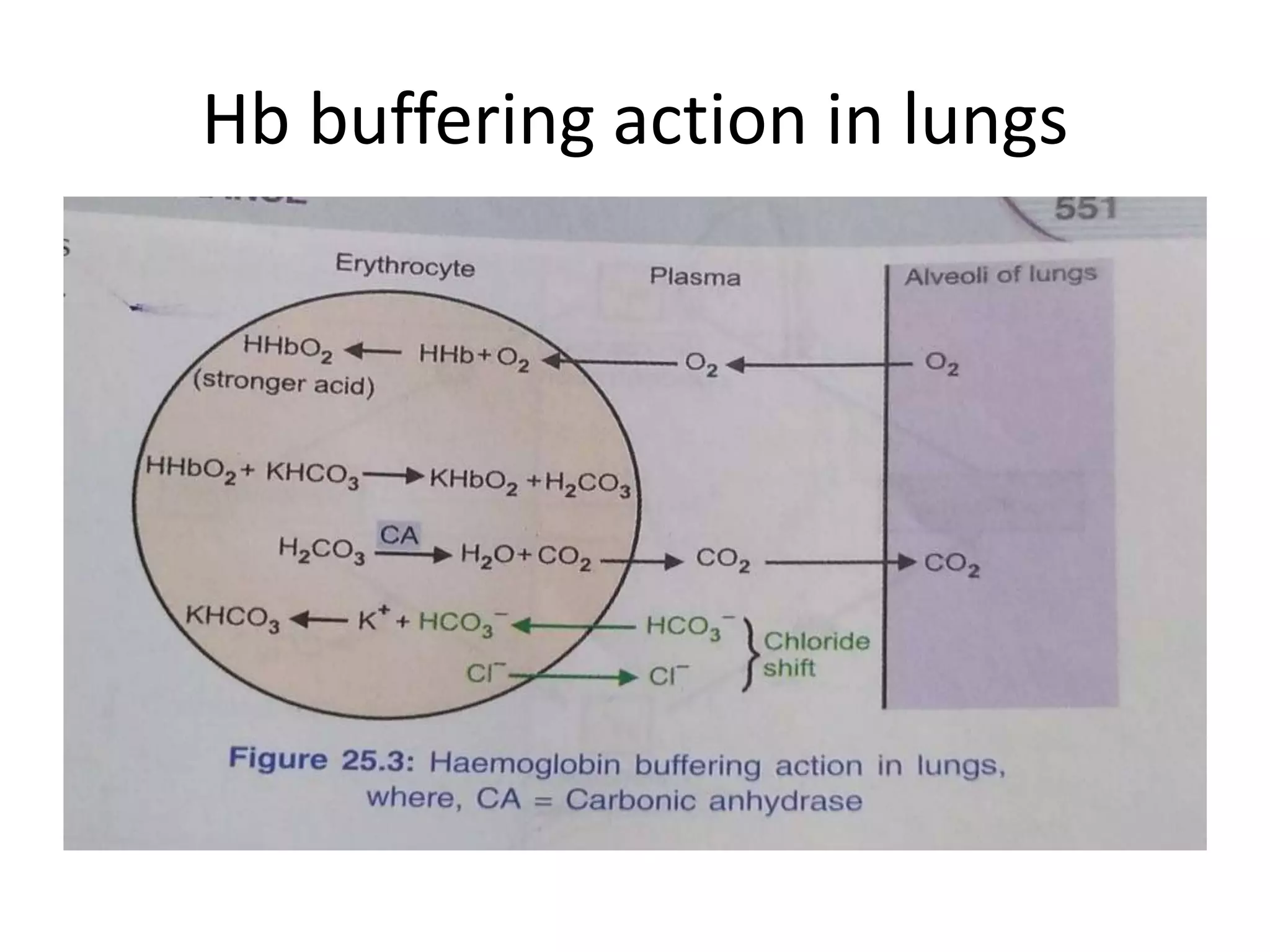
• The reverse occurs in the lungs during oxygenation and elimination of
CO2. When the blood reaches the lungs, the bicarbonate re enters
the erythrocytes by reversal of chloride shift.
• HHb + O2 ––––––––– HbO2 + H+
• HCO3
- + H+ ––––––––– H2CO3
• H2CO3 ––––––––– H2O + CO2
• CO2 is thus eliminated by the lungs.
• In contrast to chemical buffering (immediate effect) pulmonary
regulation occurs over minutes to hours.It is about 50 to 75%
effective
Hb buffering action in lungs
Hb buffering action in tissues
BLOOD
H2CO3
CO2 + H2O
H+
HCO-
3
HCO-
3
Carbonic
anhydrase
CO2
RBC
+ Hb
HHb
Cl-
Cl-
Chloride shift
• H2CO3 dissociates as HCO3 goes out to
plasma, chloride ions exchange to maintain
electrical neutrality and H+ combines with
hemoglobin to form HHb.
• This is referred to as chloride shift. Entire
process is known as isohydric transport of
CO2.
Respiratory mechanism in Acid- Base Balance
• Second line of defence
• Done by regulating the conc of carbonic acid
by the lungs
• The respiratory centre regulates the removal
or retension of CO2(H2CO3) from the ECF by
the lungs
Respiratory/Pulmonary Regulation
• This is achieved by changing the pCO2.
• The CO2 diffuses from the cells into the extracellular fluid and reaches the lungs through
the blood.
• The rate of respiration is controlled by the chemoreceptors in the respiratory center
which are sensitive to changes in the pH of blood
• A decrease in pH- sensed by arterial chemoreceptors, leads to increases in respiratory
rate; resulting in hyperventilation. This would eliminate more CO2, thus lowering the
H2CO3.
• The bicarbonate neutrilizes more than 50% of
acids
• HCO3
- +H+ H2CO3 H2O +CO2
• An increase in H+ or (H2CO3) stimulates the
respiratory centre to increase the rate and
depth of respiratory ventilation
• Similarly an increase in OH- or (HCO3
-)
depresses respiratory ventilation
• So changes in respiration will alter the HCO3-
/H2CO3 ratio and PH
• When the rate of ventilation is increased,
excess acid (H2CO3) in the form of CO2 is
quickly removed
• Similarly when the rate of ventilation is
decreased, acid(H2CO3) in the form of Co2 is
added to neutralize excess alkali(HCO3
-)
RENAL REGULATION
• An important function of the kidney is to
regulate the pH of the extracellular fluid.
• Normal urine has a pH around 6; this pH is lower
than that of extracellular fluid (pH = 7.4). This is
called acidification of urine.
Renal mechanisms
Renal mechanisms for regulation of pH are:
 Excretion of H+
Reabsorption of bicarbonate (recovery of
bicarbonate)
Excretion of titratable acid (net acid excretion)
Excretion of NH4+
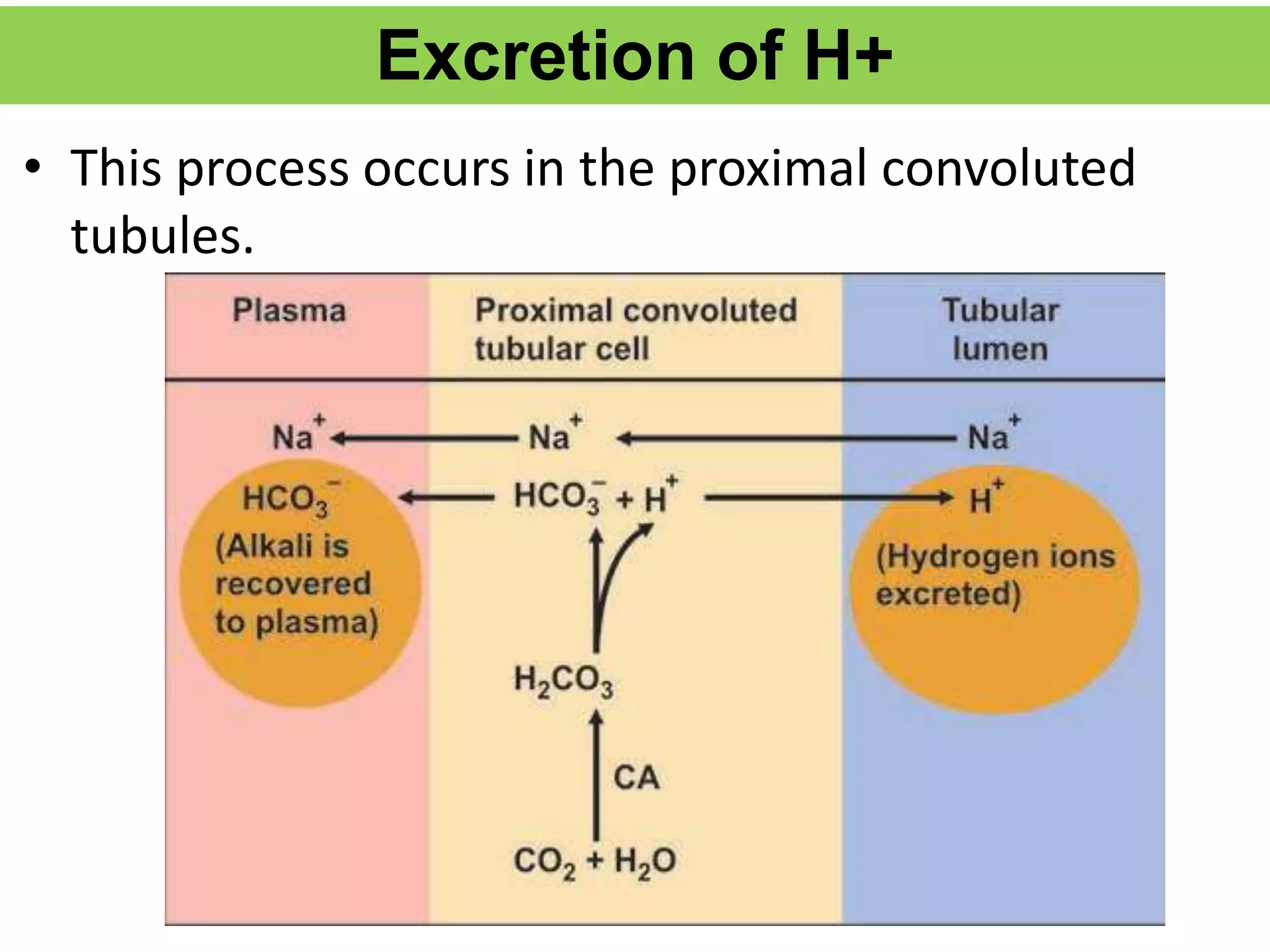
Excretion of H+
• This process occurs in the proximal convoluted
tubules.
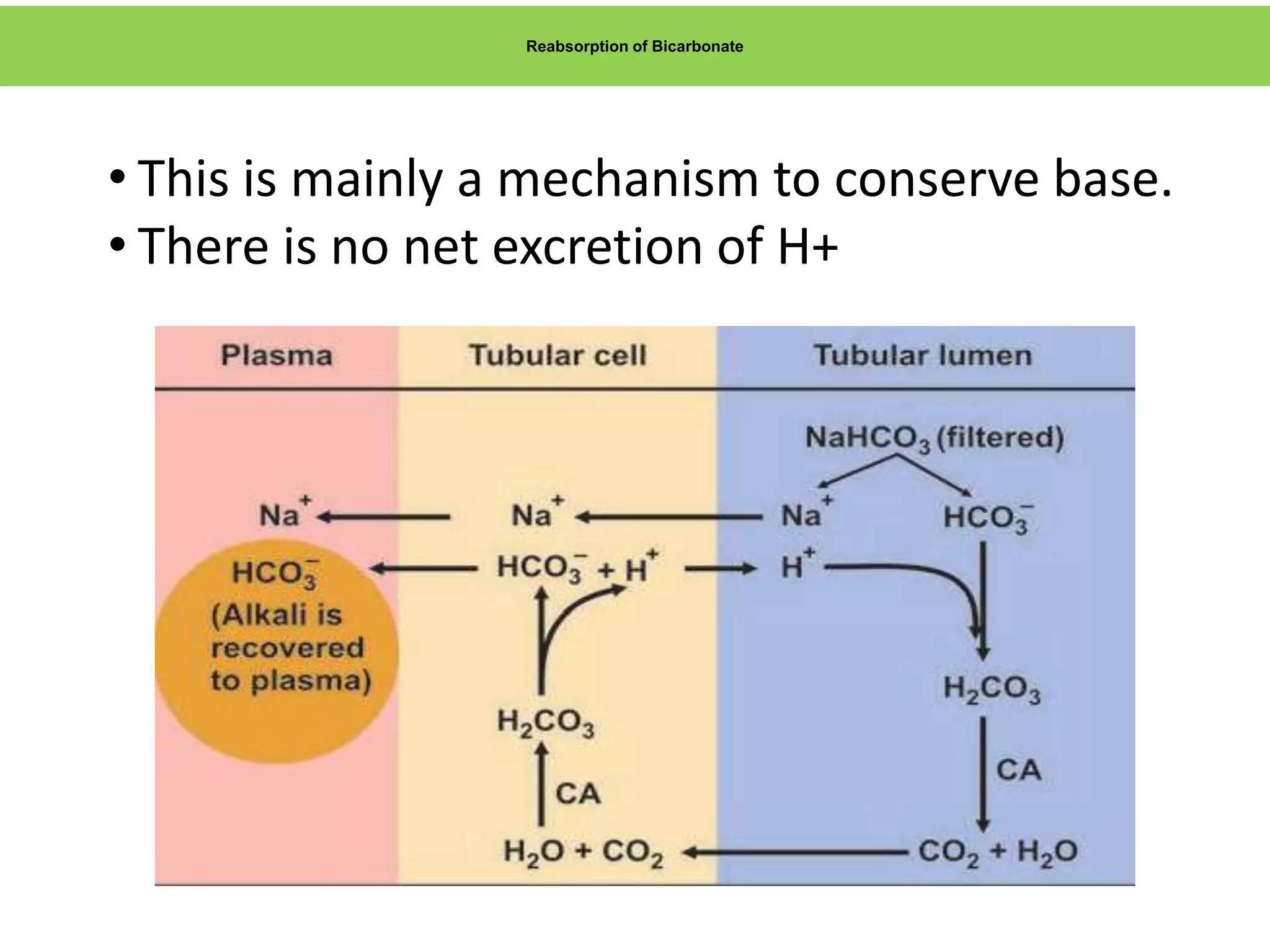
Reabsorption of Bicarbonate
• This is mainly a mechanism to conserve base.
• There is no net excretion of H+
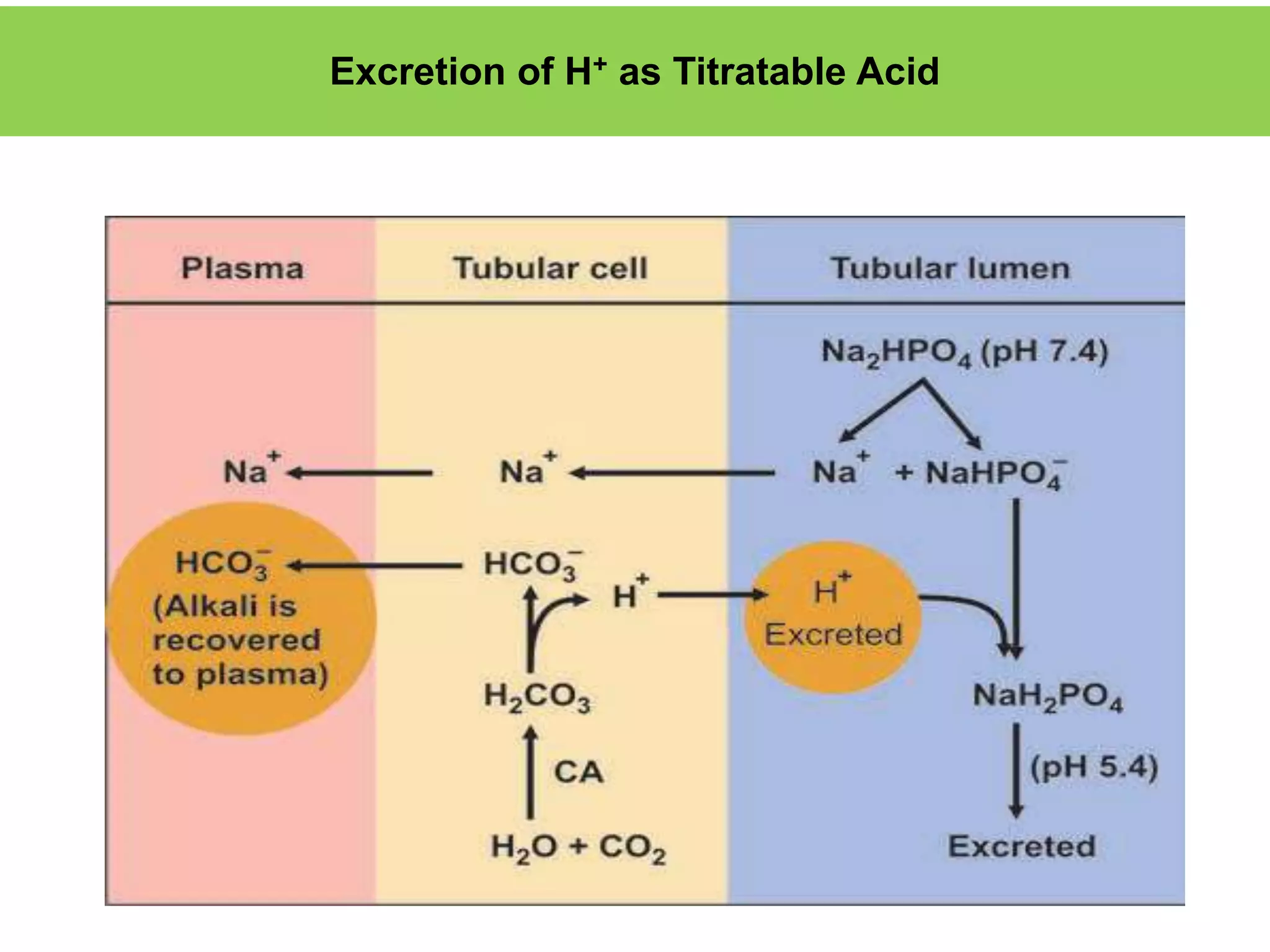
Excretion of H+ as Titratable Acid
• The major titratable acid present in the urine
is sodium acid phosphate.
• The term titratable acidity of urine refers to the number of
milliliters of N/10 NaOH required to titrate 1 liter of urine to
pH 7.4. This is a measure of net acid excretion by the kidney.
• The acid and basic phosphate pair is considered as the urinary
buffer. The maximum limit of acidification is pH 4.5.
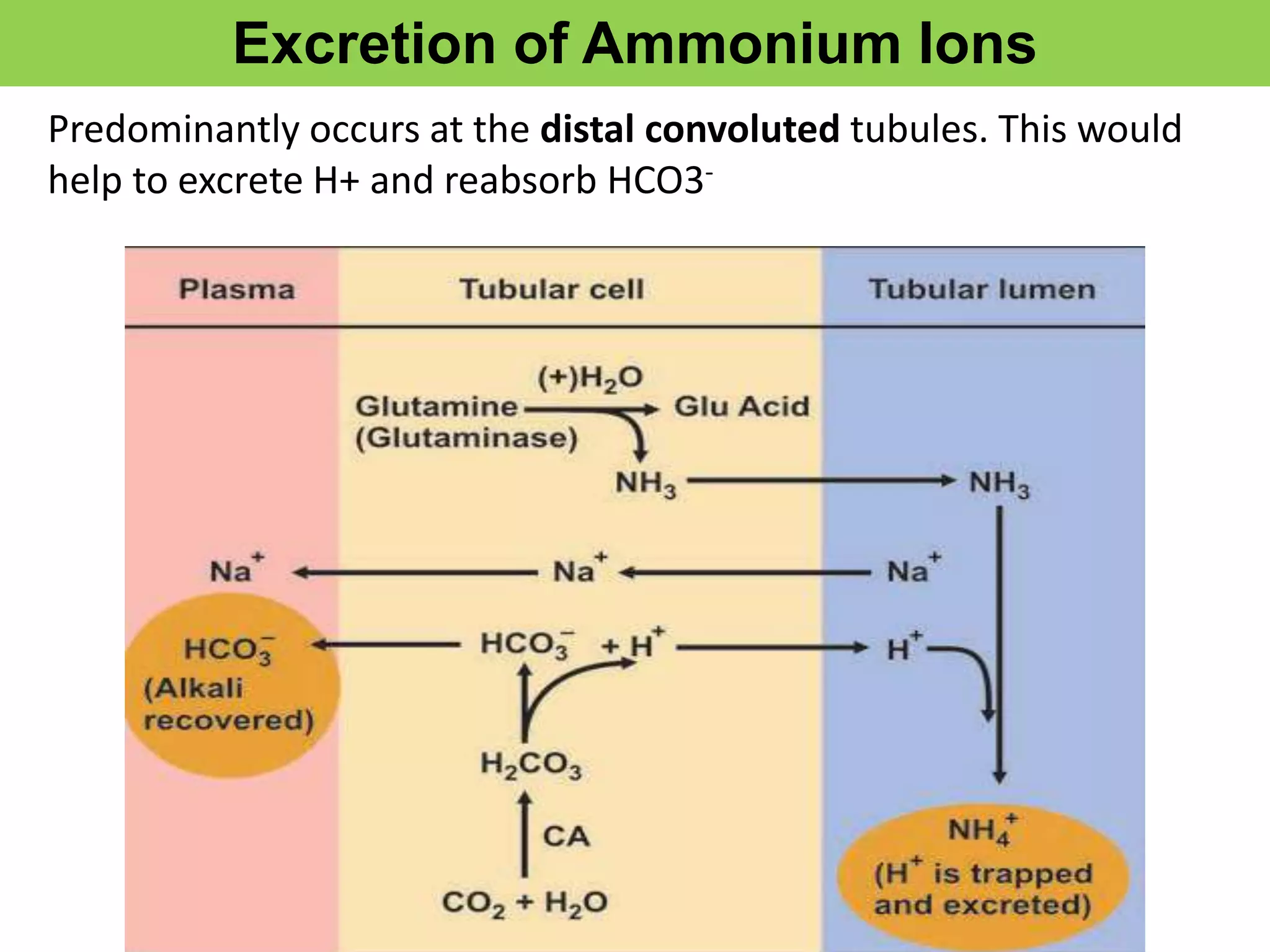
Excretion of Ammonium Ions
Predominantly occurs at the distal convoluted tubules. This would
help to excrete H+ and reabsorb HCO3-
• Normally, about 70 mEq/L of acid is excreted daily; but
in condition of acidosis, this can rise to 400 mEq/day.
• Factors Affecting Renal Acid Excretion:
• Increased filtered load of bicarbonate
• Decrease in ECF volume
• Decrease in plasma pH
• Increase in pCO2 of blood
• Hypokalemia
• Aldosterone secretion
ACID BASE DISORDERS
Types of acid–base disorders
• Two types of acid–base disorders: respiratory and
metabolic.
• Primary respiratory disorders: affect blood acidity by
causing changes in PCO2,
• Primary metabolic disorders: caused by disturbances in the
HCO3
– concentration.
• Acidosis is due to gain of acid or loss of alkali; causes may
be metabolic (fall in serum HCO3
–) or respiratory (rise in
PCO2).
• Alkalosis is due to loss of acid or addition of base and is
either metabolic (rise in HCO3
–) or respiratory (fall in PCO2).
COMPENSATORY RESPONSES TO ACID
BASE DISORDERS
RESPIRATORY COMPENSATION TO ACIDOSIS AND
ALKALOSIS
RESPONSE TO ACIDOSIS
In response to acid accumulation, ventilation is
increased(hyperventilation).
This lowers the pCo2 and this in turn reduces the H+
ion concentration driving the pH up.
 RESPONSE TO ALKALOSIS
Ventilation is inhibited(hypoventilation).
This brings the pH down.
• RENAL COMPENSATION TO ACIDOSIS AND ALKALOSIS
 RESPONSE TO ACIDOSIS
• Required no: of H+ ions are secreted by the tubular cells to
reabsorb all the filtered HCO3-.
• Tubular glutamine metabolism is enhanced resulting in more
NH4+ excretion.This process eliminates more H+ ions and also
contributes to new HCO3- to the plasma.
• RESPONSE TO ALKALOSIS
• Hydrogen ion concentration by the tubular cells is reduced.Hence
the of H+ ions is inadequate to reabsorb all the filtered HCO3- so
substantial quantities of HCO3- is excreted in urine.
• Tubular glutamine metabolism and ammonium excretion are
decreased.
• With reduced reabsorption and no addition of new HCO3- ,
plasma bicarbonate concentration is decreased thereby
compensating for the alkalosis.
Metabolic acidosis
• The low HCO3
– results from the addition of acids (organic or
inorganic) or loss of HCO3
–
Metabolic acidosis
Classified as increased anion gap or normal anion gap .
• High anion gap metabolic acidosis:
• Normal anion gap (hyperchloremic) metabolic acidosis:
Anions: 86%
• Cl- (95-105meq/l)
• HCO3
- (22-26meq/l)
• proteins, SO4
2-, HPO4
2- (unmeasured anions)
Cations : 95%
• Na+ (136-145meq/l)
• K+ (3.5-5meq/l)
• Ca+
• Mg+ unmeasured cations
Anion gap
• The sum of cations and anions in ECF is always equal, so as
to maintain the electrical neutrality.
• Sodium and potassium together account for 95% of the
cations whereas chloride and bicarbonate account for only
86% of the anions. Only these electrolytes are commonly
measured.
• There is always a difference between the measured cations
and the anions.This apparent gap is due to unmeasured
anions (e.g. proteins, SO4
2-, HPO4
2-) present in plasma.
• So the difference between unmeasured anions
and unmeasured cations is called Anion gap
• The anion gap is calculated as the difference between (Na+ + K+) and (HCO3–
+ Cl–).
• Normally this is about 12 mmol/liter.(8-16)
• Anion gap- increased (>12 mmol/L) in metabolic acidosis due to
consumption of bicarbonate in buffering excess acid.
• Remains normal in some cases: more Cl- ions are reabsorbed to maintain
electrical neutrality, hence there is hyperchloremia if anion gap is normal
Metabolic Acidosis is of two types:
• Normal anion gap metabolic acidosis
• High anion gap metabolic acidosis
K
Na+
HCO3-
Cl-
Unmeasured Anions
Cations Anions
Cations
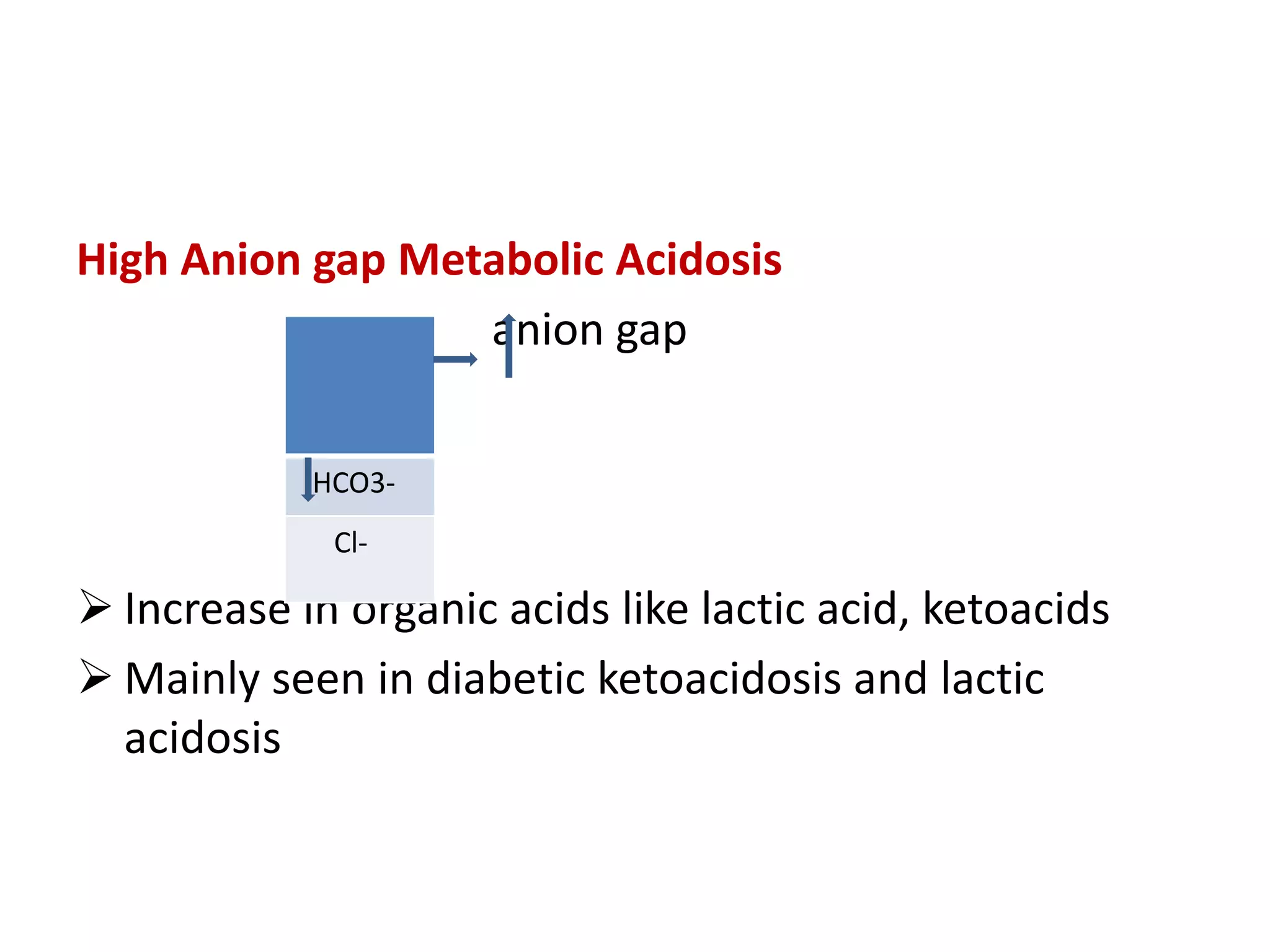
High Anion gap Metabolic Acidosis
anion gap
 Increase in organic acids like lactic acid, ketoacids
 Mainly seen in diabetic ketoacidosis and lactic
acidosis
HCO3-
Cl-
• High Anion gap Metabolic Acidosis
• D-Diabetic ketoacidosis
• R-Renal failure
• M-methanol Toxicity
• A-alcoholic ketoacidosis
• P-paracetomol poisoning
• L-Lactic acidosis
• E- Ethylene glycol poisoning
• S- Salicylate Toxicity
High anion gap metabolic
acidosis(HAGMA)
A value between 15 and 20 is accepted as
reliable index of accumulation of acid anions in
metabolic acidosis (HAGMA).
Normal anion gap metabolic acidosis(NAGMA)
• When there is a loss of both anions and cations, the
anion gap is normal, but acidosis may prevail.
• Also known as hyperchloremic normal Anion gap acidosis
• Increased Cl- ions to maintain electrical neutrality
Causes
• Severe diarrohea
• Renal tubular acidosis
Normal
HCO3
-
Cl-
Normal anion gap metabolic acidosis
• Severe diarrhoea(loss of HCO3-, Na+ and K+)
• gastrointestinal fluid loss
• Pancreatitis
• Renal tubular acidosis(defect in the
reabsorption of HCO3
-
Metabolic acidosis
• Decrease in PH due to decrease in bicarbonate
in blood
Due to
• Production of acid
• Loss of bicarbonate(GIT,Kidney)
• Retention of acid by kidney
• Production of acid is seen in
• Uncontrolled diabetic ketoacidosis-ketoacids
• Lactic acidosis-lactic acid
• Vigourous exercise-
• shock
Loss of bicarbonate(GIT,Kidney)
• Severe diarrhea(GIT)
• Kidney(RTA secretion defect in H+)
Retention of acid by kidney
• Chronic renal failure
• Features of metabolic acidosis:
• Primary defecit-loss of HCO3-
HCO3
-
H2CO3
• Compensatory mechanism in metabolic acidosis
• PH H+ Respiratory centre in brain-
hyperventilation PCO2 is eliminated by lungs
• So the ratio can be restored
• Kidney- excretion of acids and urinary ammonia
HCO3
-
H2CO3
COMPENSATED METABOLIC ACIDOSIS
• Decrease in pH in metabolic acidosis stimulates the
respiratory compensatory mechanism and produces
hyperventilation— Kussmaul respiration to eliminate carbon
dioxide leading to hypocapnia.
• Renal compensation: Increased excretion of acid and
conservation of base occurs.
• Na-H exchange, NH4+ excretion and bicarbonate
reabsorption are increased.
• As much as 500 mmol acid is excreted per day.
The reabsorption of more bicarbonate also helps
to restore the ratio to 20.
• Renal compensation sets in within 2 to 4 days. If
the ratio is restored to 20, the condition is said to
be fully compensated.
• Associated hyperkalemia is commonly seen due
to a redistribution of K+ and H+.
• The intracellular K+ comes out in exchange for H+
moving into the cells. Hence care should be taken
while correcting acidosis which may lead to
sudden hypokalemia. This is more likely to
happen in treating diabetic ketoacidosis by
insulin therapy.
CLINICAL FEATURES
• The respiratory response to metabolic acidosis is
to hyperventilate. So there is marked increase in
respiratory rate and depth of respiration; this is
called as Kussmaul respiration.
• The acidosis is said to be dangerous when pH is
<7.2 and serum bicarbonate is <10 mmol/L. In such
conditions, there is depressed myocardial
contractility.
MANAGEMENT
• Treatment is to stop the production of acid.
• Identifying and treating the underlying cause.
• This includes treatment of diabetes, control of diarrhea,etc.
• In patient with lactic acidosis, oxygen is given.
• Generous administration of IV fluids – sodium and water loss.
• When the underlying cause is unidentified and
the acidosis is severe , intravenous
bicarbonate administration can be considered.
• In all cases, potassium abnormalities should
be carefully looked into and treated.(Risk of
hypokalemia)
Metabolic alkalosis
• Characterized by a primary increase in serum [HCO3
-].
• Alkalosis occurs when:
 Excess base is added
 Acid is lost.
• All these will lead to an excess of bicarbonate, so that the
ratio becomes more than 20.
Causes of metabolic alkalosis
• Chloride responsive metabolic alkalosis: Prolonged
vomiting or naso gastric suction (loss of hydrogen and Cl
ions), pyloric or upper duodenal obstruction etc
• Chloride resistant metabolic alkalosis: Mineralocorticoid
excess (primary & secondary hyperaldosteronism),
glucocorticoid excess (Cushing syndrome), Bartter’s
syndrome (defective renal Cl reabsorption at loop of
henle) etc.
• Exogenous base excess: Bicarbonate containing
intravenous fluid therapy, antacids, etc.
Clinical Features
• The respiratory center is depressed by the high
pH leading to hypoventilation. This would result
in accumulation of CO2 in an attempt to lower
the HCO3–/H2CO3 ratio.
• However, the compensation is limited by the
hypoxic stimulation of respiratory center, so that
the increase in PaCO2 is not above 55 mm Hg
• The renal mechanism is more effective which conserves
H+ and excretes more HCO3–.
• However, complete correction of alkalosis will be effective
only if potassium is administered and the cause is
removed.
• Increased neuromuscular activity is seen when pH is
above 7.55. Tetany results even in the presence of normal
serum calcium.
Base excess (range: -3 to +3)
• Used for the assessment of the metabolic
component of acid-base disorders, indicates
whether the patient has metabolic acidosis or
alkalosis.
• A negative base excess indicates- metabolic
acidosis (primary or secondary to respiratory
alkalosis).
• A positive base excess indicates- metabolic alkalosis
(primary or secondary to respiratory acidosis).
Respiratory acidosis
• Characterized by CO2 retention ( H2CO3)due to impaired alveolar
ventilation.
Factors causing respiratory acidosis
• Conditions that directly depress the respiratory center: Drugs (narcotics,
sedatives etc), CNS disorders (trauma, tumours etc), comatose states etc
• Conditions that affect the respiratory apparatus: Chronic obstructive
pulmonary diseases, pulmonary fibrosis, acute respiratory distress
syndrome (ARDS) pneumothorax,bronchitis,pneumonia,neurological
disorders affecting the muscles of respiration etc.
COMPENSATION
• Renal response compensates for respiratory
acidosis.
• More bicarbonate is generated by the kidneys
and added to the alkali reserve of the body.
• The excretion of H+ ions by various mechanisms
are also increased.
MANAGEMENT
• Involves correction of causative factors.
• The general principle of treating respiratory
acidosis is to improve alveolar ventilation and
lower the pCo2.
Respiratory alkalosis
• Primary deficit of carbonic acid is described as the respiratory
alkalosis.
• Hyperventilation will result in washing out of CO2. So, bicarbonate :
carbonic acid ratio is more than 20.
Factors causing respiratory alkalosis
• Non Pulmonary stimulation of respiratory centre: Anxiety, hysteria,
febrile states, meningitis, encephalitis, intracranial surgery etc
• Pulmonary disorders: Pulmonary embolism, interstitial lung disease
• Ventilator induced hyperventilation
• Clinically, hyperventilation, muscle cramps,
tingling and paraesthesia are seen.
• Alkaline pH will favor increased binding of
calcium to proteins, resulting in a decreased
ionized calcium.
COMPENSATION
• Renal mechanisms ensure the urinary excretion
of HCO3-.
• There is fall in HCO3-level as a compensatory
response by the kidneys to handle alkalosis.
MANAGEMENT
• Include correcting the underlying the causes,
alleviating anxiety.
• In acute cases, the patient is subjected to a re-
breathing into a closed bag to allow CO2 levels to
rise.
TYPES OS ACID BASE DISORDERS
DISORDER pH PRIMARY
CHANGE
RATIO COMPENSATION
Metabolic
acidosis
DEFICIT OF
HCO3
-
<20 PCO2
Metabolic
alkalosis
EXCESS OF
HCO3
-
>20 PCO2
Respiratory
acidosis
EXCESS OF
H2CO3
<20 HCO3
-
Respiratory
alkalosis
DEFICIT OF
H2CO3
>20 HCO3
-
BLOOD GAS ANALYSIS
• Arterial blood gas test measures the dissolved oxygen and
carbon dioxide in the arterial blood
• Reveals the acid-base state and how well the oxygen is
being carried to the body.
• The pH is the measurement of free H+ ion concentration in
circulating blood.
• Blood gas analyzers directly measure pH and PCO2, and the
HCO3
– value is calculated from the Henderson–Hasselbalch
equation:
pH= 6.1 + log [HCO3
-/0.3 x PCO2]
Normal blood gas analysis
pH 7.38–7.42
PaO2 80–100 mmHg
PCO2 35-45 mmHg
HCO3
- 22–26 mEq/L
O2 saturation 96%–100%
Standard bicarbonate (bicarbonate at normal temperature and
PCO2)
An excellent measurement of the metabolic component.
Defined as the bicarbonate concentration under standard
conditions: PCO2 = 40 mmHg, and 37oC
Interpretation of ABG report
• pH: First step; look whether there is acidemia (<7.35)
or alkalemia (>7.45).
• HCO3- levels: Levels <22 mEq/L in presence of acidosis
imply metabolic acidosis. Bicarbonate levels >28
mEq/L in presence of alkalosis imply metabolic
alkalosis.
• PCO2 levels: PCO2 levels >45 mmHg in presence of
acidosis imply respiratory acidosis. PCO2 levels <35
mmHg in presence of alkalosis imply respiratory
alkalosis.
• Respiratory compensation occurs for a metabolic acid-
base disturbance and vice versa- PCO2 & HCO3
- move in
the same direction
• If HCO3
- decreases (metabolic acidosis) then PCO2 also
decreases (respiratory compensation)
• If PCO2 increases (respiratory acidosis), HCO3
- also
increases (metabolic compensation)
Interpretation of ABG report
BASE EXCESS (RANGE: -3 TO +3)
• Used for the assessment of the metabolic
component of acid-base disorders, indicates
whether the patient has metabolic acidosis or
alkalosis.
• A negative base excess indicates- metabolic
acidosis (primary or secondary to respiratory
alkalosis).
• A positive base excess indicates- metabolic alkalosis
(primary or secondary to respiratory acidosis).
Following is the arterial blood gas (ABG) report of a 24 yrs
hyperventilating female who presented to the hospital with hysteria
– pH: 7.55
– PCO2: 27 mm Hg
– PO2: 105 mm Hg
– HCO3: 19 mEq/L
Question: Which acid-base imbalance is the patient suffering from?
Justify
Question: Which acid-base imbalance is characterized by CO2 retention
due to ventilatory failure?
CASE REPORTS
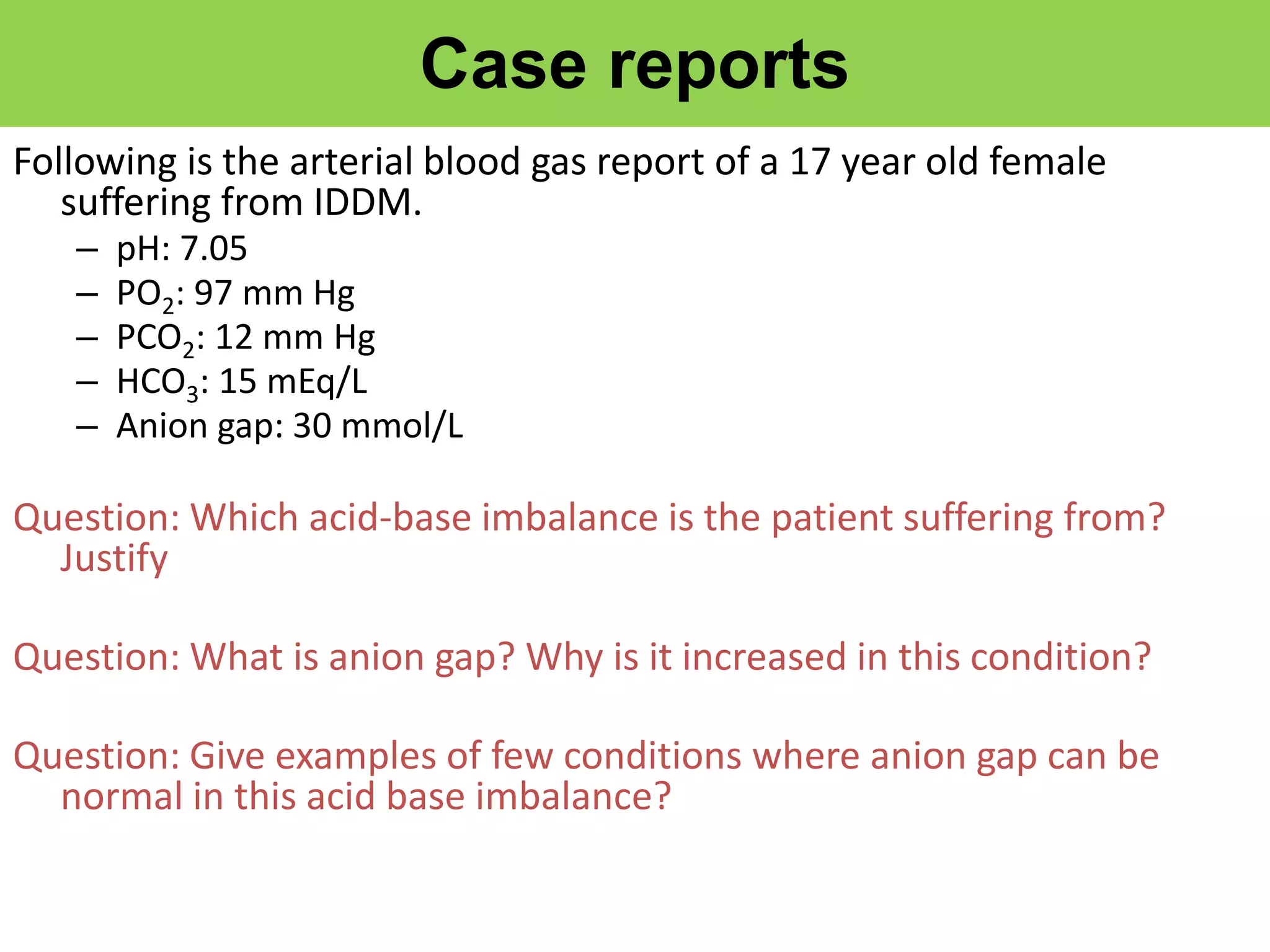
Case reports
Following is the arterial blood gas report of a 17 year old female
suffering from IDDM.
– pH: 7.05
– PO2: 97 mm Hg
– PCO2: 12 mm Hg
– HCO3: 15 mEq/L
– Anion gap: 30 mmol/L
Question: Which acid-base imbalance is the patient suffering from?
Justify
Question: What is anion gap? Why is it increased in this condition?
Question: Give examples of few conditions where anion gap can be
normal in this acid base imbalance?
References:
• Text book of biochemistry-DM.VASUDHEVAN
• Text book of clinical biochemistry- Chatterjea
and shinde
• Pankaja naik
• Sk.gupta-textbook of biochemistry

ACID BASE BALANCE AND RELATED DISORDERS(Dr.M PRIYANKA)

  • 2.
    ACID BASE BALANCE& RELATED DISORDERS MAHE INSTITUTE OF DENTAL SCIENCES & HOSPITAL Chalakkara, P.O Palloor, Mahe – 673310 U.T. of Puducherry.ph:0490 2337765 Dr. M. Priyanka Reader Department of Biochemistry
  • 3.
    ACIDS AND BASES •Acids are substances that are capable of donating protons and bases are those that accept protons. • Acids are proton donors and bases are proton acceptors. HCl H+ + Cl – H2CO3 H+ + HCO3 – NH3 + H+ NH4 + HCO3 - + H+ H2CO3
  • 4.
    CONTD… • The extentof dissociation decides whether they are strong acids or weak acids. • Strong acids dissociate completely in solution, while weak acids ionize incompletely. HCl H+ + Cl– (Complete) H2CO3 H+ + HCO3– (Partial)
  • 5.
    CONTD… • In asolution of HCl, almost all the molecules dissociate and exist as H+ and Cl– ions. Hence the concentration of H+ is very high and it is a strong acid. • But in the case of a weak acid it will ionize only partially. So, the number of acid molecules existing in the ionized state is much less.
  • 6.
    Dissociation Constant • Thedissociation of an acid is a freely reversible reaction, at equilibrium the ratio between dissociated and undissociated particle is a constant. The dissociation constant (Ka) of an acid is given by the formula: Ka = [H+][A-] [HA] • [H+] concentration of hydrogen ions • [A–] = the concentration of anions or conjugate base • [HA] is the concentration of undissociated molecules.
  • 7.
    • Pka: ThePH at which the acid is half ionized is called Pka of an acid which is constant at a particular temperature and pressure • Strong acid- low Pka • Weak acid – high pka
  • 8.
    CONTD… PH: • Negative logarithmof hydrogen ion concentration – pH. pH = –log [H+] • pH value is inversely proportional to the acidity. • Lower the pH, higher the acidity or hydrogen ion concentration while higher the pH, the acidity is lower. • pH 7 indicates the neutral pH.
  • 9.
    Acids produced bythe body Metabolic sources of acids Classified as • Respiratory (or volatile) acids • Metabolic (or fixed) acids. • Amount of acid excreted per day must equal the amount produced per day. • Routes of excretion are: lungs (for CO2,volatile acid) and kidneys (for the fixed acids).
  • 10.
    Respiratory acid orvolatile acid • The acid is carbonic acid (H2CO3) but the term 'respiratory acid' used to denote CO2. • Only acid that is excreted as gas by lungs • Carbonic acid has important role in bicarbonate buffer system to maintain the acid base homeostasis
  • 11.
    Respiratory Acid • CO2:Itself not an acid, does not contain a hydrogen, cannot be a proton donor. • CO2: has a potential to create an equivalent amount of carbonic acid. • CO2: the end-product of complete oxidation of carbohydrates and fatty acids. • CO2: called as volatile acid, it can be excreted via the lungs.
  • 12.
    Metabolic Acids • Therest of the acids, body produces are non-volatile. • Not excreted by the lungs, hence also called fixed acids (all acids other then H2CO3 are fixed acids) • (e.g lactate, phosphate, sulphate, acetoacetate or β- hydroxybutyrate) • Produced due to metabolism of carbohydrates (e.g. lactate), fats (e.g. ketones) and protein (e.g. sulphate, phosphate) • Non-volatile acid load is excreted by the kidney
  • 13.
    • Metabolic sourcesof bases: • Catabolism of few food materials produces bases • Eg: citrate salts of fruit juices-bicarbonate salts • Deamination of amino acids-ammonia
  • 14.
    BUFFERS • Buffers aresolutions which can resist changes in pH when acid or alkali is added. • Buffers are of two types: a. Mixtures of weak acids with their salt with a strong base Weak acid/strong base b. Mixtures of weak bases with their salt with a strong acid. Weak base/strong acid
  • 15.
    examples are givenbelow: • i. H2CO3/NaHCO3 (Bicarbonate buffer) (carbonic acid and sodium bicarbonate) • ii. CH3COOH/CH3COO Na (Acetate buffer) (acetic acid and sodium acetate)
  • 16.
    How do buffersact: • CH3COOH + NaoH CH3COONa + H2o • Weak Acid + base salt + water • CH3COONa +HCL CH3COOH+ Nacl • Salt +Acid weak acid + salt
  • 17.
    BUFFERING CAPACITY • Thebuffering capacity is determined by the actual concentrations of salt and acid present, as well as by their ratio. • The buffering capacity of a buffer is defined as the ability of the buffer to resist changes in pH when an acid or base is added.
  • 18.
    EFFECTIVE RANGE OFA BUFFER • A buffer is most effective when the concentrations of salt and acid are equal or when pH = pKa. • The effective range of a buffer is 1 pH unit higher or lower than pKa. • Phosphate buffer is effective at a wide range, because it has 3 pKa values.
  • 19.
    ACID-BASE BALANCE • ThepH of plasma is maintained within a narrow range of 7.35 to 7.45 • If the pH is below 7.35, it is called acidosis. • Life is threatened when the pH is lowered below 7.25. • Acidosis leads to CNS depression and coma. Death occurs when pH is below 7.0.
  • 20.
    CONTD… • When thepH is more than 7.42, it is alkalosis. • It is very dangerous if pH is increased above 7.55. • Alkalosis induces neuromuscular hyperexcitability and tetany. • Death occurs when the pH is above 7.6.
  • 21.
  • 22.
    MECHANISMS OF REGULATION •Blood buffers or chemical buffering First line of defense • Respiratory/pulmonar y regulation Second line of defense • Renal regulation Third line of defense
  • 23.
    • Buffer systemsand their role in Acid base balance • Buffers can reversibly bind H+ ion • Buffer + H+ H buffer • The buffer systems of the blood, tissue, fluids and cells immediately combine with acid or base to prevent excessive changes in H+ ion conc
  • 24.
    BLOOD BUFFERS BICARBONATE BUFFERSYSTEM • The most important buffer system in the plasma is the bicarbonate-carbonic acid system (NaHCO3/H2CO3). • It accounts for 65% of buffering capacity in plasma and 40% of buffering action in the whole body. • The base constituent, bicarbonate (HCO3–), is regulated by the kidney (metabolic component).
  • 25.
    • While theacid part, carbonic acid (H2CO3), is under respiratory regulation (respiratory component). • Bicarbonate system- the only buffer measured for the calculation of acid-base status in patients
  • 26.
    • The normalbicarbonate level of plasma is 24 mmol/liter • Normal pCO2 of arterial blood is 40mm of Hg • Normal H2CO3 is 1.2mmol/L • PKa of carbonic acid is 6.1 PH = Pka +log [HCO3 -] H2CO3 • 7.4= 6.1 +log24 =20 1.2 Hence the ratio of HCO3 to H2CO3 at PH 7.4 is 20
  • 27.
    • A strongacid is converted into a weak acid • HCL + NaHCO3 H2CO3+ NaCL • H2CO3 CA H20+CO2 • Carbonic acid is volatile and is eliminated through lungs • Hence bicarbonate buffer system is directly linked with respiration H2CO3 H2CO3
  • 28.
    • Similarly when(alkaline sub) strong base like NaOH enters the ECF, it reacts with acid • NaOH + H2CO3 NaHCO3 + H20
  • 29.
    ALKALI RESERVE • Bicarbonaterepresents the alkali reserve and it has to be sufficiently high to meet the acid load. • If it was too low to give a ratio of 1, all the HCO3 would have been exhausted within a very short time; and buffering will not be effective. • So, under physiological circumstances, the ratio of 20 (a high alkali reserve) ensures high buffering efficiency against acids.
  • 30.
    The bicarbonate bufferis the most important : I. Presence of bicarbonate in relatively high concentration. II. The components are under physiological control.
  • 31.
    • Bicarbonate buffer– directly linked with respiration. • Advantages: • Present in highest concentration. • Produces volatile CO2. • Good physiological buffer. • Disadvantages: It is weak chemical buffer since pKa is further away from pH 7.4.
  • 32.
    PHOSPHATE BUFFER SYSTEM •It is mainly an intracellular buffer. Its concentration in plasma is very low. • The phosphate buffer system is found to be effective at a wide pH range. • The pKa value is 6.8 • In the body, Na2HPO4/NaH2PO4 is an effective buffer system, because its pKa value is nearest to physiological pH.
  • 33.
    • When astrong acid enters the blood ,it combines with alkaline PO4 to form acid PO4,which is excreted by the kidneys, so urine is more acidic • HCL + Na2HPO4 NaH2PO4 + NaCL • When an strong base enters the blood , it combines with acid PO4 to form alkaline PO4,so urine is alkaline • NaOH + NaH2PO4 Na2HPO4 +H20
  • 34.
     Ratio: 4:1kept constant by kidneys.  Thus phosphate buffer system is directly linked up with kidneys • Advantage: It is a good chemical buffer since pKa 6.8 (close to 7.4) • Disadvantage: Concentration of phosphate buffer system in blood is low = 1 mmol
  • 35.
    PROTEIN BUFFER • Bufferingcapacity of protein depends on the pKa value of ionizable side chains. • The most effective group is histidine imidazole group with a pKa value of 6.1 • The role of the hemoglobin buffer is considered along with the respiratory regulation of pH
  • 36.
    Relative Capacity ofBuffer Systems
  • 37.
    Buffers Act Quickly,But Not Permanently • Buffers can respond immediately to addition of acid or base, but they do not serve to eliminate the acid from the body. • They are also unable to replenish the alkali reserve of the body. • For the final elimination of acids, the respiratory and renal regulations are very essential.
  • 38.
    Hb buffer • HbBuffer: First line of defence • Intracellular buffer in RBC • Important buffer to transport CO2 and O2 • Work effectively with the bicarbonate buffer system
  • 39.
    • The reverseoccurs in the lungs during oxygenation and elimination of CO2. When the blood reaches the lungs, the bicarbonate re enters the erythrocytes by reversal of chloride shift. • HHb + O2 ––––––––– HbO2 + H+ • HCO3 - + H+ ––––––––– H2CO3 • H2CO3 ––––––––– H2O + CO2 • CO2 is thus eliminated by the lungs. • In contrast to chemical buffering (immediate effect) pulmonary regulation occurs over minutes to hours.It is about 50 to 75% effective
  • 40.
  • 41.
  • 42.
  • 43.
    • H2CO3 dissociatesas HCO3 goes out to plasma, chloride ions exchange to maintain electrical neutrality and H+ combines with hemoglobin to form HHb. • This is referred to as chloride shift. Entire process is known as isohydric transport of CO2.
  • 44.
    Respiratory mechanism inAcid- Base Balance • Second line of defence • Done by regulating the conc of carbonic acid by the lungs • The respiratory centre regulates the removal or retension of CO2(H2CO3) from the ECF by the lungs
  • 45.
    Respiratory/Pulmonary Regulation • Thisis achieved by changing the pCO2. • The CO2 diffuses from the cells into the extracellular fluid and reaches the lungs through the blood. • The rate of respiration is controlled by the chemoreceptors in the respiratory center which are sensitive to changes in the pH of blood • A decrease in pH- sensed by arterial chemoreceptors, leads to increases in respiratory rate; resulting in hyperventilation. This would eliminate more CO2, thus lowering the H2CO3.
  • 46.
    • The bicarbonateneutrilizes more than 50% of acids • HCO3 - +H+ H2CO3 H2O +CO2
  • 47.
    • An increasein H+ or (H2CO3) stimulates the respiratory centre to increase the rate and depth of respiratory ventilation • Similarly an increase in OH- or (HCO3 -) depresses respiratory ventilation • So changes in respiration will alter the HCO3- /H2CO3 ratio and PH
  • 48.
    • When therate of ventilation is increased, excess acid (H2CO3) in the form of CO2 is quickly removed • Similarly when the rate of ventilation is decreased, acid(H2CO3) in the form of Co2 is added to neutralize excess alkali(HCO3 -)
  • 50.
    RENAL REGULATION • Animportant function of the kidney is to regulate the pH of the extracellular fluid. • Normal urine has a pH around 6; this pH is lower than that of extracellular fluid (pH = 7.4). This is called acidification of urine.
  • 51.
    Renal mechanisms Renal mechanismsfor regulation of pH are:  Excretion of H+ Reabsorption of bicarbonate (recovery of bicarbonate) Excretion of titratable acid (net acid excretion) Excretion of NH4+
  • 52.
    Excretion of H+ •This process occurs in the proximal convoluted tubules.
  • 53.
    Reabsorption of Bicarbonate •This is mainly a mechanism to conserve base. • There is no net excretion of H+
  • 54.
    Excretion of H+as Titratable Acid
  • 55.
    • The majortitratable acid present in the urine is sodium acid phosphate. • The term titratable acidity of urine refers to the number of milliliters of N/10 NaOH required to titrate 1 liter of urine to pH 7.4. This is a measure of net acid excretion by the kidney. • The acid and basic phosphate pair is considered as the urinary buffer. The maximum limit of acidification is pH 4.5.
  • 56.
    Excretion of AmmoniumIons Predominantly occurs at the distal convoluted tubules. This would help to excrete H+ and reabsorb HCO3-
  • 57.
    • Normally, about70 mEq/L of acid is excreted daily; but in condition of acidosis, this can rise to 400 mEq/day. • Factors Affecting Renal Acid Excretion: • Increased filtered load of bicarbonate • Decrease in ECF volume • Decrease in plasma pH • Increase in pCO2 of blood • Hypokalemia • Aldosterone secretion
  • 58.
  • 59.
    Types of acid–basedisorders • Two types of acid–base disorders: respiratory and metabolic. • Primary respiratory disorders: affect blood acidity by causing changes in PCO2, • Primary metabolic disorders: caused by disturbances in the HCO3 – concentration. • Acidosis is due to gain of acid or loss of alkali; causes may be metabolic (fall in serum HCO3 –) or respiratory (rise in PCO2). • Alkalosis is due to loss of acid or addition of base and is either metabolic (rise in HCO3 –) or respiratory (fall in PCO2).
  • 60.
    COMPENSATORY RESPONSES TOACID BASE DISORDERS RESPIRATORY COMPENSATION TO ACIDOSIS AND ALKALOSIS RESPONSE TO ACIDOSIS In response to acid accumulation, ventilation is increased(hyperventilation). This lowers the pCo2 and this in turn reduces the H+ ion concentration driving the pH up.
  • 61.
     RESPONSE TOALKALOSIS Ventilation is inhibited(hypoventilation). This brings the pH down. • RENAL COMPENSATION TO ACIDOSIS AND ALKALOSIS  RESPONSE TO ACIDOSIS • Required no: of H+ ions are secreted by the tubular cells to reabsorb all the filtered HCO3-. • Tubular glutamine metabolism is enhanced resulting in more NH4+ excretion.This process eliminates more H+ ions and also contributes to new HCO3- to the plasma.
  • 62.
    • RESPONSE TOALKALOSIS • Hydrogen ion concentration by the tubular cells is reduced.Hence the of H+ ions is inadequate to reabsorb all the filtered HCO3- so substantial quantities of HCO3- is excreted in urine. • Tubular glutamine metabolism and ammonium excretion are decreased. • With reduced reabsorption and no addition of new HCO3- , plasma bicarbonate concentration is decreased thereby compensating for the alkalosis.
  • 63.
    Metabolic acidosis • Thelow HCO3 – results from the addition of acids (organic or inorganic) or loss of HCO3 – Metabolic acidosis Classified as increased anion gap or normal anion gap . • High anion gap metabolic acidosis: • Normal anion gap (hyperchloremic) metabolic acidosis:
  • 64.
    Anions: 86% • Cl-(95-105meq/l) • HCO3 - (22-26meq/l) • proteins, SO4 2-, HPO4 2- (unmeasured anions) Cations : 95% • Na+ (136-145meq/l) • K+ (3.5-5meq/l) • Ca+ • Mg+ unmeasured cations
  • 65.
    Anion gap • Thesum of cations and anions in ECF is always equal, so as to maintain the electrical neutrality. • Sodium and potassium together account for 95% of the cations whereas chloride and bicarbonate account for only 86% of the anions. Only these electrolytes are commonly measured. • There is always a difference between the measured cations and the anions.This apparent gap is due to unmeasured anions (e.g. proteins, SO4 2-, HPO4 2-) present in plasma.
  • 66.
    • So thedifference between unmeasured anions and unmeasured cations is called Anion gap
  • 67.
    • The aniongap is calculated as the difference between (Na+ + K+) and (HCO3– + Cl–). • Normally this is about 12 mmol/liter.(8-16) • Anion gap- increased (>12 mmol/L) in metabolic acidosis due to consumption of bicarbonate in buffering excess acid. • Remains normal in some cases: more Cl- ions are reabsorbed to maintain electrical neutrality, hence there is hyperchloremia if anion gap is normal
  • 68.
    Metabolic Acidosis isof two types: • Normal anion gap metabolic acidosis • High anion gap metabolic acidosis
  • 69.
  • 70.
    High Anion gapMetabolic Acidosis anion gap  Increase in organic acids like lactic acid, ketoacids  Mainly seen in diabetic ketoacidosis and lactic acidosis HCO3- Cl-
  • 71.
    • High Aniongap Metabolic Acidosis • D-Diabetic ketoacidosis • R-Renal failure • M-methanol Toxicity • A-alcoholic ketoacidosis • P-paracetomol poisoning • L-Lactic acidosis • E- Ethylene glycol poisoning • S- Salicylate Toxicity
  • 72.
    High anion gapmetabolic acidosis(HAGMA) A value between 15 and 20 is accepted as reliable index of accumulation of acid anions in metabolic acidosis (HAGMA).
  • 73.
    Normal anion gapmetabolic acidosis(NAGMA) • When there is a loss of both anions and cations, the anion gap is normal, but acidosis may prevail. • Also known as hyperchloremic normal Anion gap acidosis • Increased Cl- ions to maintain electrical neutrality Causes • Severe diarrohea • Renal tubular acidosis Normal HCO3 - Cl-
  • 74.
    Normal anion gapmetabolic acidosis • Severe diarrhoea(loss of HCO3-, Na+ and K+) • gastrointestinal fluid loss • Pancreatitis • Renal tubular acidosis(defect in the reabsorption of HCO3 -
  • 76.
    Metabolic acidosis • Decreasein PH due to decrease in bicarbonate in blood Due to • Production of acid • Loss of bicarbonate(GIT,Kidney) • Retention of acid by kidney
  • 77.
    • Production ofacid is seen in • Uncontrolled diabetic ketoacidosis-ketoacids • Lactic acidosis-lactic acid • Vigourous exercise- • shock
  • 78.
    Loss of bicarbonate(GIT,Kidney) •Severe diarrhea(GIT) • Kidney(RTA secretion defect in H+) Retention of acid by kidney • Chronic renal failure
  • 79.
    • Features ofmetabolic acidosis: • Primary defecit-loss of HCO3- HCO3 - H2CO3
  • 80.
    • Compensatory mechanismin metabolic acidosis • PH H+ Respiratory centre in brain- hyperventilation PCO2 is eliminated by lungs • So the ratio can be restored • Kidney- excretion of acids and urinary ammonia HCO3 - H2CO3
  • 81.
    COMPENSATED METABOLIC ACIDOSIS •Decrease in pH in metabolic acidosis stimulates the respiratory compensatory mechanism and produces hyperventilation— Kussmaul respiration to eliminate carbon dioxide leading to hypocapnia. • Renal compensation: Increased excretion of acid and conservation of base occurs. • Na-H exchange, NH4+ excretion and bicarbonate reabsorption are increased.
  • 82.
    • As muchas 500 mmol acid is excreted per day. The reabsorption of more bicarbonate also helps to restore the ratio to 20. • Renal compensation sets in within 2 to 4 days. If the ratio is restored to 20, the condition is said to be fully compensated. • Associated hyperkalemia is commonly seen due to a redistribution of K+ and H+.
  • 83.
    • The intracellularK+ comes out in exchange for H+ moving into the cells. Hence care should be taken while correcting acidosis which may lead to sudden hypokalemia. This is more likely to happen in treating diabetic ketoacidosis by insulin therapy.
  • 84.
    CLINICAL FEATURES • Therespiratory response to metabolic acidosis is to hyperventilate. So there is marked increase in respiratory rate and depth of respiration; this is called as Kussmaul respiration. • The acidosis is said to be dangerous when pH is <7.2 and serum bicarbonate is <10 mmol/L. In such conditions, there is depressed myocardial contractility.
  • 85.
    MANAGEMENT • Treatment isto stop the production of acid. • Identifying and treating the underlying cause. • This includes treatment of diabetes, control of diarrhea,etc. • In patient with lactic acidosis, oxygen is given. • Generous administration of IV fluids – sodium and water loss.
  • 86.
    • When theunderlying cause is unidentified and the acidosis is severe , intravenous bicarbonate administration can be considered. • In all cases, potassium abnormalities should be carefully looked into and treated.(Risk of hypokalemia)
  • 87.
    Metabolic alkalosis • Characterizedby a primary increase in serum [HCO3 -]. • Alkalosis occurs when:  Excess base is added  Acid is lost. • All these will lead to an excess of bicarbonate, so that the ratio becomes more than 20.
  • 88.
    Causes of metabolicalkalosis • Chloride responsive metabolic alkalosis: Prolonged vomiting or naso gastric suction (loss of hydrogen and Cl ions), pyloric or upper duodenal obstruction etc • Chloride resistant metabolic alkalosis: Mineralocorticoid excess (primary & secondary hyperaldosteronism), glucocorticoid excess (Cushing syndrome), Bartter’s syndrome (defective renal Cl reabsorption at loop of henle) etc. • Exogenous base excess: Bicarbonate containing intravenous fluid therapy, antacids, etc.
  • 89.
    Clinical Features • Therespiratory center is depressed by the high pH leading to hypoventilation. This would result in accumulation of CO2 in an attempt to lower the HCO3–/H2CO3 ratio. • However, the compensation is limited by the hypoxic stimulation of respiratory center, so that the increase in PaCO2 is not above 55 mm Hg
  • 90.
    • The renalmechanism is more effective which conserves H+ and excretes more HCO3–. • However, complete correction of alkalosis will be effective only if potassium is administered and the cause is removed. • Increased neuromuscular activity is seen when pH is above 7.55. Tetany results even in the presence of normal serum calcium.
  • 91.
    Base excess (range:-3 to +3) • Used for the assessment of the metabolic component of acid-base disorders, indicates whether the patient has metabolic acidosis or alkalosis. • A negative base excess indicates- metabolic acidosis (primary or secondary to respiratory alkalosis). • A positive base excess indicates- metabolic alkalosis (primary or secondary to respiratory acidosis).
  • 92.
    Respiratory acidosis • Characterizedby CO2 retention ( H2CO3)due to impaired alveolar ventilation. Factors causing respiratory acidosis • Conditions that directly depress the respiratory center: Drugs (narcotics, sedatives etc), CNS disorders (trauma, tumours etc), comatose states etc • Conditions that affect the respiratory apparatus: Chronic obstructive pulmonary diseases, pulmonary fibrosis, acute respiratory distress syndrome (ARDS) pneumothorax,bronchitis,pneumonia,neurological disorders affecting the muscles of respiration etc.
  • 93.
    COMPENSATION • Renal responsecompensates for respiratory acidosis. • More bicarbonate is generated by the kidneys and added to the alkali reserve of the body. • The excretion of H+ ions by various mechanisms are also increased.
  • 94.
    MANAGEMENT • Involves correctionof causative factors. • The general principle of treating respiratory acidosis is to improve alveolar ventilation and lower the pCo2.
  • 95.
    Respiratory alkalosis • Primarydeficit of carbonic acid is described as the respiratory alkalosis. • Hyperventilation will result in washing out of CO2. So, bicarbonate : carbonic acid ratio is more than 20. Factors causing respiratory alkalosis • Non Pulmonary stimulation of respiratory centre: Anxiety, hysteria, febrile states, meningitis, encephalitis, intracranial surgery etc • Pulmonary disorders: Pulmonary embolism, interstitial lung disease • Ventilator induced hyperventilation
  • 96.
    • Clinically, hyperventilation,muscle cramps, tingling and paraesthesia are seen. • Alkaline pH will favor increased binding of calcium to proteins, resulting in a decreased ionized calcium.
  • 97.
    COMPENSATION • Renal mechanismsensure the urinary excretion of HCO3-. • There is fall in HCO3-level as a compensatory response by the kidneys to handle alkalosis.
  • 98.
    MANAGEMENT • Include correctingthe underlying the causes, alleviating anxiety. • In acute cases, the patient is subjected to a re- breathing into a closed bag to allow CO2 levels to rise.
  • 99.
    TYPES OS ACIDBASE DISORDERS DISORDER pH PRIMARY CHANGE RATIO COMPENSATION Metabolic acidosis DEFICIT OF HCO3 - <20 PCO2 Metabolic alkalosis EXCESS OF HCO3 - >20 PCO2 Respiratory acidosis EXCESS OF H2CO3 <20 HCO3 - Respiratory alkalosis DEFICIT OF H2CO3 >20 HCO3 -
  • 101.
    BLOOD GAS ANALYSIS •Arterial blood gas test measures the dissolved oxygen and carbon dioxide in the arterial blood • Reveals the acid-base state and how well the oxygen is being carried to the body. • The pH is the measurement of free H+ ion concentration in circulating blood. • Blood gas analyzers directly measure pH and PCO2, and the HCO3 – value is calculated from the Henderson–Hasselbalch equation: pH= 6.1 + log [HCO3 -/0.3 x PCO2]
  • 102.
    Normal blood gasanalysis pH 7.38–7.42 PaO2 80–100 mmHg PCO2 35-45 mmHg HCO3 - 22–26 mEq/L O2 saturation 96%–100% Standard bicarbonate (bicarbonate at normal temperature and PCO2) An excellent measurement of the metabolic component. Defined as the bicarbonate concentration under standard conditions: PCO2 = 40 mmHg, and 37oC
  • 103.
    Interpretation of ABGreport • pH: First step; look whether there is acidemia (<7.35) or alkalemia (>7.45). • HCO3- levels: Levels <22 mEq/L in presence of acidosis imply metabolic acidosis. Bicarbonate levels >28 mEq/L in presence of alkalosis imply metabolic alkalosis. • PCO2 levels: PCO2 levels >45 mmHg in presence of acidosis imply respiratory acidosis. PCO2 levels <35 mmHg in presence of alkalosis imply respiratory alkalosis.
  • 104.
    • Respiratory compensationoccurs for a metabolic acid- base disturbance and vice versa- PCO2 & HCO3 - move in the same direction • If HCO3 - decreases (metabolic acidosis) then PCO2 also decreases (respiratory compensation) • If PCO2 increases (respiratory acidosis), HCO3 - also increases (metabolic compensation) Interpretation of ABG report
  • 105.
    BASE EXCESS (RANGE:-3 TO +3) • Used for the assessment of the metabolic component of acid-base disorders, indicates whether the patient has metabolic acidosis or alkalosis. • A negative base excess indicates- metabolic acidosis (primary or secondary to respiratory alkalosis). • A positive base excess indicates- metabolic alkalosis (primary or secondary to respiratory acidosis).
  • 106.
    Following is thearterial blood gas (ABG) report of a 24 yrs hyperventilating female who presented to the hospital with hysteria – pH: 7.55 – PCO2: 27 mm Hg – PO2: 105 mm Hg – HCO3: 19 mEq/L Question: Which acid-base imbalance is the patient suffering from? Justify Question: Which acid-base imbalance is characterized by CO2 retention due to ventilatory failure? CASE REPORTS
  • 107.
    Case reports Following isthe arterial blood gas report of a 17 year old female suffering from IDDM. – pH: 7.05 – PO2: 97 mm Hg – PCO2: 12 mm Hg – HCO3: 15 mEq/L – Anion gap: 30 mmol/L Question: Which acid-base imbalance is the patient suffering from? Justify Question: What is anion gap? Why is it increased in this condition? Question: Give examples of few conditions where anion gap can be normal in this acid base imbalance?
  • 108.
    References: • Text bookof biochemistry-DM.VASUDHEVAN • Text book of clinical biochemistry- Chatterjea and shinde • Pankaja naik • Sk.gupta-textbook of biochemistry