ACID BASE BALANCE


          Dr Amith Sreedharan
DISCUSSION HEADINGS
•   BASICS
•   NORMAL PHYSIOLOGY
•   ABNORMALITIES
•   METABOLIC ACID BASE DISORDERS
•   RESPIRATORY ACID BASE DISORDERS
•   ALTERNATIVE CONCEPTS
• Acid
     Any compound which forms H⁺ ions in
 solution (proton donors)
 eg: Carbonic acid releases H⁺ ions
• Base
     Any compound which combines with
 H⁺ ions in solution (proton acceptors)
 eg:Bicarbonate(HCO3⁻) accepts H+ ions
Acid–Base Balance
Normal pH : 7.35-7.45
Acidosis
  Physiological state resulting from abnormally low plasma pH

Alkalosis
  Physiological state resulting from abnormally high plasma pH

Acidemia: plasma pH < 7.35
 Alkalemia: plasma pH > 7.45
Henderson-Hasselbach equation (clinically
                  relevant form)
• pH = pKa + log([HCO3-]/.03xpCO2)

• pH = 6.1 + log([HCO3-]/.03xpCO2)

• Shows that pH is a function of the RATIO
  between bicarbonate and pCO2
•   PCO₂ - ventilatory parameter (40 +/- 4)
•   HCO₃⁻ - metabolic parameter (22-26 mmol/L)
ACIDS
• VOLATILE ACIDS:
 Produced by oxidative metabolism of CHO,Fat,Protein
 Average 15000-20000 mmol of CO₂ per day
 Excreted through LUNGS as CO₂ gas
• FIXED ACIDS (1 mEq/kg/day)
 Acids that do not leave solution ,once produced they
  remain in body fluids Until eliminated by KIDNEYS
   Eg: Sulfuric acid ,phosphoric acid , Organic acids
      Are most important fixed acids in the body
      Are generated during catabolism of:
          amino acids(oxidation of sulfhydryl gps of cystine,methionine)
          Phospholipids(hydrolysis)
          nucleic acids
Response to ACID BASE challenge


1.Buffering
2. Compensation
Buffers
First line of defence (> 50 – 100 mEq/day)
Two most common chemical buffer groups
  – Bicarbonate
  – Non bicarbonate (Hb,protein,phosphate)
  Blood buffer systems act instantaneously
  Regulate pH by binding or releasing H⁺
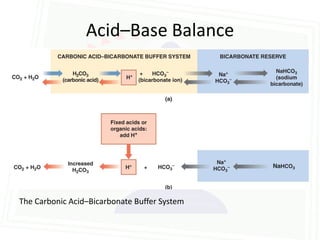
Carbonic Acid–Bicarbonate Buffer System
 Carbon Dioxide
      Most body cells constantly generate carbon dioxide
      Most carbon dioxide is converted to carbonic acid, which dissociates
       into H+ and a bicarbonate ion

 Prevents changes in pH caused by organic acids and fixed
 acids in ECF
 Cannot protect ECF from changes in pH that result
    from elevated or depressed levels of CO2
 Functions only when respiratory system and
    respiratory control centers are working normally
 Ability to buffer acids is limited by availability of
    bicarbonate ions
Acid–Base Balance


The Carbonic Acid–Bicarbonate Buffer System
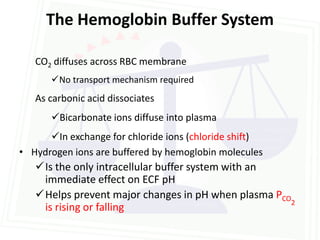
The Hemoglobin Buffer System

   CO2 diffuses across RBC membrane
      No transport mechanism required
   As carbonic acid dissociates
      Bicarbonate ions diffuse into plasma
      In exchange for chloride ions (chloride shift)
• Hydrogen ions are buffered by hemoglobin molecules
   Is the only intracellular buffer system with an
    immediate effect on ECF pH
   Helps prevent major changes in pH when plasma PCO
                                                     2
    is rising or falling
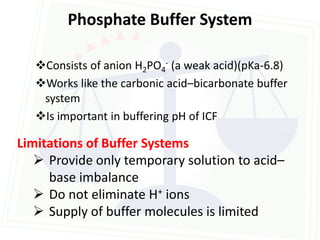
Phosphate Buffer System

   Consists of anion H2PO4- (a weak acid)(pKa-6.8)
   Works like the carbonic acid–bicarbonate buffer
    system
   Is important in buffering pH of ICF

Limitations of Buffer Systems
    Provide only temporary solution to acid–
     base imbalance
    Do not eliminate H+ ions
    Supply of buffer molecules is limited
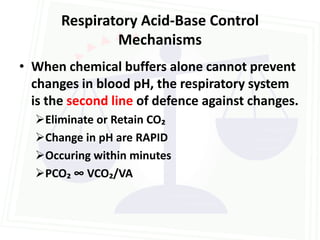
Respiratory Acid-Base Control
               Mechanisms
• When chemical buffers alone cannot prevent
  changes in blood pH, the respiratory system
  is the second line of defence against changes.
  Eliminate or Retain CO₂
  Change in pH are RAPID
  Occuring within minutes
  PCO₂ ∞ VCO₂/VA
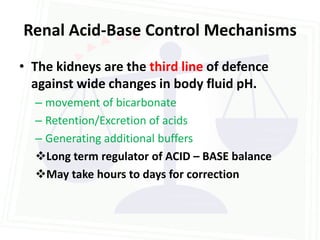
Renal Acid-Base Control Mechanisms
• The kidneys are the third line of defence
  against wide changes in body fluid pH.
  – movement of bicarbonate
  – Retention/Excretion of acids
  – Generating additional buffers
  Long term regulator of ACID – BASE balance
  May take hours to days for correction
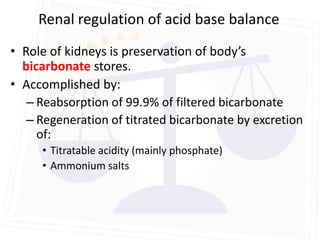
Renal regulation of acid base balance
• Role of kidneys is preservation of body’s
  bicarbonate stores.
• Accomplished by:
   – Reabsorption of 99.9% of filtered bicarbonate
   – Regeneration of titrated bicarbonate by excretion
     of:
     • Titratable acidity (mainly phosphate)
     • Ammonium salts
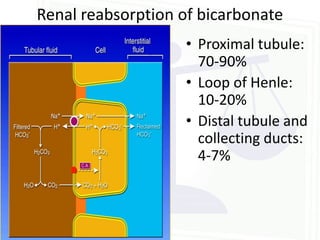
Renal reabsorption of bicarbonate
                   • Proximal tubule:
                     70-90%
                   • Loop of Henle:
                     10-20%
                   • Distal tubule and
                     collecting ducts:
                     4-7%
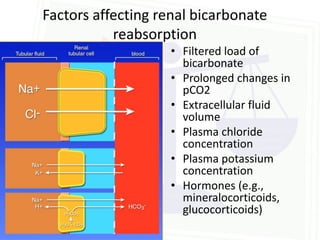
Factors affecting renal bicarbonate
           reabsorption
                   • Filtered load of
                     bicarbonate
                   • Prolonged changes in
                     pCO2
                   • Extracellular fluid
                     volume
                   • Plasma chloride
                     concentration
                   • Plasma potassium
                     concentration
                   • Hormones (e.g.,
                     mineralocorticoids,
                     glucocorticoids)
• If secreted H+ ions combine with filtered
  bicarbonate, bicarbonate is reabsorbed
• If secreted H+ ions combine with
  phosphate or ammonia, net acid excretion
  and generation of new bicarbonate occur
NET ACID EXCRETION
• Hydrogen Ions
  Are secreted into tubular fluid along
     • Proximal convoluted tubule (PCT)
     • Distal convoluted tubule (DCT)
     • Collecting system
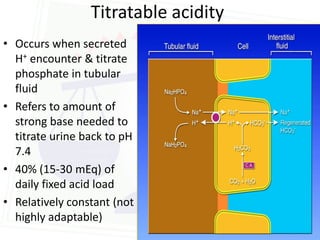
Titratable acidity
• Occurs when secreted
  H+ encounter & titrate
  phosphate in tubular
  fluid
• Refers to amount of
  strong base needed to
  titrate urine back to pH
  7.4
• 40% (15-30 mEq) of
  daily fixed acid load
• Relatively constant (not
  highly adaptable)
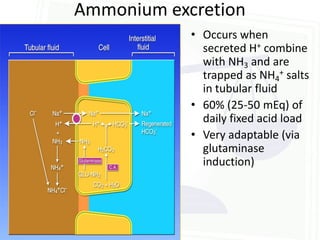
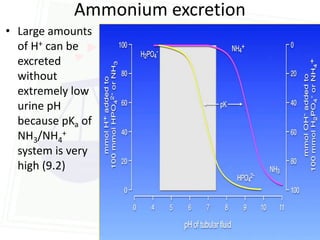
Ammonium excretion
            • Occurs when
              secreted H+ combine
              with NH3 and are
              trapped as NH4+ salts
              in tubular fluid
            • 60% (25-50 mEq) of
              daily fixed acid load
            • Very adaptable (via
              glutaminase
              induction)
Ammonium excretion
• Large amounts
  of H+ can be
  excreted
  without
  extremely low
  urine pH
  because pKa of
  NH3/NH4+
  system is very
  high (9.2)
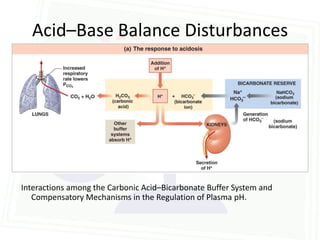
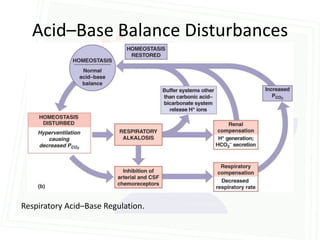
Acid–Base Balance Disturbances


Interactions among the Carbonic Acid–Bicarbonate Buffer System and
   Compensatory Mechanisms in the Regulation of Plasma pH.
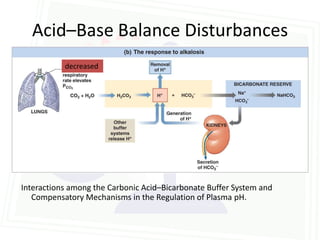
Acid–Base Balance Disturbances
           decreased


Interactions among the Carbonic Acid–Bicarbonate Buffer System and
   Compensatory Mechanisms in the Regulation of Plasma pH.
Four Basic Types of Imbalance
•   Metabolic Acidosis
•   Metabolic Alkalosis
•   Respiratory Acidosis
•   Respiratory Alkalosis
Acid Base Disorders
   Disorder       pH [H+]     Primary Secondary
                            disturbance response
Metabolic                  [HCO3-]    pCO2
acidosis
Metabolic                  [HCO3-]    pCO2
alkalosis
Respiratory                 pCO2      [HCO3-]
acidosis
Respiratory                 pCO2      [HCO3-]
alkalosis
Metabolic Acidosis
•   Primary AB disorder
•   ↓HCO₃⁻ → ↓ pH
•   Gain of strong acid
•   Loss of base(HCO₃⁻)
ANION GAP CONCEPT
• To know if Metabolic Acidosis due to
 Loss of bicarbonate
 Accumulation of non-volatile acids
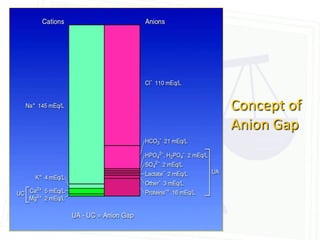
• Provides an index of the relative conc of plasma anions
  other than chloride,bicarbonate
• *serum Na⁺ - (serum Cl⁻ + serum HCO₃⁻)+
• Unmeasured anions – unmeasured cations
• 8 – 16 mEq/L (5 – 11,with newer techniques)
• Mostly represent ALBUMIN
Concept of
Anion Gap
Back
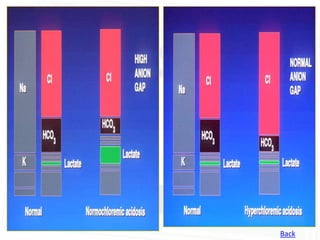
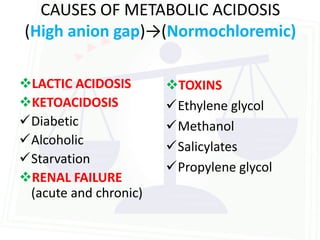
CAUSES OF METABOLIC ACIDOSIS
(High anion gap)→(Normochloremic)

LACTIC ACIDOSIS       TOXINS
KETOACIDOSIS          Ethylene glycol
Diabetic              Methanol
Alcoholic             Salicylates
Starvation
                       Propylene glycol
RENAL FAILURE
 (acute and chronic)
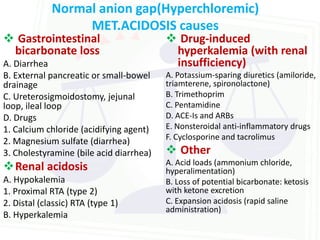
Normal anion gap(Hyperchloremic)
                  MET.ACIDOSIS causes
 Gastrointestinal                        Drug-induced
 bicarbonate loss                         hyperkalemia (with renal
A. Diarrhea                               insufficiency)
B. External pancreatic or small-bowel    A. Potassium-sparing diuretics (amiloride,
drainage                                 triamterene, spironolactone)
C. Ureterosigmoidostomy, jejunal         B. Trimethoprim
loop, ileal loop                         C. Pentamidine
D. Drugs                                 D. ACE-Is and ARBs
1. Calcium chloride (acidifying agent)   E. Nonsteroidal anti-inflammatory drugs
                                         F. Cyclosporine and tacrolimus
2. Magnesium sulfate (diarrhea)
3. Cholestyramine (bile acid diarrhea)    Other
                                         A. Acid loads (ammonium chloride,
Renal acidosis                          hyperalimentation)
A. Hypokalemia                           B. Loss of potential bicarbonate: ketosis
1. Proximal RTA (type 2)                 with ketone excretion
2. Distal (classic) RTA (type 1)         C. Expansion acidosis (rapid saline
                                         administration)
B. Hyperkalemia
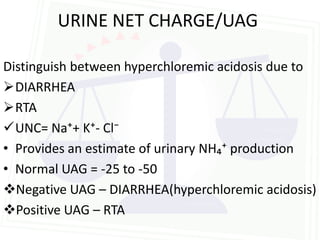
URINE NET CHARGE/UAG

Distinguish between hyperchloremic acidosis due to
DIARRHEA
RTA
UNC= Na⁺+ K⁺- Cl⁻
• Provides an estimate of urinary NH₄⁺ production
• Normal UAG = -25 to -50
Negative UAG – DIARRHEA(hyperchloremic acidosis)
Positive UAG – RTA
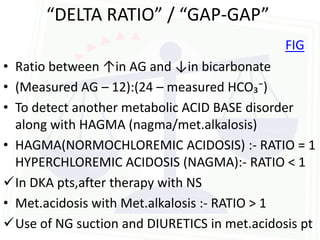
“DELTA RATIO” / “GAP-GAP”
                                              FIG
• Ratio between ↑in AG and ↓in bicarbonate
• (Measured AG – 12):(24 – measured HCO₃⁻)
• To detect another metabolic ACID BASE disorder
  along with HAGMA (nagma/met.alkalosis)
• HAGMA(NORMOCHLOREMIC ACIDOSIS) :- RATIO = 1
  HYPERCHLOREMIC ACIDOSIS (NAGMA):- RATIO < 1
In DKA pts,after therapy with NS
• Met.acidosis with Met.alkalosis :- RATIO > 1
Use of NG suction and DIURETICS in met.acidosis pt
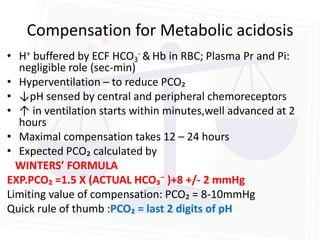
Compensation for Metabolic acidosis
• H+ buffered by ECF HCO3- & Hb in RBC; Plasma Pr and Pi:
  negligible role (sec-min)
• Hyperventilation – to reduce PCO₂
• ↓pH sensed by central and peripheral chemoreceptors
• ↑ in ventilation starts within minutes,well advanced at 2
  hours
• Maximal compensation takes 12 – 24 hours
• Expected PCO₂ calculated by
  WINTERS’ FORMULA
EXP.PCO₂ =1.5 X (ACTUAL HCO₃⁻ )+8 +/- 2 mmHg
Limiting value of compensation: PCO₂ = 8-10mmHg
Quick rule of thumb :PCO₂ = last 2 digits of pH
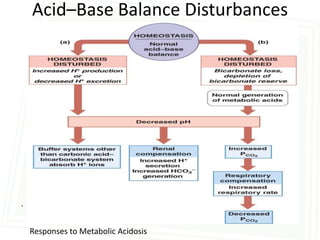
Acid–Base Balance Disturbances


.


    Responses to Metabolic Acidosis
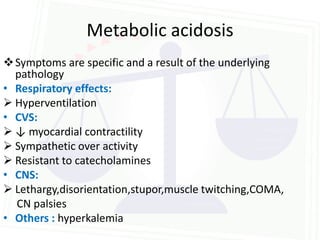
Metabolic acidosis
 Symptoms are specific and a result of the underlying
  pathology
• Respiratory effects:
 Hyperventilation
• CVS:
 ↓ myocardial contractility
 Sympathetic over activity
 Resistant to catecholamines
• CNS:
 Lethargy,disorientation,stupor,muscle twitching,COMA,
  CN palsies
• Others : hyperkalemia
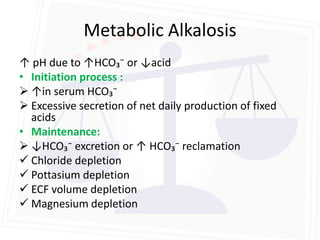
Metabolic Alkalosis
↑ pH due to ↑HCO₃⁻ or ↓acid
• Initiation process :
 ↑in serum HCO₃⁻
 Excessive secretion of net daily production of fixed
  acids
• Maintenance:
 ↓HCO₃⁻ excretion or ↑ HCO₃⁻ reclamation
 Chloride depletion
 Pottasium depletion
 ECF volume depletion
 Magnesium depletion
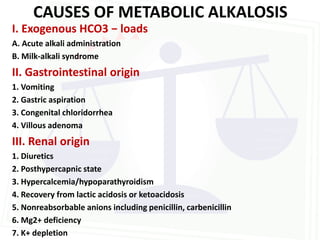
CAUSES OF METABOLIC ALKALOSIS
I. Exogenous HCO3 − loads
A. Acute alkali administration
B. Milk-alkali syndrome
II. Gastrointestinal origin
1. Vomiting
2. Gastric aspiration
3. Congenital chloridorrhea
4. Villous adenoma
III. Renal origin
1. Diuretics
2. Posthypercapnic state
3. Hypercalcemia/hypoparathyroidism
4. Recovery from lactic acidosis or ketoacidosis
5. Nonreabsorbable anions including penicillin, carbenicillin
6. Mg2+ deficiency
7. K+ depletion
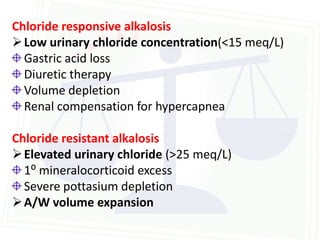
Chloride responsive alkalosis
 Low urinary chloride concentration(<15 meq/L)
  Gastric acid loss
  Diuretic therapy
  Volume depletion
  Renal compensation for hypercapnea

Chloride resistant alkalosis
 Elevated urinary chloride (>25 meq/L)
  1⁰ mineralocorticoid excess
  Severe pottasium depletion
 A/W volume expansion
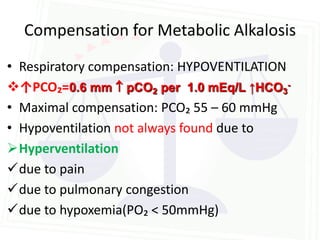
Compensation for Metabolic Alkalosis
• Respiratory compensation: HYPOVENTILATION
↑PCO₂=0.6 mm  pCO2 per 1.0 mEq/L ↑HCO3-
• Maximal compensation: PCO₂ 55 – 60 mmHg
• Hypoventilation not always found due to
Hyperventilation
due to pain
due to pulmonary congestion
due to hypoxemia(PO₂ < 50mmHg)
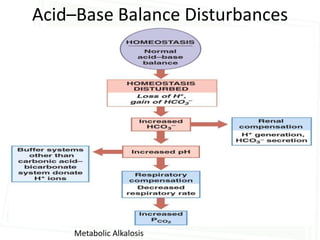
Acid–Base Balance Disturbances


.


        Metabolic Alkalosis
Metabolic Alkalosis
 Decreased myocardial contractility
 Arrythmias

 ↓ cerebral blood flow
 Confusion
 Mental obtundation
 Neuromuscular excitability

• Hypoventilation
 pulmonary micro atelectasis
 V/Q mismatch(alkalosis inhibits HPV)
Contraction Alkalosis
•   Loss of HCO₃⁻ poor, chloride rich ECF
•   Contraction of ECF volume
•   Original HCO₃⁻ dissolved in smaller volume
•   ↑HCO₃⁻ concentration
•   Eg : Loop diuretics/Thiazides in a generalised
    edematous pt.
Respiratory Acidosis
• ↑ PCO₂ → ↓pH
• Acute(< 24 hours)
• Chronic(>24 hours)
RESPIRATORY ACIDOSIS - CAUSES
CNS DEPRESSION
 DRUGS:Opiates,sedatives,anaesthetics
 OBESITY HYPOVENTILATION SYNDROME
 STROKE
NEUROMUSCULAR DISORDERS
 NEUROLOGIC:MS,POLIO,GBS,TETANUS,BOTULISM,
  HIGH CORD LESIONS
 END PLATE:MG,OP POISONING,AG TOXICITY
 MUSCLE:↓K⁺,↓PO₄,MUSCULAR DYSTROPHY
AIRWAY OBSTRUCTION
 COPD,ACUTE ASPIRATION,LARYNGOSPASM
CONT..
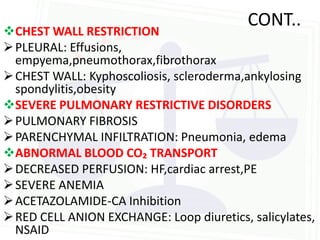
CHEST WALL RESTRICTION
 PLEURAL: Effusions,
  empyema,pneumothorax,fibrothorax
 CHEST WALL: Kyphoscoliosis, scleroderma,ankylosing
  spondylitis,obesity
SEVERE PULMONARY RESTRICTIVE DISORDERS
 PULMONARY FIBROSIS
 PARENCHYMAL INFILTRATION: Pneumonia, edema
ABNORMAL BLOOD CO₂ TRANSPORT
 DECREASED PERFUSION: HF,cardiac arrest,PE
 SEVERE ANEMIA
 ACETAZOLAMIDE-CA Inhibition
 RED CELL ANION EXCHANGE: Loop diuretics, salicylates,
  NSAID
Compensation in Respiratory Acidosis
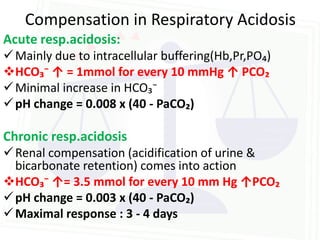
Acute resp.acidosis:
 Mainly due to intracellular buffering(Hb,Pr,PO₄)
HCO₃⁻ ↑ = 1mmol for every 10 mmHg ↑ PCO₂
 Minimal increase in HCO₃⁻
 pH change = 0.008 x (40 - PaCO₂)

Chronic resp.acidosis
 Renal compensation (acidification of urine &
  bicarbonate retention) comes into action
HCO₃⁻ ↑= 3.5 mmol for every 10 mm Hg ↑PCO₂
 pH change = 0.003 x (40 - PaCO₂)
 Maximal response : 3 - 4 days
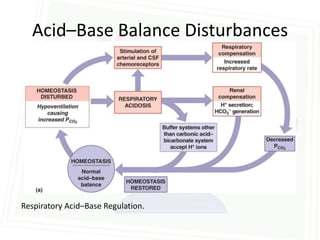
Acid–Base Balance Disturbances


Respiratory Acid–Base Regulation.
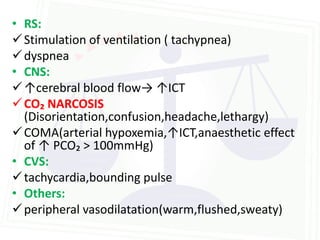
• RS:
 Stimulation of ventilation ( tachypnea)
 dyspnea
• CNS:
 ↑cerebral blood flow→ ↑ICT
 CO₂ NARCOSIS
  (Disorientation,confusion,headache,lethargy)
 COMA(arterial hypoxemia,↑ICT,anaesthetic effect
  of ↑ PCO₂ > 100mmHg)
• CVS:
 tachycardia,bounding pulse
• Others:
 peripheral vasodilatation(warm,flushed,sweaty)
Post hypercapnic alkalosis
•   In chronic resp.acidosis
•   Renal compensation → ↑HCO₃⁻
•   If the pt intubated and mechanical ventilated
•   PCO₂ rapidly corrected
•   Plasma HCO₃⁻ doesn’t return to normal rapidly
•   HCO₃⁻ remains high
Respiratory Alkalosis
•   Most common AB abnormality in critically ill
•   ↓PCO₂ → ↑pH
•   1⁰ process : hyperventilation
•   Acute: PaCO₂ ↓,pH-alkalemic
•   Chronic: PaCO₂↓,pH normal / near normal
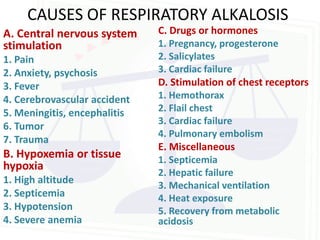
CAUSES OF RESPIRATORY ALKALOSIS
A. Central nervous system     C. Drugs or hormones
stimulation                   1. Pregnancy, progesterone
1. Pain                       2. Salicylates
2. Anxiety, psychosis         3. Cardiac failure
3. Fever                      D. Stimulation of chest receptors
4. Cerebrovascular accident   1. Hemothorax
5. Meningitis, encephalitis   2. Flail chest
                              3. Cardiac failure
6. Tumor
                              4. Pulmonary embolism
7. Trauma
                              E. Miscellaneous
B. Hypoxemia or tissue        1. Septicemia
hypoxia
                              2. Hepatic failure
1. High altitude              3. Mechanical ventilation
2. Septicemia                 4. Heat exposure
3. Hypotension                5. Recovery from metabolic
4. Severe anemia              acidosis
Compensation for respiratory Alkalosis
Acute resp.alkalosis:
 Intracellular buffering response-slight decrease in HCO₃⁻
 Start within 10 mins ,maximal response 6 hrs
 Magnitude:2 mmol/L↓HCO₃⁻ for 10 mmHg↓PCO₂
 LIMIT: 12-20 mmol/L (avg=18)

Chronic resp.alkalosis:
 Renal compensation (acid retention,HCO₃⁻ loss)
 Starts after 6 hours, maximal response 2- 3 days
 Magnitude : 5mmol/L ↓HCO₃⁻ for 10mmHg ↓PCO₂
 LIMIT: 12-15 mmol/L HCO₃⁻
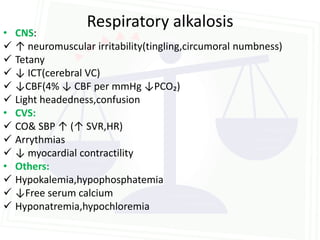
Acid–Base Balance Disturbances


Respiratory Acid–Base Regulation.
Respiratory alkalosis
• CNS:
 ↑ neuromuscular irritability(tingling,circumoral numbness)
 Tetany
 ↓ ICT(cerebral VC)
 ↓CBF(4% ↓ CBF per mmHg ↓PCO₂)
 Light headedness,confusion
• CVS:
 CO& SBP ↑ (↑ SVR,HR)
 Arrythmias
 ↓ myocardial contractility
• Others:
 Hypokalemia,hypophosphatemia
 ↓Free serum calcium
 Hyponatremia,hypochloremia
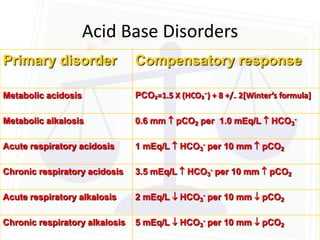
Acid Base Disorders
Primary disorder                Compensatory response

Metabolic acidosis              PCO₂=1.5 X (HCO₃⁻) + 8 +/₋ 2*Winter’s formula+

Metabolic alkalosis             0.6 mm  pCO2 per 1.0 mEq/L  HCO3-

Acute respiratory acidosis      1 mEq/L  HCO3- per 10 mm  pCO2

Chronic respiratory acidosis    3.5 mEq/L  HCO3- per 10 mm  pCO2

Acute respiratory alkalosis     2 mEq/L  HCO3- per 10 mm  pCO2

Chronic respiratory alkalosis   5 mEq/L  HCO3- per 10 mm  pCO2
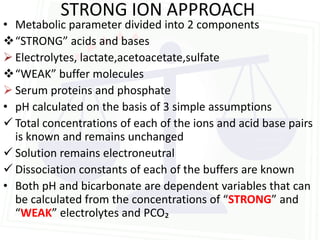
STRONG ION APPROACH
• Metabolic parameter divided into 2 components
“STRONG” acids and bases
 Electrolytes, lactate,acetoacetate,sulfate
“WEAK” buffer molecules
 Serum proteins and phosphate
• pH calculated on the basis of 3 simple assumptions
 Total concentrations of each of the ions and acid base pairs
  is known and remains unchanged
 Solution remains electroneutral
 Dissociation constants of each of the buffers are known
• Both pH and bicarbonate are dependent variables that can
  be calculated from the concentrations of “STRONG” and
  “WEAK” electrolytes and PCO₂
STRONG ION DIFFERENCE (SID)
• STRONG CATIONS – STRONG ANIONS
• Decrease in SID → Acidification of PLASMA
• Explains – NS induced ACIDOSIS
• ADV: Estimate of H⁺ conc more accurate than
  Henderson Hasselbalch equation.
• DIS ADV:Complex nature of equations,increased
  parameters limit clinical application
BASE EXCESS/DEFICIT
• Base excess and base deficit are terms applied to an
  analytical method for determination of the appropriateness
  of responses to disorders of acid-base metabolism
• by measuring blood pH against ambient PCO2 and against a
  PCO2 of 40 mmHg

• deficit is expressed as the number of mEq of bicarbonate
  needed to restore the serum bicarbonate to 25 mEq/L at a
  PCO₂ of 40 mmHg compared with that at the ambient PCO₂
• misleading in chronic respiratory alkalosis or acidosis
• physiological evaluation of the patient be the mode of
  analysis of acid-base disorders rather than an emphasis on
  derived formulae
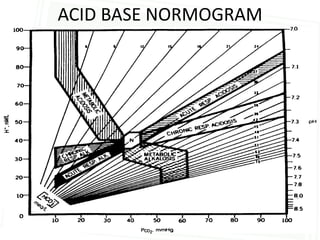
ACID BASE NORMOGRAM
MIXED ACID BASE DISORDER
Diagnosed by combination of clinical
assessment, application of expected compensatory
responses , assessment of the anion gap, and application
of principles of physiology.
Respiratory acidosis and alkalosis never coexist
Metabolic disorders can coexist
Eg: lactic acidosis/DKA with vomiting
Metabolic and respiratory AB disorders can coexist
Eg: salicylate poisoning (met.acidosis + resp.alkalosis)
THANK YOU
LIFE IS A STRUGGLE,
NOT AGAINST SIN,
NOT AGAINST MONEY POWER..
BUT AGAINST HYDROGEN IONS .
                              H.L.MENCKEN

Acid base balance

  • 1.
    ACID BASE BALANCE Dr Amith Sreedharan
  • 2.
    DISCUSSION HEADINGS • BASICS • NORMAL PHYSIOLOGY • ABNORMALITIES • METABOLIC ACID BASE DISORDERS • RESPIRATORY ACID BASE DISORDERS • ALTERNATIVE CONCEPTS
  • 3.
    • Acid Any compound which forms H⁺ ions in solution (proton donors) eg: Carbonic acid releases H⁺ ions • Base Any compound which combines with H⁺ ions in solution (proton acceptors) eg:Bicarbonate(HCO3⁻) accepts H+ ions
  • 4.
    Acid–Base Balance Normal pH: 7.35-7.45 Acidosis Physiological state resulting from abnormally low plasma pH Alkalosis Physiological state resulting from abnormally high plasma pH Acidemia: plasma pH < 7.35  Alkalemia: plasma pH > 7.45
  • 5.
    Henderson-Hasselbach equation (clinically relevant form) • pH = pKa + log([HCO3-]/.03xpCO2) • pH = 6.1 + log([HCO3-]/.03xpCO2) • Shows that pH is a function of the RATIO between bicarbonate and pCO2 • PCO₂ - ventilatory parameter (40 +/- 4) • HCO₃⁻ - metabolic parameter (22-26 mmol/L)
  • 6.
    ACIDS • VOLATILE ACIDS: Produced by oxidative metabolism of CHO,Fat,Protein  Average 15000-20000 mmol of CO₂ per day  Excreted through LUNGS as CO₂ gas • FIXED ACIDS (1 mEq/kg/day)  Acids that do not leave solution ,once produced they remain in body fluids Until eliminated by KIDNEYS Eg: Sulfuric acid ,phosphoric acid , Organic acids Are most important fixed acids in the body Are generated during catabolism of: amino acids(oxidation of sulfhydryl gps of cystine,methionine) Phospholipids(hydrolysis) nucleic acids
  • 7.
    Response to ACIDBASE challenge 1.Buffering 2. Compensation
  • 8.
    Buffers First line ofdefence (> 50 – 100 mEq/day) Two most common chemical buffer groups – Bicarbonate – Non bicarbonate (Hb,protein,phosphate) Blood buffer systems act instantaneously Regulate pH by binding or releasing H⁺
  • 9.
    Carbonic Acid–Bicarbonate BufferSystem Carbon Dioxide  Most body cells constantly generate carbon dioxide  Most carbon dioxide is converted to carbonic acid, which dissociates into H+ and a bicarbonate ion Prevents changes in pH caused by organic acids and fixed acids in ECF  Cannot protect ECF from changes in pH that result from elevated or depressed levels of CO2  Functions only when respiratory system and respiratory control centers are working normally  Ability to buffer acids is limited by availability of bicarbonate ions
  • 10.
    Acid–Base Balance The CarbonicAcid–Bicarbonate Buffer System
  • 11.
    The Hemoglobin BufferSystem CO2 diffuses across RBC membrane No transport mechanism required As carbonic acid dissociates Bicarbonate ions diffuse into plasma In exchange for chloride ions (chloride shift) • Hydrogen ions are buffered by hemoglobin molecules Is the only intracellular buffer system with an immediate effect on ECF pH Helps prevent major changes in pH when plasma PCO 2 is rising or falling
  • 12.
    Phosphate Buffer System Consists of anion H2PO4- (a weak acid)(pKa-6.8) Works like the carbonic acid–bicarbonate buffer system Is important in buffering pH of ICF Limitations of Buffer Systems  Provide only temporary solution to acid– base imbalance  Do not eliminate H+ ions  Supply of buffer molecules is limited
  • 13.
    Respiratory Acid-Base Control Mechanisms • When chemical buffers alone cannot prevent changes in blood pH, the respiratory system is the second line of defence against changes. Eliminate or Retain CO₂ Change in pH are RAPID Occuring within minutes PCO₂ ∞ VCO₂/VA
  • 14.
    Renal Acid-Base ControlMechanisms • The kidneys are the third line of defence against wide changes in body fluid pH. – movement of bicarbonate – Retention/Excretion of acids – Generating additional buffers Long term regulator of ACID – BASE balance May take hours to days for correction
  • 15.
    Renal regulation ofacid base balance • Role of kidneys is preservation of body’s bicarbonate stores. • Accomplished by: – Reabsorption of 99.9% of filtered bicarbonate – Regeneration of titrated bicarbonate by excretion of: • Titratable acidity (mainly phosphate) • Ammonium salts
  • 16.
    Renal reabsorption ofbicarbonate • Proximal tubule: 70-90% • Loop of Henle: 10-20% • Distal tubule and collecting ducts: 4-7%
  • 17.
    Factors affecting renalbicarbonate reabsorption • Filtered load of bicarbonate • Prolonged changes in pCO2 • Extracellular fluid volume • Plasma chloride concentration • Plasma potassium concentration • Hormones (e.g., mineralocorticoids, glucocorticoids)
  • 18.
    • If secretedH+ ions combine with filtered bicarbonate, bicarbonate is reabsorbed • If secreted H+ ions combine with phosphate or ammonia, net acid excretion and generation of new bicarbonate occur
  • 19.
    NET ACID EXCRETION •Hydrogen Ions Are secreted into tubular fluid along • Proximal convoluted tubule (PCT) • Distal convoluted tubule (DCT) • Collecting system
  • 20.
    Titratable acidity • Occurswhen secreted H+ encounter & titrate phosphate in tubular fluid • Refers to amount of strong base needed to titrate urine back to pH 7.4 • 40% (15-30 mEq) of daily fixed acid load • Relatively constant (not highly adaptable)
  • 21.
    Ammonium excretion • Occurs when secreted H+ combine with NH3 and are trapped as NH4+ salts in tubular fluid • 60% (25-50 mEq) of daily fixed acid load • Very adaptable (via glutaminase induction)
  • 22.
    Ammonium excretion • Largeamounts of H+ can be excreted without extremely low urine pH because pKa of NH3/NH4+ system is very high (9.2)
  • 23.
    Acid–Base Balance Disturbances Interactionsamong the Carbonic Acid–Bicarbonate Buffer System and Compensatory Mechanisms in the Regulation of Plasma pH.
  • 24.
    Acid–Base Balance Disturbances decreased Interactions among the Carbonic Acid–Bicarbonate Buffer System and Compensatory Mechanisms in the Regulation of Plasma pH.
  • 25.
    Four Basic Typesof Imbalance • Metabolic Acidosis • Metabolic Alkalosis • Respiratory Acidosis • Respiratory Alkalosis
  • 26.
    Acid Base Disorders Disorder pH [H+] Primary Secondary disturbance response Metabolic    [HCO3-]  pCO2 acidosis Metabolic    [HCO3-]  pCO2 alkalosis Respiratory    pCO2  [HCO3-] acidosis Respiratory    pCO2  [HCO3-] alkalosis
  • 27.
    Metabolic Acidosis • Primary AB disorder • ↓HCO₃⁻ → ↓ pH • Gain of strong acid • Loss of base(HCO₃⁻)
  • 28.
    ANION GAP CONCEPT •To know if Metabolic Acidosis due to  Loss of bicarbonate  Accumulation of non-volatile acids • Provides an index of the relative conc of plasma anions other than chloride,bicarbonate • *serum Na⁺ - (serum Cl⁻ + serum HCO₃⁻)+ • Unmeasured anions – unmeasured cations • 8 – 16 mEq/L (5 – 11,with newer techniques) • Mostly represent ALBUMIN
  • 29.
  • 30.
  • 31.
    CAUSES OF METABOLICACIDOSIS (High anion gap)→(Normochloremic) LACTIC ACIDOSIS TOXINS KETOACIDOSIS Ethylene glycol Diabetic Methanol Alcoholic Salicylates Starvation Propylene glycol RENAL FAILURE (acute and chronic)
  • 32.
    Normal anion gap(Hyperchloremic) MET.ACIDOSIS causes  Gastrointestinal  Drug-induced bicarbonate loss hyperkalemia (with renal A. Diarrhea insufficiency) B. External pancreatic or small-bowel A. Potassium-sparing diuretics (amiloride, drainage triamterene, spironolactone) C. Ureterosigmoidostomy, jejunal B. Trimethoprim loop, ileal loop C. Pentamidine D. Drugs D. ACE-Is and ARBs 1. Calcium chloride (acidifying agent) E. Nonsteroidal anti-inflammatory drugs F. Cyclosporine and tacrolimus 2. Magnesium sulfate (diarrhea) 3. Cholestyramine (bile acid diarrhea)  Other A. Acid loads (ammonium chloride, Renal acidosis hyperalimentation) A. Hypokalemia B. Loss of potential bicarbonate: ketosis 1. Proximal RTA (type 2) with ketone excretion 2. Distal (classic) RTA (type 1) C. Expansion acidosis (rapid saline administration) B. Hyperkalemia
  • 33.
    URINE NET CHARGE/UAG Distinguishbetween hyperchloremic acidosis due to DIARRHEA RTA UNC= Na⁺+ K⁺- Cl⁻ • Provides an estimate of urinary NH₄⁺ production • Normal UAG = -25 to -50 Negative UAG – DIARRHEA(hyperchloremic acidosis) Positive UAG – RTA
  • 34.
    “DELTA RATIO” /“GAP-GAP” FIG • Ratio between ↑in AG and ↓in bicarbonate • (Measured AG – 12):(24 – measured HCO₃⁻) • To detect another metabolic ACID BASE disorder along with HAGMA (nagma/met.alkalosis) • HAGMA(NORMOCHLOREMIC ACIDOSIS) :- RATIO = 1 HYPERCHLOREMIC ACIDOSIS (NAGMA):- RATIO < 1 In DKA pts,after therapy with NS • Met.acidosis with Met.alkalosis :- RATIO > 1 Use of NG suction and DIURETICS in met.acidosis pt
  • 35.
    Compensation for Metabolicacidosis • H+ buffered by ECF HCO3- & Hb in RBC; Plasma Pr and Pi: negligible role (sec-min) • Hyperventilation – to reduce PCO₂ • ↓pH sensed by central and peripheral chemoreceptors • ↑ in ventilation starts within minutes,well advanced at 2 hours • Maximal compensation takes 12 – 24 hours • Expected PCO₂ calculated by WINTERS’ FORMULA EXP.PCO₂ =1.5 X (ACTUAL HCO₃⁻ )+8 +/- 2 mmHg Limiting value of compensation: PCO₂ = 8-10mmHg Quick rule of thumb :PCO₂ = last 2 digits of pH
  • 36.
    Acid–Base Balance Disturbances . Responses to Metabolic Acidosis
  • 37.
    Metabolic acidosis  Symptomsare specific and a result of the underlying pathology • Respiratory effects:  Hyperventilation • CVS:  ↓ myocardial contractility  Sympathetic over activity  Resistant to catecholamines • CNS:  Lethargy,disorientation,stupor,muscle twitching,COMA, CN palsies • Others : hyperkalemia
  • 38.
    Metabolic Alkalosis ↑ pHdue to ↑HCO₃⁻ or ↓acid • Initiation process :  ↑in serum HCO₃⁻  Excessive secretion of net daily production of fixed acids • Maintenance:  ↓HCO₃⁻ excretion or ↑ HCO₃⁻ reclamation  Chloride depletion  Pottasium depletion  ECF volume depletion  Magnesium depletion
  • 39.
    CAUSES OF METABOLICALKALOSIS I. Exogenous HCO3 − loads A. Acute alkali administration B. Milk-alkali syndrome II. Gastrointestinal origin 1. Vomiting 2. Gastric aspiration 3. Congenital chloridorrhea 4. Villous adenoma III. Renal origin 1. Diuretics 2. Posthypercapnic state 3. Hypercalcemia/hypoparathyroidism 4. Recovery from lactic acidosis or ketoacidosis 5. Nonreabsorbable anions including penicillin, carbenicillin 6. Mg2+ deficiency 7. K+ depletion
  • 40.
    Chloride responsive alkalosis Low urinary chloride concentration(<15 meq/L) Gastric acid loss Diuretic therapy Volume depletion Renal compensation for hypercapnea Chloride resistant alkalosis  Elevated urinary chloride (>25 meq/L) 1⁰ mineralocorticoid excess Severe pottasium depletion  A/W volume expansion
  • 41.
    Compensation for MetabolicAlkalosis • Respiratory compensation: HYPOVENTILATION ↑PCO₂=0.6 mm  pCO2 per 1.0 mEq/L ↑HCO3- • Maximal compensation: PCO₂ 55 – 60 mmHg • Hypoventilation not always found due to Hyperventilation due to pain due to pulmonary congestion due to hypoxemia(PO₂ < 50mmHg)
  • 42.
  • 43.
    Metabolic Alkalosis  Decreasedmyocardial contractility  Arrythmias  ↓ cerebral blood flow  Confusion  Mental obtundation  Neuromuscular excitability • Hypoventilation  pulmonary micro atelectasis  V/Q mismatch(alkalosis inhibits HPV)
  • 44.
    Contraction Alkalosis • Loss of HCO₃⁻ poor, chloride rich ECF • Contraction of ECF volume • Original HCO₃⁻ dissolved in smaller volume • ↑HCO₃⁻ concentration • Eg : Loop diuretics/Thiazides in a generalised edematous pt.
  • 45.
    Respiratory Acidosis • ↑PCO₂ → ↓pH • Acute(< 24 hours) • Chronic(>24 hours)
  • 46.
    RESPIRATORY ACIDOSIS -CAUSES CNS DEPRESSION  DRUGS:Opiates,sedatives,anaesthetics  OBESITY HYPOVENTILATION SYNDROME  STROKE NEUROMUSCULAR DISORDERS  NEUROLOGIC:MS,POLIO,GBS,TETANUS,BOTULISM, HIGH CORD LESIONS  END PLATE:MG,OP POISONING,AG TOXICITY  MUSCLE:↓K⁺,↓PO₄,MUSCULAR DYSTROPHY AIRWAY OBSTRUCTION  COPD,ACUTE ASPIRATION,LARYNGOSPASM
  • 47.
    CONT.. CHEST WALL RESTRICTION PLEURAL: Effusions, empyema,pneumothorax,fibrothorax  CHEST WALL: Kyphoscoliosis, scleroderma,ankylosing spondylitis,obesity SEVERE PULMONARY RESTRICTIVE DISORDERS  PULMONARY FIBROSIS  PARENCHYMAL INFILTRATION: Pneumonia, edema ABNORMAL BLOOD CO₂ TRANSPORT  DECREASED PERFUSION: HF,cardiac arrest,PE  SEVERE ANEMIA  ACETAZOLAMIDE-CA Inhibition  RED CELL ANION EXCHANGE: Loop diuretics, salicylates, NSAID
  • 48.
    Compensation in RespiratoryAcidosis Acute resp.acidosis:  Mainly due to intracellular buffering(Hb,Pr,PO₄) HCO₃⁻ ↑ = 1mmol for every 10 mmHg ↑ PCO₂  Minimal increase in HCO₃⁻  pH change = 0.008 x (40 - PaCO₂) Chronic resp.acidosis  Renal compensation (acidification of urine & bicarbonate retention) comes into action HCO₃⁻ ↑= 3.5 mmol for every 10 mm Hg ↑PCO₂  pH change = 0.003 x (40 - PaCO₂)  Maximal response : 3 - 4 days
  • 49.
  • 50.
    • RS:  Stimulationof ventilation ( tachypnea)  dyspnea • CNS:  ↑cerebral blood flow→ ↑ICT  CO₂ NARCOSIS (Disorientation,confusion,headache,lethargy)  COMA(arterial hypoxemia,↑ICT,anaesthetic effect of ↑ PCO₂ > 100mmHg) • CVS:  tachycardia,bounding pulse • Others:  peripheral vasodilatation(warm,flushed,sweaty)
  • 51.
    Post hypercapnic alkalosis • In chronic resp.acidosis • Renal compensation → ↑HCO₃⁻ • If the pt intubated and mechanical ventilated • PCO₂ rapidly corrected • Plasma HCO₃⁻ doesn’t return to normal rapidly • HCO₃⁻ remains high
  • 52.
    Respiratory Alkalosis • Most common AB abnormality in critically ill • ↓PCO₂ → ↑pH • 1⁰ process : hyperventilation • Acute: PaCO₂ ↓,pH-alkalemic • Chronic: PaCO₂↓,pH normal / near normal
  • 53.
    CAUSES OF RESPIRATORYALKALOSIS A. Central nervous system C. Drugs or hormones stimulation 1. Pregnancy, progesterone 1. Pain 2. Salicylates 2. Anxiety, psychosis 3. Cardiac failure 3. Fever D. Stimulation of chest receptors 4. Cerebrovascular accident 1. Hemothorax 5. Meningitis, encephalitis 2. Flail chest 3. Cardiac failure 6. Tumor 4. Pulmonary embolism 7. Trauma E. Miscellaneous B. Hypoxemia or tissue 1. Septicemia hypoxia 2. Hepatic failure 1. High altitude 3. Mechanical ventilation 2. Septicemia 4. Heat exposure 3. Hypotension 5. Recovery from metabolic 4. Severe anemia acidosis
  • 54.
    Compensation for respiratoryAlkalosis Acute resp.alkalosis:  Intracellular buffering response-slight decrease in HCO₃⁻  Start within 10 mins ,maximal response 6 hrs  Magnitude:2 mmol/L↓HCO₃⁻ for 10 mmHg↓PCO₂  LIMIT: 12-20 mmol/L (avg=18) Chronic resp.alkalosis:  Renal compensation (acid retention,HCO₃⁻ loss)  Starts after 6 hours, maximal response 2- 3 days  Magnitude : 5mmol/L ↓HCO₃⁻ for 10mmHg ↓PCO₂  LIMIT: 12-15 mmol/L HCO₃⁻
  • 55.
  • 56.
    Respiratory alkalosis • CNS: ↑ neuromuscular irritability(tingling,circumoral numbness)  Tetany  ↓ ICT(cerebral VC)  ↓CBF(4% ↓ CBF per mmHg ↓PCO₂)  Light headedness,confusion • CVS:  CO& SBP ↑ (↑ SVR,HR)  Arrythmias  ↓ myocardial contractility • Others:  Hypokalemia,hypophosphatemia  ↓Free serum calcium  Hyponatremia,hypochloremia
  • 57.
    Acid Base Disorders Primarydisorder Compensatory response Metabolic acidosis PCO₂=1.5 X (HCO₃⁻) + 8 +/₋ 2*Winter’s formula+ Metabolic alkalosis 0.6 mm  pCO2 per 1.0 mEq/L  HCO3- Acute respiratory acidosis 1 mEq/L  HCO3- per 10 mm  pCO2 Chronic respiratory acidosis 3.5 mEq/L  HCO3- per 10 mm  pCO2 Acute respiratory alkalosis 2 mEq/L  HCO3- per 10 mm  pCO2 Chronic respiratory alkalosis 5 mEq/L  HCO3- per 10 mm  pCO2
  • 58.
    STRONG ION APPROACH •Metabolic parameter divided into 2 components “STRONG” acids and bases  Electrolytes, lactate,acetoacetate,sulfate “WEAK” buffer molecules  Serum proteins and phosphate • pH calculated on the basis of 3 simple assumptions  Total concentrations of each of the ions and acid base pairs is known and remains unchanged  Solution remains electroneutral  Dissociation constants of each of the buffers are known • Both pH and bicarbonate are dependent variables that can be calculated from the concentrations of “STRONG” and “WEAK” electrolytes and PCO₂
  • 59.
    STRONG ION DIFFERENCE(SID) • STRONG CATIONS – STRONG ANIONS • Decrease in SID → Acidification of PLASMA • Explains – NS induced ACIDOSIS • ADV: Estimate of H⁺ conc more accurate than Henderson Hasselbalch equation. • DIS ADV:Complex nature of equations,increased parameters limit clinical application
  • 60.
    BASE EXCESS/DEFICIT • Baseexcess and base deficit are terms applied to an analytical method for determination of the appropriateness of responses to disorders of acid-base metabolism • by measuring blood pH against ambient PCO2 and against a PCO2 of 40 mmHg • deficit is expressed as the number of mEq of bicarbonate needed to restore the serum bicarbonate to 25 mEq/L at a PCO₂ of 40 mmHg compared with that at the ambient PCO₂ • misleading in chronic respiratory alkalosis or acidosis • physiological evaluation of the patient be the mode of analysis of acid-base disorders rather than an emphasis on derived formulae
  • 61.
  • 62.
    MIXED ACID BASEDISORDER Diagnosed by combination of clinical assessment, application of expected compensatory responses , assessment of the anion gap, and application of principles of physiology. Respiratory acidosis and alkalosis never coexist Metabolic disorders can coexist Eg: lactic acidosis/DKA with vomiting Metabolic and respiratory AB disorders can coexist Eg: salicylate poisoning (met.acidosis + resp.alkalosis)
  • 63.
    THANK YOU LIFE ISA STRUGGLE, NOT AGAINST SIN, NOT AGAINST MONEY POWER.. BUT AGAINST HYDROGEN IONS . H.L.MENCKEN

Editor's Notes

  • #9 Buffers are always present and can act fast to reduce amount of free H+ ions.Bicarbonate active in both ICP and ECFPhosphate active in ICFProtein buffers are largest source and are present in both intracellular and extracellular fluid Major protein buffers: hemoglobin, albumin, globulin