VENTILATION


      Dr. Amith Sreedharan
DEFINITION
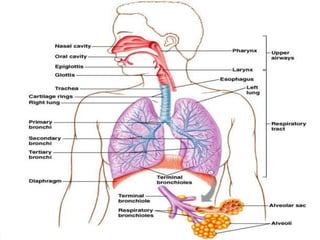
ANATOMY OF THE AIRWAYS
DISTRIBUTION OF VENTILATION
PULMONARY PRESSURES
MECHANICS OF BREATHING
FACTORS AFFECTING VENTILATION
SPIROMETRY VOLUMES
CONTROL OF BREATHING
ABNORMAL VENTILATION
REFERENCES
DEFINITION
• Mass movement of gas in and out of the lungs
ANATOMY

                 Nostrils (Nares)
• Transfer air back and forth between the
  outside environment and the Nasal Cavity.
• These structures serve as the primary air
  intake site.
Nasal Cavity
• A chamber that transfers air and gases back and
  forth between the nostrils and the pharynx.
• Air is warmed and humidified – temp rises to
  within 1⁰ F of body temperature and to within 2-3
  % of full saturation with water vapour before it
  reaches trachea.
• Partially filtered- turbulent filtration(>6 micron)
• Clinical significance
Pharynx
• The throat passage way that allows air and gases
  to pass back and forth between the nasal cavity
  and the glottis.
• During inspiration,pressure in pharynx fall below
  atm.pressure
• Opposed by pharyngeal dilator
  muscles(genioglossus and tensor palati)
• Patency in supine position maintained by tensor
  palati,palatoglossus and palatopharyngeus
Epiglottis
• A flap-like structure in the lower pharynx that
  is located above the glottis.
• The epiglottis operates like a valve that allows
  air to pass through the glottis and into the
  trachea during breathing, but, closes over the
  glottis during the swallowing of food and drink
  to prevent choking.
Glottis
• An opening that allows air to pass back and
  forth between the pharynx and the larynx
  during breathing
                    Larynx
• A set of cartilaginous structures and
  membranes that allow air to pass back and
  forth between the glottis and the trachea.
• The larynx (voicebox) also contains cord-like
  membranes that produce sounds.
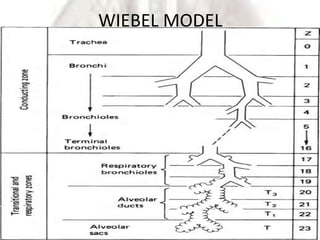
WIEBEL MODEL
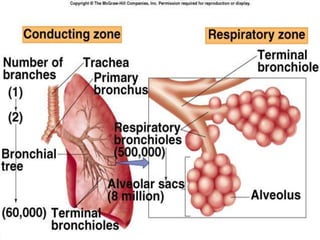
Trachea
• Generation 0
• Length 11 cm
• Mean diameter 1.8 cm
• A tube reinforced by a series of u-shaped
  cartilaginous rings that passes air back and
  forth between the larynx and the primary
  bronchi.
• Lined by ciliated columnar epithelium
Main Bronchus
• Generation 1
• A tubular structure that passes air back and
  forth between the trachea and lobar bronchi
• 2 in nos
• Mean diameter – 12 mm
• Irregular shaped cartilage present in the walls
• The epithelial lining- ciliated columnar
LOBAR BRONCHI
•   Generation 2 – 3
•   5-8 in nos
•   Mean diameter 5 mm – 8mm
•   Supply lobes
•   Irregular shaped cartilages
Segmental Bronchi
• Generation 4
• 16-20 in nos
• Supplies segments
• A tubular passageway that passes air back and
  forth between a lobar bronchus and the
  remainder of a bronchial tree (
  third, fourth, fifth degree branches, etc. ).
• Mean diameter 4 mm
Terminal Bronchiole
• Generations 5 - 16
• One of the smallest tubular passageways in
  the lung that passes air back and forth
  between the smallest bronchial tube and the
  respiratory bronchiole.
• Mean diameter 0.7mm
• Cuboidal epithelium
• Strong helical muscle bands in the wall
Respiratory Bronchiole
• Generations 17- 19
• Transitional and respiratory zone
• The smallest air tubes in the lungs that passes
  air back and forth between a terminal
  bronchiole and an alveolar sac.
• Mean diameter 0.4mm
• Cuboidal to flat epithelium
ALVEOLAR DUCTS
•   Generation 20,21,22
•   Along with alveoli forms the lung parenchyma
•   Mean diameter 0.3 mm
•   Lined by alveolar epithelium
•   Thin bands of muscle in alveolar septa
Alveolar Sac
• Generation 23
• Last generation of air passage
• A sac-like (blind) extension of a respiratory
  bronchiole that is divided into many small
  alveolar compartments.
• The alveolar sac will contain many small septa
  that act as partitions between the alveoli.
• The septa and alveolar surfaces provide surface
  area for gas exchange.
• 17 alveoli arise from each alveolar sac
Alveolus
• The smallest site in the lung for gas exchange.
• Made up of a thin membrane that is ideal for
  diffusion of gases back and forth between the
  air of the alveolar sac and the blood of
  pulmonary capillaries.
• 270 – 790 million
• Mean diameter at FRC = 0.2 mm
Pulmonary acinus
• Aka primary lobule/terminal respiratory unit
• Zone supplied by first order respiratory
  bronchioles,alveolar ducts and alveolar sacs
  distal to a single terminal bronchiole.
• 30000 acinus present in human lung
• Diameter = 3.5mm
• Contain > 10000 alveolus
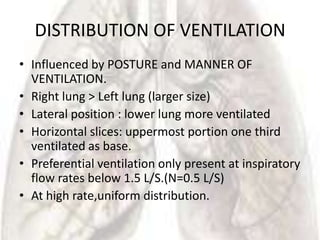
DISTRIBUTION OF VENTILATION
• Influenced by POSTURE and MANNER OF
  VENTILATION.
• Right lung > Left lung (larger size)
• Lateral position : lower lung more ventilated
• Horizontal slices: uppermost portion one third
  ventilated as base.
• Preferential ventilation only present at inspiratory
  flow rates below 1.5 L/S.(N=0.5 L/S)
• At high rate,uniform distribution.
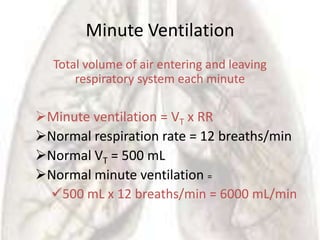
Minute Ventilation
  Total volume of air entering and leaving
      respiratory system each minute

Minute ventilation = VT x RR
Normal respiration rate = 12 breaths/min
Normal VT = 500 mL
Normal minute ventilation =
 500 mL x 12 breaths/min = 6000 mL/min
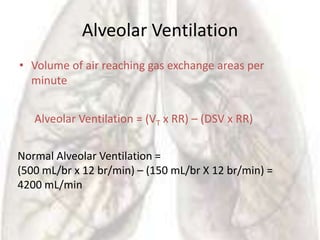
Alveolar Ventilation
• Volume of air reaching gas exchange areas per
  minute


   Alveolar Ventilation = (VT x RR) – (DSV x RR)

Normal Alveolar Ventilation =
(500 mL/br x 12 br/min) – (150 mL/br X 12 br/min) =
4200 mL/min
DEAD SPACE
• An appreciable part of each inspiration do not
  penetrate to those regions of gas exchange and
  therefore exhaled unchanged.
• This fraction of Tidal volume(Tᵥ) = DEAD SPACE
• Alveolar ventilation(VA) : Effective part of minute
  volume of respiration.
• Alveolar ventilation= respiratory rate × (Tᵥ - dead
  space)
• RATIOS
• VD/VT = Wasted portion of breath
• VA/MV = utilised portion of MV
COMPONENTS OF DEAD SPACE
• APPARATUS DEAD SPACE: First part to be
  exhaled if subject is employing any form of
  external breathing apparatus.
• ANATOMICAL DEAD SPACE: Volume of the
  conducting air passages
• ALVEOLAR DEAD SPACE: Part of inspired gas
  that passes through anatomical dead space to
  mix with gas at alveolar level , but does not
  take part in gas exchange.
ANATOMICAL DEAD SPACE
FACTORS INFLUENCING:
• Size of subject – increases with size
• Age – from adulthood increases 1 ml/year.
• Posture- 150 ml sitting,100 ml supine
• Position of neck and jaw
 Neck extended,jaw protruded-143 ml
 Normal position – 119 ml
 Neck flexed,chin depressed – 73 ml
• Lung volume at end of inspiration- 20 ml additional
  An.DS/each litre increase in LV
• Tracheal intubation,tracheostomy,LMA- decreased An.DS
• Drugs
• With Decreased Tidal volume, An.DS decreases
ALVEOLAR DEAD SPACE
FACTORS INFLUENCING:
• CARDIAC OUTPUT
• PULMONARY EMBOLISM
• POSTURE
PHYSIOLOGICAL DEAD SPACE
• Sum of all parts of Tidal volume that do not
  participate in gaseous exchange
• Sum of anatomical dead space and alveolar
  deadspace.
• 30 % of tidal volume
• Factors influencing:
• Age and sex
• Body size (17ml / every 10 cm ↑)
• Posture (↓es in supine)
• Pathology (PE,SMOKING)
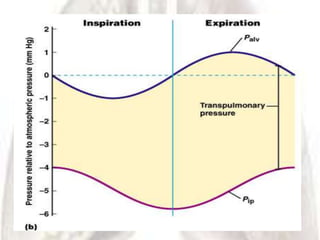
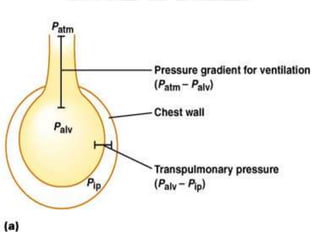
PULMONARY PRESSURES
Atmospheric pressure = Patm
Intra-alveolar pressure = Palv
  Pressure of air in alveoli
Intrapleural pressure = Pip
  Pressure inside pleural sac
Transpulmonary pressure = Palv – Pip
  Distending pressure across the lung
   wall
Atmospheric Pressure
760 mm Hg at sea level
Decreases as altitude increases
Increases under water
Other lung pressures given relative
 to atmospheric (set Patm = 0 mm Hg)
Intra-alveolar Pressure
Pressure of air in alveoli
Given relative to atmospheric pressure
Varies with phase of respiration
  During inspiration = negative
   (less than atmospheric)
  During expiration = positive
   (more than atmospheric)
Difference between Palv and Patm /(Pᵥᵥ)
 drives ventilation
Factors determining intra-alveolar
 pressure
  Quantity of air in alveoli
  Volume of alveoli
Lungs expand – alveolar volume increases
  Palv decreases
  Pressure gradient drives air into lungs
Lungs recoil – alveolar volume decreases
  Palv increases
  Pressure gradient drives air out of lungs
Intrapleural Pressure
Pressure inside pleural sac
 Always negative under normal
   conditions
 Always less than Palv
Varies with phase of respiration
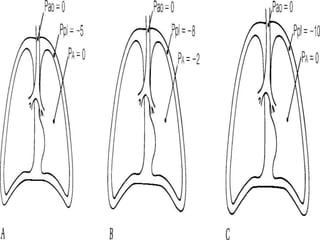
 At rest, -5 mm Hg(MEAN)
Negative pressure due to elasticity in
 lungs and chest wall
  Lungs recoil inward
  Chest wall recoils outward
  Opposing pulls on intrapleural space
  Surface tension of intrapleural fluid
   hold wall and lungs together
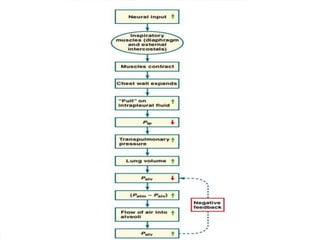
Transpulmonary Pressure
Transpulmonary pressure = Palv – Pip
Distending pressure across the lung
 wall
Increase in transpulmonary pressure:
 Increase distending pressure across
   lungs
 Lungs (alveoli) expand, increasing
   volume
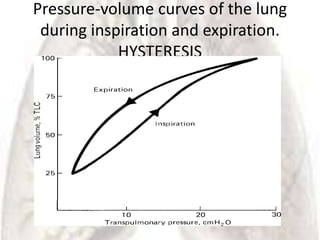
Pressure-volume curves of the lung
 during inspiration and expiration.
            HYSTERESIS
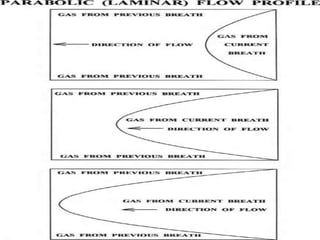
PARABOLIC (LAMINAR) FLOW PROFILE
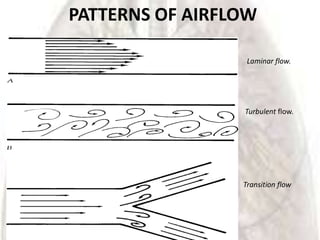
PATTERNS OF AIRFLOW

                  Laminar flow.


                 Turbulent flow.


                 Transition flow
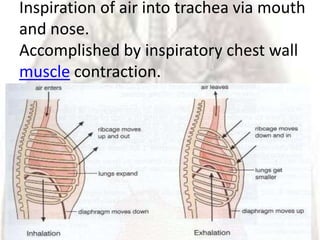
Inspiration of air into trachea via mouth
and nose.
Accomplished by inspiratory chest wall
muscle contraction.
• TRUNK / CHEST WALL
RIBCAGE
ABDOMEN
Separated by DIAPHRAGM
DIAPHRAGM
• Membranous muscle separating abdominal
  cavity and chest
• SA = 900 cm²
• Most important inspiratory muscle
• Motor innervation: Phrenic N(C3,4,5)
• Contraction      Increase in lung volume
MECHANICS OF DIAPHRAGM
            MOVEMENT
•   ‘Piston in cylinder’ Analogy
•   ‘Non piston’ behaviour
•   Combination (piston + non piston)
•   Combination of all the above mechanisms and
    change in shape involving ‘tilting and
    flattening’ of diaphragm in AP direction.
RIBCAGE MUSCLES
• RIBCAGE = CYLINDER/BUCKET
• Length
•  governed by DIAPHRAGM
• And secondarily by flexion and extension of
  Spine
• CROSS SECTION
• By movement of RIBS
MECHANICS OF RIBCAGE MUSCLES
• ‘BUCKET HANDLE’ ACTION
• ‘PUMP HANDLE’ MOVEMENT
Intercostal muscles
• External intercostals
 Deficient anteriorly
 Primarily inspiratory

• Internal intercostals
 Deficient posteriorly(less powerful)
 Primarily expiratory
 Parasternal portion is inspiratory.

• Intercostalis intima

 Posture plays important role in ICM action.
 Extreme postural changes reverts activity of intercostal
  muscles
ACCESSORY MUSCLES
 Silent in normal breathing
 Increased ventilation(about 50 L/min) leads to recruitment of
  ACCESSORY muscles.
• MUSCLES
 Generally inspiratory
 Sternocleidomastoid M
 Pectoralis minor M
 Serrati M
 Extensors of vertebral column
 ABDOMINAL M
 Generally expiratory
 Rectus abdominis
 Obliques – external and internal
 Transversalis
 Muscles of pelvic floor(supportive)
INSPIRATION
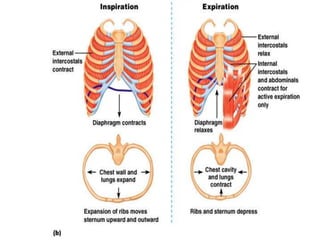
• Ribcage inspiratory muscles (ext &parasternal
  int ICM) and Diaphragm act in parallel to
  inflate the lungs.
• Scalene muscles (supportive role)
• POSTURE decides the dominant role
• Diaphragm contraction alone results in
  widening of lower ribcage and indrawing of
  upper ribcage countered by IC and neck
  muscle
EXPIRATION
• No musculature required in quiet breathing in
  supine position
• Elastic recoil of lungs provide energy required
  for expiration and is also aided by weight of
  abdominal contents
• In upright position and stimulated ventilation
  the INTERNAL ICM and Abdominal wall M are
  active in returning the ribcage and Diaphragm
  to resting position
EFFECT OF POSTURE ON MUSCLES
UPRIGHT: In Standing/Sitting position , Ribcage
  muscles more used(67 % contribution)
• Scalene and parasternal internal ICM support
SUPINE:Diaphragm upward(4 cm up)
• Decreased FRC
• Fibre length decreased in supine position
• More effective contraction
LATERAL: Only lower dome of Diaphragm pushed
  higher into chest,upper dome is flat.
• Lower dome contract effectively
• Increased ventilation of lower lung.
CHEMORECEPTOR ACTIVATION
• Respiratory muscle response to hypoxia /
  hypercarbia for an equivalent minute volume.
• Hypoxia stimulates mostly inspiratory muscles
• Hypercapnea stimulates both inspiratory and
  expiratory muscles.


                                          NEXT
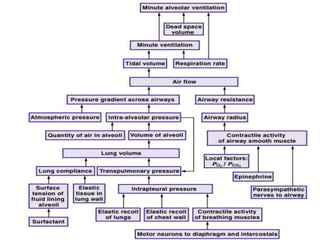
Factors Affecting Pulmonary Ventilation
    Lung Compliance
    Airway Resistance
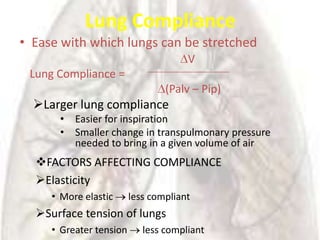
Lung Compliance
• Ease with which lungs can be stretched
                                      V
 Lung Compliance =
                                 (Palv – Pip)
  Larger lung compliance
      •   Easier for inspiration
      •   Smaller change in transpulmonary pressure
          needed to bring in a given volume of air
  FACTORS AFFECTING COMPLIANCE
  Elasticity
     • More elastic      less compliant
  Surface tension of lungs
     • Greater tension      less compliant
Surface Tension in Lungs
  Thin layer fluid lines alveoli
  Surface tension due to attractions between water
   molecules
  Surface tension = force for alveoli to collapse
   or resist expansion


• To Overcome Surface Tension
     Surfactant secreted from type II cells
        • Surfactant = detergent that decreases surface tension
     Surfactant increases lung compliance
        • Makes inspiration easier
Resistance to airflow
• < 1 cm H₂O pressure gradient (alveolar to
  atmospheric pressure) sufficient to cause enough
  airflow for quiet breathing
• Greatest amount of resistance to airflow is not in
  minute air passages of terminal bronchioles but in
  some larger bronchioles and bronchi near trachea.
• In disease,smaller bronchioles play a greater role in
  determining airflow resistance because of small size
  and they are easily occluded by
 Muscle contraction in their walls
 Edema occuring in walls
 Mucus collecting in lumen
Nervous and local control of bronchial
           musculature
• Sympathetic dilation of bronchioles
• Direct control relatively weak because few fibers
  penetrate central portions of lung
• Cause dilation of bronchioles
• Parasympathetic constriction
• Few parasympathetic fibers penetrate lung
  parenchyma
• Also activated by local irritation(noxious
  gases,infection)
• Local factors – histamine,SRS-A
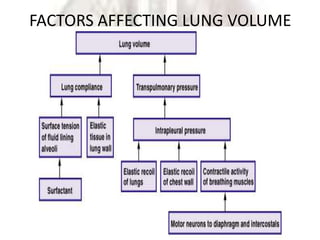
FACTORS AFFECTING LUNG VOLUME
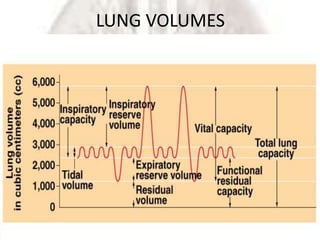
LUNG VOLUMES
• Tidal volume (TV):
• The tidal volume (TV) is the volume of air that is
  drawn into the lungs during inspiration from the end-
  expiratory position (and also leaves the lungs
  passively during expiration in the course of quiet
  breathing).
• Inspiratory reserve volume (IRV): Maximum volume of air
  inspired from the end-tidal inspiratory level.

• Expiratory reserve volume (ERV): The expiratory reserve
  volume (ERV) is the maximum volume of air that can be
  forcibly exhaled after a quiet expiration has been completed
  (i.e., from the end-expiratory position).

• Residual volume: The residual volume (RV) is the volume of
  air that remains in the lungs after a maximal expiratory effort.
  always left in lungs, even with forced expiration.
   Not measured with spirometer
• The functional residual capacity (FRC) is the
  volume of air that remains in the lungs at the
  end of a normal expiration.
• The inspiratory capacity (IC) is the maximum
  volume of air that can be inhaled from the
  end-expiratory position. It consists of two
  subdivisions:
• tidal volume and the inspiratory reserve
  volume (IRV).
• The total lung capacity (TLC) is the total
  volume of air contained in the lungs at the end
  of a maximum inspiration.
• The vital capacity (VC) is the volume of air that
  is exhaled by a maximum expiration after a
  maximum inspiration.
• So in total there are 4 volumes and 4
  capacities.
Centres
1.     Voluntary Control --- Motor Cortex

2. Involuntary (autonomic) Control --Brain Stem
 Pons
 Medulla Oblongata

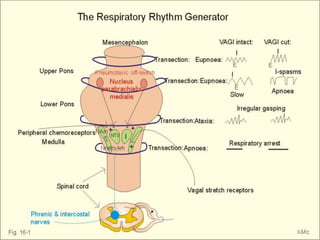
• Medulla contains two centres of breathing
 Inspiratory Centre containing inspiratory neurones
 Expiratory Centre containing expiratory neurones

• For quiet breathing (eupnoea); I neurones responsible for
  inspiration; expiration when I neurones cease firing.
• I neurones cease (probably) by a “slow loop negative feedback”
  mechanism
• During exercise (hyperpnoea) I neurones inhibited by
  Pneumotaxic centre in the Pons region
Medullary Respiratory Centre
•    Two regions:
•   1) Dorsal respiratory group(DRG) – Inspiratory Centre
•   2) Ventral respiratory group(VRG) – Expiratory Centre
•   • Probable that cells of the inspiratory centre have
    the property of “intrinsic periodic firing” - responsible
    for the basic rhythm of ventilation

• • With all stimuli abolished inspiratory cells generate
  repetitive bursts of action potentials - nervous
  impulses along efferent nerves to respiratory muscles
• Expiratory Centre
• Quiescent during normal quiet breathing
• In exercise hyperpnoea when breathing is more
  forceful, expiration becomes active due to the
  expiatory neurones.
• Pneumotaxic Centre(PRG) - Upper Pons
• Appears to switch off inspiration and so regulate
  inspiratory volume and respiration rate.
• Apneustic Centre
• Neurones are suggested to have an excitatory effect
  on the inspiratory neurones prolonging the ramp
  action potentials
Respiratory Reflexes
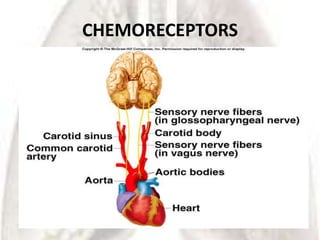
pH of body fluids/plasma is the most potent stimulus to the
   respiratory centre
↓ pH > ↑ pCO2 > ↓ pO2
Detected by
1. Peripheral Chemoreceptors
 aortic bodies
 carotid bodies
1) Small highly perfused shunts of the main arteries
2) Sensory (afferent) signals to medulla by, vagus (ao) and
   glossopharyngeal (ca)
3) pH is the predominant trigger. pO2 less important except
   at altitude or in disease
CHEMORECEPTORS
Central Chemoreceptors
Surface of the Medulla Oblongata
• Measure pH of cerebrospinal fluid (CSF) and brain tissue
  fluid
• Main aim of respiratory control is brain pH homeostasis

Hydrogen ions [H+] do not freely pass blood/CSF barrier
• But CO2 does easily (no lactic acid effect on central
   chemoreceptors)
• In CSF CO2 + H2O = H+ + [HCO3 ] - H+ liberated then influences
   the central chemoreceptors
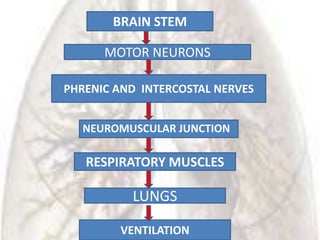
BRAIN STEM

      MOTOR NEURONS

PHRENIC AND INTERCOSTAL NERVES


  NEUROMUSCULAR JUNCTION

   RESPIRATORY MUSCLES

          LUNGS

        VENTILATION
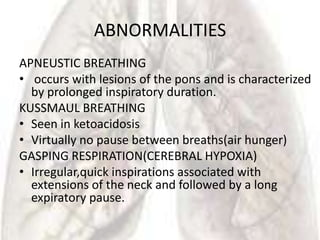
ABNORMALITIES
APNEUSTIC BREATHING
• occurs with lesions of the pons and is characterized
  by prolonged inspiratory duration.
KUSSMAUL BREATHING
• Seen in ketoacidosis
• Virtually no pause between breaths(air hunger)
GASPING RESPIRATION(CEREBRAL HYPOXIA)
• Irregular,quick inspirations associated with
  extensions of the neck and followed by a long
  expiratory pause.
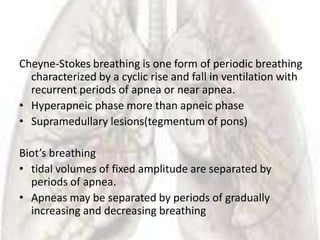
Cheyne-Stokes breathing is one form of periodic breathing
  characterized by a cyclic rise and fall in ventilation with
  recurrent periods of apnea or near apnea.
• Hyperapneic phase more than apneic phase
• Supramedullary lesions(tegmentum of pons)

Biot’s breathing
• tidal volumes of fixed amplitude are separated by
  periods of apnea.
• Apneas may be separated by periods of gradually
  increasing and decreasing breathing
REFERENCES
1. FISHMAN’S PULMONARY DISEASES AND
   DSISORDERS
2. CROFTON AND DOUGLAS’S RESPIRATORY
   DISEASES
3. NUNN’S APPLIED RESPIRATORY PHYSIOLOGY
4. GUYTON’S TEXTBOOK OF PHYSIOLOGY
5. GANONG REVIEW OF PHYSIOLOGY
6. PLEURAL DISEASES - LIGHT
THANK YOU

Ventilation final

  • 1.
    VENTILATION Dr. Amith Sreedharan
  • 2.
    DEFINITION ANATOMY OF THEAIRWAYS DISTRIBUTION OF VENTILATION PULMONARY PRESSURES MECHANICS OF BREATHING FACTORS AFFECTING VENTILATION SPIROMETRY VOLUMES CONTROL OF BREATHING ABNORMAL VENTILATION REFERENCES
  • 3.
    DEFINITION • Mass movementof gas in and out of the lungs
  • 4.
    ANATOMY Nostrils (Nares) • Transfer air back and forth between the outside environment and the Nasal Cavity. • These structures serve as the primary air intake site.
  • 6.
    Nasal Cavity • Achamber that transfers air and gases back and forth between the nostrils and the pharynx. • Air is warmed and humidified – temp rises to within 1⁰ F of body temperature and to within 2-3 % of full saturation with water vapour before it reaches trachea. • Partially filtered- turbulent filtration(>6 micron) • Clinical significance
  • 7.
    Pharynx • The throatpassage way that allows air and gases to pass back and forth between the nasal cavity and the glottis. • During inspiration,pressure in pharynx fall below atm.pressure • Opposed by pharyngeal dilator muscles(genioglossus and tensor palati) • Patency in supine position maintained by tensor palati,palatoglossus and palatopharyngeus
  • 8.
    Epiglottis • A flap-likestructure in the lower pharynx that is located above the glottis. • The epiglottis operates like a valve that allows air to pass through the glottis and into the trachea during breathing, but, closes over the glottis during the swallowing of food and drink to prevent choking.
  • 9.
    Glottis • An openingthat allows air to pass back and forth between the pharynx and the larynx during breathing Larynx • A set of cartilaginous structures and membranes that allow air to pass back and forth between the glottis and the trachea. • The larynx (voicebox) also contains cord-like membranes that produce sounds.
  • 10.
  • 11.
    Trachea • Generation 0 •Length 11 cm • Mean diameter 1.8 cm • A tube reinforced by a series of u-shaped cartilaginous rings that passes air back and forth between the larynx and the primary bronchi. • Lined by ciliated columnar epithelium
  • 12.
    Main Bronchus • Generation1 • A tubular structure that passes air back and forth between the trachea and lobar bronchi • 2 in nos • Mean diameter – 12 mm • Irregular shaped cartilage present in the walls • The epithelial lining- ciliated columnar
  • 13.
    LOBAR BRONCHI • Generation 2 – 3 • 5-8 in nos • Mean diameter 5 mm – 8mm • Supply lobes • Irregular shaped cartilages
  • 14.
    Segmental Bronchi • Generation4 • 16-20 in nos • Supplies segments • A tubular passageway that passes air back and forth between a lobar bronchus and the remainder of a bronchial tree ( third, fourth, fifth degree branches, etc. ). • Mean diameter 4 mm
  • 15.
    Terminal Bronchiole • Generations5 - 16 • One of the smallest tubular passageways in the lung that passes air back and forth between the smallest bronchial tube and the respiratory bronchiole. • Mean diameter 0.7mm • Cuboidal epithelium • Strong helical muscle bands in the wall
  • 16.
    Respiratory Bronchiole • Generations17- 19 • Transitional and respiratory zone • The smallest air tubes in the lungs that passes air back and forth between a terminal bronchiole and an alveolar sac. • Mean diameter 0.4mm • Cuboidal to flat epithelium
  • 17.
    ALVEOLAR DUCTS • Generation 20,21,22 • Along with alveoli forms the lung parenchyma • Mean diameter 0.3 mm • Lined by alveolar epithelium • Thin bands of muscle in alveolar septa
  • 18.
    Alveolar Sac • Generation23 • Last generation of air passage • A sac-like (blind) extension of a respiratory bronchiole that is divided into many small alveolar compartments. • The alveolar sac will contain many small septa that act as partitions between the alveoli. • The septa and alveolar surfaces provide surface area for gas exchange. • 17 alveoli arise from each alveolar sac
  • 19.
    Alveolus • The smallestsite in the lung for gas exchange. • Made up of a thin membrane that is ideal for diffusion of gases back and forth between the air of the alveolar sac and the blood of pulmonary capillaries. • 270 – 790 million • Mean diameter at FRC = 0.2 mm
  • 20.
    Pulmonary acinus • Akaprimary lobule/terminal respiratory unit • Zone supplied by first order respiratory bronchioles,alveolar ducts and alveolar sacs distal to a single terminal bronchiole. • 30000 acinus present in human lung • Diameter = 3.5mm • Contain > 10000 alveolus
  • 22.
    DISTRIBUTION OF VENTILATION •Influenced by POSTURE and MANNER OF VENTILATION. • Right lung > Left lung (larger size) • Lateral position : lower lung more ventilated • Horizontal slices: uppermost portion one third ventilated as base. • Preferential ventilation only present at inspiratory flow rates below 1.5 L/S.(N=0.5 L/S) • At high rate,uniform distribution.
  • 23.
    Minute Ventilation Total volume of air entering and leaving respiratory system each minute Minute ventilation = VT x RR Normal respiration rate = 12 breaths/min Normal VT = 500 mL Normal minute ventilation = 500 mL x 12 breaths/min = 6000 mL/min
  • 24.
    Alveolar Ventilation • Volumeof air reaching gas exchange areas per minute Alveolar Ventilation = (VT x RR) – (DSV x RR) Normal Alveolar Ventilation = (500 mL/br x 12 br/min) – (150 mL/br X 12 br/min) = 4200 mL/min
  • 25.
    DEAD SPACE • Anappreciable part of each inspiration do not penetrate to those regions of gas exchange and therefore exhaled unchanged. • This fraction of Tidal volume(Tᵥ) = DEAD SPACE • Alveolar ventilation(VA) : Effective part of minute volume of respiration. • Alveolar ventilation= respiratory rate × (Tᵥ - dead space) • RATIOS • VD/VT = Wasted portion of breath • VA/MV = utilised portion of MV
  • 26.
    COMPONENTS OF DEADSPACE • APPARATUS DEAD SPACE: First part to be exhaled if subject is employing any form of external breathing apparatus. • ANATOMICAL DEAD SPACE: Volume of the conducting air passages • ALVEOLAR DEAD SPACE: Part of inspired gas that passes through anatomical dead space to mix with gas at alveolar level , but does not take part in gas exchange.
  • 27.
    ANATOMICAL DEAD SPACE FACTORSINFLUENCING: • Size of subject – increases with size • Age – from adulthood increases 1 ml/year. • Posture- 150 ml sitting,100 ml supine • Position of neck and jaw  Neck extended,jaw protruded-143 ml  Normal position – 119 ml  Neck flexed,chin depressed – 73 ml • Lung volume at end of inspiration- 20 ml additional An.DS/each litre increase in LV • Tracheal intubation,tracheostomy,LMA- decreased An.DS • Drugs • With Decreased Tidal volume, An.DS decreases
  • 28.
    ALVEOLAR DEAD SPACE FACTORSINFLUENCING: • CARDIAC OUTPUT • PULMONARY EMBOLISM • POSTURE
  • 29.
    PHYSIOLOGICAL DEAD SPACE •Sum of all parts of Tidal volume that do not participate in gaseous exchange • Sum of anatomical dead space and alveolar deadspace. • 30 % of tidal volume • Factors influencing: • Age and sex • Body size (17ml / every 10 cm ↑) • Posture (↓es in supine) • Pathology (PE,SMOKING)
  • 30.
    PULMONARY PRESSURES Atmospheric pressure= Patm Intra-alveolar pressure = Palv Pressure of air in alveoli Intrapleural pressure = Pip Pressure inside pleural sac Transpulmonary pressure = Palv – Pip Distending pressure across the lung wall
  • 31.
    Atmospheric Pressure 760 mmHg at sea level Decreases as altitude increases Increases under water Other lung pressures given relative to atmospheric (set Patm = 0 mm Hg)
  • 32.
    Intra-alveolar Pressure Pressure ofair in alveoli Given relative to atmospheric pressure Varies with phase of respiration During inspiration = negative (less than atmospheric) During expiration = positive (more than atmospheric) Difference between Palv and Patm /(Pᵥᵥ) drives ventilation
  • 33.
    Factors determining intra-alveolar pressure Quantity of air in alveoli Volume of alveoli Lungs expand – alveolar volume increases Palv decreases Pressure gradient drives air into lungs Lungs recoil – alveolar volume decreases Palv increases Pressure gradient drives air out of lungs
  • 34.
    Intrapleural Pressure Pressure insidepleural sac Always negative under normal conditions Always less than Palv Varies with phase of respiration At rest, -5 mm Hg(MEAN)
  • 35.
    Negative pressure dueto elasticity in lungs and chest wall Lungs recoil inward Chest wall recoils outward Opposing pulls on intrapleural space Surface tension of intrapleural fluid hold wall and lungs together
  • 36.
    Transpulmonary Pressure Transpulmonary pressure= Palv – Pip Distending pressure across the lung wall Increase in transpulmonary pressure: Increase distending pressure across lungs Lungs (alveoli) expand, increasing volume
  • 40.
    Pressure-volume curves ofthe lung during inspiration and expiration. HYSTERESIS
  • 42.
  • 43.
    PATTERNS OF AIRFLOW Laminar flow. Turbulent flow. Transition flow
  • 44.
    Inspiration of airinto trachea via mouth and nose. Accomplished by inspiratory chest wall muscle contraction.
  • 45.
    • TRUNK /CHEST WALL RIBCAGE ABDOMEN Separated by DIAPHRAGM
  • 46.
    DIAPHRAGM • Membranous muscleseparating abdominal cavity and chest • SA = 900 cm² • Most important inspiratory muscle • Motor innervation: Phrenic N(C3,4,5) • Contraction Increase in lung volume
  • 47.
    MECHANICS OF DIAPHRAGM MOVEMENT • ‘Piston in cylinder’ Analogy • ‘Non piston’ behaviour • Combination (piston + non piston) • Combination of all the above mechanisms and change in shape involving ‘tilting and flattening’ of diaphragm in AP direction.
  • 48.
    RIBCAGE MUSCLES • RIBCAGE= CYLINDER/BUCKET • Length • governed by DIAPHRAGM • And secondarily by flexion and extension of Spine • CROSS SECTION • By movement of RIBS
  • 49.
    MECHANICS OF RIBCAGEMUSCLES • ‘BUCKET HANDLE’ ACTION • ‘PUMP HANDLE’ MOVEMENT
  • 50.
    Intercostal muscles • Externalintercostals  Deficient anteriorly  Primarily inspiratory • Internal intercostals  Deficient posteriorly(less powerful)  Primarily expiratory  Parasternal portion is inspiratory. • Intercostalis intima  Posture plays important role in ICM action.  Extreme postural changes reverts activity of intercostal muscles
  • 51.
    ACCESSORY MUSCLES  Silentin normal breathing  Increased ventilation(about 50 L/min) leads to recruitment of ACCESSORY muscles. • MUSCLES  Generally inspiratory  Sternocleidomastoid M  Pectoralis minor M  Serrati M  Extensors of vertebral column  ABDOMINAL M  Generally expiratory  Rectus abdominis  Obliques – external and internal  Transversalis  Muscles of pelvic floor(supportive)
  • 52.
    INSPIRATION • Ribcage inspiratorymuscles (ext &parasternal int ICM) and Diaphragm act in parallel to inflate the lungs. • Scalene muscles (supportive role) • POSTURE decides the dominant role • Diaphragm contraction alone results in widening of lower ribcage and indrawing of upper ribcage countered by IC and neck muscle
  • 53.
    EXPIRATION • No musculaturerequired in quiet breathing in supine position • Elastic recoil of lungs provide energy required for expiration and is also aided by weight of abdominal contents • In upright position and stimulated ventilation the INTERNAL ICM and Abdominal wall M are active in returning the ribcage and Diaphragm to resting position
  • 55.
    EFFECT OF POSTUREON MUSCLES UPRIGHT: In Standing/Sitting position , Ribcage muscles more used(67 % contribution) • Scalene and parasternal internal ICM support SUPINE:Diaphragm upward(4 cm up) • Decreased FRC • Fibre length decreased in supine position • More effective contraction LATERAL: Only lower dome of Diaphragm pushed higher into chest,upper dome is flat. • Lower dome contract effectively • Increased ventilation of lower lung.
  • 56.
    CHEMORECEPTOR ACTIVATION • Respiratorymuscle response to hypoxia / hypercarbia for an equivalent minute volume. • Hypoxia stimulates mostly inspiratory muscles • Hypercapnea stimulates both inspiratory and expiratory muscles. NEXT
  • 57.
    Factors Affecting PulmonaryVentilation  Lung Compliance  Airway Resistance
  • 58.
    Lung Compliance • Easewith which lungs can be stretched V Lung Compliance = (Palv – Pip) Larger lung compliance • Easier for inspiration • Smaller change in transpulmonary pressure needed to bring in a given volume of air FACTORS AFFECTING COMPLIANCE Elasticity • More elastic less compliant Surface tension of lungs • Greater tension less compliant
  • 59.
    Surface Tension inLungs Thin layer fluid lines alveoli Surface tension due to attractions between water molecules Surface tension = force for alveoli to collapse or resist expansion • To Overcome Surface Tension Surfactant secreted from type II cells • Surfactant = detergent that decreases surface tension Surfactant increases lung compliance • Makes inspiration easier
  • 60.
    Resistance to airflow •< 1 cm H₂O pressure gradient (alveolar to atmospheric pressure) sufficient to cause enough airflow for quiet breathing • Greatest amount of resistance to airflow is not in minute air passages of terminal bronchioles but in some larger bronchioles and bronchi near trachea. • In disease,smaller bronchioles play a greater role in determining airflow resistance because of small size and they are easily occluded by  Muscle contraction in their walls  Edema occuring in walls  Mucus collecting in lumen
  • 61.
    Nervous and localcontrol of bronchial musculature • Sympathetic dilation of bronchioles • Direct control relatively weak because few fibers penetrate central portions of lung • Cause dilation of bronchioles • Parasympathetic constriction • Few parasympathetic fibers penetrate lung parenchyma • Also activated by local irritation(noxious gases,infection) • Local factors – histamine,SRS-A
  • 62.
  • 63.
  • 64.
    • Tidal volume(TV): • The tidal volume (TV) is the volume of air that is drawn into the lungs during inspiration from the end- expiratory position (and also leaves the lungs passively during expiration in the course of quiet breathing).
  • 65.
    • Inspiratory reservevolume (IRV): Maximum volume of air inspired from the end-tidal inspiratory level. • Expiratory reserve volume (ERV): The expiratory reserve volume (ERV) is the maximum volume of air that can be forcibly exhaled after a quiet expiration has been completed (i.e., from the end-expiratory position). • Residual volume: The residual volume (RV) is the volume of air that remains in the lungs after a maximal expiratory effort. always left in lungs, even with forced expiration. Not measured with spirometer
  • 66.
    • The functionalresidual capacity (FRC) is the volume of air that remains in the lungs at the end of a normal expiration. • The inspiratory capacity (IC) is the maximum volume of air that can be inhaled from the end-expiratory position. It consists of two subdivisions: • tidal volume and the inspiratory reserve volume (IRV).
  • 67.
    • The totallung capacity (TLC) is the total volume of air contained in the lungs at the end of a maximum inspiration. • The vital capacity (VC) is the volume of air that is exhaled by a maximum expiration after a maximum inspiration. • So in total there are 4 volumes and 4 capacities.
  • 68.
    Centres 1. Voluntary Control --- Motor Cortex 2. Involuntary (autonomic) Control --Brain Stem  Pons  Medulla Oblongata • Medulla contains two centres of breathing  Inspiratory Centre containing inspiratory neurones  Expiratory Centre containing expiratory neurones • For quiet breathing (eupnoea); I neurones responsible for inspiration; expiration when I neurones cease firing. • I neurones cease (probably) by a “slow loop negative feedback” mechanism • During exercise (hyperpnoea) I neurones inhibited by Pneumotaxic centre in the Pons region
  • 69.
    Medullary Respiratory Centre • Two regions: • 1) Dorsal respiratory group(DRG) – Inspiratory Centre • 2) Ventral respiratory group(VRG) – Expiratory Centre • • Probable that cells of the inspiratory centre have the property of “intrinsic periodic firing” - responsible for the basic rhythm of ventilation • • With all stimuli abolished inspiratory cells generate repetitive bursts of action potentials - nervous impulses along efferent nerves to respiratory muscles
  • 70.
    • Expiratory Centre •Quiescent during normal quiet breathing • In exercise hyperpnoea when breathing is more forceful, expiration becomes active due to the expiatory neurones. • Pneumotaxic Centre(PRG) - Upper Pons • Appears to switch off inspiration and so regulate inspiratory volume and respiration rate. • Apneustic Centre • Neurones are suggested to have an excitatory effect on the inspiratory neurones prolonging the ramp action potentials
  • 71.
    Respiratory Reflexes pH ofbody fluids/plasma is the most potent stimulus to the respiratory centre ↓ pH > ↑ pCO2 > ↓ pO2 Detected by 1. Peripheral Chemoreceptors  aortic bodies  carotid bodies 1) Small highly perfused shunts of the main arteries 2) Sensory (afferent) signals to medulla by, vagus (ao) and glossopharyngeal (ca) 3) pH is the predominant trigger. pO2 less important except at altitude or in disease
  • 72.
  • 73.
    Central Chemoreceptors Surface ofthe Medulla Oblongata • Measure pH of cerebrospinal fluid (CSF) and brain tissue fluid • Main aim of respiratory control is brain pH homeostasis Hydrogen ions [H+] do not freely pass blood/CSF barrier • But CO2 does easily (no lactic acid effect on central chemoreceptors) • In CSF CO2 + H2O = H+ + [HCO3 ] - H+ liberated then influences the central chemoreceptors
  • 74.
    BRAIN STEM MOTOR NEURONS PHRENIC AND INTERCOSTAL NERVES NEUROMUSCULAR JUNCTION RESPIRATORY MUSCLES LUNGS VENTILATION
  • 75.
    ABNORMALITIES APNEUSTIC BREATHING • occurswith lesions of the pons and is characterized by prolonged inspiratory duration. KUSSMAUL BREATHING • Seen in ketoacidosis • Virtually no pause between breaths(air hunger) GASPING RESPIRATION(CEREBRAL HYPOXIA) • Irregular,quick inspirations associated with extensions of the neck and followed by a long expiratory pause.
  • 76.
    Cheyne-Stokes breathing isone form of periodic breathing characterized by a cyclic rise and fall in ventilation with recurrent periods of apnea or near apnea. • Hyperapneic phase more than apneic phase • Supramedullary lesions(tegmentum of pons) Biot’s breathing • tidal volumes of fixed amplitude are separated by periods of apnea. • Apneas may be separated by periods of gradually increasing and decreasing breathing
  • 79.
    REFERENCES 1. FISHMAN’S PULMONARYDISEASES AND DSISORDERS 2. CROFTON AND DOUGLAS’S RESPIRATORY DISEASES 3. NUNN’S APPLIED RESPIRATORY PHYSIOLOGY 4. GUYTON’S TEXTBOOK OF PHYSIOLOGY 5. GANONG REVIEW OF PHYSIOLOGY 6. PLEURAL DISEASES - LIGHT
  • 80.