Acid-Base disorders
Email:asterwakjira@gmail.com
By: Aster Wakjira
(B.Pharm ,MSc,clinical Pharmacist)
Acid-Base Balance
 Acidity of body fluids is quantified by hydrogen ion
concentration
🞑 pH…… degree of acidity
🞑 Inverse relationship between [H+] and pH
 Normal blood pH …..7.4
🞑 Used to analyze acid-base status
 Hydrogen ion concentration in blood may not be indicative of
concentration in other body compartments
2
Acid-Base Balance ….
 Three mechanisms collectively maintain acid–base balance:
🞑 Extracellular buffering
🞑 Ventilatory regulation of carbon dioxide elimination
🞑 Renal regulation of hydrogen ion and bicarbonate excretion
 Buffering
🞑 Ability of a weak acid and its corresponding anion (base) to
resist change in pH of a solution on addition of a strong acid or
base.
3
Extracellular Buffering
-
 Carbonic acid/bicarbonate system (H2CO3/ HCO3 )
🞑 the most important physiologic buffer system
-
 More HCO3 in ECF than any other buffer component
 CO2 supply is unlimited
-
 Acidity of ECF can be regulated by HCO3 concentration or PCO2
🞑 H2CO3 ….. respiratory component
 Changes in ventilation  changes in PCO2  regulates H2CO3level
🞑 HCO3
- …..metabolic component
-
 regulated by kidney: alters its reabsorption, generate new HCO3 , and
alters its elimination
4
Cont’d
 Phosphate buffer system
🞑 consists of serum inorganic phosphate, intracellular organic
phosphate, calcium phosphate in bone,
🞑 low extracellular concentration of phosphate and it is more
important as intracellular buffer
 Proteins as buffering systems
🞑 buffering provided by charged side chains of amino acids
🞑 more important as intracellular buffer because the concentration
of protein is much greater intracellularly than extracellularly
5
Respiratory Regulation
 Rate and depth of ventilation regulates excretion of CO2
generated by diet and tissue metabolism;
🞑 Increase respiratory rate →increase CO2 excretion →decrease
blood PCO2
🞑 Decrease respiratory rate →decrease CO2 excretion →increase
blood PCO2
 This system rapidly adjusts within minutes to changes in
acid–base balance.
6
Renal Regulation
 The kidney plays a central role in the regulation of acid–
base homeostasis through ….
🞑 excretion or reabsorption of filtered HCO3
-,
🞑 excretion of metabolic fixed acids
🞑 generation of new HCO3
-
 To maintain acid–base balance, the entire filtered HCO -
3
load must be reabsorbed, primarily in the proximal tubule.
7
Renal Regulation….
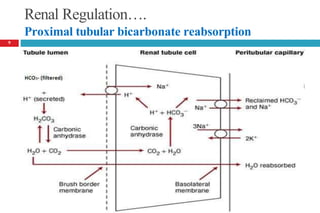
 In the tubular lumen, filtered HCO - combines with H+ secreted
3
by the Na+/H+-exchanger to form carbonic acid (H2CO3).
 H2CO3 is rapidly broken down to CO2 and water by carbonic
anhydrase located on the luminal surface of brush border
membrane.
 CO2 then diffuses into the proximal tubular cell, where it
reforms H2CO3 in the presence of intracellular carbonic
anhydrase.
 H2CO3 dissociates to form H+ that can again be secreted into
3
the tubular lumen, and HCO - that exits the cell and enters the
peritubular capillary.
8
9
Renal Regulation….
Proximal tubular bicarbonate reabsorption
Renal Regulation….
 Excretion of metabolic fixed acids and generation of new
–
HCO3 is achieved via….
🞑 renal ammoniagenesis
🞑 distal tubular H+ secretion
 Ammoniagenesis plays a role in acid-base homeostasis,
🞑 ammonium (NH4
+) excretion comprise ~50% of renal acid
excretion
🞑 for each NH4
+ excreted in the urine, one HCO3
– is regenerated
and returned to the circulation.
10
Renal Regulation….
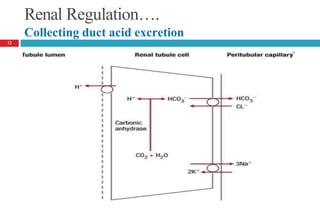
 Collecting duct acid excretion ….
🞑 Distal tubular H+ secretion accounts for 50% of net acid
excretion
🞑 In the distal tubular cell, CO2 combines with water in the
presence of intracellular carbonic anhydrase to form carbonic
acid, which dissociates to H+ and HCO3
−.
🞑 H+ is actively secreted into the tubular lumen.
🞑 HCO3
− exits the cell and enters the peritubular capillary.
11
Renal Regulation….
Collecting duct acid excretion
12
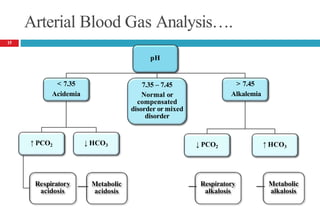
Arterial Blood Gas Analysis
 Blood gases (ABGs) are measured to determine the patient’s
acid–base status.
 Low pH values (<7.35) indicate an acidemia, whereas high pH
values (>7.45) indicate an alkalemia.
 In a metabolic acidosis, the pH is decreased in association with a
decreased serum bicarbonate concentration and a compensatory
decrease in PaCO2.
 In a respiratory acidosis, the pH is decreased; the PaCO2,
however, is elevated.
13
Arterial Blood Gas Analysis….
 In a metabolic alkalosis, the pH is elevated in association with
an increased bicarbonate concentration and a compensatory
increase in PaCO2.
 In a respiratory alkalosis, the pH is also elevated; the PaCO2,
however, is decreased.
 The normal values of each measurement;
🞑 pH = 7.4
🞑 PaCO2 = 40 mm Hg (5.3 kPa)
🞑 [HCO3
− ]= 24 mEq/L (24 mmol/L)
[PaCO : partial pressure of carbon dioxide]
14
Arterial Blood Gas Analysis….
15
pH
< 7.35
Acidemia
↑ PCO2
Respiratory
acidosis
↓ HCO3
Metabolic
acidosis
7.35 – 7.45
Normal or
compensated
disorder or mixed
disorder
> 7.45
Alkalemia
↓ PCO2
Respiratory
alkalosis
↑ HCO3
Metabolic
alkalosis
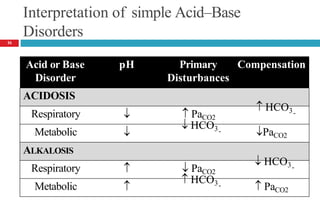
Interpretation of simple Acid–Base
Disorders
Acid or Base
Disorder
pH Primary
Disturbances
Compensation
ACIDOSIS
Respiratory   PaCO2
 HCO3-
Metabolic 
 HCO3- PaCO2
ALKALOSIS
Respiratory   PaCO2
 HCO3-
Metabolic 
 HCO3-  PaCO2
16
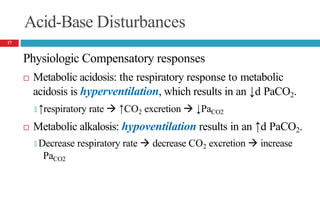
Acid-Base Disturbances
Physiologic Compensatory responses
 Metabolic acidosis: the respiratory response to metabolic
acidosis is hyperventilation, which results in an ↓d PaCO2.
🞑 ↑respiratory rate  ↑CO2 excretion  ↓PaCO2
 Metabolic alkalosis: hypoventilation results in an ↑d PaCO2.
🞑 Decrease respiratory rate  decrease CO2 excretion  increase
PaCO2
17
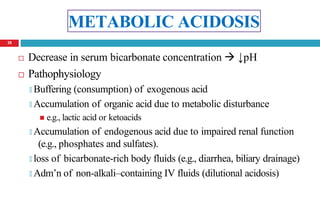
METABOLIC ACIDOSIS
 Decrease in serum bicarbonate concentration  ↓pH
 Pathophysiology
🞑 Buffering (consumption) of exogenous acid
🞑 Accumulation of organic acid due to metabolic disturbance
 e.g., lactic acid or ketoacids
🞑 Accumulation of endogenous acid due to impaired renal function
(e.g., phosphates and sulfates).
🞑 loss of bicarbonate-rich body fluids (e.g., diarrhea, biliary drainage)
🞑 Adm’n of non-alkali–containing IV fluids (dilutional acidosis)
18
Laboratory
 Serum anion gap (SAG)
🞑 SAG = [Na+] – [Cl-] – [HCO3
-]
🞑 SAG = [UAs] – [UCs]
🞑 Normal range 3 to 11 mEq/L (3 to 11 mmol/L)
🞑 High aniongap ---- accumulation of unmeasured anions in ECF.
 [UAs: unmeasured anions, UCs: Unmeasured cations]
19
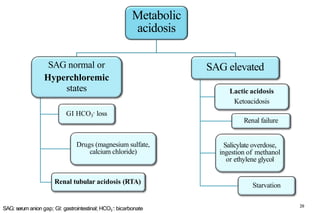
Metabolic
acidosis
SAG normal or
Hyperchloremic
states
GI HCO3
- loss
Drugs (magnesium sulfate,
calcium chloride)
Renal tubular acidosis (RTA)
SAG elevated
Renal failure
Lactic acidosis
Ketoacidosis
Salicylate overdose,
ingestion of methanol
or ethylene glycol
Starvation
20
-
SAG: serum anion gap; GI: gastrointestinal; HCO3 : bicarbonate
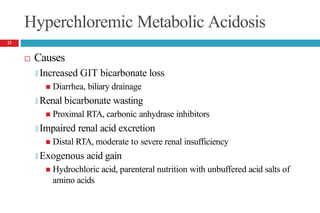
Hyperchloremic Metabolic Acidosis
 Causes
🞑 Increased GIT bicarbonate loss
 Diarrhea, biliary drainage
🞑 Renal bicarbonate wasting
 Proximal RTA, carbonic anhydrase inhibitors
🞑 Impaired renal acid excretion
 Distal RTA, moderate to severe renal insufficiency
🞑 Exogenous acid gain
 Hydrochloric acid, parenteral nutrition with unbuffered acid salts of
amino acids
21
Renal Tubular Acidosis (RTA)
 Type I (distal)
🞑Decreased distal acidification
 Urine pH during acidemia--- > 5.3
-
🞑Plasma [HCO3 ]---may be < 10 mEq/L
🞑Plasma [K+] ----usually reduced or normal
🞑Associated disease states
 Tubule defect, Multiple myeloma, Systemic lupus erythematosus,
Sjögren’s syndrome, Sickle cell disease, Renal transplant rejection
following amphotericin B, Nephrocalcinosis
22
Renal Tubular Acidosis….
 Type II (proximal)
-
🞑 Decreased proximal HCO3 reabsorption
-
🞑 Plasma [HCO3 ] ---- usually 14–20 mEq/L
🞑 Urine pH during acidemia--- variable: > 5.3 or < 5.3
🞑 Plasma [K+] --- normal or reduced
🞑Associated disease states
 Fanconi syndrome, Nephrotic syndrome, Paroxysmal nocturnal
hemoglobinuria, Carbonic anhydrase inhibitors, Impaired proximal
tubular glucose, phosphate, amino acid reabsorption
23
Renal Tubular Acidosis….
 Type IV (distal)
🞑Aldosterone deficiency or resistance
-
🞑 Plasma [HCO3 ] --- usually >15 mEq/L
🞑 Urine pH during acidemia---- <5.3
🞑 Plasma [K+] ----- Elevated
🞑Associated disease states
 Primary mineralocorticoid deficiency (Addison disease)
 Hyporeninemic hypoaldosteronism (diabetic nephropathy, mild
renal impairment)
 Impaired tubular potassium secretion and urinary obstruction
24
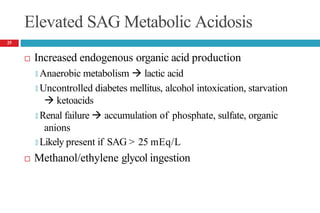
Elevated SAG Metabolic Acidosis
 Increased endogenous organic acid production
🞑 Anaerobic metabolism  lactic acid
🞑 Uncontrolled diabetes mellitus, alcohol intoxication, starvation
 ketoacids
🞑 Renal failure  accumulation of phosphate, sulfate, organic
anions
🞑 Likely present if SAG > 25 mEq/L
 Methanol/ethylene glycol ingestion
25
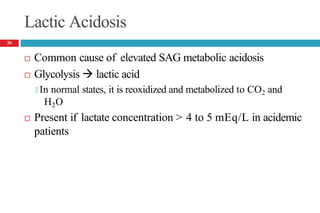
Lactic Acidosis
 Common cause of elevated SAG metabolic acidosis
 Glycolysis  lactic acid
🞑 In normal states, it is reoxidized and metabolized to CO2 and
H2O
 Present if lactate concentration > 4 to 5 mEq/L in acidemic
patients
26
Lactic Acidosis Causes
 Decrease in tissue oxygenation [tissue hypoxia] (type A)
🞑 Shock, Severe anemia, CHF, CO poisoning
 Deranged oxidative metabolism (type B)
🞑 Medications
 Catecholamines, metformin, NRTIs
 Overdose (iron, isoniazid, salicylates, theophylline)
 Propofol infusion syndrome, Propylene glycol toxicity, Na nitroprusside
🞑 Methanol, ethanol, ethylene glycol
🞑 Diabetes mellitus, Malignancy
🞑 Disorders associated with inborn errors of metabolism
27
Metabolic Acidosis Clinical Presentation
 Acute
🞑 Severe acidemia: pH < 7.15 to 7.20
 Chronic:
🞑 usually not associated with severe acidemia
🞑 relatively asymptomatic
🞑 Bone demineralization- major manifestation
 Laboratory Tests
🞑 Low serum CO2
🞑 Hyperglycemia and hyperkalemia are common
🞑 pH < 7.2 = severe acidosis
28
Metabolic Acidosis Clinical Presentation
Signs/symptoms
 Cardiac
🞑 Initial: flushing, rapid HR, wide pulse pressure, ↑in cardiac output
🞑 Later: ↓in cardiac output, BP, liver & kidney blood flow
 Cerebral: coma
 Metabolic: insulin resistance, increased protein degradation
 GI: nausea, vomiting, loss of appetite
 Respiratory: dyspnea, hyperventilation with deep, &rapid respiration
PhysiologicCompensation
 ↑respiratory rate  ↑CO2 excretion  ↓PaCO2
29
Chronic Metabolic Acidosis Treatment
 Always treat underlying disease states
 Mild to moderate acidemia
🞑Gradual correction
🞑Oral alkali replacement
 GI disorders: replace other electrolytes as needed
 RTAwith hyporeninemic-hypoaldosteronemia (type IV)
 May be corrected by treating hyperkalemia
 Supplemental alkali
30
Oral Alkali Replacement
- - -
 LD = VDHCO3 x BW x (desired [HCO3 ] – current [HCO3 ])
-
 E.g., If 60 kg and HCO3 is 15 mEq/L
🞑 LD = (0.5 L/kg x 60 kg) x (24 mEq/L – 15 mEq/L)
= 30 L x 9 mEq/L
= 270 mEq/L
 Give doseoverseveral daysto avoidvolume overloadfrom the
accompanyingNa load.
31
LD: loading dose; VD: volume of distribution; BW: body weight
Acute Severe Metabolic Acidosis Treatment
 Focus treatment on correcting underlying cause,
cardiovascular status
 Emergent hemodialysis may be needed
 IV alkali (sodium bicarbonate)
🞑 Most widely used IV alkali
🞑 Often ineffective
🞑 May be deleterious in lactic acidosis
🞑 to increase arterial pH to ~7.20.
 No controlledstudies havedemonstratedit decreasesmorbidity/ mortality vs.
supportivecare
32
Pharmacologic Therapy
 Oral alkali replacement
🞑 Shohl’s solution (sodium citrate/citric acid)
🞑Sodium bicarbonate
🞑Potassium citrate
🞑 Potassium bicarbonate/potassium citrate
🞑Potassium citrate/citric acid
🞑 Sodium citrate/potassium citrate/citric acid
33
Sodium Bicarbonate
 Provides
🞑 Fluid and electrolyte replacement
🞑 Increases arterial pH
 Paradoxical effect with IV infusion
🞑 Can ↓ intracellular PH
 the CO2 generated diffuses morereadily than HCO3- across CM
 Excessive administration can result in
🞑 Impaired oxygenation of tissues
🞑 Sodium and water overload
🞑 Paradoxical tissue acidosis
34
Sodium Bicarbonate Dosing
 Prevent overshooting
🞑 Consider endogenous sources of bicarbonate
🞑 Goal: increase, not normalize, pH and plasma bicarbonate
🞑 Consider using VD of 50% of body weight─ to avoid
overtreatment
 Monitoring
🞑 ABGs 30 minutes after end of infusion to guide therapy
35
Investigational Therapies
 Carbicarb
🞑 Equimolar mixture of sodium carbonate and sodium
bicarbonate
🞑 Can correct intracellular acidosis if present
 Dichloroacetate (DCA)
🞑 Stimulates lactate dehydrogenase
🞑 Controlled studies comparing to conventional therapy show no
improved outcomes
36
METABOLIC ALKALOSIS
Pathophysiology
 It is an acid–base disorder that presents as alkalemia (↑d
arterial pH) with an increase in plasma bicarbonate.
 Evaluation of patients with metabolic alkalosis must consider
two separate issues:
🞑 the initial process that generates the metabolic alkalosis
🞑 alterations in renal function that maintain the alkalemic state
 Initial interpretation of labs
🞑 PaCO2 (mmHg) should increase by 0.4 to 0.6 times the rise in
plasma [HCO3
-]
37
Generation of metabolic alkalosis
 Excessive H+ loss from kidneys or stomach
 Ingestion of bicarbonate-rich fluids
 Diuretics that act on:
🞑 Thick ascending limb of the loop of Henle, e.g., furosemide
🞑 Distal convoluted tubule, e.g., thiazides
 Excessive mineralocorticoid activity
🞑 stimulate collecting duct H+ secretion→ ↑d renal acid excretion
 High dose penicillins….. act as nonreabsorbable anions,
🞑 in the distal renal tubule, ↑electronegativity
🞑 ↑secretion of potassium and H ions .
38
Maintenance of Metabolic Alkalosis
 Impaired renal bicarbonate excretion
🞑Sodium chloride-responsive
 Volume-mediated
 Intravascular volume depletion
 ↓GFR ---↓filtered bicarbonate ---↓bicarbonate excretion
 ↑ tubular Na reabsorption (with reabsorption of Cl- or HCO3-, or
exchange K or H) to maintain charge neutrality
🞑 Sodium chloride-resistant
 Volume-independent
 Excess mineralocorticoid activity … ↑H ion secretion
 Persistent hypokalemia─ ↑ HCO3 reabsorption and ↑ H secretion
- +
39
Metabolic Alkalosis Clinical Presentation
 Mild to moderate
🞑 No unique signs or symptoms, but related to underlying cause of
the disorder. e.g., muscleweaknesswith hypokalemia, posturaldizziness
with volume depletion
🞑 history of vomiting, gastric drainage, or diuretic use
 Severe alkalemia (blood pH >7.6)
🞑 Associated with arrhythmias, hyperventilation, hypoxemia
🞑 Neuromuscular irritability, with signs of tetany
🞑 Mental confusion, Muscle cramping
 The respiratory response to metabolicalkalosis is hypoventilation (decreaserespiratory
rate)  decreaseCO2 excretion increasePaCO2
40
Pharmacologic Therapy
Sodium chloride-responsive disorders
 resulted from volumedepletion& chlorideloss, which can accompany
severevomiting, diuretictherapy.
 Sodium & potassium chloride-containing solutions (e.g., NS)
🞑 for patients who can tolerate the volume load
 Carbonic anhydrase inhibitor,
 For patients who are volume overloaded or intolerant to volume
administration because of CHF
🞑 e.g., Acetazolamide---Inhibits renal bicarbonate reabsorption
 250 to 375 mg once or twice daily
41
Cont’d
 Acidifying agents (HCl, ammonium chloride)
🞑 for severe (initial pH >7.6) symptomatic metabolic alkalosis
 HCl dosing: Infuse IV over 12 to 24 hrs, with the rate of 100 to
125mL/h (10 to 25 mEq/h)
🞑 usually infused as a 0.1 to 0.25N HCl solution in either D5W or
NS, or sterile water, or parenteral nutrient solutions
🞑 Check ABGs and electrolytes every 4 to 8 hrs to guide therapy
🞑 too quick infusion ---- severe transient respiratory acidosis
🞑 Stop infusion when pH decreases to 7.5 to prevent overcorrection
 Ammonium chloride--- limited use
42
Cont’d
Sodium chloride-resistant disorders
 Treat the underlying cause: mineralocorticoidexcess
🞑In patients taking corticosteroid,
 Adjust corticosteroid therapy, or switch to a corticosteroid with
less mineralocorticoid activity e.g., methylprednisolone
🞑 For endogenous excess mineralocorticoid, eg. aldosterone
 Spironolactone--- antagonist of aldosterone-receptor thus inhibits
Na+ reabsorption and H+ secretion.
 Amiloride and triamterene---inhibit aldosterone-stimulated Na
reabsorption in the collecting duct
 May require surgery
43
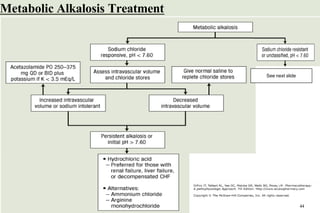
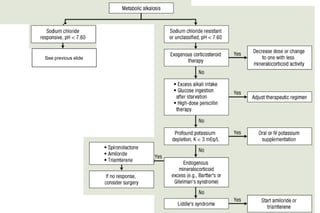
44
See next slide
Metabolic Alkalosis Treatment
45
See previous slide
RESPIRATORY ALKALOSIS
 It is characterized by a primary ↓PaCO2 that leads to an ↑pH.
🞑 Respiratory excretion of CO2 exceeds its metabolic production.
 occur physiologically in normal pregnancy& at highaltitudes.
🞑 Low O2 content of air stimulate respiration--cause excess loss of CO2
 Stimulation of respiration
🞑 Anxiety, fever; brain tumors, vascular accidents, head trauma;
pregnancy; catecholamines, theophylline, nicotine, salicylates
🞑 Pulmonary emboli, Asthma
 Hypoxemia
🞑 High altitude, pneumonia, pulmonary edema, severe anemia
46
Respiratory Alkalosis— Clinical Presentation
 Mild and chronic
🞑 Most patients asymptomatic
 Severe:
🞑 ↓PaCO2 ----- ↓d cerebral blood flow
 Light-headedness, confusion, ↓d intellectual function, syncope, seizures
🞑 Nausea, Vomiting---- cerebral hypoxia
🞑 Cardiac arrhythmiasdue to sensitization of myocardium to circulating
catecholamines
🞑 Muscle cramps, tetany---due to reductions in the blood ionized Ca
 ↑ pH  ↑ binding of Ca to albumin
47
Respiratory Alkalosis— Clinical Presentation
 Laboratory Tests
🞑 Serum chloride concentration usually slightly ↑d
🞑 ↓d serum ionized Ca , potassium, phosphorus concentrations
 Acute alkalosis: Plasma [HCO -] should decrease by 0.2 times
3
the decrease in PaCO2 but usually not to <18 mEq/L
 Chronic alkalosis: Plasma [HCO -] should fall by 0.35 times
3
the decrease in PaCO2 but usually not to <14 mEq/L
48
Physiologic Compensation
 Compensation for acuterespiratory alkalosis
🞑 Occurs within minutes
🞑 Chemical buffering
 H+ release from physiologic buffers (such as intracellular proteins,
phosphates,) and titrate down the serum bicarbonate concentration.
 Metabolic compensation occurs when the alkalosis persists for
> 6 to 12 hrs
🞑 Renal compensation….within 1 to 2 days
 Inhibition of proximal tubule bicarbonate reabsorption
49
Respiratory Alkalosis Treatment
 Mild pH alteration (pH not exceeding 7.5)
🞑 Few or no symptoms,…..treatment often not required
 Acute respiratory alkalosis (pH >7.5)
🞑 Identify and correct underlying causes
🞑 Oxygenif severe hypoxemia
 Life threatening (pH >7.6)
🞑 May require mechanical ventilation with sedation to control
hyperventilation.
50
RESPIRATORY ACIDOSIS
 Occurs when the lungs fail to excrete CO2  decrease pH
 Causes;
🞑Respiratory center inhibition (CNS depression)
 Neurologic disorders, Drugs: anesthetics, opioids, sedatives
🞑 Neuromuscular abnormalities
 Myasthenia gravis
 Diaphragmatic paralysis
🞑Airway and pulmonary abnormalities
 Airway obstruction, Asthma, COPD,…
51
Respiratory acidosis—Clinical presentation
 Usually symptomatic
🞑 Confusion, difficulty thinking, headache
 Signs
🞑 Cardiovascular
 Moderate: increased cardiac output
 Severe: cardiac output declines and vascular resistance decreases leading
to refractory hypotension
🞑 CNS: neurologic symptoms (including altered mental status,
abnormal behavior, seizures, stupor, coma)
 Headache,Papilledema —due to the vasodilator effects of CO2 in the
brain that result in an increase in cerebral blood flow
52
Cont’d
 Laboratory tests
🞑 Moderate increase in serum potassium
🞑 Moderate to severe hypercapnia
 PaCO2 = 50 to 55 mm Hg (moderate), PaCO2 >80mm Hg (severe)
🞑 Hypoxia often present (PaO2 <70 mm Hg)
🞑 Acute acidosis: plasma [HCO3-] should increase by 0.1 times the
increase in PaCO2
🞑 Chronic acidosis: plasma [HCO3-] should increase by 0.35 times the
increase in PaCO2
53
Physiologic Compensation
 Acute respiratoryacidosis
🞑 Chemical buffering
 Increase PaCO2  increase H2CO3 dissociation  H+ release
 H+ buffered by bicarbonate and nonbicarbonate buffers
  Serum bicarbonate is increased
 Respiratory acidosis >12 to 24 hours
🞑 Metabolic compensation
 Increase tubular bicarbonate reabsorption, and hydrogen secretion
Increase serum bicarbonate
54
Respiratory Acidosis Treatment
 Acute respiratoryacidosis
🞑 Restore adequate oxygenation
🞑 Treat underlying causes
🞑 Bicarbonate rarely needed and rapid correction of acidosis with
bicarbonate may precipitate metabolic alkalosis.
 Monitor ABGs every 2 to 4 hours then every 12 to 24 hours
as acidemia improves
55
Respiratory Acidosis Treatment
 Chronicrespiratoryacidosis
🞑 Goals of therapy---adequate oxygenation.
🞑 Adequate oxygenation
 PaO2 = 50 mmHg: oxygen not necessary
 PaO2 <50 mmHg: initiate oxygen slowly using controlled flow
🞑 Treat underlying causes
🞑 Check ABGs periodically
 If PaCO2 increases during oxygen therapy---indicate syndrome of carbon
dioxide narcosis-----thus, need to discontinue O2 therapy
56
MIXED ACID-BASE DISORDERS
Diagnosis
 Blood gases do not decreasewithin range of expected
responses for a simple acid-base disturbance.
🞑 Suspect a mixed disorder
🞑 Perform a thorough history and physical exam for common
causes
57
Mixed Respiratory Acidosis and Metabolic Acidosis
 Develop in cardiopulmonary arrest, chronic lung disease, shock,
and in metabolic acidosis pts who develop respiratory failure
 Compensatory mechanisms inhibited
🞑 Respiratory decrease in PaCO2
🞑 Buffering and renal mechanisms that increase bicarbonate
🞑 Thus, the pH decreases markedly.
 Treatment
🞑 Oxygenation [to improve hypercarbia and hypoxia]
🞑 Alkali to reverse the metabolic acidosis
58
Mixed Respiratory Alkalosis and Metabolic
Alkalosis
 Most common mixed acid-base disorder
🞑 Critically ill surgical patients, hepatic cirrhosis
 Compensatory mechanisms inhibited
🞑 Renal bicarbonate excretion
🞑 Retention of PaCO2
🞑 Results in severe alkalemia
 Treatment
🞑 Metabolic: NaCl and KCl solutions
🞑 Respiratory: treat underlying cause of hyperventilation
59
Mixed Metabolic Acidosis and Respiratory
Alkalosis
 Advanced liver disease, salicylate intoxication, pulmonary-renal
syndromes
 Laboratory
🞑 Decrease in PaCO2
🞑 Decrease in bicarbonate
🞑 Normal or near normal pH ----because of the enhanced
compensation
 Treat underlying cause
60
Mixed Metabolic Alkalosis and Respiratory
Acidosis
 Occurs in patients with COPD and chronic respiratory acidosis
treated with salt restriction, diuretics, glucocorticoids
 Diuretics increase plasma bicarbonate
🞑 pH increases but may be near normal
 Treatment is to maintain PaO2 and PaCO2 at acceptable levels
🞑 Sodium chloride and potassium chloride ---to decrease plasma
bicarbonate by increasing its renal excretion
 Caution not to exacerbate CHF
61
5-Acid-Base-2022.pptx

5-Acid-Base-2022.pptx

  • 1.
    Acid-Base disorders Email:asterwakjira@gmail.com By: AsterWakjira (B.Pharm ,MSc,clinical Pharmacist)
  • 2.
    Acid-Base Balance  Acidityof body fluids is quantified by hydrogen ion concentration 🞑 pH…… degree of acidity 🞑 Inverse relationship between [H+] and pH  Normal blood pH …..7.4 🞑 Used to analyze acid-base status  Hydrogen ion concentration in blood may not be indicative of concentration in other body compartments 2
  • 3.
    Acid-Base Balance …. Three mechanisms collectively maintain acid–base balance: 🞑 Extracellular buffering 🞑 Ventilatory regulation of carbon dioxide elimination 🞑 Renal regulation of hydrogen ion and bicarbonate excretion  Buffering 🞑 Ability of a weak acid and its corresponding anion (base) to resist change in pH of a solution on addition of a strong acid or base. 3
  • 4.
    Extracellular Buffering -  Carbonicacid/bicarbonate system (H2CO3/ HCO3 ) 🞑 the most important physiologic buffer system -  More HCO3 in ECF than any other buffer component  CO2 supply is unlimited -  Acidity of ECF can be regulated by HCO3 concentration or PCO2 🞑 H2CO3 ….. respiratory component  Changes in ventilation  changes in PCO2  regulates H2CO3level 🞑 HCO3 - …..metabolic component -  regulated by kidney: alters its reabsorption, generate new HCO3 , and alters its elimination 4
  • 5.
    Cont’d  Phosphate buffersystem 🞑 consists of serum inorganic phosphate, intracellular organic phosphate, calcium phosphate in bone, 🞑 low extracellular concentration of phosphate and it is more important as intracellular buffer  Proteins as buffering systems 🞑 buffering provided by charged side chains of amino acids 🞑 more important as intracellular buffer because the concentration of protein is much greater intracellularly than extracellularly 5
  • 6.
    Respiratory Regulation  Rateand depth of ventilation regulates excretion of CO2 generated by diet and tissue metabolism; 🞑 Increase respiratory rate →increase CO2 excretion →decrease blood PCO2 🞑 Decrease respiratory rate →decrease CO2 excretion →increase blood PCO2  This system rapidly adjusts within minutes to changes in acid–base balance. 6
  • 7.
    Renal Regulation  Thekidney plays a central role in the regulation of acid– base homeostasis through …. 🞑 excretion or reabsorption of filtered HCO3 -, 🞑 excretion of metabolic fixed acids 🞑 generation of new HCO3 -  To maintain acid–base balance, the entire filtered HCO - 3 load must be reabsorbed, primarily in the proximal tubule. 7
  • 8.
    Renal Regulation….  Inthe tubular lumen, filtered HCO - combines with H+ secreted 3 by the Na+/H+-exchanger to form carbonic acid (H2CO3).  H2CO3 is rapidly broken down to CO2 and water by carbonic anhydrase located on the luminal surface of brush border membrane.  CO2 then diffuses into the proximal tubular cell, where it reforms H2CO3 in the presence of intracellular carbonic anhydrase.  H2CO3 dissociates to form H+ that can again be secreted into 3 the tubular lumen, and HCO - that exits the cell and enters the peritubular capillary. 8
  • 9.
  • 10.
    Renal Regulation….  Excretionof metabolic fixed acids and generation of new – HCO3 is achieved via…. 🞑 renal ammoniagenesis 🞑 distal tubular H+ secretion  Ammoniagenesis plays a role in acid-base homeostasis, 🞑 ammonium (NH4 +) excretion comprise ~50% of renal acid excretion 🞑 for each NH4 + excreted in the urine, one HCO3 – is regenerated and returned to the circulation. 10
  • 11.
    Renal Regulation….  Collectingduct acid excretion …. 🞑 Distal tubular H+ secretion accounts for 50% of net acid excretion 🞑 In the distal tubular cell, CO2 combines with water in the presence of intracellular carbonic anhydrase to form carbonic acid, which dissociates to H+ and HCO3 −. 🞑 H+ is actively secreted into the tubular lumen. 🞑 HCO3 − exits the cell and enters the peritubular capillary. 11
  • 12.
  • 13.
    Arterial Blood GasAnalysis  Blood gases (ABGs) are measured to determine the patient’s acid–base status.  Low pH values (<7.35) indicate an acidemia, whereas high pH values (>7.45) indicate an alkalemia.  In a metabolic acidosis, the pH is decreased in association with a decreased serum bicarbonate concentration and a compensatory decrease in PaCO2.  In a respiratory acidosis, the pH is decreased; the PaCO2, however, is elevated. 13
  • 14.
    Arterial Blood GasAnalysis….  In a metabolic alkalosis, the pH is elevated in association with an increased bicarbonate concentration and a compensatory increase in PaCO2.  In a respiratory alkalosis, the pH is also elevated; the PaCO2, however, is decreased.  The normal values of each measurement; 🞑 pH = 7.4 🞑 PaCO2 = 40 mm Hg (5.3 kPa) 🞑 [HCO3 − ]= 24 mEq/L (24 mmol/L) [PaCO : partial pressure of carbon dioxide] 14
  • 15.
    Arterial Blood GasAnalysis…. 15 pH < 7.35 Acidemia ↑ PCO2 Respiratory acidosis ↓ HCO3 Metabolic acidosis 7.35 – 7.45 Normal or compensated disorder or mixed disorder > 7.45 Alkalemia ↓ PCO2 Respiratory alkalosis ↑ HCO3 Metabolic alkalosis
  • 16.
    Interpretation of simpleAcid–Base Disorders Acid or Base Disorder pH Primary Disturbances Compensation ACIDOSIS Respiratory   PaCO2  HCO3- Metabolic   HCO3- PaCO2 ALKALOSIS Respiratory   PaCO2  HCO3- Metabolic   HCO3-  PaCO2 16
  • 17.
    Acid-Base Disturbances Physiologic Compensatoryresponses  Metabolic acidosis: the respiratory response to metabolic acidosis is hyperventilation, which results in an ↓d PaCO2. 🞑 ↑respiratory rate  ↑CO2 excretion  ↓PaCO2  Metabolic alkalosis: hypoventilation results in an ↑d PaCO2. 🞑 Decrease respiratory rate  decrease CO2 excretion  increase PaCO2 17
  • 18.
    METABOLIC ACIDOSIS  Decreasein serum bicarbonate concentration  ↓pH  Pathophysiology 🞑 Buffering (consumption) of exogenous acid 🞑 Accumulation of organic acid due to metabolic disturbance  e.g., lactic acid or ketoacids 🞑 Accumulation of endogenous acid due to impaired renal function (e.g., phosphates and sulfates). 🞑 loss of bicarbonate-rich body fluids (e.g., diarrhea, biliary drainage) 🞑 Adm’n of non-alkali–containing IV fluids (dilutional acidosis) 18
  • 19.
    Laboratory  Serum aniongap (SAG) 🞑 SAG = [Na+] – [Cl-] – [HCO3 -] 🞑 SAG = [UAs] – [UCs] 🞑 Normal range 3 to 11 mEq/L (3 to 11 mmol/L) 🞑 High aniongap ---- accumulation of unmeasured anions in ECF.  [UAs: unmeasured anions, UCs: Unmeasured cations] 19
  • 20.
    Metabolic acidosis SAG normal or Hyperchloremic states GIHCO3 - loss Drugs (magnesium sulfate, calcium chloride) Renal tubular acidosis (RTA) SAG elevated Renal failure Lactic acidosis Ketoacidosis Salicylate overdose, ingestion of methanol or ethylene glycol Starvation 20 - SAG: serum anion gap; GI: gastrointestinal; HCO3 : bicarbonate
  • 21.
    Hyperchloremic Metabolic Acidosis Causes 🞑 Increased GIT bicarbonate loss  Diarrhea, biliary drainage 🞑 Renal bicarbonate wasting  Proximal RTA, carbonic anhydrase inhibitors 🞑 Impaired renal acid excretion  Distal RTA, moderate to severe renal insufficiency 🞑 Exogenous acid gain  Hydrochloric acid, parenteral nutrition with unbuffered acid salts of amino acids 21
  • 22.
    Renal Tubular Acidosis(RTA)  Type I (distal) 🞑Decreased distal acidification  Urine pH during acidemia--- > 5.3 - 🞑Plasma [HCO3 ]---may be < 10 mEq/L 🞑Plasma [K+] ----usually reduced or normal 🞑Associated disease states  Tubule defect, Multiple myeloma, Systemic lupus erythematosus, Sjögren’s syndrome, Sickle cell disease, Renal transplant rejection following amphotericin B, Nephrocalcinosis 22
  • 23.
    Renal Tubular Acidosis…. Type II (proximal) - 🞑 Decreased proximal HCO3 reabsorption - 🞑 Plasma [HCO3 ] ---- usually 14–20 mEq/L 🞑 Urine pH during acidemia--- variable: > 5.3 or < 5.3 🞑 Plasma [K+] --- normal or reduced 🞑Associated disease states  Fanconi syndrome, Nephrotic syndrome, Paroxysmal nocturnal hemoglobinuria, Carbonic anhydrase inhibitors, Impaired proximal tubular glucose, phosphate, amino acid reabsorption 23
  • 24.
    Renal Tubular Acidosis…. Type IV (distal) 🞑Aldosterone deficiency or resistance - 🞑 Plasma [HCO3 ] --- usually >15 mEq/L 🞑 Urine pH during acidemia---- <5.3 🞑 Plasma [K+] ----- Elevated 🞑Associated disease states  Primary mineralocorticoid deficiency (Addison disease)  Hyporeninemic hypoaldosteronism (diabetic nephropathy, mild renal impairment)  Impaired tubular potassium secretion and urinary obstruction 24
  • 25.
    Elevated SAG MetabolicAcidosis  Increased endogenous organic acid production 🞑 Anaerobic metabolism  lactic acid 🞑 Uncontrolled diabetes mellitus, alcohol intoxication, starvation  ketoacids 🞑 Renal failure  accumulation of phosphate, sulfate, organic anions 🞑 Likely present if SAG > 25 mEq/L  Methanol/ethylene glycol ingestion 25
  • 26.
    Lactic Acidosis  Commoncause of elevated SAG metabolic acidosis  Glycolysis  lactic acid 🞑 In normal states, it is reoxidized and metabolized to CO2 and H2O  Present if lactate concentration > 4 to 5 mEq/L in acidemic patients 26
  • 27.
    Lactic Acidosis Causes Decrease in tissue oxygenation [tissue hypoxia] (type A) 🞑 Shock, Severe anemia, CHF, CO poisoning  Deranged oxidative metabolism (type B) 🞑 Medications  Catecholamines, metformin, NRTIs  Overdose (iron, isoniazid, salicylates, theophylline)  Propofol infusion syndrome, Propylene glycol toxicity, Na nitroprusside 🞑 Methanol, ethanol, ethylene glycol 🞑 Diabetes mellitus, Malignancy 🞑 Disorders associated with inborn errors of metabolism 27
  • 28.
    Metabolic Acidosis ClinicalPresentation  Acute 🞑 Severe acidemia: pH < 7.15 to 7.20  Chronic: 🞑 usually not associated with severe acidemia 🞑 relatively asymptomatic 🞑 Bone demineralization- major manifestation  Laboratory Tests 🞑 Low serum CO2 🞑 Hyperglycemia and hyperkalemia are common 🞑 pH < 7.2 = severe acidosis 28
  • 29.
    Metabolic Acidosis ClinicalPresentation Signs/symptoms  Cardiac 🞑 Initial: flushing, rapid HR, wide pulse pressure, ↑in cardiac output 🞑 Later: ↓in cardiac output, BP, liver & kidney blood flow  Cerebral: coma  Metabolic: insulin resistance, increased protein degradation  GI: nausea, vomiting, loss of appetite  Respiratory: dyspnea, hyperventilation with deep, &rapid respiration PhysiologicCompensation  ↑respiratory rate  ↑CO2 excretion  ↓PaCO2 29
  • 30.
    Chronic Metabolic AcidosisTreatment  Always treat underlying disease states  Mild to moderate acidemia 🞑Gradual correction 🞑Oral alkali replacement  GI disorders: replace other electrolytes as needed  RTAwith hyporeninemic-hypoaldosteronemia (type IV)  May be corrected by treating hyperkalemia  Supplemental alkali 30
  • 31.
    Oral Alkali Replacement -- -  LD = VDHCO3 x BW x (desired [HCO3 ] – current [HCO3 ]) -  E.g., If 60 kg and HCO3 is 15 mEq/L 🞑 LD = (0.5 L/kg x 60 kg) x (24 mEq/L – 15 mEq/L) = 30 L x 9 mEq/L = 270 mEq/L  Give doseoverseveral daysto avoidvolume overloadfrom the accompanyingNa load. 31 LD: loading dose; VD: volume of distribution; BW: body weight
  • 32.
    Acute Severe MetabolicAcidosis Treatment  Focus treatment on correcting underlying cause, cardiovascular status  Emergent hemodialysis may be needed  IV alkali (sodium bicarbonate) 🞑 Most widely used IV alkali 🞑 Often ineffective 🞑 May be deleterious in lactic acidosis 🞑 to increase arterial pH to ~7.20.  No controlledstudies havedemonstratedit decreasesmorbidity/ mortality vs. supportivecare 32
  • 33.
    Pharmacologic Therapy  Oralalkali replacement 🞑 Shohl’s solution (sodium citrate/citric acid) 🞑Sodium bicarbonate 🞑Potassium citrate 🞑 Potassium bicarbonate/potassium citrate 🞑Potassium citrate/citric acid 🞑 Sodium citrate/potassium citrate/citric acid 33
  • 34.
    Sodium Bicarbonate  Provides 🞑Fluid and electrolyte replacement 🞑 Increases arterial pH  Paradoxical effect with IV infusion 🞑 Can ↓ intracellular PH  the CO2 generated diffuses morereadily than HCO3- across CM  Excessive administration can result in 🞑 Impaired oxygenation of tissues 🞑 Sodium and water overload 🞑 Paradoxical tissue acidosis 34
  • 35.
    Sodium Bicarbonate Dosing Prevent overshooting 🞑 Consider endogenous sources of bicarbonate 🞑 Goal: increase, not normalize, pH and plasma bicarbonate 🞑 Consider using VD of 50% of body weight─ to avoid overtreatment  Monitoring 🞑 ABGs 30 minutes after end of infusion to guide therapy 35
  • 36.
    Investigational Therapies  Carbicarb 🞑Equimolar mixture of sodium carbonate and sodium bicarbonate 🞑 Can correct intracellular acidosis if present  Dichloroacetate (DCA) 🞑 Stimulates lactate dehydrogenase 🞑 Controlled studies comparing to conventional therapy show no improved outcomes 36
  • 37.
    METABOLIC ALKALOSIS Pathophysiology  Itis an acid–base disorder that presents as alkalemia (↑d arterial pH) with an increase in plasma bicarbonate.  Evaluation of patients with metabolic alkalosis must consider two separate issues: 🞑 the initial process that generates the metabolic alkalosis 🞑 alterations in renal function that maintain the alkalemic state  Initial interpretation of labs 🞑 PaCO2 (mmHg) should increase by 0.4 to 0.6 times the rise in plasma [HCO3 -] 37
  • 38.
    Generation of metabolicalkalosis  Excessive H+ loss from kidneys or stomach  Ingestion of bicarbonate-rich fluids  Diuretics that act on: 🞑 Thick ascending limb of the loop of Henle, e.g., furosemide 🞑 Distal convoluted tubule, e.g., thiazides  Excessive mineralocorticoid activity 🞑 stimulate collecting duct H+ secretion→ ↑d renal acid excretion  High dose penicillins….. act as nonreabsorbable anions, 🞑 in the distal renal tubule, ↑electronegativity 🞑 ↑secretion of potassium and H ions . 38
  • 39.
    Maintenance of MetabolicAlkalosis  Impaired renal bicarbonate excretion 🞑Sodium chloride-responsive  Volume-mediated  Intravascular volume depletion  ↓GFR ---↓filtered bicarbonate ---↓bicarbonate excretion  ↑ tubular Na reabsorption (with reabsorption of Cl- or HCO3-, or exchange K or H) to maintain charge neutrality 🞑 Sodium chloride-resistant  Volume-independent  Excess mineralocorticoid activity … ↑H ion secretion  Persistent hypokalemia─ ↑ HCO3 reabsorption and ↑ H secretion - + 39
  • 40.
    Metabolic Alkalosis ClinicalPresentation  Mild to moderate 🞑 No unique signs or symptoms, but related to underlying cause of the disorder. e.g., muscleweaknesswith hypokalemia, posturaldizziness with volume depletion 🞑 history of vomiting, gastric drainage, or diuretic use  Severe alkalemia (blood pH >7.6) 🞑 Associated with arrhythmias, hyperventilation, hypoxemia 🞑 Neuromuscular irritability, with signs of tetany 🞑 Mental confusion, Muscle cramping  The respiratory response to metabolicalkalosis is hypoventilation (decreaserespiratory rate)  decreaseCO2 excretion increasePaCO2 40
  • 41.
    Pharmacologic Therapy Sodium chloride-responsivedisorders  resulted from volumedepletion& chlorideloss, which can accompany severevomiting, diuretictherapy.  Sodium & potassium chloride-containing solutions (e.g., NS) 🞑 for patients who can tolerate the volume load  Carbonic anhydrase inhibitor,  For patients who are volume overloaded or intolerant to volume administration because of CHF 🞑 e.g., Acetazolamide---Inhibits renal bicarbonate reabsorption  250 to 375 mg once or twice daily 41
  • 42.
    Cont’d  Acidifying agents(HCl, ammonium chloride) 🞑 for severe (initial pH >7.6) symptomatic metabolic alkalosis  HCl dosing: Infuse IV over 12 to 24 hrs, with the rate of 100 to 125mL/h (10 to 25 mEq/h) 🞑 usually infused as a 0.1 to 0.25N HCl solution in either D5W or NS, or sterile water, or parenteral nutrient solutions 🞑 Check ABGs and electrolytes every 4 to 8 hrs to guide therapy 🞑 too quick infusion ---- severe transient respiratory acidosis 🞑 Stop infusion when pH decreases to 7.5 to prevent overcorrection  Ammonium chloride--- limited use 42
  • 43.
    Cont’d Sodium chloride-resistant disorders Treat the underlying cause: mineralocorticoidexcess 🞑In patients taking corticosteroid,  Adjust corticosteroid therapy, or switch to a corticosteroid with less mineralocorticoid activity e.g., methylprednisolone 🞑 For endogenous excess mineralocorticoid, eg. aldosterone  Spironolactone--- antagonist of aldosterone-receptor thus inhibits Na+ reabsorption and H+ secretion.  Amiloride and triamterene---inhibit aldosterone-stimulated Na reabsorption in the collecting duct  May require surgery 43
  • 44.
    44 See next slide MetabolicAlkalosis Treatment
  • 45.
  • 46.
    RESPIRATORY ALKALOSIS  Itis characterized by a primary ↓PaCO2 that leads to an ↑pH. 🞑 Respiratory excretion of CO2 exceeds its metabolic production.  occur physiologically in normal pregnancy& at highaltitudes. 🞑 Low O2 content of air stimulate respiration--cause excess loss of CO2  Stimulation of respiration 🞑 Anxiety, fever; brain tumors, vascular accidents, head trauma; pregnancy; catecholamines, theophylline, nicotine, salicylates 🞑 Pulmonary emboli, Asthma  Hypoxemia 🞑 High altitude, pneumonia, pulmonary edema, severe anemia 46
  • 47.
    Respiratory Alkalosis— ClinicalPresentation  Mild and chronic 🞑 Most patients asymptomatic  Severe: 🞑 ↓PaCO2 ----- ↓d cerebral blood flow  Light-headedness, confusion, ↓d intellectual function, syncope, seizures 🞑 Nausea, Vomiting---- cerebral hypoxia 🞑 Cardiac arrhythmiasdue to sensitization of myocardium to circulating catecholamines 🞑 Muscle cramps, tetany---due to reductions in the blood ionized Ca  ↑ pH  ↑ binding of Ca to albumin 47
  • 48.
    Respiratory Alkalosis— ClinicalPresentation  Laboratory Tests 🞑 Serum chloride concentration usually slightly ↑d 🞑 ↓d serum ionized Ca , potassium, phosphorus concentrations  Acute alkalosis: Plasma [HCO -] should decrease by 0.2 times 3 the decrease in PaCO2 but usually not to <18 mEq/L  Chronic alkalosis: Plasma [HCO -] should fall by 0.35 times 3 the decrease in PaCO2 but usually not to <14 mEq/L 48
  • 49.
    Physiologic Compensation  Compensationfor acuterespiratory alkalosis 🞑 Occurs within minutes 🞑 Chemical buffering  H+ release from physiologic buffers (such as intracellular proteins, phosphates,) and titrate down the serum bicarbonate concentration.  Metabolic compensation occurs when the alkalosis persists for > 6 to 12 hrs 🞑 Renal compensation….within 1 to 2 days  Inhibition of proximal tubule bicarbonate reabsorption 49
  • 50.
    Respiratory Alkalosis Treatment Mild pH alteration (pH not exceeding 7.5) 🞑 Few or no symptoms,…..treatment often not required  Acute respiratory alkalosis (pH >7.5) 🞑 Identify and correct underlying causes 🞑 Oxygenif severe hypoxemia  Life threatening (pH >7.6) 🞑 May require mechanical ventilation with sedation to control hyperventilation. 50
  • 51.
    RESPIRATORY ACIDOSIS  Occurswhen the lungs fail to excrete CO2  decrease pH  Causes; 🞑Respiratory center inhibition (CNS depression)  Neurologic disorders, Drugs: anesthetics, opioids, sedatives 🞑 Neuromuscular abnormalities  Myasthenia gravis  Diaphragmatic paralysis 🞑Airway and pulmonary abnormalities  Airway obstruction, Asthma, COPD,… 51
  • 52.
    Respiratory acidosis—Clinical presentation Usually symptomatic 🞑 Confusion, difficulty thinking, headache  Signs 🞑 Cardiovascular  Moderate: increased cardiac output  Severe: cardiac output declines and vascular resistance decreases leading to refractory hypotension 🞑 CNS: neurologic symptoms (including altered mental status, abnormal behavior, seizures, stupor, coma)  Headache,Papilledema —due to the vasodilator effects of CO2 in the brain that result in an increase in cerebral blood flow 52
  • 53.
    Cont’d  Laboratory tests 🞑Moderate increase in serum potassium 🞑 Moderate to severe hypercapnia  PaCO2 = 50 to 55 mm Hg (moderate), PaCO2 >80mm Hg (severe) 🞑 Hypoxia often present (PaO2 <70 mm Hg) 🞑 Acute acidosis: plasma [HCO3-] should increase by 0.1 times the increase in PaCO2 🞑 Chronic acidosis: plasma [HCO3-] should increase by 0.35 times the increase in PaCO2 53
  • 54.
    Physiologic Compensation  Acuterespiratoryacidosis 🞑 Chemical buffering  Increase PaCO2  increase H2CO3 dissociation  H+ release  H+ buffered by bicarbonate and nonbicarbonate buffers   Serum bicarbonate is increased  Respiratory acidosis >12 to 24 hours 🞑 Metabolic compensation  Increase tubular bicarbonate reabsorption, and hydrogen secretion Increase serum bicarbonate 54
  • 55.
    Respiratory Acidosis Treatment Acute respiratoryacidosis 🞑 Restore adequate oxygenation 🞑 Treat underlying causes 🞑 Bicarbonate rarely needed and rapid correction of acidosis with bicarbonate may precipitate metabolic alkalosis.  Monitor ABGs every 2 to 4 hours then every 12 to 24 hours as acidemia improves 55
  • 56.
    Respiratory Acidosis Treatment Chronicrespiratoryacidosis 🞑 Goals of therapy---adequate oxygenation. 🞑 Adequate oxygenation  PaO2 = 50 mmHg: oxygen not necessary  PaO2 <50 mmHg: initiate oxygen slowly using controlled flow 🞑 Treat underlying causes 🞑 Check ABGs periodically  If PaCO2 increases during oxygen therapy---indicate syndrome of carbon dioxide narcosis-----thus, need to discontinue O2 therapy 56
  • 57.
    MIXED ACID-BASE DISORDERS Diagnosis Blood gases do not decreasewithin range of expected responses for a simple acid-base disturbance. 🞑 Suspect a mixed disorder 🞑 Perform a thorough history and physical exam for common causes 57
  • 58.
    Mixed Respiratory Acidosisand Metabolic Acidosis  Develop in cardiopulmonary arrest, chronic lung disease, shock, and in metabolic acidosis pts who develop respiratory failure  Compensatory mechanisms inhibited 🞑 Respiratory decrease in PaCO2 🞑 Buffering and renal mechanisms that increase bicarbonate 🞑 Thus, the pH decreases markedly.  Treatment 🞑 Oxygenation [to improve hypercarbia and hypoxia] 🞑 Alkali to reverse the metabolic acidosis 58
  • 59.
    Mixed Respiratory Alkalosisand Metabolic Alkalosis  Most common mixed acid-base disorder 🞑 Critically ill surgical patients, hepatic cirrhosis  Compensatory mechanisms inhibited 🞑 Renal bicarbonate excretion 🞑 Retention of PaCO2 🞑 Results in severe alkalemia  Treatment 🞑 Metabolic: NaCl and KCl solutions 🞑 Respiratory: treat underlying cause of hyperventilation 59
  • 60.
    Mixed Metabolic Acidosisand Respiratory Alkalosis  Advanced liver disease, salicylate intoxication, pulmonary-renal syndromes  Laboratory 🞑 Decrease in PaCO2 🞑 Decrease in bicarbonate 🞑 Normal or near normal pH ----because of the enhanced compensation  Treat underlying cause 60
  • 61.
    Mixed Metabolic Alkalosisand Respiratory Acidosis  Occurs in patients with COPD and chronic respiratory acidosis treated with salt restriction, diuretics, glucocorticoids  Diuretics increase plasma bicarbonate 🞑 pH increases but may be near normal  Treatment is to maintain PaO2 and PaCO2 at acceptable levels 🞑 Sodium chloride and potassium chloride ---to decrease plasma bicarbonate by increasing its renal excretion  Caution not to exacerbate CHF 61