Physiology of Acid-Base BalanceUnder the guidance of :Dr. Sandeep Tandon          Professor and  Head  of  Dept. of Pedodontics                                                Dr. Ambika S. Rathore                                        Dr. Rinku Mathur                                       Dr .Shantanu Jain                                              Dr. Tripti Sharma Rai
2CONTENT:Introduction
Acid-Base Balance
ph Scale
Acidosis and Alkalosis
Compensatory Mechanisms
Disturbance in acid-base balance
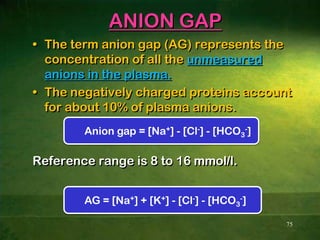
Anion Gap
Factors affecting acid-base balance in children
Infantile metabolic acidosis3IntroductionAcid-base homeostasis is the part of human homeostasis concerning the proper balance between acids and bases, in other words, the pH.
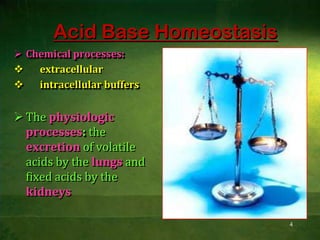
Chemical and physiologicprocesses responsible for the maintenance of the acidity of body fluids.Acid Base HomeostasisChemical processes:
      extracellular
      intracellularbuffers
The physiologic processes: the excretion of volatile acids by the lungsand fixed acids by the kidneys4
5ACID-BASE BALANCE
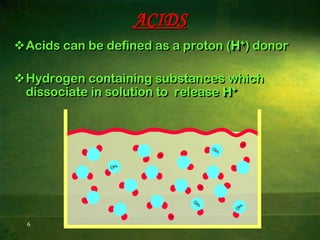
6ACIDSOH-OH-OH-OH-Acids can be defined as a proton (H+) donor
Hydrogen containing substances which dissociate in solution to  release H+H+H+H+H+
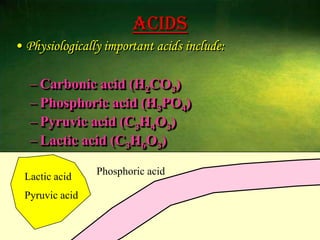
7ACIDSPhysiologically important acids include:Carbonic acid (H2CO3)Phosphoric acid (H3PO4)Pyruvic acid (C3H4O3)Lactic acid (C3H6O3)Phosphoric acidLactic acidPyruvic acidCarbonic acid
8BASES
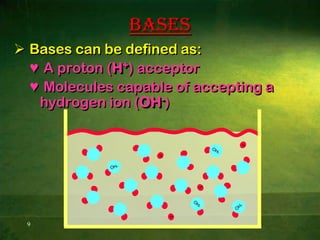
9OH-OH-OH-OH-BASES Bases can be defined as:
 A proton (H+) acceptor
 Molecules capable of accepting a hydrogen ion (OH-)H+H+H+H+
10BASESPhysiologically important bases include:Bicarbonate (HCO3- )Biphosphate (HPO4-2 )BiphosphateBicarbonate
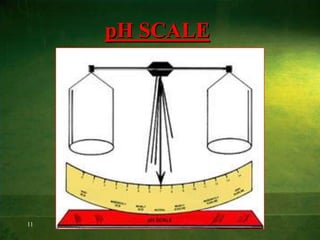
11pH SCALE
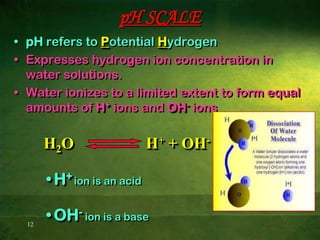
12pH SCALEpH refers to Potential HydrogenExpresses hydrogen ion concentration in water solutions.Water ionizes to a limited extent to form equal amounts of H+ ions and OH- ions  H2OH+ + OH-H+ion is an acidOH-ion is a base
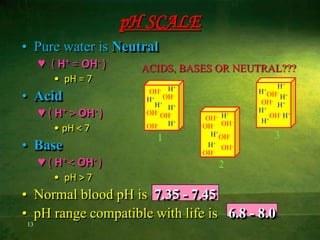
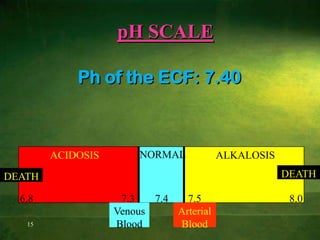
13H+H+OH-H+OH-OH-H+H+OH-H+H+H+H+OH-H+OH-OH-H+OH-H+OH-H+OH-OH-H+OH-H+OH-OH-pH SCALEPure water is Neutral( H+ = OH-) pH = 7Acid( H+ > OH- ) pH < 7Base( H+< OH-) pH > 7Normal blood pH is  7.35 - 7.45pH range compatible with life is 6.8 - 8.0ACIDS, BASES OR NEUTRAL???312
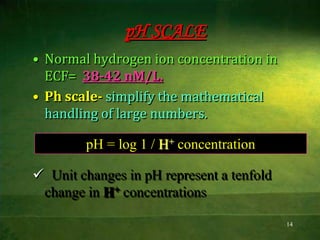
14pH SCALENormal hydrogen ion concentration in ECF=  38-42 nM/L.Ph scale- simplify the mathematical handling of large numbers.Unit changes in pH represent a tenfold change in H+ concentrationspH = log 1 / H+ concentration
15pH SCALEPh of the ECF: 7.40NORMALACIDOSISALKALOSISDEATHDEATH7.37.57.46.88.0Venous BloodArterial Blood
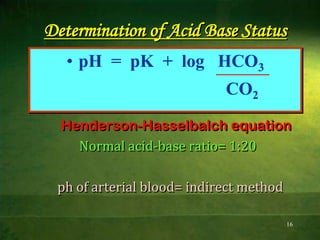
16Determination of Acid Base StatuspH  =  pK  +  log   HCO3       			             CO2Henderson-Hasselbalch equation               Normal acid-base ratio= 1:20ph of arterial blood= indirect method
17ACIDOSIS / ALKALOSIS
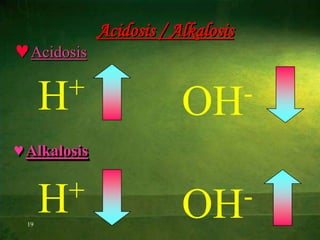
18ACIDOSIS / ALKALOSISAcidosisA condition in which the blood has too much acid (or too little base), frequently resulting in a decrease in blood pHAlkalosisA condition in which the blood has too much base (or too little acid), occasionally resulting in an increase in blood pH19Acidosis / AlkalosisAcidosisH+OH-AlkalosisH+OH-
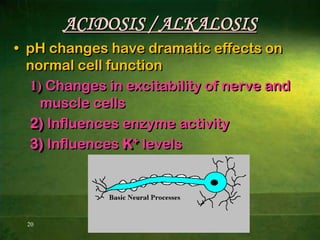
20ACIDOSIS / ALKALOSISpH changes have dramatic effects on normal cell function1)Changes in excitability of nerve and muscle cells2) Influences enzyme activity3) Influences K+ levels
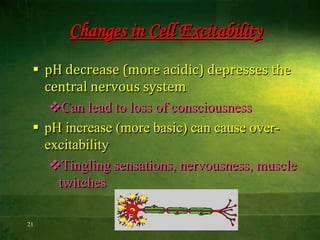
21Changes in Cell ExcitabilitypH decrease (more acidic) depresses the central nervous system
Can lead to loss of consciousness
pH increase (more basic) can cause over-excitability
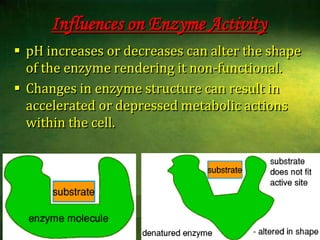
Tingling sensations, nervousness, muscle twitches22Influences on Enzyme ActivitypH increases or decreases can alter the shape of the enzyme rendering it non-functional.
Changes in enzyme structure can result in accelerated or depressed metabolic actions within the cell.23Influences On K+ LevelsWhen reabsorbing Na+ from the filtrate of the renal tubules K+ or H+ is secreted (exchanged).
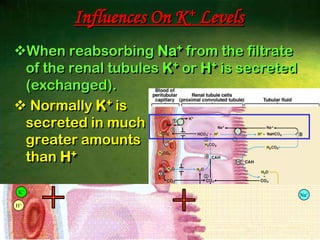
 Normally K+issecreted in muchgreater amountsthan H+K+K+K+K+K+K+Na+Na+Na+Na+Na+Na+H+K+
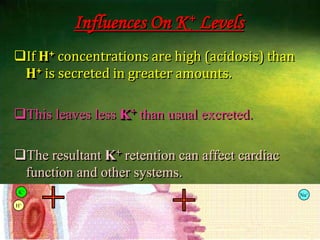
24Influences On K+ LevelsIf H+ concentrations are high (acidosis) than H+ is secreted in greater amounts.
This leaves less K+ than usual excreted.
The resultant K+ retention can affect cardiac function and other systems.K+K+K+K+K+K+K+K+Na+Na+Na+Na+Na+Na+H+H+H+H+H+H+H+
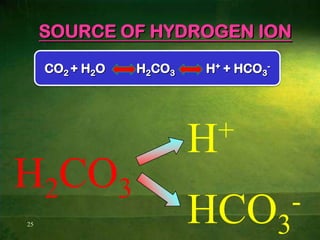
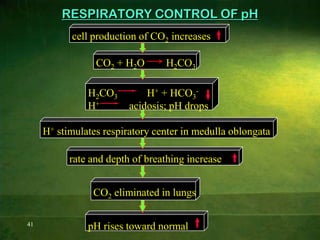
25SOURCE OF HYDROGEN IONCO2 + H2O          H2CO3          H+ + HCO3-H+ H2CO3HCO3-
26Regulation of Acid Base BalanceTwo types of acids are produced in the body:Volatile acids :CO2 produced                   during the metabolism of                 carbohydrates and lipidsNon-volatile acids:metabolism of                     protein e.g. sulphuric acids
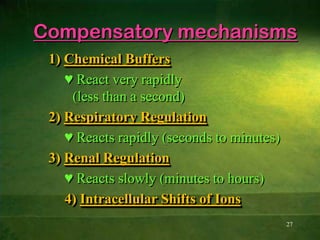
Compensatory mechanisms1)Chemical Buffers React very rapidly(less than a second)2)Respiratory Regulation Reacts rapidly (seconds to minutes)3)Renal Regulation Reacts slowly (minutes to hours)4) Intracellular Shifts of Ions27
Acid-base buffer systemMaintains the pH by binding with free hydrogen ions.
Combination of weak acid and a base (unprotonated compound).
Three major chemical buffer systems
 Bicarbonate system
 Phosphate system
 Protein system28
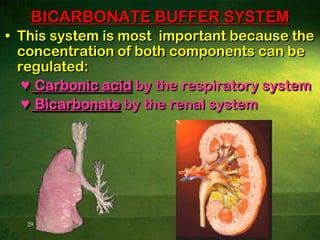
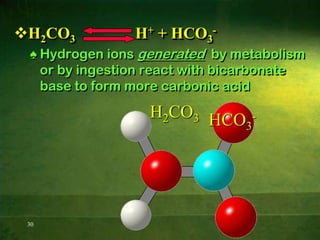
29BICARBONATE BUFFER SYSTEMThis system is most  important because the concentration of both components can be regulated: Carbonic acid by the respiratory system
 Bicarbonate by the renal system30H+H2CO3H+ + HCO3-
Hydrogen ions generated  by metabolism or by ingestion react with bicarbonate base to form more carbonic acidH2CO3HCO3-
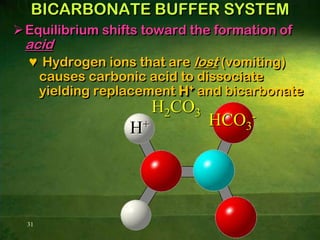
31BICARBONATE BUFFER SYSTEMH+Equilibrium shifts toward the formation of acid
 Hydrogen ions that are lost (vomiting) causes carbonic acid to dissociate yielding replacement H+ and bicarbonateH2CO3HCO3-
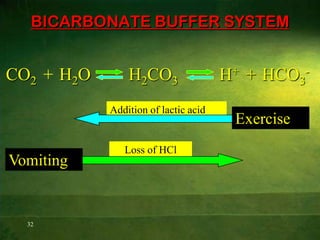
32BICARBONATE BUFFER SYSTEMH+HCO3-H2CO3H2OCO2++Addition of lactic acidExerciseLoss of HClVomiting
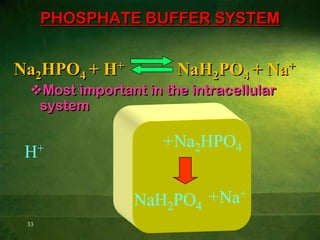
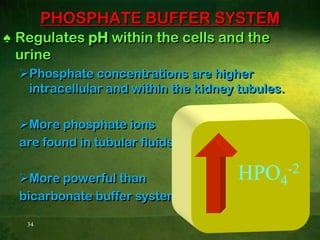
33PHOSPHATE BUFFER SYSTEMNa2HPO4 + H+               NaH2PO4+ Na+Most important in the intracellular systemNa2HPO4+H++Na+NaH2PO4
34PHOSPHATE BUFFER SYSTEMRegulates pH within the cells and the urine
Phosphate concentrations are higher intracellular and within the kidney tubules.
More phosphate ions are found in tubular fluidsMore powerful thanbicarbonate buffer systemHPO4-2
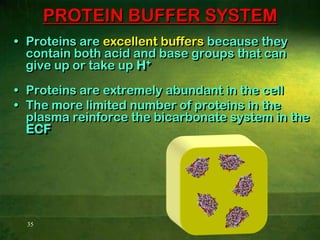
35PROTEIN BUFFER SYSTEMProteins are excellent buffers because they contain both acid and base groups that can give up or take up H+Proteins are extremely abundant in the cellThe more limited number of proteins in the plasma reinforce the bicarbonate system in the ECF
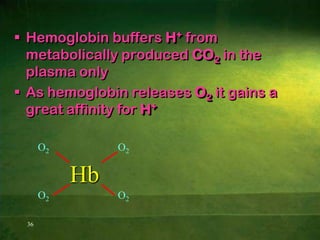
36Hemoglobin buffers H+ from metabolically produced CO2 in the plasma only
As hemoglobin releases O2 it gains a great affinity for H+H+O2O2HbO2O2
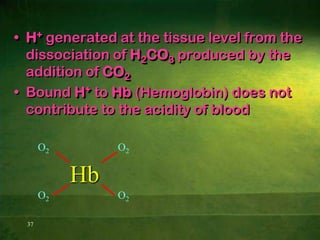
37H+ generated at the tissue level from the dissociation of H2CO3 produced by the addition of CO2Bound H+ to Hb(Hemoglobin) does not contribute to the acidity of bloodH+O2O2HbO2O2
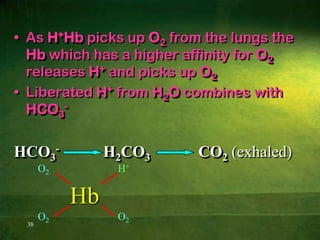
38As H+Hb picks up O2 from the lungs the Hb which has a higher affinity for O2 releases H+ and picks up O2Liberated H+ from H2O combines with HCO3-HCO3-H2CO3CO2(exhaled)O2O2H+HbO2O2
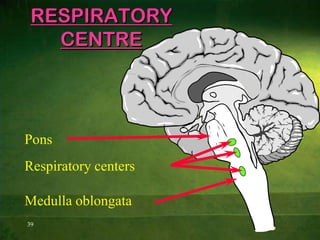
39RESPIRATORY CENTREPonsRespiratory centersMedulla oblongata
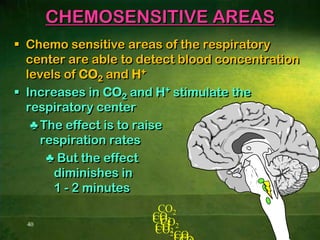
40CHEMOSENSITIVE AREASChemo sensitive areas of the respiratory center are able to detect blood concentration levels of CO2 and H+
Increases in CO2 and H+ stimulate the respiratory center
The effect is to raiserespiration rates
 But the effectdiminishes in1 - 2 minutesCO2CO2CO2CO2CO2CO2CO2CO2CO2
41cell production of CO2 increasesCO2 + H2O        H2CO3H2CO3           H+ + HCO3-H+              acidosis; pH dropsH+ stimulates respiratory center in medulla oblongatarate and depth of breathing increaseCO2 eliminated in lungspH rises toward normalRESPIRATORY CONTROL OF pH
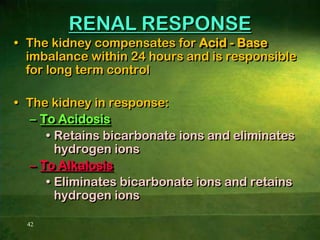
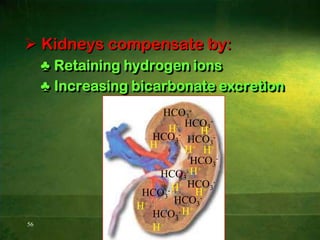
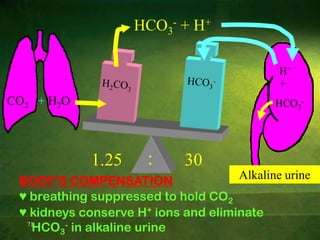
42RENAL RESPONSEThe kidney compensates for Acid - Base imbalance within 24 hours and is responsible for long term controlThe kidney in response:To AcidosisRetains bicarbonate ions and eliminates hydrogen ionsTo AlkalosisEliminates bicarbonate ions and retains hydrogen ions
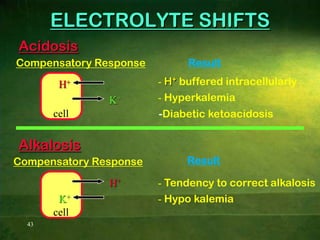
43H+K+cellH+K+cellELECTROLYTE SHIFTSAcidosisCompensatory ResponseResult- H+ buffered intracellularly- Hyperkalemia-Diabetic ketoacidosisAlkalosisResultCompensatory Response- Tendency to correct alkalosis- Hypo kalemia
44DISTURBANCE OF ACID BASE BALANCEFour general categories, depending on the source and direction of the abnormal change in H+ concentrations:
 Respiratory Acidosis
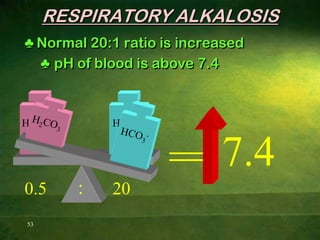
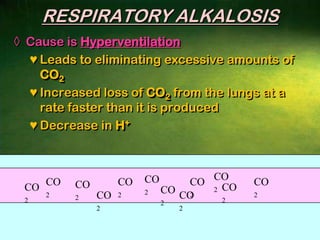
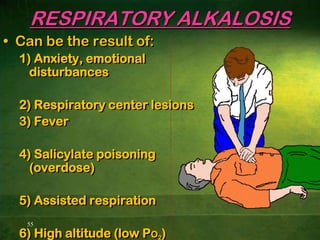
 Respiratory Alkalosis
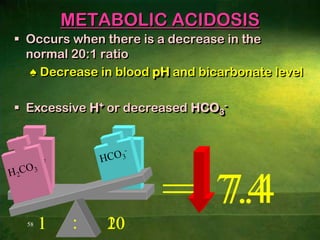
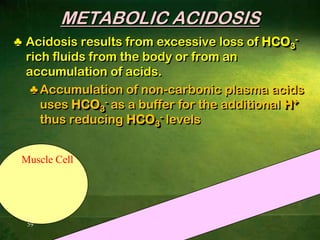
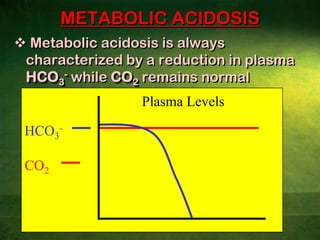
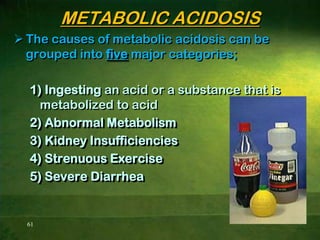
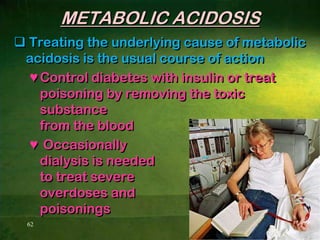
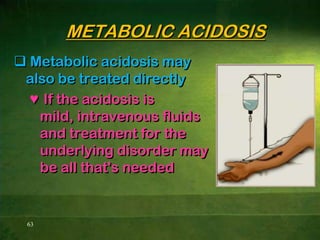
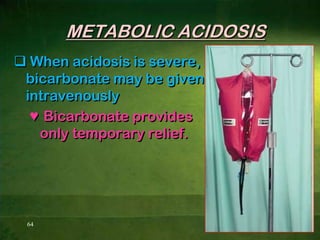
 Metabolic Acidosis
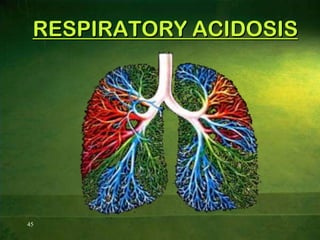
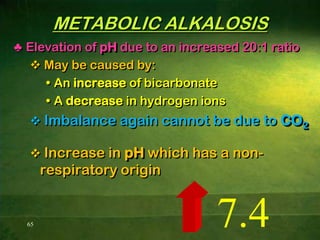
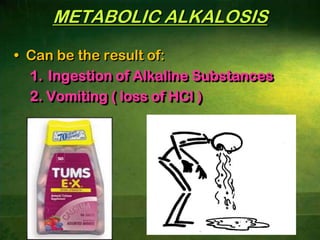
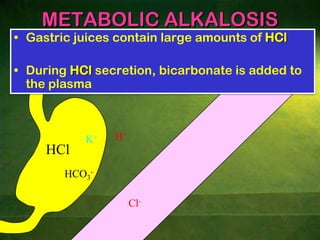
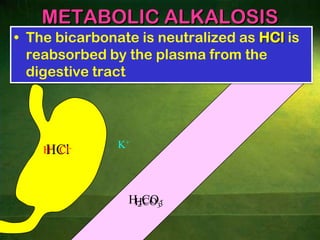
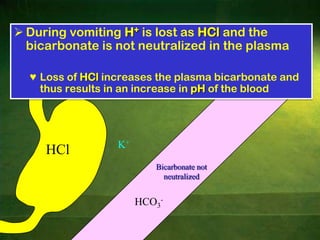
 Metabolic Alkalosis45RESPIRATORY ACIDOSIS
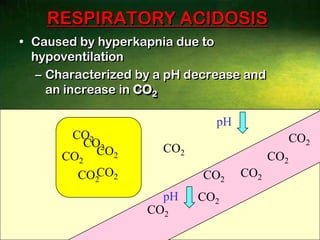
46RESPIRATORY ACIDOSISCaused by hyperkapnia due to hypoventilationCharacterized by a pH decrease and an increase in CO2pHCO2CO2CO2CO2CO2CO2CO2CO2CO2CO2CO2pH CO2CO2
47RESPIRATORY ACIDOSISRespiratory acidosis develops when the lungs don't expel CO2 adequately
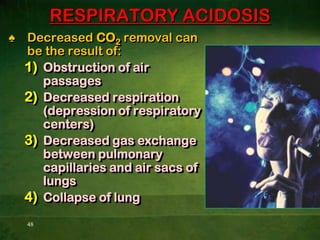
Emphysema, chronic bronchitis, severe pneumonia, pulmonary edema, and asthma48RESPIRATORY ACIDOSISDecreased CO2 removal can be the result of:Obstruction of air passagesDecreased respiration (depression of respiratory centers)Decreased gas exchange between pulmonary capillaries and air sacs of lungsCollapse of lung
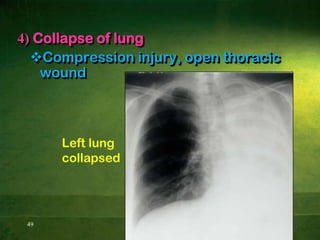
49 4) Collapse of lungCompression injury, open thoracic woundLeft lung collapsed
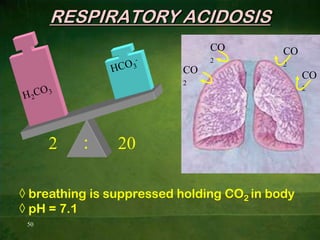
50RESPIRATORY ACIDOSISCO2CO2HCO3-CO2CO2H2CO3:220 breathing is suppressed holding CO2 in body
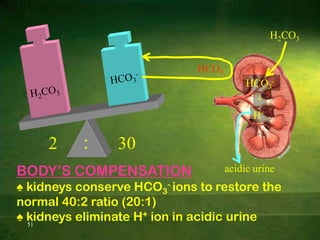
 pH = 7.151H2CO3HCO3-HCO3-HCO3-H2CO3+H+:230BODY’S COMPENSATION kidneys conserve HCO3- ions to restore the normal 40:2 ratio (20:1)
 kidneys eliminate H+ ion in acidic urineacidic urine

Acid base balane