DR MUHAMMAD AZHAR QURESHI
A BIT TO THE BASICS .........
 An acid is a substance that releases (“donates”) a
hydrogen ion (H+ ). An acid (HA) can dissociate
into a hydrogen ion (H+) and a conjugate base (A−
)
 A base is a substance that accepts a hydrogen ion.
 pH is the negative log of hydrogen ion
concentration.
 pH = -log[H+]
 pKa determines the strength of the acid. It is pH at
which 50% of acid is dissociated into its conjugate
base
OUR BODY AND PH
 Homeostasis of pH is tightly controlled
 pH of Extracellular fluid = 7.4
 pH of Blood = 7.35 – 7.45
 pH < 6.8 or > 8.0 death occurs
 Acidemia below 7.35
 Alkalemia above 7.45
WHY IS ACID-BASE BALANCE IMPORTANT ?
 Acid-base balance can also affect electrolytes (Na+, K
+,Cl-)
 Affects membrane functions, alter protein functions, etc.
 Can also affect hormones
 Small changes in pH can produce major disturbances
 Two types of acids are produced in the body:
 Volatile acids : Carbonic acid formed from CO2
 Non-volatile acids: incomplete metabolism of protein,
lipids e.g. lactic acid, keto acid, sulphuric acids
REGULATION OF BLOOD PH
 To maintain the blood pH at 7.35 –7.45, there are
three primary systems that regulate the hydrogen
ion concentration in the body fluids.
 These are :
HENDERSON HASSELBALCH EQUATION
 The Henderson-Hasselbalch equation expresses the
relationship among pH, pKa , and the concentrations of
an acid and its conjugate base.
BUFFER SYSTEM
 These are the first line of defence against pH change
 React very rapidly within seconds.
 The buffer systems of the blood, tissue fluids and cells;
immediately combine with acid or base to prevent
excessive changes in pH.
 It do not eliminate hydrogen ions from the body or add
them to the body but only keep them tied up until
balance can be re-established.
 Three major chemical buffer systems
1. Bicarbonate buffer
2. Phosphate buffer
3. Protein buffer
BICARBONATE BUFFER SYSTEM
 Bicarbonate buffer is the most important extracellular
fluid buffer.
 Bicarbonate buffer constitute sodium bicarbonate
(NaHCO3
-) and carbonic acid (H2CO3).
 Carbonic acid dissociates into hydrogen and
bicarbonate ions.
 Under normal circumstances there is much more
bicarbonate present than carbonic acid (the ratio is
approximately 20:1).
ALKALI RESERVE
 Plasma Bicarbonate (HCO3
-) represents the alkali
reserve and it has to be sufficiently high to meet the
acid load.
 If it was too low to give a ratio of 1, all the HCO3
-
would have been exhausted within a very short
time; and buffering will not be effective.
 So, under physiological circumstances, the ratio of
20:1 (a high alkali reserve) ensures high buffering
efficiency against acids.
PHOSPHATE BUFFER SYSTEM
 It is not important blood buffer.
 It plays a major role in buffering renal tubular fluid
and the intracellular fluid.
 The normal ratio of Na2HPO4 and NaH2PO4 in
plasma is 4:1 and this is kept constant by the help
of kidneys for which phosphate buffer system is
directly related to the kidneys
PROTEIN BUFFER SYSTEM
 In the blood, plasma proteins especially albumin act
as buffer because:
 It contain a large number of dissociable acidic
(COOH)
and basic (NH2) groups.
 In acid solution, NH2 accept excess H+
 In basic solutions, COOH give up H+
 Other important buffer groups of proteins in the
physiological pH range, are the imidazole groups of
histidine.
HEMOGLOBIN BUFFER SYSTEM
 Hemoglobin buffers in RBC plays an important role
in respiratory regulation of pH.
 It helps in transport of metabolically produced CO2
from cell to lungs for excretion.
 As hemoglobin releases O2 it gains a great affinity
for H+
RESPIRATORY BUFFER
 Respiratory mechanism is called second line of
defence.
 It is achieved by regulating the concentration of
carbonic acid (H2CO3) in the blood and other body
fluids by the lungs.
 The respiratory center regulates the removal or
retention of CO2 and thereby H2CO3 from the
extracellular fluid by the lungs.
 Thus lungs, function by maintaining one component
(H2CO3) of the bicarbonate buffer
RENAL BUFFERING
 The role of kidneys in the maintenance of acid base
balance of the body is highly significant.
 The renal mechanism tries to provide a permanent
solution to the acid-base disturbances.
 This is in contrast to the temporary buffering system
and a short term respiratory mechanism.
 The kidneys regulate the blood pH by maintaining
the alkali reserve.
RENAL MECHANISM
 The renal mechanism of acid base balance is
achieved by:
 Excretion of H+ ions
 Reabsorption of bicarbonate
 Excretion of titratable acid
 Excretion of ammonium ions.
ACIDIFICATION OF URINE
 The pH of urine is normally acidic (6.0).
 This clearly indicates that the kidneys have
contributed to the acidification of urine, when it is
formed from the blood plasma (pH 7.4).
 In other words, the H+ ions generated in the body
in the normal circumstances are eliminated by
acidified urine.
 Hence the pH of urine is normally acidic (6.0), while
that of blood is alkaline (7.4).
 Urine pH, however, is variable and may range
between 4.5-9.5, depending on the concentration of
H+ ions.
ACID-BASE IMBALANCES
 pH< 7.35 acidemia
 pH > 7.45 alkalemia
 The body response to acid-base imbalance is
called compensation
 May be complete if brought back within normal
limits
 Partial compensation if range is still outside norms.
STEPS TO THE CLINICAL ASSESSMENT OF
ACID-BASE DISTURBANCES
1. Assess pH (normal 7.4); pH <7.38 is acidemia and
>7.42 is alkalemia
2. Serum bicarbonate level (normal : 24)
3. Assess arterial pCO2 (normal 40)
4. Check compensatory response
5. Assess anion gap.
6. Assess the change in serum anion gap/change in
bicarbonate.
7. Assess if there is any underlying cause.
APPROPRIATE COMPENSATION
ANION GAP
 The anion gap is a biochemical tool which
sometimes helps in assessing acid-base problems.
 It is used for the diagnosis of different causes of
metabolic acidosis.
 Anion gap is defined as the difference between the
total concentration of measured cations (Na+ and
K+) and that of measured anion (Cl- and HCO3
-).
METABOLIC ACIDOSIS
 Metabolic acidosis can be defined as primary decrease
in [HCO3]
1. Consumption of HCO3 by a strong non-volatile acid
2. Renal or gastrointestinal wasting of bicarbonate
3. Rapid dilution of ECF compartment with a
bicarbonate free fluid.
ETIOLOGY
INCREASED ANION GAP
Lactic Acidosis
 Tissue hypoxia
 Shock
 Hypoxemia
 Severe anemia
 Liver failure
 Malignancy
 Intestinal bacterial overgrowth
 Inborn errors of metabolism
 Medications
 Nucleoside reverse transcriptase inhibitors
 Metformin
 Propofol
Ketoacidosis
 Diabetic ketoacidosis
 Starvation ketoacidosis
 Alcoholic ketoacidosis
Kidney Failure
Poisoning
 Ethylene glycol
 Methanol
 Salicylate
 Toluene
 Paraldehyde
Normal Anion Gap (HYPERCHLOREMIC)
 Diarrhea
 Renal tubular acidosis (RTA)
 Distal (type I) RTA
 Proximal (type II) RTA
 Mixed (type III) RTA
 Hyperkalemic (type IV) RTA
 Urinary tract diversions
 Posthypocapnia
 Ammonium chloride intake
PATHOGENESIS
 1. Loss of bicarbonate from the body
 2. Impaired ability to excrete acid by the kidney
 3. Addition of acid to the body (exogenous or
endogenous)
CLINICAL FEATURES
 CARDIOVASCULAR
1. Impairment of cardiac contractility
2. Arteriolar dilatation, venoconstriction, and
centralization of blood volume
3. Increased pulmonary vascular resistance
4. Reduction in cardiac output, arterial blood
pressure, and hepatic and renal blood flow
5. Sensitization to re-entrant arrhythmias and
reduction in threshold of ventricular fibrillation
6. Attenuation of cardiovascular responsiveness to
catecholamines
RESPIRATORY
 Hyperventilation-Kussmaul breathing is the very deep
and labored breathing
 Decreased strength of respiratory muscles and
promotion of muscle fatigue
 METABOLIC
Increased metabolic demands
Insulin resistance
Inhibition of anaerobic glycolysis
Reduction in ATP synthesis
Hyperkalemia
Increased protein degradation
CNS
 Inhibition of metabolism and cell-volume regulation
 Headache
 Lethargy
 Confusion
 Coma
TREATMENT
GENERAL MEASURES
 Any respiratory component of acidemia should be
corrected.
 If arterial pH remains below 7.20; alkali therapy
usually in the form of NaHCO3(usually a 7.5%
solution) may be necessary.
 Half of the calculated deficit should be administered
within the first 3–4 hours to avoid overcorrection.
 Large amounts of HCO 3- may have deleterious
effects
SPECIFIC THERAPY
 DIABETIC KETOACIDOSIS:
1. Replacement of existing fluid deficit
2. Insulin
3. Potassium, phosphate and magnesium
 ALCOHOLIC KETOACIDOSIS,
Thiamine
 SALICYLATE-INDUCED ACIDOSIS:
1. Vigorous gastric lavage with isotonic saline (not NaHCO3)
2. Alkalinization of urine with NaHCO3 to a pH >7.5 increases
elimination of salicylate.
 ETHYLENE GLYCOL—INDUCED ACIDOSIS:
1. Saline or osmotic diuresis
2. Ethanol
3. Hemodialysis
METABOLIC ALKALOSIS
 Manifested by an elevated arterial pH
 Increase in the serum [HCO3
-]
 Increase in PaCO2 as a result of compensatory
alveolar hypoventilation.
 It is often accompanied by hypochloremia and
hypokalemia
PATHOGENESIS
 Metabolic alkalosis occurs as a result of net gain of
[HCO3
-] or loss of non-volatile acid (usually HCl by
vomiting) from the extracellular fluid.
 Metabolic alkalosis represents a failure of the
kidneys to eliminate HCO3
- in the usual manner.
 The kidneys will retain, rather than excrete, the
excess alkali and maintain the alkalosis if
1. Volume deficiency, chloride deficiency, and K+
deficiency exist in combination with a reduced
GFR, which augments distal tubule H+ secretion.
2. Hypokalemia exists because of autonomous
hyperaldosteronism.
PHYSIOLOGIC EFFECT OF ALKALOSIS
 Alkalosis increases affinity of Hb for O2 and shifts
the ODC to the left, making it more difficult for Hb to
give up O2 to tissues.
 Movement of H+ out of the cells in exchange of
extracellar K+ into cells, can produce hypokalaemia.
 Alkalosis increases the number of anionic binding
sites for Ca2+ on plasma proteins and can therefore
decrease ionized plasma [Ca2+] leading to
circulatory depression and neuromuscular
irritability.
SYMPTOMS
TREATMENT
 Primary treatment is correcting the underlying
stimulus for HCO3
- generation.
 Proton pump inhibitors or the discontinuation of
diuretics.
 Isotonic saline
 Acetazolamide
 Dilute hydrochloric acid (0.1 N HCl)
 Hemodialysis against a dialysate low in [HCO3
- ]
and high in [Cl-]
1.Mr. X is admitted with severe attack of asthma. Her
arterial blood gas result is as follows:
 pH : 7.22
 PCO2 : 55
 HCO3
- : 25
A. Respiratory Acidosis
B. Respiratory .Alkalosis
C. Metabolic. Acidosis
D. Metabolic. Alkalosis
2.Mr. D is admitted with recurring bowel obstruction
has been experiencing intractable vomiting for the
last several hours. His ABG is:
 pH : 7.5
 PaCO2 :42
 HCO3
- : 33
A. Respiratory Acidosis
B. Respiratory Alkalosis
C. Metabolic Acidosis
D. Metabolic Alkalosis
3.The pH of the body fluids is stabilized by buffer
systems. Which of the following compounds is the
most effective buffer system at physiological pH ?
1. Bicarbonate buffer
2. Phosphate buffer
3. Protein buffer
4. Bone buffer
5. All of the above
4. A person was admitted in a coma. Analysis of the
arterial blood gave the following values:
pH 7.1
PCO2 16 mm Hg
HCO 3
- 5 mEq/L and
What is the underlying acid-base disorder?
 Metabolic Acidosis
 Metabolic Alkalosis
 Respiratory Acidosis
 Respiratory Alkalosis
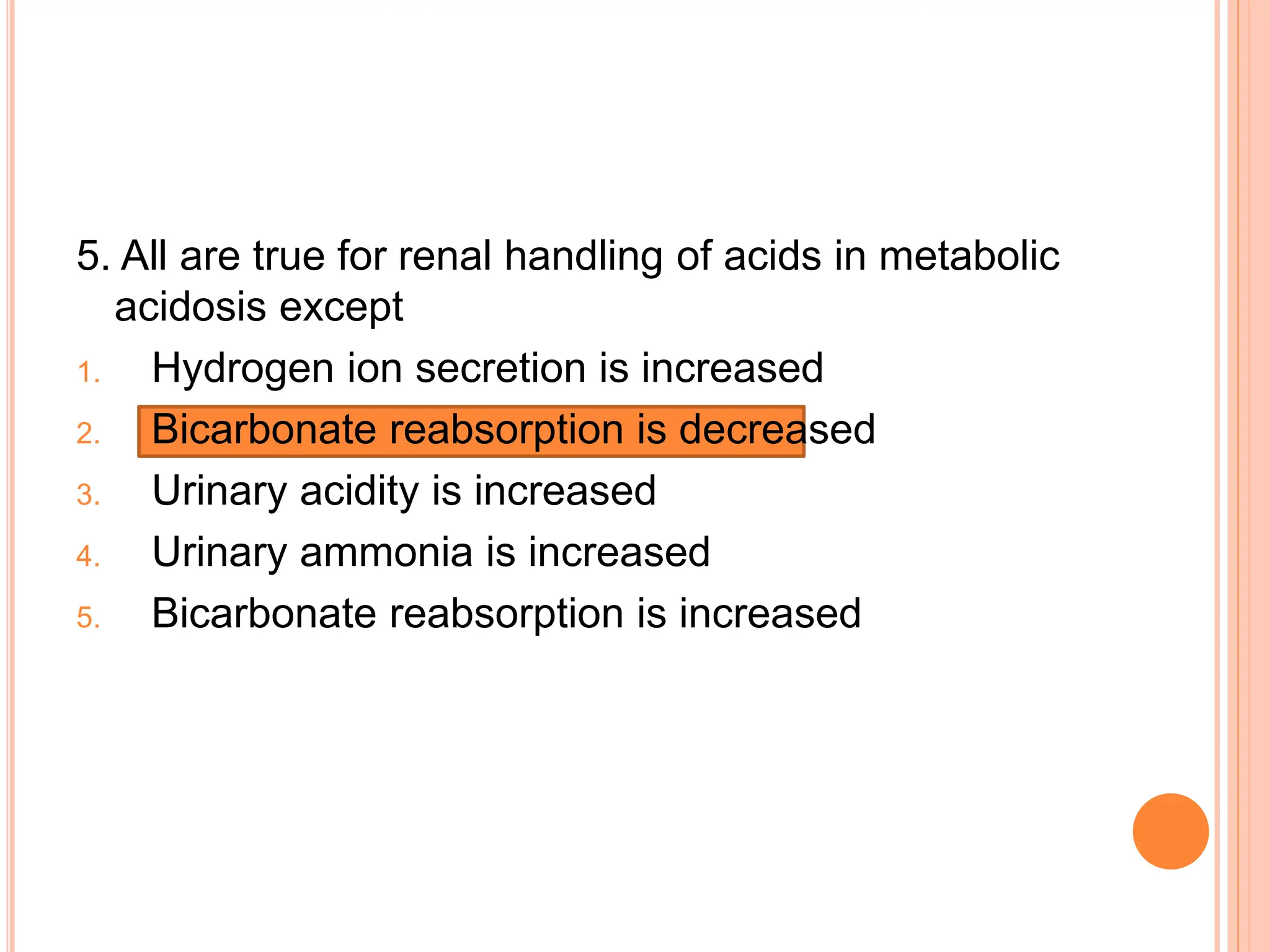
5. All are true for renal handling of acids in metabolic
acidosis except
1. Hydrogen ion secretion is increased
2. Bicarbonate reabsorption is decreased
3. Urinary acidity is increased
4. Urinary ammonia is increased
5. Bicarbonate reabsorption is increased
Acid Base Balance. An important topic in Physiologypptx

Acid Base Balance. An important topic in Physiologypptx

  • 1.
  • 2.
    A BIT TOTHE BASICS .........  An acid is a substance that releases (“donates”) a hydrogen ion (H+ ). An acid (HA) can dissociate into a hydrogen ion (H+) and a conjugate base (A− )  A base is a substance that accepts a hydrogen ion.  pH is the negative log of hydrogen ion concentration.  pH = -log[H+]  pKa determines the strength of the acid. It is pH at which 50% of acid is dissociated into its conjugate base
  • 3.
    OUR BODY ANDPH  Homeostasis of pH is tightly controlled  pH of Extracellular fluid = 7.4  pH of Blood = 7.35 – 7.45  pH < 6.8 or > 8.0 death occurs  Acidemia below 7.35  Alkalemia above 7.45
  • 4.
    WHY IS ACID-BASEBALANCE IMPORTANT ?  Acid-base balance can also affect electrolytes (Na+, K +,Cl-)  Affects membrane functions, alter protein functions, etc.  Can also affect hormones  Small changes in pH can produce major disturbances  Two types of acids are produced in the body:  Volatile acids : Carbonic acid formed from CO2  Non-volatile acids: incomplete metabolism of protein, lipids e.g. lactic acid, keto acid, sulphuric acids
  • 5.
    REGULATION OF BLOODPH  To maintain the blood pH at 7.35 –7.45, there are three primary systems that regulate the hydrogen ion concentration in the body fluids.  These are :
  • 6.
    HENDERSON HASSELBALCH EQUATION The Henderson-Hasselbalch equation expresses the relationship among pH, pKa , and the concentrations of an acid and its conjugate base.
  • 8.
    BUFFER SYSTEM  Theseare the first line of defence against pH change  React very rapidly within seconds.  The buffer systems of the blood, tissue fluids and cells; immediately combine with acid or base to prevent excessive changes in pH.  It do not eliminate hydrogen ions from the body or add them to the body but only keep them tied up until balance can be re-established.  Three major chemical buffer systems 1. Bicarbonate buffer 2. Phosphate buffer 3. Protein buffer
  • 9.
    BICARBONATE BUFFER SYSTEM Bicarbonate buffer is the most important extracellular fluid buffer.  Bicarbonate buffer constitute sodium bicarbonate (NaHCO3 -) and carbonic acid (H2CO3).  Carbonic acid dissociates into hydrogen and bicarbonate ions.  Under normal circumstances there is much more bicarbonate present than carbonic acid (the ratio is approximately 20:1).
  • 10.
    ALKALI RESERVE  PlasmaBicarbonate (HCO3 -) represents the alkali reserve and it has to be sufficiently high to meet the acid load.  If it was too low to give a ratio of 1, all the HCO3 - would have been exhausted within a very short time; and buffering will not be effective.  So, under physiological circumstances, the ratio of 20:1 (a high alkali reserve) ensures high buffering efficiency against acids.
  • 11.
    PHOSPHATE BUFFER SYSTEM It is not important blood buffer.  It plays a major role in buffering renal tubular fluid and the intracellular fluid.  The normal ratio of Na2HPO4 and NaH2PO4 in plasma is 4:1 and this is kept constant by the help of kidneys for which phosphate buffer system is directly related to the kidneys
  • 12.
    PROTEIN BUFFER SYSTEM In the blood, plasma proteins especially albumin act as buffer because:  It contain a large number of dissociable acidic (COOH) and basic (NH2) groups.  In acid solution, NH2 accept excess H+  In basic solutions, COOH give up H+  Other important buffer groups of proteins in the physiological pH range, are the imidazole groups of histidine.
  • 13.
    HEMOGLOBIN BUFFER SYSTEM Hemoglobin buffers in RBC plays an important role in respiratory regulation of pH.  It helps in transport of metabolically produced CO2 from cell to lungs for excretion.  As hemoglobin releases O2 it gains a great affinity for H+
  • 14.
    RESPIRATORY BUFFER  Respiratorymechanism is called second line of defence.  It is achieved by regulating the concentration of carbonic acid (H2CO3) in the blood and other body fluids by the lungs.  The respiratory center regulates the removal or retention of CO2 and thereby H2CO3 from the extracellular fluid by the lungs.  Thus lungs, function by maintaining one component (H2CO3) of the bicarbonate buffer
  • 15.
    RENAL BUFFERING  Therole of kidneys in the maintenance of acid base balance of the body is highly significant.  The renal mechanism tries to provide a permanent solution to the acid-base disturbances.  This is in contrast to the temporary buffering system and a short term respiratory mechanism.  The kidneys regulate the blood pH by maintaining the alkali reserve.
  • 16.
    RENAL MECHANISM  Therenal mechanism of acid base balance is achieved by:  Excretion of H+ ions  Reabsorption of bicarbonate  Excretion of titratable acid  Excretion of ammonium ions.
  • 17.
    ACIDIFICATION OF URINE The pH of urine is normally acidic (6.0).  This clearly indicates that the kidneys have contributed to the acidification of urine, when it is formed from the blood plasma (pH 7.4).  In other words, the H+ ions generated in the body in the normal circumstances are eliminated by acidified urine.  Hence the pH of urine is normally acidic (6.0), while that of blood is alkaline (7.4).  Urine pH, however, is variable and may range between 4.5-9.5, depending on the concentration of H+ ions.
  • 18.
    ACID-BASE IMBALANCES  pH<7.35 acidemia  pH > 7.45 alkalemia  The body response to acid-base imbalance is called compensation  May be complete if brought back within normal limits  Partial compensation if range is still outside norms.
  • 20.
    STEPS TO THECLINICAL ASSESSMENT OF ACID-BASE DISTURBANCES 1. Assess pH (normal 7.4); pH <7.38 is acidemia and >7.42 is alkalemia 2. Serum bicarbonate level (normal : 24) 3. Assess arterial pCO2 (normal 40) 4. Check compensatory response 5. Assess anion gap. 6. Assess the change in serum anion gap/change in bicarbonate. 7. Assess if there is any underlying cause.
  • 21.
  • 22.
    ANION GAP  Theanion gap is a biochemical tool which sometimes helps in assessing acid-base problems.  It is used for the diagnosis of different causes of metabolic acidosis.  Anion gap is defined as the difference between the total concentration of measured cations (Na+ and K+) and that of measured anion (Cl- and HCO3 -).
  • 23.
    METABOLIC ACIDOSIS  Metabolicacidosis can be defined as primary decrease in [HCO3] 1. Consumption of HCO3 by a strong non-volatile acid 2. Renal or gastrointestinal wasting of bicarbonate 3. Rapid dilution of ECF compartment with a bicarbonate free fluid.
  • 24.
    ETIOLOGY INCREASED ANION GAP LacticAcidosis  Tissue hypoxia  Shock  Hypoxemia  Severe anemia  Liver failure  Malignancy  Intestinal bacterial overgrowth  Inborn errors of metabolism  Medications  Nucleoside reverse transcriptase inhibitors  Metformin  Propofol
  • 25.
    Ketoacidosis  Diabetic ketoacidosis Starvation ketoacidosis  Alcoholic ketoacidosis Kidney Failure Poisoning  Ethylene glycol  Methanol  Salicylate  Toluene  Paraldehyde
  • 26.
    Normal Anion Gap(HYPERCHLOREMIC)  Diarrhea  Renal tubular acidosis (RTA)  Distal (type I) RTA  Proximal (type II) RTA  Mixed (type III) RTA  Hyperkalemic (type IV) RTA  Urinary tract diversions  Posthypocapnia  Ammonium chloride intake
  • 27.
    PATHOGENESIS  1. Lossof bicarbonate from the body  2. Impaired ability to excrete acid by the kidney  3. Addition of acid to the body (exogenous or endogenous)
  • 28.
    CLINICAL FEATURES  CARDIOVASCULAR 1.Impairment of cardiac contractility 2. Arteriolar dilatation, venoconstriction, and centralization of blood volume 3. Increased pulmonary vascular resistance 4. Reduction in cardiac output, arterial blood pressure, and hepatic and renal blood flow 5. Sensitization to re-entrant arrhythmias and reduction in threshold of ventricular fibrillation 6. Attenuation of cardiovascular responsiveness to catecholamines
  • 29.
    RESPIRATORY  Hyperventilation-Kussmaul breathingis the very deep and labored breathing  Decreased strength of respiratory muscles and promotion of muscle fatigue  METABOLIC Increased metabolic demands Insulin resistance Inhibition of anaerobic glycolysis Reduction in ATP synthesis Hyperkalemia Increased protein degradation
  • 30.
    CNS  Inhibition ofmetabolism and cell-volume regulation  Headache  Lethargy  Confusion  Coma
  • 31.
    TREATMENT GENERAL MEASURES  Anyrespiratory component of acidemia should be corrected.  If arterial pH remains below 7.20; alkali therapy usually in the form of NaHCO3(usually a 7.5% solution) may be necessary.  Half of the calculated deficit should be administered within the first 3–4 hours to avoid overcorrection.  Large amounts of HCO 3- may have deleterious effects
  • 32.
    SPECIFIC THERAPY  DIABETICKETOACIDOSIS: 1. Replacement of existing fluid deficit 2. Insulin 3. Potassium, phosphate and magnesium  ALCOHOLIC KETOACIDOSIS, Thiamine  SALICYLATE-INDUCED ACIDOSIS: 1. Vigorous gastric lavage with isotonic saline (not NaHCO3) 2. Alkalinization of urine with NaHCO3 to a pH >7.5 increases elimination of salicylate.  ETHYLENE GLYCOL—INDUCED ACIDOSIS: 1. Saline or osmotic diuresis 2. Ethanol 3. Hemodialysis
  • 33.
    METABOLIC ALKALOSIS  Manifestedby an elevated arterial pH  Increase in the serum [HCO3 -]  Increase in PaCO2 as a result of compensatory alveolar hypoventilation.  It is often accompanied by hypochloremia and hypokalemia
  • 34.
    PATHOGENESIS  Metabolic alkalosisoccurs as a result of net gain of [HCO3 -] or loss of non-volatile acid (usually HCl by vomiting) from the extracellular fluid.  Metabolic alkalosis represents a failure of the kidneys to eliminate HCO3 - in the usual manner.  The kidneys will retain, rather than excrete, the excess alkali and maintain the alkalosis if 1. Volume deficiency, chloride deficiency, and K+ deficiency exist in combination with a reduced GFR, which augments distal tubule H+ secretion. 2. Hypokalemia exists because of autonomous hyperaldosteronism.
  • 35.
    PHYSIOLOGIC EFFECT OFALKALOSIS  Alkalosis increases affinity of Hb for O2 and shifts the ODC to the left, making it more difficult for Hb to give up O2 to tissues.  Movement of H+ out of the cells in exchange of extracellar K+ into cells, can produce hypokalaemia.  Alkalosis increases the number of anionic binding sites for Ca2+ on plasma proteins and can therefore decrease ionized plasma [Ca2+] leading to circulatory depression and neuromuscular irritability.
  • 36.
  • 37.
    TREATMENT  Primary treatmentis correcting the underlying stimulus for HCO3 - generation.  Proton pump inhibitors or the discontinuation of diuretics.  Isotonic saline  Acetazolamide  Dilute hydrochloric acid (0.1 N HCl)  Hemodialysis against a dialysate low in [HCO3 - ] and high in [Cl-]
  • 38.
    1.Mr. X isadmitted with severe attack of asthma. Her arterial blood gas result is as follows:  pH : 7.22  PCO2 : 55  HCO3 - : 25 A. Respiratory Acidosis B. Respiratory .Alkalosis C. Metabolic. Acidosis D. Metabolic. Alkalosis
  • 39.
    2.Mr. D isadmitted with recurring bowel obstruction has been experiencing intractable vomiting for the last several hours. His ABG is:  pH : 7.5  PaCO2 :42  HCO3 - : 33 A. Respiratory Acidosis B. Respiratory Alkalosis C. Metabolic Acidosis D. Metabolic Alkalosis
  • 40.
    3.The pH ofthe body fluids is stabilized by buffer systems. Which of the following compounds is the most effective buffer system at physiological pH ? 1. Bicarbonate buffer 2. Phosphate buffer 3. Protein buffer 4. Bone buffer 5. All of the above
  • 41.
    4. A personwas admitted in a coma. Analysis of the arterial blood gave the following values: pH 7.1 PCO2 16 mm Hg HCO 3 - 5 mEq/L and What is the underlying acid-base disorder?  Metabolic Acidosis  Metabolic Alkalosis  Respiratory Acidosis  Respiratory Alkalosis
  • 42.
    5. All aretrue for renal handling of acids in metabolic acidosis except 1. Hydrogen ion secretion is increased 2. Bicarbonate reabsorption is decreased 3. Urinary acidity is increased 4. Urinary ammonia is increased 5. Bicarbonate reabsorption is increased