Acid – Base balance   By  Dr. Khaled Al nadi KHMC \ JORDAN
Objectives of this presentation Introduction Refresh the knowledge of the major buffer system  Learn to operate the Henderson-Hasselback equation Viewing simple and mixed acid-base disorders Interpretation of plasma parameters characterizing acid-base disorders
Introduction Human physiology has evolved to maintain ECF.PH at a value   of 7.40 H+ is a proton ( hydrogen atom without its orbital electron )
Acid : is a substance that acts as proton donor. Base : is a substance that accept protons in   solution.eg.HCO3-, phosphate ion( HPO4-)  ammonia(NH3-) and acetate(CH3COO-) Acid↔Base + H+
Who do we express [H+]? Direct as [H+] which give H+ concentration in mol/L or Eq/L Indirect as PH:  PH=Log10 1/[ H+]=-Log 10[H+] ***so PH + [H+] are  inversely  related ***  ****The range of [H+] that is compatible with life is  20-126 nEq/L which is equivalent to PH range of 7.7-6.9 [H=] PH 128 6.9 101 7.0 80 7.1 64 7.2 50 7.3 40 7.4 32 7.5 25 7.6 20 7.70
Sources of  H+ The greatest source of acid in the body is  CO2 ,produced as an end products of metabolism Forms of acid in the body:  •Carbonic or volatile acid( H2CO3 )  •Non carbonic or non volatile Pathways for acid removal   •  Kidneys  •Lungs  •GIT
How body maintained acid base balance? Its maintained primarily through the control of 2 organs:  Lungs+ kidneys
Henderson –Hasselbalch equation   CO2 ↔ CO2  + H2O ↔ H2CO3 ↔ H+  +  HCO3-   Body use this equation to control PH At equilibrium there are approximately 500mmol of CO2 for every 1mmol of H2CO3. 4000mmol of H2CO3 for every 1mmol of H+. Using H-H equation:  PH=PK+log [H2CO3] \ [HCO3]….. [H+] =24 X PCO2/ [HCO3]
Advantage of H-H equation [H+] is determined by ratio of PCO2 & [HCO3-]. It is a useful mean to verify the accuracy of the laboratory data by calculating one of the variable from the other two.
CO2 Under basal conditions, the average adult produce about 300L (13.5mol) of CO2 per/day through the metabolism of CHO+fat These excreted by the lungs at a rate of 200ml /min during resting condition.
Blood forms of CO2 CO2 is transported in the blood in 3 forms: 1.  HCO3- = 90% of total CO2in plasma 2.  Carbamino compounds (carbametes of  Hb + proteins)= 5% of total CO2 3.  CO2 gas dissolved in plasma = 5% of total CO2
Total CO2 [total CO2]= [ HCO3 -] +( S.PCO2) S : solubility constant for CO2 in plasma = 0.03mmol /L / mmHg  Dissolved CO2 = S.PCO2 = 0.03 xPCO2  at PCO2 = 40mmHg , dissolved CO2 = 1.2mmol / L ***total CO2 in clinical laboratory is a measure of [HCO3]  *** total CO2 gives little information about functional status of the lungs
HCO3- HCO3- is added to the blood by : A. diet  B. metabolisim C. diseases **HCO3 has no rule in buffering of H2CO3
Non carbonic acids (NCA) Sources of NCA: 1. diet (proteins, phospholipids) 2. inter mediary metabolism (keto-acids , lactic acid) 3. stool through HCO3 loss *** excretion of NCA is through kidneys as the body can not convert NCA to CO2
BODY BUFFER SYSTEM Buffer : is a solution consisting of a weak acid + its conjugate base * * * * * Buffering is the primary mean by which large changes in [H+] are minimized . The most effective buffers are : H2CO3, H2PO4, Plasma protein( Hb)
HCO3- BUFFER SYSTEM we use HCO3- buffer system to  determined acid base status depending on the  isohydric -principle  which states  that all buffer pairs are in equilibrium with  the same [H+].
Acid base disturbances Acidosis : is due to either accumulation of acid or loss of base…PH<7.36 Alkalosis : is due to either accumulation of base or loss acid …PH>7.44 Respiratory : denote that the primary event is alveolar ventilation dysfunction Metabolic : denote that the primary event is abnormal gain or loss of NCA.  Simple : consist of one primary event and its compensatory response  Mixed:  a combination of primary events are present  e.g.. :patient  with respiratory  acidosis from COPD with metabolic acidosis from uncontrolled DM. or  from large doses of steroids.
Disorders & Primary Events ↓  NCA. Or ↑ HCO3 M. alkalosis ↑  NCA. Or ↓ HCO3 M. acidosis ↓ PCO2 R. alkalosis ↑  PCO2 R. acidosis Primary events Disorders
Total CO2 in acid-base  disturbances Total  CO2 Disorders ↑ M. alkalosis ↓ M. Acidosis ↓ R. Alkalosis ↑  R. acidosis
Base excess   (BE) It refers to the change in the concentration of buffer base (BB) [BB] = [ HCO3-]+[Protein-] +[ Hb / HbO2] = 48 mEq /L BE.  Associated with abnormality in [HCO3] so it is influenced by metabolic process  M. alkalosis associated with BE.> +5 M. acidosis associated with BE.< -5
Anion gap AG = ( [Na+] + [K+]) – ( [HCO3-] + [Cl-]) Normal AG =12 ± 4 m Eq\L why? Low of electro-neutrality
Low of electro-neutrality In any solution,  positive charges = negative charges In serum ->   [ cations ] = [ anions ],  If we measured all cations + anions  We measured every cations & only  fraction of anions  True if  but
Examples of unmeasured anions 1. Negative charged proteins 2. In organic phosphate 3. Sulfate 4.Ions of organic acids: (…lactic-acids , keto-acids …)
RULE AG↑↑↑   by all metabolic-acidosis except  Hyper chloremic acidosis . Why?
If the acid in H-H equation is HCl  :  HCl + NaHCO3↔ NaCl +H2CO3  the net effect will replacement of ECF. HCO3- by Cl-  so Anions same why?
RULE AG is not  ↑ in Resp. acidosis as acid is derived from H2CO3, not from NCA . AG is not ↑in Resp. acidosis  As the acid is derived from H2CO3, not from NCA .
AG & HCO3 In simple metabolic acidosis : AG = ∆HCO3 ***By this can differentiate between simple and mixed disorders
Osmolar Gap Refers to the disparity between the measured and the calculated serum osmolarity . =2[Na+] + (BUN/2,8) +(glucose/18) It is good screen for  toxins as circulatory toxins   ↑ measured osmolarity but   not the calculated
Compensation For Primary Acid - Base Abnormalites **It is physiologic process occuring in response to events toward normalization of PH **Corrected or compensated means that PH is returned to normal **It is important to understand the degree of expected compensation for each disturbance as deviation from prediction will indicate a mixed disorder.
If patient has metabolic acidosis   +  normal   PCO2  element of Resp. acidosis as 2 nd  primary event.
Basic mechanism for compensation Buffer of ECF . : represent the 1 st  mechanism. 2.  Respiratory compensation :  ∆  in PH   ± Effect on respiratory center 3.  Carbomate ion  released from bone ( predominant source of alkali neutralizing NCA.) 4.  Renal compensation
Respiratory Acidosis It caused by  any process that reduce the effectivness of alveolar ventilation.
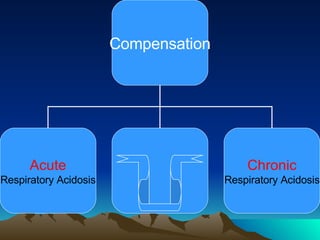
Compensation Acute Respiratory Acidosis Chronic Respiratory Acidosis
Acute Respiratory Acidosis ***In pure acute Resp. acidosis , [HCO3-] should not exceed > 30mEq/l *** PCO2  ↑  by  10 mmHg  -> ↑ HCO3- by  1 mEq /l  ∆ [H+] = 0.8 ∆ PCO2
Chronic Respiratory Acidosis  PCO2  ↑  by  10 mmHg ->  ↑  HCO3 by  3.5 mEq/l  ∆  [H+] = 0.3 X ∆ PCO2
If ↑PCO2  persist  Kidneys compensate by ↑ excretion of acid primarily NH4Cl + synthesis of HCO3  ↑ HCO3 ↓   Cl-
Respiratory Alkalosis Caused by   ↑   alveolar ventilation   ↑ CO2 excretion ->  ↓ PCO2
Acute Respiratory Alkalosis / compensation *** Acute  ↓ pco2-> rapid  ↓ [HCO3-] within minutes  /  independent of any renal compensation (Buffer system) ↓ PCO2   by 10 mmHg  -> ↓ HCO3-   by   2 mEq/l  ∆ [H+] = 0.8 X ∆PCO2
Chronic   Respiratory Alkalosis / compensation ↓ PCO2 by 10 mmHg  ->↓HCO3- by  5 mEq/l   *** [H+] = 0.17 X ∆PCO2 ∆
Chronic   Respiratory Alkalosis Most individual with PCO2  > 20 mmHg Will have normal range of PH  Even the cause is unknown   Most individual with PCO2  > 20 mmHg Will have normal range of PH  Even the cause is unknown
Metabolic Acidosis **  Produced by any process that ↓ [HCO3]  either as HCO3- loss, or via retention of NCA.  That cannot be excreted by lungs
Metabolic Acidosis / Compensation ↓ [HCO3] by 1 mEq/l   ->↓ PCO2 by 1.0_1.3 mmHg Example:   Patient with CRF.& [HCO3]=16 PCO2 compensation range ->29.6_32mmHg If PCO2 = 24->->coexistent Resp. Alkalosis If PCO2 = 40 24->->coexistent   Resp.   Acidosis
Metabolic Acidosis   / PCO2 & PH / ***  During chronic steady state  PCO2 ≈ last 2 digit of the PH  If PH = 7.25->PCO2≈ 25mmHg   ***  All these compensations are applicable only when acidosis being > 24hr.***
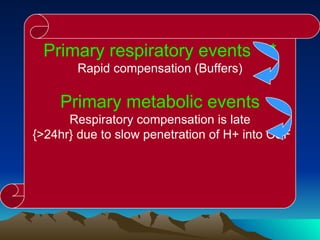
Primary respiratory events *** Rapid compensation (Buffers) Primary metabolic events Respiratory compensation is late {>24hr} due to slow penetration of H+ into CSF
Metabolic Alkalosis Produced by any process that ↑[HCO3] in plasma It is clinically useful to be divided into 2 types : 1.   Chloride responsive   2.   Chloride resistant   ******  depending on urinary [ Cl- ]  ****
Metabolic Alkalosis/ Compensation Highly variable   ↑  [HCO3-] by 1 mEq/l   ->   ↑ PCO2 by 0.6_0.7 mmHg   ***   Any PCO2 exceeding  55 mmHg  ->  coexistence primary Resp. acidosis ***

Acid base balance

  • 1.
    Acid – Basebalance By Dr. Khaled Al nadi KHMC \ JORDAN
  • 2.
    Objectives of thispresentation Introduction Refresh the knowledge of the major buffer system Learn to operate the Henderson-Hasselback equation Viewing simple and mixed acid-base disorders Interpretation of plasma parameters characterizing acid-base disorders
  • 3.
    Introduction Human physiologyhas evolved to maintain ECF.PH at a value of 7.40 H+ is a proton ( hydrogen atom without its orbital electron )
  • 4.
    Acid : isa substance that acts as proton donor. Base : is a substance that accept protons in solution.eg.HCO3-, phosphate ion( HPO4-) ammonia(NH3-) and acetate(CH3COO-) Acid↔Base + H+
  • 5.
    Who do weexpress [H+]? Direct as [H+] which give H+ concentration in mol/L or Eq/L Indirect as PH: PH=Log10 1/[ H+]=-Log 10[H+] ***so PH + [H+] are inversely related *** ****The range of [H+] that is compatible with life is 20-126 nEq/L which is equivalent to PH range of 7.7-6.9 [H=] PH 128 6.9 101 7.0 80 7.1 64 7.2 50 7.3 40 7.4 32 7.5 25 7.6 20 7.70
  • 6.
    Sources of H+ The greatest source of acid in the body is CO2 ,produced as an end products of metabolism Forms of acid in the body: •Carbonic or volatile acid( H2CO3 ) •Non carbonic or non volatile Pathways for acid removal • Kidneys •Lungs •GIT
  • 7.
    How body maintainedacid base balance? Its maintained primarily through the control of 2 organs: Lungs+ kidneys
  • 8.
    Henderson –Hasselbalch equation CO2 ↔ CO2 + H2O ↔ H2CO3 ↔ H+ + HCO3- Body use this equation to control PH At equilibrium there are approximately 500mmol of CO2 for every 1mmol of H2CO3. 4000mmol of H2CO3 for every 1mmol of H+. Using H-H equation: PH=PK+log [H2CO3] \ [HCO3]….. [H+] =24 X PCO2/ [HCO3]
  • 9.
    Advantage of H-Hequation [H+] is determined by ratio of PCO2 & [HCO3-]. It is a useful mean to verify the accuracy of the laboratory data by calculating one of the variable from the other two.
  • 10.
    CO2 Under basalconditions, the average adult produce about 300L (13.5mol) of CO2 per/day through the metabolism of CHO+fat These excreted by the lungs at a rate of 200ml /min during resting condition.
  • 11.
    Blood forms ofCO2 CO2 is transported in the blood in 3 forms: 1. HCO3- = 90% of total CO2in plasma 2. Carbamino compounds (carbametes of Hb + proteins)= 5% of total CO2 3. CO2 gas dissolved in plasma = 5% of total CO2
  • 12.
    Total CO2 [totalCO2]= [ HCO3 -] +( S.PCO2) S : solubility constant for CO2 in plasma = 0.03mmol /L / mmHg Dissolved CO2 = S.PCO2 = 0.03 xPCO2 at PCO2 = 40mmHg , dissolved CO2 = 1.2mmol / L ***total CO2 in clinical laboratory is a measure of [HCO3] *** total CO2 gives little information about functional status of the lungs
  • 13.
    HCO3- HCO3- isadded to the blood by : A. diet B. metabolisim C. diseases **HCO3 has no rule in buffering of H2CO3
  • 14.
    Non carbonic acids(NCA) Sources of NCA: 1. diet (proteins, phospholipids) 2. inter mediary metabolism (keto-acids , lactic acid) 3. stool through HCO3 loss *** excretion of NCA is through kidneys as the body can not convert NCA to CO2
  • 15.
    BODY BUFFER SYSTEMBuffer : is a solution consisting of a weak acid + its conjugate base * * * * * Buffering is the primary mean by which large changes in [H+] are minimized . The most effective buffers are : H2CO3, H2PO4, Plasma protein( Hb)
  • 16.
    HCO3- BUFFER SYSTEMwe use HCO3- buffer system to determined acid base status depending on the isohydric -principle which states that all buffer pairs are in equilibrium with the same [H+].
  • 17.
    Acid base disturbancesAcidosis : is due to either accumulation of acid or loss of base…PH<7.36 Alkalosis : is due to either accumulation of base or loss acid …PH>7.44 Respiratory : denote that the primary event is alveolar ventilation dysfunction Metabolic : denote that the primary event is abnormal gain or loss of NCA. Simple : consist of one primary event and its compensatory response Mixed: a combination of primary events are present e.g.. :patient with respiratory acidosis from COPD with metabolic acidosis from uncontrolled DM. or from large doses of steroids.
  • 18.
    Disorders & PrimaryEvents ↓ NCA. Or ↑ HCO3 M. alkalosis ↑ NCA. Or ↓ HCO3 M. acidosis ↓ PCO2 R. alkalosis ↑ PCO2 R. acidosis Primary events Disorders
  • 19.
    Total CO2 inacid-base disturbances Total CO2 Disorders ↑ M. alkalosis ↓ M. Acidosis ↓ R. Alkalosis ↑ R. acidosis
  • 20.
    Base excess (BE) It refers to the change in the concentration of buffer base (BB) [BB] = [ HCO3-]+[Protein-] +[ Hb / HbO2] = 48 mEq /L BE. Associated with abnormality in [HCO3] so it is influenced by metabolic process M. alkalosis associated with BE.> +5 M. acidosis associated with BE.< -5
  • 21.
    Anion gap AG= ( [Na+] + [K+]) – ( [HCO3-] + [Cl-]) Normal AG =12 ± 4 m Eq\L why? Low of electro-neutrality
  • 22.
    Low of electro-neutralityIn any solution, positive charges = negative charges In serum -> [ cations ] = [ anions ], If we measured all cations + anions We measured every cations & only fraction of anions True if but
  • 23.
    Examples of unmeasuredanions 1. Negative charged proteins 2. In organic phosphate 3. Sulfate 4.Ions of organic acids: (…lactic-acids , keto-acids …)
  • 24.
    RULE AG↑↑↑ by all metabolic-acidosis except Hyper chloremic acidosis . Why?
  • 25.
    If the acidin H-H equation is HCl : HCl + NaHCO3↔ NaCl +H2CO3 the net effect will replacement of ECF. HCO3- by Cl- so Anions same why?
  • 26.
    RULE AG isnot ↑ in Resp. acidosis as acid is derived from H2CO3, not from NCA . AG is not ↑in Resp. acidosis As the acid is derived from H2CO3, not from NCA .
  • 27.
    AG & HCO3In simple metabolic acidosis : AG = ∆HCO3 ***By this can differentiate between simple and mixed disorders
  • 28.
    Osmolar Gap Refersto the disparity between the measured and the calculated serum osmolarity . =2[Na+] + (BUN/2,8) +(glucose/18) It is good screen for toxins as circulatory toxins ↑ measured osmolarity but not the calculated
  • 29.
    Compensation For PrimaryAcid - Base Abnormalites **It is physiologic process occuring in response to events toward normalization of PH **Corrected or compensated means that PH is returned to normal **It is important to understand the degree of expected compensation for each disturbance as deviation from prediction will indicate a mixed disorder.
  • 30.
    If patient hasmetabolic acidosis + normal PCO2 element of Resp. acidosis as 2 nd primary event.
  • 31.
    Basic mechanism forcompensation Buffer of ECF . : represent the 1 st mechanism. 2. Respiratory compensation : ∆ in PH ± Effect on respiratory center 3. Carbomate ion released from bone ( predominant source of alkali neutralizing NCA.) 4. Renal compensation
  • 32.
    Respiratory Acidosis Itcaused by any process that reduce the effectivness of alveolar ventilation.
  • 33.
    Compensation Acute RespiratoryAcidosis Chronic Respiratory Acidosis
  • 34.
    Acute Respiratory Acidosis***In pure acute Resp. acidosis , [HCO3-] should not exceed > 30mEq/l *** PCO2 ↑ by 10 mmHg -> ↑ HCO3- by 1 mEq /l ∆ [H+] = 0.8 ∆ PCO2
  • 35.
    Chronic Respiratory Acidosis PCO2 ↑ by 10 mmHg -> ↑ HCO3 by 3.5 mEq/l ∆ [H+] = 0.3 X ∆ PCO2
  • 36.
    If ↑PCO2 persist Kidneys compensate by ↑ excretion of acid primarily NH4Cl + synthesis of HCO3 ↑ HCO3 ↓ Cl-
  • 37.
    Respiratory Alkalosis Causedby ↑ alveolar ventilation ↑ CO2 excretion -> ↓ PCO2
  • 38.
    Acute Respiratory Alkalosis/ compensation *** Acute ↓ pco2-> rapid ↓ [HCO3-] within minutes / independent of any renal compensation (Buffer system) ↓ PCO2 by 10 mmHg -> ↓ HCO3- by 2 mEq/l ∆ [H+] = 0.8 X ∆PCO2
  • 39.
    Chronic Respiratory Alkalosis / compensation ↓ PCO2 by 10 mmHg ->↓HCO3- by 5 mEq/l *** [H+] = 0.17 X ∆PCO2 ∆
  • 40.
    Chronic Respiratory Alkalosis Most individual with PCO2 > 20 mmHg Will have normal range of PH Even the cause is unknown Most individual with PCO2 > 20 mmHg Will have normal range of PH Even the cause is unknown
  • 41.
    Metabolic Acidosis ** Produced by any process that ↓ [HCO3] either as HCO3- loss, or via retention of NCA. That cannot be excreted by lungs
  • 42.
    Metabolic Acidosis /Compensation ↓ [HCO3] by 1 mEq/l ->↓ PCO2 by 1.0_1.3 mmHg Example: Patient with CRF.& [HCO3]=16 PCO2 compensation range ->29.6_32mmHg If PCO2 = 24->->coexistent Resp. Alkalosis If PCO2 = 40 24->->coexistent Resp. Acidosis
  • 43.
    Metabolic Acidosis / PCO2 & PH / *** During chronic steady state PCO2 ≈ last 2 digit of the PH If PH = 7.25->PCO2≈ 25mmHg *** All these compensations are applicable only when acidosis being > 24hr.***
  • 44.
    Primary respiratory events*** Rapid compensation (Buffers) Primary metabolic events Respiratory compensation is late {>24hr} due to slow penetration of H+ into CSF
  • 45.
    Metabolic Alkalosis Producedby any process that ↑[HCO3] in plasma It is clinically useful to be divided into 2 types : 1. Chloride responsive 2. Chloride resistant ****** depending on urinary [ Cl- ] ****
  • 46.
    Metabolic Alkalosis/ CompensationHighly variable ↑ [HCO3-] by 1 mEq/l -> ↑ PCO2 by 0.6_0.7 mmHg *** Any PCO2 exceeding 55 mmHg -> coexistence primary Resp. acidosis ***