PATHOPHYSIOLOGY OF PH
• PRESENTER: DR. JUMA O. WAKHAYANGA
MMED- ORTHO. SURG.
• FACILLITATOR: DR. J. G. KURIA
SENIOR LECTURER (UoN)
INTRO.
• pH is the negative logarithm of [H+] in a solution.
• pH of blood is 7.4 (+0.05)
• Normal pH of body fluids:
 Arterial blood is 7.4
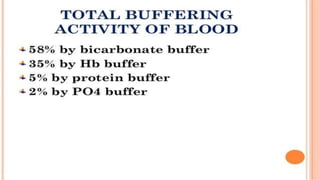
 Venous and interstitial pH is 7.35
 intracellular pH is 7.0
ACID vs BASE
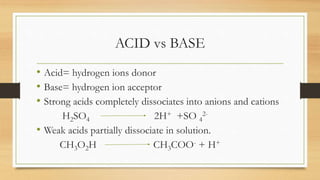
• Acid= hydrogen ions donor
• Base= hydrogen ion acceptor
• Strong acids completely dissociates into anions and cations
H2SO4 2H+ +SO 4
2-
• Weak acids partially dissociate in solution.
CH3O2H CH3COO- + H+
Acidosis vs alkalosis
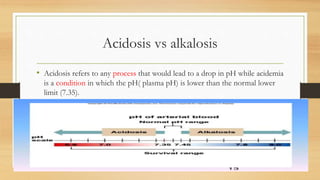
• Acidosis refers to any process that would lead to a drop in pH while acidemia
is a condition in which the pH( plasma pH) is lower than the normal lower
limit (7.35).
ACID BASE HOMEOSTASIS- why
regulate?
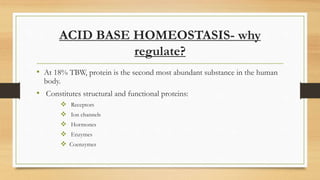
• At 18% TBW, protein is the second most abundant substance in the human
body.
• Constitutes structural and functional proteins:
 Receptors
 Ion channels
 Hormones
 Enzymes
 Coenzymes
Why regulate pH
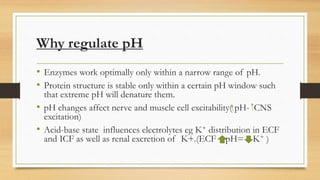
• Enzymes work optimally only within a narrow range of pH.
• Protein structure is stable only within a certain pH window such
that extreme pH will denature them.
• pH changes affect nerve and muscle cell excitability( pH- CNS
excitation)
• Acid-base state influences electrolytes eg K+ distribution in ECF
and ICF as well as renal excretion of K+.(ECF pH= K+ )
Generation of acids and bases
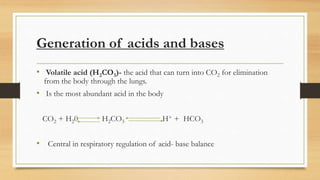
• Volatile acid (H2CO3)- the acid that can turn into CO2 for elimination
from the body through the lungs.
• Is the most abundant acid in the body
CO2 + H20 H2CO3 H+ + HCO3
• Central in respiratory regulation of acid- base balance
Generation of acids and bases
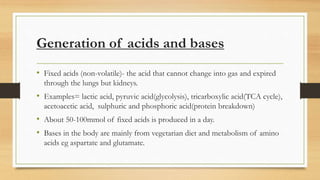
• Fixed acids (non-volatile)- the acid that cannot change into gas and expired
through the lungs but kidneys.
• Examples= lactic acid, pyruvic acid(glycolysis), tricarboxylic acid(TCA cycle),
acetoacetic acid, sulphuric and phosphoric acid(protein breakdown)
• About 50-100mmol of fixed acids is produced in a day.
• Bases in the body are mainly from vegetarian diet and metabolism of amino
acids eg aspartate and glutamate.
Regulation of acid-base balance
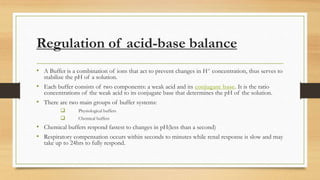
• A Buffer is a combination of ions that act to prevent changes in H+ concentration, thus serves to
stabilize the pH of a solution.
• Each buffer consists of two components: a weak acid and its conjugate base. It is the ratio
concentrations of the weak acid to its conjugate base that determines the pH of the solution.
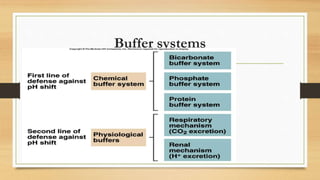
• There are two main groups of buffer systems:
 Physiological buffers
 Chemical buffers
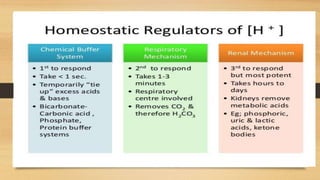
• Chemical buffers respond fastest to changes in pH(less than a second)
• Respiratory compensation occurs within seconds to minutes while renal response is slow and may
take up to 24hrs to fully respond.
Buffer systems
Protein buffers
• Most plentiful buffer because of its high concentrations
• Buffer mostly intracellular (60-70%)- intracellular proteins
• Carboxyl group(COOH) has the ability to release H+ while amine
group(NH2) accepts H+ at low pH.
• Eg plasma proteins, hb and amino acids
• Of all the amino acids, histidine is most effective as an intracellular buffer.
Why?
Bicarbonate buffer system
• Carbonic acid dissociates in solution to hydrogen ions and bicarbonate ions.
• Buffers all fixed acids but not volatile acid.
• Buffer capacity is strong , accounts for about 53% of total buffer capacity.
• For the bicarbonate buffer system, a molar ratio of weak acid to weak base of 1:20
produces a pH of 7.4
• It’s an open buffer system:
 Regulated by respiratory regulation
 Regulated by renal regulation.
Handerson-Hasselbalch equation
• The relationship between the conc. Of a weak acid and its conjugate base in
solution is well illustrated by the this equation.
• pH=pKa(H2CO3)+Log10 [HCO3
-]
[ H2CO3]
Since the conc. Of H2CO3 is proportional to PCO2, and the pKa of H2CO3 is 6.1,
the equation can be re-written as
pH=6.1+Log10 [HCO3
-]
[0.0307xPCO2]
Henderson-Hasselbalch Equation cont.
• Key.
o Pka=6.1
o α = 0.03
o PaCO2= 40mmHg
o [HCO3
-] = 24mmol/L
o pH=7.4
By keying in the variables, the ratio of
HCO3
-:H2CO3= 20:1
• pH=6.1+ log 24
0.03x40
pH= 6.1 + log 20
1
pH=7.4
Phosphate buffer system
• Important buffer in the renal tubules and intracellular fluids
• Composed of H2PO4 and HPO4
-
• pKa within the renal tubules, 6.8 =urine pH = pKa of the phosphate buffer
system
• Limitations: Supply of buffer is limited
• Equation: H2PO4
+ H+ + HPO4
-
The hemoglobin buffer system
• HHb+02 HHb02
• Predorminant non-carbonic buffer in the body( is an intracellular protein buffer)
• Buffers both resp. and metabolic acids.
• Buffers CO2 in two ways:
 Allows CO2 to combine directly with A.A to form carbamino compound (15-25% of CO2 transport)
 CO2 is converted within the RBCs to H+ + HCO3
- catalyzed by carbonic anhydrase. H+ is buffered by
Hb to HHb, the free HCO3
- diffuses to plasma in exchange to Cl- (chloride shift)
• It’s the only intracellular buffer with immediate extracellular effect
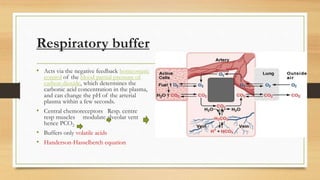
Respiratory buffer
• Acts via the negative feedback homeostatic
control of the blood partial pressure of
carbon dioxide, which determines the
carbonic acid concentration in the plasma,
and can change the pH of the arterial
plasma within a few seconds.
• Central chemoreceptors Resp. centre
resp muscles modulate alveolar vent
hence PCO2
• Buffers only volatile acids
• Handerson-Hasselberch equation
Renal buffer
• The pH of urine may vary from 4.5 to as high as 9.8 depending on the acid
base condition in the plasma.
• Takes hours to days to fully respond to pH disturbance.
• Kidney regulates pH by modulating acid excretion vs bicarbonate
conservation
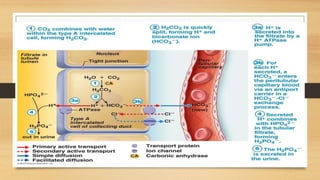
• The activity of carbonic anhydrase, H+ -ATPase and glutamase is pH
dependent and is the basis of the renal buffer.
Renal buffer cont.
• H+ elimination is in the following ways:
i. H+ secretion in the proximal tubule: accompanied with HCO3
- reclamation. Cannot
eliminate significant amount of H+
ii. H+ secretion in distal tubules and collecting duct: is accompanied by urine acidification
and is the pathway for elimination of most H+
iii. H+ elimination with ammonia secretion: depends on activity of glutaminase which is pH
sensitive.
Renal buffer
ACID-BASE DISTURBANCES
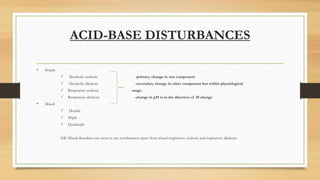
 Simple
 Metabolic acidosis -primary change in one component
 Metabolic alkalosis -secondary change in other component but within physiological
 Respiratory acidosis range.
 Respiratory alkalosis -change in pH is in the direction of 10 change
 Mixed
 Double
 Triple
 Quadruple
NB: Mixed disorders can occur in any combination apart from mixed respiratory acidosis and respiratory alkalosis.
Respiratory acidosis ( CO2 pH)
• It’s the acid-base disturbance initiated by an increase in PaCO2.
• It’s the most common cause of acid-base disturbance.
• An increase in PaCO2 can be triggered by:
 Presence of excess CO2 in inspired air
 Decreased alveolar ventilation
 Increased CO2 production in the body.
Resp. acidosis cont.
• In acute resp. acidosis, the PaCO2 is elevated above the upper limit of the
reference range (>45mmHg) with an accompanying acidemia (pH <7.35). It
occurs following an abrupt failure of ventilation.
• In chronic resp. acidosis the PaCO2 is elevated above the upper normal limit
with a normal or near normal pH due to renal compensation and an elevated
bicarbonate level.
Resp. acidosis cont.
• Symptoms: Failure to ventilate, suppression of breathing, disorientation,
weakness, coma
• Causes: Emphysema, pneumonia, bronchitis, asthma, poliomyelitis, GBS,
drugs causing CNS dipression.
• Treatment: Management of the underlying cause, administration of sodium
bicarbonate.
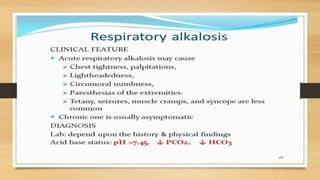
Respiratory alkalosis ( CO2 pH)
• Is an acid base disturbance due to alveolar hyperventilation.
• The decrease in PaCO2 (hypocapnia) develops when a strong respiratory stimulus causes the
respiratory system to remove more carbon dioxide than is produced metabolically in the
tissues.
• Respiratory alkalosis can be acute or chronic. In acute respiratory alkalosis, the PaCO2 level
is below the lower limit of normal and the serum pH is alkalemic. In chronic respiratory
alkalosis, the PaCO2 level is below the lower limit of normal, but the pH level is relatively
normal or near normal.
• Respiratory alkalosis is the most common acid-base abnormality observed in patients who
are critically ill. It is associated with numerous illnesses and is a common finding in patients
on mechanical ventilation
Respiratory alkalosis cont.
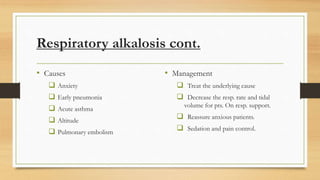
• Causes
 Anxiety
 Early pneumonia
 Acute asthma
 Altitude
 Pulmonary embolism
• Management
 Treat the underlying cause
 Decrease the resp. rate and tidal
volume for pts. On resp. support.
 Reassure anxious patients.
 Sedation and pain control.
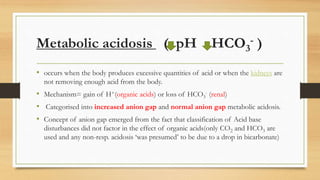
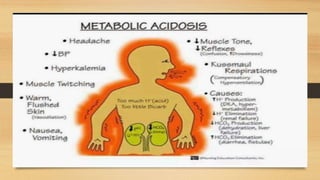
Metabolic acidosis ( pH HCO3
- )
• occurs when the body produces excessive quantities of acid or when the kidneys are
not removing enough acid from the body.
• Mechanism= gain of H+(organic acids) or loss of HCO3
- (renal)
• Categorised into increased anion gap and normal anion gap metabolic acidosis.
• Concept of anion gap emerged from the fact that classification of Acid base
disturbances did not factor in the effect of organic acids(only CO2 and HCO3 are
used and any non-resp. acidosis ‘was presumed’ to be due to a drop in bicarbonate)
Metabolic alkalosis
• Reffers to a disorder involving a primary increase in HCO3
- with resultant rise in
pH.
• Causes:
 Excessive gain of HCO3
- ( ingestion of NaHCO or CaCO(Tums), infusion of stocked blood)
 Excessive loss of H+ ( hypokalemia, vomiting, gastric lavage)
 Volume contraction ( Diuretic therapy, loss of body fluid)
• Symptoms/signs: CNS hyperexcitability, tetany, muscle cramps, convulsions,
• Respiratory compensation is overridden by the hypercapnic drive….?compensatory
challenge
Metabolic alkalosis cont.
• Treatment is by managing the underlying cause.
• Fluid deficit should be corrected and Chloride replacement done.
• Carbonic anhydrase inhibitors may be administered.
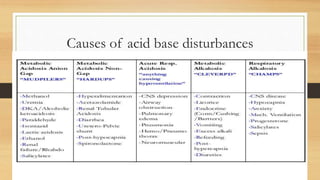
Causes of acid base disturbances
Mixed acid-base disorders
• Simultaneous presence of more than one acid base disorder.
• pH dependent on type and severity of each simple disorder
• Can be suspected from
a. Patients’ history i.e vomiting and diarrhea or COPD and renal failure
b. When there is Lesser or greater than expected compensatory response.
c. Analysis of the anion gap and delta HCO3
d. When pH is normal but PaCO2 or HCO3 is abnormal
• The disorders can occur in all combinations except for resp. acidosis and resp. alkalosis.
Compensation
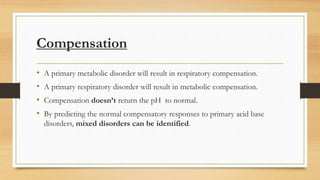
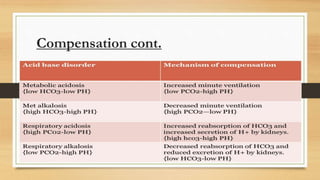
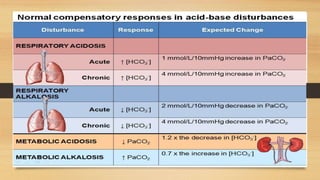
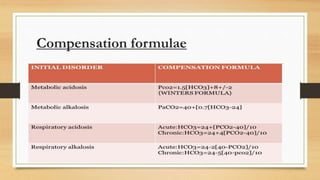
• A primary metabolic disorder will result in respiratory compensation.
• A primary respiratory disorder will result in metabolic compensation.
• Compensation doesn’t return the pH to normal.
• By predicting the normal compensatory responses to primary acid base
disorders, mixed disorders can be identified.
Compensation cont.
Compensation formulae
Anion gap concept (?Delta concept)
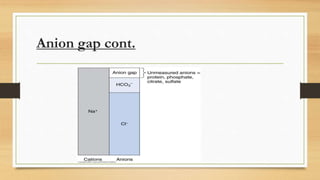
• Defined as the difference between measured cations and measured anions.
Serum AG= [Na]-[Cl+HCO3]
NORMAL=12+3 (varies depending on laboratory).....What if the anion gap is outside these figures?
• It is a concept of metabolic acidosis and it helps us to know if metabolic acidosis is due
to ;
 Loss of bicarbonate
 Accumulation of non volatile acids ( organic anions)
• Provides an index of the relative concentration of plasma anions other than chloride and bicarbonate.
• Based on this concept, met. Acidosis is categorized into anion gap [normochloremic]and non-anion
gap[normal anion gap/hyperchloremic] metabolic acidosis.
Anion gap cont.
• NB: The law of electroneutrality dictates that the number of cations and anions in
any open system hence anion ‘gap’ should not exist.
• However, since there are many anions and cations that are not routinely measured in
the lab. There exists an anion gap when calculated[using the measured ions]
• Unmeasured anions are much more than unmeasured cations hence the anion gap.
• Unmeasured anions include: albumin, phosphates, sulfates, ketones and lactate
Anion gap cont.
Causes of high anion gap (normochloremia)
• Most commonly caused by met. Acidosis in which negatively charged acids e.g
ketones[DKA, alcohol, starvation], lactate[lactic acidosis],sulfates or metabolites of
methanol, ethylene glycol or salicylate are buffered by HCO3.
• Other causes of increased anion gap include:
a) Hyperalbuminemia increased anions
b) Uremia
c) Hypocalcemia
d) Hypomagnesemia decreased cations
Causes of normal anion gap(Hyperchloremic)
GIT bicarbonate loss.
 diarrhoea
 Ureterosigmoidostomy, jejunal or ileal loop.
 Drugs ie calcium chloride{acidifying agent},magnesium sulfate ,cholestyramine.
Renal acidosis
 hypokalemia
 Proximal RTA
 hyperkalemia
Normal anion gap metabolic acidosis is also called hyperchloremic acidosis because the kidneys
reabsorb chloride (Cl−) instead of reabsorbing HCO3
−.
Causes of Negative anion gap
• Occurs rarely as a laboratory artefact except in severe cases of:
a) Hypernatremia
b) Hyperlipidemia
c) Bromide Intoxication
Delta gap
• Is the difference between patient’s anion gap and the normal(reference)anion gap.
• This amount is considered an HCO3
- equivalent since for every unit rise in the anion
gap, the [HCO3
- ]should lower by 1(by buffering)
• If the delta gap is added to the measured HCO3
- the result should be in the normal
range for HCO3
-; elevation indicates the additional presence of met. Alkalosis.
• If metabolic acidosis is present, a delta gap is calculated to identify concomitant
metabolic alkalosis.
Delta/Delta
• Also called delta ratio, is the comparison of the degree of change in AG with the change in serum
HCO3 and is a concept of High anion gap metabolic acidosis
• Used to acertain presence of concurrent Metabolic alkalosis in metabolic acidosis.
• Delta/delta = AG = AG-12
HCO3 24-HCO3
• Aimed at assessing the extent of contribution of the AG –producing process to the actual acidosis.{to detect
another metabolic AB disorder along with HAGMA} e.g
• RATIO<1;Gap+non GAP met acidosis
• RATIO=1;GAP met acidosis
• RATIO>1;metabolic acidosis + met alkalosis
Interraction between intra- and
extracellular compartments
• Intracellular pH is relatively lower than the extracellular.
• Intracellular compartment is relatively resistant to extracellular pH change in
the range (6.8-7.8) ? Survival range.
• The adverse signs and symptoms observed in acid-base disturbances are due
to intracellular pH changes while extracellular pH provides a convenient
window for accessing intracellular acid-base status.
Base Excess/Base deficict
• Amount of strong base/acid needed to be added/subtracted from a substance in order to return
the pH to normal. [change in conc. of buffer base]
• Refer to an excess or deficit, respectively, in the amount of base present in the blood.
• By measuring blood pH against ambient PaCO2 and against a PaCO2 of 40mmhg.
• BE is associated with abnormality in HCO3 so it is influenced by a metabolic process.
• BB={HCO3 -24mEq/L}+{proteins-15mEq/L}+{Hb/HbO2-9mEq/L}=48 mEq/L.
• A value outside of normal range[-2 to +2mEq/l] suggests a metabolic cause for the disorder.
• A base excess>+2mEq/l indicates a metabolic alkalosis.
• A base excess of -2mEq/l indicates a metabolic acidosis.
Base excess/deficit cont.
• Comparison of the base excess with the reference range assists in determining
whether an acid/base disturbance is caused by a respiratory, metabolic, or mixed
metabolic/respiratory problem. While carbon dioxide defines the respiratory
component of acid-base balance, base excess defines the metabolic component.
• Accordingly, measurement of base excess is defined, under a standardized pressure
of carbon dioxide, by titrating back to a standardized blood pH of 7.40.
• The predominant base contributing to base excess is bicarbonate, there are others
though.
Diagnosis of acid base disturbances
•Comprehensive history and clinical
examination
•Arterial Blood gases analysis(ABGAs)
•Serum electrolytes
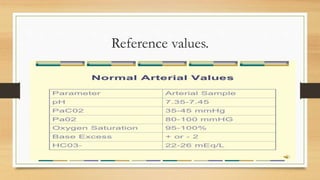
Reference values.
History & Examination
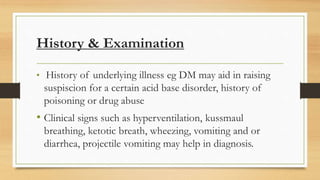
• History of underlying illness eg DM may aid in raising
suspiscion for a certain acid base disorder, history of
poisoning or drug abuse
• Clinical signs such as hyperventilation, kussmaul
breathing, ketotic breath, wheezing, vomiting and or
diarrhea, projectile vomiting may help in diagnosis.
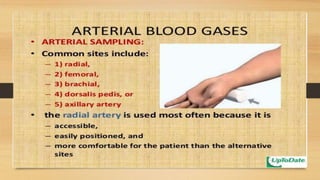
ABGs
• Important for assessing patient’s ventilation,
oxygenation and acid base status.
• pH and PCO2 are measured values while HCO3 is
calculated using the handerson hasselberch equation.
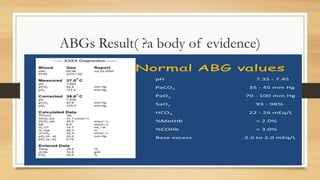
ABGs Result( ?a body of evidence)
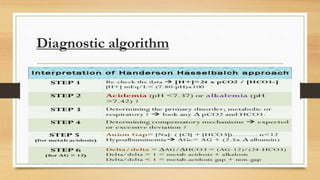
Diagnostic algorithm
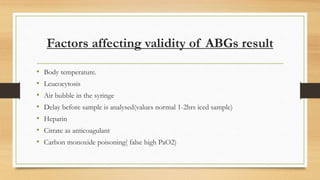
Factors affecting validity of ABGs result
• Body temperature.
• Leucocytosis
• Air bubble in the syringe
• Delay before sample is analysed(values normal 1-2hrs iced sample)
• Heparin
• Citrate as anticoagulant
• Carbon monoxide poisoning( false high PaO2)
Reference
• Review of medical physiology- F.N. Ganong.
• Uptodate
• Medscape
• www.acidbase.org
• HOW TO UNDERSTAND ACID BASE by Peter A. stewart
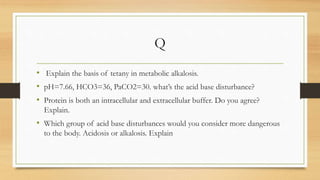
Q
• Explain the basis of tetany in metabolic alkalosis.
• pH=7.66, HCO3=36, PaCO2=30. what’s the acid base disturbance?
• Protein is both an intracellular and extracellular buffer. Do you agree?
Explain.
• Which group of acid base disturbances would you consider more dangerous
to the body. Acidosis or alkalosis. Explain

Pathophysiology of ph

  • 1.
    PATHOPHYSIOLOGY OF PH •PRESENTER: DR. JUMA O. WAKHAYANGA MMED- ORTHO. SURG. • FACILLITATOR: DR. J. G. KURIA SENIOR LECTURER (UoN)
  • 2.
    INTRO. • pH isthe negative logarithm of [H+] in a solution. • pH of blood is 7.4 (+0.05) • Normal pH of body fluids:  Arterial blood is 7.4  Venous and interstitial pH is 7.35  intracellular pH is 7.0
  • 3.
    ACID vs BASE •Acid= hydrogen ions donor • Base= hydrogen ion acceptor • Strong acids completely dissociates into anions and cations H2SO4 2H+ +SO 4 2- • Weak acids partially dissociate in solution. CH3O2H CH3COO- + H+
  • 4.
    Acidosis vs alkalosis •Acidosis refers to any process that would lead to a drop in pH while acidemia is a condition in which the pH( plasma pH) is lower than the normal lower limit (7.35).
  • 5.
    ACID BASE HOMEOSTASIS-why regulate? • At 18% TBW, protein is the second most abundant substance in the human body. • Constitutes structural and functional proteins:  Receptors  Ion channels  Hormones  Enzymes  Coenzymes
  • 6.
    Why regulate pH •Enzymes work optimally only within a narrow range of pH. • Protein structure is stable only within a certain pH window such that extreme pH will denature them. • pH changes affect nerve and muscle cell excitability( pH- CNS excitation) • Acid-base state influences electrolytes eg K+ distribution in ECF and ICF as well as renal excretion of K+.(ECF pH= K+ )
  • 7.
    Generation of acidsand bases • Volatile acid (H2CO3)- the acid that can turn into CO2 for elimination from the body through the lungs. • Is the most abundant acid in the body CO2 + H20 H2CO3 H+ + HCO3 • Central in respiratory regulation of acid- base balance
  • 8.
    Generation of acidsand bases • Fixed acids (non-volatile)- the acid that cannot change into gas and expired through the lungs but kidneys. • Examples= lactic acid, pyruvic acid(glycolysis), tricarboxylic acid(TCA cycle), acetoacetic acid, sulphuric and phosphoric acid(protein breakdown) • About 50-100mmol of fixed acids is produced in a day. • Bases in the body are mainly from vegetarian diet and metabolism of amino acids eg aspartate and glutamate.
  • 9.
    Regulation of acid-basebalance • A Buffer is a combination of ions that act to prevent changes in H+ concentration, thus serves to stabilize the pH of a solution. • Each buffer consists of two components: a weak acid and its conjugate base. It is the ratio concentrations of the weak acid to its conjugate base that determines the pH of the solution. • There are two main groups of buffer systems:  Physiological buffers  Chemical buffers • Chemical buffers respond fastest to changes in pH(less than a second) • Respiratory compensation occurs within seconds to minutes while renal response is slow and may take up to 24hrs to fully respond.
  • 10.
  • 11.
    Protein buffers • Mostplentiful buffer because of its high concentrations • Buffer mostly intracellular (60-70%)- intracellular proteins • Carboxyl group(COOH) has the ability to release H+ while amine group(NH2) accepts H+ at low pH. • Eg plasma proteins, hb and amino acids • Of all the amino acids, histidine is most effective as an intracellular buffer. Why?
  • 12.
    Bicarbonate buffer system •Carbonic acid dissociates in solution to hydrogen ions and bicarbonate ions. • Buffers all fixed acids but not volatile acid. • Buffer capacity is strong , accounts for about 53% of total buffer capacity. • For the bicarbonate buffer system, a molar ratio of weak acid to weak base of 1:20 produces a pH of 7.4 • It’s an open buffer system:  Regulated by respiratory regulation  Regulated by renal regulation.
  • 13.
    Handerson-Hasselbalch equation • Therelationship between the conc. Of a weak acid and its conjugate base in solution is well illustrated by the this equation. • pH=pKa(H2CO3)+Log10 [HCO3 -] [ H2CO3] Since the conc. Of H2CO3 is proportional to PCO2, and the pKa of H2CO3 is 6.1, the equation can be re-written as pH=6.1+Log10 [HCO3 -] [0.0307xPCO2]
  • 14.
    Henderson-Hasselbalch Equation cont. •Key. o Pka=6.1 o α = 0.03 o PaCO2= 40mmHg o [HCO3 -] = 24mmol/L o pH=7.4 By keying in the variables, the ratio of HCO3 -:H2CO3= 20:1 • pH=6.1+ log 24 0.03x40 pH= 6.1 + log 20 1 pH=7.4
  • 15.
    Phosphate buffer system •Important buffer in the renal tubules and intracellular fluids • Composed of H2PO4 and HPO4 - • pKa within the renal tubules, 6.8 =urine pH = pKa of the phosphate buffer system • Limitations: Supply of buffer is limited • Equation: H2PO4 + H+ + HPO4 -
  • 16.
    The hemoglobin buffersystem • HHb+02 HHb02 • Predorminant non-carbonic buffer in the body( is an intracellular protein buffer) • Buffers both resp. and metabolic acids. • Buffers CO2 in two ways:  Allows CO2 to combine directly with A.A to form carbamino compound (15-25% of CO2 transport)  CO2 is converted within the RBCs to H+ + HCO3 - catalyzed by carbonic anhydrase. H+ is buffered by Hb to HHb, the free HCO3 - diffuses to plasma in exchange to Cl- (chloride shift) • It’s the only intracellular buffer with immediate extracellular effect
  • 18.
    Respiratory buffer • Actsvia the negative feedback homeostatic control of the blood partial pressure of carbon dioxide, which determines the carbonic acid concentration in the plasma, and can change the pH of the arterial plasma within a few seconds. • Central chemoreceptors Resp. centre resp muscles modulate alveolar vent hence PCO2 • Buffers only volatile acids • Handerson-Hasselberch equation
  • 19.
    Renal buffer • ThepH of urine may vary from 4.5 to as high as 9.8 depending on the acid base condition in the plasma. • Takes hours to days to fully respond to pH disturbance. • Kidney regulates pH by modulating acid excretion vs bicarbonate conservation • The activity of carbonic anhydrase, H+ -ATPase and glutamase is pH dependent and is the basis of the renal buffer.
  • 20.
    Renal buffer cont. •H+ elimination is in the following ways: i. H+ secretion in the proximal tubule: accompanied with HCO3 - reclamation. Cannot eliminate significant amount of H+ ii. H+ secretion in distal tubules and collecting duct: is accompanied by urine acidification and is the pathway for elimination of most H+ iii. H+ elimination with ammonia secretion: depends on activity of glutaminase which is pH sensitive.
  • 21.
  • 23.
    ACID-BASE DISTURBANCES  Simple Metabolic acidosis -primary change in one component  Metabolic alkalosis -secondary change in other component but within physiological  Respiratory acidosis range.  Respiratory alkalosis -change in pH is in the direction of 10 change  Mixed  Double  Triple  Quadruple NB: Mixed disorders can occur in any combination apart from mixed respiratory acidosis and respiratory alkalosis.
  • 24.
    Respiratory acidosis (CO2 pH) • It’s the acid-base disturbance initiated by an increase in PaCO2. • It’s the most common cause of acid-base disturbance. • An increase in PaCO2 can be triggered by:  Presence of excess CO2 in inspired air  Decreased alveolar ventilation  Increased CO2 production in the body.
  • 25.
    Resp. acidosis cont. •In acute resp. acidosis, the PaCO2 is elevated above the upper limit of the reference range (>45mmHg) with an accompanying acidemia (pH <7.35). It occurs following an abrupt failure of ventilation. • In chronic resp. acidosis the PaCO2 is elevated above the upper normal limit with a normal or near normal pH due to renal compensation and an elevated bicarbonate level.
  • 26.
    Resp. acidosis cont. •Symptoms: Failure to ventilate, suppression of breathing, disorientation, weakness, coma • Causes: Emphysema, pneumonia, bronchitis, asthma, poliomyelitis, GBS, drugs causing CNS dipression. • Treatment: Management of the underlying cause, administration of sodium bicarbonate.
  • 28.
    Respiratory alkalosis (CO2 pH) • Is an acid base disturbance due to alveolar hyperventilation. • The decrease in PaCO2 (hypocapnia) develops when a strong respiratory stimulus causes the respiratory system to remove more carbon dioxide than is produced metabolically in the tissues. • Respiratory alkalosis can be acute or chronic. In acute respiratory alkalosis, the PaCO2 level is below the lower limit of normal and the serum pH is alkalemic. In chronic respiratory alkalosis, the PaCO2 level is below the lower limit of normal, but the pH level is relatively normal or near normal. • Respiratory alkalosis is the most common acid-base abnormality observed in patients who are critically ill. It is associated with numerous illnesses and is a common finding in patients on mechanical ventilation
  • 30.
    Respiratory alkalosis cont. •Causes  Anxiety  Early pneumonia  Acute asthma  Altitude  Pulmonary embolism • Management  Treat the underlying cause  Decrease the resp. rate and tidal volume for pts. On resp. support.  Reassure anxious patients.  Sedation and pain control.
  • 31.
    Metabolic acidosis (pH HCO3 - ) • occurs when the body produces excessive quantities of acid or when the kidneys are not removing enough acid from the body. • Mechanism= gain of H+(organic acids) or loss of HCO3 - (renal) • Categorised into increased anion gap and normal anion gap metabolic acidosis. • Concept of anion gap emerged from the fact that classification of Acid base disturbances did not factor in the effect of organic acids(only CO2 and HCO3 are used and any non-resp. acidosis ‘was presumed’ to be due to a drop in bicarbonate)
  • 33.
    Metabolic alkalosis • Reffersto a disorder involving a primary increase in HCO3 - with resultant rise in pH. • Causes:  Excessive gain of HCO3 - ( ingestion of NaHCO or CaCO(Tums), infusion of stocked blood)  Excessive loss of H+ ( hypokalemia, vomiting, gastric lavage)  Volume contraction ( Diuretic therapy, loss of body fluid) • Symptoms/signs: CNS hyperexcitability, tetany, muscle cramps, convulsions, • Respiratory compensation is overridden by the hypercapnic drive….?compensatory challenge
  • 34.
    Metabolic alkalosis cont. •Treatment is by managing the underlying cause. • Fluid deficit should be corrected and Chloride replacement done. • Carbonic anhydrase inhibitors may be administered.
  • 35.
    Causes of acidbase disturbances
  • 36.
    Mixed acid-base disorders •Simultaneous presence of more than one acid base disorder. • pH dependent on type and severity of each simple disorder • Can be suspected from a. Patients’ history i.e vomiting and diarrhea or COPD and renal failure b. When there is Lesser or greater than expected compensatory response. c. Analysis of the anion gap and delta HCO3 d. When pH is normal but PaCO2 or HCO3 is abnormal • The disorders can occur in all combinations except for resp. acidosis and resp. alkalosis.
  • 37.
    Compensation • A primarymetabolic disorder will result in respiratory compensation. • A primary respiratory disorder will result in metabolic compensation. • Compensation doesn’t return the pH to normal. • By predicting the normal compensatory responses to primary acid base disorders, mixed disorders can be identified.
  • 38.
  • 40.
  • 41.
    Anion gap concept(?Delta concept) • Defined as the difference between measured cations and measured anions. Serum AG= [Na]-[Cl+HCO3] NORMAL=12+3 (varies depending on laboratory).....What if the anion gap is outside these figures? • It is a concept of metabolic acidosis and it helps us to know if metabolic acidosis is due to ;  Loss of bicarbonate  Accumulation of non volatile acids ( organic anions) • Provides an index of the relative concentration of plasma anions other than chloride and bicarbonate. • Based on this concept, met. Acidosis is categorized into anion gap [normochloremic]and non-anion gap[normal anion gap/hyperchloremic] metabolic acidosis.
  • 42.
    Anion gap cont. •NB: The law of electroneutrality dictates that the number of cations and anions in any open system hence anion ‘gap’ should not exist. • However, since there are many anions and cations that are not routinely measured in the lab. There exists an anion gap when calculated[using the measured ions] • Unmeasured anions are much more than unmeasured cations hence the anion gap. • Unmeasured anions include: albumin, phosphates, sulfates, ketones and lactate
  • 43.
  • 44.
    Causes of highanion gap (normochloremia) • Most commonly caused by met. Acidosis in which negatively charged acids e.g ketones[DKA, alcohol, starvation], lactate[lactic acidosis],sulfates or metabolites of methanol, ethylene glycol or salicylate are buffered by HCO3. • Other causes of increased anion gap include: a) Hyperalbuminemia increased anions b) Uremia c) Hypocalcemia d) Hypomagnesemia decreased cations
  • 45.
    Causes of normalanion gap(Hyperchloremic) GIT bicarbonate loss.  diarrhoea  Ureterosigmoidostomy, jejunal or ileal loop.  Drugs ie calcium chloride{acidifying agent},magnesium sulfate ,cholestyramine. Renal acidosis  hypokalemia  Proximal RTA  hyperkalemia Normal anion gap metabolic acidosis is also called hyperchloremic acidosis because the kidneys reabsorb chloride (Cl−) instead of reabsorbing HCO3 −.
  • 46.
    Causes of Negativeanion gap • Occurs rarely as a laboratory artefact except in severe cases of: a) Hypernatremia b) Hyperlipidemia c) Bromide Intoxication
  • 47.
    Delta gap • Isthe difference between patient’s anion gap and the normal(reference)anion gap. • This amount is considered an HCO3 - equivalent since for every unit rise in the anion gap, the [HCO3 - ]should lower by 1(by buffering) • If the delta gap is added to the measured HCO3 - the result should be in the normal range for HCO3 -; elevation indicates the additional presence of met. Alkalosis. • If metabolic acidosis is present, a delta gap is calculated to identify concomitant metabolic alkalosis.
  • 48.
    Delta/Delta • Also calleddelta ratio, is the comparison of the degree of change in AG with the change in serum HCO3 and is a concept of High anion gap metabolic acidosis • Used to acertain presence of concurrent Metabolic alkalosis in metabolic acidosis. • Delta/delta = AG = AG-12 HCO3 24-HCO3 • Aimed at assessing the extent of contribution of the AG –producing process to the actual acidosis.{to detect another metabolic AB disorder along with HAGMA} e.g • RATIO<1;Gap+non GAP met acidosis • RATIO=1;GAP met acidosis • RATIO>1;metabolic acidosis + met alkalosis
  • 49.
    Interraction between intra-and extracellular compartments • Intracellular pH is relatively lower than the extracellular. • Intracellular compartment is relatively resistant to extracellular pH change in the range (6.8-7.8) ? Survival range. • The adverse signs and symptoms observed in acid-base disturbances are due to intracellular pH changes while extracellular pH provides a convenient window for accessing intracellular acid-base status.
  • 50.
    Base Excess/Base deficict •Amount of strong base/acid needed to be added/subtracted from a substance in order to return the pH to normal. [change in conc. of buffer base] • Refer to an excess or deficit, respectively, in the amount of base present in the blood. • By measuring blood pH against ambient PaCO2 and against a PaCO2 of 40mmhg. • BE is associated with abnormality in HCO3 so it is influenced by a metabolic process. • BB={HCO3 -24mEq/L}+{proteins-15mEq/L}+{Hb/HbO2-9mEq/L}=48 mEq/L. • A value outside of normal range[-2 to +2mEq/l] suggests a metabolic cause for the disorder. • A base excess>+2mEq/l indicates a metabolic alkalosis. • A base excess of -2mEq/l indicates a metabolic acidosis.
  • 51.
    Base excess/deficit cont. •Comparison of the base excess with the reference range assists in determining whether an acid/base disturbance is caused by a respiratory, metabolic, or mixed metabolic/respiratory problem. While carbon dioxide defines the respiratory component of acid-base balance, base excess defines the metabolic component. • Accordingly, measurement of base excess is defined, under a standardized pressure of carbon dioxide, by titrating back to a standardized blood pH of 7.40. • The predominant base contributing to base excess is bicarbonate, there are others though.
  • 52.
    Diagnosis of acidbase disturbances •Comprehensive history and clinical examination •Arterial Blood gases analysis(ABGAs) •Serum electrolytes
  • 53.
  • 54.
    History & Examination •History of underlying illness eg DM may aid in raising suspiscion for a certain acid base disorder, history of poisoning or drug abuse • Clinical signs such as hyperventilation, kussmaul breathing, ketotic breath, wheezing, vomiting and or diarrhea, projectile vomiting may help in diagnosis.
  • 55.
    ABGs • Important forassessing patient’s ventilation, oxygenation and acid base status. • pH and PCO2 are measured values while HCO3 is calculated using the handerson hasselberch equation.
  • 57.
    ABGs Result( ?abody of evidence)
  • 58.
  • 59.
    Factors affecting validityof ABGs result • Body temperature. • Leucocytosis • Air bubble in the syringe • Delay before sample is analysed(values normal 1-2hrs iced sample) • Heparin • Citrate as anticoagulant • Carbon monoxide poisoning( false high PaO2)
  • 60.
    Reference • Review ofmedical physiology- F.N. Ganong. • Uptodate • Medscape • www.acidbase.org • HOW TO UNDERSTAND ACID BASE by Peter A. stewart
  • 62.
    Q • Explain thebasis of tetany in metabolic alkalosis. • pH=7.66, HCO3=36, PaCO2=30. what’s the acid base disturbance? • Protein is both an intracellular and extracellular buffer. Do you agree? Explain. • Which group of acid base disturbances would you consider more dangerous to the body. Acidosis or alkalosis. Explain