BODY FLUID COMPARTMENTS
Dr Anu Priya J
Introduction
• Body is formed of solids & fluids
• The fluid part is more than 2/3 of the
whole body.
• Water forms most of the fluid part
40%
15%
20%
5%
Total Body water
Blood volume 7% of body weight
5L in a 70 kg adult male
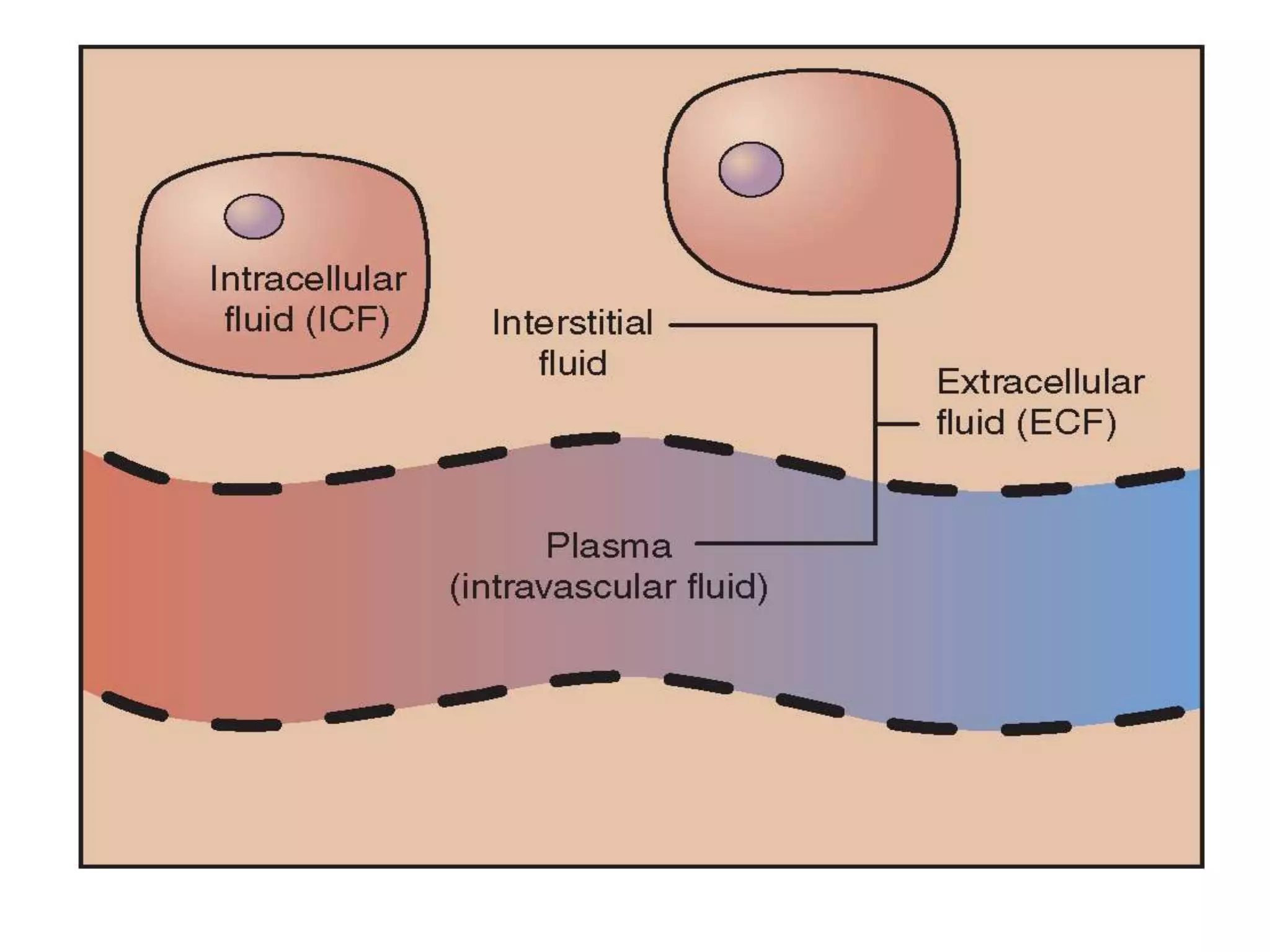
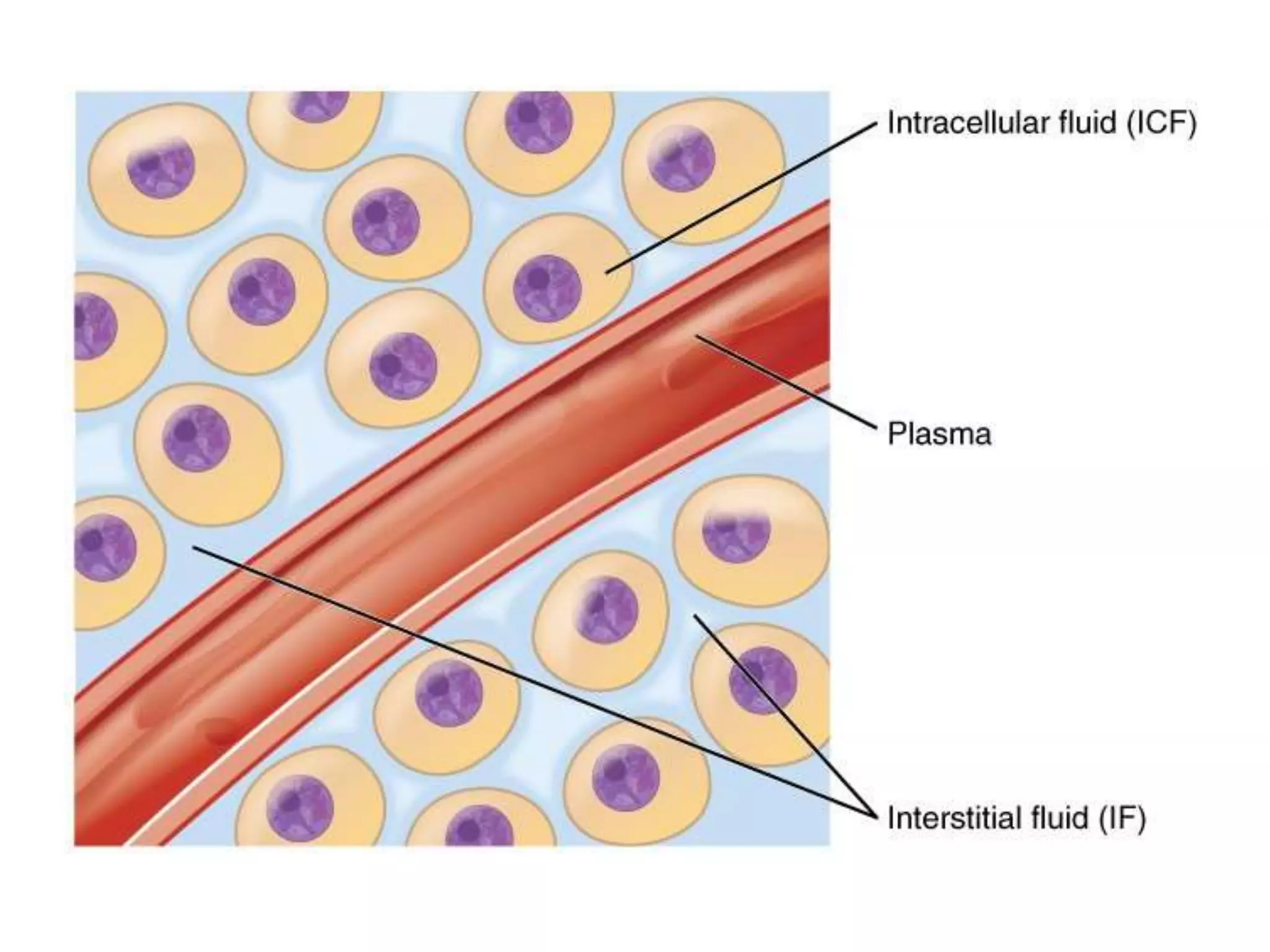
ECF constitutes of:
A. Interstitial fluid including
lymph
B. Plasma
C. Transcellular fluids
Transcellular fluids:
 CSF
 Intraocular fluid
 Gastrointestinal secretions
 Pleural fluid
 Pericardial fluid
 Peritoneal fluid
 Synovial fluid
 Fluid in urinary tract
More the amount of fat, lesser the ECF volume
Elderly – lesser ECF volume
Infants & children – greater ECF volume
Body electrolytes
• 7% of total body weight
• Functions of electrolytes in the human body
− Maintenance of acid-base balance
− Maintenance of normal osmolality and
volume of body fluids
− Ions like Na+,Ca2+,K+,Cl- , etc affects
excitability of cells
Distribution of ions across
the cell membrane at rest
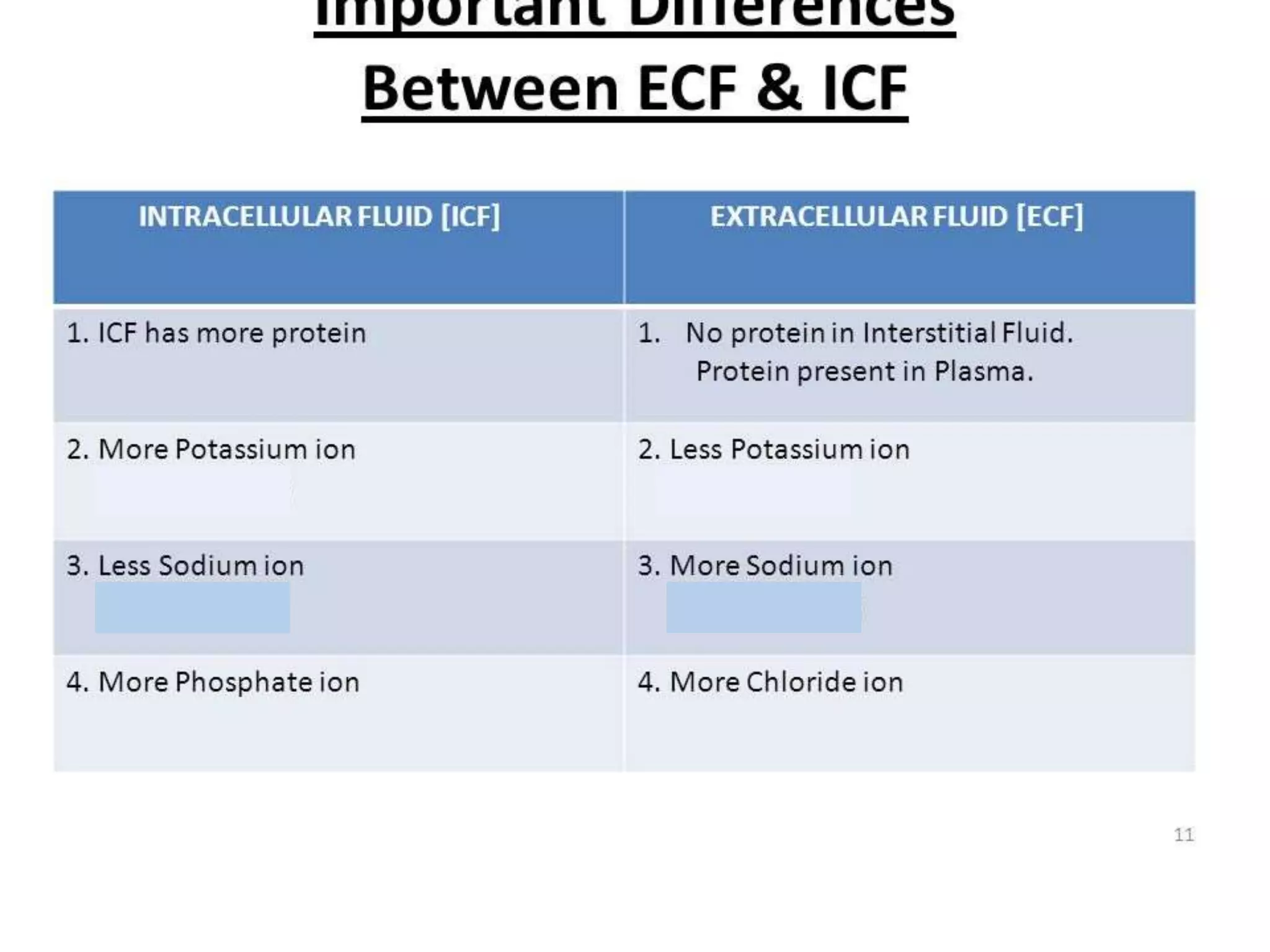
Ion ICF (mmol/L of H20) ECF(mmol/L of H20)
Na+ 1.5 150
K+ 150 5.5
Cl- 9 125
Ca2+ 0.0001 1.2
Protein anion 65 <5
Mg2+ 58 3
HCO3- 10 2.8
PO4
3- 75 4
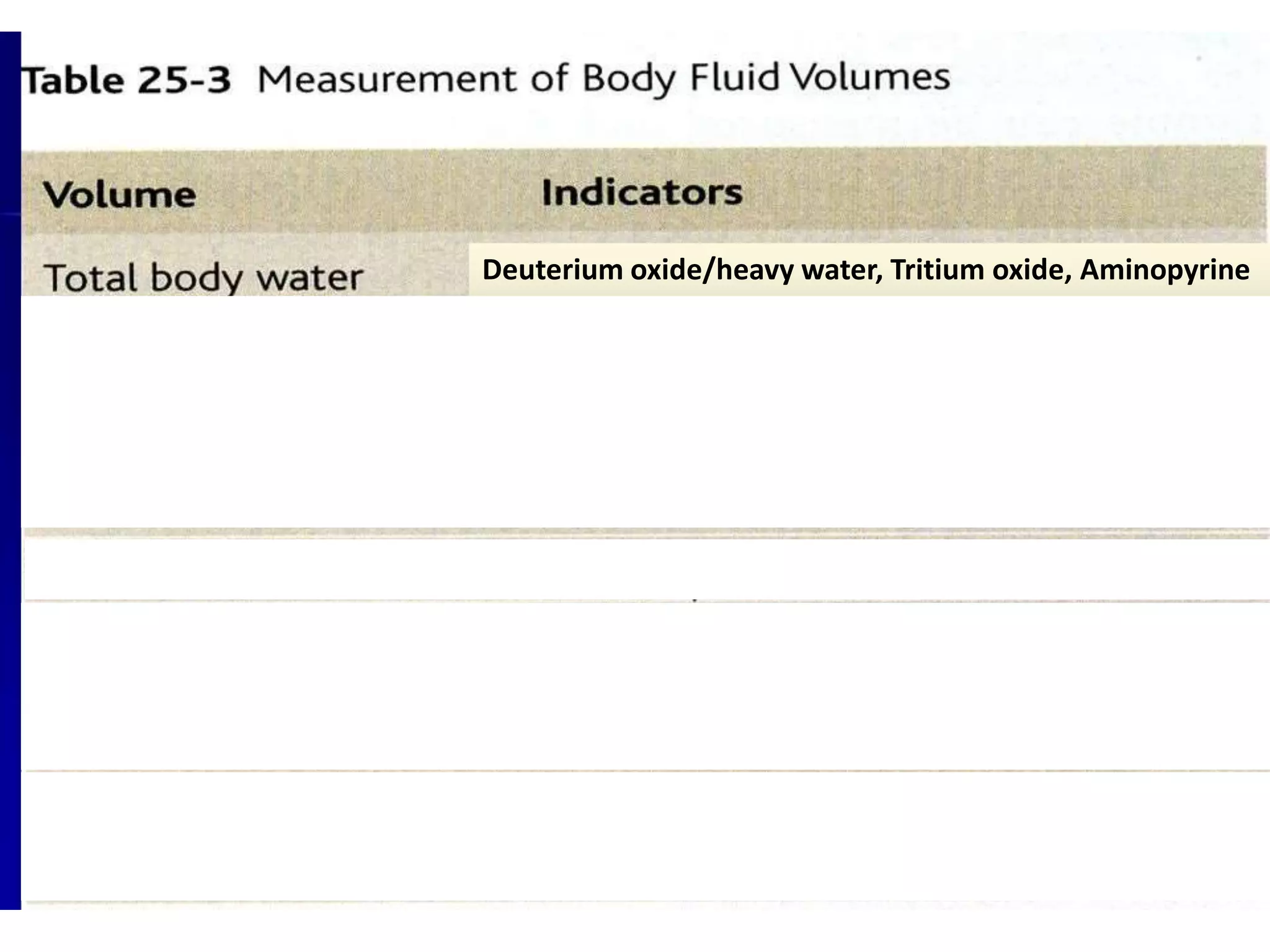
Deuterium oxide/heavy water, Tritium oxide, Aminopyrine
Inulin, Mannitol, Sucrose
131I
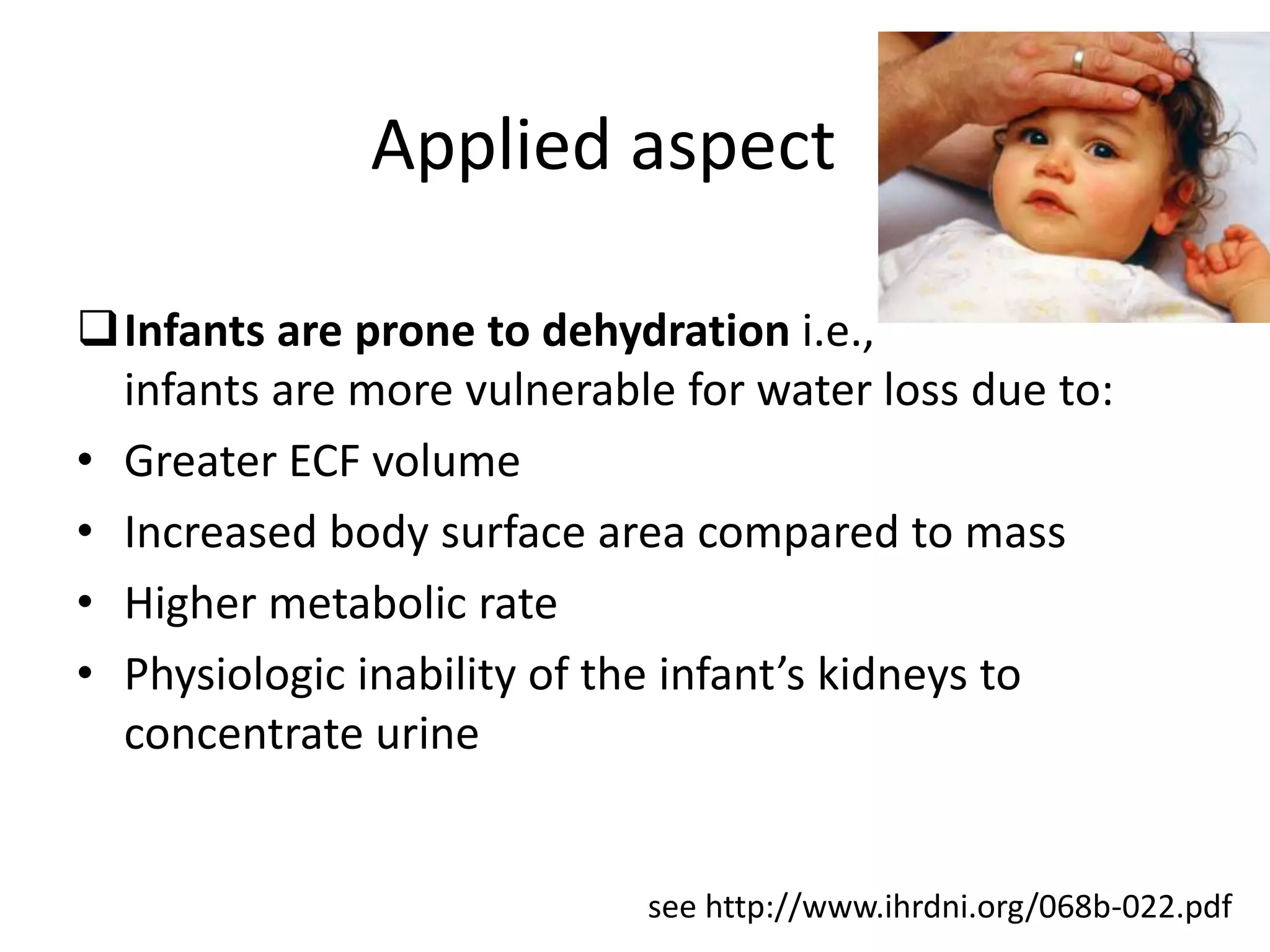
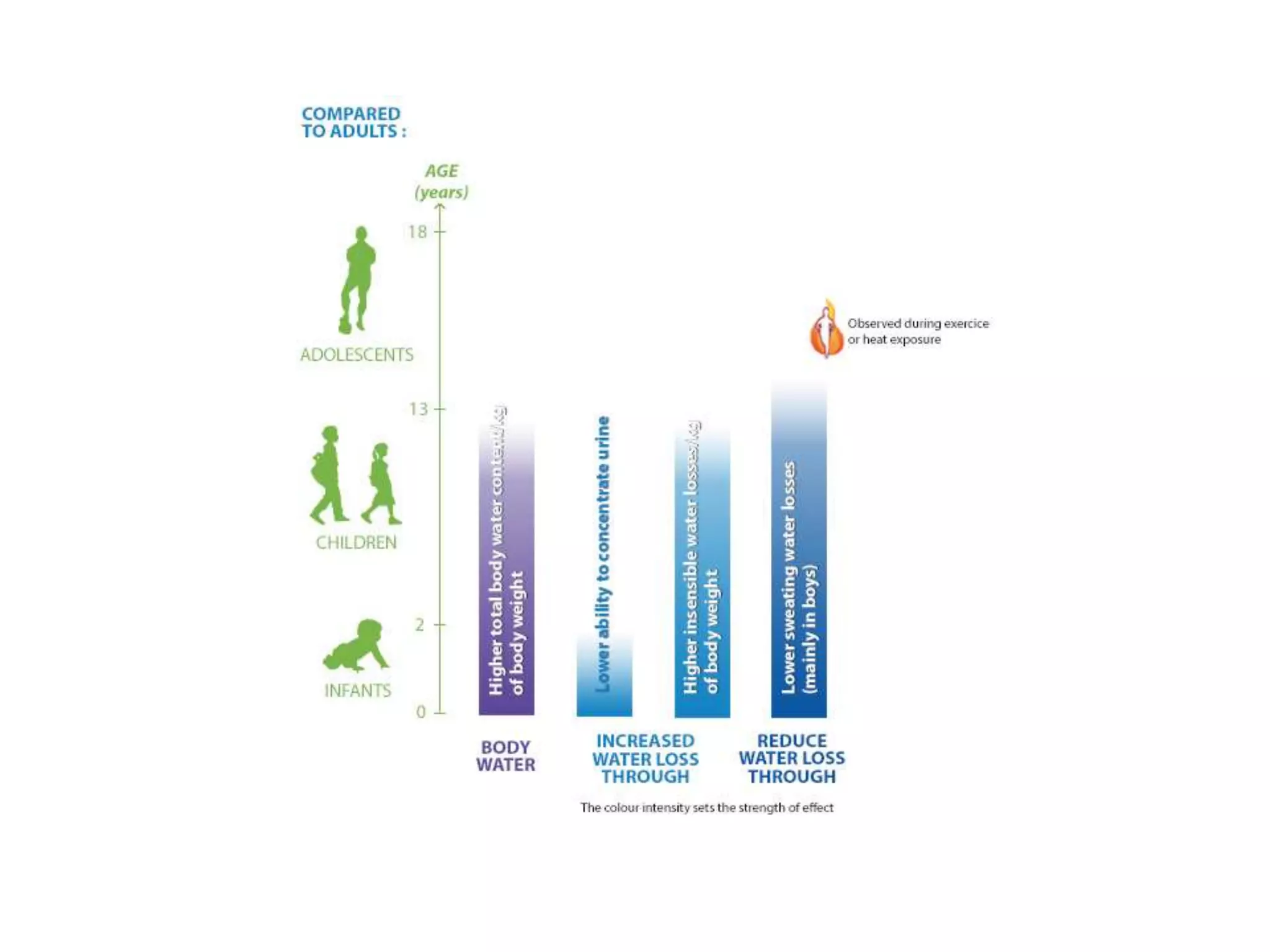
Applied aspect
Infants are prone to dehydration i.e.,
infants are more vulnerable for water loss due to:
• Absolute ECF volume is lesser
• Increased body surface area compared to mass
• Higher metabolic rate
• Physiologic inability of the infant’s kidneys to
concentrate urine
see http://www.ihrdni.org/068b-022.pdf
Thank you
Measurement of body fluid volumes
• Total body water is measured using dilution
principle.
• A marker is injected that will be evenly distributed in
all the compartments of body fluids.
• Marker that diffuses freely not only in the water
outside the cells, but also crosses the cell membrane
to reach the intracellular fluid.
• ECF volume is measured using substances that
cannot enter the cells, but can freely cross the
capillary membrane and thus distribute evenly in the
ECF compartments.
• Plasma volume is measured using substances that
binds specifically to plasma proteins, and will not
diffuse into the interstitium.
Measurement of body fluid volumes
http://www.ihrdni.org/068b-022.pdf
Body fluid compartments slide share

Body fluid compartments slide share

  • 1.
  • 2.
    Introduction • Body isformed of solids & fluids • The fluid part is more than 2/3 of the whole body. • Water forms most of the fluid part
  • 3.
    40% 15% 20% 5% Total Body water Bloodvolume 7% of body weight 5L in a 70 kg adult male
  • 6.
    ECF constitutes of: A.Interstitial fluid including lymph B. Plasma C. Transcellular fluids Transcellular fluids:  CSF  Intraocular fluid  Gastrointestinal secretions  Pleural fluid  Pericardial fluid  Peritoneal fluid  Synovial fluid  Fluid in urinary tract More the amount of fat, lesser the ECF volume Elderly – lesser ECF volume Infants & children – greater ECF volume
  • 7.
    Body electrolytes • 7%of total body weight • Functions of electrolytes in the human body − Maintenance of acid-base balance − Maintenance of normal osmolality and volume of body fluids − Ions like Na+,Ca2+,K+,Cl- , etc affects excitability of cells
  • 10.
    Distribution of ionsacross the cell membrane at rest Ion ICF (mmol/L of H20) ECF(mmol/L of H20) Na+ 1.5 150 K+ 150 5.5 Cl- 9 125 Ca2+ 0.0001 1.2 Protein anion 65 <5 Mg2+ 58 3 HCO3- 10 2.8 PO4 3- 75 4
  • 11.
    Deuterium oxide/heavy water,Tritium oxide, Aminopyrine Inulin, Mannitol, Sucrose 131I
  • 12.
    Applied aspect Infants areprone to dehydration i.e., infants are more vulnerable for water loss due to: • Absolute ECF volume is lesser • Increased body surface area compared to mass • Higher metabolic rate • Physiologic inability of the infant’s kidneys to concentrate urine see http://www.ihrdni.org/068b-022.pdf
  • 13.
  • 14.
    Measurement of bodyfluid volumes • Total body water is measured using dilution principle. • A marker is injected that will be evenly distributed in all the compartments of body fluids. • Marker that diffuses freely not only in the water outside the cells, but also crosses the cell membrane to reach the intracellular fluid.
  • 15.
    • ECF volumeis measured using substances that cannot enter the cells, but can freely cross the capillary membrane and thus distribute evenly in the ECF compartments. • Plasma volume is measured using substances that binds specifically to plasma proteins, and will not diffuse into the interstitium. Measurement of body fluid volumes
  • 16.

Editor's Notes

  • #4 EDITED PIC
  • #12 I 131 ALBUMIN – SERUM ALBUMIN LABELED WT RADIOACTIVE IODINE
  • #13 http://www.ihrdni.org/068b-022.pdf
  • #16 Red Cell Volume Can Be Accurately Determined in Sheep Using a ... https://www.ncbi.nlm.nih.gov › NCBI › Literature › PubMed Central (PMC) by DM Mock - ‎2008 - ‎Cited by 11 - ‎Related articles RCV determination by (14C)cyanate, 51Cr, and (125I)streptavidin. For each sample of blood obtained after infusion of the labeled RBCs, radioactivity per mL of blood was calculated and was plotted versus time.
  • #17 http://www.ihrdni.org/068b-022.pdf