Dr.Osama Ali Ibraheim,MD Associate Professor, Consultant,   Department of Anesthesia , College of Medicine King Saud University 01/24/10
When you first study clinical acid-base balance, this is the natural question! "What do I need to know?" The  Bird's Eye View   Let start with Physiology
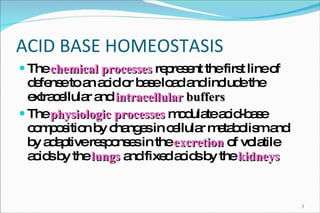
ACID BASE HOMEOSTASIS The  chemical processes  represent the first line of defense to an acid or base load and include the extracellular and  intracellular   buffers The  physiologic processes  modulate acid-base composition by changes in cellular metabolism and by adaptive responses in the  excretion  of volatile acids by the  lungs  and fixed acids by the  kidneys
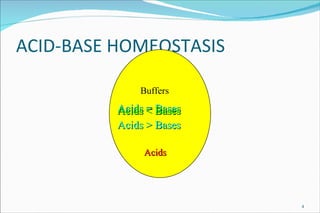
ACID-BASE HOMEOSTASIS Acids Bases Acids Acids = Bases Acids > Bases Acids < Bases Acids Buffers
01/24/10
ACID-BASE BALANCE
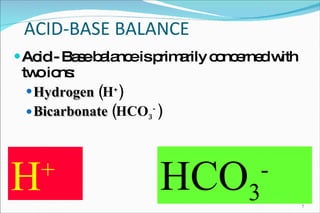
ACID-BASE BALANCE Acid - Base  balance is primarily concerned with two ions: Hydrogen  (H + )  Bicarbonate  (HCO 3 -  ) H + HCO 3 -
ACID-BASE REGULATION
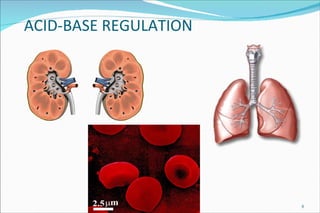
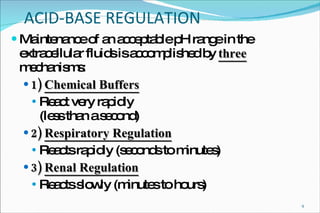
ACID-BASE REGULATION Maintenance of an acceptable pH range in the extracellular fluids is accomplished by  three  mechanisms: 1)   Chemical Buffers React very rapidly (less than a second) 2)   Respiratory Regulation Reacts rapidly (seconds to minutes) 3)   Renal Regulation Reacts slowly (minutes to hours)
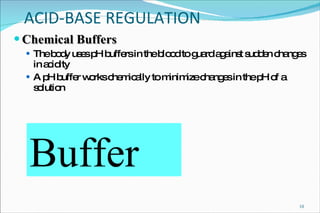
ACID-BASE REGULATION Chemical Buffers The body uses pH buffers in the blood to guard against sudden changes in acidity A pH buffer works chemically to minimize changes in the pH of a solution H + OH - H + H + OH - OH - Buffer
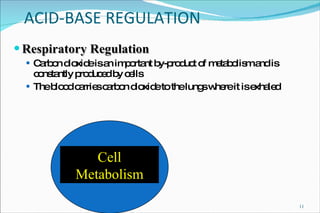
ACID-BASE REGULATION Respiratory Regulation Carbon dioxide is an important by-product of metabolism and is constantly produced by cells The blood carries carbon dioxide to the lungs where it is exhaled CO 2 CO 2 CO 2 CO 2 CO 2 CO 2 Cell Metabolism
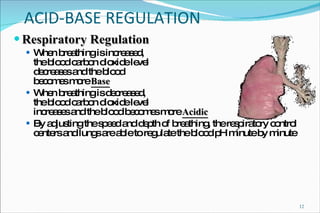
ACID-BASE REGULATION Respiratory Regulation When breathing is increased, the blood carbon dioxide level decreases and the blood becomes more  Base When breathing is decreased, the blood carbon dioxide level increases and the blood becomes more  Acidic By adjusting the speed and depth of breathing, the respiratory control centers and lungs are able to regulate the blood pH minute by minute
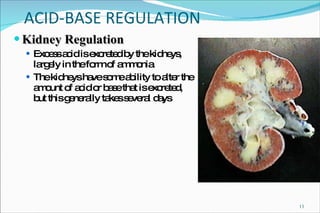
ACID-BASE REGULATION Kidney Regulation Excess acid is excreted by the kidneys, largely in the form of ammonia The kidneys have some ability to alter the amount of acid or base that is excreted, but this generally takes several days
ACIDS
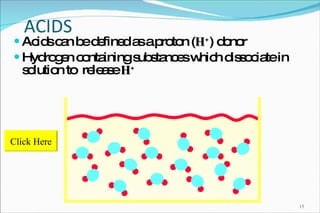
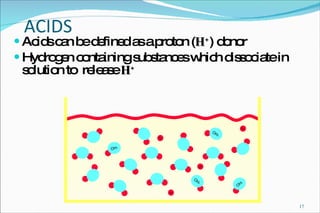
ACIDS Acids can be defined as a proton ( H + ) donor  Hydrogen containing substances which dissociate in solution to  release  H + Click Here
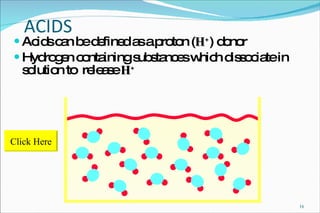
ACIDS Acids can be defined as a proton ( H + ) donor  Hydrogen containing substances which dissociate in solution to  release  H + H+ H+ H+ H+ OH- OH- OH- OH-
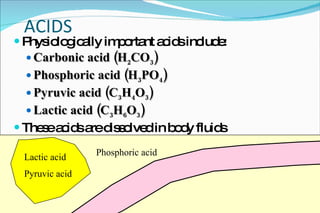
ACIDS Physiologically important acids include: Carbonic acid (H 2 CO 3 ) Phosphoric acid (H 3 PO 4 ) Pyruvic acid (C 3 H 4 O 3 ) Lactic acid (C 3 H 6 O 3 ) These acids are dissolved in body fluids Lactic acid Pyruvic acid Carbonic acid Phosphoric acid
BASES
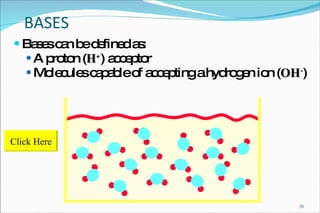
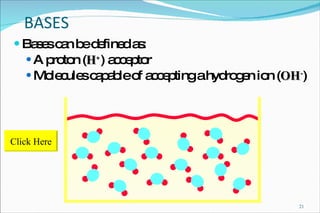
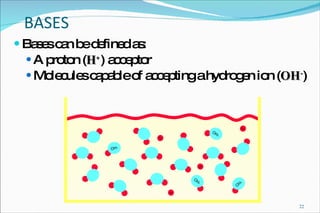
BASES Bases can be defined as: A proton ( H + ) acceptor Molecules capable of accepting a hydrogen ion ( OH - ) Click Here
BASES Bases can be defined as: A proton ( H + ) acceptor Molecules capable of accepting a hydrogen ion ( OH - ) H+ H+ H+ H+ OH- OH- OH- OH-
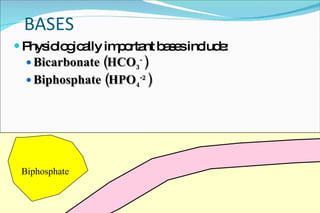
BASES Physiologically important bases include: Bicarbonate (HCO 3 -  ) Biphosphate (HPO 4 -2  ) Biphosphate Bicarbonate
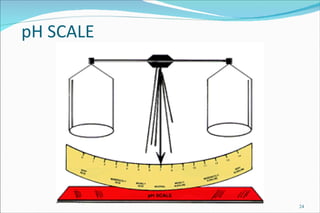
pH SCALE
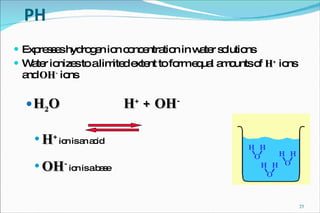
PH Expresses hydrogen ion concentration in water solutions Water ionizes to a limited extent to form equal amounts of  H +  ions and  OH -  ions H 2 O   H +  + OH - H +   ion is an acid OH -   ion is a base
H +   ion is an acid
OH -   ion is a base
H +   ion is an acid OH -  ion is a base
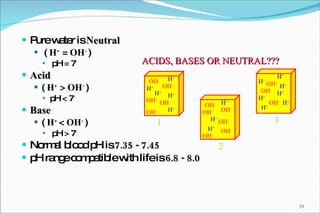
Pure water is  Neutral (  H +  =  OH -   ) pH = 7 Acid   (  H +  >  OH -  )  pH < 7 Base   (  H +   <  OH -   ) pH > 7 Normal blood pH is  7.35 - 7.45 pH range compatible with life is  6.8 - 8.0 ACIDS, BASES OR NEUTRAL??? 1 2 3 OH - OH - OH - OH - OH - OH - H + H + H + H + OH - OH - OH - OH - OH - H + H + H + H + OH - OH - OH - H + H + H + H + H + H + H +
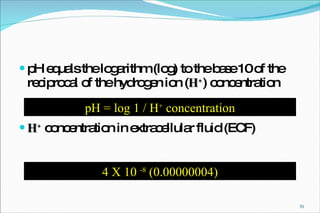
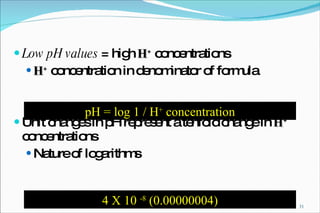
pH equals the logarithm (log) to the base 10 of the reciprocal of the hydrogen ion ( H + ) concentration H +  concentration in extracellular fluid (ECF) pH = log 1 /  H +  concentration 4 X 10  -8  (0.00000004)
Low pH values  = high  H +  concentrations H +  concentration in denominator of formula Unit changes in pH represent a tenfold change in  H +  concentrations Nature of logarithms pH = log 1 /  H +  concentration 4 X 10  -8  (0.00000004)
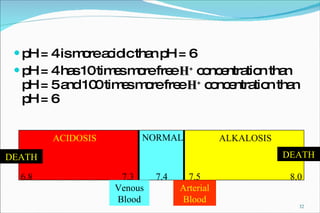
pH = 4 is more acidic than pH = 6 pH = 4 has 10 times more free  H +  concentration than pH = 5 and 100 times more free  H +  concentration than pH = 6 ACIDOSIS ALKALOSIS NORMAL DEATH DEATH Venous Blood Arterial Blood 7.3 7.5 7.4 6.8 8.0
ACIDOSIS / ALKALOSIS
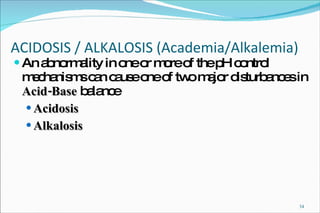
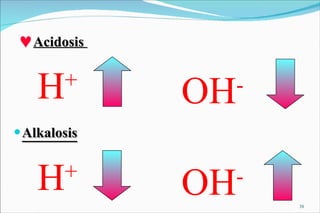
ACIDOSIS / ALKALOSIS (Academia/Alkalemia) An abnormality in one or more of the pH control mechanisms can cause one of two major disturbances in  Acid-Base  balance Acidosis Alkalosis
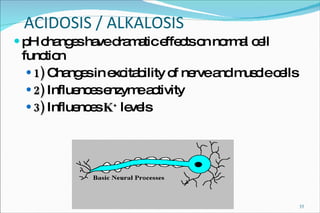
ACIDOSIS / ALKALOSIS pH changes have dramatic effects on normal cell function 1)  Changes in excitability of nerve and muscle cells 2)  Influences enzyme activity 3)  Influences  K +  levels
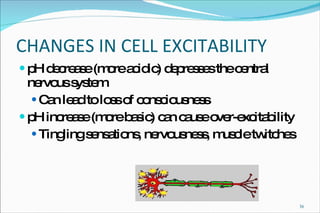
CHANGES IN CELL EXCITABILITY pH decrease (more acidic) depresses the central nervous system Can lead to loss of consciousness pH increase (more basic) can cause over-excitability Tingling sensations, nervousness, muscle twitches
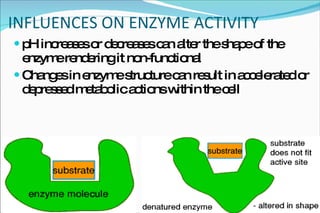
INFLUENCES ON ENZYME ACTIVITY pH increases or decreases can alter the shape of the enzyme rendering it non-functional Changes in enzyme structure can result in accelerated or depressed metabolic actions within the cell
Alkalosis H + OH - Acidosis  H + OH -
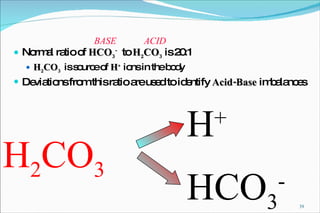
Normal ratio of  HCO 3 -   to  H 2 CO 3  is 20:1 H 2 CO 3   is source of  H +  ions in the body Deviations from this ratio are used to identify  Acid-Base  imbalances BASE ACID H 2 CO 3 H + HCO 3 -
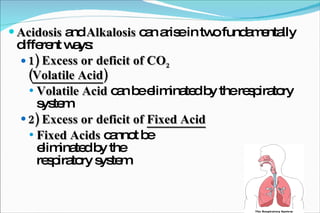
Acidosis  and  Alkalosis  can arise in two fundamentally different ways: 1) Excess or deficit of CO 2 ( Volatile Acid ) Volatile Acid  can be eliminated by the respiratory system 2) Excess or deficit of  Fixed Acid Fixed Acids  cannot be eliminated by the respiratory system
ACIDOSIS / ALKALOSIS Normal values of bicarbonate (arterial) pH  = 7.4 PCO 2  = 40 mm Hg HCO 3 -  = 24 meq/L
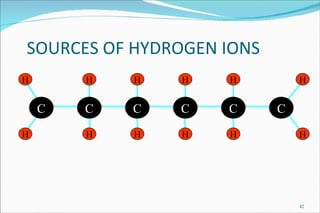
SOURCES OF HYDROGEN IONS  C C C C C C H H H H H H H H H H H H
SOURCES OF HYDROGEN IONS  1) Cell Metabolism (CO 2 ) 2) Food Products 3) Medications 4) Metabolic Intermediate by-products 5) Some Disease processes
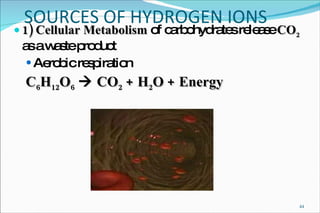
SOURCES OF HYDROGEN IONS 1) Cellular Metabolism  of carbohydrates release  CO 2  as a waste product Aerobic respiration C 6 H 12 O 6     CO 2  + H 2 O + Energy
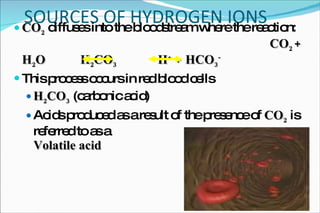
SOURCES OF HYDROGEN IONS CO 2  diffuses into the bloodstream where the reaction:  CO 2  + H 2 O  H 2 CO 3   H +  + HCO 3 -   This process occurs in red blood cells H 2 CO 3  (carbonic acid) Acids produced as a result of the presence of  CO 2  is referred to as a Volatile acid
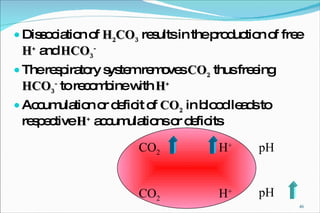
Dissociation of  H 2 CO 3  results in the production of free  H +  and  HCO 3 - The respiratory system removes  CO 2  thus freeing  HCO 3 -  to recombine with  H + Accumulation or deficit of  CO 2  in blood leads to respective  H +  accumulations or deficits CO 2 H + CO 2 H + pH pH
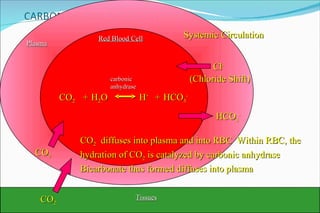
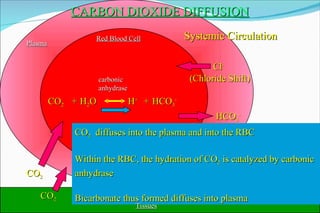
CO 2 CO 2 Red Blood Cell Systemic Circulation HCO 3 - Cl - (Chloride Shift) CO 2   diffuses into plasma and into RBC  Within RBC, the hydration of CO 2  is catalyzed by carbonic anhydrase Bicarbonate thus formed diffuses into plasma carbonic anhydrase Tissues Plasma CO 2 H 2 O H + HCO 3 - + +
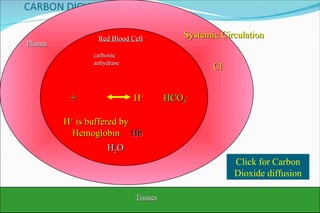
CO 2 Red Blood Cell Systemic Circulation H 2 O H + HCO 3 - carbonic anhydrase Plasma CO 2 CO 2 CO 2 CO 2 CO 2 CO 2 CO 2 Click for Carbon Dioxide diffusion + + Tissues H + Cl - Hb H +  is buffered by Hemoglobin
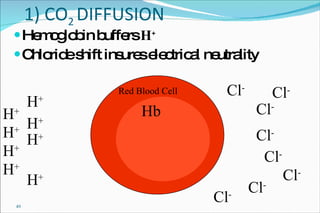
1) CO 2  DIFFUSION Hemoglobin buffers  H + Chloride shift insures electrical neutrality Hb Cl - H + H + H + H + H + H + H + H + Cl - Cl - Cl - Cl - Cl - Cl - Red Blood Cell Cl -
CARBON DIOXIDE DIFFUSION CO 2 CO 2 Red Blood Cell Systemic Circulation HCO 3 - Cl - (Chloride Shift) CO 2   diffuses into the plasma and into the RBC Within the RBC, the hydration of CO 2  is catalyzed by carbonic anhydrase Bicarbonate thus formed diffuses into plasma carbonic anhydrase Tissues Plasma CO 2 H 2 O H + HCO 3 - + +
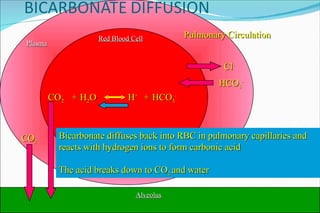
Red Blood Cell Pulmonary Circulation CO 2 H 2 O H + HCO 3 - + + HCO 3 - Cl - Alveolus Plasma CO 2 Bicarbonate diffuses back into RBC in pulmonary capillaries and reacts with hydrogen ions to form carbonic acid The acid breaks down to CO 2  and water
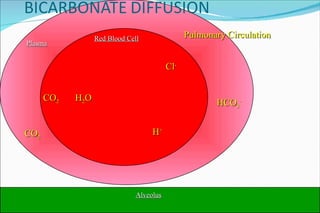
Red Blood Cell Pulmonary Circulation CO 2 H 2 O H + + + HCO 3 - Cl - Alveolus Plasma CO 2 CO 2 H 2 O
Basic Concepts   The hydrogen ion concentration [H+] in extra cellular fluid is determined by the balance between the partial pressure of carbon dioxide (PCO2)/HCO3 in the fluid.  This relationship is expressed as follows :  [H+]  (nEq/L) = 24 x (PCO2/HCO3) 01/24/10
Using a normal arterial PCO2 of 40 mm Hg and a normal serum HCO3 concentration of 24 mEq/L, the normal [H+] in arterial blood is 24 x (40/24)  = 40 nEq/L.   01/24/10
pH The body constantly tries to maintain a neutral environment. All electrolytes maintain a positive or negative charge. Water disassociates into H+ and OH- ions. pH (French for the power of hydrogen) is the percentage of hydrogen ions (H) in a solution.  Acids: substances that donate hydrogen ions (H) to a solution. Ex: carbonic acid . Bases: substances that accept hydrogen ions. Ex: bicarbonate (HCO 3 ). 01/24/10
pH A solution with more base than acid has fewer hydrogen ions so has a higher pH. A pH    than 7 makes the solution a base. A solution that contains more acid than base has more hydrogen ions so has a lower pH. A pH   7 makes the solution an acid. 01/24/10
pH is regulated by  (1) chemical buffers,  (2) respiratory system  (3) kidneys Chemical Buffers: (First system within minutes) Bicarbonate-buffer-system Phosphate buffer-system Protein-buffer-system Change strong acids to weak acids (hydrochloric acid to carbonic acid) or neutralize them. 01/24/10
Respiratory system: Chemoreceptors in the medulla of brain sense pH changes and vary the rate and depth of breathing to compensate for pH changes. The lungs combine CO2 with water to form carbonic acid.   carbonic acid leads to a    in pH.  Increased breathing blows off CO2      pH. Decreased breathing retains CO2       pH. 01/24/10
Kidneys: within days Kidneys can retain bicarbonate (HCO3) or eliminate it. Normal level in arterial blood is 22 to 26 mEq/L.  HCO3 and pH values increase or decrease together (when pH is   , HCO3 is   . When pH is   , HCO3 is   . 01/24/10
pH If acidosis or alkalosis are caused by faulty breathing, they are  respiratory acidosis or alkalosis. If acidosis or alkalosis are caused by vomiting, diarrhea, ineffective bicarbonate buffering or kidney disorders, they are  metabolic acidosis or alkalosis . 01/24/10
Question... Is the average pH of the blood lower in: a) arteries b) veins Veins!  Why? Because veins pick up the  byproducts of cellular metabolism,  including… CO 2 !
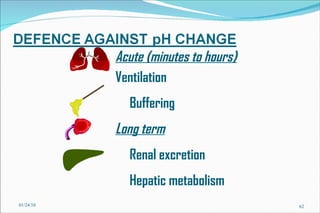
01/24/10 Acute (minutes to hours)  Ventilation Buffering Long term Renal excretion Hepatic metabolism
Henderson-Hasselbalch Equation pH = pK a  + log [base]/[acid] Ex:  = 6.1 + log 20/1 = 6.1 + 1.3 = 7.4 Key ratio is base: acid HCO 3 -  : CO 2  (standing in for H 2 CO 3 )
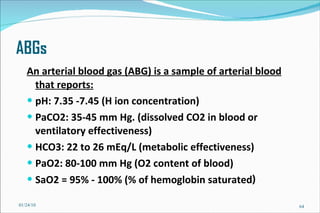
ABGs An arterial blood gas (ABG) is a sample of arterial blood that reports: pH: 7.35 -7.45 (H ion concentration) PaCO2: 35-45 mm Hg. (dissolved CO2 in blood or ventilatory effectiveness) HCO3: 22 to 26 mEq/L (metabolic effectiveness) PaO2: 80-100 mm Hg (O2 content of blood) SaO2 = 95% - 100% (% of hemoglobin saturated ) 01/24/10
Acid Base Control   The initial changes in PCO2 or HCO3 is calling the primary acid-base disorder, and the subsequent response is called the compensatory or secondary acid-base disorder.  Compensatory responses  are not strong enough  to keep the pH constant  (they do not correct the acid-base derangement)  they only to limit the change in pH that results from a primary change in PCO2 or HCO3. 01/24/10
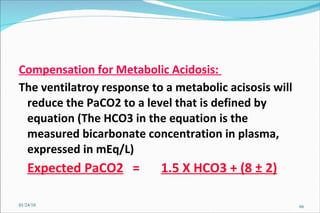
Compensation for Metabolic Acidosis:  The ventilatroy response to a metabolic acisosis will reduce the PaCO2 to a level that is defined by equation (The HCO3 in the equation is the measured bicarbonate concentration in plasma, expressed in mEq/L) Expected PaCO2   =  1.5 X HCO3 + (8 ± 2)   01/24/10
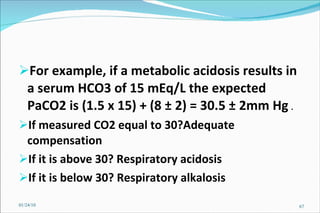
For example, if a metabolic acidosis results in a serum HCO3 of 15 mEq/L the expected PaCO2 is (1.5 x 15) + (8 ± 2) = 30.5 ± 2mm Hg  . If measured CO2 equal to 30?Adequate compensation If it is above 30? Respiratory acidosis If it is below 30? Respiratory alkalosis 01/24/10
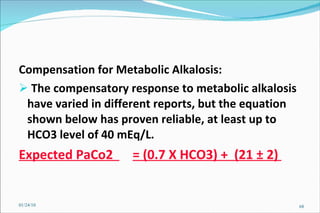
Compensation for Metabolic Alkalosis:  The compensatory response to metabolic alkalosis have varied in different reports, but the equation shown below has proven reliable, at least up to HCO3 level of 40 mEq/L. Expected PaCo2  = (0.7 X HCO3) +  (21 ± 2)  01/24/10
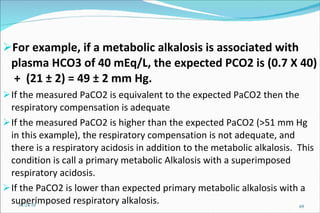
For example, if a metabolic alkalosis is associated with plasma HCO3 of 40 mEq/L, the expected PCO2 is (0.7 X 40)  +  (21 ± 2) = 49 ± 2 mm Hg.   If the measured PaCO2 is equivalent to the expected PaCO2 then the respiratory compensation is adequate  If the measured PaCO2 is higher than the expected PaCO2 (>51 mm Hg in this example), the respiratory compensation is not adequate, and there is a respiratory acidosis in addition to the metabolic alkalosis.  This condition is call a primary metabolic Alkalosis with a superimposed respiratory acidosis.  If the PaCO2 is lower than expected primary metabolic alkalosis with a superimposed respiratory alkalosis.  01/24/10
Compensation Acute Respiratory  Δ  pH  = 0.008 x  Δ  PaCO2  Acidosis   Expected pH  = 7.40 –[0.008x(PaCO2 -40)] Chronic Respiratory  Δ  pH  =  0.003  x  Δ  PaCO2  Acidosis    Expected pH  = 7.40 –[0.003x(PaCO2 -40)] Acute Respiratory    Δ  pH  =  0.008  x  Δ  PaCO2  Alkalosis    Expected pH = 7.40 + [0.008 x (40-PaCO2)] Chronic Respiratory    Δ  pH  =  0.003  x  Δ  PaCO2 Alkalosis  Expected pH = 7.40 + [0.003 x (40-PaCO2)] 01/24/10
A Stepwise Approach to Acid-Base Interpretation:  Stage I . identify the Primary Acid Base Disorder : Rule 1:  An acid base abnormality is present if either the PaCO2 or the pH is outside the normal range.  (A normal pH or PaCO2 does not exclude the presence of an acid base abnormality, as explained in Rule 3).  01/24/10
Rule 2:  If the pH and PaCO2 are both abnormal, compare the directional change.  If both change in the same direction (both increase or decrease), the primary acid base disorder is metabolic, and if both change in opposite direction, the primary acid base disorder is respiratory. Example:  Consider a patient with an arterial pH of 7.23 and a PaCO2 of 23 mm Hg.  The pH and PaCO2 are both reduced (indicating a primary metabolic problem) and the pH is low (indicating academia), so the problem is a primary metabolic acidosis.  01/24/10
Rule 3:  If either the pH or PaCO2 is normal, there is mixed metabolic and respiratory acid base disorder (one is an acidosis and the other is an alkalosis).  If the pH is normal, the direction of change in PaCO2 identifies the respiratory disorder, and if the PaCO2 is normal, the direction of change in the pH is normal identifies the metabolic disorder  01/24/10
Remember that the compensatory responses to a primary acid base disturbance are never strong enough to correct the pH, but act to reduce the severity of the change in pH.   Therefore, a normal pH in the presence of an acid base disorder always signifies a mixed respiratory and metabolic acid base disorder.  (It is sometimes easier to think of this situation as a condition of overcompensation for one of the acid base disorder .) 01/24/10
Stage II  Evaluate Compensatory Responses :  If Acid base disturbance was identified in stage I, go directly to stage III .The goal of stage II is to determine if compensatory responses are adequate and if there are additional acid base derangement. Rule 4 if there is a primary metabolic acidosis or alkalosis, use the measured bicarbonate concentration in the equation and identify expected  PaCO2. If the measured and expected PaCO2 are equivalent, the condition is fully compensated.  If the measured PaCO2 is higher than the expected PaCO2, there is superimposed respiratory acidosis.  If the measured PCO2 is less than the expected PCO2, there is a superimposed respiratory alkalosis.  01/24/10
Stage  III:  Use the &quot;Gaps&quot; to evaluate Metabolic Acidosis.  Anion Gap Is the difference between the unmeasured anions UA and unmeasured cations UC   AG= Na  -- CL – HCO3  (3-11 mEq/L) Urinary anion gap AG= urinary UA -urinary UC  = U na + U k +  —  U cl It is useful in patients with non anion gap acidosis to determine renal or gastrointestinal loss of HCO3 + ve urinary AG- ----- Type I renal tubular acidosis (RTA) - ve urinary AG ------- Diarrhea 01/24/10
To sort out high AG acidosis mixed with other acid base disorders ,measure the  Δ  Gap  If  Δ  AG Gap + HCO3 is normal  (24) high AG metabolic acidosis) If  Δ  AG Gap + HCO3 is higher than normal  > (24) high AG metabolic acidosis + metabolic alkalosis Δ  AG Gap + HCO3 is lower than normal <  (24)  high AG metabolic acidosis + non AG metabolic acidosis the gap-gap: can uncover mixed metabolic disorders (e.g, a metabolic acidosis and alkalosis) that would otherwise go undetected.  01/24/10
Steps to Assess ABGs 1 .  Check the pH. Is it normal (7.35-7.45), acidotic (   7.35) or alkalotic (   7.45)? 2. Check the PaCO2. Is it normal (34-35 mm Hg), low (below 35 mm Hg) or high (   45 mm Hg)? Is it opposite from the pH? If it is, problem is respiratory origin. Example: pH = 7.30 (low or acidotic); PaCO2 = 48 mm Hg (high) Example: pH = 7.50 (high or alkalotic); PaCO2 = 28 mm Hg (low). 01/24/10
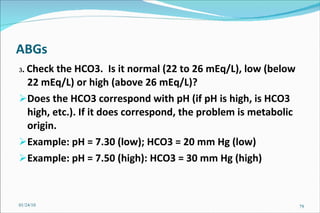
ABGs 3 .  Check the HCO3.  Is it normal (22 to 26 mEq/L), low (below 22 mEq/L) or high (above 26 mEq/L)? Does the HCO3 correspond with pH (if pH is high, is HCO3 high, etc.). If it does correspond, the problem is metabolic origin. Example: pH = 7.30 (low); HCO3 = 20 mm Hg (low) Example: pH = 7.50 (high): HCO3 = 30 mm Hg (high) 01/24/10
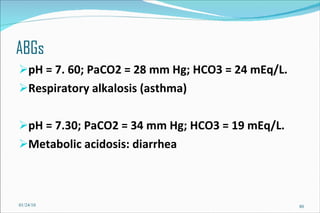
ABGs pH = 7. 60; PaCO2 = 28 mm Hg; HCO3 = 24 mEq/L. Respiratory alkalosis (asthma) pH = 7.30; PaCO2 = 34 mm Hg; HCO3 = 19 mEq/L. Metabolic acidosis: diarrhea 01/24/10
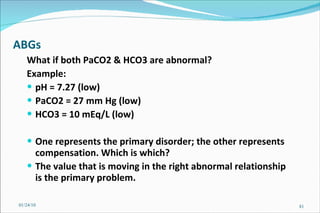
ABGs What if both PaCO2 & HCO3 are abnormal? Example:  pH = 7.27 (low) PaCO2 = 27 mm Hg (low) HCO3 = 10 mEq/L (low) One represents the primary disorder; the other represents compensation. Which is which? The value that is moving in the right abnormal relationship is the primary problem. 01/24/10
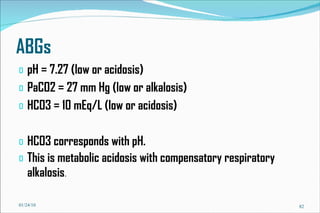
ABGs pH = 7.27 (low or acidosis) PaCO2 = 27 mm Hg (low or alkalosis) HCO3 = 10 mEq/L (low or acidosis) HCO3 corresponds with pH. This is metabolic acidosis with compensatory respiratory alkalosis . 01/24/10
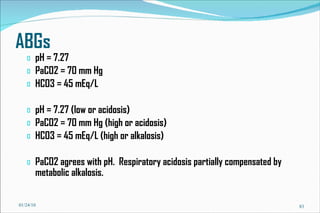
ABGs pH = 7.27 PaCO2 = 70 mm Hg HCO3 = 45 mEq/L pH = 7.27 (low or acidosis) PaCO2 = 70 mm Hg (high or acidosis) HCO3 = 45 mEq/L (high or alkalosis) PaCO2 agrees with pH.  Respiratory acidosis partially compensated by metabolic alkalosis. 01/24/10
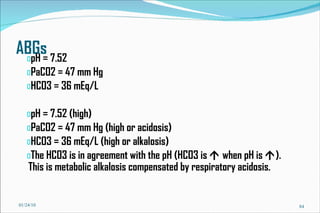
ABGs pH = 7.52 PaCO2 = 47 mm Hg HCO3 = 36 mEq/L pH = 7.52 (high) PaCO2 = 47 mm Hg (high or acidosis) HCO3 = 36 mEq/L (high or alkalosis) The HCO3 is in agreement with the pH (HCO3 is    when pH is   ). This is metabolic alkalosis compensated by respiratory acidosis. 01/24/10
Problem  Consider a hypothetical situation in which the PCO2 is 80 mmHg and [HCO3] 48 mM of arterial plasma. Which of the following statements is correct? A . There is no acid-base disturbance. B . Metabolic alkalosis is the primary acid-base disturbance. C . Respiratory acidosis is the primary acid-base disturbance. D . Intracellular pH is lower than normal. E . Intracellular pH is higher than normal. 01/24/10
Questions? 01/24/10

Acid Base Balance

  • 1.
    Dr.Osama Ali Ibraheim,MDAssociate Professor, Consultant,   Department of Anesthesia , College of Medicine King Saud University 01/24/10
  • 2.
    When you firststudy clinical acid-base balance, this is the natural question! &quot;What do I need to know?&quot; The Bird's Eye View Let start with Physiology
  • 3.
    ACID BASE HOMEOSTASISThe chemical processes represent the first line of defense to an acid or base load and include the extracellular and intracellular buffers The physiologic processes modulate acid-base composition by changes in cellular metabolism and by adaptive responses in the excretion of volatile acids by the lungs and fixed acids by the kidneys
  • 4.
    ACID-BASE HOMEOSTASIS AcidsBases Acids Acids = Bases Acids > Bases Acids < Bases Acids Buffers
  • 5.
  • 6.
  • 7.
    ACID-BASE BALANCE Acid- Base balance is primarily concerned with two ions: Hydrogen (H + ) Bicarbonate (HCO 3 - ) H + HCO 3 -
  • 8.
  • 9.
    ACID-BASE REGULATION Maintenanceof an acceptable pH range in the extracellular fluids is accomplished by three mechanisms: 1) Chemical Buffers React very rapidly (less than a second) 2) Respiratory Regulation Reacts rapidly (seconds to minutes) 3) Renal Regulation Reacts slowly (minutes to hours)
  • 10.
    ACID-BASE REGULATION ChemicalBuffers The body uses pH buffers in the blood to guard against sudden changes in acidity A pH buffer works chemically to minimize changes in the pH of a solution H + OH - H + H + OH - OH - Buffer
  • 11.
    ACID-BASE REGULATION RespiratoryRegulation Carbon dioxide is an important by-product of metabolism and is constantly produced by cells The blood carries carbon dioxide to the lungs where it is exhaled CO 2 CO 2 CO 2 CO 2 CO 2 CO 2 Cell Metabolism
  • 12.
    ACID-BASE REGULATION RespiratoryRegulation When breathing is increased, the blood carbon dioxide level decreases and the blood becomes more Base When breathing is decreased, the blood carbon dioxide level increases and the blood becomes more Acidic By adjusting the speed and depth of breathing, the respiratory control centers and lungs are able to regulate the blood pH minute by minute
  • 13.
    ACID-BASE REGULATION KidneyRegulation Excess acid is excreted by the kidneys, largely in the form of ammonia The kidneys have some ability to alter the amount of acid or base that is excreted, but this generally takes several days
  • 14.
  • 15.
    ACIDS Acids canbe defined as a proton ( H + ) donor Hydrogen containing substances which dissociate in solution to release H + Click Here
  • 16.
    ACIDS Acids canbe defined as a proton ( H + ) donor Hydrogen containing substances which dissociate in solution to release H + Click Here
  • 17.
    ACIDS Acids canbe defined as a proton ( H + ) donor Hydrogen containing substances which dissociate in solution to release H + H+ H+ H+ H+ OH- OH- OH- OH-
  • 18.
    ACIDS Physiologically importantacids include: Carbonic acid (H 2 CO 3 ) Phosphoric acid (H 3 PO 4 ) Pyruvic acid (C 3 H 4 O 3 ) Lactic acid (C 3 H 6 O 3 ) These acids are dissolved in body fluids Lactic acid Pyruvic acid Carbonic acid Phosphoric acid
  • 19.
  • 20.
    BASES Bases canbe defined as: A proton ( H + ) acceptor Molecules capable of accepting a hydrogen ion ( OH - ) Click Here
  • 21.
    BASES Bases canbe defined as: A proton ( H + ) acceptor Molecules capable of accepting a hydrogen ion ( OH - ) Click Here
  • 22.
    BASES Bases canbe defined as: A proton ( H + ) acceptor Molecules capable of accepting a hydrogen ion ( OH - ) H+ H+ H+ H+ OH- OH- OH- OH-
  • 23.
    BASES Physiologically importantbases include: Bicarbonate (HCO 3 - ) Biphosphate (HPO 4 -2 ) Biphosphate Bicarbonate
  • 24.
  • 25.
    PH Expresses hydrogenion concentration in water solutions Water ionizes to a limited extent to form equal amounts of H + ions and OH - ions H 2 O H + + OH - H + ion is an acid OH - ion is a base
  • 26.
    H + ion is an acid
  • 27.
    OH - ion is a base
  • 28.
    H + ion is an acid OH - ion is a base
  • 29.
    Pure water is Neutral ( H + = OH - ) pH = 7 Acid ( H + > OH - ) pH < 7 Base ( H + < OH - ) pH > 7 Normal blood pH is 7.35 - 7.45 pH range compatible with life is 6.8 - 8.0 ACIDS, BASES OR NEUTRAL??? 1 2 3 OH - OH - OH - OH - OH - OH - H + H + H + H + OH - OH - OH - OH - OH - H + H + H + H + OH - OH - OH - H + H + H + H + H + H + H +
  • 30.
    pH equals thelogarithm (log) to the base 10 of the reciprocal of the hydrogen ion ( H + ) concentration H + concentration in extracellular fluid (ECF) pH = log 1 / H + concentration 4 X 10 -8 (0.00000004)
  • 31.
    Low pH values = high H + concentrations H + concentration in denominator of formula Unit changes in pH represent a tenfold change in H + concentrations Nature of logarithms pH = log 1 / H + concentration 4 X 10 -8 (0.00000004)
  • 32.
    pH = 4is more acidic than pH = 6 pH = 4 has 10 times more free H + concentration than pH = 5 and 100 times more free H + concentration than pH = 6 ACIDOSIS ALKALOSIS NORMAL DEATH DEATH Venous Blood Arterial Blood 7.3 7.5 7.4 6.8 8.0
  • 33.
  • 34.
    ACIDOSIS / ALKALOSIS(Academia/Alkalemia) An abnormality in one or more of the pH control mechanisms can cause one of two major disturbances in Acid-Base balance Acidosis Alkalosis
  • 35.
    ACIDOSIS / ALKALOSISpH changes have dramatic effects on normal cell function 1) Changes in excitability of nerve and muscle cells 2) Influences enzyme activity 3) Influences K + levels
  • 36.
    CHANGES IN CELLEXCITABILITY pH decrease (more acidic) depresses the central nervous system Can lead to loss of consciousness pH increase (more basic) can cause over-excitability Tingling sensations, nervousness, muscle twitches
  • 37.
    INFLUENCES ON ENZYMEACTIVITY pH increases or decreases can alter the shape of the enzyme rendering it non-functional Changes in enzyme structure can result in accelerated or depressed metabolic actions within the cell
  • 38.
    Alkalosis H +OH - Acidosis H + OH -
  • 39.
    Normal ratio of HCO 3 - to H 2 CO 3 is 20:1 H 2 CO 3 is source of H + ions in the body Deviations from this ratio are used to identify Acid-Base imbalances BASE ACID H 2 CO 3 H + HCO 3 -
  • 40.
    Acidosis and Alkalosis can arise in two fundamentally different ways: 1) Excess or deficit of CO 2 ( Volatile Acid ) Volatile Acid can be eliminated by the respiratory system 2) Excess or deficit of Fixed Acid Fixed Acids cannot be eliminated by the respiratory system
  • 41.
    ACIDOSIS / ALKALOSISNormal values of bicarbonate (arterial) pH = 7.4 PCO 2 = 40 mm Hg HCO 3 - = 24 meq/L
  • 42.
    SOURCES OF HYDROGENIONS C C C C C C H H H H H H H H H H H H
  • 43.
    SOURCES OF HYDROGENIONS 1) Cell Metabolism (CO 2 ) 2) Food Products 3) Medications 4) Metabolic Intermediate by-products 5) Some Disease processes
  • 44.
    SOURCES OF HYDROGENIONS 1) Cellular Metabolism of carbohydrates release CO 2 as a waste product Aerobic respiration C 6 H 12 O 6  CO 2 + H 2 O + Energy
  • 45.
    SOURCES OF HYDROGENIONS CO 2 diffuses into the bloodstream where the reaction: CO 2 + H 2 O H 2 CO 3 H + + HCO 3 - This process occurs in red blood cells H 2 CO 3 (carbonic acid) Acids produced as a result of the presence of CO 2 is referred to as a Volatile acid
  • 46.
    Dissociation of H 2 CO 3 results in the production of free H + and HCO 3 - The respiratory system removes CO 2 thus freeing HCO 3 - to recombine with H + Accumulation or deficit of CO 2 in blood leads to respective H + accumulations or deficits CO 2 H + CO 2 H + pH pH
  • 47.
    CO 2 CO2 Red Blood Cell Systemic Circulation HCO 3 - Cl - (Chloride Shift) CO 2 diffuses into plasma and into RBC Within RBC, the hydration of CO 2 is catalyzed by carbonic anhydrase Bicarbonate thus formed diffuses into plasma carbonic anhydrase Tissues Plasma CO 2 H 2 O H + HCO 3 - + +
  • 48.
    CO 2 RedBlood Cell Systemic Circulation H 2 O H + HCO 3 - carbonic anhydrase Plasma CO 2 CO 2 CO 2 CO 2 CO 2 CO 2 CO 2 Click for Carbon Dioxide diffusion + + Tissues H + Cl - Hb H + is buffered by Hemoglobin
  • 49.
    1) CO 2 DIFFUSION Hemoglobin buffers H + Chloride shift insures electrical neutrality Hb Cl - H + H + H + H + H + H + H + H + Cl - Cl - Cl - Cl - Cl - Cl - Red Blood Cell Cl -
  • 50.
    CARBON DIOXIDE DIFFUSIONCO 2 CO 2 Red Blood Cell Systemic Circulation HCO 3 - Cl - (Chloride Shift) CO 2 diffuses into the plasma and into the RBC Within the RBC, the hydration of CO 2 is catalyzed by carbonic anhydrase Bicarbonate thus formed diffuses into plasma carbonic anhydrase Tissues Plasma CO 2 H 2 O H + HCO 3 - + +
  • 51.
    Red Blood CellPulmonary Circulation CO 2 H 2 O H + HCO 3 - + + HCO 3 - Cl - Alveolus Plasma CO 2 Bicarbonate diffuses back into RBC in pulmonary capillaries and reacts with hydrogen ions to form carbonic acid The acid breaks down to CO 2 and water
  • 52.
    Red Blood CellPulmonary Circulation CO 2 H 2 O H + + + HCO 3 - Cl - Alveolus Plasma CO 2 CO 2 H 2 O
  • 53.
    Basic Concepts The hydrogen ion concentration [H+] in extra cellular fluid is determined by the balance between the partial pressure of carbon dioxide (PCO2)/HCO3 in the fluid. This relationship is expressed as follows : [H+] (nEq/L) = 24 x (PCO2/HCO3) 01/24/10
  • 54.
    Using a normalarterial PCO2 of 40 mm Hg and a normal serum HCO3 concentration of 24 mEq/L, the normal [H+] in arterial blood is 24 x (40/24) = 40 nEq/L. 01/24/10
  • 55.
    pH The bodyconstantly tries to maintain a neutral environment. All electrolytes maintain a positive or negative charge. Water disassociates into H+ and OH- ions. pH (French for the power of hydrogen) is the percentage of hydrogen ions (H) in a solution. Acids: substances that donate hydrogen ions (H) to a solution. Ex: carbonic acid . Bases: substances that accept hydrogen ions. Ex: bicarbonate (HCO 3 ). 01/24/10
  • 56.
    pH A solutionwith more base than acid has fewer hydrogen ions so has a higher pH. A pH  than 7 makes the solution a base. A solution that contains more acid than base has more hydrogen ions so has a lower pH. A pH  7 makes the solution an acid. 01/24/10
  • 57.
    pH is regulatedby (1) chemical buffers, (2) respiratory system (3) kidneys Chemical Buffers: (First system within minutes) Bicarbonate-buffer-system Phosphate buffer-system Protein-buffer-system Change strong acids to weak acids (hydrochloric acid to carbonic acid) or neutralize them. 01/24/10
  • 58.
    Respiratory system: Chemoreceptorsin the medulla of brain sense pH changes and vary the rate and depth of breathing to compensate for pH changes. The lungs combine CO2 with water to form carbonic acid.  carbonic acid leads to a  in pH. Increased breathing blows off CO2   pH. Decreased breathing retains CO2   pH. 01/24/10
  • 59.
    Kidneys: within daysKidneys can retain bicarbonate (HCO3) or eliminate it. Normal level in arterial blood is 22 to 26 mEq/L. HCO3 and pH values increase or decrease together (when pH is  , HCO3 is  . When pH is  , HCO3 is  . 01/24/10
  • 60.
    pH If acidosisor alkalosis are caused by faulty breathing, they are respiratory acidosis or alkalosis. If acidosis or alkalosis are caused by vomiting, diarrhea, ineffective bicarbonate buffering or kidney disorders, they are metabolic acidosis or alkalosis . 01/24/10
  • 61.
    Question... Is theaverage pH of the blood lower in: a) arteries b) veins Veins! Why? Because veins pick up the byproducts of cellular metabolism, including… CO 2 !
  • 62.
    01/24/10 Acute (minutesto hours) Ventilation Buffering Long term Renal excretion Hepatic metabolism
  • 63.
    Henderson-Hasselbalch Equation pH= pK a + log [base]/[acid] Ex: = 6.1 + log 20/1 = 6.1 + 1.3 = 7.4 Key ratio is base: acid HCO 3 - : CO 2 (standing in for H 2 CO 3 )
  • 64.
    ABGs An arterialblood gas (ABG) is a sample of arterial blood that reports: pH: 7.35 -7.45 (H ion concentration) PaCO2: 35-45 mm Hg. (dissolved CO2 in blood or ventilatory effectiveness) HCO3: 22 to 26 mEq/L (metabolic effectiveness) PaO2: 80-100 mm Hg (O2 content of blood) SaO2 = 95% - 100% (% of hemoglobin saturated ) 01/24/10
  • 65.
    Acid Base Control The initial changes in PCO2 or HCO3 is calling the primary acid-base disorder, and the subsequent response is called the compensatory or secondary acid-base disorder. Compensatory responses are not strong enough to keep the pH constant (they do not correct the acid-base derangement) they only to limit the change in pH that results from a primary change in PCO2 or HCO3. 01/24/10
  • 66.
    Compensation for MetabolicAcidosis: The ventilatroy response to a metabolic acisosis will reduce the PaCO2 to a level that is defined by equation (The HCO3 in the equation is the measured bicarbonate concentration in plasma, expressed in mEq/L) Expected PaCO2 = 1.5 X HCO3 + (8 ± 2) 01/24/10
  • 67.
    For example, ifa metabolic acidosis results in a serum HCO3 of 15 mEq/L the expected PaCO2 is (1.5 x 15) + (8 ± 2) = 30.5 ± 2mm Hg . If measured CO2 equal to 30?Adequate compensation If it is above 30? Respiratory acidosis If it is below 30? Respiratory alkalosis 01/24/10
  • 68.
    Compensation for MetabolicAlkalosis: The compensatory response to metabolic alkalosis have varied in different reports, but the equation shown below has proven reliable, at least up to HCO3 level of 40 mEq/L. Expected PaCo2 = (0.7 X HCO3) + (21 ± 2) 01/24/10
  • 69.
    For example, ifa metabolic alkalosis is associated with plasma HCO3 of 40 mEq/L, the expected PCO2 is (0.7 X 40) + (21 ± 2) = 49 ± 2 mm Hg. If the measured PaCO2 is equivalent to the expected PaCO2 then the respiratory compensation is adequate If the measured PaCO2 is higher than the expected PaCO2 (>51 mm Hg in this example), the respiratory compensation is not adequate, and there is a respiratory acidosis in addition to the metabolic alkalosis. This condition is call a primary metabolic Alkalosis with a superimposed respiratory acidosis. If the PaCO2 is lower than expected primary metabolic alkalosis with a superimposed respiratory alkalosis. 01/24/10
  • 70.
    Compensation Acute Respiratory Δ pH = 0.008 x Δ PaCO2 Acidosis Expected pH = 7.40 –[0.008x(PaCO2 -40)] Chronic Respiratory Δ pH = 0.003 x Δ PaCO2 Acidosis Expected pH = 7.40 –[0.003x(PaCO2 -40)] Acute Respiratory Δ pH = 0.008 x Δ PaCO2 Alkalosis Expected pH = 7.40 + [0.008 x (40-PaCO2)] Chronic Respiratory Δ pH = 0.003 x Δ PaCO2 Alkalosis Expected pH = 7.40 + [0.003 x (40-PaCO2)] 01/24/10
  • 71.
    A Stepwise Approachto Acid-Base Interpretation: Stage I . identify the Primary Acid Base Disorder : Rule 1: An acid base abnormality is present if either the PaCO2 or the pH is outside the normal range. (A normal pH or PaCO2 does not exclude the presence of an acid base abnormality, as explained in Rule 3). 01/24/10
  • 72.
    Rule 2: If the pH and PaCO2 are both abnormal, compare the directional change. If both change in the same direction (both increase or decrease), the primary acid base disorder is metabolic, and if both change in opposite direction, the primary acid base disorder is respiratory. Example: Consider a patient with an arterial pH of 7.23 and a PaCO2 of 23 mm Hg. The pH and PaCO2 are both reduced (indicating a primary metabolic problem) and the pH is low (indicating academia), so the problem is a primary metabolic acidosis. 01/24/10
  • 73.
    Rule 3: If either the pH or PaCO2 is normal, there is mixed metabolic and respiratory acid base disorder (one is an acidosis and the other is an alkalosis). If the pH is normal, the direction of change in PaCO2 identifies the respiratory disorder, and if the PaCO2 is normal, the direction of change in the pH is normal identifies the metabolic disorder 01/24/10
  • 74.
    Remember that thecompensatory responses to a primary acid base disturbance are never strong enough to correct the pH, but act to reduce the severity of the change in pH. Therefore, a normal pH in the presence of an acid base disorder always signifies a mixed respiratory and metabolic acid base disorder. (It is sometimes easier to think of this situation as a condition of overcompensation for one of the acid base disorder .) 01/24/10
  • 75.
    Stage II Evaluate Compensatory Responses : If Acid base disturbance was identified in stage I, go directly to stage III .The goal of stage II is to determine if compensatory responses are adequate and if there are additional acid base derangement. Rule 4 if there is a primary metabolic acidosis or alkalosis, use the measured bicarbonate concentration in the equation and identify expected PaCO2. If the measured and expected PaCO2 are equivalent, the condition is fully compensated. If the measured PaCO2 is higher than the expected PaCO2, there is superimposed respiratory acidosis. If the measured PCO2 is less than the expected PCO2, there is a superimposed respiratory alkalosis. 01/24/10
  • 76.
    Stage III: Use the &quot;Gaps&quot; to evaluate Metabolic Acidosis. Anion Gap Is the difference between the unmeasured anions UA and unmeasured cations UC AG= Na -- CL – HCO3 (3-11 mEq/L) Urinary anion gap AG= urinary UA -urinary UC = U na + U k + — U cl It is useful in patients with non anion gap acidosis to determine renal or gastrointestinal loss of HCO3 + ve urinary AG- ----- Type I renal tubular acidosis (RTA) - ve urinary AG ------- Diarrhea 01/24/10
  • 77.
    To sort outhigh AG acidosis mixed with other acid base disorders ,measure the Δ Gap If Δ AG Gap + HCO3 is normal (24) high AG metabolic acidosis) If Δ AG Gap + HCO3 is higher than normal > (24) high AG metabolic acidosis + metabolic alkalosis Δ AG Gap + HCO3 is lower than normal < (24) high AG metabolic acidosis + non AG metabolic acidosis the gap-gap: can uncover mixed metabolic disorders (e.g, a metabolic acidosis and alkalosis) that would otherwise go undetected. 01/24/10
  • 78.
    Steps to AssessABGs 1 . Check the pH. Is it normal (7.35-7.45), acidotic (  7.35) or alkalotic (  7.45)? 2. Check the PaCO2. Is it normal (34-35 mm Hg), low (below 35 mm Hg) or high (  45 mm Hg)? Is it opposite from the pH? If it is, problem is respiratory origin. Example: pH = 7.30 (low or acidotic); PaCO2 = 48 mm Hg (high) Example: pH = 7.50 (high or alkalotic); PaCO2 = 28 mm Hg (low). 01/24/10
  • 79.
    ABGs 3 . Check the HCO3. Is it normal (22 to 26 mEq/L), low (below 22 mEq/L) or high (above 26 mEq/L)? Does the HCO3 correspond with pH (if pH is high, is HCO3 high, etc.). If it does correspond, the problem is metabolic origin. Example: pH = 7.30 (low); HCO3 = 20 mm Hg (low) Example: pH = 7.50 (high): HCO3 = 30 mm Hg (high) 01/24/10
  • 80.
    ABGs pH =7. 60; PaCO2 = 28 mm Hg; HCO3 = 24 mEq/L. Respiratory alkalosis (asthma) pH = 7.30; PaCO2 = 34 mm Hg; HCO3 = 19 mEq/L. Metabolic acidosis: diarrhea 01/24/10
  • 81.
    ABGs What ifboth PaCO2 & HCO3 are abnormal? Example: pH = 7.27 (low) PaCO2 = 27 mm Hg (low) HCO3 = 10 mEq/L (low) One represents the primary disorder; the other represents compensation. Which is which? The value that is moving in the right abnormal relationship is the primary problem. 01/24/10
  • 82.
    ABGs pH =7.27 (low or acidosis) PaCO2 = 27 mm Hg (low or alkalosis) HCO3 = 10 mEq/L (low or acidosis) HCO3 corresponds with pH. This is metabolic acidosis with compensatory respiratory alkalosis . 01/24/10
  • 83.
    ABGs pH =7.27 PaCO2 = 70 mm Hg HCO3 = 45 mEq/L pH = 7.27 (low or acidosis) PaCO2 = 70 mm Hg (high or acidosis) HCO3 = 45 mEq/L (high or alkalosis) PaCO2 agrees with pH. Respiratory acidosis partially compensated by metabolic alkalosis. 01/24/10
  • 84.
    ABGs pH =7.52 PaCO2 = 47 mm Hg HCO3 = 36 mEq/L pH = 7.52 (high) PaCO2 = 47 mm Hg (high or acidosis) HCO3 = 36 mEq/L (high or alkalosis) The HCO3 is in agreement with the pH (HCO3 is  when pH is  ). This is metabolic alkalosis compensated by respiratory acidosis. 01/24/10
  • 85.
    Problem Considera hypothetical situation in which the PCO2 is 80 mmHg and [HCO3] 48 mM of arterial plasma. Which of the following statements is correct? A . There is no acid-base disturbance. B . Metabolic alkalosis is the primary acid-base disturbance. C . Respiratory acidosis is the primary acid-base disturbance. D . Intracellular pH is lower than normal. E . Intracellular pH is higher than normal. 01/24/10
  • 86.