ACID-BASE BALANCE IN
HEALTH AND DISEASE
BY
DR O. M. AKINOSUN
INTRODUCTION
Acids: An acid is defined as any compound,
which forms hydrogen ions in solution. For
this reason acids are sometimes referred to
as "proton donors".
Bases: A base is a compound that combines
with hydrogen ions in solution. Therefore,
bases can be referred to as "proton
acceptors".
• Strong Acids: A strong acid is a compound
that ionizes completely in solution to form
hydrogen ions and a base.
• Weak Acids and Bases: these are
compounds that are only partially ionised in
solution.
The Hydrogen Ion
• The hydrogen ion consists of a single
positively charged particle (the proton) that
is not orbited by any electrons.
• The hydrogen ion is, therefore, the smallest
ionic particle and is extremely reactive.
• It is this fact that accounts for its profound
effect on the functioning of biological
systems at very low concentrations.
The Importance of Hydrogen
Ion Concentration
• Hydrogen ion concentration has a
widespread effect on the function of the
body's enzyme systems.
• The hydrogen ion is highly reactive and will
combine with bases or negatively charged
ions at very low concentrations.
• Proteins contain many negatively charged
and basic groups within their structure.
Thus, a change in pH will alter the degree
of ionization of a protein, which may in turn
affect its functioning.
• At more extreme hydrogen ion
concentrations a protein's structure may be
completely disrupted (denatured).
Sources of Hydrogen Ions
• - Most hydrogen ions originate from
cellular metabolism
– Breakdown of phosphorus-containing proteins
releases phosphoric acid into the ECF
– Anaerobic respiration of glucose produces
lactic acid
– Fat metabolism yields organic acids and ketone
bodies
– Transporting carbon dioxide as bicarbonate
releases hydrogen ions
• Acids or bases may also be ingested,
however, it is uncommon for these to make
a significant contribution to the body's
hydrogen ion concentration, other than in
deliberate overdose
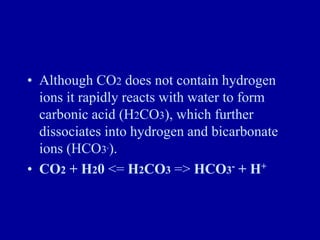
• Although CO2 does not contain hydrogen
ions it rapidly reacts with water to form
carbonic acid (H2CO3), which further
dissociates into hydrogen and bicarbonate
ions (HCO3-).
• CO2 + H20 <= H2CO3 => HCO3- + H+
• As enzymes have a huge number of
functions around the body, an abnormal pH
can result in disturbances in a wide range of
body systems.
• Thus, disturbances in pH may result in
abnormal respiratory and cardiac function,
derangements in blood clotting and drug
metabolism, to name but a few.
• The normal pH of systemic arterial blood is
7.35-7.45.
• pH is maintained by buffers. The important
buffer systems include proteins, carbonic
acid-bicarbonate buffers and phosphates.
• Homeostasis of pH is maintained by buffer
systems, via exhalation of carbon dioxide,
and via kidney excretion of H+ and
reabsorption of HCO3
- .
• The overall acid-base balance is maintained
by controlling the H+ conc. of body fluids,
especially ECF.
Control of Hydrogen Ion
Concentration
• With hydrogen ion concentration being so
critical to enzyme function, the body has
sophisticated mechanisms for ensuring pH
remains in the normal range.
• Three systems are involved: blood and
tissue buffering, excretion of CO2 by the
lungs and the renal excretion of H+ and
regeneration of HCO3-.
Buffers
• A buffer is a compound that limits the
change in hydrogen ion concentration (and
so pH) when hydrogen ions are added or
removed from the solution.
• It may be useful to think of the buffer as
being like a sponge.
• When hydrogen ions are in excess, the
sponge mops up the extra ions.
• When in short supply the sponge can be
squeezed out to release more hydrogen
ions!
• All buffers are in fact weak acids or bases
• Buffers are able to limit changes in hydrogen ion
concentration.
• This prevents the large quantities of hydrogen ions
produced by metabolism resulting in dangerous changes in
blood or tissue pH.
CHEMICAL BUFFERS
Bicarbonate
This is the most important buffer system in
the body. Although bicarbonate is not an
efficient buffer at physiological pH its
efficiency is improved because CO2 is
removed by the lungs and bicarbonate
regenerated by the kidney.
• There are other buffers that act in a similar
way to bicarbonate, for example: hydrogen
phosphate (HPO32-), however, these are
present in smaller concentrations in tissues
and plasma.
Proteins
• proteins, and notably albumin, contain weak
acidic and basic groups within their
structure. Therefore, plasma and other
proteins form important buffering systems.
• Intracellular proteins limit pH changes
within cells, whilst the protein matrix of
bone can buffer large amounts of hydrogen
ions in patients with chronic acidosis.
Haemoglobin
Haemoglobin (Hb) is not only important in
the carriage of oxygen to the tissues but also
in the transport of CO2 and in buffering
hydrogen ions
Haemoglobin binds both CO2 and H+ and so
is a powerful buffer
• Deoxygenated haemoglobin has the
strongest affinity for both CO2 and H+; thus,
its buffering effect is strongest in the
tissues.
• The buffering of hydrogen ions formed
from carbonic acid is more complicated
Physiological Buffer Systems
• Respiratory Buffer System
• Renal Mechanisms of Acid-Base Balance
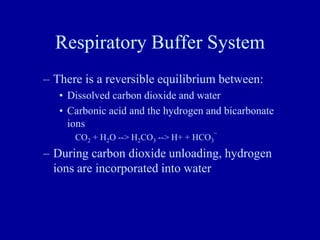
Respiratory Buffer System
– There is a reversible equilibrium between:
• Dissolved carbon dioxide and water
• Carbonic acid and the hydrogen and bicarbonate
ions
CO2 + H2O --> H2CO3 --> H+ + HCO3
¯
– During carbon dioxide unloading, hydrogen
ions are incorporated into water
– When hypercapnia or rising plasma H+ occurs:
• Deeper and more rapid breathing expels more
carbon dioxide
• Hydrogen ion concentration is reduced
– Alkalosis causes slower, more shallow
breathing, causing H+ to increase
– Respiratory system impairment causes acid-
base imbalance (respiratory acidosis or
respiratory alkalosis)
Renal Mechanisms of Acid-Base
Balance
• Introduction
• Reabsorption of Bicarbonate
• Hydrogen Ion Excretion
• Ammonium Ion (NH4
+) Excretion
Introduction
• Chemical buffers can tie up excess acids or bases,
but they cannot eliminate them from the body
• The lungs can eliminate carbonic acid by
eliminating carbon dioxide
• Only the kidneys can rid the body of metabolic acids
(phosphoric, uric, and lactic acids and ketones) and
prevent metabolic acidosis
• The ultimate acid-base regulatory organs are the
kidneys
• The most important renal mechanisms for regulating
acid-base balance are:
– Conserving (reabsorbing) or generating new bicarbonate
ions
– Excreting bicarbonate ions
• Losing a bicarbonate ion is the same as gaining a
hydrogen ion; reabsorbing a bicarbonate ion is
the same as losing a hydrogen ion
• Hydrogen ion secretion occurs in the PCT
• Hydrogen ions come from the dissociation of
carbonic acid
Reabsorption of Bicarbonate
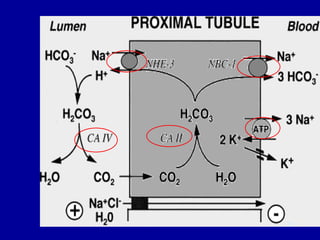
• CO2 combines with water in tubule cells, forming
H2CO3
• H2CO3 splits into H+ and HCO3
-
• For each H+ secreted, a Na+ and a HCO3
- are
reabsorbed by the PCT cells
• Secreted H+ form H2CO3; thus, HCO3
- disappears
from filtrate at the same rate that it enters the
peritubular capillary blood
.
29
• The sodium-hydrogen exchanger in the luminal
membrane(NHE3).
• The electrogenic sodium-bicarbonate
cotransporter(NBC-1)
• H2CO3 formed in filtrate dissociates to release CO2
+ H2O
• CO2 then diffuses into tubule cells, where it acts to
trigger further H+ secretion
Hydrogen Ion Excretion
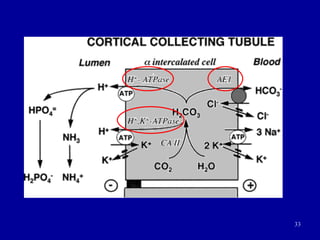
• Dietary H+ must be counteracted by generating new
HCO3
-
• The excreted H+ must bind to buffers in the urine
(phosphate buffer system)
• Intercalated cells actively secrete H+ into urine,
which is buffered and excreted
33
• HCO3
- generated is:
– Moved into the interstitial space via a cotransport system
– Passively moved into the peritubular capillary blood
• In response to acidosis:
– Kidneys generate HCO3
-and add them to the blood
– An equal amount of H+ are added to the urine
Ammonium Ion (NH4
+)
Excretion
• This method uses NH4
+ produced by the metabolism
of glutamine in PCT cells
• Each glutamine metabolized produces two
ammonium ions and two bicarbonate ions
• HCO3
- moves to the blood and ammonium ions are
excreted in urine
Ammonia Recycling
36
DISORDERS
• Respiratory Acidosis and Alkalosis
• Metabolic Acidosis
• Metabolic Alkalosis
Respiratory Acidosis and Alkalosis
• Result from failure of the respiratory system
to balance pH
• PCO2 is the single most important indicator
of respiratory inadequacy
• PCO2 levels - normal PCO2 fluctuates
between 35 and 45 mm Hg
– Values above 45 mm Hg signal respiratory
acidosis
– Values below 35 mm Hg indicate respiratory
alkalosis
• Respiratory acidosis is the most common
cause of acid-base imbalance
– Occurs when a person breathes shallowly, or
gas exchange is hampered by diseases such as
pneumonia, cystic fibrosis, or emphysema
• Respiratory alkalosis is a common result
of hyperventilation
Metabolic Acidosis
• All pH imbalances except those caused by
abnormal blood carbon dioxide levels
• Metabolic acid-base imbalance -
bicarbonate ion levels above or below
normal (22-26 mEq/L)
• Metabolic acidosis is second most common
cause of acid-base imbalance
– Typical causes are ingestion of too much
alcohol and excessive loss of bicarbonate ions
– Other causes include accumulation of lactic
acid, shock, ketosis in diabetic crisis, starvation,
and kidney failure
Metabolic Alkalosis
• Rising blood pH and bicarbonate levels
indicate metabolic alkalosis
• Typical causes are:
– Vomiting of the acid contents of the stomach
– Intake of excess base (e.g., from antacids)
– Constipation, in which excessive bicarbonate is
reabsorbed
Compensation
• maintenance of pH as near normal is vital,
therefore dysfunction in one system will
result in compensatory changes in the
others.
• The three mechanisms for compensation
mentioned earlier occur at different speeds
and remain effective for different periods.
• Rapid chemical buffering: this occurs almost
instantly but buffers are rapidly exhausted,
requiring the elimination of hydrogen ions to
remain effective.
• Respiratory compensation: the respiratory centre
in the brainstem responds rapidly to changes in
CSF pH. Thus, a change in plasma pH or PaCO2
results in a change in ventilation within minutes
• Renal compensation: the kidneys respond to
disturbances in acid base balance by
altering the amount of bicarbonate
reabsorbed and hydrogen ions excreted.
• However, it may take up to 2 days for
bicarbonate concentration to reach a new
equilibrium.
• These compensatory mechanisms are
efficient and often return the plasma pH to
near normal.
• However, it is uncommon for complete
compensation to occur and over
compensation does not occur
Thank you

Acid Base Balance.pdf

  • 1.
    ACID-BASE BALANCE IN HEALTHAND DISEASE BY DR O. M. AKINOSUN
  • 2.
    INTRODUCTION Acids: An acidis defined as any compound, which forms hydrogen ions in solution. For this reason acids are sometimes referred to as "proton donors". Bases: A base is a compound that combines with hydrogen ions in solution. Therefore, bases can be referred to as "proton acceptors".
  • 3.
    • Strong Acids:A strong acid is a compound that ionizes completely in solution to form hydrogen ions and a base. • Weak Acids and Bases: these are compounds that are only partially ionised in solution.
  • 4.
    The Hydrogen Ion •The hydrogen ion consists of a single positively charged particle (the proton) that is not orbited by any electrons. • The hydrogen ion is, therefore, the smallest ionic particle and is extremely reactive. • It is this fact that accounts for its profound effect on the functioning of biological systems at very low concentrations.
  • 5.
    The Importance ofHydrogen Ion Concentration • Hydrogen ion concentration has a widespread effect on the function of the body's enzyme systems. • The hydrogen ion is highly reactive and will combine with bases or negatively charged ions at very low concentrations.
  • 6.
    • Proteins containmany negatively charged and basic groups within their structure. Thus, a change in pH will alter the degree of ionization of a protein, which may in turn affect its functioning. • At more extreme hydrogen ion concentrations a protein's structure may be completely disrupted (denatured).
  • 7.
    Sources of HydrogenIons • - Most hydrogen ions originate from cellular metabolism – Breakdown of phosphorus-containing proteins releases phosphoric acid into the ECF – Anaerobic respiration of glucose produces lactic acid – Fat metabolism yields organic acids and ketone bodies – Transporting carbon dioxide as bicarbonate releases hydrogen ions
  • 8.
    • Acids orbases may also be ingested, however, it is uncommon for these to make a significant contribution to the body's hydrogen ion concentration, other than in deliberate overdose
  • 9.
    • Although CO2does not contain hydrogen ions it rapidly reacts with water to form carbonic acid (H2CO3), which further dissociates into hydrogen and bicarbonate ions (HCO3-). • CO2 + H20 <= H2CO3 => HCO3- + H+
  • 10.
    • As enzymeshave a huge number of functions around the body, an abnormal pH can result in disturbances in a wide range of body systems. • Thus, disturbances in pH may result in abnormal respiratory and cardiac function, derangements in blood clotting and drug metabolism, to name but a few.
  • 11.
    • The normalpH of systemic arterial blood is 7.35-7.45. • pH is maintained by buffers. The important buffer systems include proteins, carbonic acid-bicarbonate buffers and phosphates.
  • 12.
    • Homeostasis ofpH is maintained by buffer systems, via exhalation of carbon dioxide, and via kidney excretion of H+ and reabsorption of HCO3 - . • The overall acid-base balance is maintained by controlling the H+ conc. of body fluids, especially ECF.
  • 13.
    Control of HydrogenIon Concentration • With hydrogen ion concentration being so critical to enzyme function, the body has sophisticated mechanisms for ensuring pH remains in the normal range. • Three systems are involved: blood and tissue buffering, excretion of CO2 by the lungs and the renal excretion of H+ and regeneration of HCO3-.
  • 14.
    Buffers • A bufferis a compound that limits the change in hydrogen ion concentration (and so pH) when hydrogen ions are added or removed from the solution. • It may be useful to think of the buffer as being like a sponge.
  • 15.
    • When hydrogenions are in excess, the sponge mops up the extra ions. • When in short supply the sponge can be squeezed out to release more hydrogen ions! • All buffers are in fact weak acids or bases
  • 16.
    • Buffers areable to limit changes in hydrogen ion concentration. • This prevents the large quantities of hydrogen ions produced by metabolism resulting in dangerous changes in blood or tissue pH.
  • 17.
    CHEMICAL BUFFERS Bicarbonate This isthe most important buffer system in the body. Although bicarbonate is not an efficient buffer at physiological pH its efficiency is improved because CO2 is removed by the lungs and bicarbonate regenerated by the kidney.
  • 18.
    • There areother buffers that act in a similar way to bicarbonate, for example: hydrogen phosphate (HPO32-), however, these are present in smaller concentrations in tissues and plasma.
  • 19.
    Proteins • proteins, andnotably albumin, contain weak acidic and basic groups within their structure. Therefore, plasma and other proteins form important buffering systems. • Intracellular proteins limit pH changes within cells, whilst the protein matrix of bone can buffer large amounts of hydrogen ions in patients with chronic acidosis.
  • 20.
    Haemoglobin Haemoglobin (Hb) isnot only important in the carriage of oxygen to the tissues but also in the transport of CO2 and in buffering hydrogen ions Haemoglobin binds both CO2 and H+ and so is a powerful buffer
  • 21.
    • Deoxygenated haemoglobinhas the strongest affinity for both CO2 and H+; thus, its buffering effect is strongest in the tissues. • The buffering of hydrogen ions formed from carbonic acid is more complicated
  • 22.
    Physiological Buffer Systems •Respiratory Buffer System • Renal Mechanisms of Acid-Base Balance
  • 23.
    Respiratory Buffer System –There is a reversible equilibrium between: • Dissolved carbon dioxide and water • Carbonic acid and the hydrogen and bicarbonate ions CO2 + H2O --> H2CO3 --> H+ + HCO3 ¯ – During carbon dioxide unloading, hydrogen ions are incorporated into water
  • 24.
    – When hypercapniaor rising plasma H+ occurs: • Deeper and more rapid breathing expels more carbon dioxide • Hydrogen ion concentration is reduced – Alkalosis causes slower, more shallow breathing, causing H+ to increase – Respiratory system impairment causes acid- base imbalance (respiratory acidosis or respiratory alkalosis)
  • 25.
    Renal Mechanisms ofAcid-Base Balance • Introduction • Reabsorption of Bicarbonate • Hydrogen Ion Excretion • Ammonium Ion (NH4 +) Excretion
  • 26.
    Introduction • Chemical bufferscan tie up excess acids or bases, but they cannot eliminate them from the body • The lungs can eliminate carbonic acid by eliminating carbon dioxide • Only the kidneys can rid the body of metabolic acids (phosphoric, uric, and lactic acids and ketones) and prevent metabolic acidosis • The ultimate acid-base regulatory organs are the kidneys
  • 27.
    • The mostimportant renal mechanisms for regulating acid-base balance are: – Conserving (reabsorbing) or generating new bicarbonate ions – Excreting bicarbonate ions • Losing a bicarbonate ion is the same as gaining a hydrogen ion; reabsorbing a bicarbonate ion is the same as losing a hydrogen ion • Hydrogen ion secretion occurs in the PCT • Hydrogen ions come from the dissociation of carbonic acid
  • 28.
    Reabsorption of Bicarbonate •CO2 combines with water in tubule cells, forming H2CO3 • H2CO3 splits into H+ and HCO3 - • For each H+ secreted, a Na+ and a HCO3 - are reabsorbed by the PCT cells • Secreted H+ form H2CO3; thus, HCO3 - disappears from filtrate at the same rate that it enters the peritubular capillary blood
  • 29.
  • 30.
    • The sodium-hydrogenexchanger in the luminal membrane(NHE3). • The electrogenic sodium-bicarbonate cotransporter(NBC-1)
  • 31.
    • H2CO3 formedin filtrate dissociates to release CO2 + H2O • CO2 then diffuses into tubule cells, where it acts to trigger further H+ secretion
  • 32.
    Hydrogen Ion Excretion •Dietary H+ must be counteracted by generating new HCO3 - • The excreted H+ must bind to buffers in the urine (phosphate buffer system) • Intercalated cells actively secrete H+ into urine, which is buffered and excreted
  • 33.
  • 34.
    • HCO3 - generatedis: – Moved into the interstitial space via a cotransport system – Passively moved into the peritubular capillary blood • In response to acidosis: – Kidneys generate HCO3 -and add them to the blood – An equal amount of H+ are added to the urine
  • 35.
    Ammonium Ion (NH4 +) Excretion •This method uses NH4 + produced by the metabolism of glutamine in PCT cells • Each glutamine metabolized produces two ammonium ions and two bicarbonate ions • HCO3 - moves to the blood and ammonium ions are excreted in urine
  • 36.
  • 37.
    DISORDERS • Respiratory Acidosisand Alkalosis • Metabolic Acidosis • Metabolic Alkalosis
  • 38.
    Respiratory Acidosis andAlkalosis • Result from failure of the respiratory system to balance pH • PCO2 is the single most important indicator of respiratory inadequacy • PCO2 levels - normal PCO2 fluctuates between 35 and 45 mm Hg – Values above 45 mm Hg signal respiratory acidosis – Values below 35 mm Hg indicate respiratory alkalosis
  • 39.
    • Respiratory acidosisis the most common cause of acid-base imbalance – Occurs when a person breathes shallowly, or gas exchange is hampered by diseases such as pneumonia, cystic fibrosis, or emphysema • Respiratory alkalosis is a common result of hyperventilation
  • 40.
    Metabolic Acidosis • AllpH imbalances except those caused by abnormal blood carbon dioxide levels • Metabolic acid-base imbalance - bicarbonate ion levels above or below normal (22-26 mEq/L)
  • 41.
    • Metabolic acidosisis second most common cause of acid-base imbalance – Typical causes are ingestion of too much alcohol and excessive loss of bicarbonate ions – Other causes include accumulation of lactic acid, shock, ketosis in diabetic crisis, starvation, and kidney failure
  • 42.
    Metabolic Alkalosis • Risingblood pH and bicarbonate levels indicate metabolic alkalosis • Typical causes are: – Vomiting of the acid contents of the stomach – Intake of excess base (e.g., from antacids) – Constipation, in which excessive bicarbonate is reabsorbed
  • 43.
    Compensation • maintenance ofpH as near normal is vital, therefore dysfunction in one system will result in compensatory changes in the others. • The three mechanisms for compensation mentioned earlier occur at different speeds and remain effective for different periods.
  • 44.
    • Rapid chemicalbuffering: this occurs almost instantly but buffers are rapidly exhausted, requiring the elimination of hydrogen ions to remain effective. • Respiratory compensation: the respiratory centre in the brainstem responds rapidly to changes in CSF pH. Thus, a change in plasma pH or PaCO2 results in a change in ventilation within minutes
  • 45.
    • Renal compensation:the kidneys respond to disturbances in acid base balance by altering the amount of bicarbonate reabsorbed and hydrogen ions excreted. • However, it may take up to 2 days for bicarbonate concentration to reach a new equilibrium.
  • 46.
    • These compensatorymechanisms are efficient and often return the plasma pH to near normal. • However, it is uncommon for complete compensation to occur and over compensation does not occur
  • 47.