ATOMIC
ABSORPTION
SPECTROSCOPY
PRESENTED BY,
DEVIPRIYA P V
M PHARM
Department of Pharmaceutical Analysis
ATOMIC ABSORPTION
SPECTROSCOPY
“The absorption of specific wavelength of
radiation by neutral atoms in the ground state”.
2
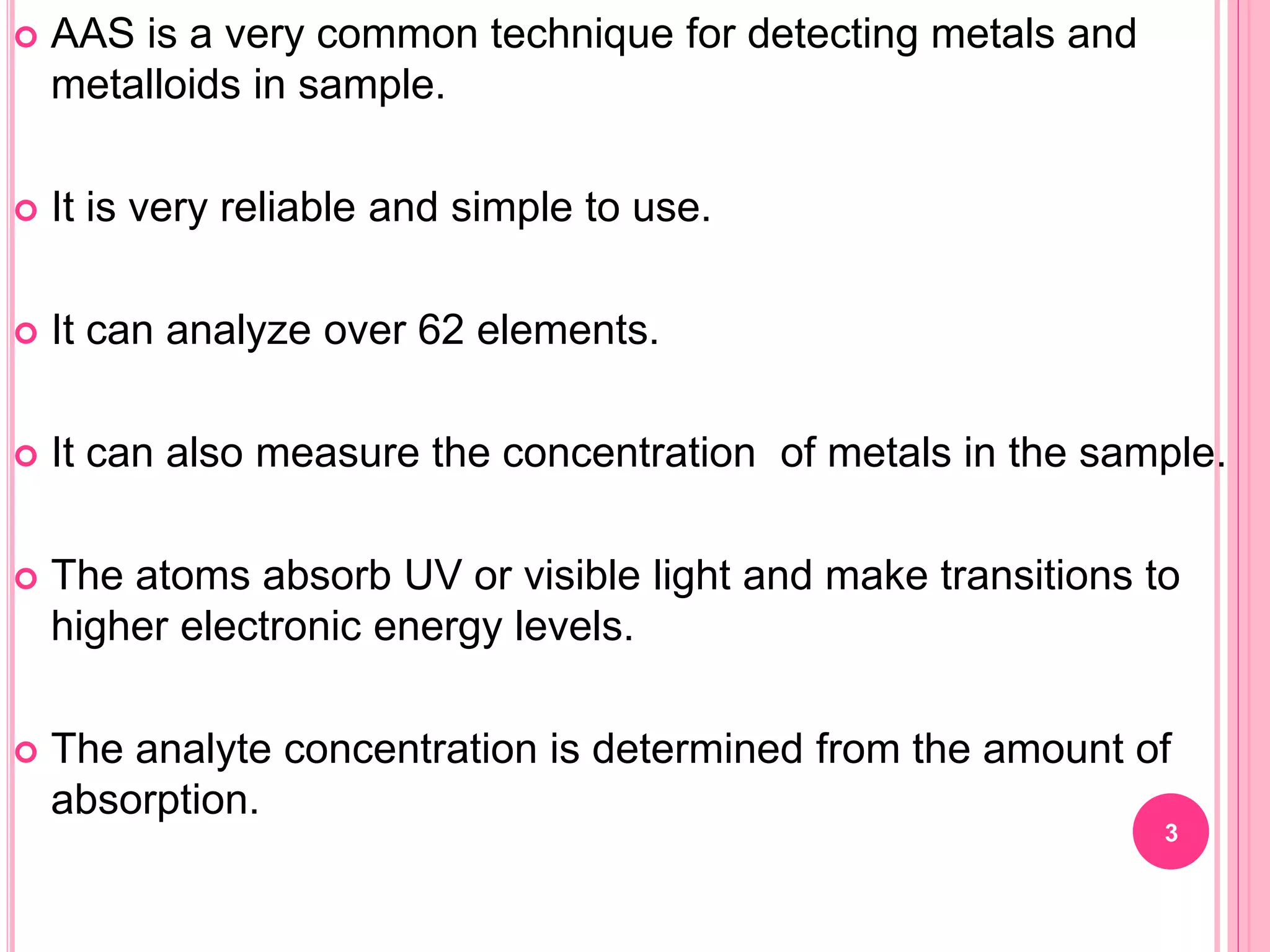
 AAS is a very common technique for detecting metals and
metalloids in sample.
 It is very reliable and simple to use.
 It can analyze over 62 elements.
 It can also measure the concentration of metals in the sample.
 The atoms absorb UV or visible light and make transitions to
higher electronic energy levels.
 The analyte concentration is determined from the amount of
absorption.
3
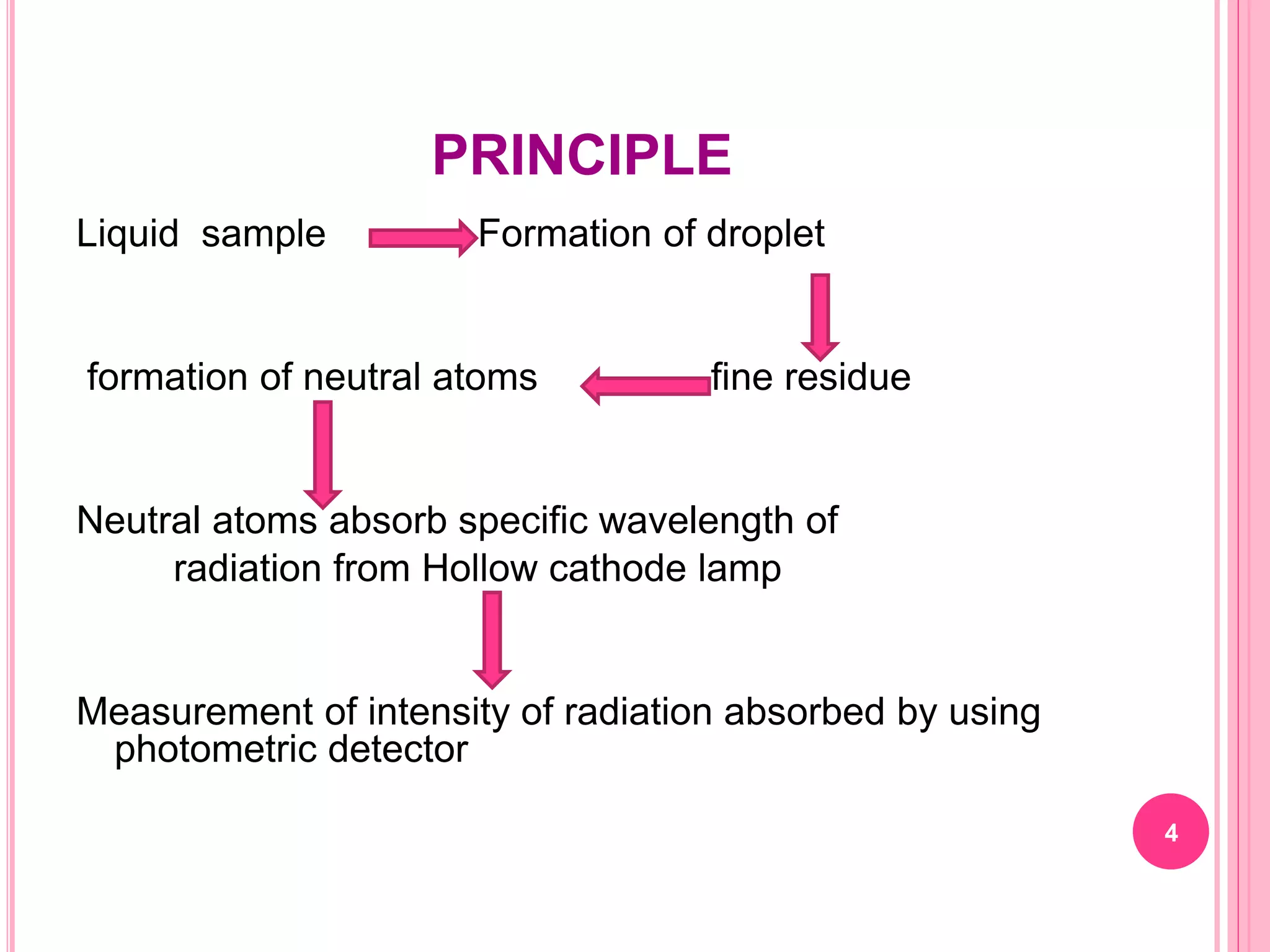
PRINCIPLE
Liquid sample Formation of droplet
formation of neutral atoms fine residue
Neutral atoms absorb specific wavelength of
radiation from Hollow cathode lamp
Measurement of intensity of radiation absorbed by using
photometric detector
4
INSTRUMENTATION
5
COMPONENTS OF AAS
 Radiation source
:Hollow cathode lamp
:Electrodeless discharge lamp
 Chopper
 Atomizers
:flame atomizer
:Non flame atomizer
 Nebulisation of the liquid sample
 Monochromator
 Detector
 Amplifier
 Read out device 6
HOLLOW CATHODE LAMP
 Source of light in AAS
 Tungsten anode.
 Hollow cylindrical cathode made of elements to be
determined
 These are sealed in a glass tube filled with inert gas
(Ne or Ar).
 Lamp window is constructed of either quartz, silica,
or glass.
7
8
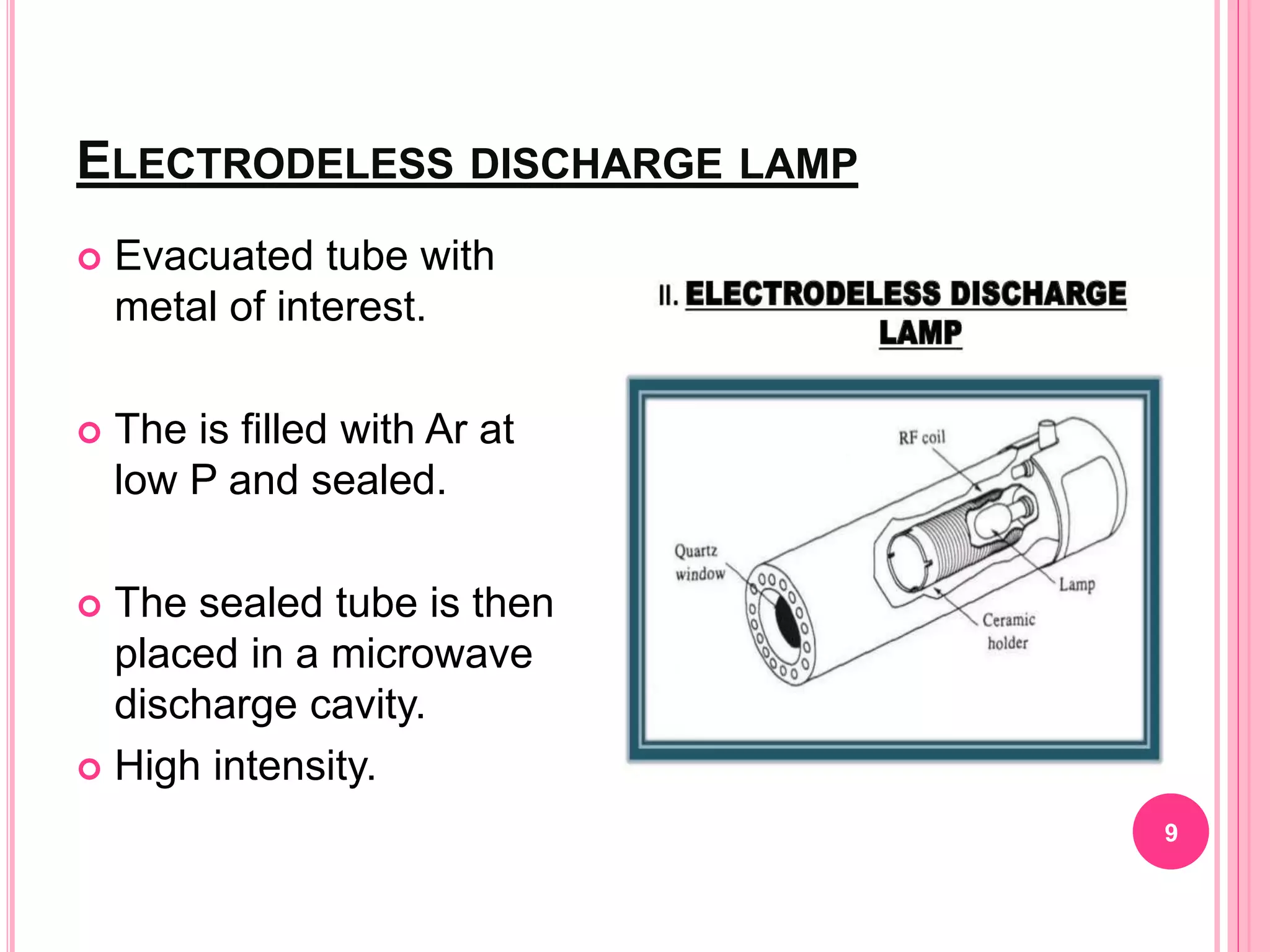
ELECTRODELESS DISCHARGE LAMP
 Evacuated tube with
metal of interest.
 The is filled with Ar at
low P and sealed.
 The sealed tube is then
placed in a microwave
discharge cavity.
 High intensity.
9
CHOPPER
 Rotating wheel interposed between the hollow
cathode lamp and the flame.
 Produces pulsating current which is amplified and
recorded
10
ATOMIZERS
 Elements to be analyzed needs to be in the atomic
state
 Flame atomizer: total consumption burner
:premixed burner
11
 Mixing of gas and sample
within the flame.
 Flame is hot enough for
molecular dissociations
needed.
 Rate of sample
introduction depends on
viscosity.
 No explosive hazards.
 Consume entire sample.
 Gases are mixed and
sample is atomized
before burned.
 Uniformity of flame
 Less tendency to clog.
 Quiet operation.
 Possibility of explosion
in the mixing chamber.
Total consumption burner Premixed burner
12
MONOCHROMATOR
 Prisms and gratings
 To select a given absorbing line from spectral line
emitted from HCL
 Good resolution of 1nm or less is used.
13
14
DETECTOR
 Photomultiplier tubes.
 Convert radiant energy into an electrical signal.
 Evacuated envelope with a
: photocathode
: a series of electrodes called dynodes
: anode
 Photocathode is fixed to the terminal of power
supply.
15
16
AMPLIFIER
 Lock-in amplifiers are preferred.
READ OUT DEVICES:
Chart recorders or digital devices are used. 17
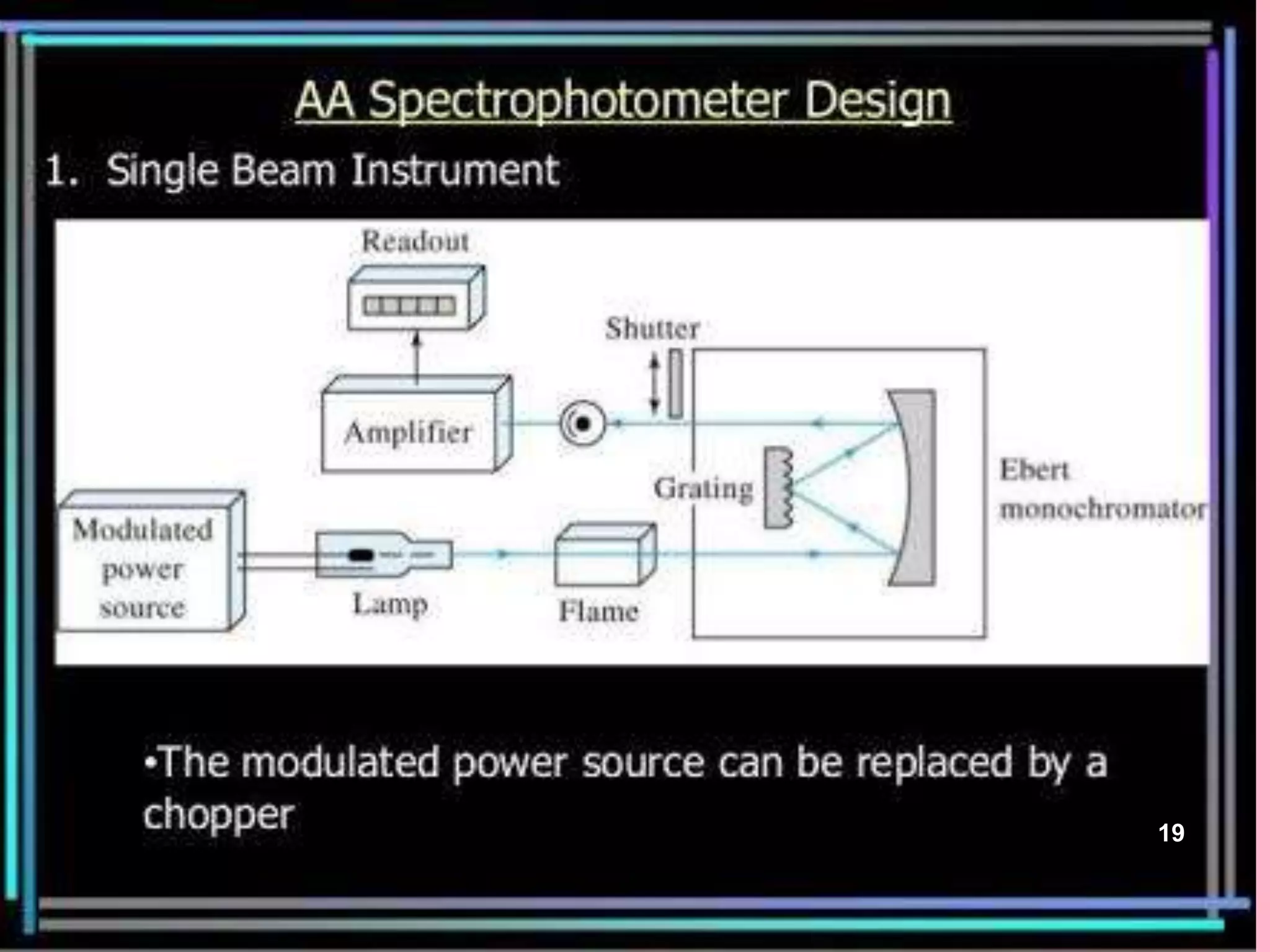
SINGLE BEAM AAS
 All measurements are based on the varying
intensity of a single beam of light in a single optical
path.
 It consists of several hollow cathode sources, a
chopper or a pulsed power supply, an atomizer, and
a simple grating spectrophotometer with a
photomultiplier transducer.
 Blank is replaced by sample.
 Low stability. 18
19
DOUBLE BEAM INSTRUMENT
 The beam from the HCL is split by a mirror
chopper, one half passing through the flame and
the half around it.
 Sample beam : focused to sample cell
 Reference beam : focused around the sample cell.
 The 2 beams are then recombined .
20
21
22

Atomic absorption spectroscopy

  • 1.
    ATOMIC ABSORPTION SPECTROSCOPY PRESENTED BY, DEVIPRIYA PV M PHARM Department of Pharmaceutical Analysis
  • 2.
    ATOMIC ABSORPTION SPECTROSCOPY “The absorptionof specific wavelength of radiation by neutral atoms in the ground state”. 2
  • 3.
     AAS isa very common technique for detecting metals and metalloids in sample.  It is very reliable and simple to use.  It can analyze over 62 elements.  It can also measure the concentration of metals in the sample.  The atoms absorb UV or visible light and make transitions to higher electronic energy levels.  The analyte concentration is determined from the amount of absorption. 3
  • 4.
    PRINCIPLE Liquid sample Formationof droplet formation of neutral atoms fine residue Neutral atoms absorb specific wavelength of radiation from Hollow cathode lamp Measurement of intensity of radiation absorbed by using photometric detector 4
  • 5.
  • 6.
    COMPONENTS OF AAS Radiation source :Hollow cathode lamp :Electrodeless discharge lamp  Chopper  Atomizers :flame atomizer :Non flame atomizer  Nebulisation of the liquid sample  Monochromator  Detector  Amplifier  Read out device 6
  • 7.
    HOLLOW CATHODE LAMP Source of light in AAS  Tungsten anode.  Hollow cylindrical cathode made of elements to be determined  These are sealed in a glass tube filled with inert gas (Ne or Ar).  Lamp window is constructed of either quartz, silica, or glass. 7
  • 8.
  • 9.
    ELECTRODELESS DISCHARGE LAMP Evacuated tube with metal of interest.  The is filled with Ar at low P and sealed.  The sealed tube is then placed in a microwave discharge cavity.  High intensity. 9
  • 10.
    CHOPPER  Rotating wheelinterposed between the hollow cathode lamp and the flame.  Produces pulsating current which is amplified and recorded 10
  • 11.
    ATOMIZERS  Elements tobe analyzed needs to be in the atomic state  Flame atomizer: total consumption burner :premixed burner 11
  • 12.
     Mixing ofgas and sample within the flame.  Flame is hot enough for molecular dissociations needed.  Rate of sample introduction depends on viscosity.  No explosive hazards.  Consume entire sample.  Gases are mixed and sample is atomized before burned.  Uniformity of flame  Less tendency to clog.  Quiet operation.  Possibility of explosion in the mixing chamber. Total consumption burner Premixed burner 12
  • 13.
    MONOCHROMATOR  Prisms andgratings  To select a given absorbing line from spectral line emitted from HCL  Good resolution of 1nm or less is used. 13
  • 14.
  • 15.
    DETECTOR  Photomultiplier tubes. Convert radiant energy into an electrical signal.  Evacuated envelope with a : photocathode : a series of electrodes called dynodes : anode  Photocathode is fixed to the terminal of power supply. 15
  • 16.
  • 17.
    AMPLIFIER  Lock-in amplifiersare preferred. READ OUT DEVICES: Chart recorders or digital devices are used. 17
  • 18.
    SINGLE BEAM AAS All measurements are based on the varying intensity of a single beam of light in a single optical path.  It consists of several hollow cathode sources, a chopper or a pulsed power supply, an atomizer, and a simple grating spectrophotometer with a photomultiplier transducer.  Blank is replaced by sample.  Low stability. 18
  • 19.
  • 20.
    DOUBLE BEAM INSTRUMENT The beam from the HCL is split by a mirror chopper, one half passing through the flame and the half around it.  Sample beam : focused to sample cell  Reference beam : focused around the sample cell.  The 2 beams are then recombined . 20
  • 21.
  • 22.