FACTORS INFLUENCING
CHEMICAL SHIFT
Presented by: B.Kavita
Under the guidance of
Dr.K.Shanta Kumari, M.Pharm,Ph.D
The shifts in the positions of NMR signals
resulting from the Shielding / Deshielding by the
Electrons is called as “CHEMICAL SHIFTS”
As the shift is due to difference in the
chemical environment ,it is known as chemical
shift.
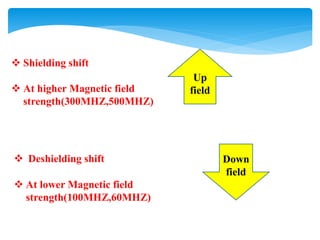
 Shielding shift
 At higher Magnetic field
strength(300MHZ,500MHZ)
Up
field
 Deshielding shift
 At lower Magnetic field
strength(100MHZ,60MHZ)
Down
field
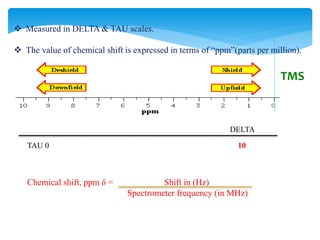
10
TMS
 Measured in DELTA & TAU scales.
 The value of chemical shift is expressed in terms of “ppm”(parts per million).
DELTA
TAU 0
Chemical shift, ppm δ = Shift in (Hz)
Spectrometer frequency (in MHz)
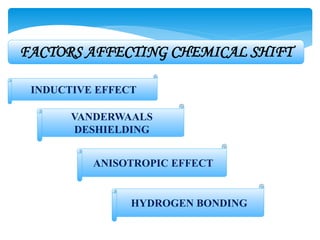
FACTORS AFFECTING CHEMICAL SHIFT
INDUCTIVE EFFECT
VANDERWAALS
DESHIELDING
ANISOTROPIC EFFECT
HYDROGEN BONDING
INDUCTIVE EFFECT
 Greater the electronegativity.
 Greater is the deshielding.
 Delta value will be more.
VANDERWAALS DESHIELDING
 The Electron cloud of the bulky group will tend to
repel,the electron cloud (in over crowded molecules)
surrounding the proton , & the proton is deshielded .
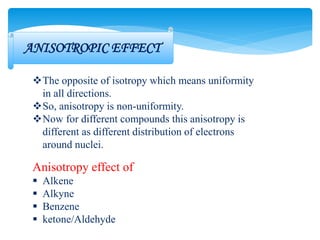
ANISOTROPIC EFFECT
The opposite of isotropy which means uniformity
in all directions.
So, anisotropy is non-uniformity.
Now for different compounds this anisotropy is
different as different distribution of electrons
around nuclei.
Anisotropy effect of
 Alkene
 Alkyne
 Benzene
 ketone/Aldehyde
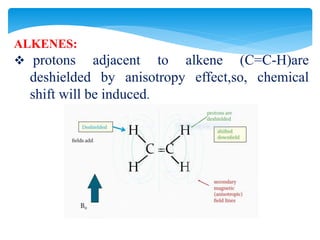
ALKENES:
 protons adjacent to alkene (C=C-H)are
deshielded by anisotropy effect,so, chemical
shift will be induced.
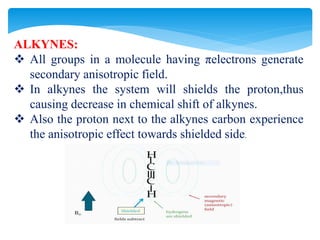
ALKYNES:
 All groups in a molecule having πelectrons generate
secondary anisotropic field.
 In alkynes the system will shields the proton,thus
causing decrease in chemical shift of alkynes.
 Also the proton next to the alkynes carbon experience
the anisotropic effect towards shielded side.
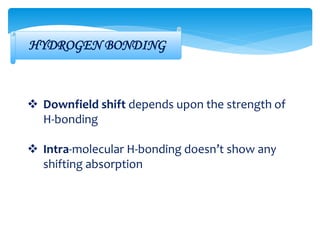
HYDROGEN BONDING
 Downfield shift depends upon the strength of
H-bonding
 Intra-molecular H-bonding doesn’t show any
shifting absorption
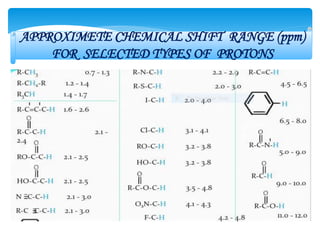
APPROXIMETE CHEMICAL SHIFT RANGE (ppm)
FOR SELECTED TYPES OF PROTONS
REFERENCE
 Organic spectroscopy by WILLIAM KEMP.
 Spectroscopy by SILVERSTEIN.
 Instrumental methods of chemical analysis by
GURUDEEP R.CHARWAL.
 Introduction to spectroscopy by DONALD L .
PAVIA.
Factors influencing chemical shift

Factors influencing chemical shift

  • 1.
    FACTORS INFLUENCING CHEMICAL SHIFT Presentedby: B.Kavita Under the guidance of Dr.K.Shanta Kumari, M.Pharm,Ph.D
  • 2.
    The shifts inthe positions of NMR signals resulting from the Shielding / Deshielding by the Electrons is called as “CHEMICAL SHIFTS” As the shift is due to difference in the chemical environment ,it is known as chemical shift.
  • 3.
     Shielding shift At higher Magnetic field strength(300MHZ,500MHZ) Up field  Deshielding shift  At lower Magnetic field strength(100MHZ,60MHZ) Down field
  • 4.
    10 TMS  Measured inDELTA & TAU scales.  The value of chemical shift is expressed in terms of “ppm”(parts per million). DELTA TAU 0 Chemical shift, ppm δ = Shift in (Hz) Spectrometer frequency (in MHz)
  • 5.
    FACTORS AFFECTING CHEMICALSHIFT INDUCTIVE EFFECT VANDERWAALS DESHIELDING ANISOTROPIC EFFECT HYDROGEN BONDING
  • 6.
    INDUCTIVE EFFECT  Greaterthe electronegativity.  Greater is the deshielding.  Delta value will be more.
  • 7.
    VANDERWAALS DESHIELDING  TheElectron cloud of the bulky group will tend to repel,the electron cloud (in over crowded molecules) surrounding the proton , & the proton is deshielded .
  • 8.
    ANISOTROPIC EFFECT The oppositeof isotropy which means uniformity in all directions. So, anisotropy is non-uniformity. Now for different compounds this anisotropy is different as different distribution of electrons around nuclei. Anisotropy effect of  Alkene  Alkyne  Benzene  ketone/Aldehyde
  • 9.
    ALKENES:  protons adjacentto alkene (C=C-H)are deshielded by anisotropy effect,so, chemical shift will be induced.
  • 10.
    ALKYNES:  All groupsin a molecule having πelectrons generate secondary anisotropic field.  In alkynes the system will shields the proton,thus causing decrease in chemical shift of alkynes.  Also the proton next to the alkynes carbon experience the anisotropic effect towards shielded side.
  • 11.
    HYDROGEN BONDING  Downfieldshift depends upon the strength of H-bonding  Intra-molecular H-bonding doesn’t show any shifting absorption
  • 12.
    APPROXIMETE CHEMICAL SHIFTRANGE (ppm) FOR SELECTED TYPES OF PROTONS
  • 13.
    REFERENCE  Organic spectroscopyby WILLIAM KEMP.  Spectroscopy by SILVERSTEIN.  Instrumental methods of chemical analysis by GURUDEEP R.CHARWAL.  Introduction to spectroscopy by DONALD L . PAVIA.