Atomic Absorption of
Spectrophotometry
Introduction.
History.
Definition.
Principal‘s.
Instrumentation.
Application.
Atomic absorption Spectroscopy is a very common technique for detecting metals and
metalloids in samples.
It is very simple and reliable to use.
Atomic absorption spectroscopy is based on absorption of light by free metallic ions.
It also measure the concentration of metals in the samples.
It can analyze over 62 elements.
History
 In 1953 Australian physicist Sir Alan Walsh and their co-workers demonstrated that
atomic absorption could be used as a quantitative analytical tool.
 Sir Alan Walsh (19 December 1916 – 3 August 1998) was a British-Australian
physicist, originator and developer of a method of chemical analysis called atomic
absorption spectroscopy.
 The underlying principles were established in the second half of the 19th century
by Robert Wilhelm Bunsen and Gustav Robert Kirchhoff, both professors at
the University of Heidelberg, Germany.
Elements in Periodic Table
Elements predictable by Atomic absorption are highlighted in Pink
in this periodic table.
Definition
 Atomic absorption spectroscopy (AAS) is a spectroanalytical procedure for the
quantitative determination of chemical elements using the absorption of optical
radiation (light) by free atoms in the gaseous state.
 Atomic absorption spectroscopy is based on absorption of light by free metallic
ions.
 In analytical chemistry the technique is used for determining the concentration of
a particular element (the analyte) in a sample to be analyzed.
Principles
A liquid sample is allowed to convert into free atoms (desolated and atomized).
 These free atoms absorb the light of a specific wavelength.
The remaining unabsorbed light is detected and recorded.
The intensity of absorption is directly proportional to the concentration of the
sample.
The technique uses basically principle that free atoms (gas) generated in an
atomizer can absorb radiation at specific frequency.
Instrumentation
 The Atomic absorption spectroscopy has simple instrumentation.
 It has two additional requirements.
 These include:
1. A specially designed lamp to produce light of a desired
wavelength
2. A burner to prepare the sample for absorption of light
radiation.
Continue….
 The Instrumentation includes:
1. The atomizer (burner) to dry the sample and produce atoms.
2. Sample container.
3. Fuel and oxidant to burn the sample by heat.
4. Hollow cathode lamp to produce light of the desired wavelength.
5. Detector to detect the absorption intensity.
6. Amplifier and data recorder.
The instrument is available as single and double beam instruments.
Continue…..
Continue…..
 Light source:
o The light source should produce a narrow spectrum with little background noise.
 1. Hollow cathode lamp:
o Most widely used as a light source.
o Inside the lamp, the cathode is coated with a metal of analyte to be analyzed.
o For instance, if magnesium is to be analyzed from the sample, a cathode coated
with magnesium is used.
o Similarly, for all the other elements like Na, Ca, K, Zn, etc. analysis respective
metal coated cathodes are used in the lamp.
Continue…..
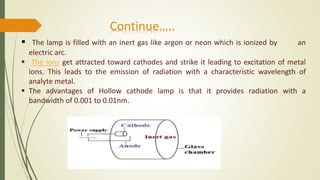
 The lamp is filled with an inert gas like argon or neon which is ionized by an
electric arc.
 The ions get attracted toward cathodes and strike it leading to excitation of metal
ions. This leads to the emission of radiation with a characteristic wavelength of
analyte metal.
 The advantages of Hollow cathode lamp is that it provides radiation with a
bandwidth of 0.001 to 0.01nm.
Continue…
 Sample container:
o This is a beaker-like a container of the sample which is placed below the burner
preferably.
o A capillary tube drains the sample to the tip of the burner.
 The burner (atomizer):
o Here the sample from the capillary rises to the tip of the burner. Here it is burned
with the flame.
o This flame is produced by a fuel and oxidant combination. The sample after
evaporation leaves a fine residue of neutral atoms.
 Fuel and oxidant:
o Commonly used flues include propane, Hydrogen, and acetylene and
oxidants are mostly air or oxygen.
Continue….
 Monochromator:
o We need to isolate the desired spectral line for the measurement of absorption.
o To achieve this a monochromator which can filter and provide a resolution of <1nm
is employed.
 Detector:
o This part of the instrument detects the intensity of radiation absorbed by the
elements. The detector consists of a photomultiplier tube or simple photocell.
o The current or potential recorded for the sample absorption is recorded in
computer software and then analyzed.
 Read device:
o This can be a display computer.
o It displays the absorbance at a specific wavelength.
Atomic absorption Spectroscopy
Procedure
 Based on the metal of analysis a suitable cathode lamp is selected.
 The sample is dissolved in a polar solvent is placed in the container.
 With the help of fuel and oxidant in the presence of a mixer, the sample
solution is sprayed on to the flame.
 The neutral atoms in the flame absorb light radiation from the cathode
lamp. The unabsorbed radiation is recorded by the detector.
Application‘s
 There are many applications of atomic absorption spectroscopy (AAS)
due to its specificity.
 Atomic spectroscopy is used for quantitative analysis of metal
elements in water, soil, plant material and ceramics.
 In health care, it is used to analyze ionic metal elements in blood,
saliva, urine samples.
 The elements analyzed routinely include sodium, potassium,
magnesium, calcium and zinc.
 To determine heavy metals like iron, manganese, copper, zinc,
mercury, lead, nickel, and in urine and blood.
.
Continue…
 This analysis is essential in case of heavy metal poisoning.
 Since heavy metal poisoning is mostly lethal a regular monitoring of
poison levels in the patient blood are essential.
 To determine metal elements like copper, nickel and zinc in
the food industry.
 To estimate Lead in petroleum products.
 To determine metal concentrations in groundwater and bore well
samplings before using for drinking and irrigation.
Presentation biological techinque   copy

Presentation biological techinque copy

  • 2.
  • 3.
  • 4.
    Atomic absorption Spectroscopyis a very common technique for detecting metals and metalloids in samples. It is very simple and reliable to use. Atomic absorption spectroscopy is based on absorption of light by free metallic ions. It also measure the concentration of metals in the samples. It can analyze over 62 elements.
  • 5.
    History  In 1953Australian physicist Sir Alan Walsh and their co-workers demonstrated that atomic absorption could be used as a quantitative analytical tool.  Sir Alan Walsh (19 December 1916 – 3 August 1998) was a British-Australian physicist, originator and developer of a method of chemical analysis called atomic absorption spectroscopy.  The underlying principles were established in the second half of the 19th century by Robert Wilhelm Bunsen and Gustav Robert Kirchhoff, both professors at the University of Heidelberg, Germany.
  • 6.
    Elements in PeriodicTable Elements predictable by Atomic absorption are highlighted in Pink in this periodic table.
  • 7.
    Definition  Atomic absorptionspectroscopy (AAS) is a spectroanalytical procedure for the quantitative determination of chemical elements using the absorption of optical radiation (light) by free atoms in the gaseous state.  Atomic absorption spectroscopy is based on absorption of light by free metallic ions.  In analytical chemistry the technique is used for determining the concentration of a particular element (the analyte) in a sample to be analyzed.
  • 8.
    Principles A liquid sampleis allowed to convert into free atoms (desolated and atomized).  These free atoms absorb the light of a specific wavelength. The remaining unabsorbed light is detected and recorded. The intensity of absorption is directly proportional to the concentration of the sample. The technique uses basically principle that free atoms (gas) generated in an atomizer can absorb radiation at specific frequency.
  • 9.
    Instrumentation  The Atomicabsorption spectroscopy has simple instrumentation.  It has two additional requirements.  These include: 1. A specially designed lamp to produce light of a desired wavelength 2. A burner to prepare the sample for absorption of light radiation.
  • 10.
    Continue….  The Instrumentationincludes: 1. The atomizer (burner) to dry the sample and produce atoms. 2. Sample container. 3. Fuel and oxidant to burn the sample by heat. 4. Hollow cathode lamp to produce light of the desired wavelength. 5. Detector to detect the absorption intensity. 6. Amplifier and data recorder.
  • 11.
    The instrument isavailable as single and double beam instruments. Continue…..
  • 12.
    Continue…..  Light source: oThe light source should produce a narrow spectrum with little background noise.  1. Hollow cathode lamp: o Most widely used as a light source. o Inside the lamp, the cathode is coated with a metal of analyte to be analyzed. o For instance, if magnesium is to be analyzed from the sample, a cathode coated with magnesium is used. o Similarly, for all the other elements like Na, Ca, K, Zn, etc. analysis respective metal coated cathodes are used in the lamp.
  • 13.
    Continue…..  The lampis filled with an inert gas like argon or neon which is ionized by an electric arc.  The ions get attracted toward cathodes and strike it leading to excitation of metal ions. This leads to the emission of radiation with a characteristic wavelength of analyte metal.  The advantages of Hollow cathode lamp is that it provides radiation with a bandwidth of 0.001 to 0.01nm.
  • 14.
    Continue…  Sample container: oThis is a beaker-like a container of the sample which is placed below the burner preferably. o A capillary tube drains the sample to the tip of the burner.  The burner (atomizer): o Here the sample from the capillary rises to the tip of the burner. Here it is burned with the flame. o This flame is produced by a fuel and oxidant combination. The sample after evaporation leaves a fine residue of neutral atoms.  Fuel and oxidant: o Commonly used flues include propane, Hydrogen, and acetylene and oxidants are mostly air or oxygen.
  • 15.
    Continue….  Monochromator: o Weneed to isolate the desired spectral line for the measurement of absorption. o To achieve this a monochromator which can filter and provide a resolution of <1nm is employed.  Detector: o This part of the instrument detects the intensity of radiation absorbed by the elements. The detector consists of a photomultiplier tube or simple photocell. o The current or potential recorded for the sample absorption is recorded in computer software and then analyzed.  Read device: o This can be a display computer. o It displays the absorbance at a specific wavelength.
  • 16.
    Atomic absorption Spectroscopy Procedure Based on the metal of analysis a suitable cathode lamp is selected.  The sample is dissolved in a polar solvent is placed in the container.  With the help of fuel and oxidant in the presence of a mixer, the sample solution is sprayed on to the flame.  The neutral atoms in the flame absorb light radiation from the cathode lamp. The unabsorbed radiation is recorded by the detector.
  • 17.
    Application‘s  There aremany applications of atomic absorption spectroscopy (AAS) due to its specificity.  Atomic spectroscopy is used for quantitative analysis of metal elements in water, soil, plant material and ceramics.  In health care, it is used to analyze ionic metal elements in blood, saliva, urine samples.  The elements analyzed routinely include sodium, potassium, magnesium, calcium and zinc.  To determine heavy metals like iron, manganese, copper, zinc, mercury, lead, nickel, and in urine and blood. .
  • 18.
    Continue…  This analysisis essential in case of heavy metal poisoning.  Since heavy metal poisoning is mostly lethal a regular monitoring of poison levels in the patient blood are essential.  To determine metal elements like copper, nickel and zinc in the food industry.  To estimate Lead in petroleum products.  To determine metal concentrations in groundwater and bore well samplings before using for drinking and irrigation.