ULTRA PERFORMANCE LIQUID 
CHROMATOGRAPHY (UPLC) 
` 
Prepared by 
Mr. MANOJ R. INGALE 
M.Pharm . 
Department of Quality Assurance Technique. 
Sinhgad Technical Education Society’s 
SINHGAD INSTITUTE OF PHARMACY 
Narhe, Pune - 411041
CONTENT OF PRESENTATION 
Introduction 
Principle 
Chemistry of small particle 
Comparison between HPLC and UPLC 
Instrumentation 
Advantages 
Disadvantages 
Advancements in UPLC 
Summary 
References 
2 7-Dec-14
INTRODUCTION 
Chromatography- 
Separation technique involving mass transfer between 
stationary and mobile phase. 
In Greek chromo meaning “color”, Graphic meaning 
“writing”. 
Since the 1970’s chromatographers have been limited to LC 
systems that were capable of operating at maximum 
operating system pressure of only 6000 psi (400bar). 
3 7-Dec-14
Continue.. 
This pressure limitation coupled with large system 
volumes & slow data acquisition rates hindered the 
ability of separation scientist to fully realize speed & 
efficiencies. 
4 7-Dec-14
INTRODUCTION TO UPLC 
Ultra Performance Liquid Chromatography or 
Ultra Pressure Liquid chromatography. 
It improves in three areas: 
 Resolution, 
 Speed, 
 Sensitivity. 
It can withstand high system back-pressure. 
Special analytical columns UPLC BEH C18 packed with 
1.7μm particles are used in connection with system. 
5 7-Dec-14
Continue.. 
The factor responsible for development of UPLC technique 
was evolution of packing material used to effect the 
separation. 
The technology takes full advantage of chromatographic 
principles to run separations using columns packed with 
smaller particles. 
It decreases analysis time and solvent consumption. 
6 7-Dec-14
PRINCIPLE 
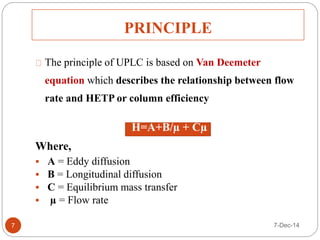
The principle of UPLC is based on Van Deemeter 
equation which describes the relationship between flow 
rate and HETP or column efficiency 
H=A+B/μ + Cμ 
Where, 
 A = Eddy diffusion 
 B = Longitudinal diffusion 
 C = Equilibrium mass transfer 
 μ = Flow rate 
7 7-Dec-14
Continue.. 
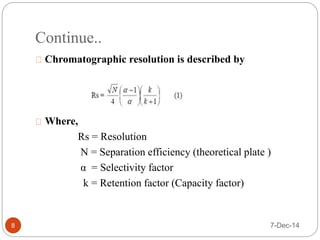
Chromatographic resolution is described by 
Where, 
Rs = Resolution 
N = Separation efficiency (theoretical plate ) 
α = Selectivity factor 
k = Retention factor (Capacity factor) 
8 7-Dec-14
Continue.. 
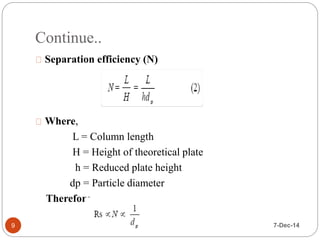
Separation efficiency (N) 
Where, 
L = Column length 
H = Height of theoretical plate 
h = Reduced plate height 
dp = Particle diameter 
Therefore, 
9 7-Dec-14
CHEMISTRY OF SMALL PARTICLES 
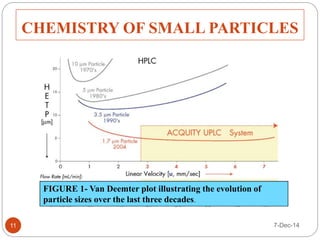
As the particle size decreases to less than 2.5μm, not only 
there is significant gain in efficiency, but the efficiency 
doesn't diminish at increased flow rates. 
By using smaller particles, speed and peak capacity 
(number of peaks resolved per unit time in gradient 
separation) can be extended to new limits, termed ultra 
performance liquid chromatography. 
10 7-Dec-14
CHEMISTRY OF SMALL PARTICLES 
FIGURE 1- Van Deemter plot illustrating the evolution of 
particle sizes over the last three decades. 
11 7-Dec-14
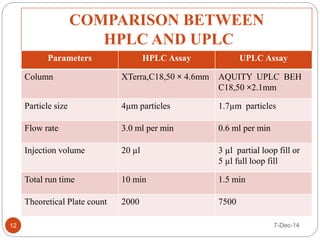
COMPARISON BETWEEN 
HPLC AND UPLC 
Parameters HPLC Assay UPLC Assay 
Column XTerra,C18,50 × 4.6mm AQUITY UPLC BEH 
C18,50 ×2.1mm 
Particle size 4μm particles 1.7μm particles 
Flow rate 3.0 ml per min 0.6 ml per min 
Injection volume 20 μl 3 μl partial loop fill or 
5 μl full loop fill 
Total run time 10 min 1.5 min 
Theoretical Plate count 2000 7500 
12 7-Dec-14
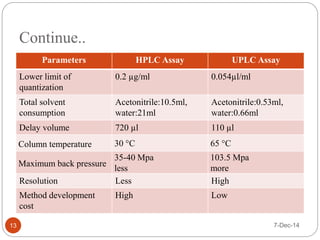
Continue.. 
Parameters HPLC Assay UPLC Assay 
Lower limit of 
quantization 
0.2 μg/ml 0.054μl/ml 
Total solvent 
consumption 
Acetonitrile:10.5ml, 
water:21ml 
Acetonitrile:0.53ml, 
water:0.66ml 
Delay volume 720 μl 110 μl 
Column temperature 30 °C 65 °C 
Maximum back pressure 
35-40 Mpa 
less 
103.5 Mpa 
more 
Resolution Less High 
Method development 
High Low 
cost 
13 7-Dec-14
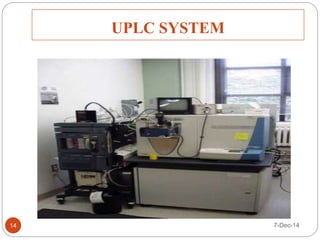
UPLC SYSTEM 
14 7-Dec-14
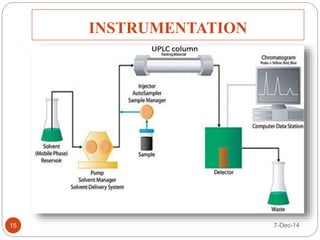
INSTRUMENTATION 
15 7-Dec-14
Continue.. 
A completely new system design with advanced 
technology in the pump, auto sampler, detector, data 
system, and service diagnostics was required. 
The ACQUITY UPLC system has been designed for low 
system and dwell volume. 
Achieving small particle, high peak capacity separations 
requires a greater pressure range than that achievable by 
HPLC system. 
16 7-Dec-14
SYSTEM COMPONENTS 
 Solvent reservoirs 
Auto sampler 
Van guard column 
Tubing's 
Column 
 Detectors 
17 7-Dec-14
UPLC COLUMN 
To maintain retention and capacity similar to the 
HPLC,UPLC uses novel porous particles that can 
withstand high pressure. 
Xterra TM :- 
 First generation technology 
 Introduced by Waters in year 2000. 
 Have high efficiency and operates over extended pH 
range. 
 They produced by incorporating carbon in the form of 
methyl groups. 
18 7-Dec-14
Continue.. 
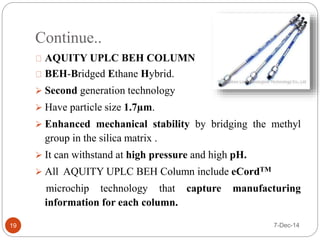
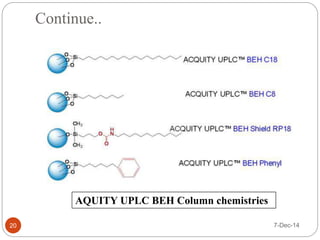
AQUITY UPLC BEH COLUMN 
BEH-Bridged Ethane Hybrid. 
 Second generation technology 
 Have particle size 1.7μm. 
 Enhanced mechanical stability by bridging the methyl 
group in the silica matrix . 
 It can withstand at high pressure and high pH. 
 All AQUITY UPLC BEH Column include eCordTM 
microchip technology that capture manufacturing 
information for each column. 
19 7-Dec-14
Continue.. 
AQUITY UPLC BEH Column chemistries 
20 7-Dec-14
PUMPS 
Pumps are capable of delivering solvent smoothly and 
reproducibly. 
Calculated pressure drop at optimum flow rate for 
maximum efficiency across the 15cm long column packed 
with 1.7μm particle is approximately 15000 psi. 
21 7-Dec-14
DETECTORS 
1. UV detectors 
2. Fluorescent detector 
3. Refractive index detector 
4. Light scattering detector 
5. Electrochemical detector 
6. Mass spectrometric detector 
22 7-Dec-14
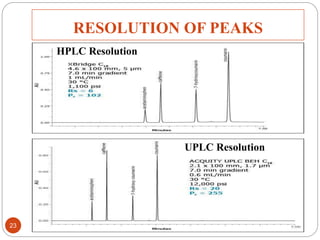
RESOLUTION OF PEAKS 
HPLC Resolution 
UPLC Resolution 
23 7-Dec-14
ADVANTAGES OF UPLC 
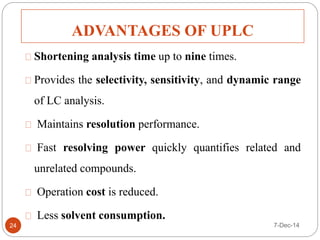
Shortening analysis time up to nine times. 
Provides the selectivity, sensitivity, and dynamic range 
of LC analysis. 
Maintains resolution performance. 
Fast resolving power quickly quantifies related and 
unrelated compounds. 
Operation cost is reduced. 
Less solvent consumption. 
24 7-Dec-14
Continue.. 
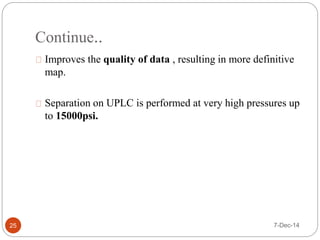
Improves the quality of data , resulting in more definitive 
map. 
Separation on UPLC is performed at very high pressures up 
to 15000psi. 
25 7-Dec-14
DISADVANTAGES OF UPLC 
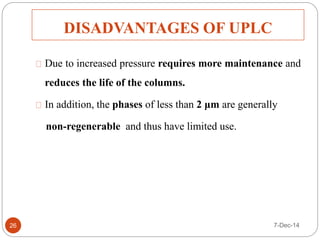
Due to increased pressure requires more maintenance and 
reduces the life of the columns. 
In addition, the phases of less than 2 μm are generally 
non-regenerable and thus have limited use. 
26 7-Dec-14
FACTORS AFFECTING 
PRFORMANCE OF UPLC 
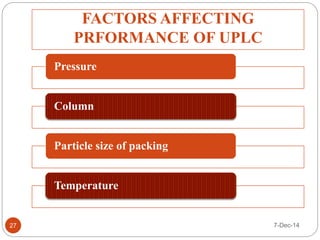
Pressure 
Column 
Particle size of packing 
Temperature 
27 7-Dec-14
EFFECT OF TEMPERATURE 
Improve protein separation. 
Modify properties of column surface alter protein 
structure. 
Increase column efficiency. 
Reduces mobile phase viscosity decrease in 
backpressure. 
Reduced run times in UPLC experiments 
28 7-Dec-14
WHAT IS UPLC –Q- TOF? 
29 
Hybrid Quadrupole Orthogonal Time of Flight 
(Q-TOF) Mass Spectrometer. 
Highly sophisticated 
High resolution mass spectrometry system, which 
employs a time-of-flight mass spectrometry technology. 
Used to analyze compounds in samples with a mass 
accuracy of typically 5 ppm (or better) between the found 
and the theoretical molecular weight of the analyte. 
7-Dec-14
Continue.. 
30 
Excellent chromatographic separation at the cost of high 
operating system pressure. 
Overcome by a high-precision plumbing and fittings 
system design, in which exotic materials, such as gold, etc., 
are used to efficiently resist high liquid pressure. 
(i.e., 14,000 psi or more) and provide a leak-free 
environment. 
7-Dec-14
APPLICATIONS 
OF THE UPLC/Q-TOF 
31 
High resolution mass spectrometry 
Accurate mass determinations 
Bioanalytical method of validation 
Application to a pharmacokinetic study 
Comprehensive screening and quantification of 
veterinary drugs in milk 
Peptide and Protein Research (MW approx. <12 kDa) 
with Accurate Mass 
7-Dec-14
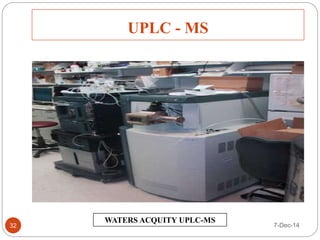
UPLC - MS 
32 
WATERS ACQUITY UPLC-MS 
7-Dec-14
APPLICATIONS(UPLC) 
33 
Drug Discovery : UPLC improves the drug discovery 
process by means of 
 High throughput screening 
 Combinational chemistry 
 High throughput screening determines physicochemical and 
drugs pharmacokinetics. 
High throughput quantitative analysis : 
UPLC coupled with time of flight mass spectroscopy give 
the metabolic stability assay. 
7-Dec-14
Continue.. 
Analysis of dosage form : 
It provides high speed, accuracy and reproducible results 
for isocratic and gradient analysis of drug. Thus method 
development time decreases. 
Determination of pesticides : 
UPLC couples the triple Quadra-pole tandem mass 
spectroscopy will help in identification of trace level of 
pesticide from water. 
34 7-Dec-14
Continue.. 
35 
Analysis of amino acids : 
UPLC used to accurate, reliable and reproducible 
analysis of amino acids in the areas of 
 Protein characterization, 
 Cell culture monitoring, 
 The nutritional analysis of food. 
7-Dec-14
SUMMARY 
36 
New materials and smaller particles are now available 
which gives improved separations, mostly following 
expected trends. 
 For UPLC, some reduction in sample size, significantly 
show reduction in flow rate. 
 As we go small we need matching of particle size, 
chemistry , analytes , and separation methods. 
 UPLC sets new standard in the science of chromatography. 
Working range with 15000 to 16000 psi pressure and 
column packed with size less than 2μm. 
7-Dec-14
Continue.. 
37 
Due to very narrow and sharp peaks, more number of 
peaks may appear in less time which may facilitate in 
analysis of complex mixtures and it may give more 
information regarding sample to be analysed. 
Now a day’s pharmaceutical industries are in search of 
new ways to reduce cost and time for analysis of drugs 
therefore UPLC serve as best substitute for previous 
technologies. 
7-Dec-14
REFERENCES 
Preeti Vinod Gaikwad*, Sanjay Dinkar Sawant, Minal 
Rushikesh Ghante and Neha Manish Munot,(2010),Ultra 
Performance Liquid Chromatography: A Recent Novel 
Development In HPLC, International Journal of 
Comprehensive Pharmacy(sep 5,2010) Page no:1-3 
Maulik Acharya*, Mandev Patel, Darshan Patel, Mahesh 
Chaudhary, Divyang Patel,(2012), Ultra Performance 
Liquid Chromatography, American Journal of Pharmatech 
Research,2(3),Page no:327-336 
Dr. Michael E. Swartz and Brian J. Murphy,(2004), Ultra 
performance liquid chromatography: Tomorrow's HPLC 
technology today, LPI,(june,2004),Page no-1-3 
38 7-Dec-14
Continue.. 
Dr.P.D.Sethi, (2001),High Performance Liquid 
Chromatography, First edition, New Delhi, CBS Publishers 
and distributor, Page no-6-8,69. 
Dr. Michael E. Swartz,(2005), Ultra Performance Liquid 
Chromatography: An introduction,massachusetts,Separation 
Science Redefined, Page no:8-14 
Ecord System-http:// 
www.waters.com/webassets/cms/support/docs/WA4000 
1.pdf(Accessed on-09-11-2014) 
39 7-Dec-14
THANK YOU... 
40 7-Dec-14

ultra performance liquid chromatography ppt.by Manoj Ingale

  • 1.
    ULTRA PERFORMANCE LIQUID CHROMATOGRAPHY (UPLC) ` Prepared by Mr. MANOJ R. INGALE M.Pharm . Department of Quality Assurance Technique. Sinhgad Technical Education Society’s SINHGAD INSTITUTE OF PHARMACY Narhe, Pune - 411041
  • 2.
    CONTENT OF PRESENTATION Introduction Principle Chemistry of small particle Comparison between HPLC and UPLC Instrumentation Advantages Disadvantages Advancements in UPLC Summary References 2 7-Dec-14
  • 3.
    INTRODUCTION Chromatography- Separationtechnique involving mass transfer between stationary and mobile phase. In Greek chromo meaning “color”, Graphic meaning “writing”. Since the 1970’s chromatographers have been limited to LC systems that were capable of operating at maximum operating system pressure of only 6000 psi (400bar). 3 7-Dec-14
  • 4.
    Continue.. This pressurelimitation coupled with large system volumes & slow data acquisition rates hindered the ability of separation scientist to fully realize speed & efficiencies. 4 7-Dec-14
  • 5.
    INTRODUCTION TO UPLC Ultra Performance Liquid Chromatography or Ultra Pressure Liquid chromatography. It improves in three areas:  Resolution,  Speed,  Sensitivity. It can withstand high system back-pressure. Special analytical columns UPLC BEH C18 packed with 1.7μm particles are used in connection with system. 5 7-Dec-14
  • 6.
    Continue.. The factorresponsible for development of UPLC technique was evolution of packing material used to effect the separation. The technology takes full advantage of chromatographic principles to run separations using columns packed with smaller particles. It decreases analysis time and solvent consumption. 6 7-Dec-14
  • 7.
    PRINCIPLE The principleof UPLC is based on Van Deemeter equation which describes the relationship between flow rate and HETP or column efficiency H=A+B/μ + Cμ Where,  A = Eddy diffusion  B = Longitudinal diffusion  C = Equilibrium mass transfer  μ = Flow rate 7 7-Dec-14
  • 8.
    Continue.. Chromatographic resolutionis described by Where, Rs = Resolution N = Separation efficiency (theoretical plate ) α = Selectivity factor k = Retention factor (Capacity factor) 8 7-Dec-14
  • 9.
    Continue.. Separation efficiency(N) Where, L = Column length H = Height of theoretical plate h = Reduced plate height dp = Particle diameter Therefore, 9 7-Dec-14
  • 10.
    CHEMISTRY OF SMALLPARTICLES As the particle size decreases to less than 2.5μm, not only there is significant gain in efficiency, but the efficiency doesn't diminish at increased flow rates. By using smaller particles, speed and peak capacity (number of peaks resolved per unit time in gradient separation) can be extended to new limits, termed ultra performance liquid chromatography. 10 7-Dec-14
  • 11.
    CHEMISTRY OF SMALLPARTICLES FIGURE 1- Van Deemter plot illustrating the evolution of particle sizes over the last three decades. 11 7-Dec-14
  • 12.
    COMPARISON BETWEEN HPLCAND UPLC Parameters HPLC Assay UPLC Assay Column XTerra,C18,50 × 4.6mm AQUITY UPLC BEH C18,50 ×2.1mm Particle size 4μm particles 1.7μm particles Flow rate 3.0 ml per min 0.6 ml per min Injection volume 20 μl 3 μl partial loop fill or 5 μl full loop fill Total run time 10 min 1.5 min Theoretical Plate count 2000 7500 12 7-Dec-14
  • 13.
    Continue.. Parameters HPLCAssay UPLC Assay Lower limit of quantization 0.2 μg/ml 0.054μl/ml Total solvent consumption Acetonitrile:10.5ml, water:21ml Acetonitrile:0.53ml, water:0.66ml Delay volume 720 μl 110 μl Column temperature 30 °C 65 °C Maximum back pressure 35-40 Mpa less 103.5 Mpa more Resolution Less High Method development High Low cost 13 7-Dec-14
  • 14.
  • 15.
  • 16.
    Continue.. A completelynew system design with advanced technology in the pump, auto sampler, detector, data system, and service diagnostics was required. The ACQUITY UPLC system has been designed for low system and dwell volume. Achieving small particle, high peak capacity separations requires a greater pressure range than that achievable by HPLC system. 16 7-Dec-14
  • 17.
    SYSTEM COMPONENTS Solvent reservoirs Auto sampler Van guard column Tubing's Column  Detectors 17 7-Dec-14
  • 18.
    UPLC COLUMN Tomaintain retention and capacity similar to the HPLC,UPLC uses novel porous particles that can withstand high pressure. Xterra TM :-  First generation technology  Introduced by Waters in year 2000.  Have high efficiency and operates over extended pH range.  They produced by incorporating carbon in the form of methyl groups. 18 7-Dec-14
  • 19.
    Continue.. AQUITY UPLCBEH COLUMN BEH-Bridged Ethane Hybrid.  Second generation technology  Have particle size 1.7μm.  Enhanced mechanical stability by bridging the methyl group in the silica matrix .  It can withstand at high pressure and high pH.  All AQUITY UPLC BEH Column include eCordTM microchip technology that capture manufacturing information for each column. 19 7-Dec-14
  • 20.
    Continue.. AQUITY UPLCBEH Column chemistries 20 7-Dec-14
  • 21.
    PUMPS Pumps arecapable of delivering solvent smoothly and reproducibly. Calculated pressure drop at optimum flow rate for maximum efficiency across the 15cm long column packed with 1.7μm particle is approximately 15000 psi. 21 7-Dec-14
  • 22.
    DETECTORS 1. UVdetectors 2. Fluorescent detector 3. Refractive index detector 4. Light scattering detector 5. Electrochemical detector 6. Mass spectrometric detector 22 7-Dec-14
  • 23.
    RESOLUTION OF PEAKS HPLC Resolution UPLC Resolution 23 7-Dec-14
  • 24.
    ADVANTAGES OF UPLC Shortening analysis time up to nine times. Provides the selectivity, sensitivity, and dynamic range of LC analysis. Maintains resolution performance. Fast resolving power quickly quantifies related and unrelated compounds. Operation cost is reduced. Less solvent consumption. 24 7-Dec-14
  • 25.
    Continue.. Improves thequality of data , resulting in more definitive map. Separation on UPLC is performed at very high pressures up to 15000psi. 25 7-Dec-14
  • 26.
    DISADVANTAGES OF UPLC Due to increased pressure requires more maintenance and reduces the life of the columns. In addition, the phases of less than 2 μm are generally non-regenerable and thus have limited use. 26 7-Dec-14
  • 27.
    FACTORS AFFECTING PRFORMANCEOF UPLC Pressure Column Particle size of packing Temperature 27 7-Dec-14
  • 28.
    EFFECT OF TEMPERATURE Improve protein separation. Modify properties of column surface alter protein structure. Increase column efficiency. Reduces mobile phase viscosity decrease in backpressure. Reduced run times in UPLC experiments 28 7-Dec-14
  • 29.
    WHAT IS UPLC–Q- TOF? 29 Hybrid Quadrupole Orthogonal Time of Flight (Q-TOF) Mass Spectrometer. Highly sophisticated High resolution mass spectrometry system, which employs a time-of-flight mass spectrometry technology. Used to analyze compounds in samples with a mass accuracy of typically 5 ppm (or better) between the found and the theoretical molecular weight of the analyte. 7-Dec-14
  • 30.
    Continue.. 30 Excellentchromatographic separation at the cost of high operating system pressure. Overcome by a high-precision plumbing and fittings system design, in which exotic materials, such as gold, etc., are used to efficiently resist high liquid pressure. (i.e., 14,000 psi or more) and provide a leak-free environment. 7-Dec-14
  • 31.
    APPLICATIONS OF THEUPLC/Q-TOF 31 High resolution mass spectrometry Accurate mass determinations Bioanalytical method of validation Application to a pharmacokinetic study Comprehensive screening and quantification of veterinary drugs in milk Peptide and Protein Research (MW approx. <12 kDa) with Accurate Mass 7-Dec-14
  • 32.
    UPLC - MS 32 WATERS ACQUITY UPLC-MS 7-Dec-14
  • 33.
    APPLICATIONS(UPLC) 33 DrugDiscovery : UPLC improves the drug discovery process by means of  High throughput screening  Combinational chemistry  High throughput screening determines physicochemical and drugs pharmacokinetics. High throughput quantitative analysis : UPLC coupled with time of flight mass spectroscopy give the metabolic stability assay. 7-Dec-14
  • 34.
    Continue.. Analysis ofdosage form : It provides high speed, accuracy and reproducible results for isocratic and gradient analysis of drug. Thus method development time decreases. Determination of pesticides : UPLC couples the triple Quadra-pole tandem mass spectroscopy will help in identification of trace level of pesticide from water. 34 7-Dec-14
  • 35.
    Continue.. 35 Analysisof amino acids : UPLC used to accurate, reliable and reproducible analysis of amino acids in the areas of  Protein characterization,  Cell culture monitoring,  The nutritional analysis of food. 7-Dec-14
  • 36.
    SUMMARY 36 Newmaterials and smaller particles are now available which gives improved separations, mostly following expected trends.  For UPLC, some reduction in sample size, significantly show reduction in flow rate.  As we go small we need matching of particle size, chemistry , analytes , and separation methods.  UPLC sets new standard in the science of chromatography. Working range with 15000 to 16000 psi pressure and column packed with size less than 2μm. 7-Dec-14
  • 37.
    Continue.. 37 Dueto very narrow and sharp peaks, more number of peaks may appear in less time which may facilitate in analysis of complex mixtures and it may give more information regarding sample to be analysed. Now a day’s pharmaceutical industries are in search of new ways to reduce cost and time for analysis of drugs therefore UPLC serve as best substitute for previous technologies. 7-Dec-14
  • 38.
    REFERENCES Preeti VinodGaikwad*, Sanjay Dinkar Sawant, Minal Rushikesh Ghante and Neha Manish Munot,(2010),Ultra Performance Liquid Chromatography: A Recent Novel Development In HPLC, International Journal of Comprehensive Pharmacy(sep 5,2010) Page no:1-3 Maulik Acharya*, Mandev Patel, Darshan Patel, Mahesh Chaudhary, Divyang Patel,(2012), Ultra Performance Liquid Chromatography, American Journal of Pharmatech Research,2(3),Page no:327-336 Dr. Michael E. Swartz and Brian J. Murphy,(2004), Ultra performance liquid chromatography: Tomorrow's HPLC technology today, LPI,(june,2004),Page no-1-3 38 7-Dec-14
  • 39.
    Continue.. Dr.P.D.Sethi, (2001),HighPerformance Liquid Chromatography, First edition, New Delhi, CBS Publishers and distributor, Page no-6-8,69. Dr. Michael E. Swartz,(2005), Ultra Performance Liquid Chromatography: An introduction,massachusetts,Separation Science Redefined, Page no:8-14 Ecord System-http:// www.waters.com/webassets/cms/support/docs/WA4000 1.pdf(Accessed on-09-11-2014) 39 7-Dec-14
  • 40.