Atmospheric Pressure 
Chemical Ionization 
(APCI). 
PRESENTED BY : VISHAL THAKUR 
M.PHARM SEM.I 
Dr. L.H.Hiranandani College Of pharmacy , 
Ulhasnagar.Maharashtra
INTRODUCTION 
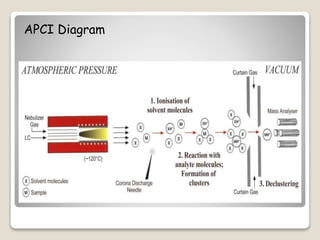
This is an ionization method in which the sample is 
ionized using an ion – molecule reaction with a 
reactant ion. Sample solution is nebulized by the N2 
nebulizer gas to form a spray as it enters the heater(at 
about 400°C),and both sample and solvent molecules 
are vaporized to a gaseous state. The solvent molecules 
are ionized by the corona discharge, and stable reactant 
ions are formed.
Protein transfer occurs between these reactant 
ions and sample molecules (ion – molecule 
reaction), and the sample molecules either add 
or lose protons to become ions. This ion – 
molecule reaction is known to occur in a 
variety of patterns, such as protein shift 
reactions, electrophilic addition reactions, etc.
APCI Diagram
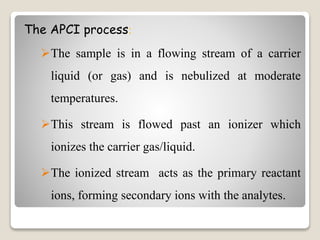
The APCI process: 
The sample is in a flowing stream of a carrier 
liquid (or gas) and is nebulized at moderate 
temperatures. 
This stream is flowed past an ionizer which 
ionizes the carrier gas/liquid. 
The ionized stream acts as the primary reactant 
ions, forming secondary ions with the analytes.
The ions are formed at AP in this process, and 
are sent into the vaccuum 
In the vaccuum, a free-jet expansion occurs to 
form a Mach disk and strong adiabatic cooling 
occurs. 
Cooling promotes the stability of analyte ions
Benefits : 
Excellent LC/MS interface 
Good for less-polar compounds 
Compatible with MS/MS methods 
Mass range : 
 Low-moderate Typically less than 2000 D.
Limitations : 
Very sensitive to contaminants such as alkali metals 
or basic compounds . 
 Relatively low ion currents. 
 Relatively complex hardware compared to other ion 
sources.
REFERENCE 
1.Http://Imaisd.Usc.Es/Riaidt/Masas/Imagenes/Ap 
ci1.Jpg 
2. Hoffman, Edmond, and Vincent Stroobant. Mass 
Spectrometry: Principles and Applications. Great 
Britain: JohnWiley & Sons Ltd., 2007 
3.http://www.spectroscopynow.com/Spy/basehtml/ 
SpyH/1,1181,4-0-0-0-0-home-0-0,00.html
THANK YOU

Atmospheric Pressure Chemical Ionization

  • 1.
    Atmospheric Pressure ChemicalIonization (APCI). PRESENTED BY : VISHAL THAKUR M.PHARM SEM.I Dr. L.H.Hiranandani College Of pharmacy , Ulhasnagar.Maharashtra
  • 2.
    INTRODUCTION This isan ionization method in which the sample is ionized using an ion – molecule reaction with a reactant ion. Sample solution is nebulized by the N2 nebulizer gas to form a spray as it enters the heater(at about 400°C),and both sample and solvent molecules are vaporized to a gaseous state. The solvent molecules are ionized by the corona discharge, and stable reactant ions are formed.
  • 3.
    Protein transfer occursbetween these reactant ions and sample molecules (ion – molecule reaction), and the sample molecules either add or lose protons to become ions. This ion – molecule reaction is known to occur in a variety of patterns, such as protein shift reactions, electrophilic addition reactions, etc.
  • 4.
  • 5.
    The APCI process: The sample is in a flowing stream of a carrier liquid (or gas) and is nebulized at moderate temperatures. This stream is flowed past an ionizer which ionizes the carrier gas/liquid. The ionized stream acts as the primary reactant ions, forming secondary ions with the analytes.
  • 6.
    The ions areformed at AP in this process, and are sent into the vaccuum In the vaccuum, a free-jet expansion occurs to form a Mach disk and strong adiabatic cooling occurs. Cooling promotes the stability of analyte ions
  • 7.
    Benefits : ExcellentLC/MS interface Good for less-polar compounds Compatible with MS/MS methods Mass range :  Low-moderate Typically less than 2000 D.
  • 8.
    Limitations : Verysensitive to contaminants such as alkali metals or basic compounds .  Relatively low ion currents.  Relatively complex hardware compared to other ion sources.
  • 9.
    REFERENCE 1.Http://Imaisd.Usc.Es/Riaidt/Masas/Imagenes/Ap ci1.Jpg 2. Hoffman, Edmond, and Vincent Stroobant. Mass Spectrometry: Principles and Applications. Great Britain: JohnWiley & Sons Ltd., 2007 3.http://www.spectroscopynow.com/Spy/basehtml/ SpyH/1,1181,4-0-0-0-0-home-0-0,00.html
  • 10.