Atomic Absorption
Spectroscopy
INTRODUCTION
 Atomic Absorption Spectroscopy is a very common technique for
detecting metals and metalloids in samples.
 It is very reliable and simple to use.
 It can analyse over 62 elements.
 It also measures the concentration of metals in the sample.
DEFINITION
 In analytical chemistry, Atomic absorption spectroscopy is a
technique for determining the concentration of a particular metal
element in a sample.
 Atomic absorption spectroscopy can be used to analyse the
concentration of over 62 different metals in a solution.
4
HISTORY
 The first atomic absorption spectrometer was built by CSIRO scientist
Alan Walsh in 1954 (Australia). Shown in the picture Alan
Walsh(left), with a spectrometer.
 Firstly used for mining, medical treatment & agriculture.
https://www.google.com/url?sa=i&url=http%3A%2F%2Farchive.maas.museum%2Faustralia_innovates%2Findex4e36.html%3Fbehaviour%3Dview_article%26Section_id%3D1070%26article_id
%3D10062&psig=AOvVaw1b9krnxfYXaFPoxoYvBMo-&ust=1603860038750000&source=images&cd=vfe&ved=0CAIQjRxqFwoTCIi9z7r60-wCFQAAAAAdAAAAABAJ
5
PROPERTIES OF AAS
 The most widely used method in analysis of elements
 Based on the absorption of radiation
 So sensitive (ppb)
 Quantitative analysis
https://www.google.com/url?sa=i&url=https%3A%2F%2Fweb.nmsu.edu%2F~esevosti%2Freport.htm&psig=AOvVaw3VsSV2sDPVW98GRFwL3u1B&ust=1603859397833000&source=images&cd
=vfe&ved=0CAIQjRxqFwoTCIjsl4j40-wCFQAAAAAdAAAAABAD
6
PRINCIPLE
 The technique uses basically the principle that free atoms (gas)
generated in an atomizer can absorb radiation at specific frequency.
 Atomic-absorption spectroscopy quantifies the absorption of ground
state atoms in the gaseous state .
 The atoms absorb ultraviolet or visible light and make transitions to
higher electronic energy levels. The analyte concentration is
determined from the amount of absorption.
7
Continue..
 Concentration measurements are usually determined from a working
curve after calibrating the instrument with standards of known
concentration.
 Atomic absorption is a very common technique for detecting metals
and metalloids in environmental samples.
8
THEORY
Hollow
Cathode
Lamp
Detector
Atomic
Absorption
spectrometer
Nebulizer
Monochromator Atomizer
9
TECHNIQUES & STEPS
 The technique typically makes use of a flame to atomize the sample,
but other atomizers such as a graphite furnace are also used.
 Three steps are involved in turning a liquid sample into an atomic
gas:
 Three steps are involved in turning a liquid sample into an atomic
gas
10
Continue..
 Desolvation – the liquid solvent is evaporated, and the dry sample
remains.
 Vaporisation – the solid sample vaporises to a gas.
 Volatilization – the compounds making up the sample are broken
into free atoms.
11
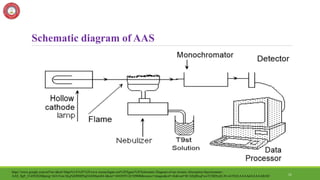
Schematic diagram of AAS
https://www.google.com/url?sa=i&url=https%3A%2F%2Fwww.researchgate.net%2Ffigure%2FSchematic-Diagram-of-an-Atomic-Absorption-Spectrometer-
AAS_fig9_314502828&psig=AOvVaw1KqNjSf0MPJqDADMqm84-I&ust=1603859126749000&source=images&cd=vfe&ved=0CAIQjRxqFwoTCMDvj4L30-wCFQAAAAAdAAAAABAD
12
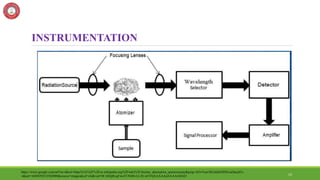
INSTRUMENTATION
https://www.google.com/url?sa=i&url=https%3A%2F%2Fen.wikipedia.org%2Fwiki%2FAtomic_absorption_spectroscopy&psig=AOvVaw3KJyk8dZ89ZcaZdoq45x-
v&ust=1603859212582000&source=images&cd=vfe&ved=0CAIQjRxqFwoTCND6vLL30-wCFQAAAAAdAAAAABAD
13
Radiation Source
Beer’s Law only applies to monochromatic radiation.
In practice, monochromatic implies that the line width of the radiation being measured is less than the
bandwidth of the absorbing species.
Atomic absorption lines very sharp with an inherent line width of 0.0001 nm.
Due to Doppler effect and pressure broadening, line widths of atoms in a flame are typically 0.001 - 0.01 nm.
Therefore, we require a source having a line width of less than 0.01 nm.
Typical monochromator has a bandwidth of 1 nm i.e. x100 greater than the line width of the atom in a flame.
14
LIGHT SOURCE
 Hollow Cathode Lamp are the most common radiation source in AAS.
 It contains a tungsten anode and a hollow cylindrical cathode made of
the element to be determined.
 These are sealed in a glass tube filled with an inert gas (neon or argon ) .
 Each element has its own unique lamp which must be used for that
analysis .
15
Hollow Cathode Lamp
https://www.google.com/url?sa=i&url=https%3A%2F%2Fwww.shimadzu.eu%2Fhollow-cathode-
lamps&psig=AOvVaw3q3ij1etwZ5Ym8AVd3aisr&ust=1603859287721000&source=images&cd=vfe&ved=0CAIQjRxqFwoTCJjpudz30-wCFQAAAAAdAAAAABAD
16
Hollow Cathode Lamp
17
Reactions in the Hollow Cathode Lamp
Apply sufficiently high voltage between the cathode and the anode:
(1) Ionization of the filler gas:
Ne + e- = Ne+ + 2e-
(2) Sputtering of the cathode element (M):
M(s) + Ne+ = M(g) + Ne
(3) Excitation of the cathode element (M)
M(g) + Ne+ = M*(g) + Ne
(4) Emission of radiation
M*(g)  (M(g) + h
18
NEBULIZER
 Suck up liquid samples at controlled rate.
 Create a fine aerosol spray for introduction into flame.
 Mix the aerosol and fuel and oxidant thoroughly for introduction
into flame.
19
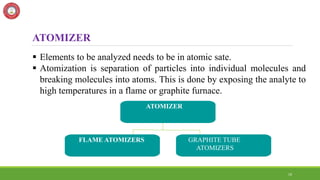
ATOMIZER
 Elements to be analyzed needs to be in atomic sate.
 Atomization is separation of particles into individual molecules and
breaking molecules into atoms. This is done by exposing the analyte to
high temperatures in a flame or graphite furnace.
ATOMIZER
FLAME ATOMIZERS GRAPHITE TUBE
ATOMIZERS
20
FLAME ATOMIZER
 To create flame, we need to mix an oxidant gas and a fuel gas.
 In most of the cases air-acetylene flame or nitrous oxide- acetylene
flame is used.
 liquid or dissolved samples are typically used with flame atomizer.
21
Electrothermal Atomisation - Graphite Furnace
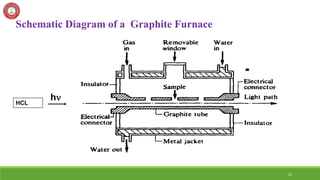
Sample holder consists of a graphite tube.
Tube is heated electrically
Beam of light passes through the tube.
Offers greater sensitivity than flames.
Uses smaller volume of sample
◦ typically 5 - 50 l (0.005 - 0.05 ml).
All of sample is atomised in the graphite tube.
Atomised sample is confined to the optical path for several seconds (residence time in
flame is very short).
Uses a number of stages as shown on next slide.
22
Advantages and Disadvantages of
Electrothermal Atomisation
Advantages
◦ very sensitive for many elements
◦ small sample size
Disadvantages
◦ poor precision
◦ long cycle times means a low sample throughput
◦ expensive to purchase and run (argon, tubes)
◦ requires background correction
◦ method development lengthy and complicated
◦ requires a high degree of operator skill (compared to flame AAS)
23
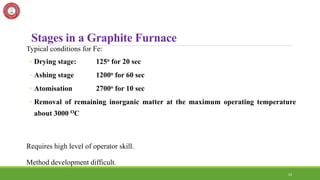
Stages in a Graphite Furnace
Typical conditions for Fe:
◦ Drying stage: 125o for 20 sec
◦ Ashing stage 1200o for 60 sec
◦ Atomisation 2700o for 10 sec
◦ Removal of remaining inorganic matter at the maximum operating temperature
about 3000 OC
Requires high level of operator skill.
Method development difficult.
24
GRAPHITE TUBE ATOMIZER
 Uses a graphite coated furnace to vaporize the sample.
 ln GFAAS sample, samples are deposited in a small graphite coated
tube which can then be heated to vaporize and atomize the analyte.
 The graphite tubes are heated using a high current power supply.
25
Schematic Diagram of a Graphite Furnace
HCL
h
26
MONOCHROMATOR
 This is a very important part in an AA spectrometer. It is used to
separate out all of the thousands of lines.
 A monochromator is used to select the specific wavelength of light
which is absorbed by the sample, and to exclude other wavelengths.
 The selection of the specific light allows the determination of the
selected element in the presence of others.
27
DETECTOR
 The light selected by the monochromator is directed onto a detector
that is typically a photomultiplier tube , whose function is to convert
the light signal into an electrical signal proportional to the light
intensity.
 The processing of electrical signal is fulfilled by a signal amplifier .
The signal could be displayed for readout , or further fed into a data
station for printout by the requested format.
28
Advantages and Disadvantages of AAS
Advantages
◦ equipment relatively cheap
◦ easy to use (training easy compared to furnace)
◦ good precision
◦ high sample throughput
◦ relatively facile method development
◦ cheap to run
Disadvantages
◦ lack of sensitivity (compared to furnace)
◦ problems with refractory elements
◦ require large sample size
◦ sample must be in solution
29
APPLICATIONS
 Determination of even small amounts of metals (lead, mercury, calcium,
magnesium, etc) as follows:
 Clinical analysis (blood samples: whole blood, Plasma, serum; Ca, Mg, Li, Na, K,
Fe)
 Environmental studies: drinking water, ocean water, soil.
 Food industry: Food analysis
 Water analysis (e.g. Ca, Mg, Fe, Si, Al, Ba content)
 Analysis of soils
 Pharmaceutical industry.
30
Applications of AAS
Agricultural analysis
◦ soils
◦ plants
Clinical and biochemistry
◦ whole blood, plasma and serum Ca, Mg, Li, Na, K, Cu, Zn, Fe etc.
Metallurgy
◦ ores, metals and alloys
31
Applications of AAS
Lubricating oils
◦ Ba, Ca, Mg and Zn additives
Greases
◦ Li, Na, Ca
32
Applications of AAS
Water and effluents
◦ many elements e.g. Ca, Mg, Fe, Si, Al, Ba
Food
◦ wide range of elements
Animal feedstuffs
◦ Mn, Fe, Co, Cu, Zn, Cr, Se
Medicines
◦ range of elements
33
CONCLUSION
 One of the most important technique in quantitative analysis
 It is based on the absorption of radiation
 Measurements could be done at very sensitivity levels
 It’s widely used method
 The preparation of the sample is usually simple and rapid
Advantages
 High sensitivity [10--10 g (flame), 10-14 g (non-flame)]
 Good accuracy (Relative error 0.1 ~ 0.5 % )
 High selectivity
34
REFERENCES
 Pharmaceutical analysis Instrumental methods Volume II by Dr. A.V.
kasture, Dr. S.G. Wadodkar, Nirali prakashan page no. 23.9 – 23.12
 Instrumental methods of Chemical analysis by G.R Chatwal, S.K.
Anand, Himalaya publishing house, fifth edition page no. 2.340 – 2.360
35
Thank You

Atomic Absorption Spectroscopy Final.pptx

  • 1.
  • 2.
    INTRODUCTION  Atomic AbsorptionSpectroscopy is a very common technique for detecting metals and metalloids in samples.  It is very reliable and simple to use.  It can analyse over 62 elements.  It also measures the concentration of metals in the sample.
  • 3.
    DEFINITION  In analyticalchemistry, Atomic absorption spectroscopy is a technique for determining the concentration of a particular metal element in a sample.  Atomic absorption spectroscopy can be used to analyse the concentration of over 62 different metals in a solution.
  • 4.
    4 HISTORY  The firstatomic absorption spectrometer was built by CSIRO scientist Alan Walsh in 1954 (Australia). Shown in the picture Alan Walsh(left), with a spectrometer.  Firstly used for mining, medical treatment & agriculture. https://www.google.com/url?sa=i&url=http%3A%2F%2Farchive.maas.museum%2Faustralia_innovates%2Findex4e36.html%3Fbehaviour%3Dview_article%26Section_id%3D1070%26article_id %3D10062&psig=AOvVaw1b9krnxfYXaFPoxoYvBMo-&ust=1603860038750000&source=images&cd=vfe&ved=0CAIQjRxqFwoTCIi9z7r60-wCFQAAAAAdAAAAABAJ
  • 5.
    5 PROPERTIES OF AAS The most widely used method in analysis of elements  Based on the absorption of radiation  So sensitive (ppb)  Quantitative analysis https://www.google.com/url?sa=i&url=https%3A%2F%2Fweb.nmsu.edu%2F~esevosti%2Freport.htm&psig=AOvVaw3VsSV2sDPVW98GRFwL3u1B&ust=1603859397833000&source=images&cd =vfe&ved=0CAIQjRxqFwoTCIjsl4j40-wCFQAAAAAdAAAAABAD
  • 6.
    6 PRINCIPLE  The techniqueuses basically the principle that free atoms (gas) generated in an atomizer can absorb radiation at specific frequency.  Atomic-absorption spectroscopy quantifies the absorption of ground state atoms in the gaseous state .  The atoms absorb ultraviolet or visible light and make transitions to higher electronic energy levels. The analyte concentration is determined from the amount of absorption.
  • 7.
    7 Continue..  Concentration measurementsare usually determined from a working curve after calibrating the instrument with standards of known concentration.  Atomic absorption is a very common technique for detecting metals and metalloids in environmental samples.
  • 8.
  • 9.
    9 TECHNIQUES & STEPS The technique typically makes use of a flame to atomize the sample, but other atomizers such as a graphite furnace are also used.  Three steps are involved in turning a liquid sample into an atomic gas:  Three steps are involved in turning a liquid sample into an atomic gas
  • 10.
    10 Continue..  Desolvation –the liquid solvent is evaporated, and the dry sample remains.  Vaporisation – the solid sample vaporises to a gas.  Volatilization – the compounds making up the sample are broken into free atoms.
  • 11.
    11 Schematic diagram ofAAS https://www.google.com/url?sa=i&url=https%3A%2F%2Fwww.researchgate.net%2Ffigure%2FSchematic-Diagram-of-an-Atomic-Absorption-Spectrometer- AAS_fig9_314502828&psig=AOvVaw1KqNjSf0MPJqDADMqm84-I&ust=1603859126749000&source=images&cd=vfe&ved=0CAIQjRxqFwoTCMDvj4L30-wCFQAAAAAdAAAAABAD
  • 12.
  • 13.
    13 Radiation Source Beer’s Lawonly applies to monochromatic radiation. In practice, monochromatic implies that the line width of the radiation being measured is less than the bandwidth of the absorbing species. Atomic absorption lines very sharp with an inherent line width of 0.0001 nm. Due to Doppler effect and pressure broadening, line widths of atoms in a flame are typically 0.001 - 0.01 nm. Therefore, we require a source having a line width of less than 0.01 nm. Typical monochromator has a bandwidth of 1 nm i.e. x100 greater than the line width of the atom in a flame.
  • 14.
    14 LIGHT SOURCE  HollowCathode Lamp are the most common radiation source in AAS.  It contains a tungsten anode and a hollow cylindrical cathode made of the element to be determined.  These are sealed in a glass tube filled with an inert gas (neon or argon ) .  Each element has its own unique lamp which must be used for that analysis .
  • 15.
  • 16.
  • 17.
    17 Reactions in theHollow Cathode Lamp Apply sufficiently high voltage between the cathode and the anode: (1) Ionization of the filler gas: Ne + e- = Ne+ + 2e- (2) Sputtering of the cathode element (M): M(s) + Ne+ = M(g) + Ne (3) Excitation of the cathode element (M) M(g) + Ne+ = M*(g) + Ne (4) Emission of radiation M*(g)  (M(g) + h
  • 18.
    18 NEBULIZER  Suck upliquid samples at controlled rate.  Create a fine aerosol spray for introduction into flame.  Mix the aerosol and fuel and oxidant thoroughly for introduction into flame.
  • 19.
    19 ATOMIZER  Elements tobe analyzed needs to be in atomic sate.  Atomization is separation of particles into individual molecules and breaking molecules into atoms. This is done by exposing the analyte to high temperatures in a flame or graphite furnace. ATOMIZER FLAME ATOMIZERS GRAPHITE TUBE ATOMIZERS
  • 20.
    20 FLAME ATOMIZER  Tocreate flame, we need to mix an oxidant gas and a fuel gas.  In most of the cases air-acetylene flame or nitrous oxide- acetylene flame is used.  liquid or dissolved samples are typically used with flame atomizer.
  • 21.
    21 Electrothermal Atomisation -Graphite Furnace Sample holder consists of a graphite tube. Tube is heated electrically Beam of light passes through the tube. Offers greater sensitivity than flames. Uses smaller volume of sample ◦ typically 5 - 50 l (0.005 - 0.05 ml). All of sample is atomised in the graphite tube. Atomised sample is confined to the optical path for several seconds (residence time in flame is very short). Uses a number of stages as shown on next slide.
  • 22.
    22 Advantages and Disadvantagesof Electrothermal Atomisation Advantages ◦ very sensitive for many elements ◦ small sample size Disadvantages ◦ poor precision ◦ long cycle times means a low sample throughput ◦ expensive to purchase and run (argon, tubes) ◦ requires background correction ◦ method development lengthy and complicated ◦ requires a high degree of operator skill (compared to flame AAS)
  • 23.
    23 Stages in aGraphite Furnace Typical conditions for Fe: ◦ Drying stage: 125o for 20 sec ◦ Ashing stage 1200o for 60 sec ◦ Atomisation 2700o for 10 sec ◦ Removal of remaining inorganic matter at the maximum operating temperature about 3000 OC Requires high level of operator skill. Method development difficult.
  • 24.
    24 GRAPHITE TUBE ATOMIZER Uses a graphite coated furnace to vaporize the sample.  ln GFAAS sample, samples are deposited in a small graphite coated tube which can then be heated to vaporize and atomize the analyte.  The graphite tubes are heated using a high current power supply.
  • 25.
    25 Schematic Diagram ofa Graphite Furnace HCL h
  • 26.
    26 MONOCHROMATOR  This isa very important part in an AA spectrometer. It is used to separate out all of the thousands of lines.  A monochromator is used to select the specific wavelength of light which is absorbed by the sample, and to exclude other wavelengths.  The selection of the specific light allows the determination of the selected element in the presence of others.
  • 27.
    27 DETECTOR  The lightselected by the monochromator is directed onto a detector that is typically a photomultiplier tube , whose function is to convert the light signal into an electrical signal proportional to the light intensity.  The processing of electrical signal is fulfilled by a signal amplifier . The signal could be displayed for readout , or further fed into a data station for printout by the requested format.
  • 28.
    28 Advantages and Disadvantagesof AAS Advantages ◦ equipment relatively cheap ◦ easy to use (training easy compared to furnace) ◦ good precision ◦ high sample throughput ◦ relatively facile method development ◦ cheap to run Disadvantages ◦ lack of sensitivity (compared to furnace) ◦ problems with refractory elements ◦ require large sample size ◦ sample must be in solution
  • 29.
    29 APPLICATIONS  Determination ofeven small amounts of metals (lead, mercury, calcium, magnesium, etc) as follows:  Clinical analysis (blood samples: whole blood, Plasma, serum; Ca, Mg, Li, Na, K, Fe)  Environmental studies: drinking water, ocean water, soil.  Food industry: Food analysis  Water analysis (e.g. Ca, Mg, Fe, Si, Al, Ba content)  Analysis of soils  Pharmaceutical industry.
  • 30.
    30 Applications of AAS Agriculturalanalysis ◦ soils ◦ plants Clinical and biochemistry ◦ whole blood, plasma and serum Ca, Mg, Li, Na, K, Cu, Zn, Fe etc. Metallurgy ◦ ores, metals and alloys
  • 31.
    31 Applications of AAS Lubricatingoils ◦ Ba, Ca, Mg and Zn additives Greases ◦ Li, Na, Ca
  • 32.
    32 Applications of AAS Waterand effluents ◦ many elements e.g. Ca, Mg, Fe, Si, Al, Ba Food ◦ wide range of elements Animal feedstuffs ◦ Mn, Fe, Co, Cu, Zn, Cr, Se Medicines ◦ range of elements
  • 33.
    33 CONCLUSION  One ofthe most important technique in quantitative analysis  It is based on the absorption of radiation  Measurements could be done at very sensitivity levels  It’s widely used method  The preparation of the sample is usually simple and rapid Advantages  High sensitivity [10--10 g (flame), 10-14 g (non-flame)]  Good accuracy (Relative error 0.1 ~ 0.5 % )  High selectivity
  • 34.
    34 REFERENCES  Pharmaceutical analysisInstrumental methods Volume II by Dr. A.V. kasture, Dr. S.G. Wadodkar, Nirali prakashan page no. 23.9 – 23.12  Instrumental methods of Chemical analysis by G.R Chatwal, S.K. Anand, Himalaya publishing house, fifth edition page no. 2.340 – 2.360
  • 35.