 NUCLEAR MAGNETIC DOUBLE
RESONANCE
 INTRODUCTION
 SPIN-SPIN DECOUPLING BY NDMR
 13C NMR
 APPLICATION OF NMR
During a normal NMR experiment the sample
is subjected to a single radiofrequency field. If a
2nd radiofrequency is applied in a specific
manner, then a series of techniques collectively
known as NUCLEAR MAGNETIC DOUBLE
RESONANCE.
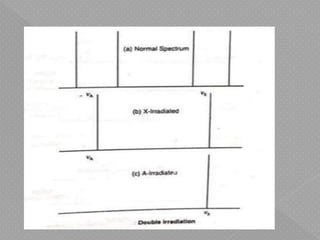
 During an NMR experiment on a sample
AX system, the X nucleus is irradiated with a
2nd radiofrequency signal of frequency (vx)
equal to the precessional frequency of X, then
the X- nuclei will undergo rapid changes of spin state.
 Nucleus A is aware of only one equivalent spin state of X
and therefore its resonance signal appears, not as a
doublet, but as a sharp singlet.
 Irradiation of X effectively decouples the signal form A.
 Similarly if A is irradiated with a 2nd r/f signal equal to
its own resonance frequency (vA), then the signal from X
will collapse to a singlet.
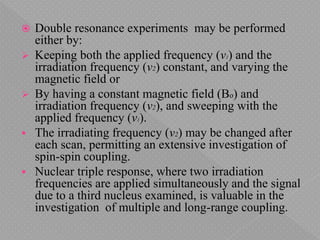
 Double resonance experiments may be performed
either by:
 Keeping both the applied frequency (v1) and the
irradiation frequency (v2) constant, and varying the
magnetic field or
 By having a constant magnetic field (Bo) and
irradiation frequency (v2), and sweeping with the
applied frequency (v1).
 The irradiating frequency (v2) may be changed after
each scan, permitting an extensive investigation of
spin-spin coupling.
 Nuclear triple response, where two irradiation
frequencies are applied simultaneously and the signal
due to a third nucleus examined, is valuable in the
investigation of multiple and long-range coupling.
Carbon-12 nucleus is spin inactive, I = 0
Carbon-13 nucleus is spin active, I = ½
Hence C-13 NMR spectroscopy is possible and very
useful in organic structure elucidation
 It is based on the principle that major nuclei of atoms
possess magnetic moments and angular momentum
and external magnetic field is applied to them, they
arrange themselves in the direction of the magnetic
field.
 Let us consider an example of 13C atom as a magnet
which has a north pole and a south pole. If we place
the atom in a magnetic field, then the 13C atom will
reorient itself in such a way that the north pole will
be pointing towards the south pole of the magnetic
field.
 Similarly, the other atoms also have magnetic
moment based on their lone pairs.
 When they are placed in some external magnetic
field, they reorient themselves. This reorientation is
termed as α-spin.
 Once the reorientation of the atoms in the direction
of the magnetic field is accomplished, some energy
in the form of radio waves are provided to the same
atom so that the atom can reorient themselves into
the opposite direction. This spin is termed as β-spin.
 In this spin the north pole of the nucleus will be
facing the north pole of the magnetic field. Hence
this spin will lead to the arrangement of the nucleus
against the magnetic field.
 The energy required for the same task is very less as
the energy difference between the α-spin and the β-
spin is not large.
 As the energy provided to the nucleus will lead to β-
spin, when we remove the energy, the nucleus will
relax back to its original state i.e., the α state.
 When the nucleus returns to its initial state, there
would be fluctuation in the magnetic field which is
often termed as Resonance.
The primary applications of NMR are in the field
of structure determination and delineration.
 Structural diagnosis by NMR or Qualitative
analysis:
A large number of principles are known which
will decide about the structure of an unknown from
its NMR spectra.
 Quantitative analysis:
NMR spectroscopy has been used to determine
the molar ratio of the components in a mixture.
 Hydrogen bonding:
The NMR can be used to study the Hydrogen
bonding in metal chelates as well as in organic
compounds.
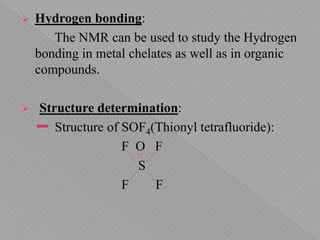
 Structure determination:
Structure of SOF4(Thionyl tetrafluoride):
F O F
S
F F
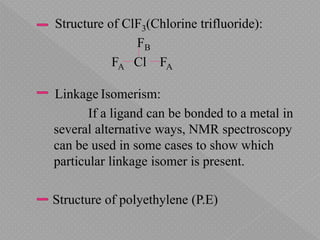
Structure of ClF3(Chlorine trifluoride):
FB
FA Cl FA
Linkage Isomerism:
If a ligand can be bonded to a metal in
several alternative ways, NMR spectroscopy
can be used in some cases to show which
particular linkage isomer is present.
Structure of polyethylene (P.E)
 Exchange effects
 Elemental analysis
 Determination of optical purity
 Study of molecular interactions: Micelle
formation, drug- macromolecule/ drug receptor
interaction.
 Instrumental methods of chemical analysis by
G.R. Chatwal
 www.google.com
NMR spectroscopy(double resonance, C 13 NMR, applications)