GAS LAWS
EUGENE JAY M. AQUINO, LPT
INSTRUCTOR I, NATURAL SCIENCE DEPT.
College of Education, Arts, and Sciences
Gordon College
Gases are complicated. They’re full of
billions and billions of energetic gas
molecules that can collide and possibly
interact with each other.
Created in the early 17th century, the gas
laws have been around to assist scientists in
finding volumes, amount, pressures and
temperature when coming to matters of gas.
The gas laws consist of three primary laws:
Charles’ Law, Boyle’s Law and Avogadro’s Law
(all of which will later combine into the
General Gas Equation and Ideal Gas Law).
The three fundamental gas laws discover the
relationship of pressure (P), temperature (T),
volume (V) and amount of gas (n).
Gases have three characteristic properties: (1)
they are easy to compress, (2) they expand to
fill their containers, and (3) they occupy far
more space than the liquids or solids from which
they form.
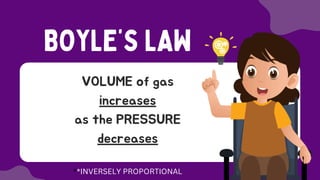
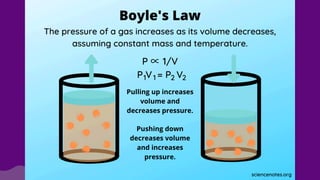
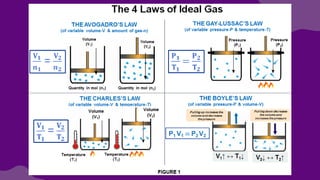
BOYLE’S LAW
VOLUME of gas
increases
as the PRESSURE
decreases
**INVERSELY PROPORTIONAL
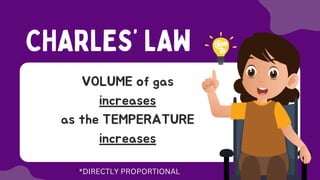
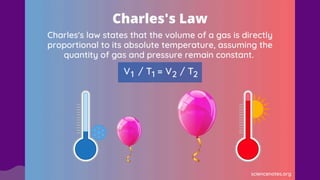
CHARLES’ LAW
VOLUME of gas
increases
as the TEMPERATURE
increases
**DIRECTLY PROPORTIONAL
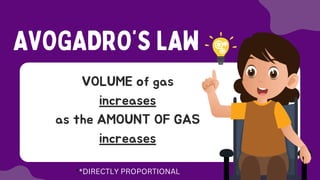
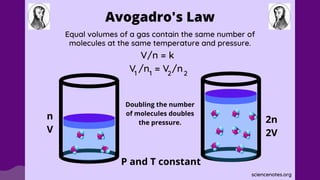
AVOGADRO’S LAW
VOLUME of gas
increases
as the AMOUNT OF GAS
increases
**DIRECTLY PROPORTIONAL
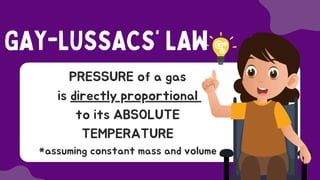
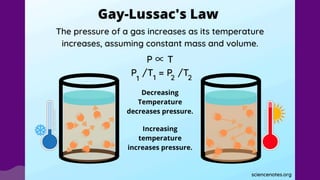
GAY-LUSSACS’ LAW
PRESSURE of a gas
is directly proportional
to its ABSOLUTE
TEMPERATURE
*assuming constant mass and volume
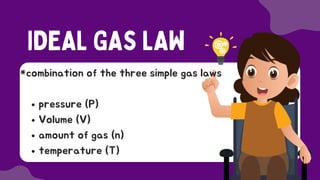
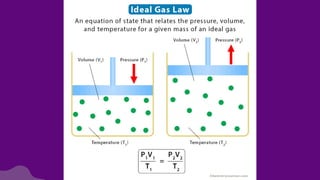
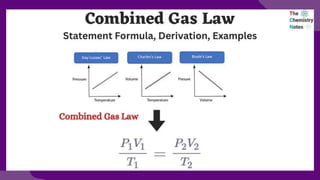
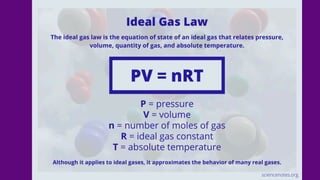
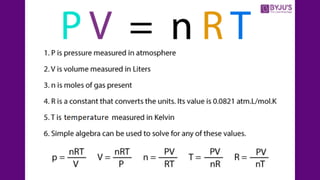
IDEAL GAS LAW
*combination of the three simple gas laws
pressure (P)
Volume (V)
amount of gas (n)
temperature (T)
D
i
f
f
erence of
IDEAL GAS
and
REAL GAS
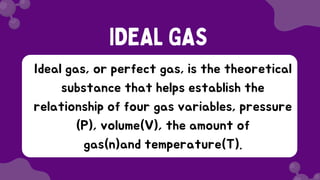
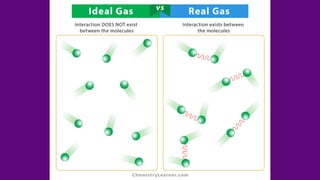
Ideal gas, or perfect gas, is the theoretical
substance that helps establish the
relationship of four gas variables, pressure
(P), volume(V), the amount of
gas(n)and temperature(T).
IDEAL GAS
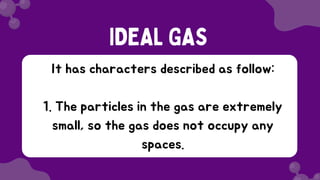
It has characters described as follow:
1. The particles in the gas are extremely
small, so the gas does not occupy any
spaces.
IDEAL GAS
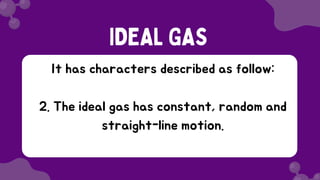
It has characters described as follow:
2. The ideal gas has constant, random and
straight-line motion.
IDEAL GAS
It has characters described as follow:
3. No forces between the particles of the
gas. Particles only collide elastically with
each other and with the walls of container.
IDEAL GAS
Real gas, in contrast, has real volume and
the collision of the particles is not elastic,
because there are attractive forces
between particles.
REAL GAS
As a result, the volume of real gas is much
larger than of the ideal gas, and the
pressure of real gas is lower than of ideal
gas.
REAL GAS
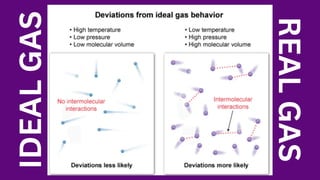
All real gases tend to perform ideal gas
behavior at low pressure and relatively high
temperature.
REAL GAS
REAL
GAS
IDEAL
GAS
end

GAS LAWS PRESENTATION PROPER AND LESSONS

  • 1.
    GAS LAWS EUGENE JAYM. AQUINO, LPT INSTRUCTOR I, NATURAL SCIENCE DEPT. College of Education, Arts, and Sciences Gordon College
  • 2.
    Gases are complicated.They’re full of billions and billions of energetic gas molecules that can collide and possibly interact with each other.
  • 3.
    Created in theearly 17th century, the gas laws have been around to assist scientists in finding volumes, amount, pressures and temperature when coming to matters of gas.
  • 4.
    The gas lawsconsist of three primary laws: Charles’ Law, Boyle’s Law and Avogadro’s Law (all of which will later combine into the General Gas Equation and Ideal Gas Law).
  • 5.
    The three fundamentalgas laws discover the relationship of pressure (P), temperature (T), volume (V) and amount of gas (n).
  • 6.
    Gases have threecharacteristic properties: (1) they are easy to compress, (2) they expand to fill their containers, and (3) they occupy far more space than the liquids or solids from which they form.
  • 7.
    BOYLE’S LAW VOLUME ofgas increases as the PRESSURE decreases **INVERSELY PROPORTIONAL
  • 9.
    CHARLES’ LAW VOLUME ofgas increases as the TEMPERATURE increases **DIRECTLY PROPORTIONAL
  • 11.
    AVOGADRO’S LAW VOLUME ofgas increases as the AMOUNT OF GAS increases **DIRECTLY PROPORTIONAL
  • 13.
    GAY-LUSSACS’ LAW PRESSURE ofa gas is directly proportional to its ABSOLUTE TEMPERATURE *assuming constant mass and volume
  • 15.
    IDEAL GAS LAW *combinationof the three simple gas laws pressure (P) Volume (V) amount of gas (n) temperature (T)
  • 19.
  • 20.
    Ideal gas, orperfect gas, is the theoretical substance that helps establish the relationship of four gas variables, pressure (P), volume(V), the amount of gas(n)and temperature(T). IDEAL GAS
  • 23.
    It has charactersdescribed as follow: 1. The particles in the gas are extremely small, so the gas does not occupy any spaces. IDEAL GAS
  • 24.
    It has charactersdescribed as follow: 2. The ideal gas has constant, random and straight-line motion. IDEAL GAS
  • 25.
    It has charactersdescribed as follow: 3. No forces between the particles of the gas. Particles only collide elastically with each other and with the walls of container. IDEAL GAS
  • 26.
    Real gas, incontrast, has real volume and the collision of the particles is not elastic, because there are attractive forces between particles. REAL GAS
  • 27.
    As a result,the volume of real gas is much larger than of the ideal gas, and the pressure of real gas is lower than of ideal gas. REAL GAS
  • 28.
    All real gasestend to perform ideal gas behavior at low pressure and relatively high temperature. REAL GAS
  • 30.
  • 31.