Thermal
Expansion
Linear and Volume
Objectives
• Define thermal expansion
• Identify the factors affecting thermal
  expansion
• Solve sample problems involving
  linear expansion and volume
  expansion
• Cite everyday applications of the
  concepts
Thermal Expansion

• Change in the dimension(s) of
  a substance due to change in
  temperature
Factors affecting
   THERMAL
  EXPANSION
Temperature

• Higher change in
  temperature, the higher the
  expansion
• ΔT for the symbol
Kind of Material

• Quantified by a constant value
  for coefficient of thermal
  expansion for some materials
• The higher the coefficient, the
  higher the expansion
• Symbol used -   α
Original Dimension

• Greater original dimension,
  greater the expansion.
• L for linear
• A for area
• V for volume
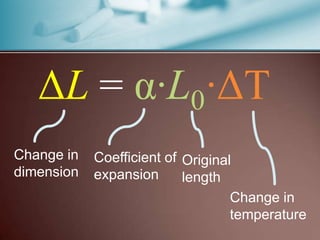
ΔL = α·L0·ΔT
Change in   Coefficient of Original
dimension   expansion      length
                                   Change in
                                   temperature
Types of
EXPANSION
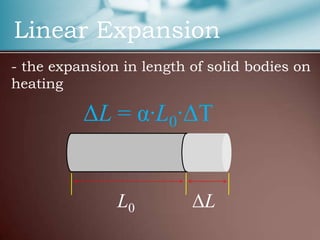
Linear Expansion
- the expansion in length of solid bodies on
heating

          ΔL = α·L0·ΔT


               L0         ΔL
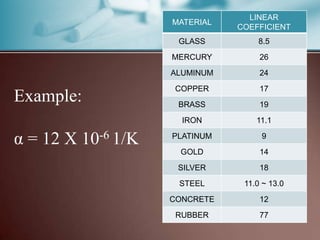
Coefficients of
Thermal Expansion
for Some materials
LINEAR
                    MATERIAL
                               COEFFICIENT
                     GLASS         8.5
                    MERCURY         26
                    ALUMINUM        24
                    COPPER          17
Example:             BRASS          19
                      IRON         11.1

α = 12 X 10-6 1/K   PLATINUM        9
                     GOLD           14
                     SILVER         18
                     STEEL      11.0 ~ 13.0
                    CONCRETE        12
                     RUBBER         77
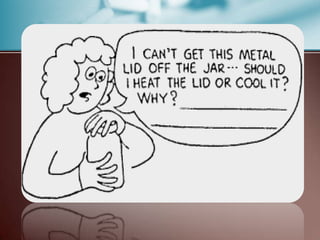
Opening a tight Jar lid
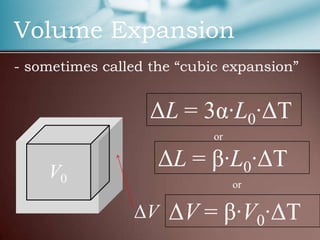
Volume Expansion
- sometimes called the “cubic expansion”


                   ΔL = 3α·L0·ΔT
                            or


    V0
                    ΔL = β·L0·ΔT
                                 or

                ΔV   ΔV = β·V0·ΔT
Exercises
1. During winter, why is it
important to protect water pipes?
2. Why is it
advisable to allow
telephone lines to
sag when stringing
them between
pokes in summer?
3. What is the change in length of
a metal rod with an initial length
of 2 meters, a coefficient of
thermal expansion 0.00002 /K and
a temperature change of 20 K?
4. Suppose you have a 0.05 L
container made of glass that is at
283 K. You raised its temperature
to 303 K. By how much will its
volume increase? (glass = 25.5
x10-6 1/K)
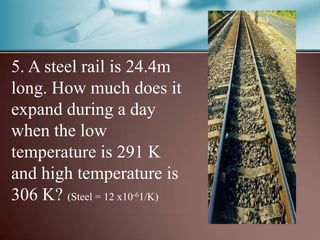
5. A steel rail is 24.4m
long. How much does it
expand during a day
when the low
temperature is 291 K
and high temperature is
306 K? (Steel = 12 x10 1/K)
                   -6
6. The length of a brass bar is 150
cm at 40 C. What will be its length
at 100 C?
(α = 19 x 10-6/K)
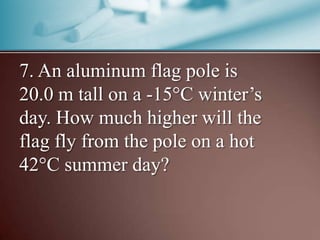
7. An aluminum flag pole is
20.0 m tall on a -15 C winter’s
day. How much higher will the
flag fly from the pole on a hot
42 C summer day?
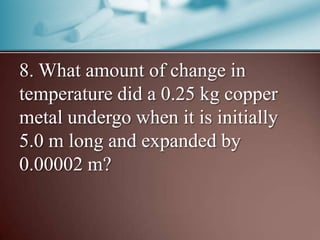
8. What amount of change in
temperature did a 0.25 kg copper
metal undergo when it is initially
5.0 m long and expanded by
0.00002 m?
9. A glass flask whose volume is 1000.0
cm 3 at 0.0 C is completely filled with

mercury at this temperature. When
flask and mercury are warmed to 80.0
 C, 12.5 cm3 of mercury overflow.
Compute the coefficient of volume
expansion of the glass.

Thermal expansion

  • 1.
  • 2.
    Objectives • Define thermalexpansion • Identify the factors affecting thermal expansion • Solve sample problems involving linear expansion and volume expansion • Cite everyday applications of the concepts
  • 3.
    Thermal Expansion • Changein the dimension(s) of a substance due to change in temperature
  • 4.
    Factors affecting THERMAL EXPANSION
  • 5.
    Temperature • Higher changein temperature, the higher the expansion • ΔT for the symbol
  • 6.
    Kind of Material •Quantified by a constant value for coefficient of thermal expansion for some materials • The higher the coefficient, the higher the expansion • Symbol used - α
  • 7.
    Original Dimension • Greateroriginal dimension, greater the expansion. • L for linear • A for area • V for volume
  • 8.
    ΔL = α·L0·ΔT Changein Coefficient of Original dimension expansion length Change in temperature
  • 9.
  • 10.
    Linear Expansion - theexpansion in length of solid bodies on heating ΔL = α·L0·ΔT L0 ΔL
  • 11.
  • 12.
    LINEAR MATERIAL COEFFICIENT GLASS 8.5 MERCURY 26 ALUMINUM 24 COPPER 17 Example: BRASS 19 IRON 11.1 α = 12 X 10-6 1/K PLATINUM 9 GOLD 14 SILVER 18 STEEL 11.0 ~ 13.0 CONCRETE 12 RUBBER 77
  • 14.
  • 15.
    Volume Expansion - sometimescalled the “cubic expansion” ΔL = 3α·L0·ΔT or V0 ΔL = β·L0·ΔT or ΔV ΔV = β·V0·ΔT
  • 16.
  • 17.
    1. During winter,why is it important to protect water pipes?
  • 18.
    2. Why isit advisable to allow telephone lines to sag when stringing them between pokes in summer?
  • 19.
    3. What isthe change in length of a metal rod with an initial length of 2 meters, a coefficient of thermal expansion 0.00002 /K and a temperature change of 20 K?
  • 20.
    4. Suppose youhave a 0.05 L container made of glass that is at 283 K. You raised its temperature to 303 K. By how much will its volume increase? (glass = 25.5 x10⁻⁶ 1/K)
  • 21.
    5. A steelrail is 24.4m long. How much does it expand during a day when the low temperature is 291 K and high temperature is 306 K? (Steel = 12 x10 1/K) -6
  • 22.
    6. The lengthof a brass bar is 150 cm at 40 C. What will be its length at 100 C? (α = 19 x 10-6/K)
  • 23.
    7. An aluminumflag pole is 20.0 m tall on a -15 C winter’s day. How much higher will the flag fly from the pole on a hot 42 C summer day?
  • 24.
    8. What amountof change in temperature did a 0.25 kg copper metal undergo when it is initially 5.0 m long and expanded by 0.00002 m?
  • 25.
    9. A glassflask whose volume is 1000.0 cm 3 at 0.0 C is completely filled with mercury at this temperature. When flask and mercury are warmed to 80.0 C, 12.5 cm3 of mercury overflow. Compute the coefficient of volume expansion of the glass.