MIXTURES, SOLUTIONS AND
   PURE SUBSTANCES
Matter and its appearance

     According to its appearance, there are two
    kinds of material systems:
       
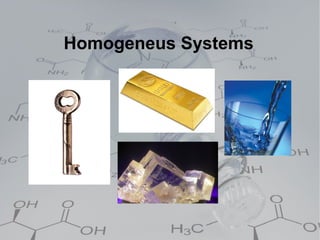
           Homogeneus systems: they have the
           same properties and compositions in all
           different parts of them.
       
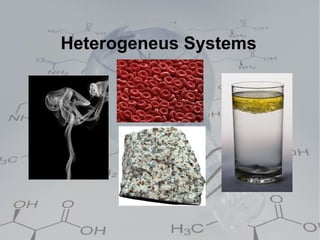
           Heterogeneus systems: different parts
           with different properties can be found in
           them.
Homogeneus Systems
Heterogeneus Systems
Heterogeneus Mixtures

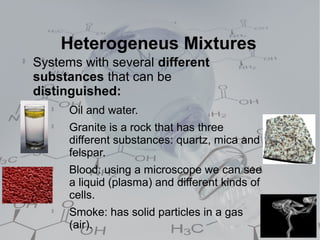
    Systems with several different
    substances that can be
    distinguished:
       
           Oil and water.
       
           Granite is a rock that has three
           different substances: quartz, mica and
           felspar.
       
           Blood: using a microscope we can see
           a liquid (plasma) and different kinds of
           cells.
       
           Smoke: has solid particles in a gas
           (air).
Heterogeneous Mixtures

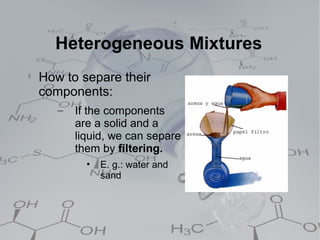
    How to separe their
    components:
       –   If the components
           are a solid and a
           liquid, we can separe
           them by filtering.
             •   E. g.: water and
                 sand
Heterogeneous Mixtures

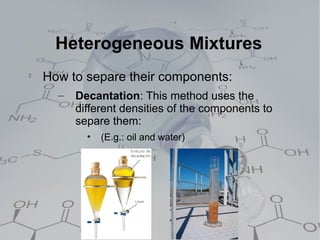
    How to separe their components:
      –   Decantation: This method uses the
          different densities of the components to
          separe them:
            •   (E.g.: oil and water)
Homogeneous Systems

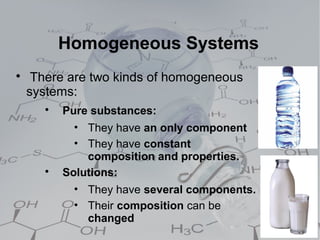
     There are two kinds of homogeneous
    systems:
       
           Pure substances:
             • They have an only component
             • They have constant
               composition and properties.
       
           Solutions:
             • They have several components.
             • Their composition can be
               changed
Solutions

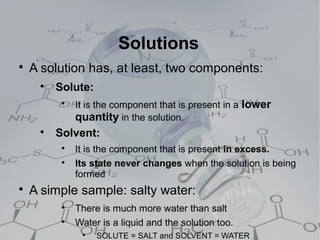
    A solution has, at least, two components:
     
         Solute:
          
              It is the component that is present in a lower
              quantity in the solution.
     
         Solvent:
          
              It is the component that is present in excess.
          
              Its state never changes when the solution is being
              formed

    A simple sample: salty water:
          
              There is much more water than salt
          
              Water is a liquid and the solution too.
               
                   SOLUTE = SALT and SOLVENT = WATER
Solutions
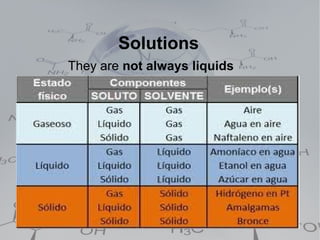
They are not always liquids
Solutions

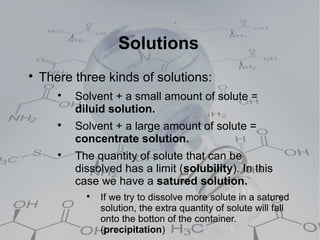
    There three kinds of solutions:
       
           Solvent + a small amount of solute =
           diluid solution.
       
           Solvent + a large amount of solute =
           concentrate solution.
       
           The quantity of solute that can be
           dissolved has a limit (solubility). In this
           case we have a satured solution.
             
                 If we try to dissolve more solute in a satured
                 solution, the extra quantity of solute will fall
                 onto the botton of the container.
                 (precipitation)
Solutions
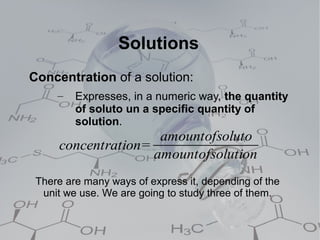
Concentration of a solution:
     –   Expresses, in a numeric way, the quantity
         of soluto un a specific quantity of
         solution.
                     amountofsoluto
     concentration=
                    amountofsolution
 There are many ways of express it, depending of the
  unit we use. We are going to study three of them.
Solutions
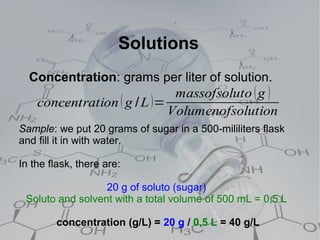
  Concentration: grams per liter of solution.
                             massofsoluto ( g )
   concentration ( g / L )=
                            Volumenofsolution
Sample: we put 20 grams of sugar in a 500-mililiters flask
and fill it in with water.

In the flask, there are:

                  20 g of soluto (sugar)
 Soluto and solvent with a total volume of 500 mL = 0,5 L

        concentration (g/L) = 20 g / 0,5 L = 40 g/L
Solutions
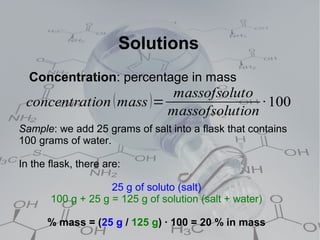
  Concentration: percentage in mass
                         massofsoluto
 concentration ( mass )=                · 100
                         massofsolution
Sample: we add 25 grams of salt into a flask that contains
100 grams of water.

In the flask, there are:

                    25 g of soluto (salt)
       100 g + 25 g = 125 g of solution (salt + water)

      % mass = (25 g / 125 g) · 100 = 20 % in mass
Solutions
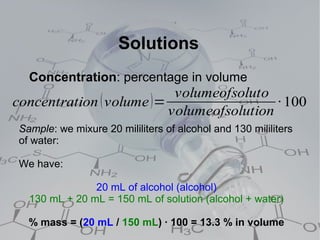
   Concentration: percentage in volume
                           volumeofsoluto
concentration ( volume )=                  · 100
                          volumeofsolution
 Sample: we mixure 20 mililiters of alcohol and 130 mililiters
 of water:

 We have:

                20 mL of alcohol (alcohol)
   130 mL + 20 mL = 150 mL of solution (alcohol + water)

   % mass = (20 mL / 150 mL) · 100 = 13.3 % in volume
Solutions

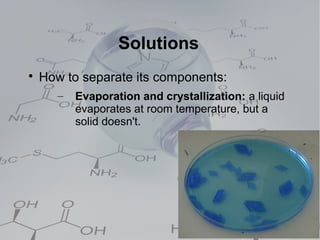
    How to separate its components:
       –   Evaporation and crystallization: a liquid
           evaporates at room temperature, but a
           solid doesn't.
Solutions

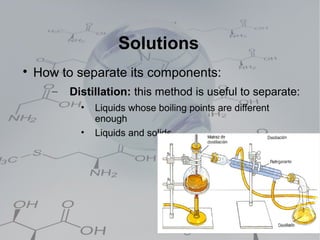
    How to separate its components:
       –   Distillation: this method is useful to separate:
             •   Liquids whose boiling points are different
                 enough
             •   Liquids and solids
Pure Substances

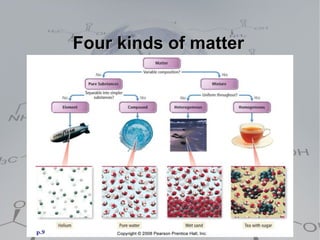
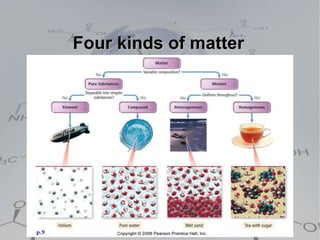
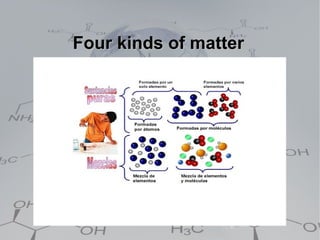
    Pure substances:
       
           They have a constant composition.
       
           They can't be separated in simpler
           substances using physical methods.

     There are two different kinds of pure
    substances:
       
           Chemical compounds: pure substances
           that can be separated in others using
           chemical methods.
       
           Elements: pure substances that can't be
           separated in others
Compound

     Pure substance composed of two or more different elements
    joined by chemical bonds.
        
             Made of elements in a specific ratio that is always
             the same
        
             Has a chemical formula
        
             Can only be separated by chemical means, not
             physically

    There are millions of different compounds in nature
Compound

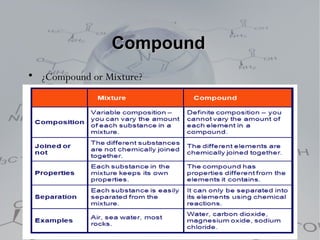
    ¿Compound or Mixture?
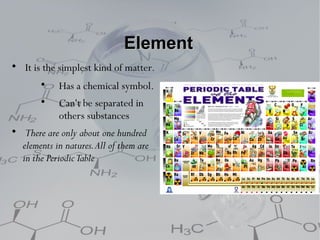
Element

    It is the simplest kind of matter.
         
              Has a chemical symbol.
         
              Can't be separated in
              others substances

     There are only about one hundred
    elements in natures. All of them are
    in the Periodic Table
Four kinds of matter

Mixtures solutions and pure substances

  • 1.
    MIXTURES, SOLUTIONS AND PURE SUBSTANCES
  • 2.
    Matter and itsappearance  According to its appearance, there are two kinds of material systems:  Homogeneus systems: they have the same properties and compositions in all different parts of them.  Heterogeneus systems: different parts with different properties can be found in them.
  • 3.
  • 4.
  • 5.
    Heterogeneus Mixtures  Systems with several different substances that can be distinguished:  Oil and water.  Granite is a rock that has three different substances: quartz, mica and felspar.  Blood: using a microscope we can see a liquid (plasma) and different kinds of cells.  Smoke: has solid particles in a gas (air).
  • 6.
    Heterogeneous Mixtures  How to separe their components: – If the components are a solid and a liquid, we can separe them by filtering. • E. g.: water and sand
  • 7.
    Heterogeneous Mixtures  How to separe their components: – Decantation: This method uses the different densities of the components to separe them: • (E.g.: oil and water)
  • 8.
    Homogeneous Systems  There are two kinds of homogeneous systems:  Pure substances: • They have an only component • They have constant composition and properties.  Solutions: • They have several components. • Their composition can be changed
  • 9.
    Solutions  A solution has, at least, two components:  Solute:  It is the component that is present in a lower quantity in the solution.  Solvent:  It is the component that is present in excess.  Its state never changes when the solution is being formed  A simple sample: salty water:  There is much more water than salt  Water is a liquid and the solution too.  SOLUTE = SALT and SOLVENT = WATER
  • 10.
    Solutions They are notalways liquids
  • 11.
    Solutions  There three kinds of solutions:  Solvent + a small amount of solute = diluid solution.  Solvent + a large amount of solute = concentrate solution.  The quantity of solute that can be dissolved has a limit (solubility). In this case we have a satured solution.  If we try to dissolve more solute in a satured solution, the extra quantity of solute will fall onto the botton of the container. (precipitation)
  • 12.
    Solutions Concentration of asolution: – Expresses, in a numeric way, the quantity of soluto un a specific quantity of solution. amountofsoluto concentration= amountofsolution There are many ways of express it, depending of the unit we use. We are going to study three of them.
  • 13.
    Solutions Concentration:grams per liter of solution. massofsoluto ( g ) concentration ( g / L )= Volumenofsolution Sample: we put 20 grams of sugar in a 500-mililiters flask and fill it in with water. In the flask, there are: 20 g of soluto (sugar) Soluto and solvent with a total volume of 500 mL = 0,5 L concentration (g/L) = 20 g / 0,5 L = 40 g/L
  • 14.
    Solutions Concentration:percentage in mass massofsoluto concentration ( mass )= · 100 massofsolution Sample: we add 25 grams of salt into a flask that contains 100 grams of water. In the flask, there are: 25 g of soluto (salt) 100 g + 25 g = 125 g of solution (salt + water) % mass = (25 g / 125 g) · 100 = 20 % in mass
  • 15.
    Solutions Concentration: percentage in volume volumeofsoluto concentration ( volume )= · 100 volumeofsolution Sample: we mixure 20 mililiters of alcohol and 130 mililiters of water: We have: 20 mL of alcohol (alcohol) 130 mL + 20 mL = 150 mL of solution (alcohol + water) % mass = (20 mL / 150 mL) · 100 = 13.3 % in volume
  • 16.
    Solutions  How to separate its components: – Evaporation and crystallization: a liquid evaporates at room temperature, but a solid doesn't.
  • 17.
    Solutions  How to separate its components: – Distillation: this method is useful to separate: • Liquids whose boiling points are different enough • Liquids and solids
  • 18.
    Pure Substances  Pure substances:  They have a constant composition.  They can't be separated in simpler substances using physical methods.  There are two different kinds of pure substances:  Chemical compounds: pure substances that can be separated in others using chemical methods.  Elements: pure substances that can't be separated in others
  • 19.
    Compound  Pure substance composed of two or more different elements joined by chemical bonds.  Made of elements in a specific ratio that is always the same  Has a chemical formula  Can only be separated by chemical means, not physically  There are millions of different compounds in nature
  • 20.
    Compound  ¿Compound or Mixture?
  • 21.
    Element  It is the simplest kind of matter.  Has a chemical symbol.  Can't be separated in others substances  There are only about one hundred elements in natures. All of them are in the Periodic Table
  • 22.
  • 23.
  • 24.