Molecular Composition of Gases Objectives State Avogadro’s Law and explain its importance Solve problems using the ideal gas law
Avogadro’s Law So far, we have studied three gas laws: Boyle’s Charles’ Gay-Lussac’s A fourth law, called  Avogadro’s Law , gives us a relationship between the  volume  of a gas and the  number of moles  of that gas (at the same temp and pressure)
Avogadro’s Law naturally, this law has a formula: V = kn where V= volume k = the proportionality constant (same for all gases) n = number of moles of gas In plain English, it states  "Equal volumes of ideal or perfect gases, at the same temperature and pressure, contain the same number of molecules."
Avogadro’s Law and its Significance Avogadro’s Law isn’t so much used to calculate as it is used to explain the relationship between the volume of any gas at STP. It has been determined that 22.41 L of argon at 0°C and 1 atm has a mass of 39.95 g Therefore, 22.41 L is the volume of 1 mole of any gas at STP.
The Ideal Gas Law No gas perfectly follows all four gas laws under all conditions. However, the assumption that they do holds true for most gases and in most conditions To study gases and their behavior then, is to assume that the gas is an “ideal” gas and follows all four gas laws (Boyle’s, Charles’, Gay-Lussac’s, & Avogadro’s)
Ideal Gases do not condense into a liquid at low temperatures do not have an attractive or repulsive force between particles is composed of particles that have no volume
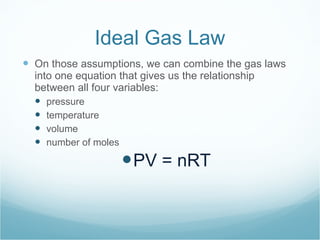
Ideal Gas Law On those assumptions, we can combine the gas laws into one equation that gives us the relationship between all four variables: pressure temperature volume number of moles PV = nRT
Ideal Gas Law PV = nRT P = pressure V = volume n = number of moles R = proportionality constant T = temperature
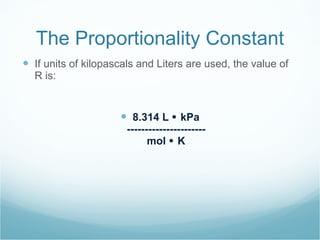
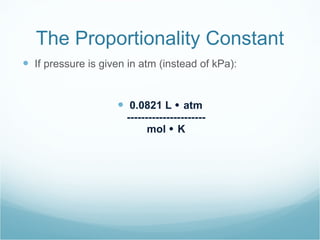
The Proportionality Constant If units of kilopascals and Liters are used, the value of R is: 8.314 L    kPa ---------------------- mol    K
The Proportionality Constant If pressure is given in atm (instead of kPa): 0.0821 L    atm ---------------------- mol    K
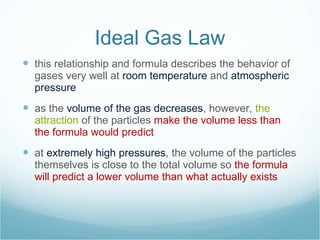
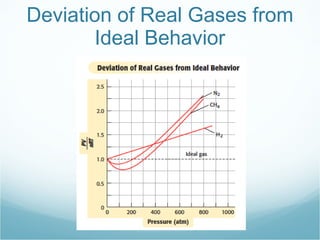
Ideal Gas Law this relationship and formula describes the behavior of gases very well at  room temperature  and  atmospheric pressure as the  volume of the gas decreases , however,  the attraction  of the particles  make the volume less than the formula would predict at  extremely high pressures , the volume of the particles themselves is close to the total volume so  the formula will predict a lower volume than what actually exists
Deviation of Real Gases from Ideal Behavior
Practice Using Ideal Gas Law pg 435 # 1 - 4

Ideal Gas Law

  • 1.
    Molecular Composition ofGases Objectives State Avogadro’s Law and explain its importance Solve problems using the ideal gas law
  • 2.
    Avogadro’s Law Sofar, we have studied three gas laws: Boyle’s Charles’ Gay-Lussac’s A fourth law, called Avogadro’s Law , gives us a relationship between the volume of a gas and the number of moles of that gas (at the same temp and pressure)
  • 3.
    Avogadro’s Law naturally,this law has a formula: V = kn where V= volume k = the proportionality constant (same for all gases) n = number of moles of gas In plain English, it states "Equal volumes of ideal or perfect gases, at the same temperature and pressure, contain the same number of molecules."
  • 4.
    Avogadro’s Law andits Significance Avogadro’s Law isn’t so much used to calculate as it is used to explain the relationship between the volume of any gas at STP. It has been determined that 22.41 L of argon at 0°C and 1 atm has a mass of 39.95 g Therefore, 22.41 L is the volume of 1 mole of any gas at STP.
  • 5.
    The Ideal GasLaw No gas perfectly follows all four gas laws under all conditions. However, the assumption that they do holds true for most gases and in most conditions To study gases and their behavior then, is to assume that the gas is an “ideal” gas and follows all four gas laws (Boyle’s, Charles’, Gay-Lussac’s, & Avogadro’s)
  • 6.
    Ideal Gases donot condense into a liquid at low temperatures do not have an attractive or repulsive force between particles is composed of particles that have no volume
  • 7.
    Ideal Gas LawOn those assumptions, we can combine the gas laws into one equation that gives us the relationship between all four variables: pressure temperature volume number of moles PV = nRT
  • 8.
    Ideal Gas LawPV = nRT P = pressure V = volume n = number of moles R = proportionality constant T = temperature
  • 9.
    The Proportionality ConstantIf units of kilopascals and Liters are used, the value of R is: 8.314 L  kPa ---------------------- mol  K
  • 10.
    The Proportionality ConstantIf pressure is given in atm (instead of kPa): 0.0821 L  atm ---------------------- mol  K
  • 11.
    Ideal Gas Lawthis relationship and formula describes the behavior of gases very well at room temperature and atmospheric pressure as the volume of the gas decreases , however, the attraction of the particles make the volume less than the formula would predict at extremely high pressures , the volume of the particles themselves is close to the total volume so the formula will predict a lower volume than what actually exists
  • 12.
    Deviation of RealGases from Ideal Behavior
  • 13.
    Practice Using IdealGas Law pg 435 # 1 - 4