Chapter 5
Work, Energy and Power

01/22/14

IB Physics (IC NL)

1
ENERGY




Energy is the crown for physics. It is
found in every branch of physics.
Definition: Energy is the capacity of a
physical system to perform work.
Energy exists in several forms such as
heat, kinetic or mechanical energy,
light, potential energy, electrical, solar
wind, hydroelectric or other forms.

01/22/14

IB Physics (IC NL)

2
Some Energy Considerations




Energy can be transformed from one
form to another
 Essential to the study of physics,
chemistry, biology, geology,
astronomy and other topics.
Can be used in place of Newton’s laws
to solve certain problems more simply

01/22/14

IB Physics (IC NL)

3
Forms of Energy







The type of energy to be covered in this
power point is the Mechanical Energy.
In order to fully cover the subject we
have to start with work,
Then study energy,
And later relate them together.

01/22/14

IB Physics (IC NL)

4
×
∆

Work




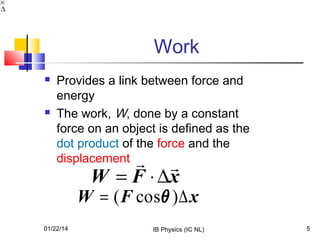
Provides a link between force and
energy
The work, W, done by a constant
force on an object is defined as the
dot product of the force and the
displacement 


W = F ⋅ ∆x

W = ( F cosθ )∆ x
01/22/14

IB Physics (IC NL)

5
Work, cont.
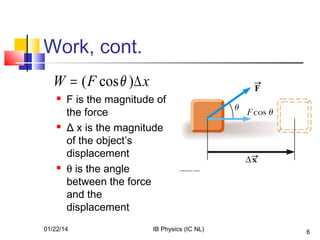
W = ( F cos θ )∆ x






F is the magnitude of
the force
Δ x is the magnitude
of the object’s
displacement
θ is the angle
between the force
and the
displacement

01/22/14

IB Physics (IC NL)

6
Work, cont.


This gives no information about






the time it took for the displacement to
occur
the velocity or acceleration of the object

Work is a scalar quantity

01/22/14

IB Physics (IC NL)

7
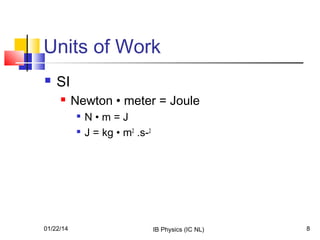
Units of Work


SI


Newton • meter = Joule



01/22/14

N•m=J
J = kg • m2 .s-2

IB Physics (IC NL)

8
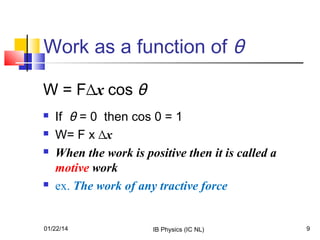
Work as a function of θ
W = F∆x cos θ






If θ = 0 then cos 0 = 1
W= F x ∆x
When the work is positive then it is called a
motive work
ex. The work of any tractive force

01/22/14

IB Physics (IC NL)

9
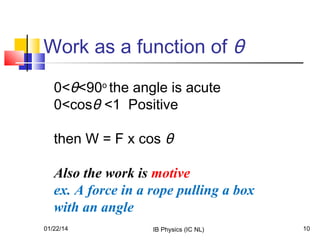
Work as a function of θ
0<θ<90o the angle is acute
0<cosθ <1 Positive
then W = F x cos θ
Also the work is motive
ex. A force in a rope pulling a box
with an angle
01/22/14

IB Physics (IC NL)

10
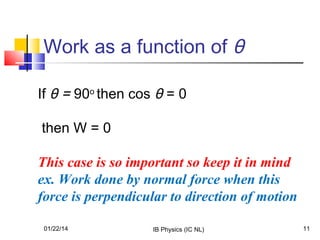
Work as a function of θ
If θ = 90o then cos θ = 0
then W = 0
This case is so important so keep it in mind
ex. Work done by normal force when this
force is perpendicular to direction of motion
01/22/14

IB Physics (IC NL)

11
Work as a function of θ
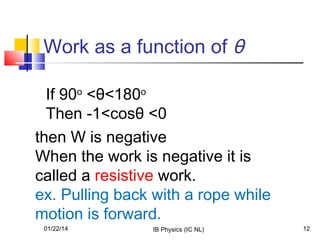
If 90o <θ<180o
Then -1<cosθ <0
then W is negative
When the work is negative it is
called a resistive work.
ex. Pulling back with a rope while
motion is forward.
01/22/14

IB Physics (IC NL)

12
Work as a function of θ
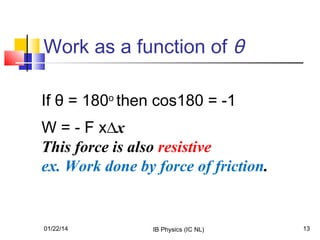
If θ = 180o then cos180 = -1
W = - F x∆x
This force is also resistive
ex. Work done by force of friction.

01/22/14

IB Physics (IC NL)

13
Conclusion






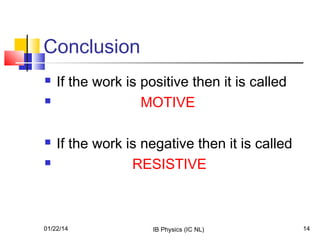
If the work is positive then it is called
MOTIVE
If the work is negative then it is called
RESISTIVE

01/22/14

IB Physics (IC NL)

14
More About Work


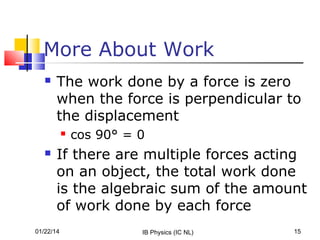
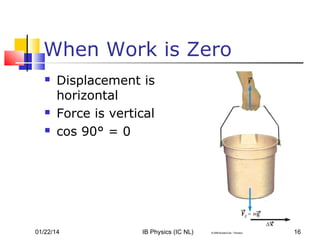
The work done by a force is zero
when the force is perpendicular to
the displacement




cos 90° = 0

If there are multiple forces acting
on an object, the total work done
is the algebraic sum of the amount
of work done by each force

01/22/14

IB Physics (IC NL)

15
When Work is Zero





Displacement is
horizontal
Force is vertical
cos 90° = 0

01/22/14

IB Physics (IC NL)

16
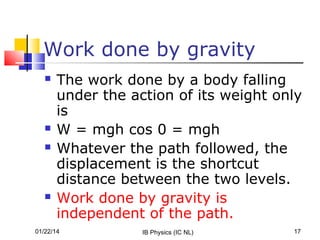
Work done by gravity







The work done by a body falling
under the action of its weight only
is
W = mgh cos 0 = mgh
Whatever the path followed, the
displacement is the shortcut
distance between the two levels.
Work done by gravity is
independent of the path.

01/22/14

IB Physics (IC NL)

17
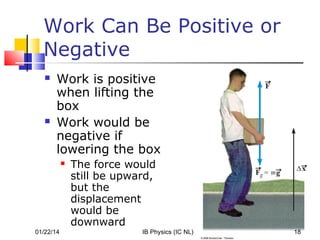
Work Can Be Positive or
Negative




Work is positive
when lifting the
box
Work would be
negative if
lowering the box


01/22/14

The force would
still be upward,
but the
displacement
would be
downward

IB Physics (IC NL)

18
Work and Dissipative
Forces



Work can be done by friction
The energy lost to friction by an
object goes into heating both the
object and its environment
 So energy may be converted into
heat, sound or light.

01/22/14

IB Physics (IC NL)

19
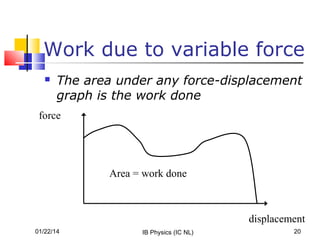
Work due to variable force


The area under any force-displacement
graph is the work done

force

Area = work done

displacement
01/22/14

IB Physics (IC NL)

20
Energy
Is the ability to do work
 Work and energy are
interchangeable even they
have the same unit the
joule (J)


01/22/14

IB Physics (IC NL)

21
Mechanical Energy


It could be one of two types or
their sum:
1- Kinetic Energy
2- Potential energy which is, from
a mechanical point of view,
of two types:
a- Gravitational P.E.
b- Elastic P.E.

01/22/14

IB Physics (IC NL)

22
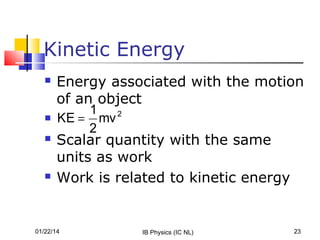
Kinetic Energy







Energy associated with the motion
of an object
1
KE = mv 2
2

Scalar quantity with the same
units as work
Work is related to kinetic energy

01/22/14

IB Physics (IC NL)

23
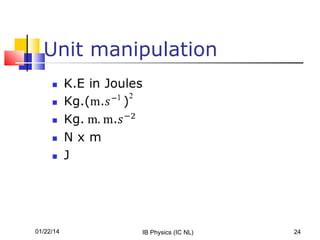
Unit manipulation

01/22/14

IB Physics (IC NL)

24
Work-Kinetic Energy
Theorem




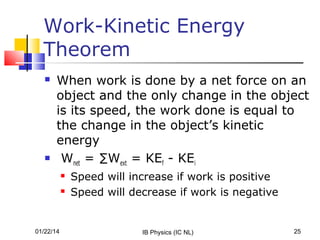
When work is done by a net force on an
object and the only change in the object
is its speed, the work done is equal to
the change in the object’s kinetic
energy
Wnet = ∑Wext = KEf - KEi



01/22/14

Speed will increase if work is positive
Speed will decrease if work is negative

IB Physics (IC NL)

25
Work and Kinetic Energy


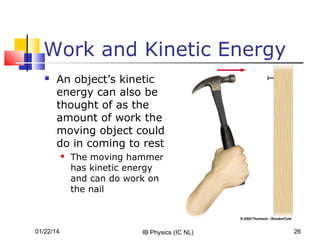
An object’s kinetic
energy can also be
thought of as the
amount of work the
moving object could
do in coming to rest


01/22/14

The moving hammer
has kinetic energy
and can do work on
the nail

IB Physics (IC NL)

26
Potential Energy


Potential energy is associated with
the position of the object within
some system




01/22/14

Potential energy is a property of the
system, not the object
A system is a collection of objects
interacting via forces or processes
that are internal to the system
IB Physics (IC NL)

27
Gravitational Potential
Energy


Gravitational Potential Energy is
the energy associated with the
relative position of an object in
space near the Earth’s surface




01/22/14

Objects interact with the earth
through the gravitational force
Actually the potential energy is for
the earth-object system
IB Physics (IC NL)

28
Reference level for G.P.E.





Whenever gravitational potential
energy is mentioned there should
be a chosen reference level
relative to which the energy must
be studied.
G.P.E. = mgh
mg is the weight and h is the
height

01/22/14

IB Physics (IC NL)

29
Work and Gravitational
Potential Energy
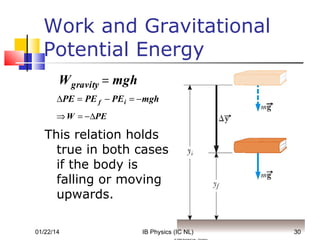
W gravity = mgh
∆PE = PE f − PE i = − mgh

∆

⇒ W = − ∆PE

This relation holds
true in both cases
if the body is
falling or moving
upwards.
01/22/14

IB Physics (IC NL)

30
Work-Energy Theorem,
Extended






The work-energy theorem can be
extended to include potential energy:
W = (KEf – KEi) + (PEf – PEi)
If other conservative forces are present,
potential energy functions can be
developed for them and their change in
that potential energy added to the right
side of the equation

01/22/14

IB Physics (IC NL)

31
Reference Levels for
Gravitational Potential Energy


A location where the gravitational
potential energy is zero must be chosen
for each problem




The choice is arbitrary since the change in
the potential energy is the important
quantity
Choose a convenient location for the zero
reference height





01/22/14

often the Earth’s surface
may be some other point suggested by the
problem

Once the position is chosen, it must remain
fixed for the entire problem
IB Physics (IC NL)

32
Conservation of
Mechanical Energy


Conservation in general




To say a physical quantity is conserved is to
say that the numerical value of the quantity
remains constant throughout any physical
process

In Conservation of Energy, the total
mechanical energy remains constant


01/22/14

In any isolated system of objects interacting
only through conservative forces, the total
mechanical energy of the system remains
constant.
IB Physics (IC NL)

33
Conservation of Energy,
cont.


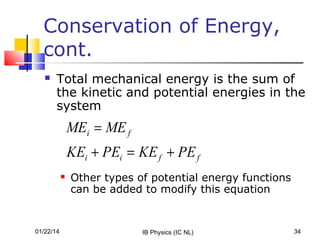
Total mechanical energy is the sum of
the kinetic and potential energies in the
system

MEi = ME f
KEi + PEi = KE f + PE f


01/22/14

Other types of potential energy functions
can be added to modify this equation

IB Physics (IC NL)

34
Conservation cont.


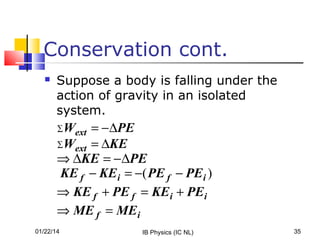
Suppose a body is falling under the
action of gravity in an isolated
system.

Wext = − ∆PE
∑W
ext = ∆KE
⇒ ∆KE = − ∆PE
KE f − KE i = −( PE f − PE i )
⇒ KE f + PE f = KE i + PEi
⇒ ME f = ME i
∑

01/22/14

IB Physics (IC NL)

35
Problem Solving with
Conservation of Energy



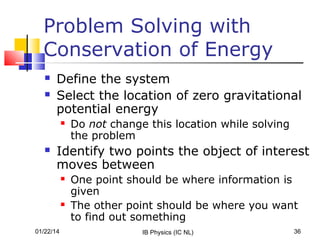
Define the system
Select the location of zero gravitational
potential energy




Do not change this location while solving
the problem

Identify two points the object of interest
moves between




01/22/14

One point should be where information is
given
The other point should be where you want
to find out something
IB Physics (IC NL)

36
Problem Solving, cont




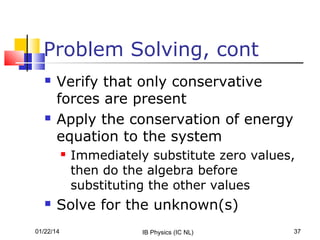
Verify that only conservative
forces are present
Apply the conservation of energy
equation to the system




Immediately substitute zero values,
then do the algebra before
substituting the other values

Solve for the unknown(s)

01/22/14

IB Physics (IC NL)

37
Potential Energy Stored in
a Spring



Involves the spring constant, k
Hooke’s Law gives the force


F=-kx




01/22/14

F is the restoring force
F is in the opposite direction of x
k depends on how the spring was
formed, the material it is made from,
thickness of the wire, etc. (unit N/m)

IB Physics (IC NL)

38
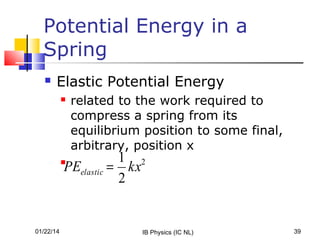
Potential Energy in a
Spring


Elastic Potential Energy


related to the work required to
compress a spring from its
equilibrium position to some final,
arbitrary, position x

1 2
PEelastic = kx
2



01/22/14

IB Physics (IC NL)

39
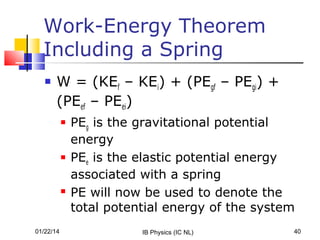
Work-Energy Theorem
Including a Spring


W = (KEf – KEi) + (PEgf – PEgi) +
(PEef – PEei)






01/22/14

PEg is the gravitational potential
energy
PEe is the elastic potential energy
associated with a spring
PE will now be used to denote the
total potential energy of the system
IB Physics (IC NL)

40
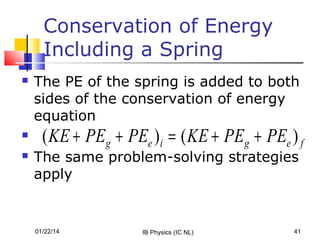
Conservation of Energy
Including a Spring





The PE of the spring is added to both
sides of the conservation of energy
equation

( KE + PEg + PEe )i = ( KE + PEg + PEe ) f

The same problem-solving strategies
apply

01/22/14

IB Physics (IC NL)

41
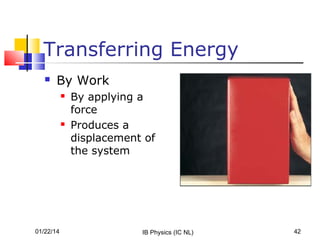
Transferring Energy


By Work




01/22/14

By applying a
force
Produces a
displacement of
the system

IB Physics (IC NL)

42
Transferring Energy


Heat




01/22/14

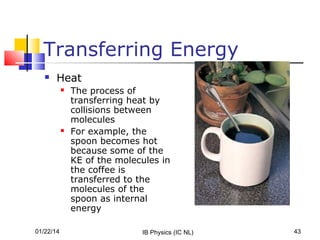
The process of
transferring heat by
collisions between
molecules
For example, the
spoon becomes hot
because some of the
KE of the molecules in
the coffee is
transferred to the
molecules of the
spoon as internal
energy
IB Physics (IC NL)

43
Transferring Energy


Mechanical Waves




01/22/14

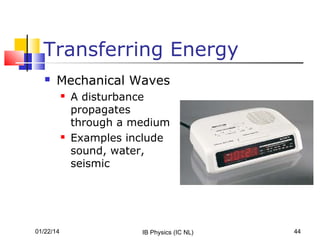
A disturbance
propagates
through a medium
Examples include
sound, water,
seismic

IB Physics (IC NL)

44
Transferring Energy


Electrical
transmission




01/22/14

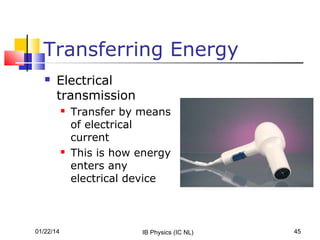
Transfer by means
of electrical
current
This is how energy
enters any
electrical device

IB Physics (IC NL)

45
Transferring Energy


Electromagnetic
radiation


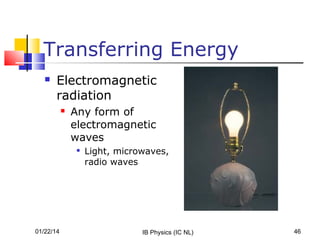
Any form of
electromagnetic
waves


01/22/14

Light, microwaves,
radio waves

IB Physics (IC NL)

46
Notes About Conservation
of Energy


We can neither create nor destroy
energy






01/22/14

Another way of saying energy is
conserved
If the total energy of the system does
not remain constant, the energy must
have crossed the boundary by some
mechanism
Applies to areas other than physics
IB Physics (IC NL)

47
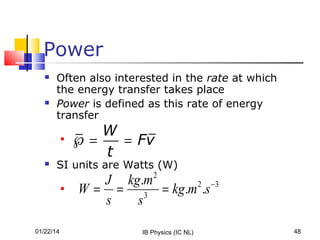
Power




Often also interested in the rate at which
the energy transfer takes place
Power is defined as this rate of energy
transfer




W
℘=
= Fv
t

SI units are Watts (W)


01/22/14

J kg.m 2
W = = 3 = kg.m 2 .s − 3
s
s
IB Physics (IC NL)

48
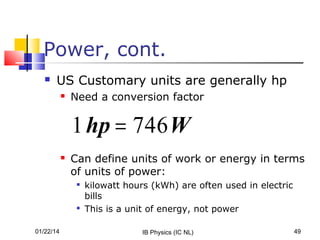
Power, cont.


US Customary units are generally hp


Need a conversion factor

1 hp = 746 W


Can define units of work or energy in terms
of units of power:




01/22/14

kilowatt hours (kWh) are often used in electric
bills
This is a unit of energy, not power
IB Physics (IC NL)

49
Efficiency






01/22/14

Efficiency is defined as the ratio of
the useful output to the total input
This can be calculated using
energy or power values as long as
you are consistent
Efficiency is normally expressed as
a percentage
IB Physics (IC NL)

50
Spring Example





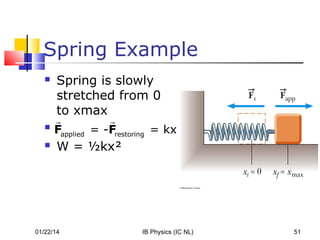
Spring is slowly
stretched from 0
to xmax

r
r
Fapplied = -Frestoring = kx

W = ½kx²

01/22/14

IB Physics (IC NL)

51
Spring Example, cont.






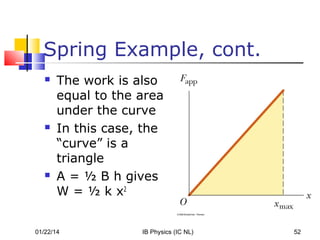
The work is also
equal to the area
under the curve
In this case, the
“curve” is a
triangle
A = ½ B h gives
W = ½ k x2

01/22/14

IB Physics (IC NL)

52

Work, energy and power

  • 1.
    Chapter 5 Work, Energyand Power 01/22/14 IB Physics (IC NL) 1
  • 2.
    ENERGY   Energy is thecrown for physics. It is found in every branch of physics. Definition: Energy is the capacity of a physical system to perform work. Energy exists in several forms such as heat, kinetic or mechanical energy, light, potential energy, electrical, solar wind, hydroelectric or other forms. 01/22/14 IB Physics (IC NL) 2
  • 3.
    Some Energy Considerations   Energycan be transformed from one form to another  Essential to the study of physics, chemistry, biology, geology, astronomy and other topics. Can be used in place of Newton’s laws to solve certain problems more simply 01/22/14 IB Physics (IC NL) 3
  • 4.
    Forms of Energy     Thetype of energy to be covered in this power point is the Mechanical Energy. In order to fully cover the subject we have to start with work, Then study energy, And later relate them together. 01/22/14 IB Physics (IC NL) 4
  • 5.
    × ∆ Work   Provides a linkbetween force and energy The work, W, done by a constant force on an object is defined as the dot product of the force and the displacement   W = F ⋅ ∆x W = ( F cosθ )∆ x 01/22/14 IB Physics (IC NL) 5
  • 6.
    Work, cont. W =( F cos θ )∆ x    F is the magnitude of the force Δ x is the magnitude of the object’s displacement θ is the angle between the force and the displacement 01/22/14 IB Physics (IC NL) 6
  • 7.
    Work, cont.  This givesno information about    the time it took for the displacement to occur the velocity or acceleration of the object Work is a scalar quantity 01/22/14 IB Physics (IC NL) 7
  • 8.
    Units of Work  SI  Newton• meter = Joule   01/22/14 N•m=J J = kg • m2 .s-2 IB Physics (IC NL) 8
  • 9.
    Work as afunction of θ W = F∆x cos θ     If θ = 0 then cos 0 = 1 W= F x ∆x When the work is positive then it is called a motive work ex. The work of any tractive force 01/22/14 IB Physics (IC NL) 9
  • 10.
    Work as afunction of θ 0<θ<90o the angle is acute 0<cosθ <1 Positive then W = F x cos θ Also the work is motive ex. A force in a rope pulling a box with an angle 01/22/14 IB Physics (IC NL) 10
  • 11.
    Work as afunction of θ If θ = 90o then cos θ = 0 then W = 0 This case is so important so keep it in mind ex. Work done by normal force when this force is perpendicular to direction of motion 01/22/14 IB Physics (IC NL) 11
  • 12.
    Work as afunction of θ If 90o <θ<180o Then -1<cosθ <0 then W is negative When the work is negative it is called a resistive work. ex. Pulling back with a rope while motion is forward. 01/22/14 IB Physics (IC NL) 12
  • 13.
    Work as afunction of θ If θ = 180o then cos180 = -1 W = - F x∆x This force is also resistive ex. Work done by force of friction. 01/22/14 IB Physics (IC NL) 13
  • 14.
    Conclusion     If the workis positive then it is called MOTIVE If the work is negative then it is called RESISTIVE 01/22/14 IB Physics (IC NL) 14
  • 15.
    More About Work  Thework done by a force is zero when the force is perpendicular to the displacement   cos 90° = 0 If there are multiple forces acting on an object, the total work done is the algebraic sum of the amount of work done by each force 01/22/14 IB Physics (IC NL) 15
  • 16.
    When Work isZero    Displacement is horizontal Force is vertical cos 90° = 0 01/22/14 IB Physics (IC NL) 16
  • 17.
    Work done bygravity     The work done by a body falling under the action of its weight only is W = mgh cos 0 = mgh Whatever the path followed, the displacement is the shortcut distance between the two levels. Work done by gravity is independent of the path. 01/22/14 IB Physics (IC NL) 17
  • 18.
    Work Can BePositive or Negative   Work is positive when lifting the box Work would be negative if lowering the box  01/22/14 The force would still be upward, but the displacement would be downward IB Physics (IC NL) 18
  • 19.
    Work and Dissipative Forces   Workcan be done by friction The energy lost to friction by an object goes into heating both the object and its environment  So energy may be converted into heat, sound or light. 01/22/14 IB Physics (IC NL) 19
  • 20.
    Work due tovariable force  The area under any force-displacement graph is the work done force Area = work done displacement 01/22/14 IB Physics (IC NL) 20
  • 21.
    Energy Is the abilityto do work  Work and energy are interchangeable even they have the same unit the joule (J)  01/22/14 IB Physics (IC NL) 21
  • 22.
    Mechanical Energy  It couldbe one of two types or their sum: 1- Kinetic Energy 2- Potential energy which is, from a mechanical point of view, of two types: a- Gravitational P.E. b- Elastic P.E. 01/22/14 IB Physics (IC NL) 22
  • 23.
    Kinetic Energy     Energy associatedwith the motion of an object 1 KE = mv 2 2 Scalar quantity with the same units as work Work is related to kinetic energy 01/22/14 IB Physics (IC NL) 23
  • 24.
  • 25.
    Work-Kinetic Energy Theorem   When workis done by a net force on an object and the only change in the object is its speed, the work done is equal to the change in the object’s kinetic energy Wnet = ∑Wext = KEf - KEi   01/22/14 Speed will increase if work is positive Speed will decrease if work is negative IB Physics (IC NL) 25
  • 26.
    Work and KineticEnergy  An object’s kinetic energy can also be thought of as the amount of work the moving object could do in coming to rest  01/22/14 The moving hammer has kinetic energy and can do work on the nail IB Physics (IC NL) 26
  • 27.
    Potential Energy  Potential energyis associated with the position of the object within some system   01/22/14 Potential energy is a property of the system, not the object A system is a collection of objects interacting via forces or processes that are internal to the system IB Physics (IC NL) 27
  • 28.
    Gravitational Potential Energy  Gravitational PotentialEnergy is the energy associated with the relative position of an object in space near the Earth’s surface   01/22/14 Objects interact with the earth through the gravitational force Actually the potential energy is for the earth-object system IB Physics (IC NL) 28
  • 29.
    Reference level forG.P.E.    Whenever gravitational potential energy is mentioned there should be a chosen reference level relative to which the energy must be studied. G.P.E. = mgh mg is the weight and h is the height 01/22/14 IB Physics (IC NL) 29
  • 30.
    Work and Gravitational PotentialEnergy W gravity = mgh ∆PE = PE f − PE i = − mgh ∆ ⇒ W = − ∆PE This relation holds true in both cases if the body is falling or moving upwards. 01/22/14 IB Physics (IC NL) 30
  • 31.
    Work-Energy Theorem, Extended    The work-energytheorem can be extended to include potential energy: W = (KEf – KEi) + (PEf – PEi) If other conservative forces are present, potential energy functions can be developed for them and their change in that potential energy added to the right side of the equation 01/22/14 IB Physics (IC NL) 31
  • 32.
    Reference Levels for GravitationalPotential Energy  A location where the gravitational potential energy is zero must be chosen for each problem   The choice is arbitrary since the change in the potential energy is the important quantity Choose a convenient location for the zero reference height    01/22/14 often the Earth’s surface may be some other point suggested by the problem Once the position is chosen, it must remain fixed for the entire problem IB Physics (IC NL) 32
  • 33.
    Conservation of Mechanical Energy  Conservationin general   To say a physical quantity is conserved is to say that the numerical value of the quantity remains constant throughout any physical process In Conservation of Energy, the total mechanical energy remains constant  01/22/14 In any isolated system of objects interacting only through conservative forces, the total mechanical energy of the system remains constant. IB Physics (IC NL) 33
  • 34.
    Conservation of Energy, cont.  Totalmechanical energy is the sum of the kinetic and potential energies in the system MEi = ME f KEi + PEi = KE f + PE f  01/22/14 Other types of potential energy functions can be added to modify this equation IB Physics (IC NL) 34
  • 35.
    Conservation cont.  Suppose abody is falling under the action of gravity in an isolated system. Wext = − ∆PE ∑W ext = ∆KE ⇒ ∆KE = − ∆PE KE f − KE i = −( PE f − PE i ) ⇒ KE f + PE f = KE i + PEi ⇒ ME f = ME i ∑ 01/22/14 IB Physics (IC NL) 35
  • 36.
    Problem Solving with Conservationof Energy   Define the system Select the location of zero gravitational potential energy   Do not change this location while solving the problem Identify two points the object of interest moves between   01/22/14 One point should be where information is given The other point should be where you want to find out something IB Physics (IC NL) 36
  • 37.
    Problem Solving, cont   Verifythat only conservative forces are present Apply the conservation of energy equation to the system   Immediately substitute zero values, then do the algebra before substituting the other values Solve for the unknown(s) 01/22/14 IB Physics (IC NL) 37
  • 38.
    Potential Energy Storedin a Spring   Involves the spring constant, k Hooke’s Law gives the force  F=-kx    01/22/14 F is the restoring force F is in the opposite direction of x k depends on how the spring was formed, the material it is made from, thickness of the wire, etc. (unit N/m) IB Physics (IC NL) 38
  • 39.
    Potential Energy ina Spring  Elastic Potential Energy  related to the work required to compress a spring from its equilibrium position to some final, arbitrary, position x 1 2 PEelastic = kx 2  01/22/14 IB Physics (IC NL) 39
  • 40.
    Work-Energy Theorem Including aSpring  W = (KEf – KEi) + (PEgf – PEgi) + (PEef – PEei)    01/22/14 PEg is the gravitational potential energy PEe is the elastic potential energy associated with a spring PE will now be used to denote the total potential energy of the system IB Physics (IC NL) 40
  • 41.
    Conservation of Energy Includinga Spring    The PE of the spring is added to both sides of the conservation of energy equation ( KE + PEg + PEe )i = ( KE + PEg + PEe ) f The same problem-solving strategies apply 01/22/14 IB Physics (IC NL) 41
  • 42.
    Transferring Energy  By Work   01/22/14 Byapplying a force Produces a displacement of the system IB Physics (IC NL) 42
  • 43.
    Transferring Energy  Heat   01/22/14 The processof transferring heat by collisions between molecules For example, the spoon becomes hot because some of the KE of the molecules in the coffee is transferred to the molecules of the spoon as internal energy IB Physics (IC NL) 43
  • 44.
    Transferring Energy  Mechanical Waves   01/22/14 Adisturbance propagates through a medium Examples include sound, water, seismic IB Physics (IC NL) 44
  • 45.
    Transferring Energy  Electrical transmission   01/22/14 Transfer bymeans of electrical current This is how energy enters any electrical device IB Physics (IC NL) 45
  • 46.
    Transferring Energy  Electromagnetic radiation  Any formof electromagnetic waves  01/22/14 Light, microwaves, radio waves IB Physics (IC NL) 46
  • 47.
    Notes About Conservation ofEnergy  We can neither create nor destroy energy    01/22/14 Another way of saying energy is conserved If the total energy of the system does not remain constant, the energy must have crossed the boundary by some mechanism Applies to areas other than physics IB Physics (IC NL) 47
  • 48.
    Power   Often also interestedin the rate at which the energy transfer takes place Power is defined as this rate of energy transfer   W ℘= = Fv t SI units are Watts (W)  01/22/14 J kg.m 2 W = = 3 = kg.m 2 .s − 3 s s IB Physics (IC NL) 48
  • 49.
    Power, cont.  US Customaryunits are generally hp  Need a conversion factor 1 hp = 746 W  Can define units of work or energy in terms of units of power:   01/22/14 kilowatt hours (kWh) are often used in electric bills This is a unit of energy, not power IB Physics (IC NL) 49
  • 50.
    Efficiency    01/22/14 Efficiency is definedas the ratio of the useful output to the total input This can be calculated using energy or power values as long as you are consistent Efficiency is normally expressed as a percentage IB Physics (IC NL) 50
  • 51.
    Spring Example    Spring isslowly stretched from 0 to xmax r r Fapplied = -Frestoring = kx W = ½kx² 01/22/14 IB Physics (IC NL) 51
  • 52.
    Spring Example, cont.    Thework is also equal to the area under the curve In this case, the “curve” is a triangle A = ½ B h gives W = ½ k x2 01/22/14 IB Physics (IC NL) 52