IDEAL GAS & LAWS
PRESENTED BY
FARHAN QASIM
SALIHA MUNIR
NIDA NADEEM
ASSIGNED BY
DR. NOSHEEN AKBAR
OUTLINE
HISTORY OF IDEAL GAS
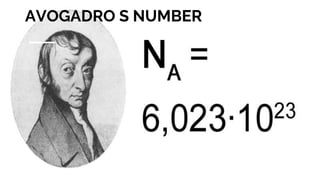
AVOGADRO S NUMBER
IDEAL GAS
REAL GAS
IDEAL GAS LAW
BOLTZMANN CONSTANT
WORK DONE BY IDEAL GAS AT CONSTANT TEMP/
VOLUME / PRESSURE
Applications of varoius LAWS
HISTORY OF IDEAL GAS
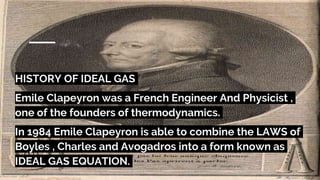
Emile Clapeyron was a French Engineer And Physicist ,
one of the founders of thermodynamics.
In 1984 Emile Clapeyron is able to combine the LAWS of
Boyles , Charles and Avogadros into a form known as
IDEAL GAS EQUATION.
AVOGADRO S NUMBER
CARBON 12
One mole of a substance
contains as many particles as
there are atoms in 12 grams of
the isotope cabron-12.
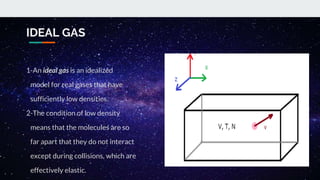
IDEAL GAS
1-An ideal gas is an idealized
model for real gases that have
sufficiently low densities.
2-The condition of low density
means that the molecules are so
far apart that they do not interact
except during collisions, which are
effectively elastic.
If ideal gases are not exist in nature then why we
study ideal gases?
1. Because many gases under usual pressures
behave almost like an ideal gas
1. Ideal conditions required for a gas to be
Ideal do not exist, that s why Ideal gases
do not exist in practical life
Real Gases
Real gases are non-
hypothetical gases whose
molecules occupy space
and have interactions;
consequently, they adhere
to gas laws.
IDEAL GAS LAW
The Ideal Gas Law. The volume (V) occupied by n
moles of any gas has a pressure (P) at
temperature (T) in Kelvin. The relationship for
these variables, P V = n R T, where R is known as
the gas constant, is called the ideal gas law or
equation of state.
UNIVERSAL GAS CONSTANT (R)
The gas constant R is 8.314 J
/ mol. K
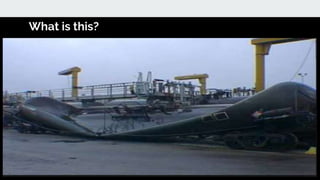
What is this?
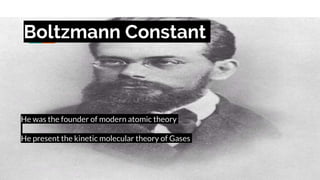
Boltzmann Constant
He was the founder of modern atomic theory
He present the kinetic molecular theory of Gases
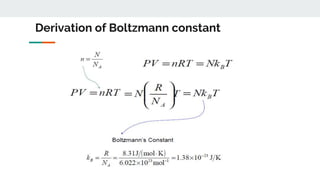
Derivation of Boltzmann constant
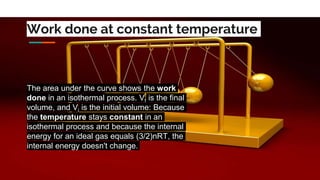
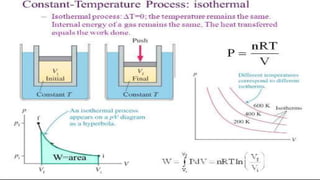
Work done at constant temperature
The area under the curve shows the work
done in an isothermal process. Vf is the final
volume, and Vi is the initial volume: Because
the temperature stays constant in an
isothermal process and because the internal
energy for an ideal gas equals (3/2)nRT, the
internal energy doesn't change.
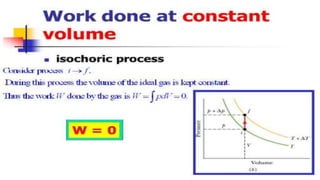
The pressure is constant, the force exerted is constant and the work
done is given as PΔV. An isobaric expansion of a gas requires heat
transfer to keep the pressure constant. An isochoric process is one in
which the volume is held constant, meaning that the work done by the
system will be zero.
Work done at constant volume and pressure
Application of Ideal Gas Law
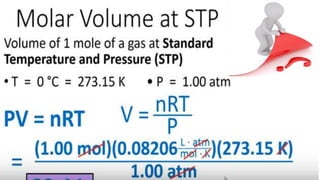
❖ 1-Molar volume of gas at STP
❖ The volume of one mole of a Gas at standard temperature and
pressure (STP)
❖ Temperature (T)= 0C = 273.15k
❖ Pressure (P) = 1.00 atm
❖ For comapring any two gases its impotant that bpoth gases shuold
have the same SATANDERD CONDITIONS
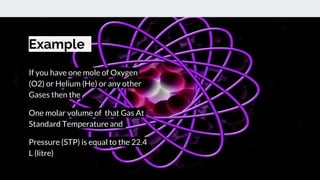
Example
If you have one mole of Oxygen
(O2) or Helium (He) or any other
Gases then the
One molar volume of that Gas At
Standard Temperature and
Pressure (STP) is equal to the 22.4
L (litre)
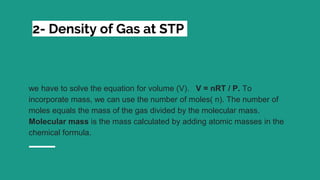
2- Density of Gas at STP
we have to solve the equation for volume (V). V = nRT / P. To
incorporate mass, we can use the number of moles( n). The number of
moles equals the mass of the gas divided by the molecular mass.
Molecular mass is the mass calculated by adding atomic masses in the
chemical formula.
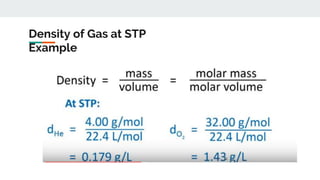
Density of Gas at STP
Example
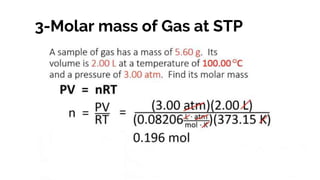
3-Molar mass of Gas at STP
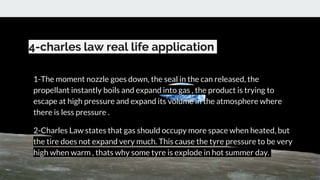
4-charles law real life application
1-The moment nozzle goes down, the seal in the can released, the
propellant instantly boils and expand into gas , the product is trying to
escape at high pressure and expand its volume in the atmosphere where
there is less pressure .
2-Charles Law states that gas should occupy more space when heated, but
the tire does not expand very much. This cause the tyre pressure to be very
high when warm , thats why some tyre is explode in hot summer day.
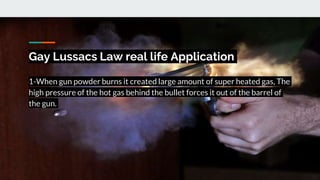
Gay Lussacs Law real life Application
1-When gun powder burns it created large amount of super heated gas, The
high pressure of the hot gas behind the bullet forces it out of the barrel of
the gun.
Avogadros real life application
When we breathe molecules fill up our lungs and it expand, exhaling
decreases the volume of our lungs
IDEAL GAS AND LAWS
IDEAL GAS AND LAWS

IDEAL GAS AND LAWS

  • 1.
    IDEAL GAS &LAWS PRESENTED BY FARHAN QASIM SALIHA MUNIR NIDA NADEEM ASSIGNED BY DR. NOSHEEN AKBAR
  • 2.
    OUTLINE HISTORY OF IDEALGAS AVOGADRO S NUMBER IDEAL GAS REAL GAS IDEAL GAS LAW BOLTZMANN CONSTANT WORK DONE BY IDEAL GAS AT CONSTANT TEMP/ VOLUME / PRESSURE Applications of varoius LAWS
  • 3.
    HISTORY OF IDEALGAS Emile Clapeyron was a French Engineer And Physicist , one of the founders of thermodynamics. In 1984 Emile Clapeyron is able to combine the LAWS of Boyles , Charles and Avogadros into a form known as IDEAL GAS EQUATION.
  • 4.
  • 5.
    CARBON 12 One moleof a substance contains as many particles as there are atoms in 12 grams of the isotope cabron-12.
  • 6.
    IDEAL GAS 1-An idealgas is an idealized model for real gases that have sufficiently low densities. 2-The condition of low density means that the molecules are so far apart that they do not interact except during collisions, which are effectively elastic.
  • 7.
    If ideal gasesare not exist in nature then why we study ideal gases?
  • 8.
    1. Because manygases under usual pressures behave almost like an ideal gas 1. Ideal conditions required for a gas to be Ideal do not exist, that s why Ideal gases do not exist in practical life
  • 9.
    Real Gases Real gasesare non- hypothetical gases whose molecules occupy space and have interactions; consequently, they adhere to gas laws.
  • 10.
    IDEAL GAS LAW TheIdeal Gas Law. The volume (V) occupied by n moles of any gas has a pressure (P) at temperature (T) in Kelvin. The relationship for these variables, P V = n R T, where R is known as the gas constant, is called the ideal gas law or equation of state.
  • 11.
    UNIVERSAL GAS CONSTANT(R) The gas constant R is 8.314 J / mol. K
  • 12.
  • 13.
    Boltzmann Constant He wasthe founder of modern atomic theory He present the kinetic molecular theory of Gases
  • 14.
  • 15.
    Work done atconstant temperature The area under the curve shows the work done in an isothermal process. Vf is the final volume, and Vi is the initial volume: Because the temperature stays constant in an isothermal process and because the internal energy for an ideal gas equals (3/2)nRT, the internal energy doesn't change.
  • 17.
    The pressure isconstant, the force exerted is constant and the work done is given as PΔV. An isobaric expansion of a gas requires heat transfer to keep the pressure constant. An isochoric process is one in which the volume is held constant, meaning that the work done by the system will be zero. Work done at constant volume and pressure
  • 19.
    Application of IdealGas Law ❖ 1-Molar volume of gas at STP ❖ The volume of one mole of a Gas at standard temperature and pressure (STP) ❖ Temperature (T)= 0C = 273.15k ❖ Pressure (P) = 1.00 atm ❖ For comapring any two gases its impotant that bpoth gases shuold have the same SATANDERD CONDITIONS
  • 21.
    Example If you haveone mole of Oxygen (O2) or Helium (He) or any other Gases then the One molar volume of that Gas At Standard Temperature and Pressure (STP) is equal to the 22.4 L (litre)
  • 22.
    2- Density ofGas at STP we have to solve the equation for volume (V). V = nRT / P. To incorporate mass, we can use the number of moles( n). The number of moles equals the mass of the gas divided by the molecular mass. Molecular mass is the mass calculated by adding atomic masses in the chemical formula.
  • 23.
    Density of Gasat STP Example
  • 24.
    3-Molar mass ofGas at STP
  • 25.
    4-charles law reallife application 1-The moment nozzle goes down, the seal in the can released, the propellant instantly boils and expand into gas , the product is trying to escape at high pressure and expand its volume in the atmosphere where there is less pressure . 2-Charles Law states that gas should occupy more space when heated, but the tire does not expand very much. This cause the tyre pressure to be very high when warm , thats why some tyre is explode in hot summer day.
  • 26.
    Gay Lussacs Lawreal life Application 1-When gun powder burns it created large amount of super heated gas, The high pressure of the hot gas behind the bullet forces it out of the barrel of the gun.
  • 27.
    Avogadros real lifeapplication When we breathe molecules fill up our lungs and it expand, exhaling decreases the volume of our lungs