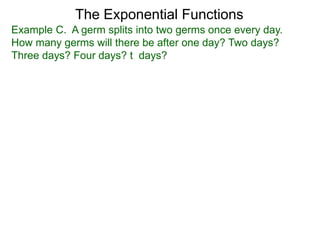
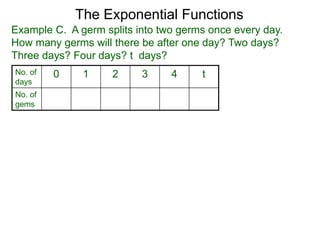
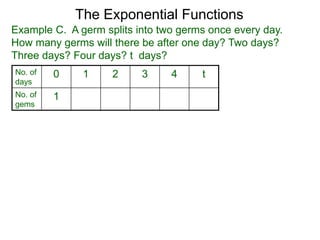
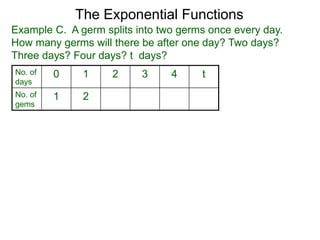
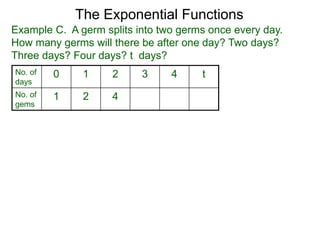
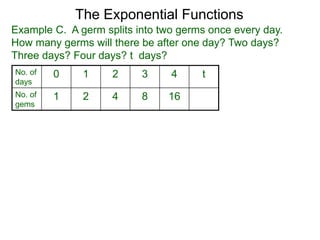
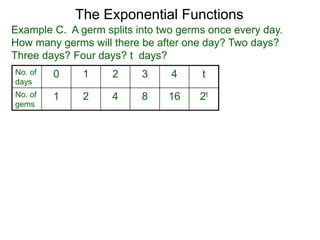
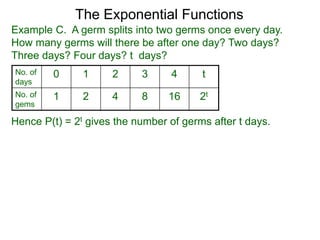
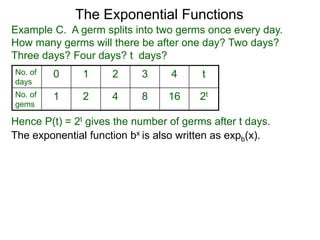
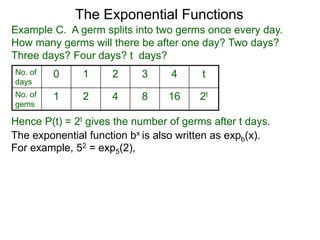
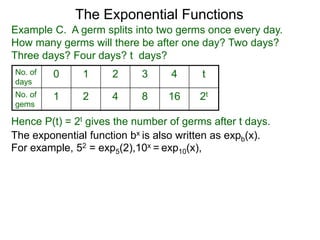
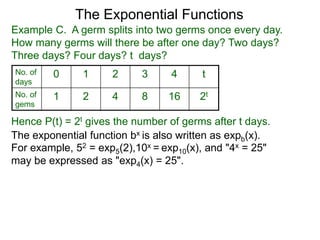
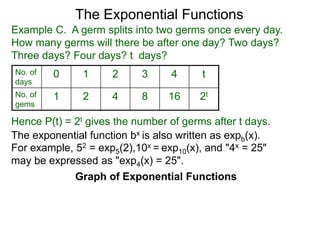
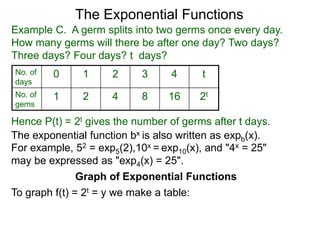
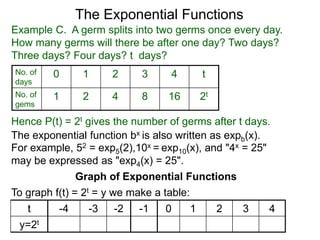
The Exponential Functions
http://www.lahc.edu/math/precalculus/math_260a.html
The Exponential Functions
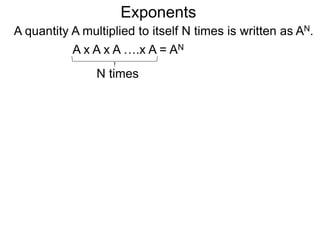
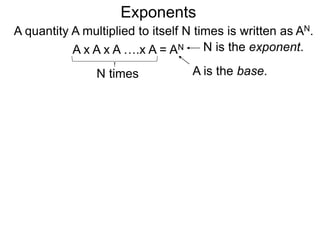
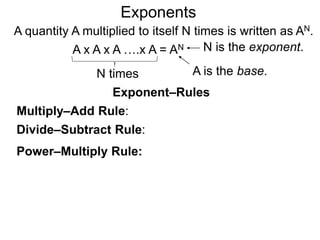
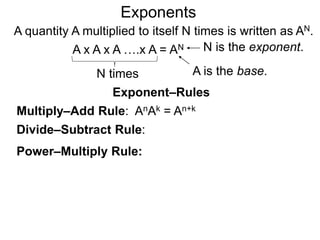
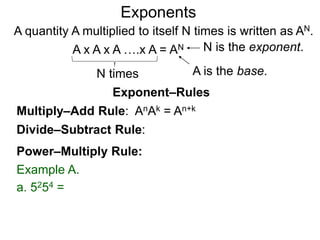
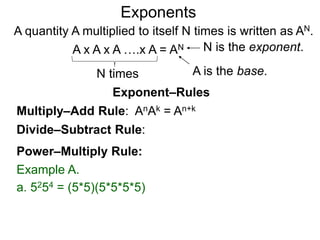
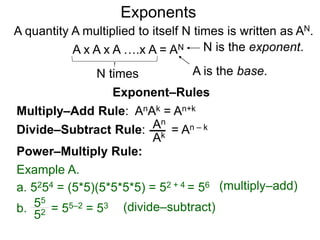
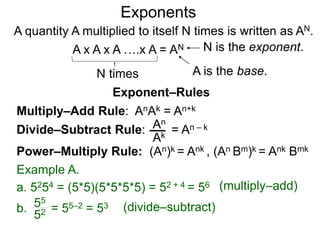
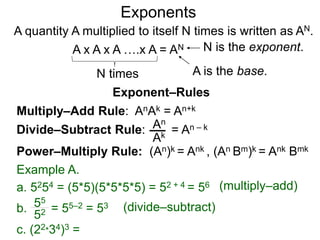
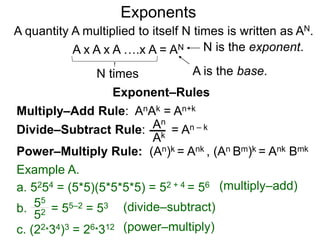
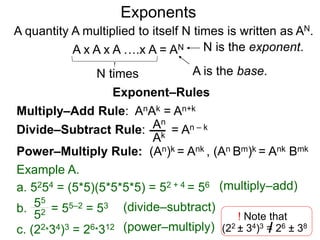
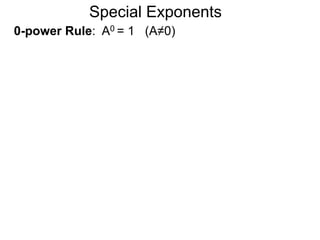
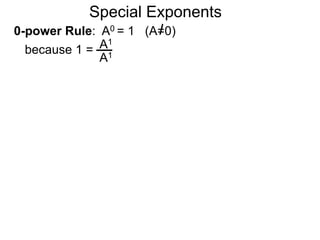
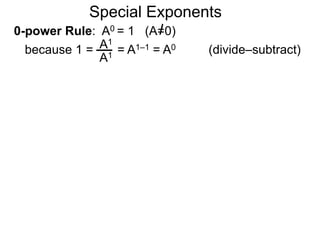
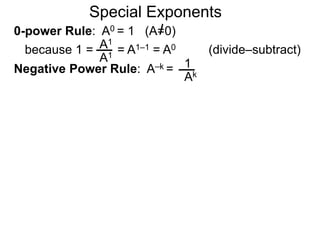
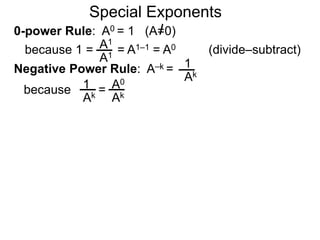
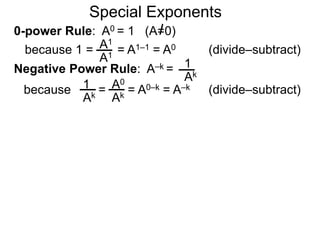
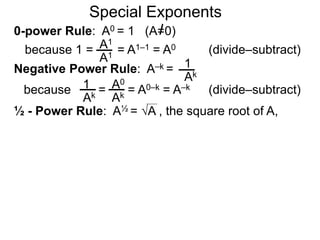
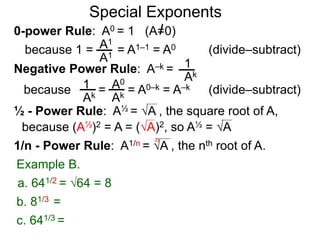
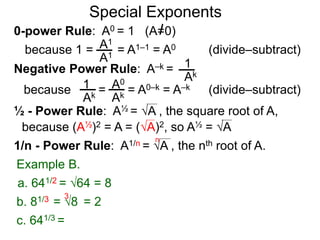
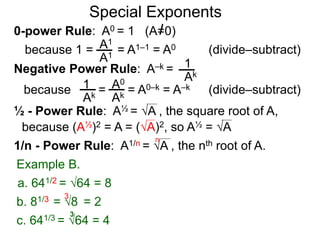
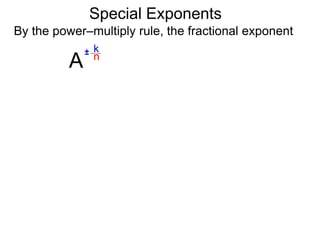
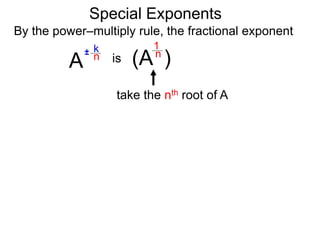
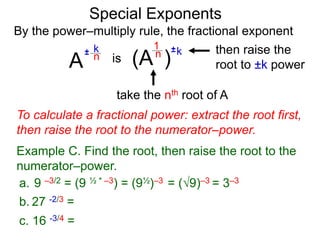
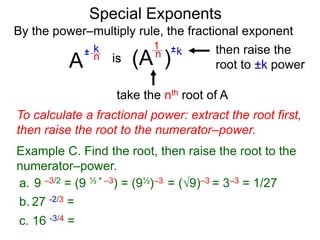
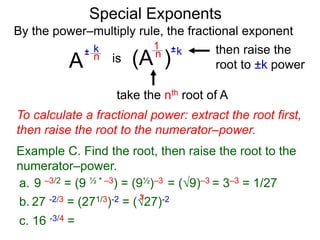
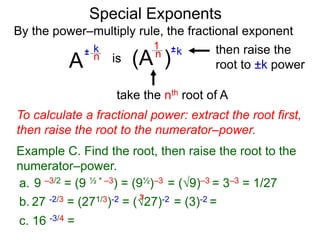
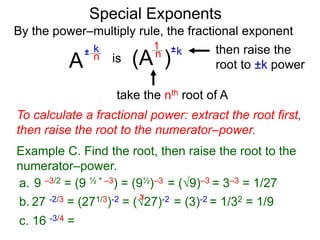
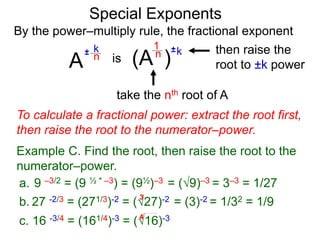
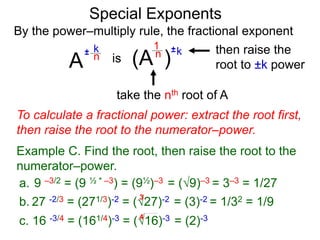
The meaning positive integral exponents such as x2 is clear.
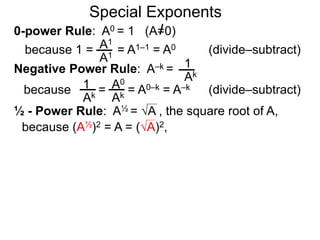
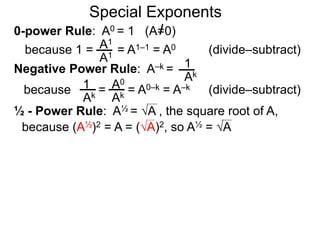
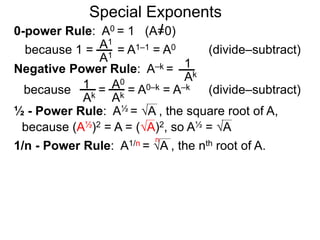
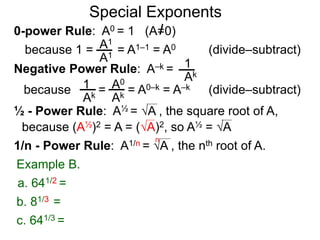
b0 = 1 b–K =
b = ( b ) b = ( )
K
N
K N
bK
1
K
N
 b
1
The Exponential Functions
K
N
The meaning positive integral exponents such as x2 is clear.
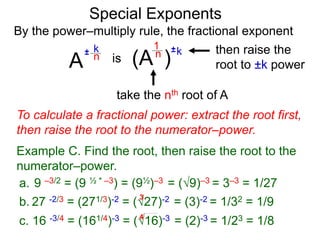
Below are the rules for other special exponents:
b0 = 1 b–K =
b = ( b ) b = ( )
K
N
K N
bK
1
K
N
 b
1
Example A.
80 =
8 =
The Exponential Functions
K
N
3
2
3
2
8 –2 =
8 =
The meaning positive integral exponents such as x2 is clear.
Below are the rules for other special exponents:
b0 = 1 b–K =
b = ( b ) b = ( )
K
N
K N
bK
1
K
N
 b
1
Example A.
80 = 1
8 =
The Exponential Functions
K
N
3
2
3
2
8 –2 =
8 =
The meaning positive integral exponents such as x2 is clear.
Below are the rules for other special exponents:
b0 = 1 b–K =
b = ( b ) b = ( )
K
N
K N
bK
1
K
N
 b
1
Example A.
80 = 1
8 =
82
1
64
1
The Exponential Functions
K
N
3
2
3
2
8 –2 = =
8 =
The meaning positive integral exponents such as x2 is clear.
Below are the rules for other special exponents:
b0 = 1 b–K =
b = ( b ) b = ( )
K
N
K N
bK
1
K
N
 b
1
Example A.
80 = 1
8 = (  8 ) = 4
3 2
82
1
64
1
The Exponential Functions
K
N
3
2
3
2
8 –2 = =
8 =
The meaning positive integral exponents such as x2 is clear.
Below are the rules for other special exponents:
b0 = 1 b–K =
b = ( b ) b = ( )
K
N
K N
bK
1
K
N
 b
1
Example A.
80 = 1
8 = (  8 ) = 4
3 2
82
1
3
2
 8
1
64
1
The Exponential Functions
K
N
3
2
3
2
8 –2 = =
8 = ( ) = 1/4
The meaning positive integral exponents such as x2 is clear.
Below are the rules for other special exponents:
b0 = 1 b–K =
b = ( b ) b = ( )
K
N
K N
bK
1
K
N
 b
1
Example A.
80 = 1
8 = (  8 ) = 4
3 2
82
1
3
2
 8
1
64
1
The Exponential Functions
K
N
3
2
3
2
Decimal exponents are well defined since decimals may be
represented as reduced fractions.
8 –2 = =
8 = ( ) = 1/4
The meaning positive integral exponents such as x2 is clear.
Below are the rules for other special exponents:
b0 = 1 b–K =
b = ( b ) b = ( )
K
N
K N
bK
1
K
N
 b
1
Example A.
80 = 1
8 = (  8 ) = 4
3 2
82
1
3
2
 8
1
64
1
The Exponential Functions
K
N
3
2
3
2
Decimal exponents are well defined since decimals may be
represented as reduced fractions.
b. 101.22 =
8 –2 = =
8 = ( ) = 1/4
Example B.
a. 91.50 =
The meaning positive integral exponents such as x2 is clear.
Below are the rules for other special exponents:
b0 = 1 b–K =
b = ( b ) b = ( )
K
N
K N
bK
1
K
N
 b
1
Example A.
80 = 1
8 = (  8 ) = 4
3 2
82
1
3
2
 8
1
64
1
The Exponential Functions
K
N
3
2
3
2
Decimal exponents are well defined since decimals may be
represented as reduced fractions.
b. 101.22 =
8 –2 = =
8 = ( ) = 1/4
Example B.
a. 91.50 = 9 =
3
2
The meaning positive integral exponents such as x2 is clear.
Below are the rules for other special exponents:
b0 = 1 b–K =
b = ( b ) b = ( )
K
N
K N
bK
1
K
N
 b
1
Example A.
80 = 1
8 = (  8 ) = 4
3 2
82
1
3
2
 8
1
64
1
The Exponential Functions
K
N
3
2
3
2
Decimal exponents are well defined since decimals may be
represented as reduced fractions.
b. 101.22 =
8 –2 = =
8 = ( ) = 1/4
Example B.
a. 91.50 = 9 = (9 ) = 27
3
2
3
The meaning positive integral exponents such as x2 is clear.
Below are the rules for other special exponents:
b0 = 1 b–K =
b = ( b ) b = ( )
K
N
K N
bK
1
K
N
 b
1
Example A.
80 = 1
8 = (  8 ) = 4
3 2
82
1
3
2
 8
1
64
1
The Exponential Functions
K
N
3
2
3
2
Decimal exponents are well defined since decimals may be
represented as reduced fractions.
b. 101.22 = 10
61
50
8 –2 = =
8 = ( ) = 1/4
Example B.
a. 91.50 = 9 = (9 ) = 27
3
2
3
The meaning positive integral exponents such as x2 is clear.
Below are the rules for other special exponents:
b0 = 1 b–K =
b = ( b ) b = ( )
K
N
K N
bK
1
K
N
 b
1
Example A.
80 = 1
8 = (  8 ) = 4
3 2
82
1
3
2
 8
1
64
1
The Exponential Functions
K
N
3
2
3
2
Decimal exponents are well defined since decimals may be
represented as reduced fractions.
b. 101.22 = 10 = ( 10 )  16.59586….
61
50
50 61
8 –2 = =
8 = ( ) = 1/4
Example B.
a. 91.50 = 9 = (9 ) = 27
3
2
3
The meaning positive integral exponents such as x2 is clear.
Below are the rules for other special exponents:
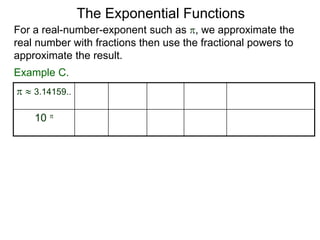
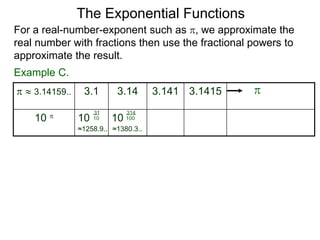
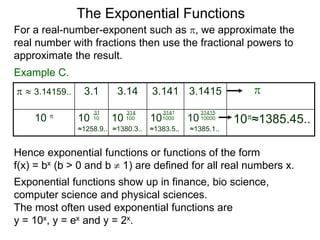
For a real-number-exponent such as , we approximate the
real number with fractions then use the fractional powers to
approximate the result.
  3.14159..
10 
Example C.
The Exponential Functions
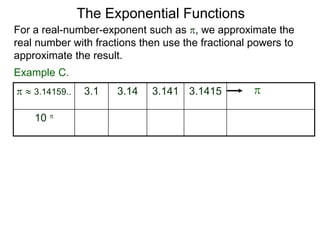
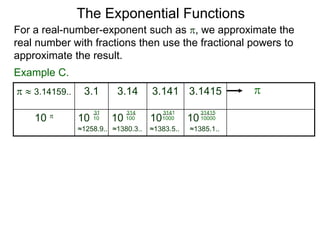
For a real-number-exponent such as , we approximate the
real number with fractions then use the fractional powers to
approximate the result.
  3.14159.. 3.1 3.14 3.141 3.1415
10 
Example C.

The Exponential Functions
For a real-number-exponent such as , we approximate the
real number with fractions then use the fractional powers to
approximate the result.
  3.14159.. 3.1 3.14 3.141 3.1415
10  10
Example C.
31
10

The Exponential Functions
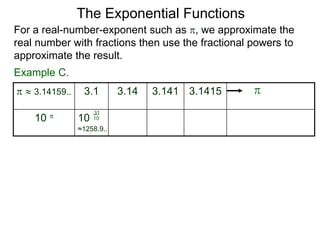
≈1258.9..
For a real-number-exponent such as , we approximate the
real number with fractions then use the fractional powers to
approximate the result.
  3.14159.. 3.1 3.14 3.141 3.1415
10  10 10
Example C.
31
10
314
100

The Exponential Functions
≈1258.9.. ≈1380.3..
For a real-number-exponent such as , we approximate the
real number with fractions then use the fractional powers to
approximate the result.
  3.14159.. 3.1 3.14 3.141 3.1415
10  10 10 10 10
Example C.
31
10
314
100
3141
1000
31415
10000

The Exponential Functions
≈1258.9.. ≈1380.3.. ≈1383.5.. ≈1385.1..
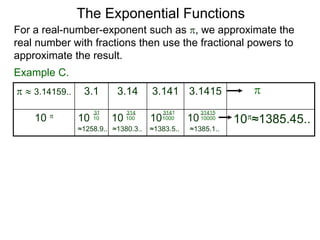
For a real-number-exponent such as , we approximate the
real number with fractions then use the fractional powers to
approximate the result.
  3.14159.. 3.1 3.14 3.141 3.1415
10  10 10 10 10 10≈1385.45..
Example C.
31
10
314
100
3141
1000
31415
10000

The Exponential Functions
≈1258.9.. ≈1380.3.. ≈1383.5.. ≈1385.1..
For a real-number-exponent such as , we approximate the
real number with fractions then use the fractional powers to
approximate the result.
  3.14159.. 3.1 3.14 3.141 3.1415
10  10 10 10 10 10≈1385.45..
Example C.
31
10
314
100
3141
1000
31415
10000

The Exponential Functions
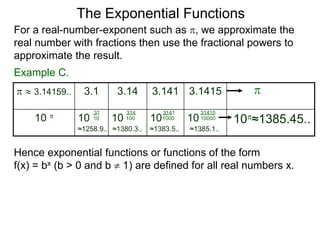
Hence exponential functions or functions of the form
f(x) = bx (b > 0 and b  1) are defined for all real numbers x.
≈1258.9.. ≈1380.3.. ≈1383.5.. ≈1385.1..
For a real-number-exponent such as , we approximate the
real number with fractions then use the fractional powers to
approximate the result.
  3.14159.. 3.1 3.14 3.141 3.1415
10  10 10 10 10 10≈1385.45..
Example C.
31
10
314
100
3141
1000
31415
10000

The Exponential Functions
Hence exponential functions or functions of the form
f(x) = bx (b > 0 and b  1) are defined for all real numbers x.
≈1258.9.. ≈1380.3.. ≈1383.5.. ≈1385.1..
Exponential functions show up in finance, bio science,
computer science and physical sciences.
For a real-number-exponent such as , we approximate the
real number with fractions then use the fractional powers to
approximate the result.
  3.14159.. 3.1 3.14 3.141 3.1415
10  10 10 10 10 10≈1385.45..
Example C.
31
10
314
100
3141
1000
31415
10000

The Exponential Functions
Hence exponential functions or functions of the form
f(x) = bx (b > 0 and b  1) are defined for all real numbers x.
≈1258.9.. ≈1380.3.. ≈1383.5.. ≈1385.1..
Exponential functions show up in finance, bio science,
computer science and physical sciences.
The most used exponential functions are
y = 10x, y = ex and y = 2x.
For a real-number-exponent such as , we approximate the
real number with fractions then use the fractional powers to
approximate the result.
  3.14159.. 3.1 3.14 3.141 3.1415
10  10 10 10 10 10≈1385.45..
Example C.
31
10
314
100
3141
1000
31415
10000

The Exponential Functions
Hence exponential functions or functions of the form
f(x) = bx (b > 0 and b  1) are defined for all real numbers x.
≈1258.9.. ≈1380.3.. ≈1383.5.. ≈1385.1..
Exponential functions show up in finance, bio science,
computer science and physical sciences.
The most used exponential functions are
y = 10x, y = ex and y = 2x.
Let’s use $ growth as applications below.
Example D. We deposit $1,000 in an account that gives
1% interest compounded monthly. How much money is there
after 1 month? 2 months? 3 months? and after 4 months?
Compound Interest
Example D. We deposit $1,000 in an account that gives
1% interest compounded monthly. How much money is there
after 1 month? 2 months? 3 months? and after 4 months?
Compound Interest
Let P = principal, i = (periodic) interest rate, A = accumulation.
After 1 period A = P(1 + i)
Example D. We deposit $1,000 in an account that gives
1% interest compounded monthly. How much money is there
after 1 month? 2 months? 3 months? and after 4 months?
After 1 month: 1000(1 + 0.01) = $1010.
Compound Interest
Let P = principal, i = (periodic) interest rate, A = accumulation.
After 1 period A = P(1 + i)
Example D. We deposit $1,000 in an account that gives
1% interest compounded monthly. How much money is there
after 1 month? 2 months? 3 months? and after 4 months?
After 1 month: 1000(1 + 0.01) = $1010.
After 2 months: 1010(1 + 0.01)
Compound Interest
Let P = principal, i = (periodic) interest rate, A = accumulation.
After 1 period A = P(1 + i)
Example D. We deposit $1,000 in an account that gives
1% interest compounded monthly. How much money is there
after 1 month? 2 months? 3 months? and after 4 months?
After 1 month: 1000(1 + 0.01) = $1010.
After 2 months: 1010(1 + 0.01) = 1000(1 + 0.01)(1 + 0.01)
Compound Interest
Let P = principal, i = (periodic) interest rate, A = accumulation.
After 1 period A = P(1 + i)
Example D. We deposit $1,000 in an account that gives
1% interest compounded monthly. How much money is there
after 1 month? 2 months? 3 months? and after 4 months?
After 1 month: 1000(1 + 0.01) = $1010.
After 2 months: 1010(1 + 0.01) = 1000(1 + 0.01)(1 + 0.01)
= 1000(1 + 0.01)2 = $1020.10
Compound Interest
Let P = principal, i = (periodic) interest rate, A = accumulation.
After 1 period A = P(1 + i)
Example D. We deposit $1,000 in an account that gives
1% interest compounded monthly. How much money is there
after 1 month? 2 months? 3 months? and after 4 months?
After 1 month: 1000(1 + 0.01) = $1010.
After 2 months: 1010(1 + 0.01) = 1000(1 + 0.01)(1 + 0.01)
= 1000(1 + 0.01)2 = $1020.10
Compound Interest
Let P = principal, i = (periodic) interest rate, A = accumulation.
After 1 period A = P(1 + i)
After 2 periods A = P(1 + i)(1 + i) = P(1 + i)2
Example D. We deposit $1,000 in an account that gives
1% interest compounded monthly. How much money is there
after 1 month? 2 months? 3 months? and after 4 months?
After 1 month: 1000(1 + 0.01) = $1010.
After 2 months: 1010(1 + 0.01) = 1000(1 + 0.01)(1 + 0.01)
= 1000(1 + 0.01)2 = $1020.10
After 3 months: 1020.10(1 + 0.01) = 1000(1 + 0.01)2(1 + 0.01)
= 1000(1 + 0.01)3 = $1030.30
Compound Interest
Let P = principal, i = (periodic) interest rate, A = accumulation.
After 1 period A = P(1 + i)
After 2 periods A = P(1 + i)(1 + i) = P(1 + i)2
Example D. We deposit $1,000 in an account that gives
1% interest compounded monthly. How much money is there
after 1 month? 2 months? 3 months? and after 4 months?
After 1 month: 1000(1 + 0.01) = $1010.
After 2 months: 1010(1 + 0.01) = 1000(1 + 0.01)(1 + 0.01)
= 1000(1 + 0.01)2 = $1020.10
After 3 months: 1020.10(1 + 0.01) = 1000(1 + 0.01)2(1 + 0.01)
= 1000(1 + 0.01)3 = $1030.30
Compound Interest
Let P = principal, i = (periodic) interest rate, A = accumulation.
After 1 period A = P(1 + i)
After 2 periods A = P(1 + i)(1 + i) = P(1 + i)2
After 3 periods A = P(1 + i)2(1 + i) = P(1 + i)3
Example D. We deposit $1,000 in an account that gives
1% interest compounded monthly. How much money is there
after 1 month? 2 months? 3 months? and after 4 months?
After 1 month: 1000(1 + 0.01) = $1010.
After 2 months: 1010(1 + 0.01) = 1000(1 + 0.01)(1 + 0.01)
= 1000(1 + 0.01)2 = $1020.10
After 3 months: 1020.10(1 + 0.01) = 1000(1 + 0.01)2(1 + 0.01)
= 1000(1 + 0.01)3 = $1030.30
After 4 months: 1030.30(1 + 0.01) = 1000(1 + 0.01)3(1 + 0.01)
= 1000(1 + 0.01)4 = $1040.60
Compound Interest
Let P = principal, i = (periodic) interest rate, A = accumulation.
After 1 period A = P(1 + i)
After 2 periods A = P(1 + i)(1 + i) = P(1 + i)2
After 3 periods A = P(1 + i)2(1 + i) = P(1 + i)3
Example D. We deposit $1,000 in an account that gives
1% interest compounded monthly. How much money is there
after 1 month? 2 months? 3 months? and after 4 months?
After 1 month: 1000(1 + 0.01) = $1010.
After 2 months: 1010(1 + 0.01) = 1000(1 + 0.01)(1 + 0.01)
= 1000(1 + 0.01)2 = $1020.10
After 3 months: 1020.10(1 + 0.01) = 1000(1 + 0.01)2(1 + 0.01)
= 1000(1 + 0.01)3 = $1030.30
After 4 months: 1030.30(1 + 0.01) = 1000(1 + 0.01)3(1 + 0.01)
= 1000(1 + 0.01)4 = $1040.60
Compound Interest
Let P = principal, i = (periodic) interest rate, A = accumulation.
After 1 period A = P(1 + i)
After 2 periods A = P(1 + i)(1 + i) = P(1 + i)2
After 3 periods A = P(1 + i)2(1 + i) = P(1 + i)3
Continue the pattern, after N periods, we obtain the
exponential periodic-compound formula (PINA): P(1 + i)N = A.
Compound Interest
Let P = principal
i = (periodic) interest rate,
N = number of periods
A = accumulation
The PINA Formula (Periodic Interest)
Compound Interest
Let P = principal
i = (periodic) interest rate,
N = number of periods
A = accumulation
then P(1 + i) N = A
The PINA Formula (Periodic Interest)
Compound Interest
Let P = principal
i = (periodic) interest rate,
N = number of periods
A = accumulation
then P(1 + i) N = A
The PINA Formula (Periodic Interest)
We use the following time line to see what is happening.
0 1 2 3 Nth periodN–1
Compound Interest
Let P = principal
i = (periodic) interest rate,
N = number of periods
A = accumulation
then P(1 + i) N = A
The PINA Formula (Periodic Interest)
We use the following time line to see what is happening.
P
0 1 2 3 Nth periodN–1
Rule: Multiply (1 + i) each period forward
Compound Interest
Let P = principal
i = (periodic) interest rate,
N = number of periods
A = accumulation
then P(1 + i) N = A
The PINA Formula (Periodic Interest)
We use the following time line to see what is happening.
P
0 1 2 3 Nth periodN–1
Rule: Multiply (1 + i) each period forward
P(1 + i)
Compound Interest
Let P = principal
i = (periodic) interest rate,
N = number of periods
A = accumulation
then P(1 + i) N = A
The PINA Formula (Periodic Interest)
We use the following time line to see what is happening.
P
0 1 2 3 Nth periodN–1
Rule: Multiply (1 + i) each period forward
P(1 + i) P(1 + i) 2
Compound Interest
Let P = principal
i = (periodic) interest rate,
N = number of periods
A = accumulation
then P(1 + i) N = A
The PINA Formula (Periodic Interest)
We use the following time line to see what is happening.
P
0 1 2 3 Nth periodN–1
Rule: Multiply (1 + i) each period forward
P(1 + i) P(1 + i) 2 P(1 + i) 3
Compound Interest
Let P = principal
i = (periodic) interest rate,
N = number of periods
A = accumulation
then P(1 + i) N = A
The PINA Formula (Periodic Interest)
We use the following time line to see what is happening.
P
0 1 2 3 Nth periodN–1
Rule: Multiply (1 + i) each period forward
P(1 + i) P(1 + i) 2 P(1 + i) 3 P(1 + i) N - 1
Compound Interest
Let P = principal
i = (periodic) interest rate,
N = number of periods
A = accumulation
then P(1 + i) N = A
The PINA Formula (Periodic Interest)
We use the following time line to see what is happening.
P
0 1 2 3 Nth periodN–1
Rule: Multiply (1 + i) each period forward
P(1 + i) P(1 + i) 2 P(1 + i) 3 P(1 + i) N - 1 P(1 + i) N
Compound Interest
Let P = principal
i = (periodic) interest rate,
N = number of periods
A = accumulation
then P(1 + i) N = A
The PINA Formula (Periodic Interest)
We use the following time line to see what is happening.
P
0 1 2 3 Nth periodN–1
Rule: Multiply (1 + i) each period forward
P(1 + i) P(1 + i) 2 P(1 + i) 3 P(1 + i) N - 1 P(1 + i) N
Example E. $1,000 is in an account that has a monthly interest
rate of 1%. How much will be there after 60 years?
Compound Interest
Let P = principal
i = (periodic) interest rate,
N = number of periods
A = accumulation
then P(1 + i) N = A
The PINA Formula (Periodic Interest)
We use the following time line to see what is happening.
P
0 1 2 3 Nth periodN–1
Rule: Multiply (1 + i) each period forward
P(1 + i) P(1 + i) 2 P(1 + i) 3 P(1 + i) N - 1 P(1 + i) N
Example E. $1,000 is in an account that has a monthly interest
rate of 1%. How much will be there after 60 years?
We have P = $1,000, i = 1% = 0.01, N =
Compound Interest
Let P = principal
i = (periodic) interest rate,
N = number of periods
A = accumulation
then P(1 + i) N = A
The PINA Formula (Periodic Interest)
We use the following time line to see what is happening.
P
0 1 2 3 Nth periodN–1
Rule: Multiply (1 + i) each period forward
P(1 + i) P(1 + i) 2 P(1 + i) 3 P(1 + i) N - 1 P(1 + i) N
Example E. $1,000 is in an account that has a monthly interest
rate of 1%. How much will be there after 60 years?
We have P = $1,000, i = 1% = 0.01, N = 60 *12 = 720 months
Compound Interest
Let P = principal
i = (periodic) interest rate,
N = number of periods
A = accumulation
then P(1 + i) N = A
The PINA Formula (Periodic Interest)
We use the following time line to see what is happening.
P
0 1 2 3 Nth periodN–1
Rule: Multiply (1 + i) each period forward
P(1 + i) P(1 + i) 2 P(1 + i) 3 P(1 + i) N - 1 P(1 + i) N
Example E. $1,000 is in an account that has a monthly interest
rate of 1%. How much will be there after 60 years?
We have P = $1,000, i = 1% = 0.01, N = 60 *12 = 720 months
so by PINA, there will be 1000(1 + 0.01) 720
Compound Interest
Let P = principal
i = (periodic) interest rate,
N = number of periods
A = accumulation
then P(1 + i) N = A
The PINA Formula (Periodic Interest)
We use the following time line to see what is happening.
P
0 1 2 3 Nth periodN–1
Rule: Multiply (1 + i) each period forward
P(1 + i) P(1 + i) 2 P(1 + i) 3 P(1 + i) N - 1 P(1 + i) N
Example E. $1,000 is in an account that has a monthly interest
rate of 1%. How much will be there after 60 years?
We have P = $1,000, i = 1% = 0.01, N = 60 *12 = 720 months
so by PINA, there will be 1000(1 + 0.01) 720 = $1,292,376.71
after 60 years.
Compound Interest
In practice, compound interests are usually quoted in
annual interest rate r and the frequency f, the number of times
of compounding in one year, so the periodic rate i = .
r
f
Example F. We open an account with annual rate r = 9%,
compounded monthly, i.e. 12 times a year.
Compound Interest
In practice, compound interests are usually quoted in
annual interest rate r and the frequency f, the number of times
of compounding in one year, so the periodic rate i = .
r
f
Example F. We open an account with annual rate r = 9%,
compounded monthly, i.e. 12 times a year.
We have r = 9% = 0.09 for one year,
and f = 12 is the number of times of compounding in one year,
Compound Interest
In practice, compound interests are usually quoted in
annual interest rate r and the frequency f, the number of times
of compounding in one year, so the periodic rate i = .
r
f
Example F. We open an account with annual rate r = 9%,
compounded monthly, i.e. 12 times a year.
We have r = 9% = 0.09 for one year,
and f = 12 is the number of times of compounding in one year,
so the periodic or monthly rate i = 0.09/12.
Compound Interest
In practice, compound interests are usually quoted in
annual interest rate r and the frequency f, the number of times
of compounding in one year, so the periodic rate i = .
r
f
Example F. We open an account with annual rate r = 9%,
compounded monthly, i.e. 12 times a year. After 40 years the
total return is $250,000, what was the initial principal?
We have r = 9% = 0.09 for one year,
and f = 12 is the number of times of compounding in one year,
so the periodic or monthly rate i = 0.09/12.
Compound Interest
In practice, compound interests are usually quoted in
annual interest rate r and the frequency f, the number of times
of compounding in one year, so the periodic rate i = .
r
f
Example F. We open an account with annual rate r = 9%,
compounded monthly, i.e. 12 times a year. After 40 years the
total return is $250,000, what was the initial principal?
We have r = 9% = 0.09 for one year,
and f = 12 is the number of times of compounding in one year,
so the periodic or monthly rate i = 0.09/12. After 40 years, i.e.
N = 40(12) = 480 months the return A = 250,000
Compound Interest
In practice, compound interests are usually quoted in
annual interest rate r and the frequency f, the number of times
of compounding in one year, so the periodic rate i = .
r
f
Example F. We open an account with annual rate r = 9%,
compounded monthly, i.e. 12 times a year. After 40 years the
total return is $250,000, what was the initial principal?
We have r = 9% = 0.09 for one year,
and f = 12 is the number of times of compounding in one year,
so the periodic or monthly rate i = 0.09/12. After 40 years, i.e.
N = 40(12) = 480 months the return A = 250,000, so by PINA:
Compound Interest
P (1 + ) 480 = 250,0000.09
12
In practice, compound interests are usually quoted in
annual interest rate r and the frequency f, the number of times
of compounding in one year, so the periodic rate i = .
r
f
Example F. We open an account with annual rate r = 9%,
compounded monthly, i.e. 12 times a year. After 40 years the
total return is $250,000, what was the initial principal?
We have r = 9% = 0.09 for one year,
and f = 12 is the number of times of compounding in one year,
so the periodic or monthly rate i = 0.09/12. After 40 years, i.e.
N = 40(12) = 480 months the return A = 250,000, so by PINA:
Compound Interest
P (1 + ) 480 = 250,0000.09
12 or
(1 + ) 480
P = 250,000
0.09
12
In practice, compound interests are usually quoted in
annual interest rate r and the frequency f, the number of times
of compounding in one year, so the periodic rate i = .
r
f
Example F. We open an account with annual rate r = 9%,
compounded monthly, i.e. 12 times a year. After 40 years the
total return is $250,000, what was the initial principal?
We have r = 9% = 0.09 for one year,
and f = 12 is the number of times of compounding in one year,
so the periodic or monthly rate i = 0.09/12. After 40 years, i.e.
N = 40(12) = 480 months the return A = 250,000, so by PINA:
Compound Interest
P (1 + ) 480 = 250,0000.09
12 or
(1 + ) 480
P = 250,000
0.09
12
P = $6,923.31
by calculator
Hence the initial deposit is $6,923.31.
In practice, compound interests are usually quoted in
annual interest rate r and the frequency f, the number of times
of compounding in one year, so the periodic rate i = .
r
f
x -4 -3 -2 -1 0 1 2 3 4
y=2x 1/16 1/8 1/4 1/2 1 2 4 8 16
Graphs of the Exponential Functions
Here is a table of y = 2x for plotting its graph.
(0,1)
(1,2)
(2,4)
(3,8)
(-1,1/2)(-2,1/4)
y=2x
Graph of y = 2x
x -4 -3 -2 -1 0 1 2 3 4
y=2x 1/16 1/8 1/4 1/2 1 2 4 8 16
Graphs of the Exponential Functions
Here is a table of y = 2x for plotting its graph.
(0,1)
(1,2)
(2,4)
(3,8)
(-1,1/2)(-2,1/4)
y=2x
Graph of y = 2x
x -4 -3 -2 -1 0 1 2 3 4
y=2x 1/16 1/8 1/4 1/2 1 2 4 8 16
Graphs of the Exponential Functions
Graph of y = bx where b>1
Here is a table of y = 2x for plotting its graph.
This is the shape of the graphs of y = bx for b > 1.
x -4 -3 -2 -1 0 1 2 3 4
y=(½)x 16 8 4 2 1 1/2 1/4 1/8 1/16
Here is a table of y = (½)x for plotting its graph.
Graphs of the Exponential Functions
(0,1)
(-1,2)
(-2,4)
(-3,8)
(1,1/2) (2,1/4)
y= (½)x
Graph of y = (½)x
x -4 -3 -2 -1 0 1 2 3 4
y=(½)x 16 8 4 2 1 1/2 1/4 1/8 1/16
Here is a table of y = (½)x for plotting its graph.
Graphs of the Exponential Functions
(0,1)
(-1,2)
(-2,4)
(-3,8)
(1,1/2) (2,1/4)
y= (½)x
Graph of y = bx where 0<b<1Graph of y = (½)x
x -4 -3 -2 -1 0 1 2 3 4
y=(½)x 16 8 4 2 1 1/2 1/4 1/8 1/16
Here is a table of y = (½)x for plotting its graph.
Graphs of the Exponential Functions
This is the shape of the graphs of y = bx for b < 1.
The graphs shown here are the different returns with r = 20%
with different compounding frequencies.
Compounded return on $1,000 with annual interest rate r = 20% (Wikipedia)
Compound Interest
The graphs shown here are the different returns with r = 20%
with different compounding frequencies. We observe that
I. the more frequently we compound, the bigger the return
Compounded return on $1,000 with annual interest rate r = 20% (Wikipedia)
Compound Interest
The graphs shown here are the different returns with r = 20%
with different compounding frequencies. We observe that
I. the more frequently we compound, the bigger the return
II. but the returns do not go above the blue-line
the continuous compound return, which is the next topic.
Compounded return on $1,000 with annual interest rate r = 20% (Wikipedia)
Compound Interest
Compound Interest
B. Given the monthly compounded periodic rate i, find the
principal needed to obtain a return of $1,000 after the given
amount the time.
1. i = 1%, time = 60 months.
Exercise A. Given the monthly compounded periodic rate i and
the amount of time, find the return with a principal of $1,000.
2. i = 1%, time = 60 years.
3. i = ½ %, time = 60 years 4. i = ½ %, time = 60 months.
5. i = 1¼ %, time = 6 months. 6. i = 1¼ %, time = 5½ years.
.7. i = 3/8%, time = 52 months. 8. i = 2/3%, time = 27 months.
1. i = 1%, time = 60 months. 2. i = 1%, time = 60 years.
3. i = ½ %, time = 60 years 4. i = ½ %, time = 60 months.
5. i = 1¼ %, time = 60 months. 6. i = 1¼ %, time = 60 years.
7. i = 3/8%, time = 60 years 8. i = 2/3%, time = 60 months.
Compound Interest
D. Given the annual rate r, convert it into the monthly
compounded periodic rate i and find the principal needed to
obtain $1,000 after the given amount the time.
1. r = 1%, time = 60 months.
C. Given the annual rate r, convert it into the monthly
compounded periodic rate i and find the return with a principal
of $1,000 after the given amount of time.
2. r = 1%, time = 60 years.
3. r = 3 %, time = 60 years 4. r = 3½ %, time = 60 months.
1. r = 1%, time = 60 months. 2. r = 1%, time = 60 years.
3. r = 3 %, time = 60 years 4. r = 3½ %, time = 60 months.
5. r = 1¼ %, time = 6 months. 6. r = 1¼ %, time = 5½ years.
.7. r = 3/8%, time = 52 months. 8. r = 2/3%, time = 27 months.
5. r = 1¼ %, time = 6 months. 6. r = 1¼ %, time = 5½ years.
.7. r = 3/8%, time = 52 months. 8. r = 2/3%, time = 27 months.

2.2 exponential function and compound interest

  • 1.
  • 2.
    The Exponential Functions Themeaning positive integral exponents such as x2 is clear.
  • 3.
    b0 = 1b–K = b = ( b ) b = ( ) K N K N bK 1 K N  b 1 The Exponential Functions K N The meaning positive integral exponents such as x2 is clear. Below are the rules for other special exponents:
  • 4.
    b0 = 1b–K = b = ( b ) b = ( ) K N K N bK 1 K N  b 1 Example A. 80 = 8 = The Exponential Functions K N 3 2 3 2 8 –2 = 8 = The meaning positive integral exponents such as x2 is clear. Below are the rules for other special exponents:
  • 5.
    b0 = 1b–K = b = ( b ) b = ( ) K N K N bK 1 K N  b 1 Example A. 80 = 1 8 = The Exponential Functions K N 3 2 3 2 8 –2 = 8 = The meaning positive integral exponents such as x2 is clear. Below are the rules for other special exponents:
  • 6.
    b0 = 1b–K = b = ( b ) b = ( ) K N K N bK 1 K N  b 1 Example A. 80 = 1 8 = 82 1 64 1 The Exponential Functions K N 3 2 3 2 8 –2 = = 8 = The meaning positive integral exponents such as x2 is clear. Below are the rules for other special exponents:
  • 7.
    b0 = 1b–K = b = ( b ) b = ( ) K N K N bK 1 K N  b 1 Example A. 80 = 1 8 = (  8 ) = 4 3 2 82 1 64 1 The Exponential Functions K N 3 2 3 2 8 –2 = = 8 = The meaning positive integral exponents such as x2 is clear. Below are the rules for other special exponents:
  • 8.
    b0 = 1b–K = b = ( b ) b = ( ) K N K N bK 1 K N  b 1 Example A. 80 = 1 8 = (  8 ) = 4 3 2 82 1 3 2  8 1 64 1 The Exponential Functions K N 3 2 3 2 8 –2 = = 8 = ( ) = 1/4 The meaning positive integral exponents such as x2 is clear. Below are the rules for other special exponents:
  • 9.
    b0 = 1b–K = b = ( b ) b = ( ) K N K N bK 1 K N  b 1 Example A. 80 = 1 8 = (  8 ) = 4 3 2 82 1 3 2  8 1 64 1 The Exponential Functions K N 3 2 3 2 Decimal exponents are well defined since decimals may be represented as reduced fractions. 8 –2 = = 8 = ( ) = 1/4 The meaning positive integral exponents such as x2 is clear. Below are the rules for other special exponents:
  • 10.
    b0 = 1b–K = b = ( b ) b = ( ) K N K N bK 1 K N  b 1 Example A. 80 = 1 8 = (  8 ) = 4 3 2 82 1 3 2  8 1 64 1 The Exponential Functions K N 3 2 3 2 Decimal exponents are well defined since decimals may be represented as reduced fractions. b. 101.22 = 8 –2 = = 8 = ( ) = 1/4 Example B. a. 91.50 = The meaning positive integral exponents such as x2 is clear. Below are the rules for other special exponents:
  • 11.
    b0 = 1b–K = b = ( b ) b = ( ) K N K N bK 1 K N  b 1 Example A. 80 = 1 8 = (  8 ) = 4 3 2 82 1 3 2  8 1 64 1 The Exponential Functions K N 3 2 3 2 Decimal exponents are well defined since decimals may be represented as reduced fractions. b. 101.22 = 8 –2 = = 8 = ( ) = 1/4 Example B. a. 91.50 = 9 = 3 2 The meaning positive integral exponents such as x2 is clear. Below are the rules for other special exponents:
  • 12.
    b0 = 1b–K = b = ( b ) b = ( ) K N K N bK 1 K N  b 1 Example A. 80 = 1 8 = (  8 ) = 4 3 2 82 1 3 2  8 1 64 1 The Exponential Functions K N 3 2 3 2 Decimal exponents are well defined since decimals may be represented as reduced fractions. b. 101.22 = 8 –2 = = 8 = ( ) = 1/4 Example B. a. 91.50 = 9 = (9 ) = 27 3 2 3 The meaning positive integral exponents such as x2 is clear. Below are the rules for other special exponents:
  • 13.
    b0 = 1b–K = b = ( b ) b = ( ) K N K N bK 1 K N  b 1 Example A. 80 = 1 8 = (  8 ) = 4 3 2 82 1 3 2  8 1 64 1 The Exponential Functions K N 3 2 3 2 Decimal exponents are well defined since decimals may be represented as reduced fractions. b. 101.22 = 10 61 50 8 –2 = = 8 = ( ) = 1/4 Example B. a. 91.50 = 9 = (9 ) = 27 3 2 3 The meaning positive integral exponents such as x2 is clear. Below are the rules for other special exponents:
  • 14.
    b0 = 1b–K = b = ( b ) b = ( ) K N K N bK 1 K N  b 1 Example A. 80 = 1 8 = (  8 ) = 4 3 2 82 1 3 2  8 1 64 1 The Exponential Functions K N 3 2 3 2 Decimal exponents are well defined since decimals may be represented as reduced fractions. b. 101.22 = 10 = ( 10 )  16.59586…. 61 50 50 61 8 –2 = = 8 = ( ) = 1/4 Example B. a. 91.50 = 9 = (9 ) = 27 3 2 3 The meaning positive integral exponents such as x2 is clear. Below are the rules for other special exponents:
  • 15.
    For a real-number-exponentsuch as , we approximate the real number with fractions then use the fractional powers to approximate the result.   3.14159.. 10  Example C. The Exponential Functions
  • 16.
    For a real-number-exponentsuch as , we approximate the real number with fractions then use the fractional powers to approximate the result.   3.14159.. 3.1 3.14 3.141 3.1415 10  Example C.  The Exponential Functions
  • 17.
    For a real-number-exponentsuch as , we approximate the real number with fractions then use the fractional powers to approximate the result.   3.14159.. 3.1 3.14 3.141 3.1415 10  10 Example C. 31 10  The Exponential Functions ≈1258.9..
  • 18.
    For a real-number-exponentsuch as , we approximate the real number with fractions then use the fractional powers to approximate the result.   3.14159.. 3.1 3.14 3.141 3.1415 10  10 10 Example C. 31 10 314 100  The Exponential Functions ≈1258.9.. ≈1380.3..
  • 19.
    For a real-number-exponentsuch as , we approximate the real number with fractions then use the fractional powers to approximate the result.   3.14159.. 3.1 3.14 3.141 3.1415 10  10 10 10 10 Example C. 31 10 314 100 3141 1000 31415 10000  The Exponential Functions ≈1258.9.. ≈1380.3.. ≈1383.5.. ≈1385.1..
  • 20.
    For a real-number-exponentsuch as , we approximate the real number with fractions then use the fractional powers to approximate the result.   3.14159.. 3.1 3.14 3.141 3.1415 10  10 10 10 10 10≈1385.45.. Example C. 31 10 314 100 3141 1000 31415 10000  The Exponential Functions ≈1258.9.. ≈1380.3.. ≈1383.5.. ≈1385.1..
  • 21.
    For a real-number-exponentsuch as , we approximate the real number with fractions then use the fractional powers to approximate the result.   3.14159.. 3.1 3.14 3.141 3.1415 10  10 10 10 10 10≈1385.45.. Example C. 31 10 314 100 3141 1000 31415 10000  The Exponential Functions Hence exponential functions or functions of the form f(x) = bx (b > 0 and b  1) are defined for all real numbers x. ≈1258.9.. ≈1380.3.. ≈1383.5.. ≈1385.1..
  • 22.
    For a real-number-exponentsuch as , we approximate the real number with fractions then use the fractional powers to approximate the result.   3.14159.. 3.1 3.14 3.141 3.1415 10  10 10 10 10 10≈1385.45.. Example C. 31 10 314 100 3141 1000 31415 10000  The Exponential Functions Hence exponential functions or functions of the form f(x) = bx (b > 0 and b  1) are defined for all real numbers x. ≈1258.9.. ≈1380.3.. ≈1383.5.. ≈1385.1.. Exponential functions show up in finance, bio science, computer science and physical sciences.
  • 23.
    For a real-number-exponentsuch as , we approximate the real number with fractions then use the fractional powers to approximate the result.   3.14159.. 3.1 3.14 3.141 3.1415 10  10 10 10 10 10≈1385.45.. Example C. 31 10 314 100 3141 1000 31415 10000  The Exponential Functions Hence exponential functions or functions of the form f(x) = bx (b > 0 and b  1) are defined for all real numbers x. ≈1258.9.. ≈1380.3.. ≈1383.5.. ≈1385.1.. Exponential functions show up in finance, bio science, computer science and physical sciences. The most used exponential functions are y = 10x, y = ex and y = 2x.
  • 24.
    For a real-number-exponentsuch as , we approximate the real number with fractions then use the fractional powers to approximate the result.   3.14159.. 3.1 3.14 3.141 3.1415 10  10 10 10 10 10≈1385.45.. Example C. 31 10 314 100 3141 1000 31415 10000  The Exponential Functions Hence exponential functions or functions of the form f(x) = bx (b > 0 and b  1) are defined for all real numbers x. ≈1258.9.. ≈1380.3.. ≈1383.5.. ≈1385.1.. Exponential functions show up in finance, bio science, computer science and physical sciences. The most used exponential functions are y = 10x, y = ex and y = 2x. Let’s use $ growth as applications below.
  • 25.
    Example D. Wedeposit $1,000 in an account that gives 1% interest compounded monthly. How much money is there after 1 month? 2 months? 3 months? and after 4 months? Compound Interest
  • 26.
    Example D. Wedeposit $1,000 in an account that gives 1% interest compounded monthly. How much money is there after 1 month? 2 months? 3 months? and after 4 months? Compound Interest Let P = principal, i = (periodic) interest rate, A = accumulation. After 1 period A = P(1 + i)
  • 27.
    Example D. Wedeposit $1,000 in an account that gives 1% interest compounded monthly. How much money is there after 1 month? 2 months? 3 months? and after 4 months? After 1 month: 1000(1 + 0.01) = $1010. Compound Interest Let P = principal, i = (periodic) interest rate, A = accumulation. After 1 period A = P(1 + i)
  • 28.
    Example D. Wedeposit $1,000 in an account that gives 1% interest compounded monthly. How much money is there after 1 month? 2 months? 3 months? and after 4 months? After 1 month: 1000(1 + 0.01) = $1010. After 2 months: 1010(1 + 0.01) Compound Interest Let P = principal, i = (periodic) interest rate, A = accumulation. After 1 period A = P(1 + i)
  • 29.
    Example D. Wedeposit $1,000 in an account that gives 1% interest compounded monthly. How much money is there after 1 month? 2 months? 3 months? and after 4 months? After 1 month: 1000(1 + 0.01) = $1010. After 2 months: 1010(1 + 0.01) = 1000(1 + 0.01)(1 + 0.01) Compound Interest Let P = principal, i = (periodic) interest rate, A = accumulation. After 1 period A = P(1 + i)
  • 30.
    Example D. Wedeposit $1,000 in an account that gives 1% interest compounded monthly. How much money is there after 1 month? 2 months? 3 months? and after 4 months? After 1 month: 1000(1 + 0.01) = $1010. After 2 months: 1010(1 + 0.01) = 1000(1 + 0.01)(1 + 0.01) = 1000(1 + 0.01)2 = $1020.10 Compound Interest Let P = principal, i = (periodic) interest rate, A = accumulation. After 1 period A = P(1 + i)
  • 31.
    Example D. Wedeposit $1,000 in an account that gives 1% interest compounded monthly. How much money is there after 1 month? 2 months? 3 months? and after 4 months? After 1 month: 1000(1 + 0.01) = $1010. After 2 months: 1010(1 + 0.01) = 1000(1 + 0.01)(1 + 0.01) = 1000(1 + 0.01)2 = $1020.10 Compound Interest Let P = principal, i = (periodic) interest rate, A = accumulation. After 1 period A = P(1 + i) After 2 periods A = P(1 + i)(1 + i) = P(1 + i)2
  • 32.
    Example D. Wedeposit $1,000 in an account that gives 1% interest compounded monthly. How much money is there after 1 month? 2 months? 3 months? and after 4 months? After 1 month: 1000(1 + 0.01) = $1010. After 2 months: 1010(1 + 0.01) = 1000(1 + 0.01)(1 + 0.01) = 1000(1 + 0.01)2 = $1020.10 After 3 months: 1020.10(1 + 0.01) = 1000(1 + 0.01)2(1 + 0.01) = 1000(1 + 0.01)3 = $1030.30 Compound Interest Let P = principal, i = (periodic) interest rate, A = accumulation. After 1 period A = P(1 + i) After 2 periods A = P(1 + i)(1 + i) = P(1 + i)2
  • 33.
    Example D. Wedeposit $1,000 in an account that gives 1% interest compounded monthly. How much money is there after 1 month? 2 months? 3 months? and after 4 months? After 1 month: 1000(1 + 0.01) = $1010. After 2 months: 1010(1 + 0.01) = 1000(1 + 0.01)(1 + 0.01) = 1000(1 + 0.01)2 = $1020.10 After 3 months: 1020.10(1 + 0.01) = 1000(1 + 0.01)2(1 + 0.01) = 1000(1 + 0.01)3 = $1030.30 Compound Interest Let P = principal, i = (periodic) interest rate, A = accumulation. After 1 period A = P(1 + i) After 2 periods A = P(1 + i)(1 + i) = P(1 + i)2 After 3 periods A = P(1 + i)2(1 + i) = P(1 + i)3
  • 34.
    Example D. Wedeposit $1,000 in an account that gives 1% interest compounded monthly. How much money is there after 1 month? 2 months? 3 months? and after 4 months? After 1 month: 1000(1 + 0.01) = $1010. After 2 months: 1010(1 + 0.01) = 1000(1 + 0.01)(1 + 0.01) = 1000(1 + 0.01)2 = $1020.10 After 3 months: 1020.10(1 + 0.01) = 1000(1 + 0.01)2(1 + 0.01) = 1000(1 + 0.01)3 = $1030.30 After 4 months: 1030.30(1 + 0.01) = 1000(1 + 0.01)3(1 + 0.01) = 1000(1 + 0.01)4 = $1040.60 Compound Interest Let P = principal, i = (periodic) interest rate, A = accumulation. After 1 period A = P(1 + i) After 2 periods A = P(1 + i)(1 + i) = P(1 + i)2 After 3 periods A = P(1 + i)2(1 + i) = P(1 + i)3
  • 35.
    Example D. Wedeposit $1,000 in an account that gives 1% interest compounded monthly. How much money is there after 1 month? 2 months? 3 months? and after 4 months? After 1 month: 1000(1 + 0.01) = $1010. After 2 months: 1010(1 + 0.01) = 1000(1 + 0.01)(1 + 0.01) = 1000(1 + 0.01)2 = $1020.10 After 3 months: 1020.10(1 + 0.01) = 1000(1 + 0.01)2(1 + 0.01) = 1000(1 + 0.01)3 = $1030.30 After 4 months: 1030.30(1 + 0.01) = 1000(1 + 0.01)3(1 + 0.01) = 1000(1 + 0.01)4 = $1040.60 Compound Interest Let P = principal, i = (periodic) interest rate, A = accumulation. After 1 period A = P(1 + i) After 2 periods A = P(1 + i)(1 + i) = P(1 + i)2 After 3 periods A = P(1 + i)2(1 + i) = P(1 + i)3 Continue the pattern, after N periods, we obtain the exponential periodic-compound formula (PINA): P(1 + i)N = A.
  • 36.
    Compound Interest Let P= principal i = (periodic) interest rate, N = number of periods A = accumulation The PINA Formula (Periodic Interest)
  • 37.
    Compound Interest Let P= principal i = (periodic) interest rate, N = number of periods A = accumulation then P(1 + i) N = A The PINA Formula (Periodic Interest)
  • 38.
    Compound Interest Let P= principal i = (periodic) interest rate, N = number of periods A = accumulation then P(1 + i) N = A The PINA Formula (Periodic Interest) We use the following time line to see what is happening. 0 1 2 3 Nth periodN–1
  • 39.
    Compound Interest Let P= principal i = (periodic) interest rate, N = number of periods A = accumulation then P(1 + i) N = A The PINA Formula (Periodic Interest) We use the following time line to see what is happening. P 0 1 2 3 Nth periodN–1 Rule: Multiply (1 + i) each period forward
  • 40.
    Compound Interest Let P= principal i = (periodic) interest rate, N = number of periods A = accumulation then P(1 + i) N = A The PINA Formula (Periodic Interest) We use the following time line to see what is happening. P 0 1 2 3 Nth periodN–1 Rule: Multiply (1 + i) each period forward P(1 + i)
  • 41.
    Compound Interest Let P= principal i = (periodic) interest rate, N = number of periods A = accumulation then P(1 + i) N = A The PINA Formula (Periodic Interest) We use the following time line to see what is happening. P 0 1 2 3 Nth periodN–1 Rule: Multiply (1 + i) each period forward P(1 + i) P(1 + i) 2
  • 42.
    Compound Interest Let P= principal i = (periodic) interest rate, N = number of periods A = accumulation then P(1 + i) N = A The PINA Formula (Periodic Interest) We use the following time line to see what is happening. P 0 1 2 3 Nth periodN–1 Rule: Multiply (1 + i) each period forward P(1 + i) P(1 + i) 2 P(1 + i) 3
  • 43.
    Compound Interest Let P= principal i = (periodic) interest rate, N = number of periods A = accumulation then P(1 + i) N = A The PINA Formula (Periodic Interest) We use the following time line to see what is happening. P 0 1 2 3 Nth periodN–1 Rule: Multiply (1 + i) each period forward P(1 + i) P(1 + i) 2 P(1 + i) 3 P(1 + i) N - 1
  • 44.
    Compound Interest Let P= principal i = (periodic) interest rate, N = number of periods A = accumulation then P(1 + i) N = A The PINA Formula (Periodic Interest) We use the following time line to see what is happening. P 0 1 2 3 Nth periodN–1 Rule: Multiply (1 + i) each period forward P(1 + i) P(1 + i) 2 P(1 + i) 3 P(1 + i) N - 1 P(1 + i) N
  • 45.
    Compound Interest Let P= principal i = (periodic) interest rate, N = number of periods A = accumulation then P(1 + i) N = A The PINA Formula (Periodic Interest) We use the following time line to see what is happening. P 0 1 2 3 Nth periodN–1 Rule: Multiply (1 + i) each period forward P(1 + i) P(1 + i) 2 P(1 + i) 3 P(1 + i) N - 1 P(1 + i) N Example E. $1,000 is in an account that has a monthly interest rate of 1%. How much will be there after 60 years?
  • 46.
    Compound Interest Let P= principal i = (periodic) interest rate, N = number of periods A = accumulation then P(1 + i) N = A The PINA Formula (Periodic Interest) We use the following time line to see what is happening. P 0 1 2 3 Nth periodN–1 Rule: Multiply (1 + i) each period forward P(1 + i) P(1 + i) 2 P(1 + i) 3 P(1 + i) N - 1 P(1 + i) N Example E. $1,000 is in an account that has a monthly interest rate of 1%. How much will be there after 60 years? We have P = $1,000, i = 1% = 0.01, N =
  • 47.
    Compound Interest Let P= principal i = (periodic) interest rate, N = number of periods A = accumulation then P(1 + i) N = A The PINA Formula (Periodic Interest) We use the following time line to see what is happening. P 0 1 2 3 Nth periodN–1 Rule: Multiply (1 + i) each period forward P(1 + i) P(1 + i) 2 P(1 + i) 3 P(1 + i) N - 1 P(1 + i) N Example E. $1,000 is in an account that has a monthly interest rate of 1%. How much will be there after 60 years? We have P = $1,000, i = 1% = 0.01, N = 60 *12 = 720 months
  • 48.
    Compound Interest Let P= principal i = (periodic) interest rate, N = number of periods A = accumulation then P(1 + i) N = A The PINA Formula (Periodic Interest) We use the following time line to see what is happening. P 0 1 2 3 Nth periodN–1 Rule: Multiply (1 + i) each period forward P(1 + i) P(1 + i) 2 P(1 + i) 3 P(1 + i) N - 1 P(1 + i) N Example E. $1,000 is in an account that has a monthly interest rate of 1%. How much will be there after 60 years? We have P = $1,000, i = 1% = 0.01, N = 60 *12 = 720 months so by PINA, there will be 1000(1 + 0.01) 720
  • 49.
    Compound Interest Let P= principal i = (periodic) interest rate, N = number of periods A = accumulation then P(1 + i) N = A The PINA Formula (Periodic Interest) We use the following time line to see what is happening. P 0 1 2 3 Nth periodN–1 Rule: Multiply (1 + i) each period forward P(1 + i) P(1 + i) 2 P(1 + i) 3 P(1 + i) N - 1 P(1 + i) N Example E. $1,000 is in an account that has a monthly interest rate of 1%. How much will be there after 60 years? We have P = $1,000, i = 1% = 0.01, N = 60 *12 = 720 months so by PINA, there will be 1000(1 + 0.01) 720 = $1,292,376.71 after 60 years.
  • 50.
    Compound Interest In practice,compound interests are usually quoted in annual interest rate r and the frequency f, the number of times of compounding in one year, so the periodic rate i = . r f
  • 51.
    Example F. Weopen an account with annual rate r = 9%, compounded monthly, i.e. 12 times a year. Compound Interest In practice, compound interests are usually quoted in annual interest rate r and the frequency f, the number of times of compounding in one year, so the periodic rate i = . r f
  • 52.
    Example F. Weopen an account with annual rate r = 9%, compounded monthly, i.e. 12 times a year. We have r = 9% = 0.09 for one year, and f = 12 is the number of times of compounding in one year, Compound Interest In practice, compound interests are usually quoted in annual interest rate r and the frequency f, the number of times of compounding in one year, so the periodic rate i = . r f
  • 53.
    Example F. Weopen an account with annual rate r = 9%, compounded monthly, i.e. 12 times a year. We have r = 9% = 0.09 for one year, and f = 12 is the number of times of compounding in one year, so the periodic or monthly rate i = 0.09/12. Compound Interest In practice, compound interests are usually quoted in annual interest rate r and the frequency f, the number of times of compounding in one year, so the periodic rate i = . r f
  • 54.
    Example F. Weopen an account with annual rate r = 9%, compounded monthly, i.e. 12 times a year. After 40 years the total return is $250,000, what was the initial principal? We have r = 9% = 0.09 for one year, and f = 12 is the number of times of compounding in one year, so the periodic or monthly rate i = 0.09/12. Compound Interest In practice, compound interests are usually quoted in annual interest rate r and the frequency f, the number of times of compounding in one year, so the periodic rate i = . r f
  • 55.
    Example F. Weopen an account with annual rate r = 9%, compounded monthly, i.e. 12 times a year. After 40 years the total return is $250,000, what was the initial principal? We have r = 9% = 0.09 for one year, and f = 12 is the number of times of compounding in one year, so the periodic or monthly rate i = 0.09/12. After 40 years, i.e. N = 40(12) = 480 months the return A = 250,000 Compound Interest In practice, compound interests are usually quoted in annual interest rate r and the frequency f, the number of times of compounding in one year, so the periodic rate i = . r f
  • 56.
    Example F. Weopen an account with annual rate r = 9%, compounded monthly, i.e. 12 times a year. After 40 years the total return is $250,000, what was the initial principal? We have r = 9% = 0.09 for one year, and f = 12 is the number of times of compounding in one year, so the periodic or monthly rate i = 0.09/12. After 40 years, i.e. N = 40(12) = 480 months the return A = 250,000, so by PINA: Compound Interest P (1 + ) 480 = 250,0000.09 12 In practice, compound interests are usually quoted in annual interest rate r and the frequency f, the number of times of compounding in one year, so the periodic rate i = . r f
  • 57.
    Example F. Weopen an account with annual rate r = 9%, compounded monthly, i.e. 12 times a year. After 40 years the total return is $250,000, what was the initial principal? We have r = 9% = 0.09 for one year, and f = 12 is the number of times of compounding in one year, so the periodic or monthly rate i = 0.09/12. After 40 years, i.e. N = 40(12) = 480 months the return A = 250,000, so by PINA: Compound Interest P (1 + ) 480 = 250,0000.09 12 or (1 + ) 480 P = 250,000 0.09 12 In practice, compound interests are usually quoted in annual interest rate r and the frequency f, the number of times of compounding in one year, so the periodic rate i = . r f
  • 58.
    Example F. Weopen an account with annual rate r = 9%, compounded monthly, i.e. 12 times a year. After 40 years the total return is $250,000, what was the initial principal? We have r = 9% = 0.09 for one year, and f = 12 is the number of times of compounding in one year, so the periodic or monthly rate i = 0.09/12. After 40 years, i.e. N = 40(12) = 480 months the return A = 250,000, so by PINA: Compound Interest P (1 + ) 480 = 250,0000.09 12 or (1 + ) 480 P = 250,000 0.09 12 P = $6,923.31 by calculator Hence the initial deposit is $6,923.31. In practice, compound interests are usually quoted in annual interest rate r and the frequency f, the number of times of compounding in one year, so the periodic rate i = . r f
  • 59.
    x -4 -3-2 -1 0 1 2 3 4 y=2x 1/16 1/8 1/4 1/2 1 2 4 8 16 Graphs of the Exponential Functions Here is a table of y = 2x for plotting its graph.
  • 60.
    (0,1) (1,2) (2,4) (3,8) (-1,1/2)(-2,1/4) y=2x Graph of y= 2x x -4 -3 -2 -1 0 1 2 3 4 y=2x 1/16 1/8 1/4 1/2 1 2 4 8 16 Graphs of the Exponential Functions Here is a table of y = 2x for plotting its graph.
  • 61.
    (0,1) (1,2) (2,4) (3,8) (-1,1/2)(-2,1/4) y=2x Graph of y= 2x x -4 -3 -2 -1 0 1 2 3 4 y=2x 1/16 1/8 1/4 1/2 1 2 4 8 16 Graphs of the Exponential Functions Graph of y = bx where b>1 Here is a table of y = 2x for plotting its graph. This is the shape of the graphs of y = bx for b > 1.
  • 62.
    x -4 -3-2 -1 0 1 2 3 4 y=(½)x 16 8 4 2 1 1/2 1/4 1/8 1/16 Here is a table of y = (½)x for plotting its graph. Graphs of the Exponential Functions
  • 63.
    (0,1) (-1,2) (-2,4) (-3,8) (1,1/2) (2,1/4) y= (½)x Graphof y = (½)x x -4 -3 -2 -1 0 1 2 3 4 y=(½)x 16 8 4 2 1 1/2 1/4 1/8 1/16 Here is a table of y = (½)x for plotting its graph. Graphs of the Exponential Functions
  • 64.
    (0,1) (-1,2) (-2,4) (-3,8) (1,1/2) (2,1/4) y= (½)x Graphof y = bx where 0<b<1Graph of y = (½)x x -4 -3 -2 -1 0 1 2 3 4 y=(½)x 16 8 4 2 1 1/2 1/4 1/8 1/16 Here is a table of y = (½)x for plotting its graph. Graphs of the Exponential Functions This is the shape of the graphs of y = bx for b < 1.
  • 65.
    The graphs shownhere are the different returns with r = 20% with different compounding frequencies. Compounded return on $1,000 with annual interest rate r = 20% (Wikipedia) Compound Interest
  • 66.
    The graphs shownhere are the different returns with r = 20% with different compounding frequencies. We observe that I. the more frequently we compound, the bigger the return Compounded return on $1,000 with annual interest rate r = 20% (Wikipedia) Compound Interest
  • 67.
    The graphs shownhere are the different returns with r = 20% with different compounding frequencies. We observe that I. the more frequently we compound, the bigger the return II. but the returns do not go above the blue-line the continuous compound return, which is the next topic. Compounded return on $1,000 with annual interest rate r = 20% (Wikipedia) Compound Interest
  • 68.
    Compound Interest B. Giventhe monthly compounded periodic rate i, find the principal needed to obtain a return of $1,000 after the given amount the time. 1. i = 1%, time = 60 months. Exercise A. Given the monthly compounded periodic rate i and the amount of time, find the return with a principal of $1,000. 2. i = 1%, time = 60 years. 3. i = ½ %, time = 60 years 4. i = ½ %, time = 60 months. 5. i = 1¼ %, time = 6 months. 6. i = 1¼ %, time = 5½ years. .7. i = 3/8%, time = 52 months. 8. i = 2/3%, time = 27 months. 1. i = 1%, time = 60 months. 2. i = 1%, time = 60 years. 3. i = ½ %, time = 60 years 4. i = ½ %, time = 60 months. 5. i = 1¼ %, time = 60 months. 6. i = 1¼ %, time = 60 years. 7. i = 3/8%, time = 60 years 8. i = 2/3%, time = 60 months.
  • 69.
    Compound Interest D. Giventhe annual rate r, convert it into the monthly compounded periodic rate i and find the principal needed to obtain $1,000 after the given amount the time. 1. r = 1%, time = 60 months. C. Given the annual rate r, convert it into the monthly compounded periodic rate i and find the return with a principal of $1,000 after the given amount of time. 2. r = 1%, time = 60 years. 3. r = 3 %, time = 60 years 4. r = 3½ %, time = 60 months. 1. r = 1%, time = 60 months. 2. r = 1%, time = 60 years. 3. r = 3 %, time = 60 years 4. r = 3½ %, time = 60 months. 5. r = 1¼ %, time = 6 months. 6. r = 1¼ %, time = 5½ years. .7. r = 3/8%, time = 52 months. 8. r = 2/3%, time = 27 months. 5. r = 1¼ %, time = 6 months. 6. r = 1¼ %, time = 5½ years. .7. r = 3/8%, time = 52 months. 8. r = 2/3%, time = 27 months.