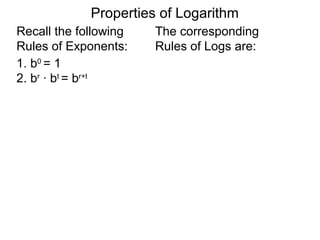
Properties of Logarithm
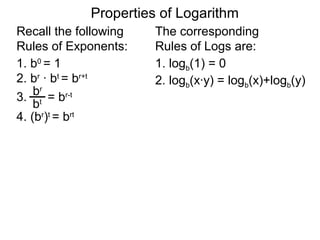
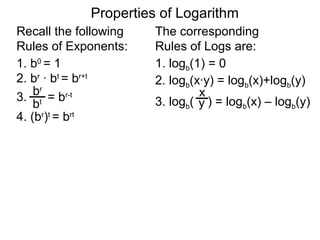
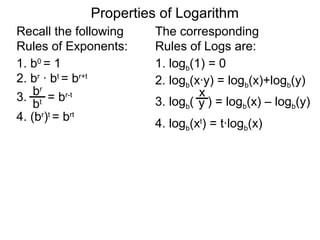
Recall the following
Rules of Exponents:
The corresponding
Rules of Logs are:
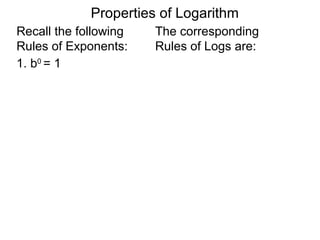
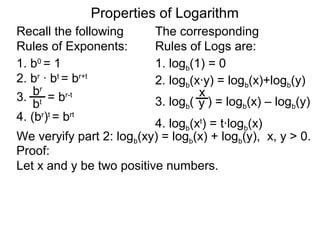
1. b0
= 1
Properties of Logarithm
Recall the following
Rules of Exponents:
The corresponding
Rules of Logs are:
1. b0
= 1
2. br
· bt
= br+t
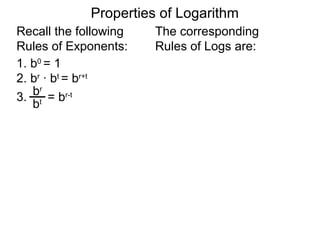
Properties of Logarithm
Recall the following
Rules of Exponents:
The corresponding
Rules of Logs are:
1. b0
= 1
2. br
· bt
= br+t
3. = br-t
bt
br
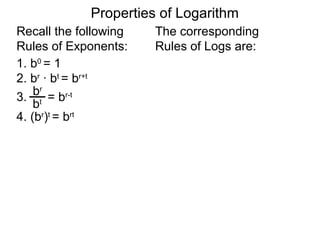
Properties of Logarithm
Recall the following
Rules of Exponents:
The corresponding
Rules of Logs are:
1. b0
= 1
2. br
· bt
= br+t
3. = br-t
4. (br
)t
= brt
bt
br
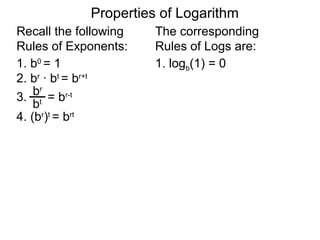
Properties of Logarithm
Recall the following
Rules of Exponents:
The corresponding
Rules of Logs are:
1. logb(1) = 01. b0
= 1
2. br
· bt
= br+t
3. = br-t
4. (br
)t
= brt
bt
br
Properties of Logarithm
Recall the following
Rules of Exponents:
The corresponding
Rules of Logs are:
1. logb(1) = 0
2. logb(x·y) = logb(x)+logb(y)
1. b0
= 1
2. br
· bt
= br+t
3. = br-t
4. (br
)t
= brt
bt
br
Properties of Logarithm
Recall the following
Rules of Exponents:
The corresponding
Rules of Logs are:
1. logb(1) = 0
2. logb(x·y) = logb(x)+logb(y)
3. logb( ) = logb(x) – logb(y)
x
y
1. b0
= 1
2. br
· bt
= br+t
3. = br-t
4. (br
)t
= brt
bt
br
Properties of Logarithm
Recall the following
Rules of Exponents:
The corresponding
Rules of Logs are:
1. logb(1) = 0
2. logb(x·y) = logb(x)+logb(y)
3. logb( ) = logb(x) – logb(y)
4. logb(xt
) = t·logb(x)
x
y
1. b0
= 1
2. br
· bt
= br+t
3. = br-t
4. (br
)t
= brt
bt
br
Properties of Logarithm
Recall the following
Rules of Exponents:
The corresponding
Rules of Logs are:
1. logb(1) = 0
2. logb(x·y) = logb(x)+logb(y)
3. logb( ) = logb(x) – logb(y)
4. logb(xt
) = t·logb(x)
x
y
1. b0
= 1
2. br
· bt
= br+t
3. = br-t
4. (br
)t
= brt
bt
br
Properties of Logarithm
Recall the following
Rules of Exponents:
The corresponding
Rules of Logs are:
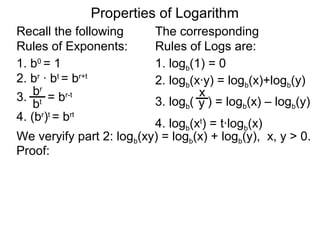
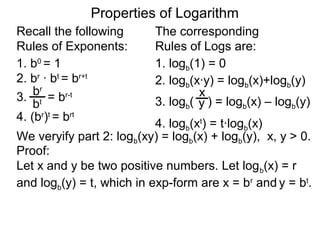
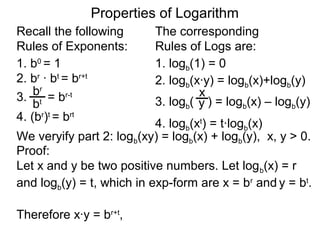
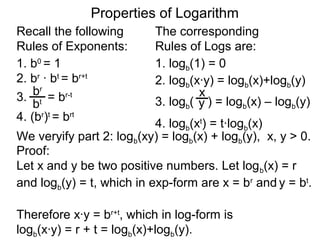
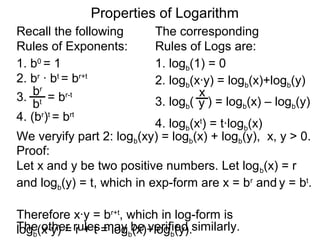
We veryify part 2: logb(xy) = logb(x) + logb(y), x, y > 0.
Proof:
1. logb(1) = 0
2. logb(x·y) = logb(x)+logb(y)
3. logb( ) = logb(x) – logb(y)
4. logb(xt
) = t·logb(x)
x
y
1. b0
= 1
2. br
· bt
= br+t
3. = br-t
4. (br
)t
= brt
bt
br
Properties of Logarithm
Recall the following
Rules of Exponents:
The corresponding
Rules of Logs are:
We veryify part 2: logb(xy) = logb(x) + logb(y), x, y > 0.
Proof:
Let x and y be two positive numbers.
1. logb(1) = 0
2. logb(x·y) = logb(x)+logb(y)
3. logb( ) = logb(x) – logb(y)
4. logb(xt
) = t·logb(x)
x
y
1. b0
= 1
2. br
· bt
= br+t
3. = br-t
4. (br
)t
= brt
bt
br
Properties of Logarithm
Recall the following
Rules of Exponents:
The corresponding
Rules of Logs are:
We veryify part 2: logb(xy) = logb(x) + logb(y), x, y > 0.
Proof:
Let x and y be two positive numbers. Let logb(x) = r
and logb(y) = t, which in exp-form are x = br
and y = bt
.
1. logb(1) = 0
2. logb(x·y) = logb(x)+logb(y)
3. logb( ) = logb(x) – logb(y)
4. logb(xt
) = t·logb(x)
x
y
1. b0
= 1
2. br
· bt
= br+t
3. = br-t
4. (br
)t
= brt
bt
br
Properties of Logarithm
Recall the following
Rules of Exponents:
The corresponding
Rules of Logs are:
We veryify part 2: logb(xy) = logb(x) + logb(y), x, y > 0.
Proof:
Let x and y be two positive numbers. Let logb(x) = r
and logb(y) = t, which in exp-form are x = br
and y = bt
.
Therefore x·y = br+t
,
1. logb(1) = 0
2. logb(x·y) = logb(x)+logb(y)
3. logb( ) = logb(x) – logb(y)
4. logb(xt
) = t·logb(x)
x
y
1. b0
= 1
2. br
· bt
= br+t
3. = br-t
4. (br
)t
= brt
bt
br
Properties of Logarithm
Recall the following
Rules of Exponents:
The corresponding
Rules of Logs are:
We veryify part 2: logb(xy) = logb(x) + logb(y), x, y > 0.
Proof:
Let x and y be two positive numbers. Let logb(x) = r
and logb(y) = t, which in exp-form are x = br
and y = bt
.
Therefore x·y = br+t
, which in log-form is
logb(x·y) = r + t = logb(x)+logb(y).
1. logb(1) = 0
2. logb(x·y) = logb(x)+logb(y)
3. logb( ) = logb(x) – logb(y)
4. logb(xt
) = t·logb(x)
x
y
1. b0
= 1
2. br
· bt
= br+t
3. = br-t
4. (br
)t
= brt
bt
br
Properties of Logarithm
Recall the following
Rules of Exponents:
The corresponding
Rules of Logs are:
We veryify part 2: logb(xy) = logb(x) + logb(y), x, y > 0.
Proof:
Let x and y be two positive numbers. Let logb(x) = r
and logb(y) = t, which in exp-form are x = br
and y = bt
.
Therefore x·y = br+t
, which in log-form is
logb(x·y) = r + t = logb(x)+logb(y).The other rules may be verified similarly.
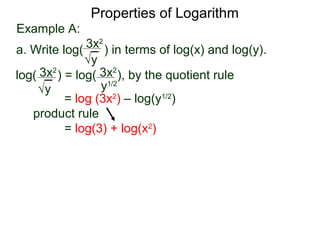
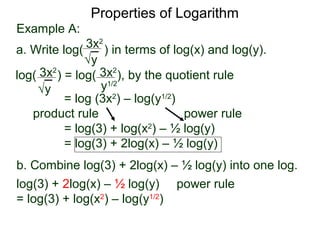
Example A:
3x2
√y
Properties of Logarithm
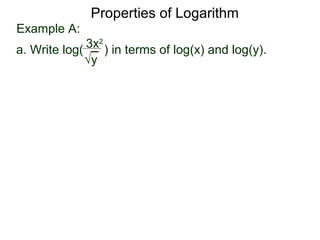
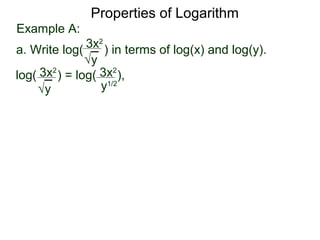
a. Write log( ) in terms of log(x) and log(y).
3x2
√y
log( ) = log( ),3x2
√y
3x2
y1/2
Properties of Logarithm
a. Write log( ) in terms of log(x) and log(y).
Example A:
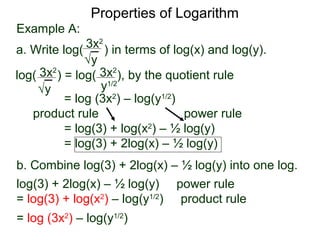
3x2
√y
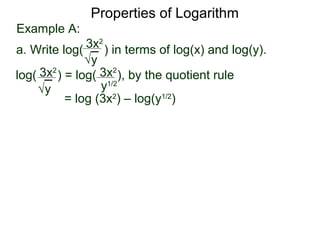
log( ) = log( ), by the quotient rule
= log (3x2
) – log(y1/2
)
3x2
√y
3x2
y1/2
Properties of Logarithm
a. Write log( ) in terms of log(x) and log(y).
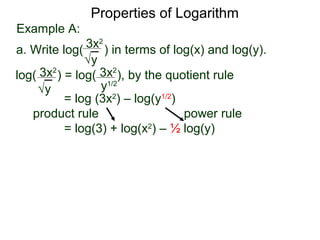
Example A:
3x2
√y
log( ) = log( ), by the quotient rule
= log (3x2
) – log(y1/2
)
product rule
= log(3) + log(x2
)
3x2
√y
3x2
y1/2
Properties of Logarithm
a. Write log( ) in terms of log(x) and log(y).
Example A:
3x2
√y
log( ) = log( ), by the quotient rule
= log (3x2
) – log(y1/2
)
product rule power rule
= log(3) + log(x2
) – ½ log(y)
3x2
√y
3x2
y1/2
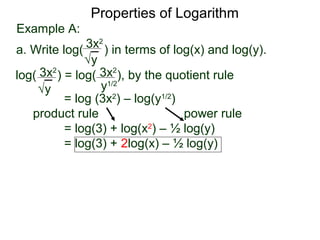
Properties of Logarithm
a. Write log( ) in terms of log(x) and log(y).
Example A:
3x2
√y
log( ) = log( ), by the quotient rule
= log (3x2
) – log(y1/2
)
product rule power rule
= log(3) + log(x2
) – ½ log(y)
= log(3) + 2log(x) – ½ log(y)
3x2
√y
3x2
y1/2
Properties of Logarithm
a. Write log( ) in terms of log(x) and log(y).
Example A:
3x2
√y
log( ) = log( ), by the quotient rule
= log (3x2
) – log(y1/2
)
product rule power rule
= log(3) + log(x2
) – ½ log(y)
= log(3) + 2log(x) – ½ log(y)
3x2
√y
3x2
y1/2
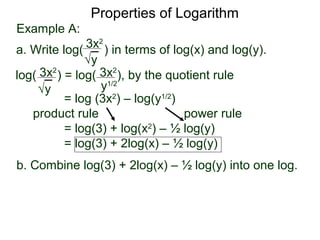
Properties of Logarithm
a. Write log( ) in terms of log(x) and log(y).
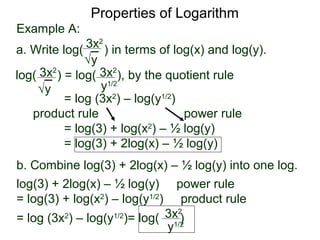
b. Combine log(3) + 2log(x) – ½ log(y) into one log.
Example A:
3x2
√y
log( ) = log( ), by the quotient rule
= log (3x2
) – log(y1/2
)
product rule power rule
= log(3) + log(x2
) – ½ log(y)
= log(3) + 2log(x) – ½ log(y)
3x2
√y
3x2
y1/2
Properties of Logarithm
a. Write log( ) in terms of log(x) and log(y).
log(3) + 2log(x) – ½ log(y) power rule
= log(3) + log(x2
) – log(y1/2
)
b. Combine log(3) + 2log(x) – ½ log(y) into one log.
Example A:
3x2
√y
log( ) = log( ), by the quotient rule
= log (3x2
) – log(y1/2
)
product rule power rule
= log(3) + log(x2
) – ½ log(y)
= log(3) + 2log(x) – ½ log(y)
3x2
√y
3x2
y1/2
Properties of Logarithm
a. Write log( ) in terms of log(x) and log(y).
log(3) + 2log(x) – ½ log(y) power rule
= log(3) + log(x2
) – log(y1/2
) product rule
= log (3x2
) – log(y1/2
)
b. Combine log(3) + 2log(x) – ½ log(y) into one log.
Example A:
3x2
√y
log( ) = log( ), by the quotient rule
= log (3x2
) – log(y1/2
)
product rule power rule
= log(3) + log(x2
) – ½ log(y)
= log(3) + 2log(x) – ½ log(y)
3x2
√y
3x2
y1/2
Properties of Logarithm
a. Write log( ) in terms of log(x) and log(y).
log(3) + 2log(x) – ½ log(y) power rule
= log(3) + log(x2
) – log(y1/2
) product rule
= log (3x2
) – log(y1/2
)= log( )3x2
y1/2
b. Combine log(3) + 2log(x) – ½ log(y) into one log.
Example A:
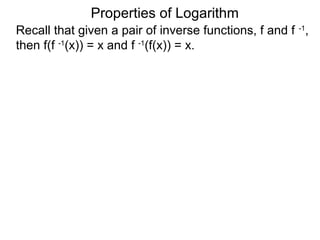
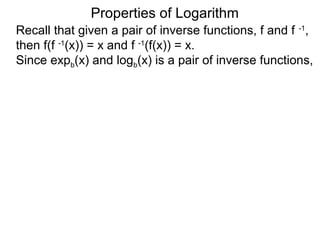
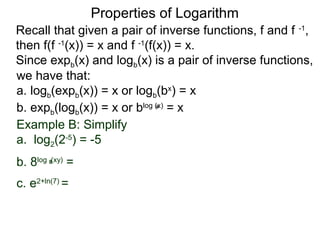
Recall that given a pair of inverse functions, f and f -1
,
then f(f -1
(x)) = x and f -1
(f(x)) = x.
Properties of Logarithm
Recall that given a pair of inverse functions, f and f -1
,
then f(f -1
(x)) = x and f -1
(f(x)) = x.
Since expb(x) and logb(x) is a pair of inverse functions,
Properties of Logarithm
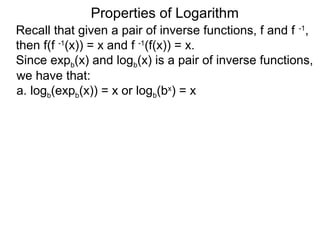
Recall that given a pair of inverse functions, f and f -1
,
then f(f -1
(x)) = x and f -1
(f(x)) = x.
Since expb(x) and logb(x) is a pair of inverse functions,
we have that:
a. logb(expb(x)) = x or logb(bx
) = x
Properties of Logarithm
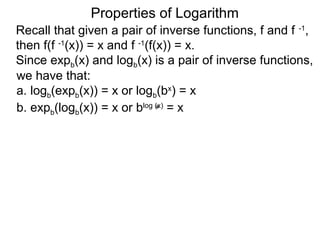
Recall that given a pair of inverse functions, f and f -1
,
then f(f -1
(x)) = x and f -1
(f(x)) = x.
Since expb(x) and logb(x) is a pair of inverse functions,
we have that:
a. logb(expb(x)) = x or logb(bx
) = x
b. expb(logb(x)) = x or blog (x)
= x
Properties of Logarithm
b
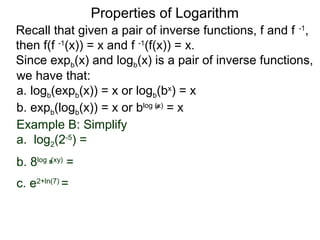
Recall that given a pair of inverse functions, f and f -1
,
then f(f -1
(x)) = x and f -1
(f(x)) = x.
Since expb(x) and logb(x) is a pair of inverse functions,
we have that:
a. logb(expb(x)) = x or logb(bx
) = x
b. expb(logb(x)) = x or blog (x)
= x
Properties of Logarithm
b
Example B: Simplify
a. log2(2-5
) =
b. 8log (xy)
=
c. e2+ln(7)
=
8
Recall that given a pair of inverse functions, f and f -1
,
then f(f -1
(x)) = x and f -1
(f(x)) = x.
Since expb(x) and logb(x) is a pair of inverse functions,
we have that:
a. logb(expb(x)) = x or logb(bx
) = x
b. expb(logb(x)) = x or blog (x)
= x
Properties of Logarithm
b
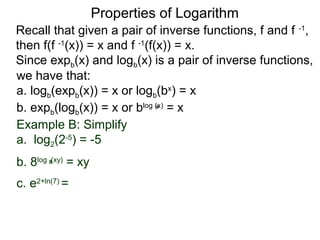
Example B: Simplify
a. log2(2-5
) = -5
b. 8log (xy)
=
c. e2+ln(7)
=
8
Recall that given a pair of inverse functions, f and f -1
,
then f(f -1
(x)) = x and f -1
(f(x)) = x.
Since expb(x) and logb(x) is a pair of inverse functions,
we have that:
a. logb(expb(x)) = x or logb(bx
) = x
b. expb(logb(x)) = x or blog (x)
= x
Properties of Logarithm
b
Example B: Simplify
a. log2(2-5
) = -5
b. 8log (xy)
= xy
c. e2+ln(7)
=
8
Recall that given a pair of inverse functions, f and f -1
,
then f(f -1
(x)) = x and f -1
(f(x)) = x.
Since expb(x) and logb(x) is a pair of inverse functions,
we have that:
a. logb(expb(x)) = x or logb(bx
) = x
b. expb(logb(x)) = x or blog (x)
= x
Properties of Logarithm
b
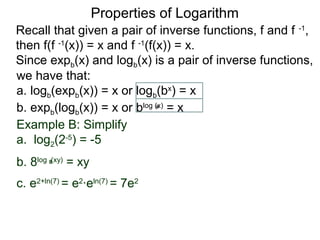
Example B: Simplify
a. log2(2-5
) = -5
b. 8log (xy)
= xy
c. e2+ln(7)
= e2
·eln(7)
= 7e2
8
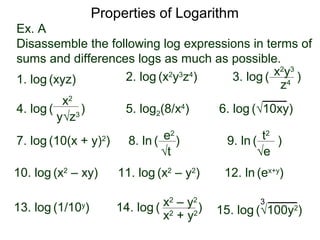
Ex. A
Disassemble the following log expressions in terms of
sums and differences logs as much as possible.
Properties of Logarithm
5. log2(8/x4
) 6. log (√10xy)
y√z3
2. log (x2
y3
z4
)
4. log ( )
x2
1. log (xyz)
7. log (10(x + y)2
) 8. ln ( )
√t
e2
9. ln ( )
√e
t2
10. log (x2
– xy) 11. log (x2
– y2
) 12. ln (ex+y
)
13. log (1/10y
) 14. log ( )x2
– y2
x2
+ y2 15. log (√100y2
)
3
3. log ( )
z4
x2
y3
Ex. B
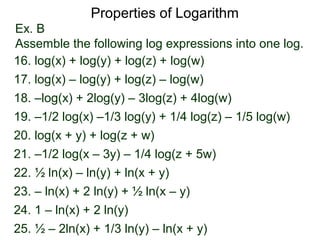
Assemble the following log expressions into one log.
Properties of Logarithm
17. log(x) – log(y) + log(z) – log(w)
18. –log(x) + 2log(y) – 3log(z) + 4log(w)
19. –1/2 log(x) –1/3 log(y) + 1/4 log(z) – 1/5 log(w)
16. log(x) + log(y) + log(z) + log(w)
21. –1/2 log(x – 3y) – 1/4 log(z + 5w)
20. log(x + y) + log(z + w)
22. ½ ln(x) – ln(y) + ln(x + y)
23. – ln(x) + 2 ln(y) + ½ ln(x – y)
24. 1 – ln(x) + 2 ln(y)
25. ½ – 2ln(x) + 1/3 ln(y) – ln(x + y)
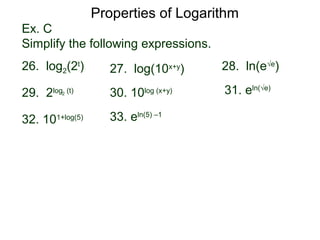
Properties of Logarithm
32. 101+log(5)
Ex. C
Simplify the following expressions.
30. 10log (x+y)
26. log2(2t
) 27. log(10x+y
)
29. 2log (t)2
28. ln(e√e
)
31. eln(√e)
33. eln(5) –1

3.1 properties of logarithm

  • 1.
  • 2.
    Properties of Logarithm Recallthe following Rules of Exponents: The corresponding Rules of Logs are:
  • 3.
    1. b0 = 1 Propertiesof Logarithm Recall the following Rules of Exponents: The corresponding Rules of Logs are:
  • 4.
    1. b0 = 1 2.br · bt = br+t Properties of Logarithm Recall the following Rules of Exponents: The corresponding Rules of Logs are:
  • 5.
    1. b0 = 1 2.br · bt = br+t 3. = br-t bt br Properties of Logarithm Recall the following Rules of Exponents: The corresponding Rules of Logs are:
  • 6.
    1. b0 = 1 2.br · bt = br+t 3. = br-t 4. (br )t = brt bt br Properties of Logarithm Recall the following Rules of Exponents: The corresponding Rules of Logs are:
  • 7.
    1. logb(1) =01. b0 = 1 2. br · bt = br+t 3. = br-t 4. (br )t = brt bt br Properties of Logarithm Recall the following Rules of Exponents: The corresponding Rules of Logs are:
  • 8.
    1. logb(1) =0 2. logb(x·y) = logb(x)+logb(y) 1. b0 = 1 2. br · bt = br+t 3. = br-t 4. (br )t = brt bt br Properties of Logarithm Recall the following Rules of Exponents: The corresponding Rules of Logs are:
  • 9.
    1. logb(1) =0 2. logb(x·y) = logb(x)+logb(y) 3. logb( ) = logb(x) – logb(y) x y 1. b0 = 1 2. br · bt = br+t 3. = br-t 4. (br )t = brt bt br Properties of Logarithm Recall the following Rules of Exponents: The corresponding Rules of Logs are:
  • 10.
    1. logb(1) =0 2. logb(x·y) = logb(x)+logb(y) 3. logb( ) = logb(x) – logb(y) 4. logb(xt ) = t·logb(x) x y 1. b0 = 1 2. br · bt = br+t 3. = br-t 4. (br )t = brt bt br Properties of Logarithm Recall the following Rules of Exponents: The corresponding Rules of Logs are:
  • 11.
    1. logb(1) =0 2. logb(x·y) = logb(x)+logb(y) 3. logb( ) = logb(x) – logb(y) 4. logb(xt ) = t·logb(x) x y 1. b0 = 1 2. br · bt = br+t 3. = br-t 4. (br )t = brt bt br Properties of Logarithm Recall the following Rules of Exponents: The corresponding Rules of Logs are: We veryify part 2: logb(xy) = logb(x) + logb(y), x, y > 0. Proof:
  • 12.
    1. logb(1) =0 2. logb(x·y) = logb(x)+logb(y) 3. logb( ) = logb(x) – logb(y) 4. logb(xt ) = t·logb(x) x y 1. b0 = 1 2. br · bt = br+t 3. = br-t 4. (br )t = brt bt br Properties of Logarithm Recall the following Rules of Exponents: The corresponding Rules of Logs are: We veryify part 2: logb(xy) = logb(x) + logb(y), x, y > 0. Proof: Let x and y be two positive numbers.
  • 13.
    1. logb(1) =0 2. logb(x·y) = logb(x)+logb(y) 3. logb( ) = logb(x) – logb(y) 4. logb(xt ) = t·logb(x) x y 1. b0 = 1 2. br · bt = br+t 3. = br-t 4. (br )t = brt bt br Properties of Logarithm Recall the following Rules of Exponents: The corresponding Rules of Logs are: We veryify part 2: logb(xy) = logb(x) + logb(y), x, y > 0. Proof: Let x and y be two positive numbers. Let logb(x) = r and logb(y) = t, which in exp-form are x = br and y = bt .
  • 14.
    1. logb(1) =0 2. logb(x·y) = logb(x)+logb(y) 3. logb( ) = logb(x) – logb(y) 4. logb(xt ) = t·logb(x) x y 1. b0 = 1 2. br · bt = br+t 3. = br-t 4. (br )t = brt bt br Properties of Logarithm Recall the following Rules of Exponents: The corresponding Rules of Logs are: We veryify part 2: logb(xy) = logb(x) + logb(y), x, y > 0. Proof: Let x and y be two positive numbers. Let logb(x) = r and logb(y) = t, which in exp-form are x = br and y = bt . Therefore x·y = br+t ,
  • 15.
    1. logb(1) =0 2. logb(x·y) = logb(x)+logb(y) 3. logb( ) = logb(x) – logb(y) 4. logb(xt ) = t·logb(x) x y 1. b0 = 1 2. br · bt = br+t 3. = br-t 4. (br )t = brt bt br Properties of Logarithm Recall the following Rules of Exponents: The corresponding Rules of Logs are: We veryify part 2: logb(xy) = logb(x) + logb(y), x, y > 0. Proof: Let x and y be two positive numbers. Let logb(x) = r and logb(y) = t, which in exp-form are x = br and y = bt . Therefore x·y = br+t , which in log-form is logb(x·y) = r + t = logb(x)+logb(y).
  • 16.
    1. logb(1) =0 2. logb(x·y) = logb(x)+logb(y) 3. logb( ) = logb(x) – logb(y) 4. logb(xt ) = t·logb(x) x y 1. b0 = 1 2. br · bt = br+t 3. = br-t 4. (br )t = brt bt br Properties of Logarithm Recall the following Rules of Exponents: The corresponding Rules of Logs are: We veryify part 2: logb(xy) = logb(x) + logb(y), x, y > 0. Proof: Let x and y be two positive numbers. Let logb(x) = r and logb(y) = t, which in exp-form are x = br and y = bt . Therefore x·y = br+t , which in log-form is logb(x·y) = r + t = logb(x)+logb(y).The other rules may be verified similarly.
  • 17.
    Example A: 3x2 √y Properties ofLogarithm a. Write log( ) in terms of log(x) and log(y).
  • 18.
    3x2 √y log( ) =log( ),3x2 √y 3x2 y1/2 Properties of Logarithm a. Write log( ) in terms of log(x) and log(y). Example A:
  • 19.
    3x2 √y log( ) =log( ), by the quotient rule = log (3x2 ) – log(y1/2 ) 3x2 √y 3x2 y1/2 Properties of Logarithm a. Write log( ) in terms of log(x) and log(y). Example A:
  • 20.
    3x2 √y log( ) =log( ), by the quotient rule = log (3x2 ) – log(y1/2 ) product rule = log(3) + log(x2 ) 3x2 √y 3x2 y1/2 Properties of Logarithm a. Write log( ) in terms of log(x) and log(y). Example A:
  • 21.
    3x2 √y log( ) =log( ), by the quotient rule = log (3x2 ) – log(y1/2 ) product rule power rule = log(3) + log(x2 ) – ½ log(y) 3x2 √y 3x2 y1/2 Properties of Logarithm a. Write log( ) in terms of log(x) and log(y). Example A:
  • 22.
    3x2 √y log( ) =log( ), by the quotient rule = log (3x2 ) – log(y1/2 ) product rule power rule = log(3) + log(x2 ) – ½ log(y) = log(3) + 2log(x) – ½ log(y) 3x2 √y 3x2 y1/2 Properties of Logarithm a. Write log( ) in terms of log(x) and log(y). Example A:
  • 23.
    3x2 √y log( ) =log( ), by the quotient rule = log (3x2 ) – log(y1/2 ) product rule power rule = log(3) + log(x2 ) – ½ log(y) = log(3) + 2log(x) – ½ log(y) 3x2 √y 3x2 y1/2 Properties of Logarithm a. Write log( ) in terms of log(x) and log(y). b. Combine log(3) + 2log(x) – ½ log(y) into one log. Example A:
  • 24.
    3x2 √y log( ) =log( ), by the quotient rule = log (3x2 ) – log(y1/2 ) product rule power rule = log(3) + log(x2 ) – ½ log(y) = log(3) + 2log(x) – ½ log(y) 3x2 √y 3x2 y1/2 Properties of Logarithm a. Write log( ) in terms of log(x) and log(y). log(3) + 2log(x) – ½ log(y) power rule = log(3) + log(x2 ) – log(y1/2 ) b. Combine log(3) + 2log(x) – ½ log(y) into one log. Example A:
  • 25.
    3x2 √y log( ) =log( ), by the quotient rule = log (3x2 ) – log(y1/2 ) product rule power rule = log(3) + log(x2 ) – ½ log(y) = log(3) + 2log(x) – ½ log(y) 3x2 √y 3x2 y1/2 Properties of Logarithm a. Write log( ) in terms of log(x) and log(y). log(3) + 2log(x) – ½ log(y) power rule = log(3) + log(x2 ) – log(y1/2 ) product rule = log (3x2 ) – log(y1/2 ) b. Combine log(3) + 2log(x) – ½ log(y) into one log. Example A:
  • 26.
    3x2 √y log( ) =log( ), by the quotient rule = log (3x2 ) – log(y1/2 ) product rule power rule = log(3) + log(x2 ) – ½ log(y) = log(3) + 2log(x) – ½ log(y) 3x2 √y 3x2 y1/2 Properties of Logarithm a. Write log( ) in terms of log(x) and log(y). log(3) + 2log(x) – ½ log(y) power rule = log(3) + log(x2 ) – log(y1/2 ) product rule = log (3x2 ) – log(y1/2 )= log( )3x2 y1/2 b. Combine log(3) + 2log(x) – ½ log(y) into one log. Example A:
  • 27.
    Recall that givena pair of inverse functions, f and f -1 , then f(f -1 (x)) = x and f -1 (f(x)) = x. Properties of Logarithm
  • 28.
    Recall that givena pair of inverse functions, f and f -1 , then f(f -1 (x)) = x and f -1 (f(x)) = x. Since expb(x) and logb(x) is a pair of inverse functions, Properties of Logarithm
  • 29.
    Recall that givena pair of inverse functions, f and f -1 , then f(f -1 (x)) = x and f -1 (f(x)) = x. Since expb(x) and logb(x) is a pair of inverse functions, we have that: a. logb(expb(x)) = x or logb(bx ) = x Properties of Logarithm
  • 30.
    Recall that givena pair of inverse functions, f and f -1 , then f(f -1 (x)) = x and f -1 (f(x)) = x. Since expb(x) and logb(x) is a pair of inverse functions, we have that: a. logb(expb(x)) = x or logb(bx ) = x b. expb(logb(x)) = x or blog (x) = x Properties of Logarithm b
  • 31.
    Recall that givena pair of inverse functions, f and f -1 , then f(f -1 (x)) = x and f -1 (f(x)) = x. Since expb(x) and logb(x) is a pair of inverse functions, we have that: a. logb(expb(x)) = x or logb(bx ) = x b. expb(logb(x)) = x or blog (x) = x Properties of Logarithm b Example B: Simplify a. log2(2-5 ) = b. 8log (xy) = c. e2+ln(7) = 8
  • 32.
    Recall that givena pair of inverse functions, f and f -1 , then f(f -1 (x)) = x and f -1 (f(x)) = x. Since expb(x) and logb(x) is a pair of inverse functions, we have that: a. logb(expb(x)) = x or logb(bx ) = x b. expb(logb(x)) = x or blog (x) = x Properties of Logarithm b Example B: Simplify a. log2(2-5 ) = -5 b. 8log (xy) = c. e2+ln(7) = 8
  • 33.
    Recall that givena pair of inverse functions, f and f -1 , then f(f -1 (x)) = x and f -1 (f(x)) = x. Since expb(x) and logb(x) is a pair of inverse functions, we have that: a. logb(expb(x)) = x or logb(bx ) = x b. expb(logb(x)) = x or blog (x) = x Properties of Logarithm b Example B: Simplify a. log2(2-5 ) = -5 b. 8log (xy) = xy c. e2+ln(7) = 8
  • 34.
    Recall that givena pair of inverse functions, f and f -1 , then f(f -1 (x)) = x and f -1 (f(x)) = x. Since expb(x) and logb(x) is a pair of inverse functions, we have that: a. logb(expb(x)) = x or logb(bx ) = x b. expb(logb(x)) = x or blog (x) = x Properties of Logarithm b Example B: Simplify a. log2(2-5 ) = -5 b. 8log (xy) = xy c. e2+ln(7) = e2 ·eln(7) = 7e2 8
  • 35.
    Ex. A Disassemble thefollowing log expressions in terms of sums and differences logs as much as possible. Properties of Logarithm 5. log2(8/x4 ) 6. log (√10xy) y√z3 2. log (x2 y3 z4 ) 4. log ( ) x2 1. log (xyz) 7. log (10(x + y)2 ) 8. ln ( ) √t e2 9. ln ( ) √e t2 10. log (x2 – xy) 11. log (x2 – y2 ) 12. ln (ex+y ) 13. log (1/10y ) 14. log ( )x2 – y2 x2 + y2 15. log (√100y2 ) 3 3. log ( ) z4 x2 y3
  • 36.
    Ex. B Assemble thefollowing log expressions into one log. Properties of Logarithm 17. log(x) – log(y) + log(z) – log(w) 18. –log(x) + 2log(y) – 3log(z) + 4log(w) 19. –1/2 log(x) –1/3 log(y) + 1/4 log(z) – 1/5 log(w) 16. log(x) + log(y) + log(z) + log(w) 21. –1/2 log(x – 3y) – 1/4 log(z + 5w) 20. log(x + y) + log(z + w) 22. ½ ln(x) – ln(y) + ln(x + y) 23. – ln(x) + 2 ln(y) + ½ ln(x – y) 24. 1 – ln(x) + 2 ln(y) 25. ½ – 2ln(x) + 1/3 ln(y) – ln(x + y)
  • 37.
    Properties of Logarithm 32.101+log(5) Ex. C Simplify the following expressions. 30. 10log (x+y) 26. log2(2t ) 27. log(10x+y ) 29. 2log (t)2 28. ln(e√e ) 31. eln(√e) 33. eln(5) –1