Permutations and Combinations
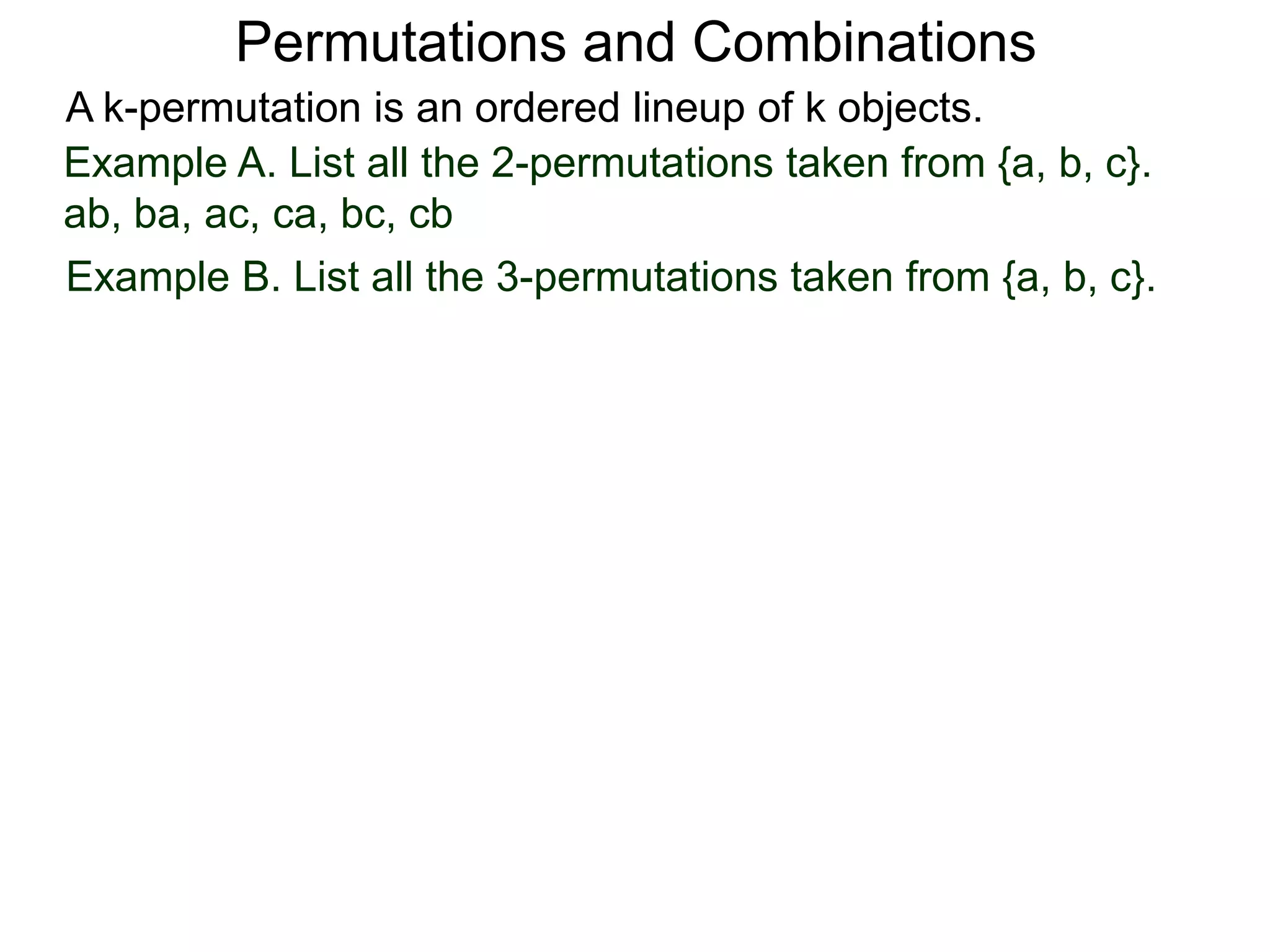
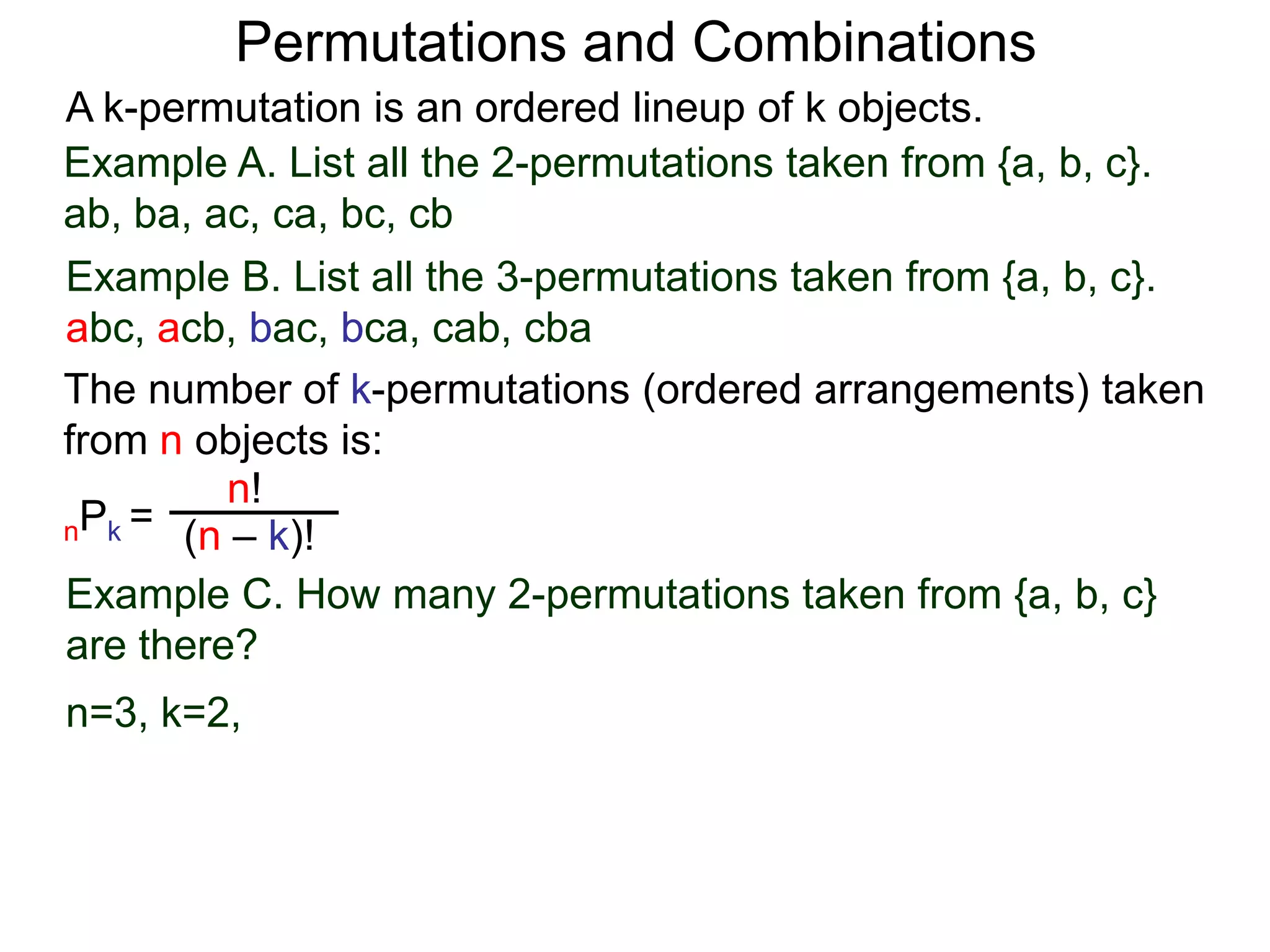
A k-permutation is an ordered lineup of k objects.
Permutations and Combinations
A k-permutation is an ordered lineup of k objects.
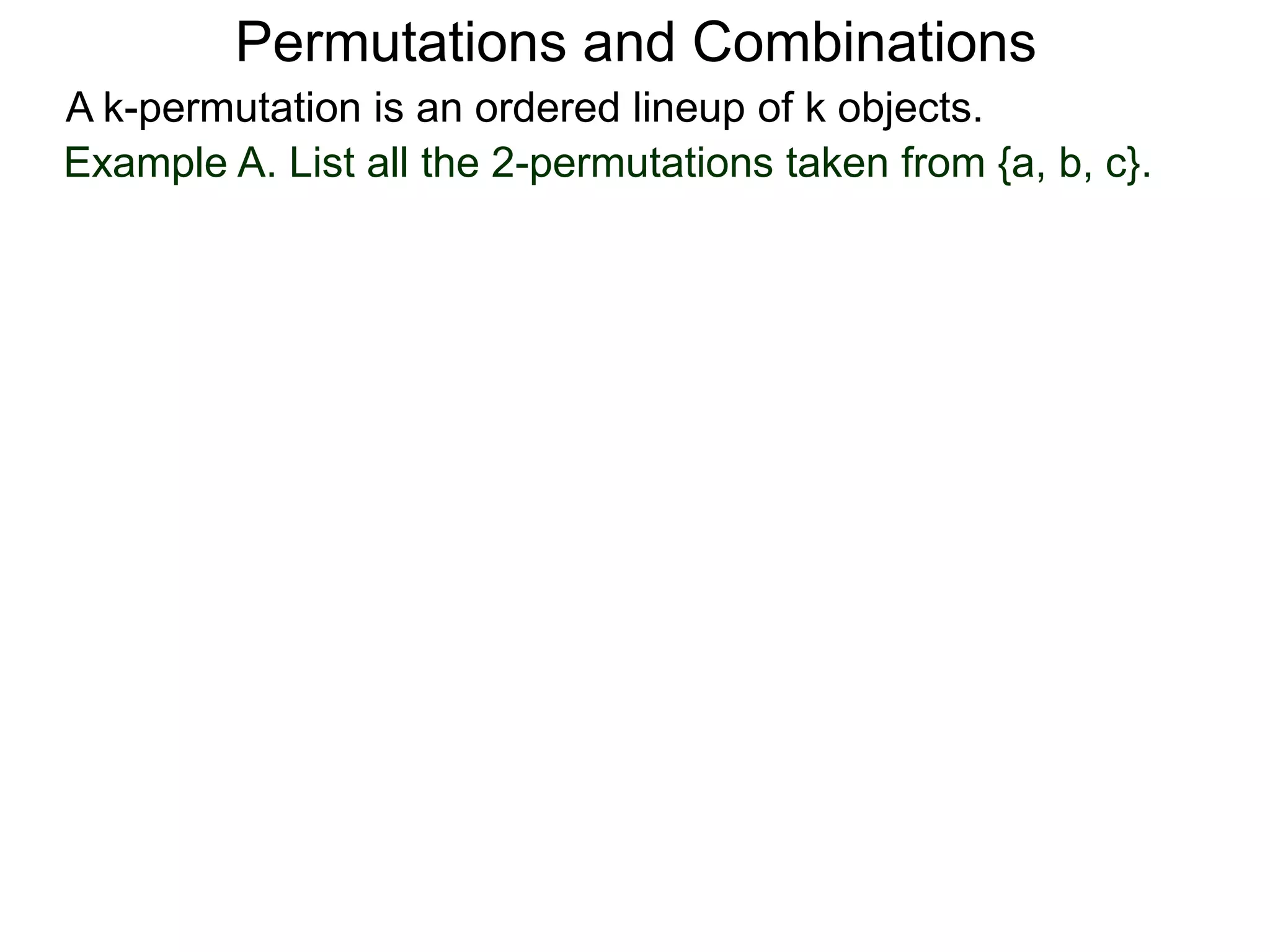
Example A. List all the 2-permutations taken from {a, b, c}.
Permutations and Combinations
A k-permutation is an ordered lineup of k objects.
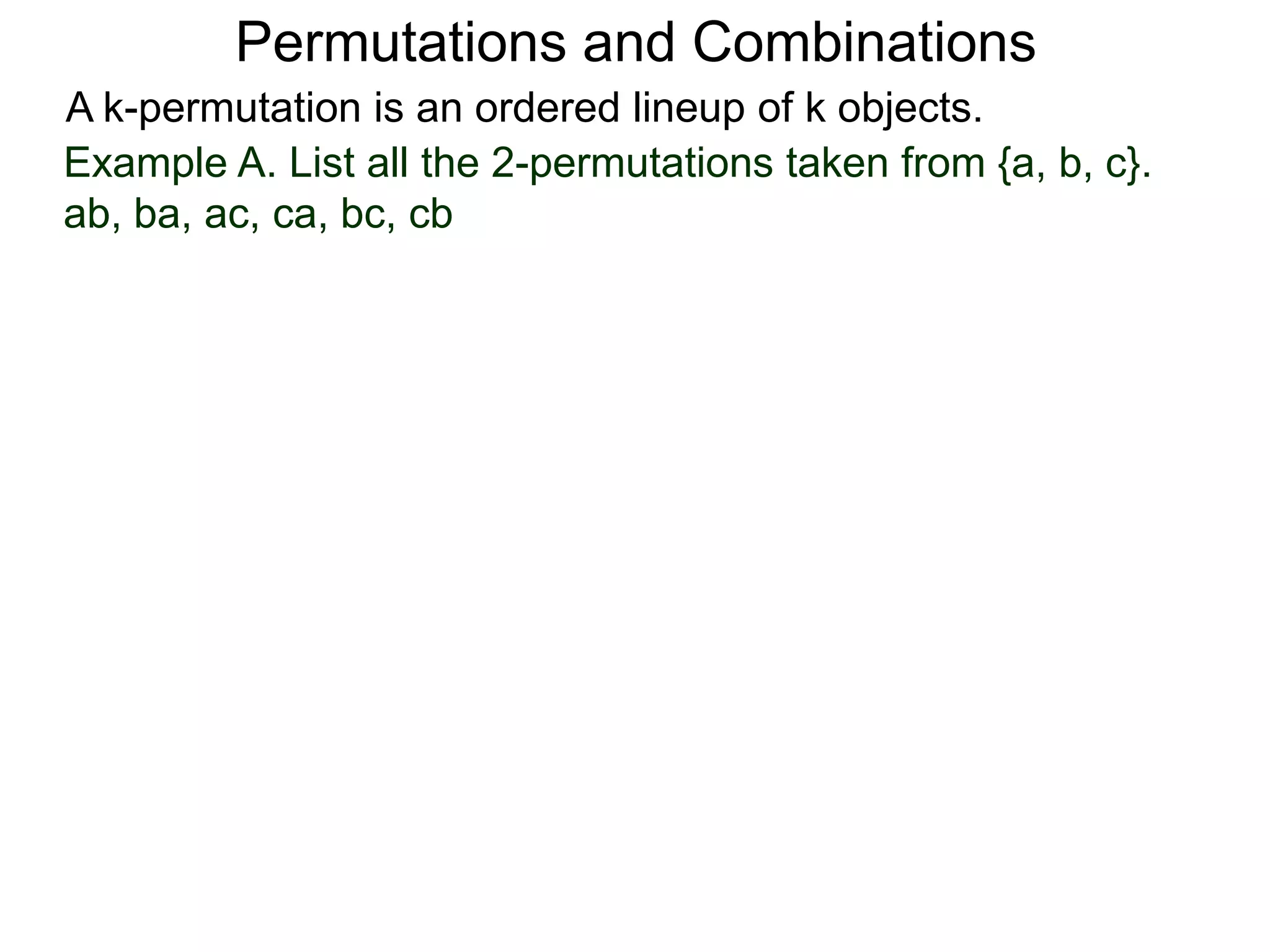
Example A. List all the 2-permutations taken from {a, b, c}.
ab, ba, ac, ca, bc, cb
Permutations and Combinations
A k-permutation is an ordered lineup of k objects.
Example A. List all the 2-permutations taken from {a, b, c}.
ab, ba, ac, ca, bc, cb
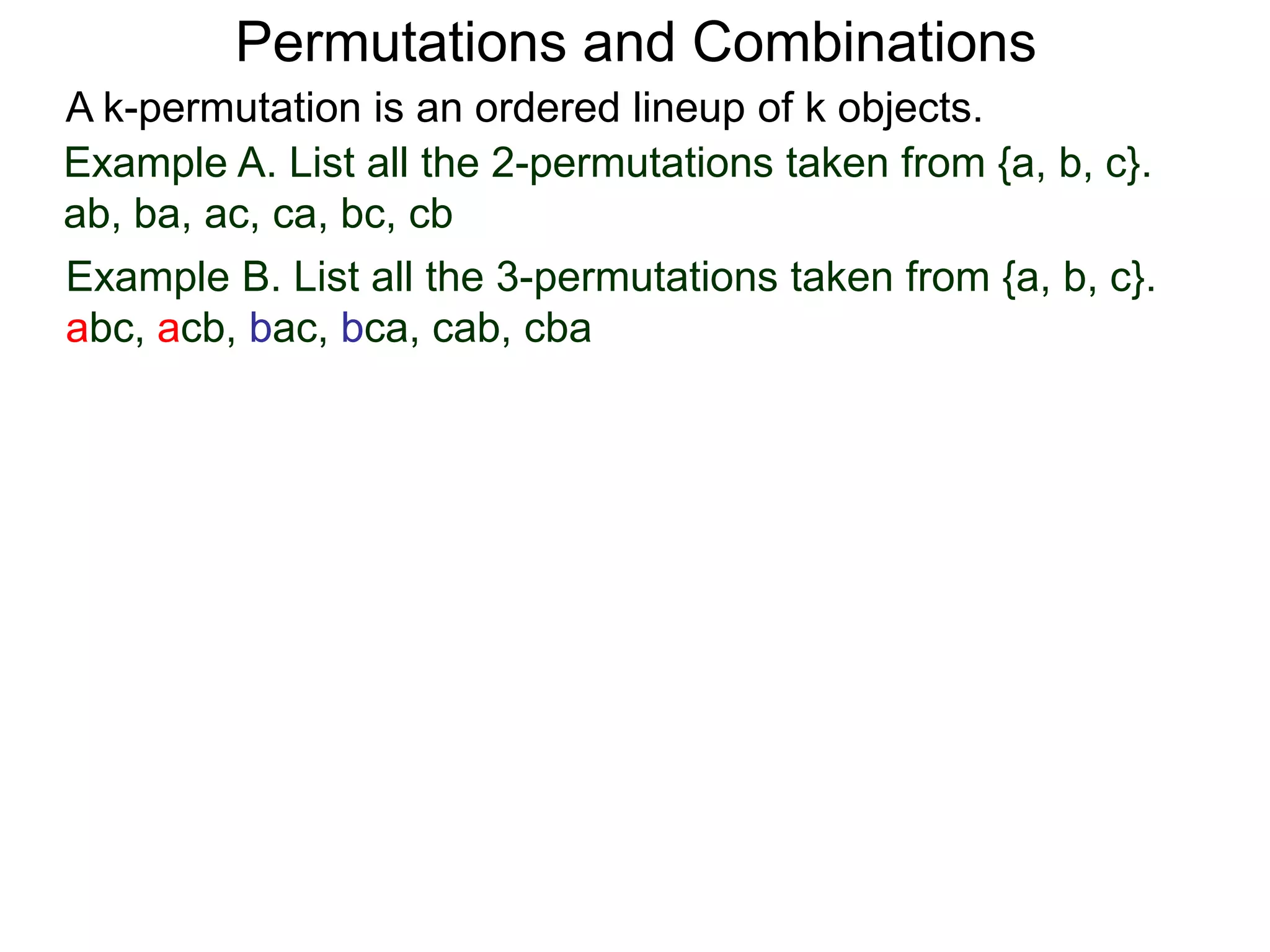
Example B. List all the 3-permutations taken from {a, b, c}.
Permutations and Combinations
A k-permutation is an ordered lineup of k objects.
Example A. List all the 2-permutations taken from {a, b, c}.
ab, ba, ac, ca, bc, cb
Example B. List all the 3-permutations taken from {a, b, c}.
abc, acb, bac, bca, cab, cba
Permutations and Combinations
A k-permutation is an ordered lineup of k objects.
Example A. List all the 2-permutations taken from {a, b, c}.
ab, ba, ac, ca, bc, cb
Example B. List all the 3-permutations taken from {a, b, c}.
abc, acb, bac, bca, cab, cba
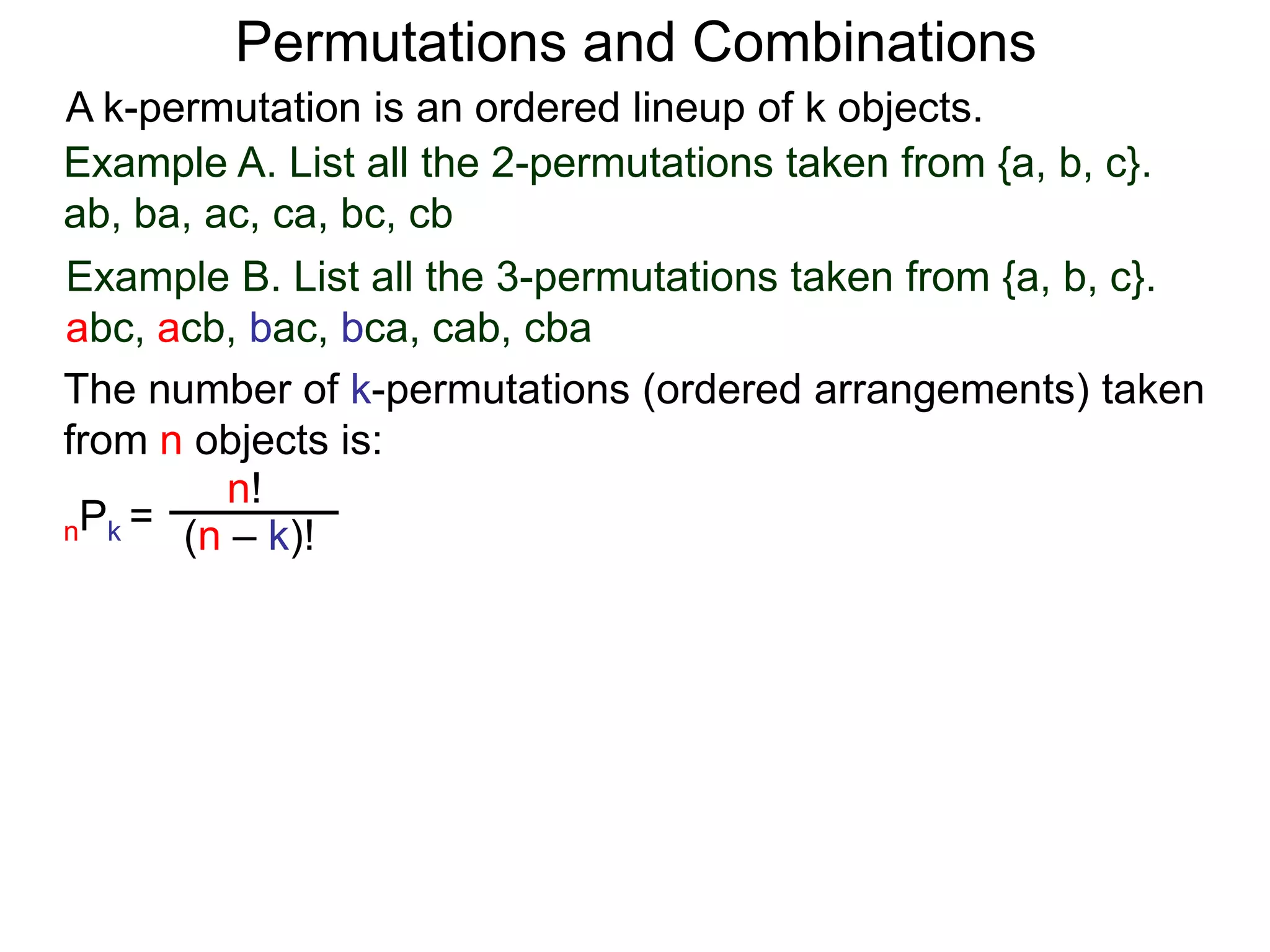
The number of k-permutations (ordered arrangements) taken
from n objects is:
         n!
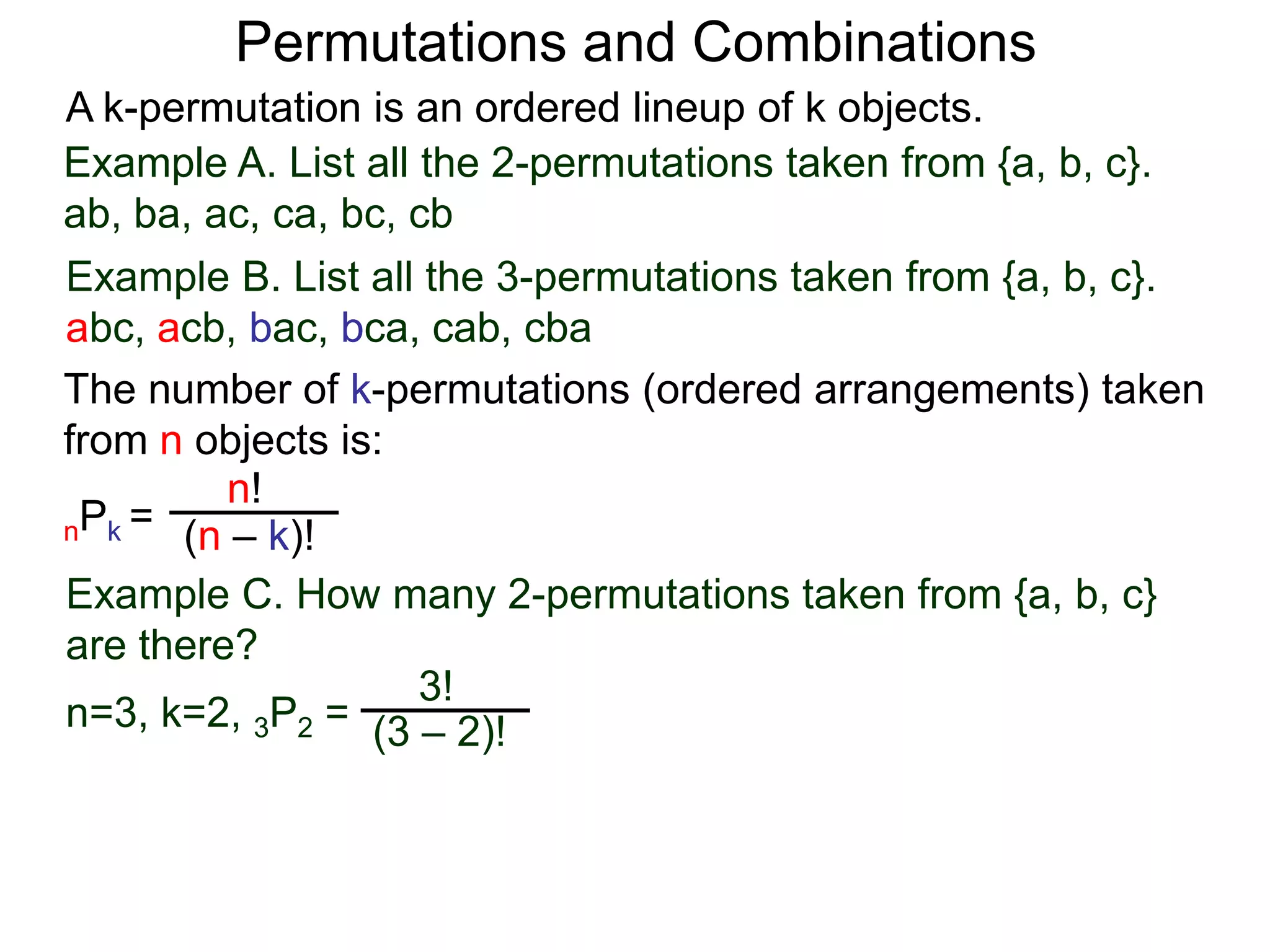
nPk = (n – k)!
Permutations and Combinations
A k-permutation is an ordered lineup of k objects.
Example A. List all the 2-permutations taken from {a, b, c}.
ab, ba, ac, ca, bc, cb
Example B. List all the 3-permutations taken from {a, b, c}.
abc, acb, bac, bca, cab, cba
The number of k-permutations (ordered arrangements) taken
from n objects is:
         n!
nPk = (n – k)!

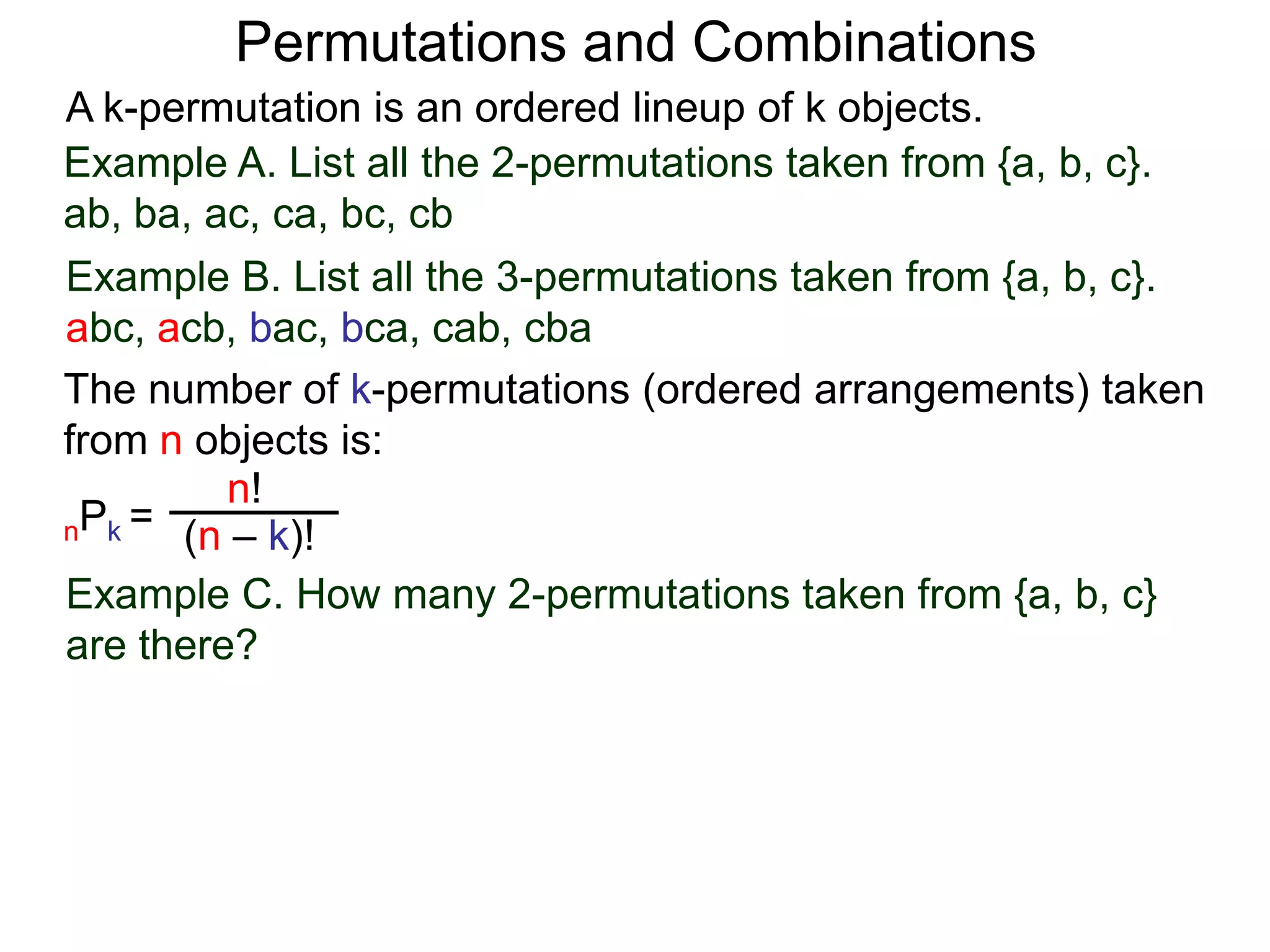
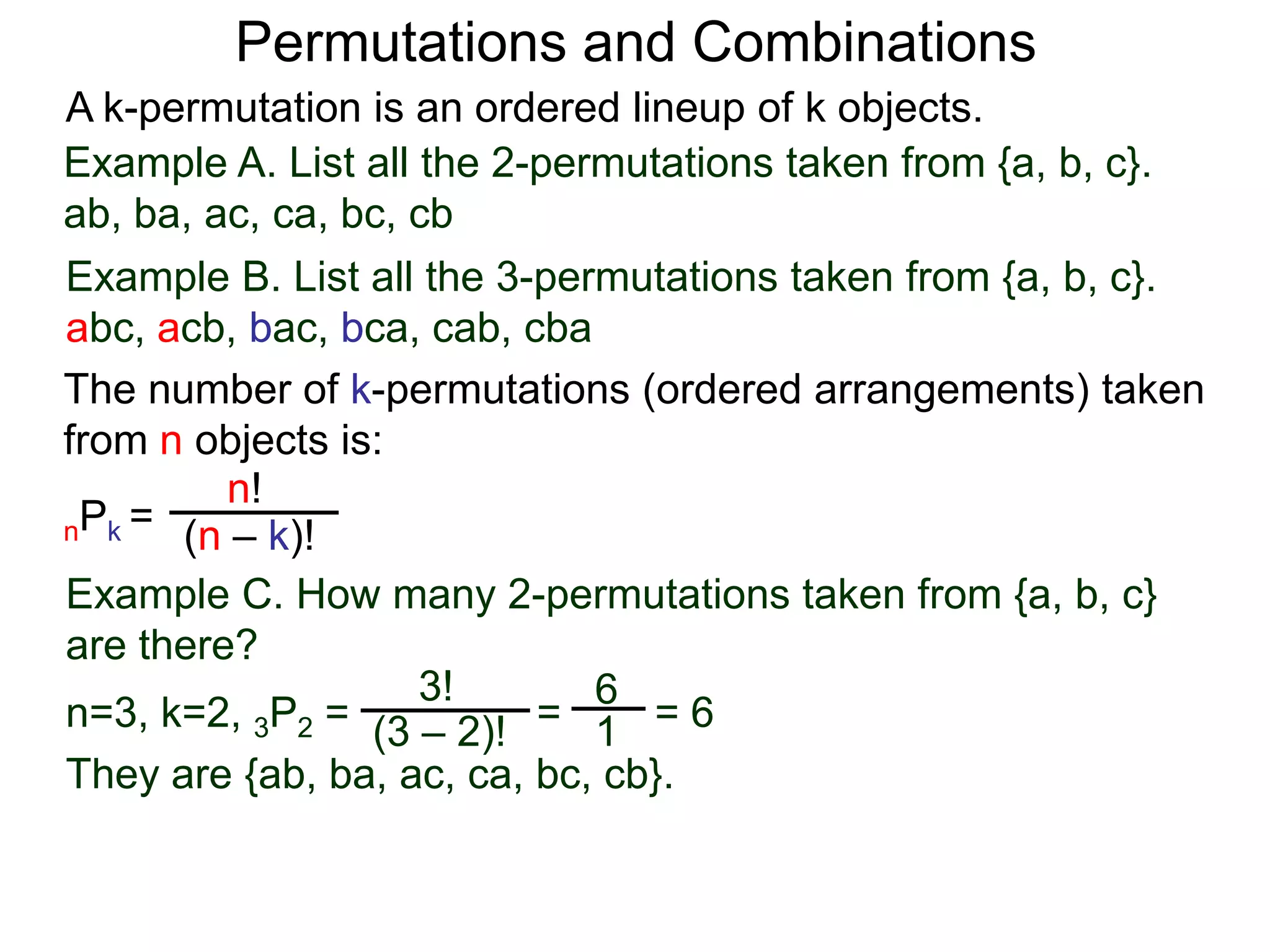
Example C. How many 2-permutations taken from {a, b, c}
are there?
Permutations and Combinations
A k-permutation is an ordered lineup of k objects.
Example A. List all the 2-permutations taken from {a, b, c}.
ab, ba, ac, ca, bc, cb
Example B. List all the 3-permutations taken from {a, b, c}.
abc, acb, bac, bca, cab, cba
The number of k-permutations (ordered arrangements) taken
from n objects is:
         n!
nPk = (n – k)!

Example C. How many 2-permutations taken from {a, b, c}
are there?
n=3, k=2,
Permutations and Combinations
A k-permutation is an ordered lineup of k objects.
Example A. List all the 2-permutations taken from {a, b, c}.
ab, ba, ac, ca, bc, cb
Example B. List all the 3-permutations taken from {a, b, c}.
abc, acb, bac, bca, cab, cba
The number of k-permutations (ordered arrangements) taken
from n objects is:
         n!
nPk = (n – k)!

Example C. How many 2-permutations taken from {a, b, c}
are there?
                    3!
n=3, k=2, 3P2 = (3 – 2)!
Permutations and Combinations
A k-permutation is an ordered lineup of k objects.
Example A. List all the 2-permutations taken from {a, b, c}.
ab, ba, ac, ca, bc, cb
Example B. List all the 3-permutations taken from {a, b, c}.
abc, acb, bac, bca, cab, cba
The number of k-permutations (ordered arrangements) taken
from n objects is:
         n!
nPk = (n – k)!

Example C. How many 2-permutations taken from {a, b, c}
are there?
                    3!       6
n=3, k=2, 3P2 = (3 – 2)! = 1 = 6
Permutations and Combinations
A k-permutation is an ordered lineup of k objects.
Example A. List all the 2-permutations taken from {a, b, c}.
ab, ba, ac, ca, bc, cb
Example B. List all the 3-permutations taken from {a, b, c}.
abc, acb, bac, bca, cab, cba
The number of k-permutations (ordered arrangements) taken
from n objects is:
         n!
nPk = (n – k)!

Example C. How many 2-permutations taken from {a, b, c}
are there?
                    3!       6
n=3, k=2, 3P2 = (3 – 2)! = 1 = 6
They are {ab, ba, ac, ca, bc, cb}.
Permutations and Combinations
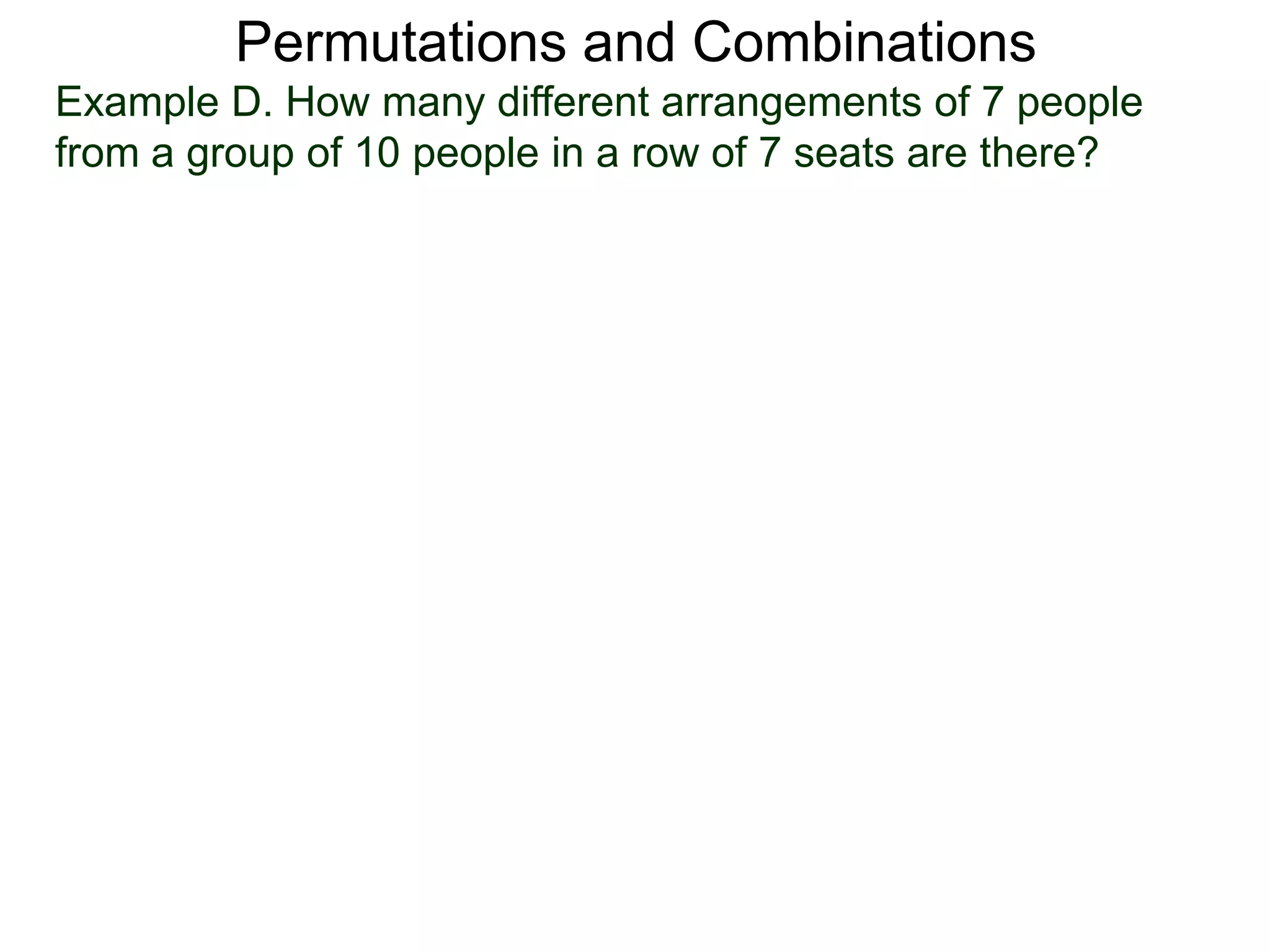
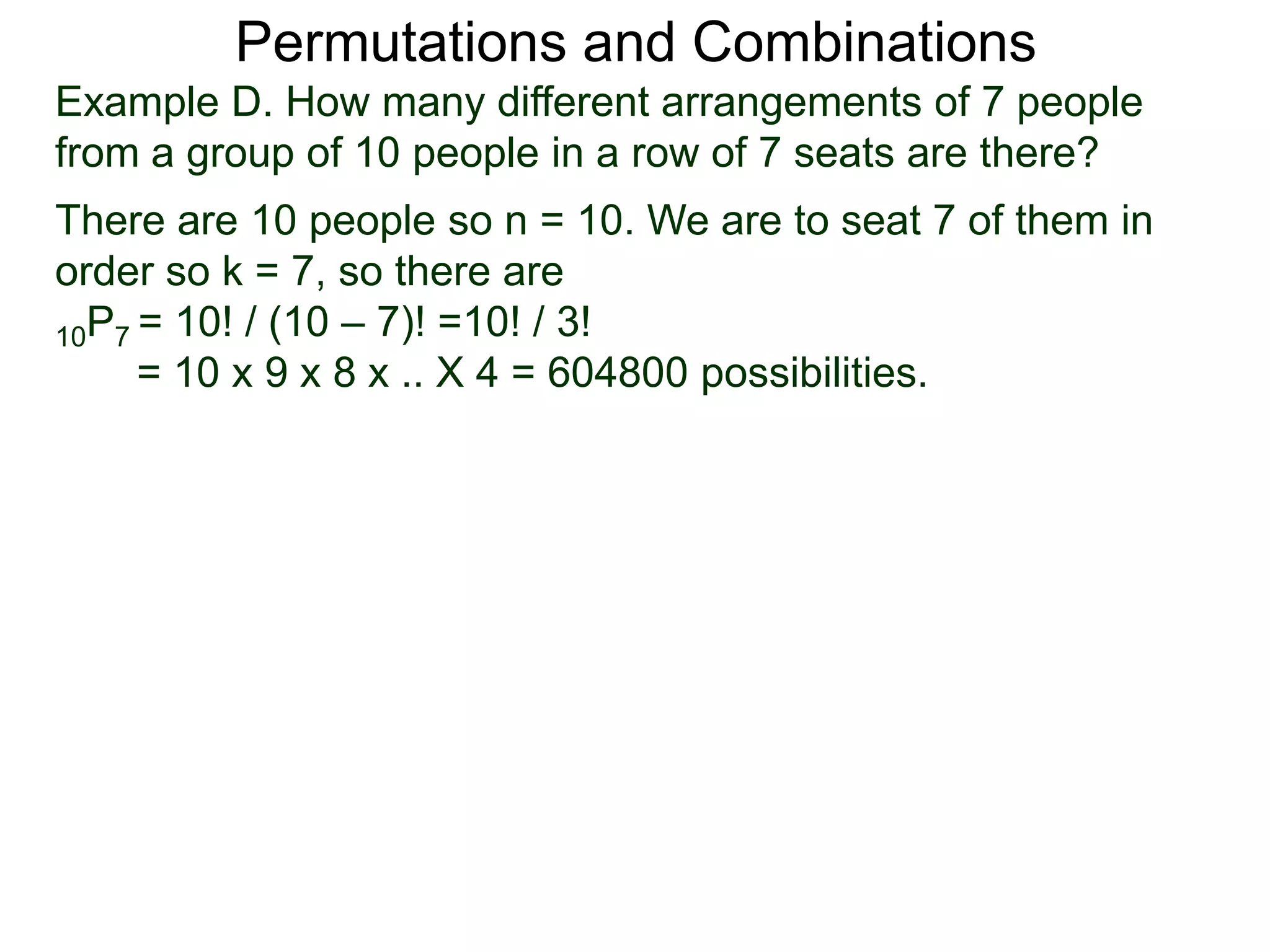
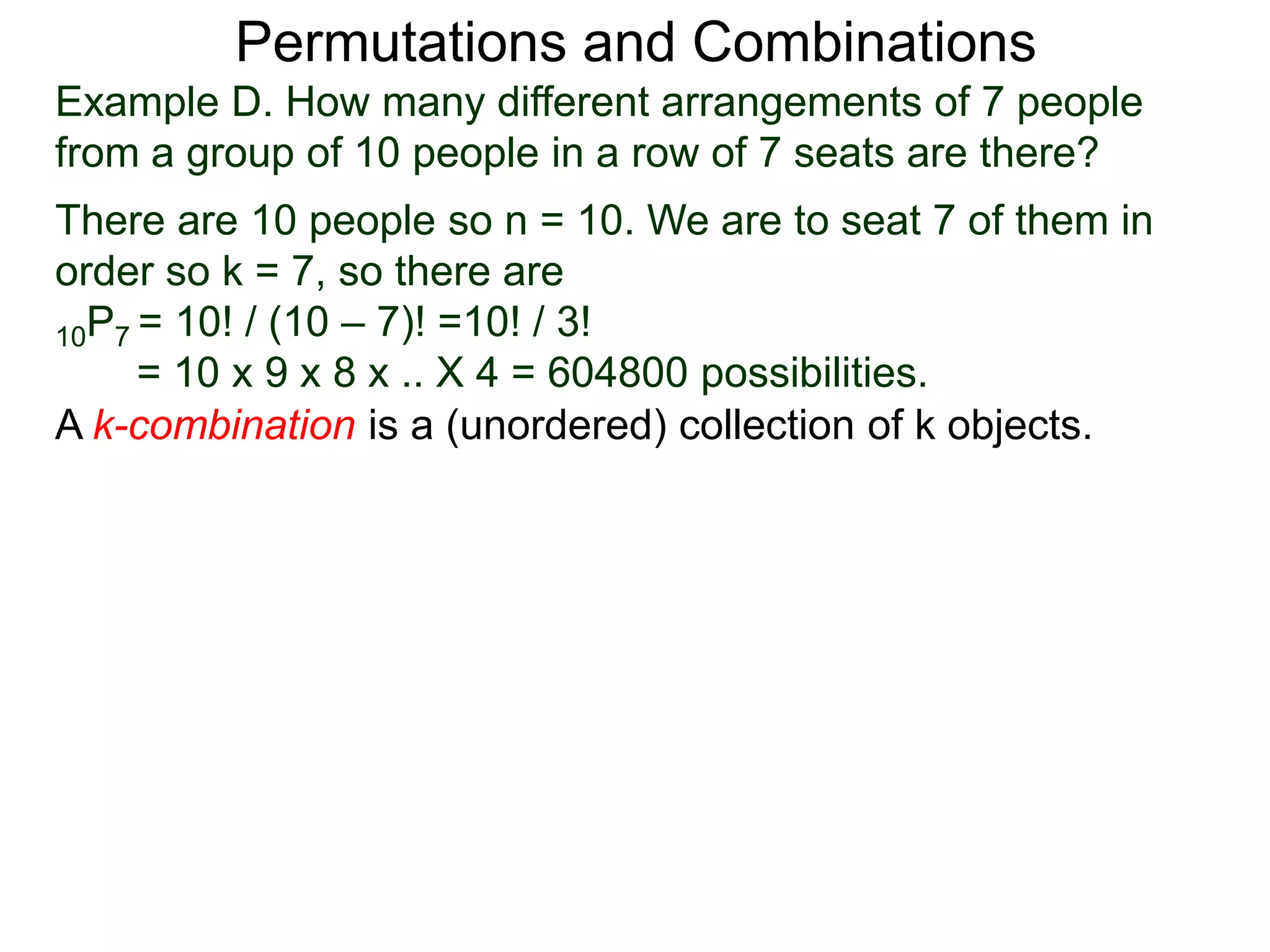
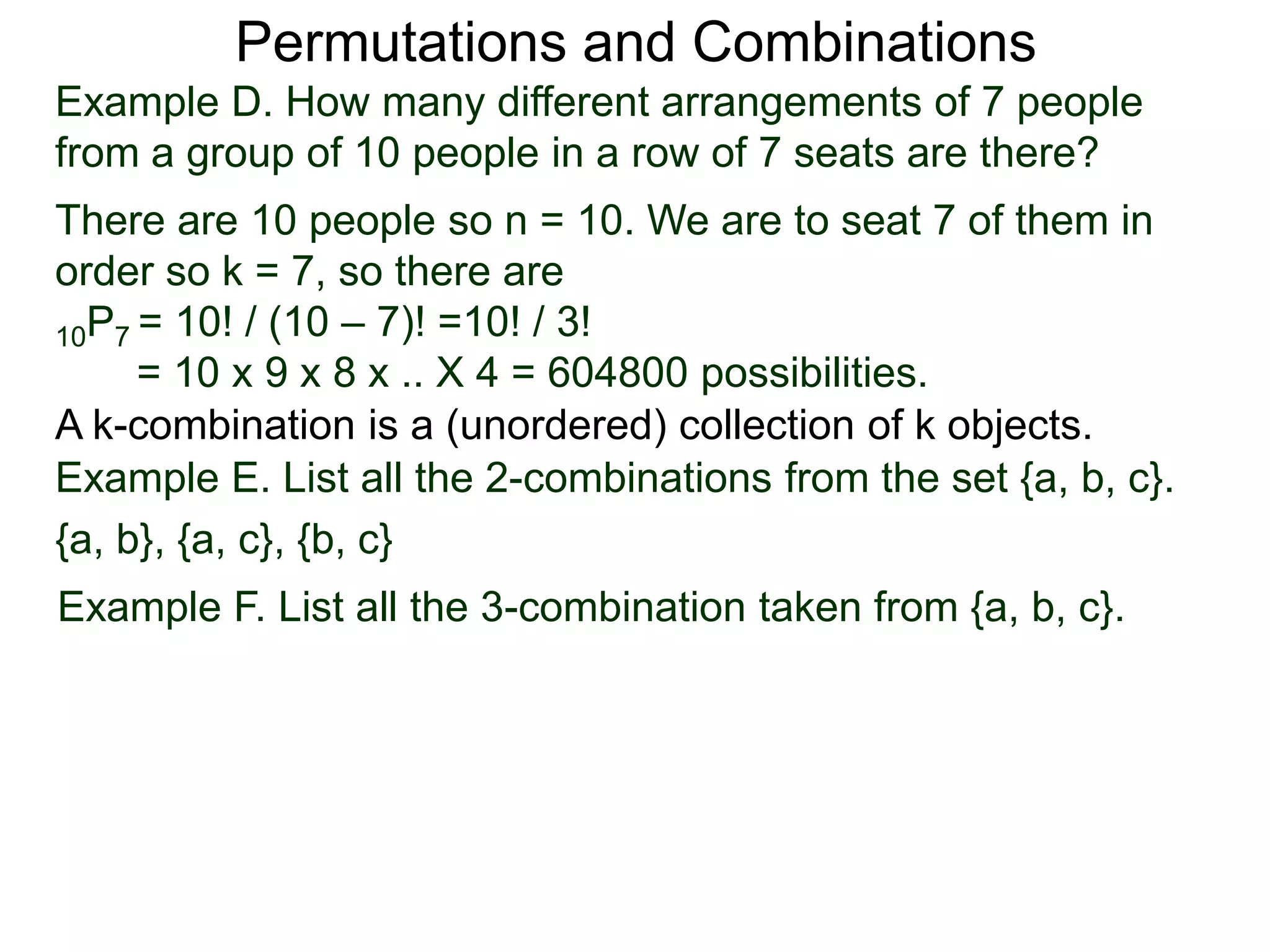
Example D. How many different arrangements of 7 people
from a group of 10 people in a row of 7 seats are there?
Permutations and Combinations
Example D. How many different arrangements of 7 people
from a group of 10 people in a row of 7 seats are there?
There are 10 people so n = 10.
Permutations and Combinations
Example D. How many different arrangements of 7 people
from a group of 10 people in a row of 7 seats are there?
There are 10 people so n = 10. We are to seat 7 of them in
order so k = 7,
Permutations and Combinations
Example D. How many different arrangements of 7 people
from a group of 10 people in a row of 7 seats are there?
There are 10 people so n = 10. We are to seat 7 of them in
order so k = 7, so there are
10P7 = 10! / (10 – 7)!
Permutations and Combinations
Example D. How many different arrangements of 7 people
from a group of 10 people in a row of 7 seats are there?
There are 10 people so n = 10. We are to seat 7 of them in
order so k = 7, so there are
10P7 = 10! / (10 – 7)! =10! / 3!
Permutations and Combinations
Example D. How many different arrangements of 7 people
from a group of 10 people in a row of 7 seats are there?
There are 10 people so n = 10. We are to seat 7 of them in
order so k = 7, so there are
10P7 = 10! / (10 – 7)! =10! / 3!
     = 10 x 9 x 8 x .. X 4 = 604800 possibilities.
Permutations and Combinations
Example D. How many different arrangements of 7 people
from a group of 10 people in a row of 7 seats are there?
There are 10 people so n = 10. We are to seat 7 of them in
order so k = 7, so there are
10P7 = 10! / (10 – 7)! =10! / 3!
     = 10 x 9 x 8 x .. X 4 = 604800 possibilities.
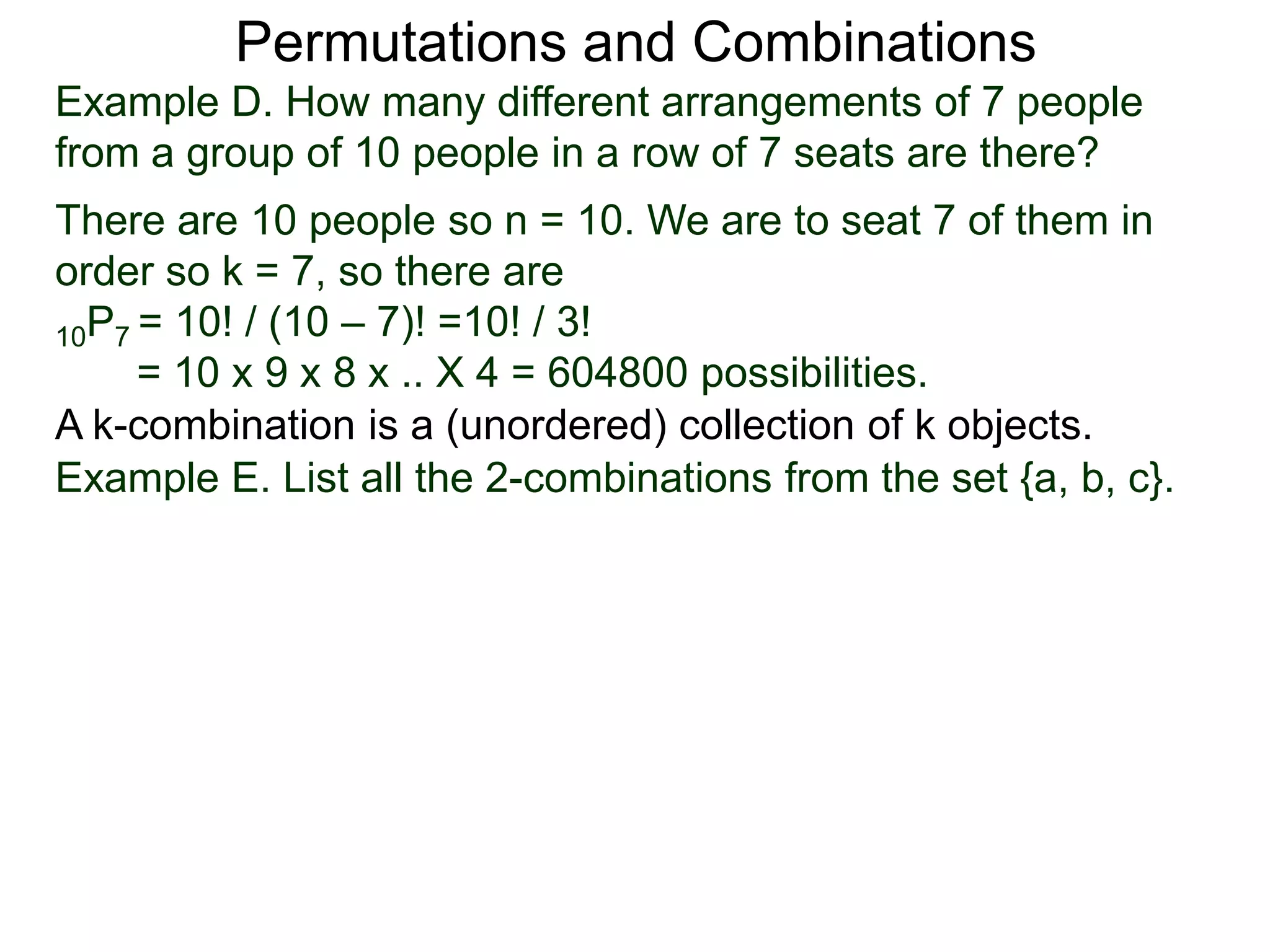
A k-combination is a (unordered) collection of k objects.
Permutations and Combinations
Example D. How many different arrangements of 7 people
from a group of 10 people in a row of 7 seats are there?
There are 10 people so n = 10. We are to seat 7 of them in
order so k = 7, so there are
10P7 = 10! / (10 – 7)! =10! / 3!
     = 10 x 9 x 8 x .. X 4 = 604800 possibilities.
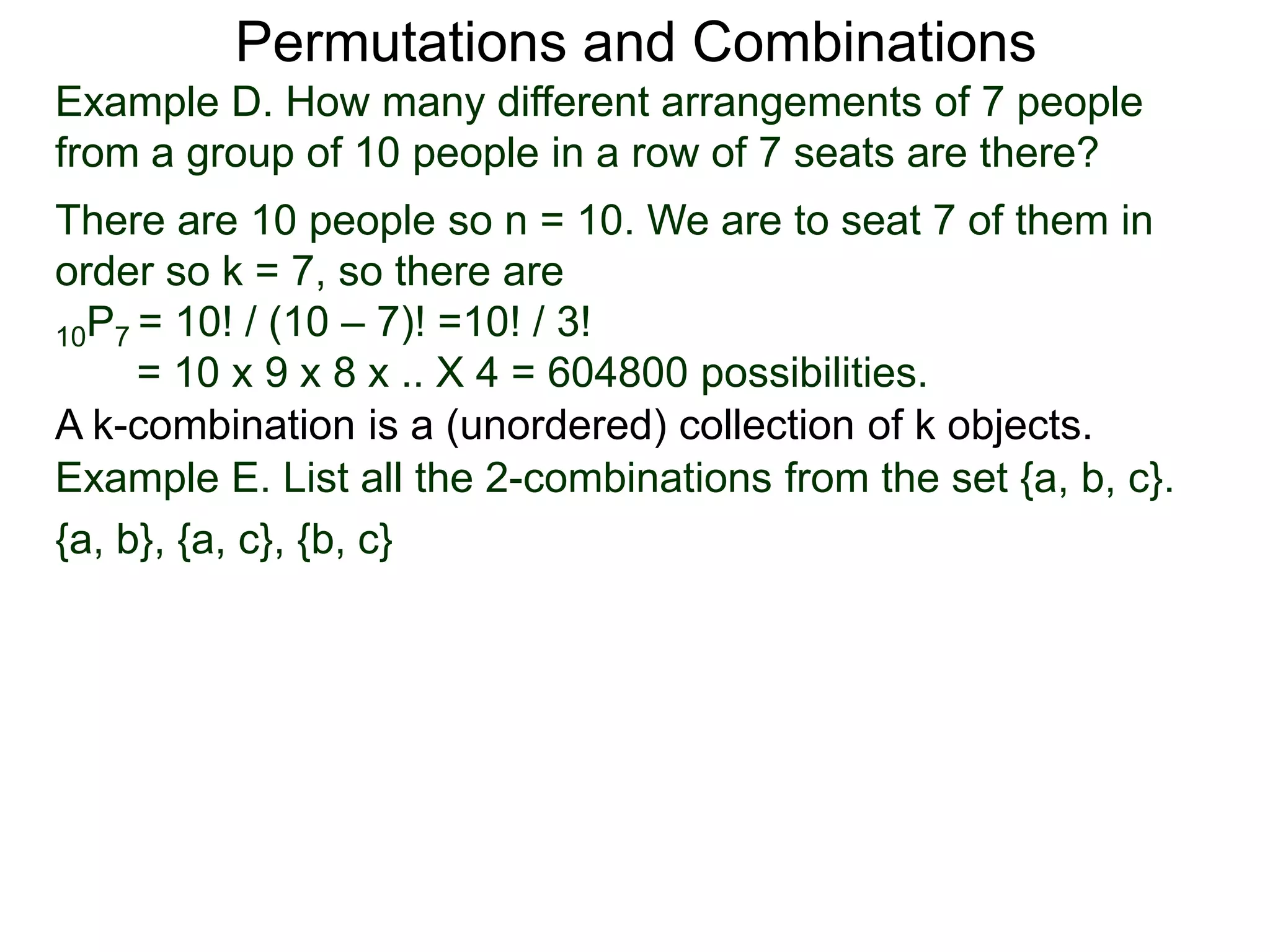
A k-combination is a (unordered) collection of k objects.
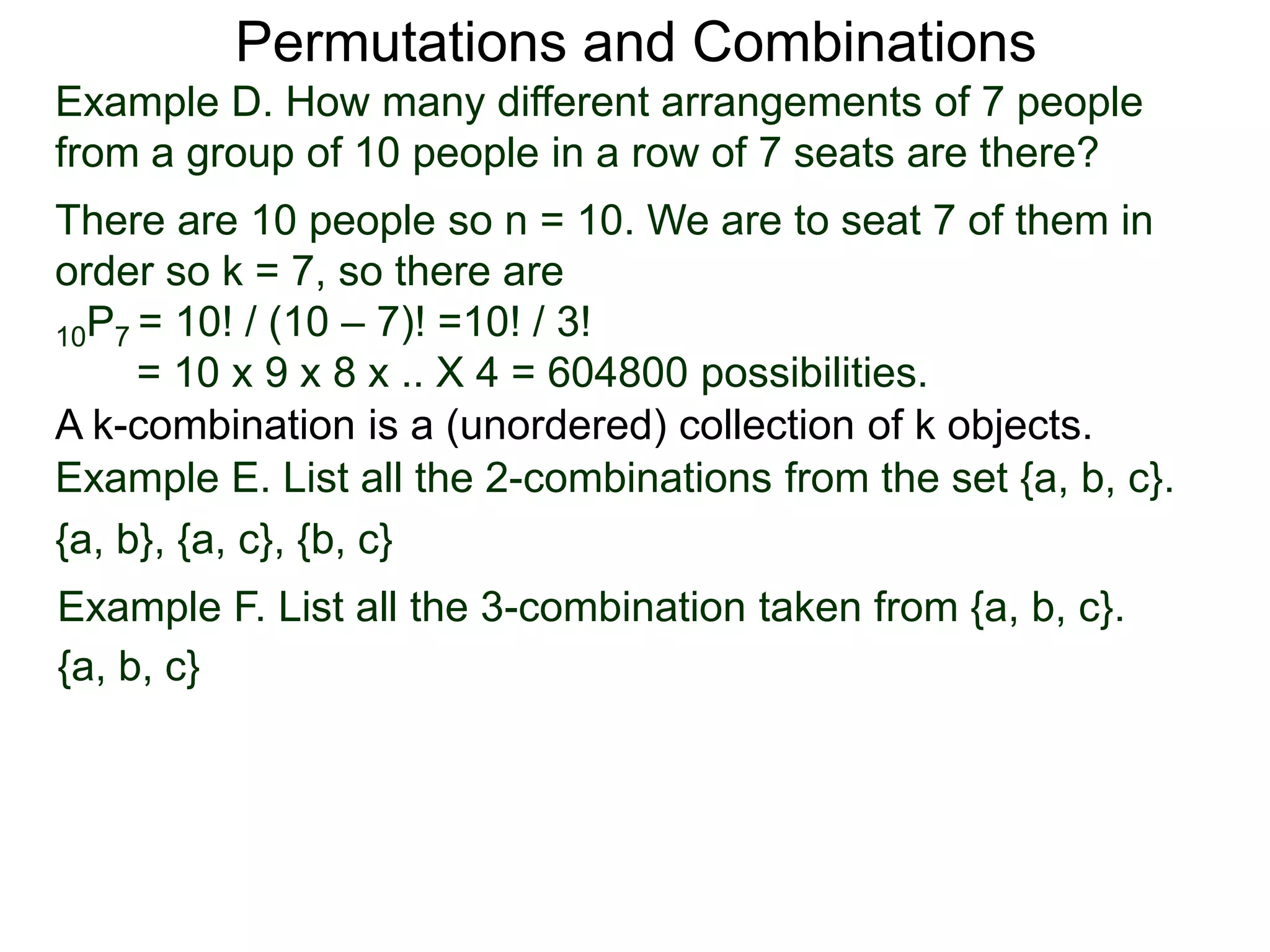
Example E. List all the 2-combinations from the set {a, b, c}.
Permutations and Combinations
Example D. How many different arrangements of 7 people
from a group of 10 people in a row of 7 seats are there?
There are 10 people so n = 10. We are to seat 7 of them in
order so k = 7, so there are
10P7 = 10! / (10 – 7)! =10! / 3!
     = 10 x 9 x 8 x .. X 4 = 604800 possibilities.
A k-combination is a (unordered) collection of k objects.
Example E. List all the 2-combinations from the set {a, b, c}.
{a, b}, {a, c}, {b, c}
Permutations and Combinations
Example D. How many different arrangements of 7 people
from a group of 10 people in a row of 7 seats are there?
There are 10 people so n = 10. We are to seat 7 of them in
order so k = 7, so there are
10P7 = 10! / (10 – 7)! =10! / 3!
     = 10 x 9 x 8 x .. X 4 = 604800 possibilities.
A k-combination is a (unordered) collection of k objects.
Example E. List all the 2-combinations from the set {a, b, c}.
{a, b}, {a, c}, {b, c}
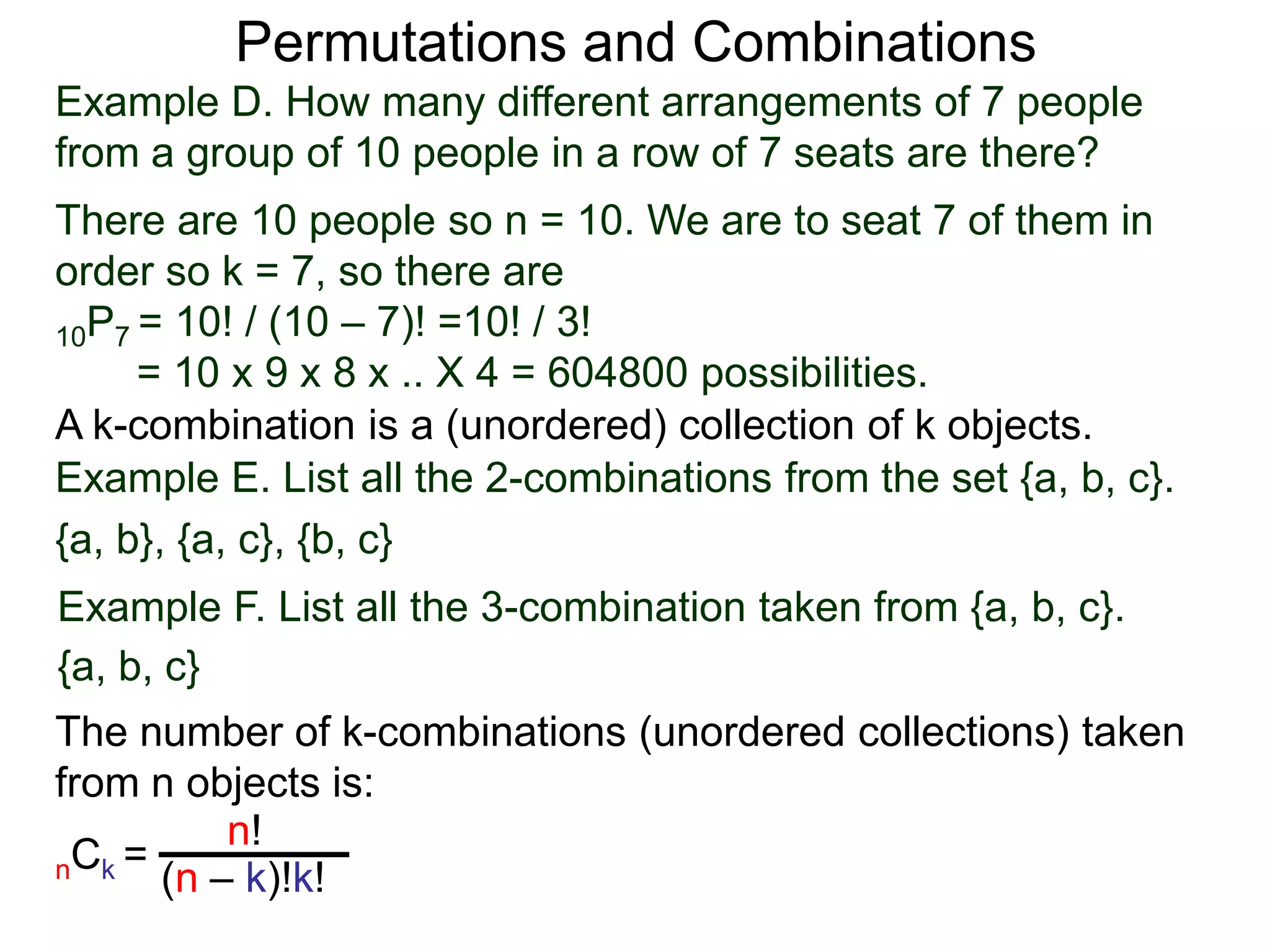
Example F. List all the 3-combination taken from {a, b, c}.
Permutations and Combinations
Example D. How many different arrangements of 7 people
from a group of 10 people in a row of 7 seats are there?
There are 10 people so n = 10. We are to seat 7 of them in
order so k = 7, so there are
10P7 = 10! / (10 – 7)! =10! / 3!
     = 10 x 9 x 8 x .. X 4 = 604800 possibilities.
A k-combination is a (unordered) collection of k objects.
Example E. List all the 2-combinations from the set {a, b, c}.
{a, b}, {a, c}, {b, c}
Example F. List all the 3-combination taken from {a, b, c}.
{a, b, c}
Permutations and Combinations
Example D. How many different arrangements of 7 people
from a group of 10 people in a row of 7 seats are there?
There are 10 people so n = 10. We are to seat 7 of them in
order so k = 7, so there are
10P7 = 10! / (10 – 7)! =10! / 3!
     = 10 x 9 x 8 x .. X 4 = 604800 possibilities.
A k-combination is a (unordered) collection of k objects.
Example E. List all the 2-combinations from the set {a, b, c}.
{a, b}, {a, c}, {b, c}
Example F. List all the 3-combination taken from {a, b, c}.
{a, b, c}
The number of k-combinations (unordered collections) taken
from n objects is:
          n!
nCk = (n – k)!k!
Permutations and Combinations
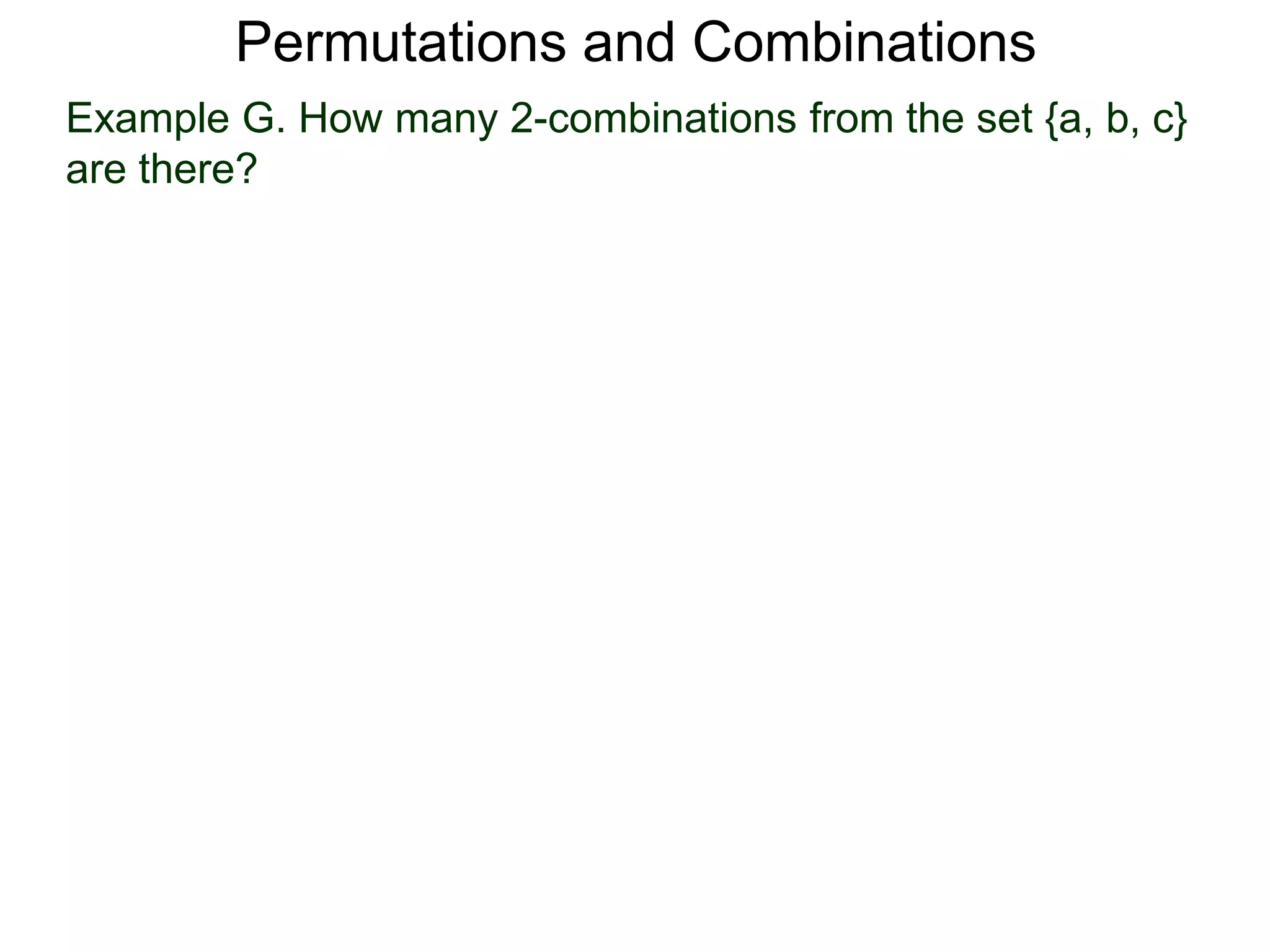
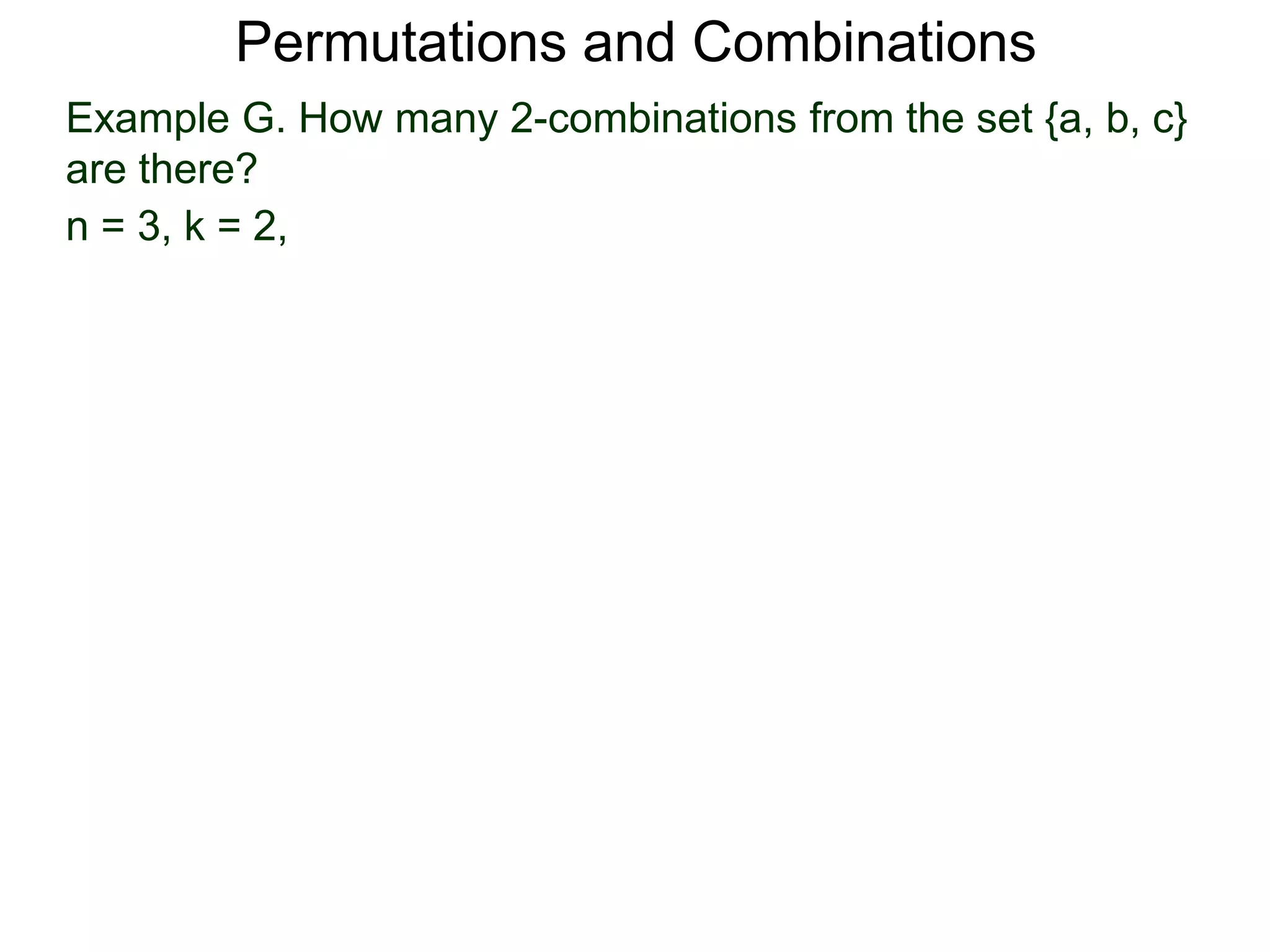
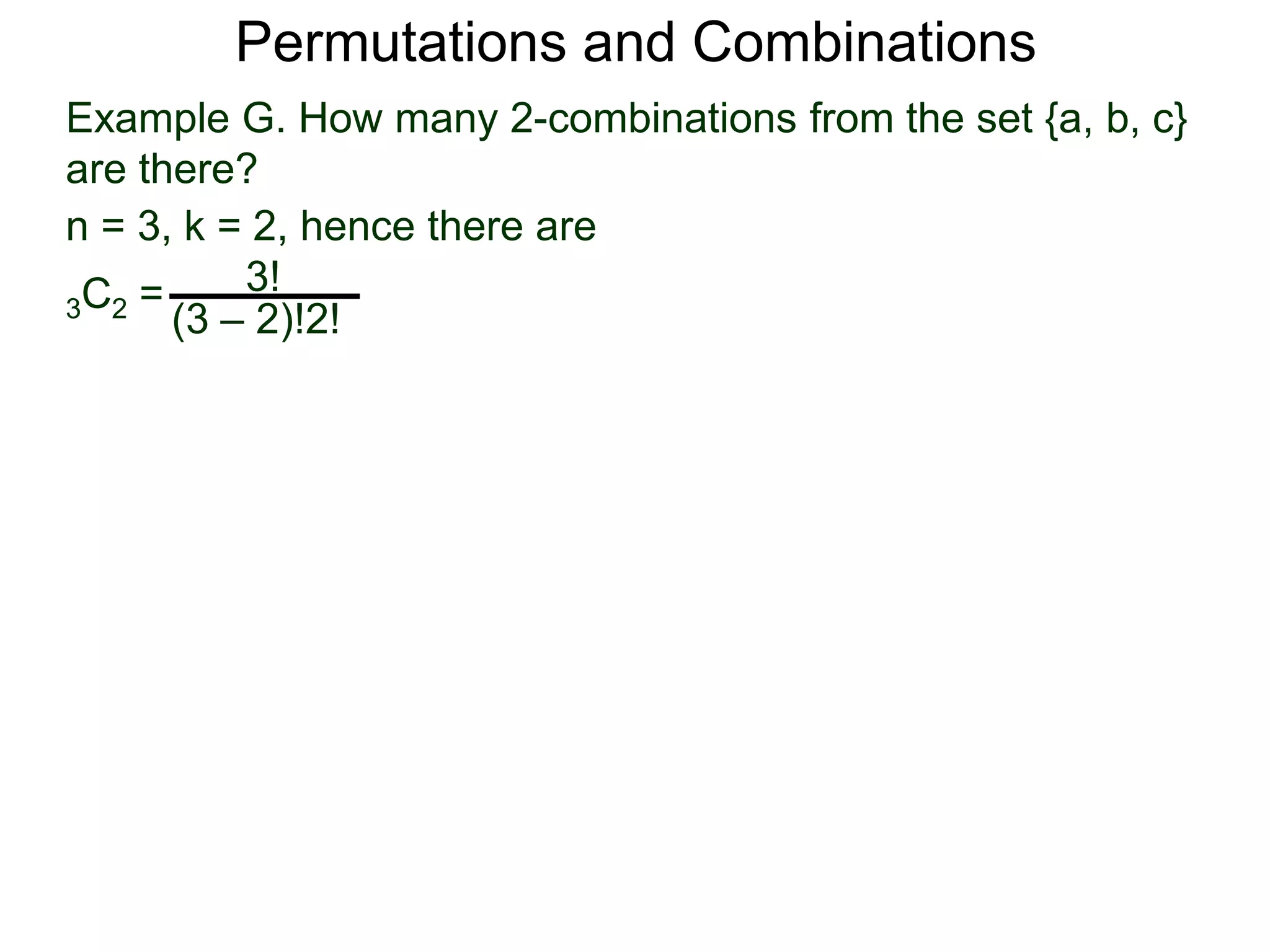
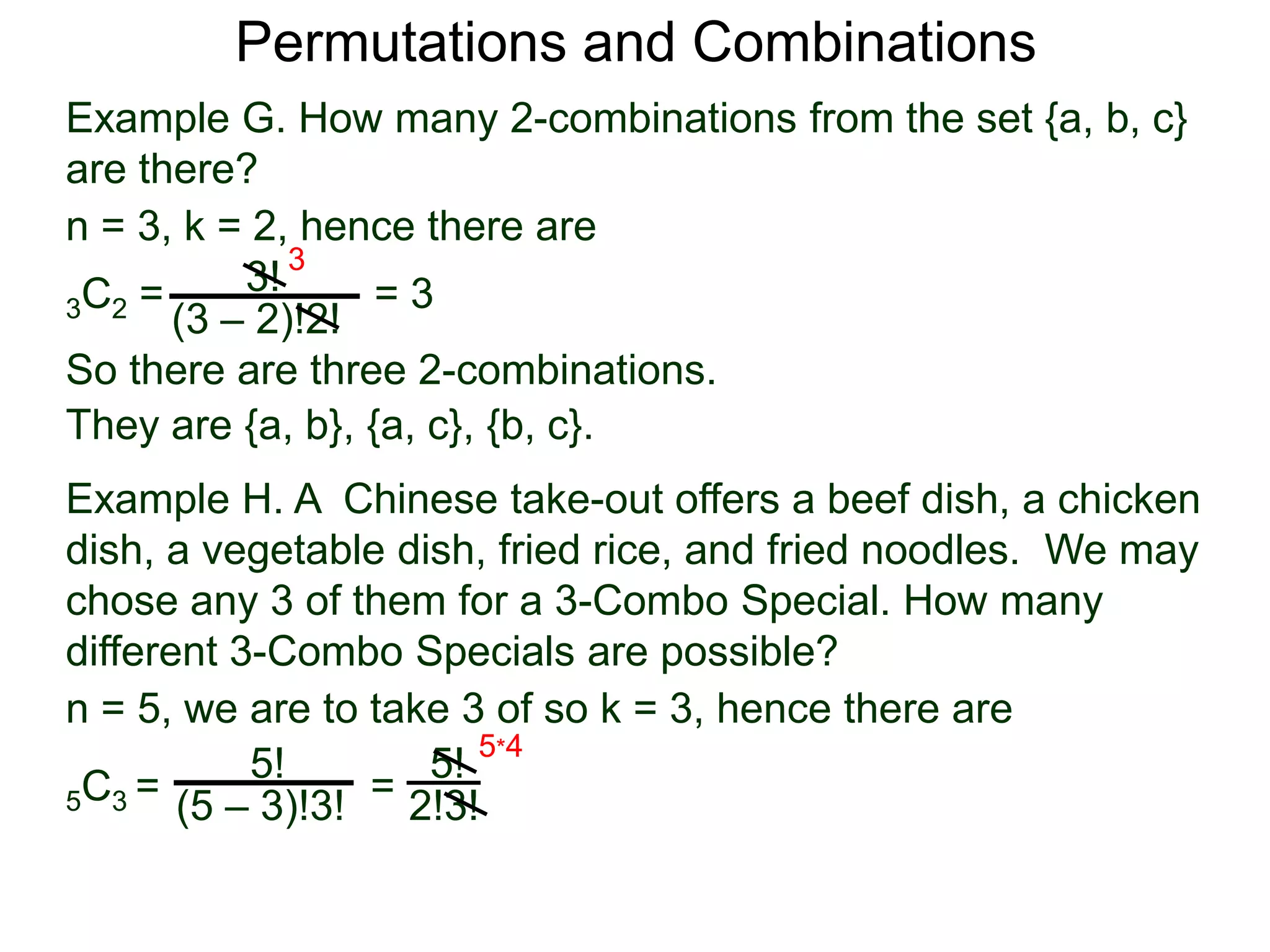
Example G. How many 2-combinations from the set {a, b, c}
are there?
Permutations and Combinations
Example G. How many 2-combinations from the set {a, b, c}
are there?
n = 3, k = 2,
Permutations and Combinations
Example G. How many 2-combinations from the set {a, b, c}
are there?
n = 3, k = 2, hence there are
  C2 =     3!
3
       (3 – 2)!2!
Permutations and Combinations
Example G. How many 2-combinations from the set {a, b, c}
are there?
n = 3, k = 2, hence there are
          3! 3
3C2 =
      (3 – 2)!2!
Permutations and Combinations
Example G. How many 2-combinations from the set {a, b, c}
are there?
n = 3, k = 2, hence there are
          3! 3
3C2 =            =3
      (3 – 2)!2!
Permutations and Combinations
Example G. How many 2-combinations from the set {a, b, c}
are there?
n = 3, k = 2, hence there are
          3! 3
3C2 =            =3
      (3 – 2)!2!
So there are three 2-combinations.
Permutations and Combinations
Example G. How many 2-combinations from the set {a, b, c}
are there?
n = 3, k = 2, hence there are
          3! 3
3C2 =             =3
      (3 – 2)!2!
So there are three 2-combinations.
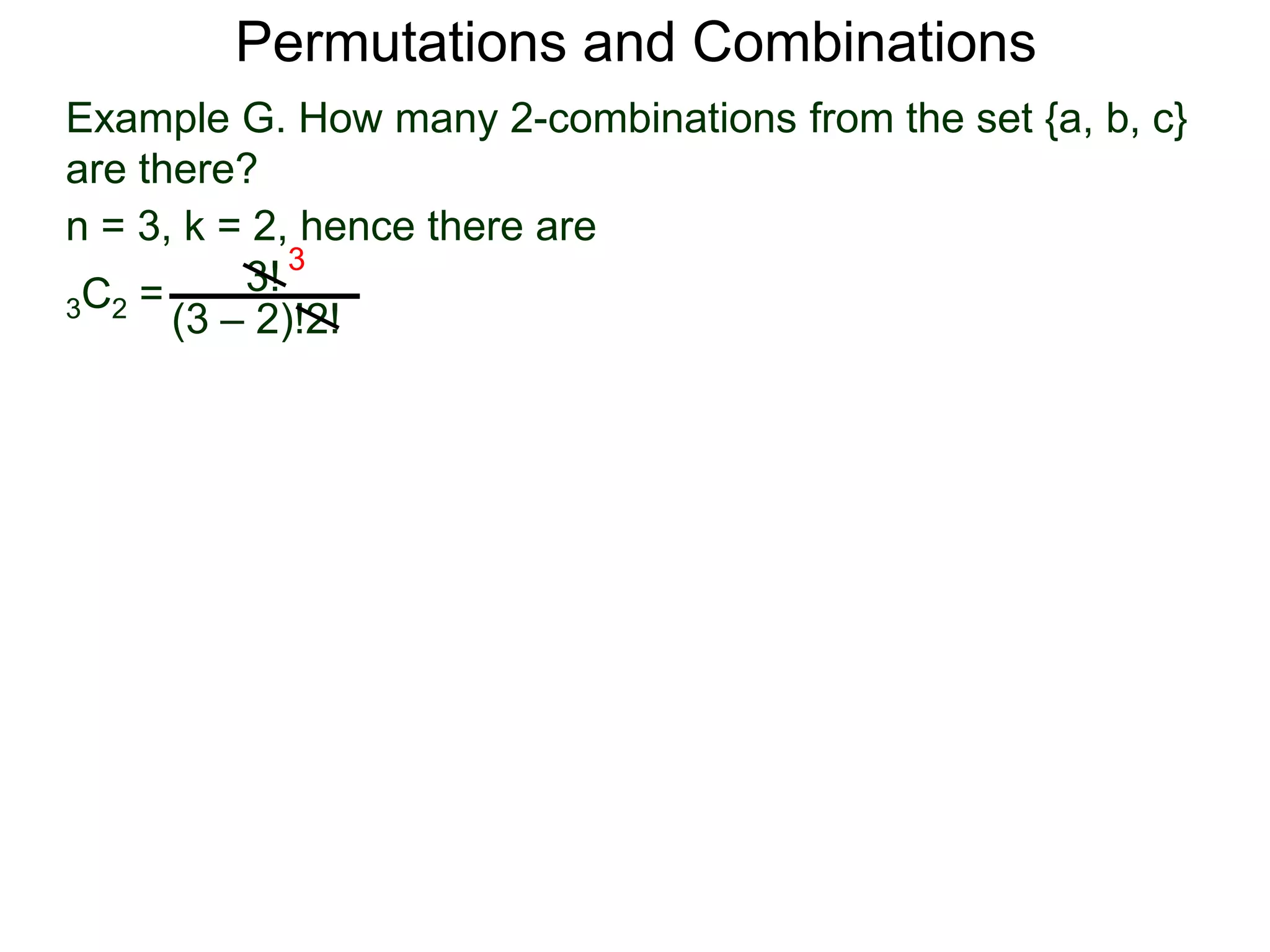
They are {a, b}, {a, c}, {b, c}.
Permutations and Combinations
Example G. How many 2-combinations from the set {a, b, c}
are there?
n = 3, k = 2, hence there are
          3! 3
3C2 =             =3
      (3 – 2)!2!
So there are three 2-combinations.
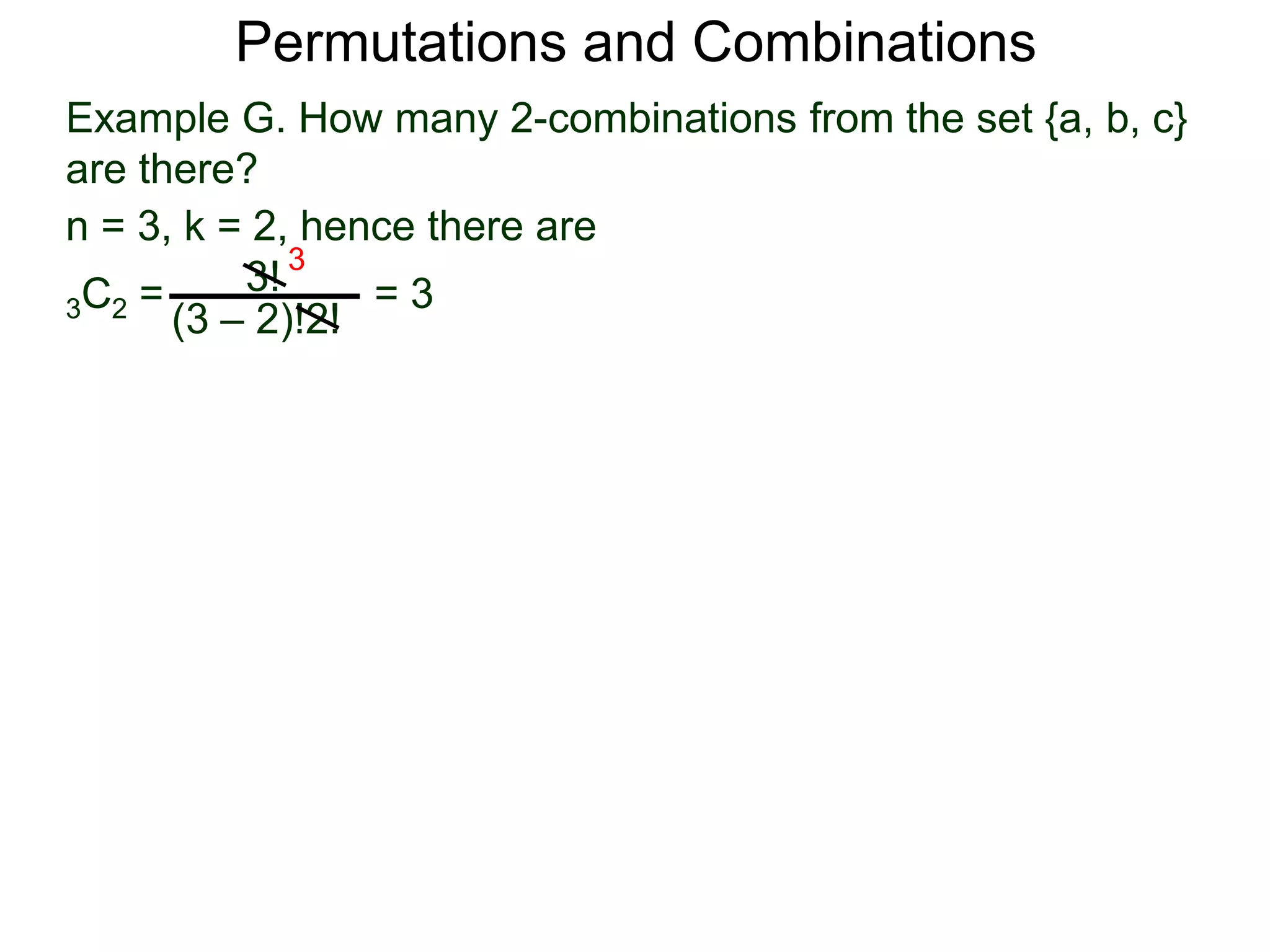
They are {a, b}, {a, c}, {b, c}.
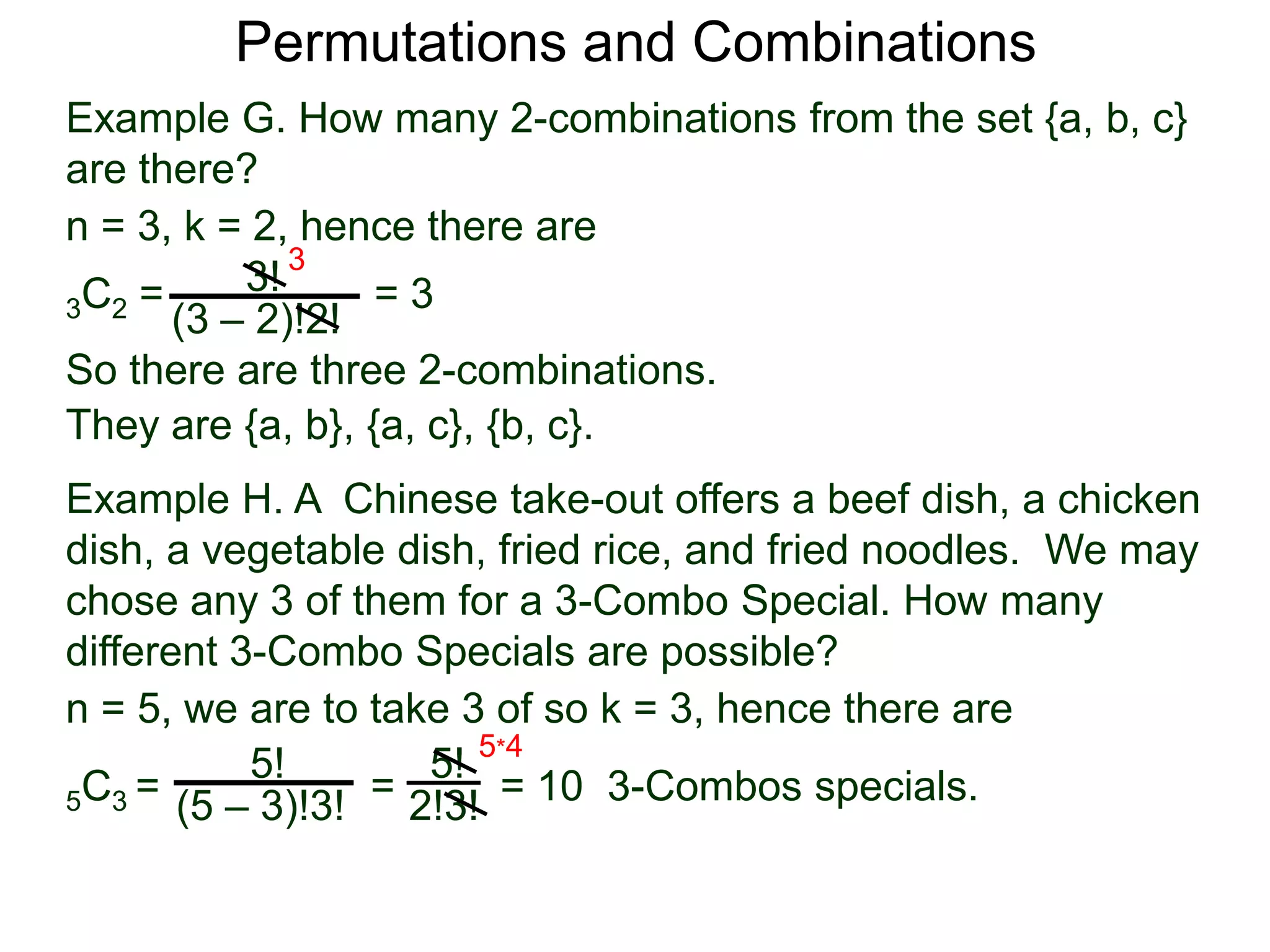
Example H. A Chinese take-out offers a beef dish, a chicken
dish, a vegetable dish, fried rice, and fried noodles. We may
chose any 3 of them for a 3-Combo Special. How many
different 3-Combo Specials are possible?
Permutations and Combinations
Example G. How many 2-combinations from the set {a, b, c}
are there?
n = 3, k = 2, hence there are
          3! 3
3C2 =             =3
      (3 – 2)!2!
So there are three 2-combinations.
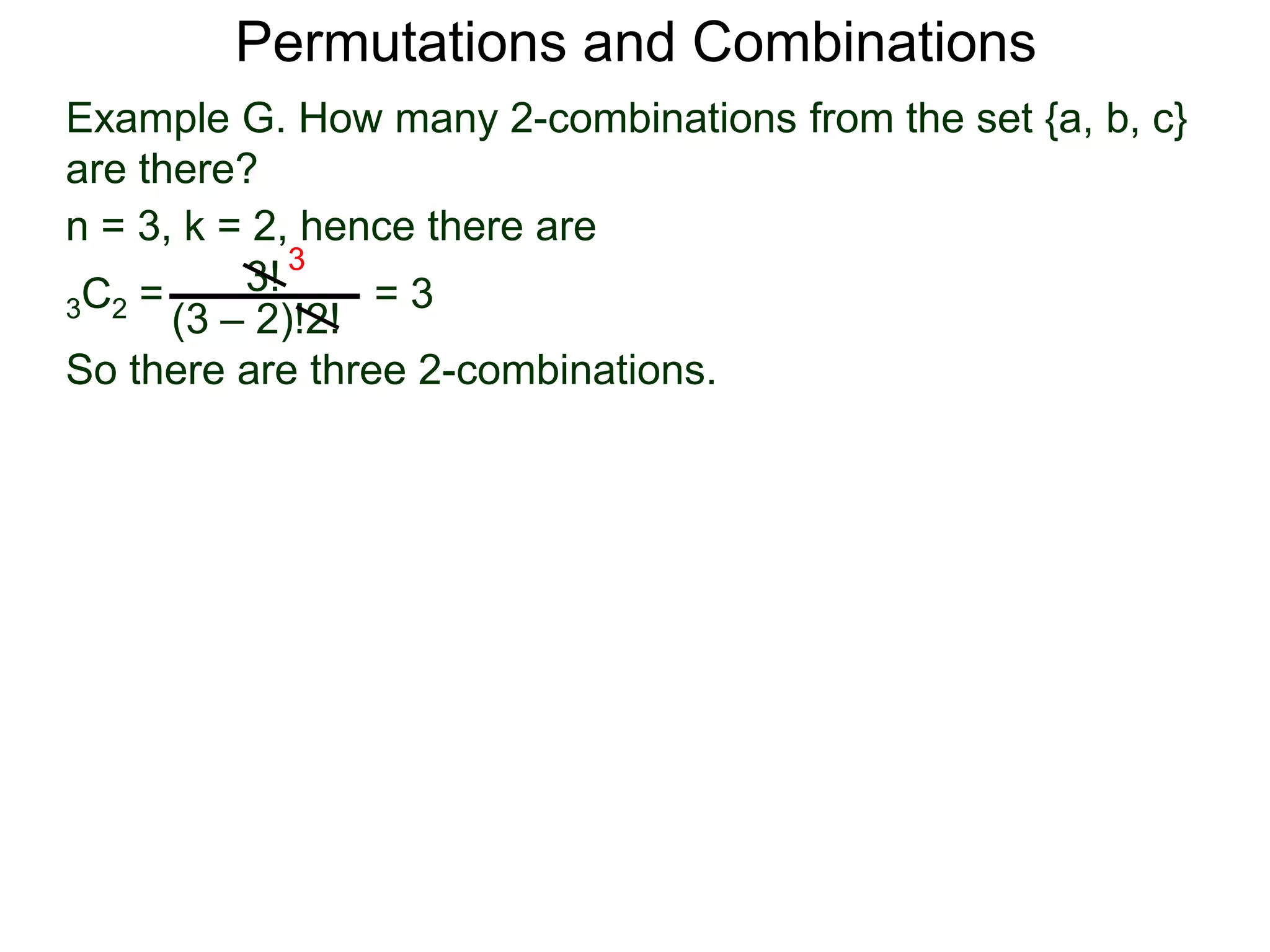
They are {a, b}, {a, c}, {b, c}.
Example H. A Chinese take-out offers a beef dish, a chicken
dish, a vegetable dish, fried rice, and fried noodles. We may
chose any 3 of them for a 3-Combo Special. How many
different 3-Combo Specials are possible?
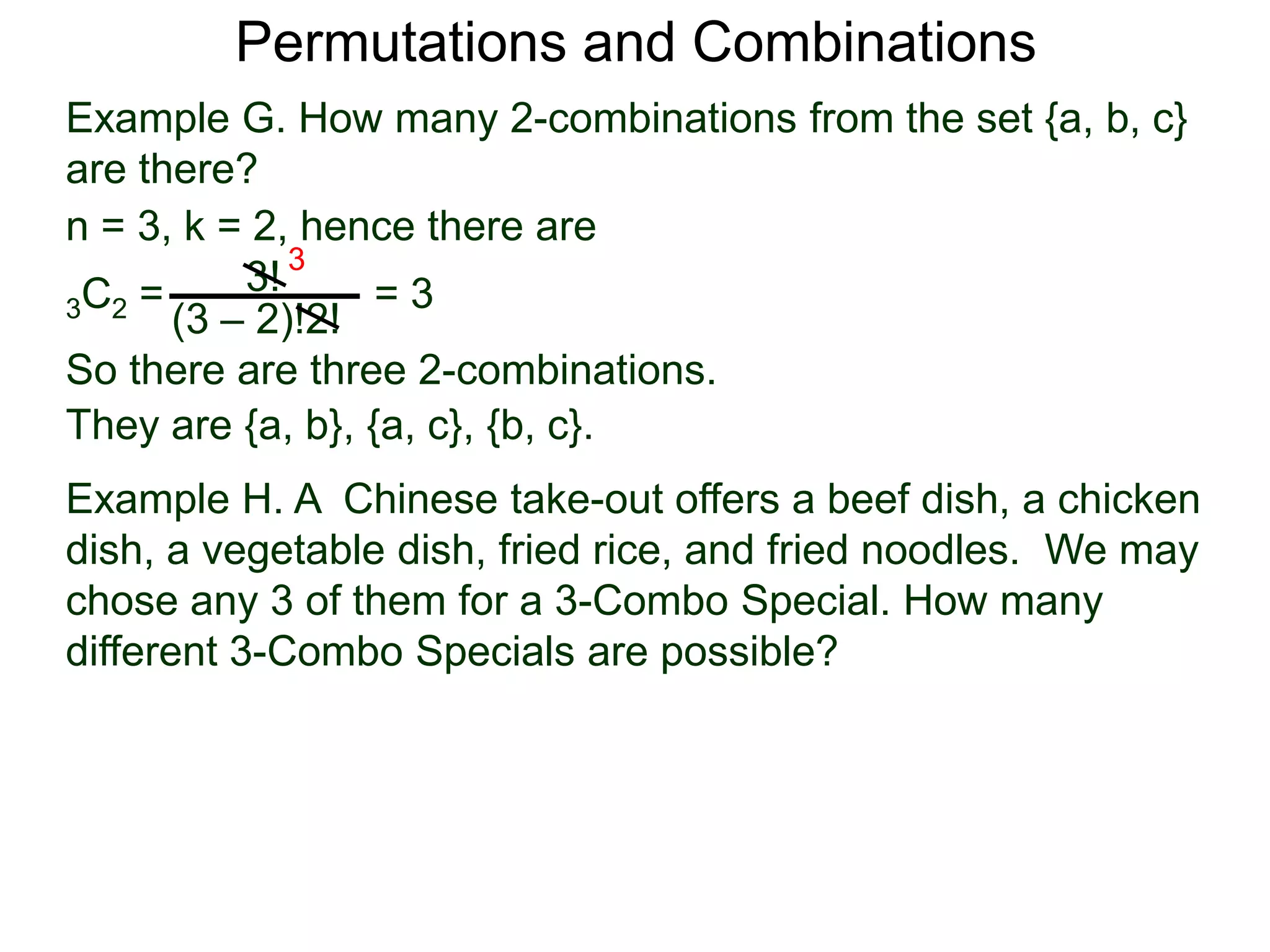
n = 5, we are to take 3 of so k = 3,
Permutations and Combinations
Example G. How many 2-combinations from the set {a, b, c}
are there?
n = 3, k = 2, hence there are
          3! 3
3C2 =             =3
      (3 – 2)!2!
So there are three 2-combinations.
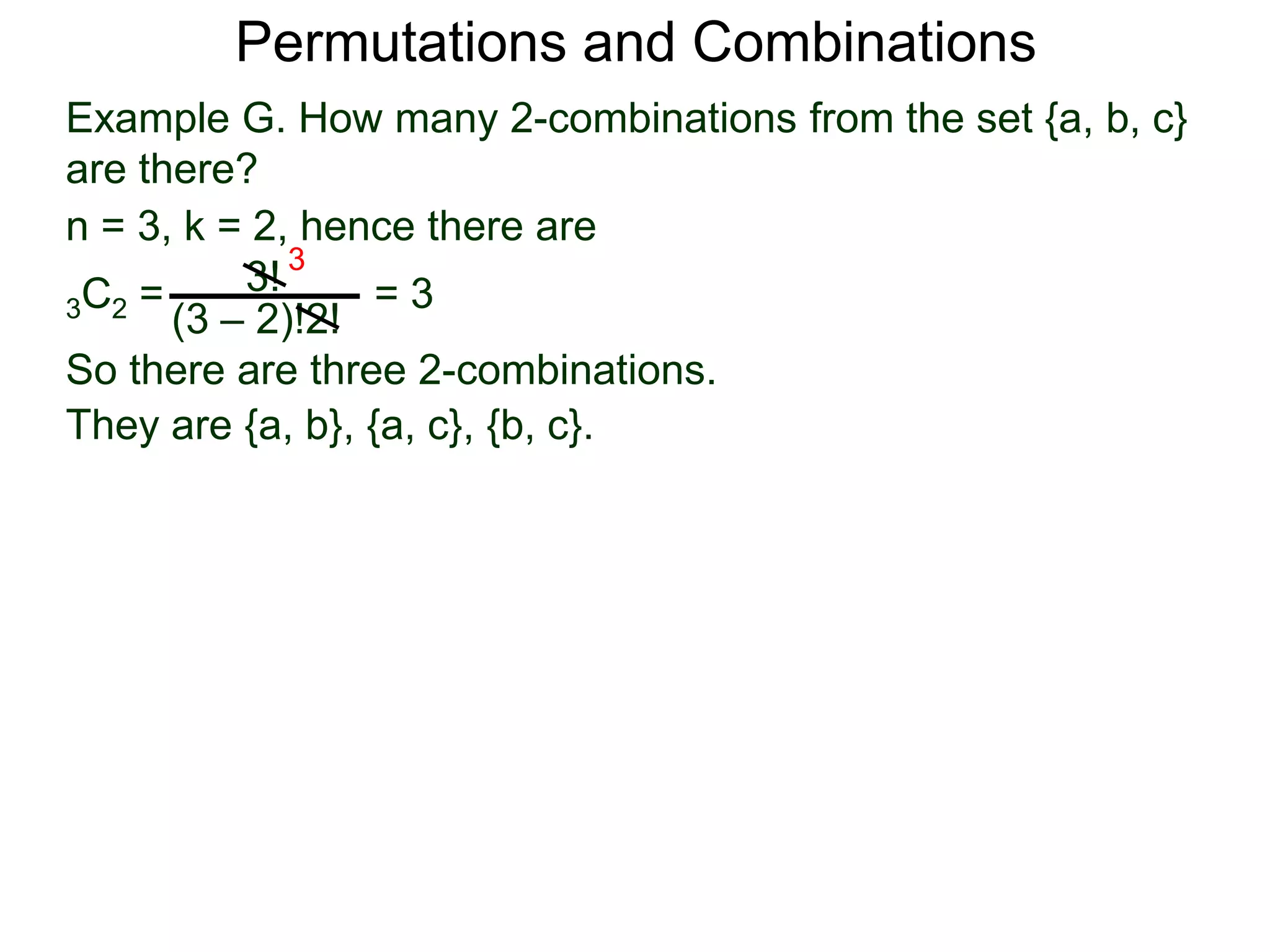
They are {a, b}, {a, c}, {b, c}.
Example H. A Chinese take-out offers a beef dish, a chicken
dish, a vegetable dish, fried rice, and fried noodles. We may
chose any 3 of them for a 3-Combo Special. How many
different 3-Combo Specials are possible?
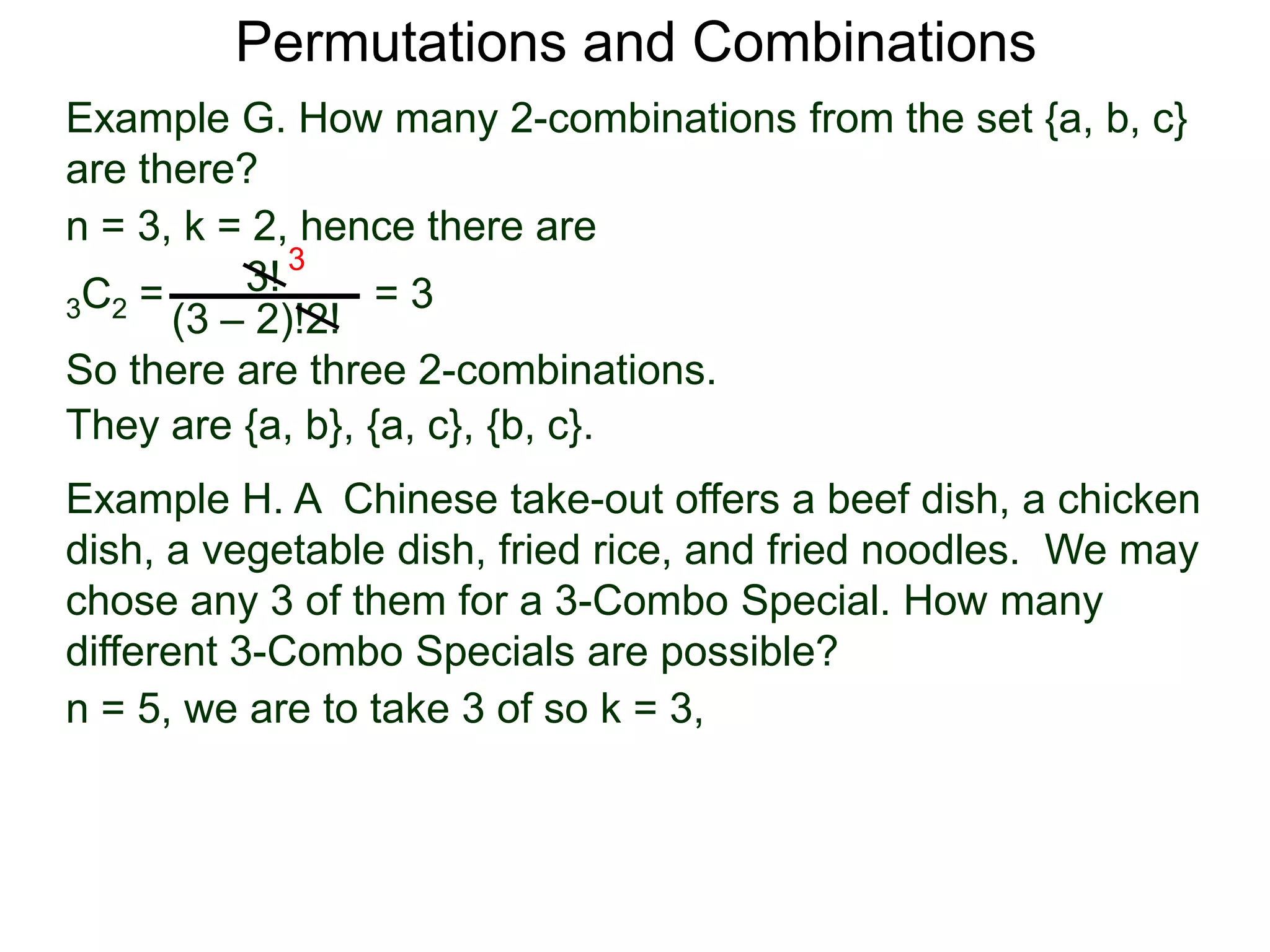
n = 5, we are to take 3 of so k = 3, hence there are
           5!
5 C3 = (5 – 3)!3!
Permutations and Combinations
Example G. How many 2-combinations from the set {a, b, c}
are there?
n = 3, k = 2, hence there are
          3! 3
3C2 =             =3
      (3 – 2)!2!
So there are three 2-combinations.
They are {a, b}, {a, c}, {b, c}.
Example H. A Chinese take-out offers a beef dish, a chicken
dish, a vegetable dish, fried rice, and fried noodles. We may
chose any 3 of them for a 3-Combo Special. How many
different 3-Combo Specials are possible?
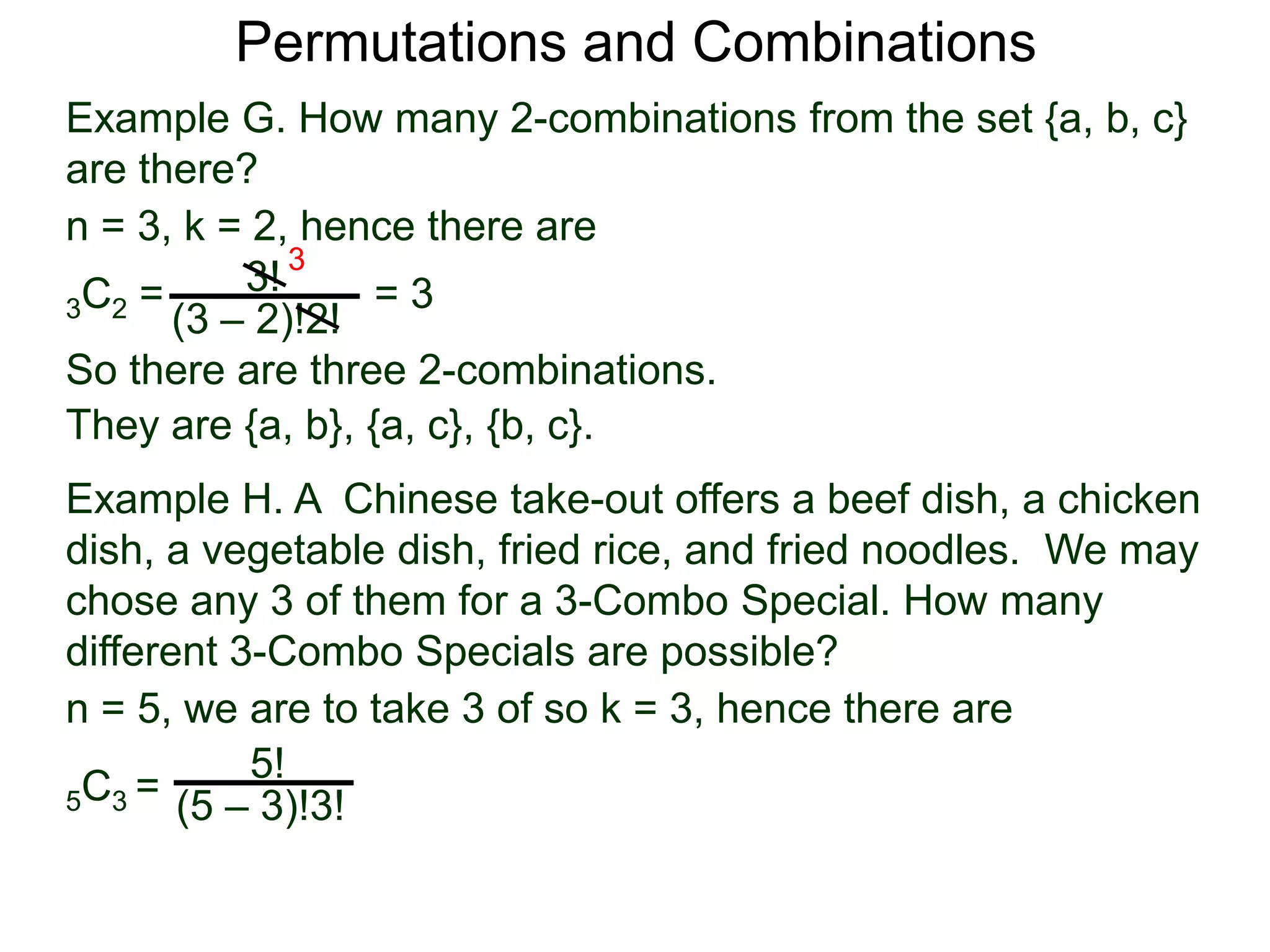
n = 5, we are to take 3 of so k = 3, hence there are
           5!        5!
5 C3 = (5 – 3)!3! = 2!3!
Permutations and Combinations
Example G. How many 2-combinations from the set {a, b, c}
are there?
n = 3, k = 2, hence there are
          3! 3
3C2 =             =3
      (3 – 2)!2!
So there are three 2-combinations.
They are {a, b}, {a, c}, {b, c}.
Example H. A Chinese take-out offers a beef dish, a chicken
dish, a vegetable dish, fried rice, and fried noodles. We may
chose any 3 of them for a 3-Combo Special. How many
different 3-Combo Specials are possible?
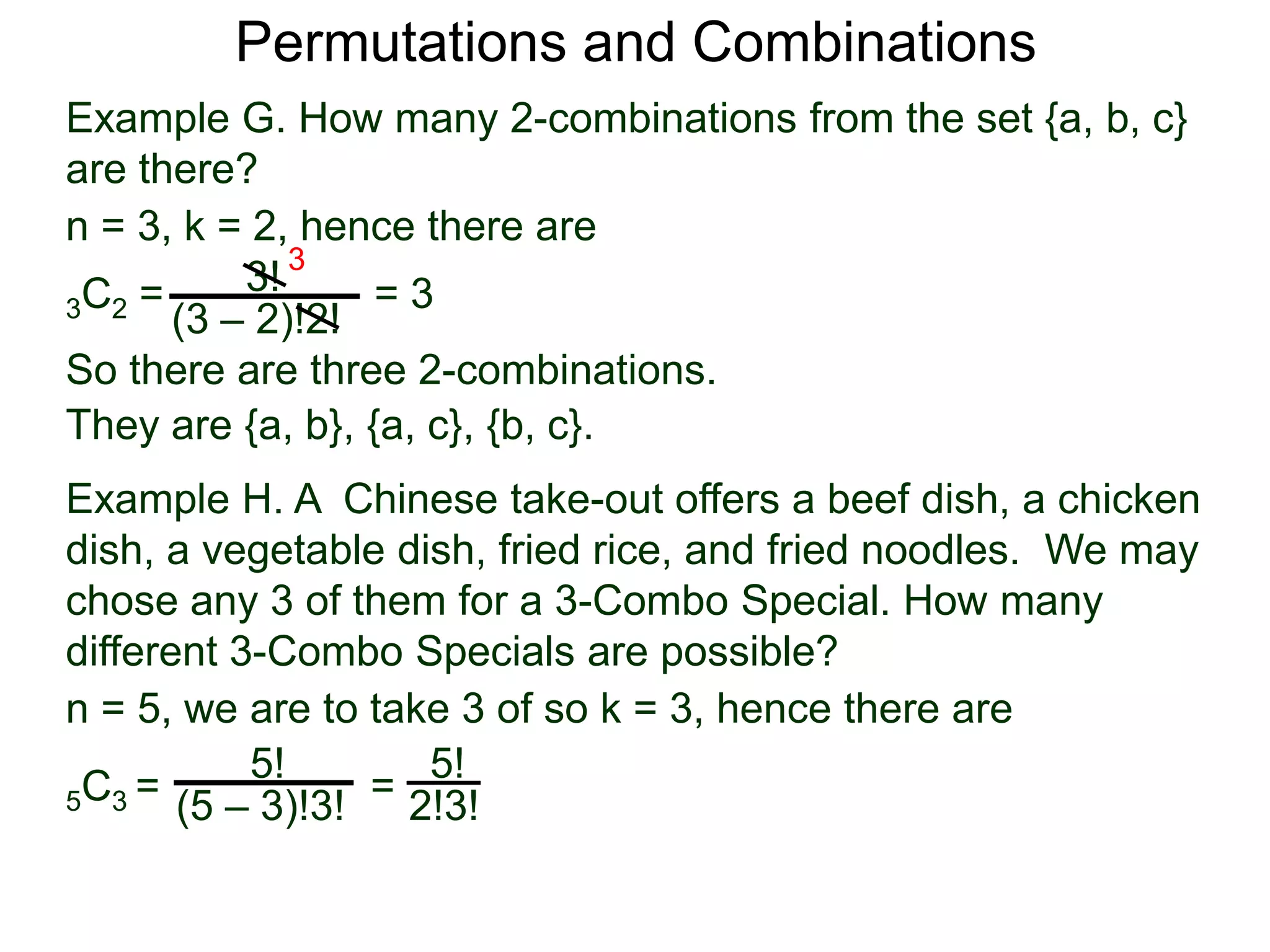
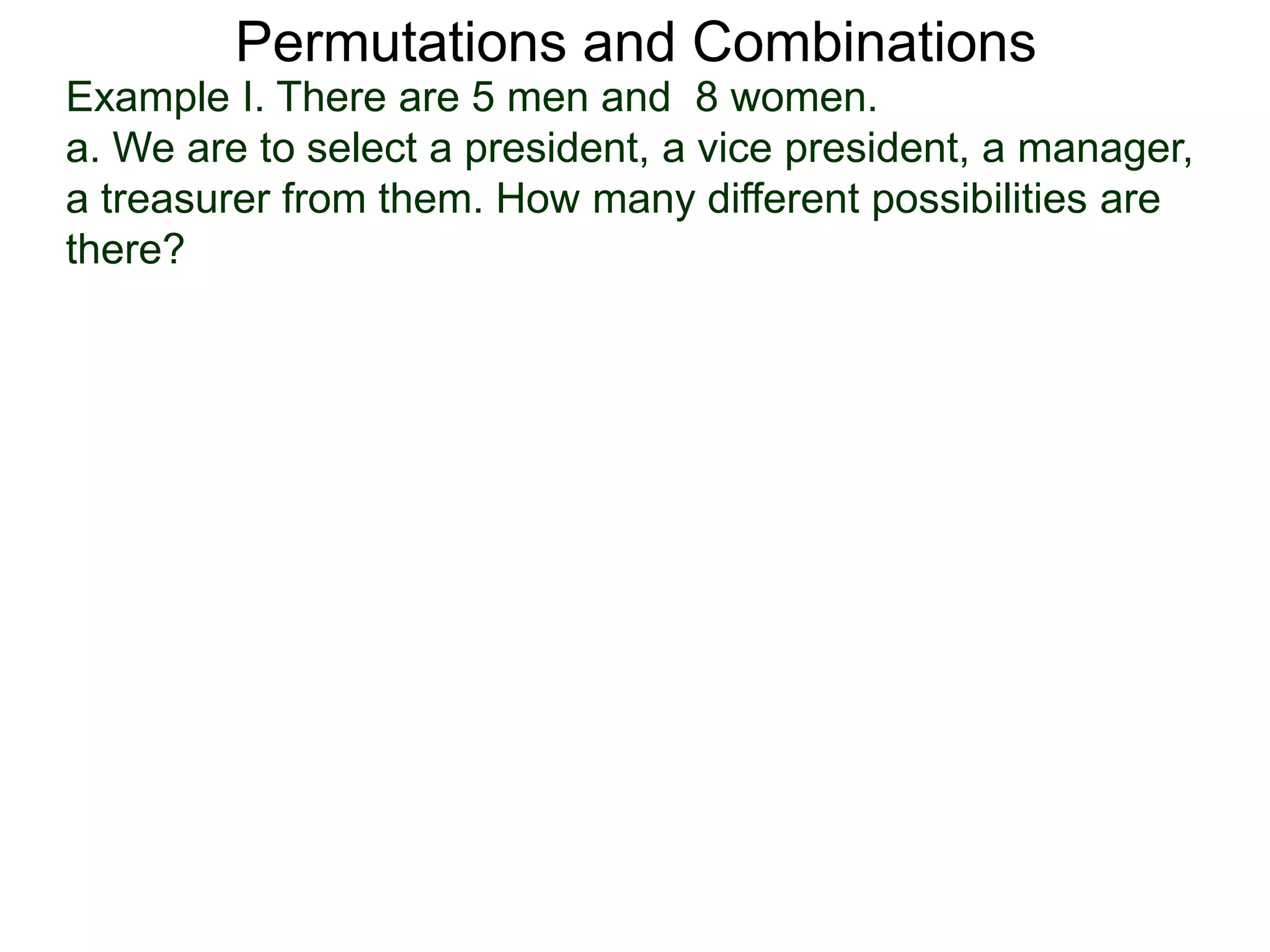
n = 5, we are to take 3 of so k = 3, hence there are
           5!       5! 5*4
5C3 = (5 – 3)!3! = 2!3!
Permutations and Combinations
Example G. How many 2-combinations from the set {a, b, c}
are there?
n = 3, k = 2, hence there are
          3! 3
3C2 =             =3
      (3 – 2)!2!
So there are three 2-combinations.
They are {a, b}, {a, c}, {b, c}.
Example H. A Chinese take-out offers a beef dish, a chicken
dish, a vegetable dish, fried rice, and fried noodles. We may
chose any 3 of them for a 3-Combo Special. How many
different 3-Combo Specials are possible?
n = 5, we are to take 3 of so k = 3, hence there are
           5!       5! 5*4
5C3 = (5 – 3)!3! = 2!3! = 10 3-Combos specials.
Permutations and Combinations
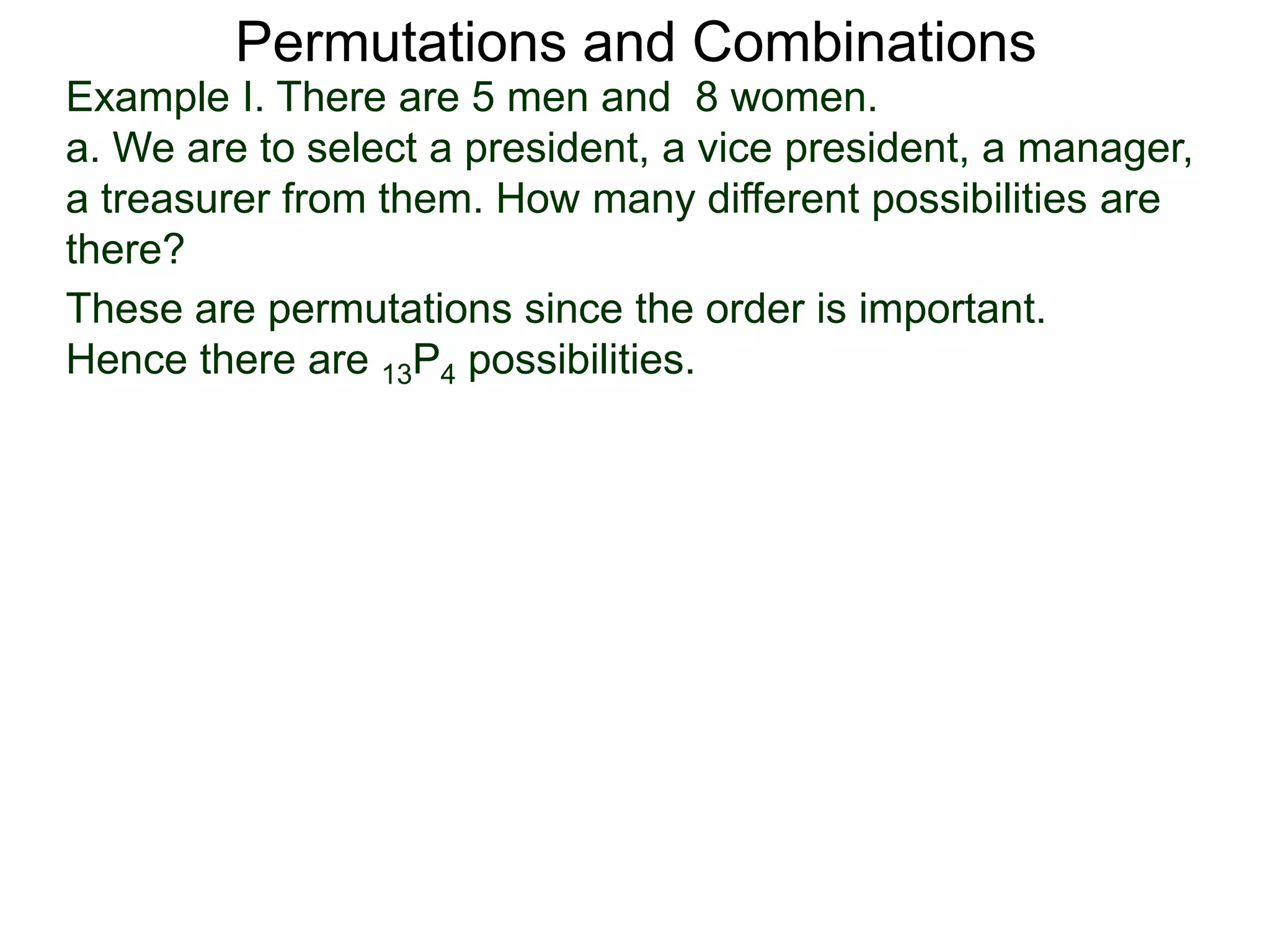
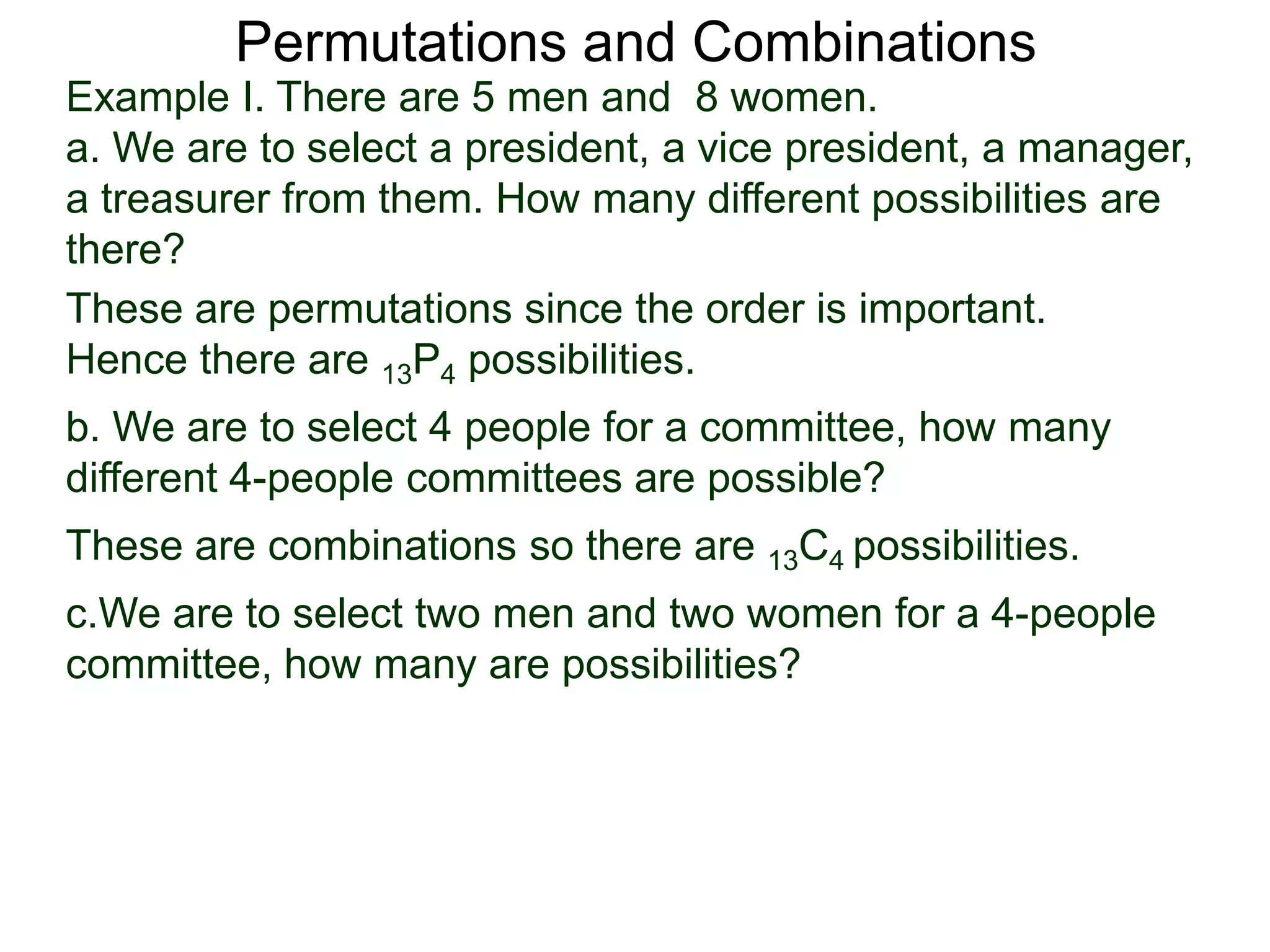
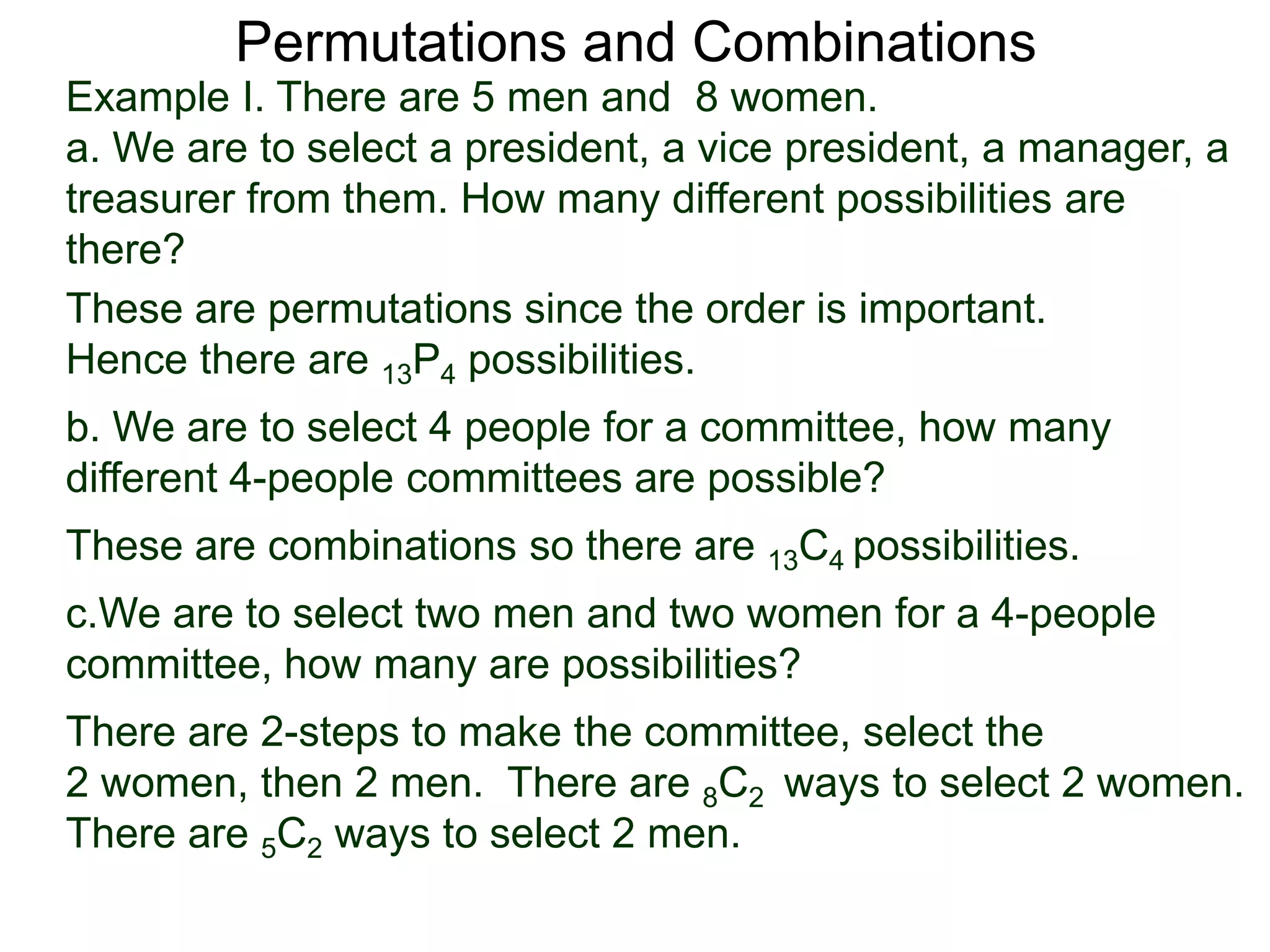
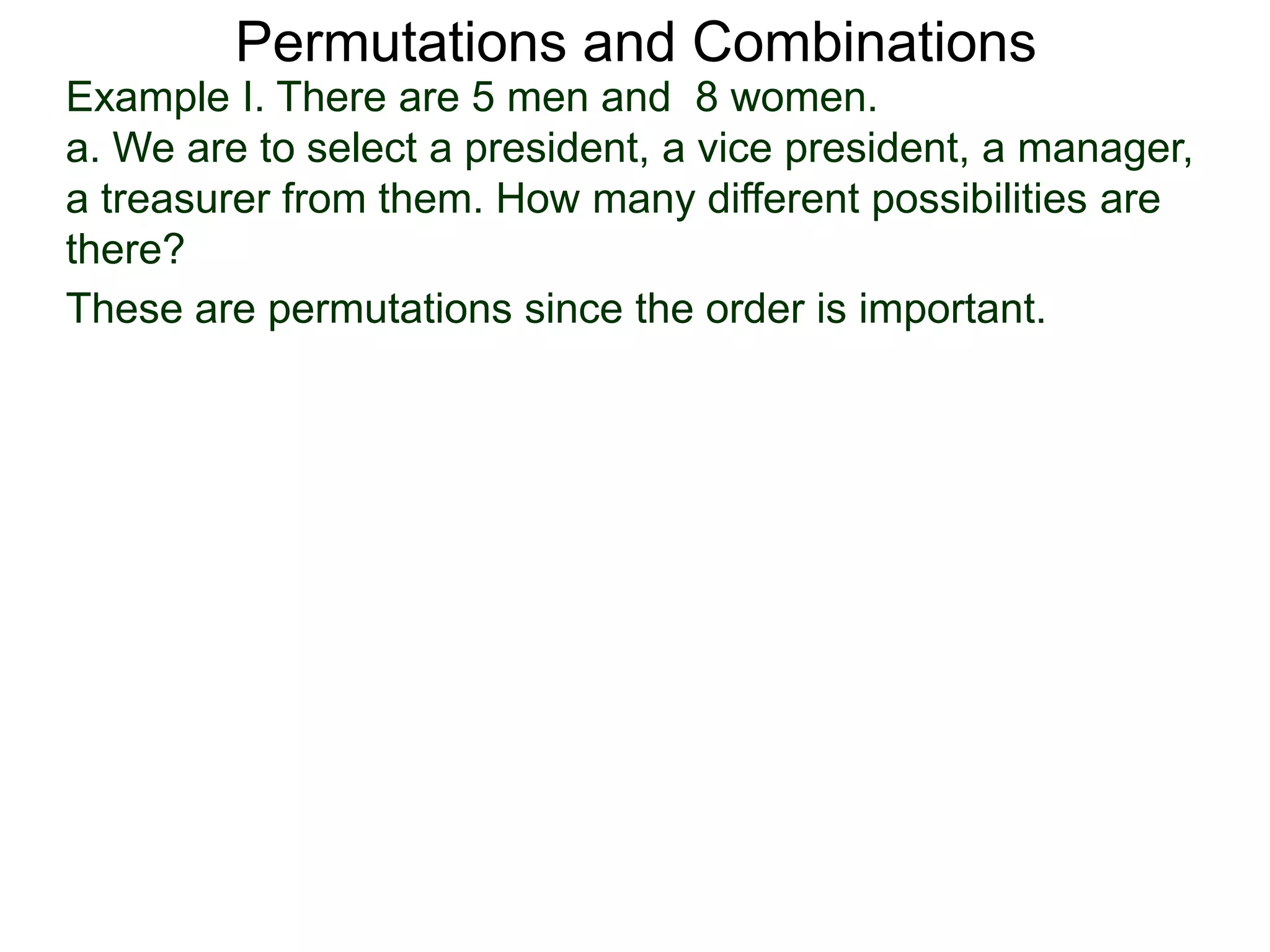
Example I. There are 5 men and 8 women.
a. We are to select a president, a vice president, a manager,
a treasurer from them. How many different possibilities are
there?
Permutations and Combinations
Example I. There are 5 men and 8 women.
a. We are to select a president, a vice president, a manager,
a treasurer from them. How many different possibilities are
there?
These are permutations since the order is important.
Permutations and Combinations
Example I. There are 5 men and 8 women.
a. We are to select a president, a vice president, a manager,
a treasurer from them. How many different possibilities are
there?
These are permutations since the order is important.
Hence there are 13P4 possibilities.
Permutations and Combinations
Example I. There are 5 men and 8 women.
a. We are to select a president, a vice president, a manager,
a treasurer from them. How many different possibilities are
there?
These are permutations since the order is important.
Hence there are 13P4 possibilities.
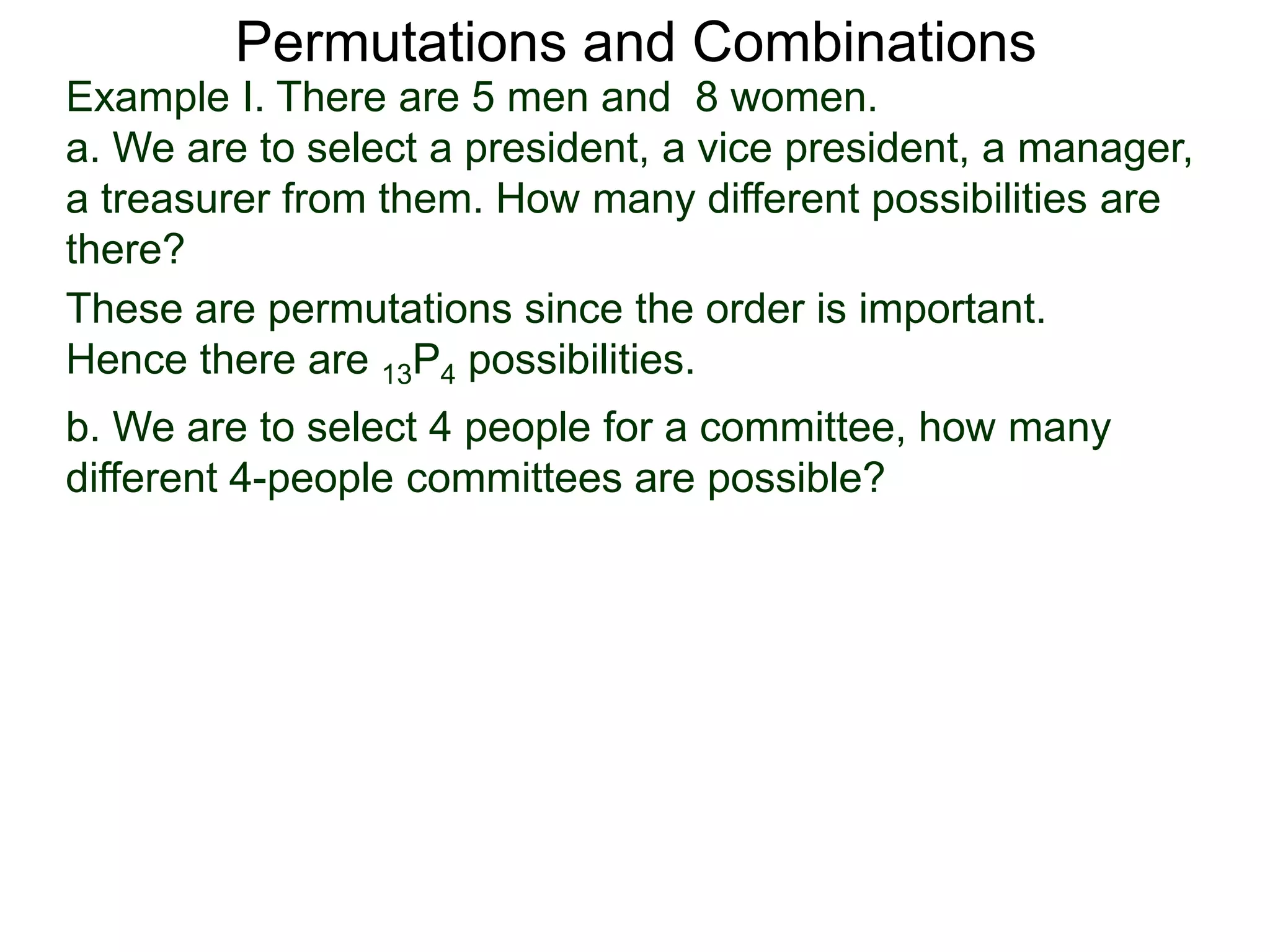
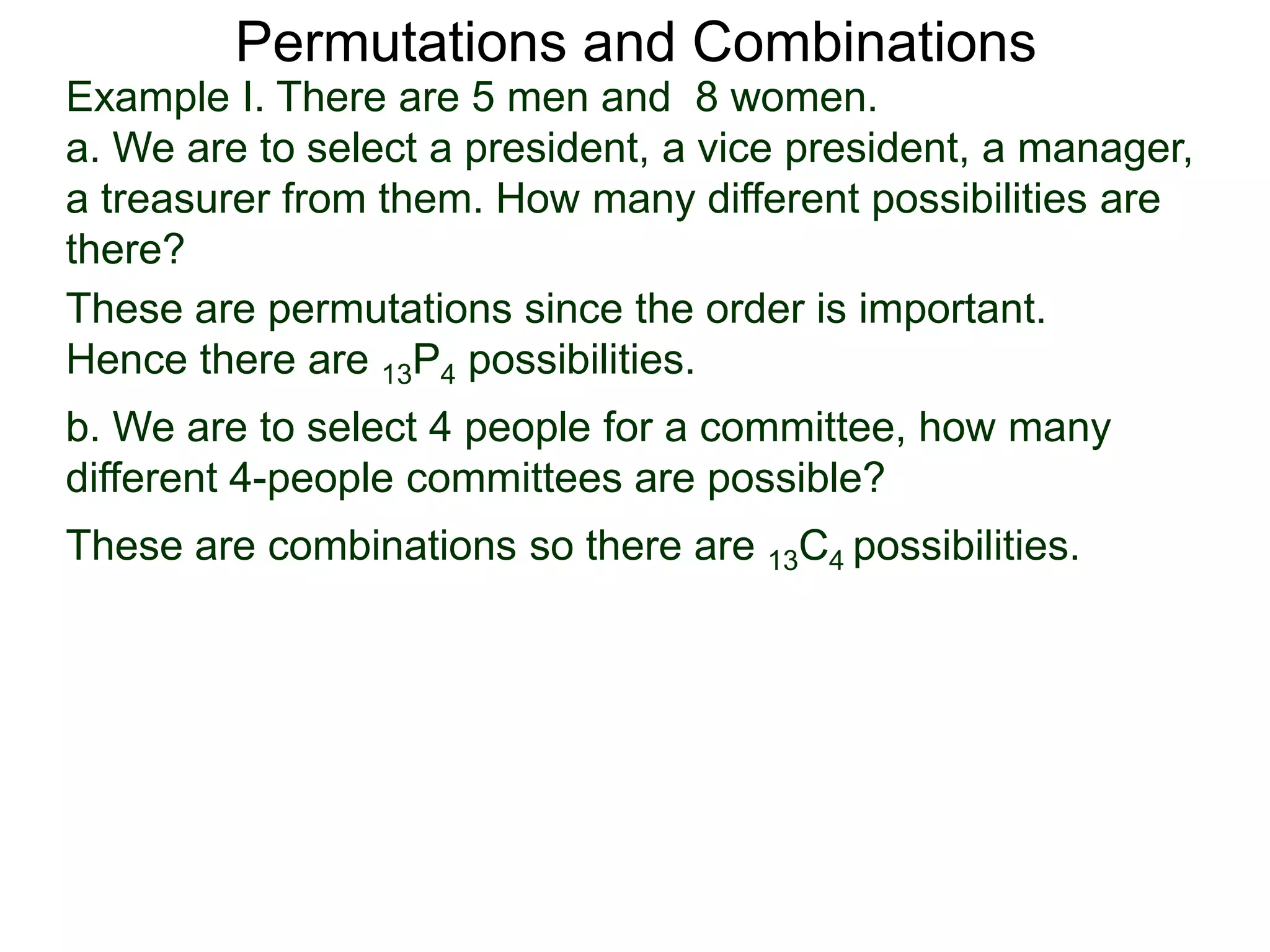
b. We are to select 4 people for a committee, how many
different 4-people committees are possible?
Permutations and Combinations
Example I. There are 5 men and 8 women.
a. We are to select a president, a vice president, a manager,
a treasurer from them. How many different possibilities are
there?
These are permutations since the order is important.
Hence there are 13P4 possibilities.
b. We are to select 4 people for a committee, how many
different 4-people committees are possible?
These are combinations so there are 13C4 possibilities.
Permutations and Combinations
Example I. There are 5 men and 8 women.
a. We are to select a president, a vice president, a manager,
a treasurer from them. How many different possibilities are
there?
These are permutations since the order is important.
Hence there are 13P4 possibilities.
b. We are to select 4 people for a committee, how many
different 4-people committees are possible?
These are combinations so there are 13C4 possibilities.
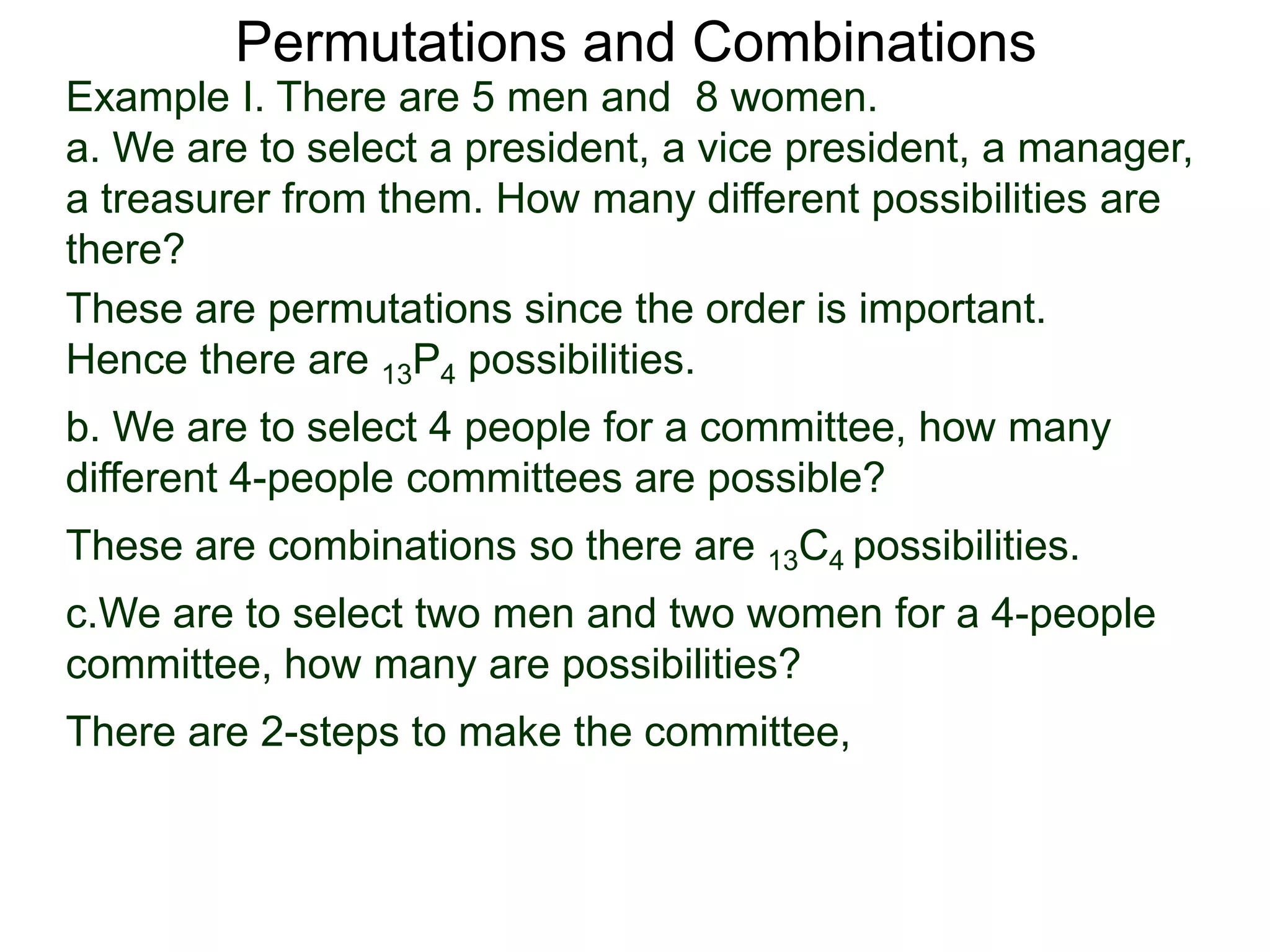
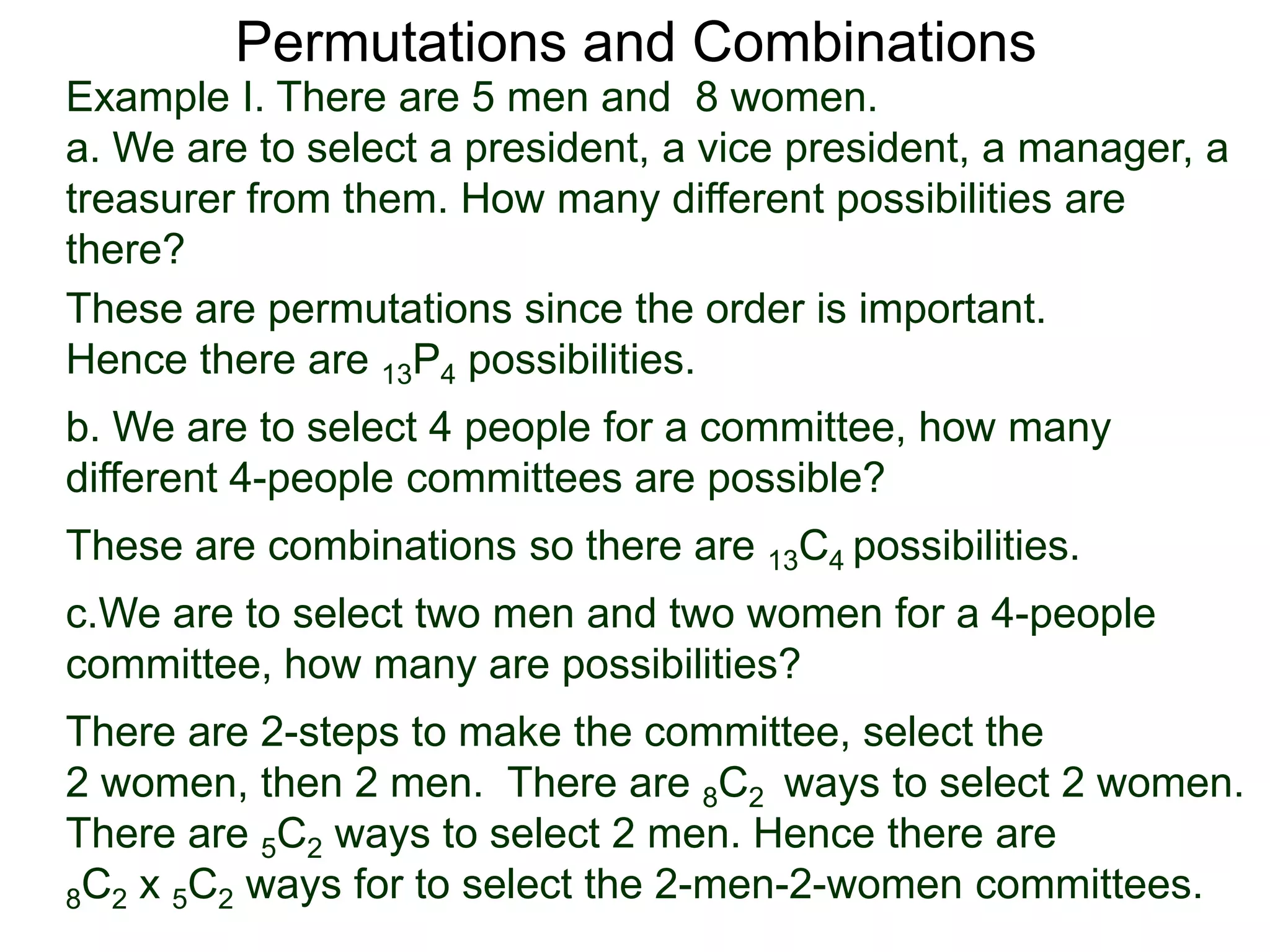
c.We are to select two men and two women for a 4-people
committee, how many are possibilities?
Permutations and Combinations
Example I. There are 5 men and 8 women.
a. We are to select a president, a vice president, a manager,
a treasurer from them. How many different possibilities are
there?
These are permutations since the order is important.
Hence there are 13P4 possibilities.
b. We are to select 4 people for a committee, how many
different 4-people committees are possible?
These are combinations so there are 13C4 possibilities.
c.We are to select two men and two women for a 4-people
committee, how many are possibilities?
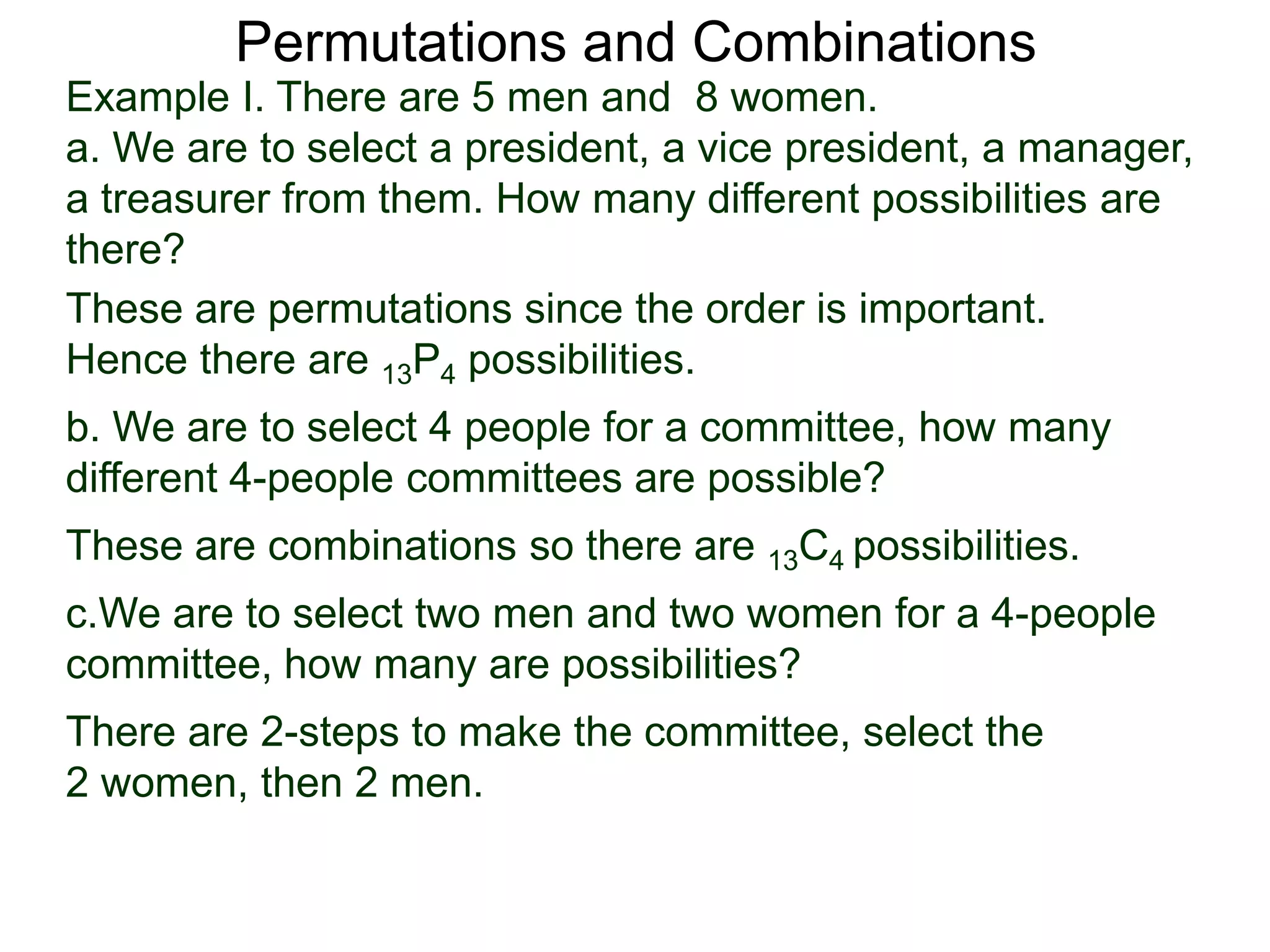
There are 2-steps to make the committee,
Permutations and Combinations
Example I. There are 5 men and 8 women.
a. We are to select a president, a vice president, a manager,
a treasurer from them. How many different possibilities are
there?
These are permutations since the order is important.
Hence there are 13P4 possibilities.
b. We are to select 4 people for a committee, how many
different 4-people committees are possible?
These are combinations so there are 13C4 possibilities.
c.We are to select two men and two women for a 4-people
committee, how many are possibilities?
There are 2-steps to make the committee, select the
2 women, then 2 men.
Permutations and Combinations
Example I. There are 5 men and 8 women.
a. We are to select a president, a vice president, a manager, a
treasurer from them. How many different possibilities are
there?
These are permutations since the order is important.
Hence there are 13P4 possibilities.
b. We are to select 4 people for a committee, how many
different 4-people committees are possible?
These are combinations so there are 13C4 possibilities.
c.We are to select two men and two women for a 4-people
committee, how many are possibilities?
There are 2-steps to make the committee, select the
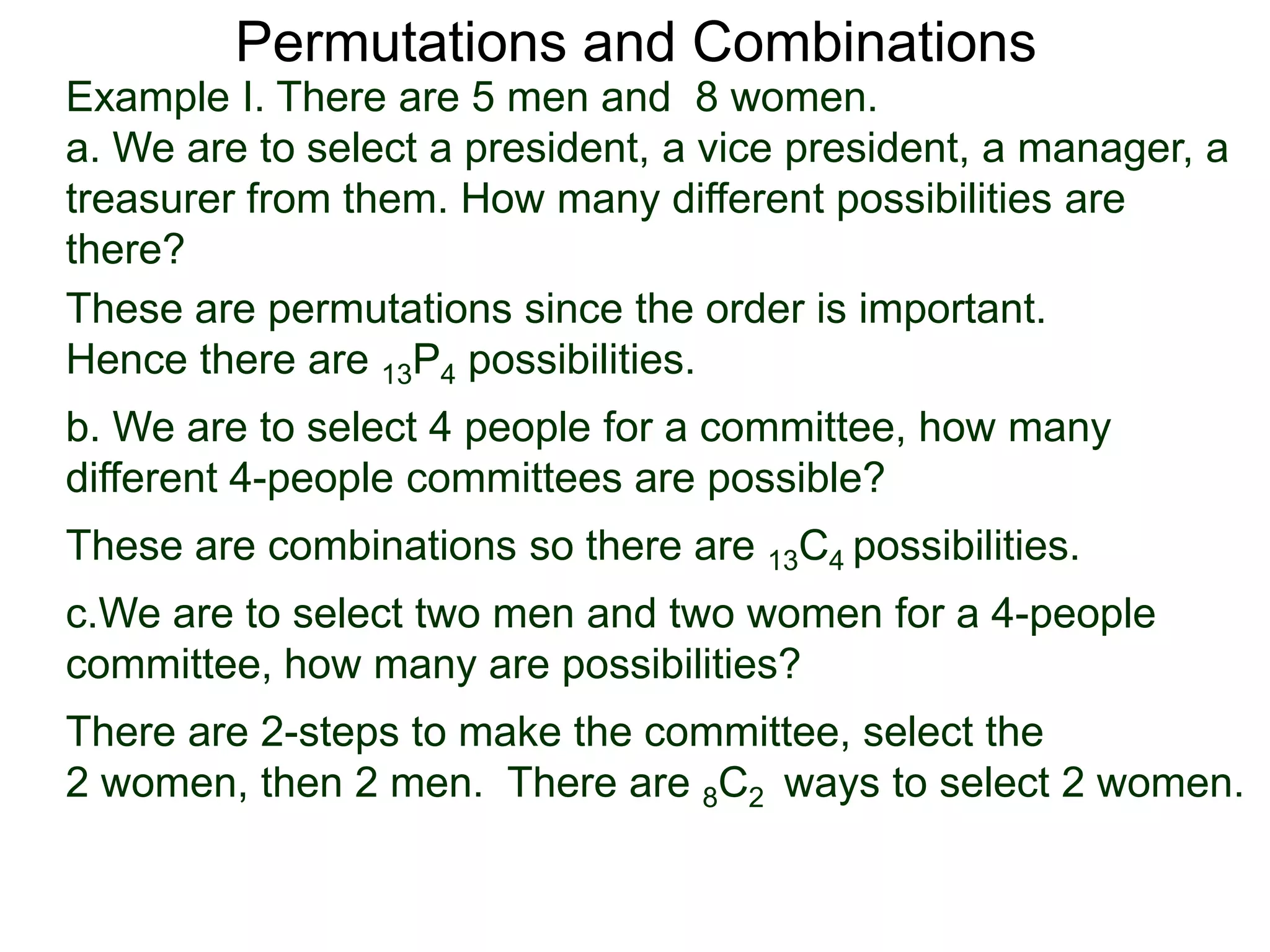
2 women, then 2 men. There are 8C2 ways to select 2 women.
Permutations and Combinations
Example I. There are 5 men and 8 women.
a. We are to select a president, a vice president, a manager, a
treasurer from them. How many different possibilities are
there?
These are permutations since the order is important.
Hence there are 13P4 possibilities.
b. We are to select 4 people for a committee, how many
different 4-people committees are possible?
These are combinations so there are 13C4 possibilities.
c.We are to select two men and two women for a 4-people
committee, how many are possibilities?
There are 2-steps to make the committee, select the
2 women, then 2 men. There are 8C2 ways to select 2 women.
There are 5C2 ways to select 2 men.
Permutations and Combinations
Example I. There are 5 men and 8 women.
a. We are to select a president, a vice president, a manager, a
treasurer from them. How many different possibilities are
there?
These are permutations since the order is important.
Hence there are 13P4 possibilities.
b. We are to select 4 people for a committee, how many
different 4-people committees are possible?
These are combinations so there are 13C4 possibilities.
c.We are to select two men and two women for a 4-people
committee, how many are possibilities?
There are 2-steps to make the committee, select the
2 women, then 2 men. There are 8C2 ways to select 2 women.
There are 5C2 ways to select 2 men. Hence there are
8C2 x 5C2 ways for to select the 2-men-2-women committees.
Permutations and Combinations

5.5 permutations and combinations

  • 1.
  • 2.
    Permutations and Combinations Ak-permutation is an ordered lineup of k objects.
  • 3.
    Permutations and Combinations Ak-permutation is an ordered lineup of k objects. Example A. List all the 2-permutations taken from {a, b, c}.
  • 4.
    Permutations and Combinations Ak-permutation is an ordered lineup of k objects. Example A. List all the 2-permutations taken from {a, b, c}. ab, ba, ac, ca, bc, cb
  • 5.
    Permutations and Combinations Ak-permutation is an ordered lineup of k objects. Example A. List all the 2-permutations taken from {a, b, c}. ab, ba, ac, ca, bc, cb Example B. List all the 3-permutations taken from {a, b, c}.
  • 6.
    Permutations and Combinations Ak-permutation is an ordered lineup of k objects. Example A. List all the 2-permutations taken from {a, b, c}. ab, ba, ac, ca, bc, cb Example B. List all the 3-permutations taken from {a, b, c}. abc, acb, bac, bca, cab, cba
  • 7.
    Permutations and Combinations Ak-permutation is an ordered lineup of k objects. Example A. List all the 2-permutations taken from {a, b, c}. ab, ba, ac, ca, bc, cb Example B. List all the 3-permutations taken from {a, b, c}. abc, acb, bac, bca, cab, cba The number of k-permutations (ordered arrangements) taken from n objects is: n! nPk = (n – k)!
  • 8.
    Permutations and Combinations Ak-permutation is an ordered lineup of k objects. Example A. List all the 2-permutations taken from {a, b, c}. ab, ba, ac, ca, bc, cb Example B. List all the 3-permutations taken from {a, b, c}. abc, acb, bac, bca, cab, cba The number of k-permutations (ordered arrangements) taken from n objects is: n! nPk = (n – k)! Example C. How many 2-permutations taken from {a, b, c} are there?
  • 9.
    Permutations and Combinations Ak-permutation is an ordered lineup of k objects. Example A. List all the 2-permutations taken from {a, b, c}. ab, ba, ac, ca, bc, cb Example B. List all the 3-permutations taken from {a, b, c}. abc, acb, bac, bca, cab, cba The number of k-permutations (ordered arrangements) taken from n objects is: n! nPk = (n – k)! Example C. How many 2-permutations taken from {a, b, c} are there? n=3, k=2,
  • 10.
    Permutations and Combinations Ak-permutation is an ordered lineup of k objects. Example A. List all the 2-permutations taken from {a, b, c}. ab, ba, ac, ca, bc, cb Example B. List all the 3-permutations taken from {a, b, c}. abc, acb, bac, bca, cab, cba The number of k-permutations (ordered arrangements) taken from n objects is: n! nPk = (n – k)! Example C. How many 2-permutations taken from {a, b, c} are there? 3! n=3, k=2, 3P2 = (3 – 2)!
  • 11.
    Permutations and Combinations Ak-permutation is an ordered lineup of k objects. Example A. List all the 2-permutations taken from {a, b, c}. ab, ba, ac, ca, bc, cb Example B. List all the 3-permutations taken from {a, b, c}. abc, acb, bac, bca, cab, cba The number of k-permutations (ordered arrangements) taken from n objects is: n! nPk = (n – k)! Example C. How many 2-permutations taken from {a, b, c} are there? 3! 6 n=3, k=2, 3P2 = (3 – 2)! = 1 = 6
  • 12.
    Permutations and Combinations Ak-permutation is an ordered lineup of k objects. Example A. List all the 2-permutations taken from {a, b, c}. ab, ba, ac, ca, bc, cb Example B. List all the 3-permutations taken from {a, b, c}. abc, acb, bac, bca, cab, cba The number of k-permutations (ordered arrangements) taken from n objects is: n! nPk = (n – k)! Example C. How many 2-permutations taken from {a, b, c} are there? 3! 6 n=3, k=2, 3P2 = (3 – 2)! = 1 = 6 They are {ab, ba, ac, ca, bc, cb}.
  • 13.
    Permutations and Combinations ExampleD. How many different arrangements of 7 people from a group of 10 people in a row of 7 seats are there?
  • 14.
    Permutations and Combinations ExampleD. How many different arrangements of 7 people from a group of 10 people in a row of 7 seats are there? There are 10 people so n = 10.
  • 15.
    Permutations and Combinations ExampleD. How many different arrangements of 7 people from a group of 10 people in a row of 7 seats are there? There are 10 people so n = 10. We are to seat 7 of them in order so k = 7,
  • 16.
    Permutations and Combinations ExampleD. How many different arrangements of 7 people from a group of 10 people in a row of 7 seats are there? There are 10 people so n = 10. We are to seat 7 of them in order so k = 7, so there are 10P7 = 10! / (10 – 7)!
  • 17.
    Permutations and Combinations ExampleD. How many different arrangements of 7 people from a group of 10 people in a row of 7 seats are there? There are 10 people so n = 10. We are to seat 7 of them in order so k = 7, so there are 10P7 = 10! / (10 – 7)! =10! / 3!
  • 18.
    Permutations and Combinations ExampleD. How many different arrangements of 7 people from a group of 10 people in a row of 7 seats are there? There are 10 people so n = 10. We are to seat 7 of them in order so k = 7, so there are 10P7 = 10! / (10 – 7)! =10! / 3! = 10 x 9 x 8 x .. X 4 = 604800 possibilities.
  • 19.
    Permutations and Combinations ExampleD. How many different arrangements of 7 people from a group of 10 people in a row of 7 seats are there? There are 10 people so n = 10. We are to seat 7 of them in order so k = 7, so there are 10P7 = 10! / (10 – 7)! =10! / 3! = 10 x 9 x 8 x .. X 4 = 604800 possibilities. A k-combination is a (unordered) collection of k objects.
  • 20.
    Permutations and Combinations ExampleD. How many different arrangements of 7 people from a group of 10 people in a row of 7 seats are there? There are 10 people so n = 10. We are to seat 7 of them in order so k = 7, so there are 10P7 = 10! / (10 – 7)! =10! / 3! = 10 x 9 x 8 x .. X 4 = 604800 possibilities. A k-combination is a (unordered) collection of k objects. Example E. List all the 2-combinations from the set {a, b, c}.
  • 21.
    Permutations and Combinations ExampleD. How many different arrangements of 7 people from a group of 10 people in a row of 7 seats are there? There are 10 people so n = 10. We are to seat 7 of them in order so k = 7, so there are 10P7 = 10! / (10 – 7)! =10! / 3! = 10 x 9 x 8 x .. X 4 = 604800 possibilities. A k-combination is a (unordered) collection of k objects. Example E. List all the 2-combinations from the set {a, b, c}. {a, b}, {a, c}, {b, c}
  • 22.
    Permutations and Combinations ExampleD. How many different arrangements of 7 people from a group of 10 people in a row of 7 seats are there? There are 10 people so n = 10. We are to seat 7 of them in order so k = 7, so there are 10P7 = 10! / (10 – 7)! =10! / 3! = 10 x 9 x 8 x .. X 4 = 604800 possibilities. A k-combination is a (unordered) collection of k objects. Example E. List all the 2-combinations from the set {a, b, c}. {a, b}, {a, c}, {b, c} Example F. List all the 3-combination taken from {a, b, c}.
  • 23.
    Permutations and Combinations ExampleD. How many different arrangements of 7 people from a group of 10 people in a row of 7 seats are there? There are 10 people so n = 10. We are to seat 7 of them in order so k = 7, so there are 10P7 = 10! / (10 – 7)! =10! / 3! = 10 x 9 x 8 x .. X 4 = 604800 possibilities. A k-combination is a (unordered) collection of k objects. Example E. List all the 2-combinations from the set {a, b, c}. {a, b}, {a, c}, {b, c} Example F. List all the 3-combination taken from {a, b, c}. {a, b, c}
  • 24.
    Permutations and Combinations ExampleD. How many different arrangements of 7 people from a group of 10 people in a row of 7 seats are there? There are 10 people so n = 10. We are to seat 7 of them in order so k = 7, so there are 10P7 = 10! / (10 – 7)! =10! / 3! = 10 x 9 x 8 x .. X 4 = 604800 possibilities. A k-combination is a (unordered) collection of k objects. Example E. List all the 2-combinations from the set {a, b, c}. {a, b}, {a, c}, {b, c} Example F. List all the 3-combination taken from {a, b, c}. {a, b, c} The number of k-combinations (unordered collections) taken from n objects is: n! nCk = (n – k)!k!
  • 25.
    Permutations and Combinations ExampleG. How many 2-combinations from the set {a, b, c} are there?
  • 26.
    Permutations and Combinations ExampleG. How many 2-combinations from the set {a, b, c} are there? n = 3, k = 2,
  • 27.
    Permutations and Combinations ExampleG. How many 2-combinations from the set {a, b, c} are there? n = 3, k = 2, hence there are C2 = 3! 3 (3 – 2)!2!
  • 28.
    Permutations and Combinations ExampleG. How many 2-combinations from the set {a, b, c} are there? n = 3, k = 2, hence there are 3! 3 3C2 = (3 – 2)!2!
  • 29.
    Permutations and Combinations ExampleG. How many 2-combinations from the set {a, b, c} are there? n = 3, k = 2, hence there are 3! 3 3C2 = =3 (3 – 2)!2!
  • 30.
    Permutations and Combinations ExampleG. How many 2-combinations from the set {a, b, c} are there? n = 3, k = 2, hence there are 3! 3 3C2 = =3 (3 – 2)!2! So there are three 2-combinations.
  • 31.
    Permutations and Combinations ExampleG. How many 2-combinations from the set {a, b, c} are there? n = 3, k = 2, hence there are 3! 3 3C2 = =3 (3 – 2)!2! So there are three 2-combinations. They are {a, b}, {a, c}, {b, c}.
  • 32.
    Permutations and Combinations ExampleG. How many 2-combinations from the set {a, b, c} are there? n = 3, k = 2, hence there are 3! 3 3C2 = =3 (3 – 2)!2! So there are three 2-combinations. They are {a, b}, {a, c}, {b, c}. Example H. A Chinese take-out offers a beef dish, a chicken dish, a vegetable dish, fried rice, and fried noodles. We may chose any 3 of them for a 3-Combo Special. How many different 3-Combo Specials are possible?
  • 33.
    Permutations and Combinations ExampleG. How many 2-combinations from the set {a, b, c} are there? n = 3, k = 2, hence there are 3! 3 3C2 = =3 (3 – 2)!2! So there are three 2-combinations. They are {a, b}, {a, c}, {b, c}. Example H. A Chinese take-out offers a beef dish, a chicken dish, a vegetable dish, fried rice, and fried noodles. We may chose any 3 of them for a 3-Combo Special. How many different 3-Combo Specials are possible? n = 5, we are to take 3 of so k = 3,
  • 34.
    Permutations and Combinations ExampleG. How many 2-combinations from the set {a, b, c} are there? n = 3, k = 2, hence there are 3! 3 3C2 = =3 (3 – 2)!2! So there are three 2-combinations. They are {a, b}, {a, c}, {b, c}. Example H. A Chinese take-out offers a beef dish, a chicken dish, a vegetable dish, fried rice, and fried noodles. We may chose any 3 of them for a 3-Combo Special. How many different 3-Combo Specials are possible? n = 5, we are to take 3 of so k = 3, hence there are 5! 5 C3 = (5 – 3)!3!
  • 35.
    Permutations and Combinations ExampleG. How many 2-combinations from the set {a, b, c} are there? n = 3, k = 2, hence there are 3! 3 3C2 = =3 (3 – 2)!2! So there are three 2-combinations. They are {a, b}, {a, c}, {b, c}. Example H. A Chinese take-out offers a beef dish, a chicken dish, a vegetable dish, fried rice, and fried noodles. We may chose any 3 of them for a 3-Combo Special. How many different 3-Combo Specials are possible? n = 5, we are to take 3 of so k = 3, hence there are 5! 5! 5 C3 = (5 – 3)!3! = 2!3!
  • 36.
    Permutations and Combinations ExampleG. How many 2-combinations from the set {a, b, c} are there? n = 3, k = 2, hence there are 3! 3 3C2 = =3 (3 – 2)!2! So there are three 2-combinations. They are {a, b}, {a, c}, {b, c}. Example H. A Chinese take-out offers a beef dish, a chicken dish, a vegetable dish, fried rice, and fried noodles. We may chose any 3 of them for a 3-Combo Special. How many different 3-Combo Specials are possible? n = 5, we are to take 3 of so k = 3, hence there are 5! 5! 5*4 5C3 = (5 – 3)!3! = 2!3!
  • 37.
    Permutations and Combinations ExampleG. How many 2-combinations from the set {a, b, c} are there? n = 3, k = 2, hence there are 3! 3 3C2 = =3 (3 – 2)!2! So there are three 2-combinations. They are {a, b}, {a, c}, {b, c}. Example H. A Chinese take-out offers a beef dish, a chicken dish, a vegetable dish, fried rice, and fried noodles. We may chose any 3 of them for a 3-Combo Special. How many different 3-Combo Specials are possible? n = 5, we are to take 3 of so k = 3, hence there are 5! 5! 5*4 5C3 = (5 – 3)!3! = 2!3! = 10 3-Combos specials.
  • 38.
    Permutations and Combinations ExampleI. There are 5 men and 8 women. a. We are to select a president, a vice president, a manager, a treasurer from them. How many different possibilities are there?
  • 39.
    Permutations and Combinations ExampleI. There are 5 men and 8 women. a. We are to select a president, a vice president, a manager, a treasurer from them. How many different possibilities are there? These are permutations since the order is important.
  • 40.
    Permutations and Combinations ExampleI. There are 5 men and 8 women. a. We are to select a president, a vice president, a manager, a treasurer from them. How many different possibilities are there? These are permutations since the order is important. Hence there are 13P4 possibilities.
  • 41.
    Permutations and Combinations ExampleI. There are 5 men and 8 women. a. We are to select a president, a vice president, a manager, a treasurer from them. How many different possibilities are there? These are permutations since the order is important. Hence there are 13P4 possibilities. b. We are to select 4 people for a committee, how many different 4-people committees are possible?
  • 42.
    Permutations and Combinations ExampleI. There are 5 men and 8 women. a. We are to select a president, a vice president, a manager, a treasurer from them. How many different possibilities are there? These are permutations since the order is important. Hence there are 13P4 possibilities. b. We are to select 4 people for a committee, how many different 4-people committees are possible? These are combinations so there are 13C4 possibilities.
  • 43.
    Permutations and Combinations ExampleI. There are 5 men and 8 women. a. We are to select a president, a vice president, a manager, a treasurer from them. How many different possibilities are there? These are permutations since the order is important. Hence there are 13P4 possibilities. b. We are to select 4 people for a committee, how many different 4-people committees are possible? These are combinations so there are 13C4 possibilities. c.We are to select two men and two women for a 4-people committee, how many are possibilities?
  • 44.
    Permutations and Combinations ExampleI. There are 5 men and 8 women. a. We are to select a president, a vice president, a manager, a treasurer from them. How many different possibilities are there? These are permutations since the order is important. Hence there are 13P4 possibilities. b. We are to select 4 people for a committee, how many different 4-people committees are possible? These are combinations so there are 13C4 possibilities. c.We are to select two men and two women for a 4-people committee, how many are possibilities? There are 2-steps to make the committee,
  • 45.
    Permutations and Combinations ExampleI. There are 5 men and 8 women. a. We are to select a president, a vice president, a manager, a treasurer from them. How many different possibilities are there? These are permutations since the order is important. Hence there are 13P4 possibilities. b. We are to select 4 people for a committee, how many different 4-people committees are possible? These are combinations so there are 13C4 possibilities. c.We are to select two men and two women for a 4-people committee, how many are possibilities? There are 2-steps to make the committee, select the 2 women, then 2 men.
  • 46.
    Permutations and Combinations ExampleI. There are 5 men and 8 women. a. We are to select a president, a vice president, a manager, a treasurer from them. How many different possibilities are there? These are permutations since the order is important. Hence there are 13P4 possibilities. b. We are to select 4 people for a committee, how many different 4-people committees are possible? These are combinations so there are 13C4 possibilities. c.We are to select two men and two women for a 4-people committee, how many are possibilities? There are 2-steps to make the committee, select the 2 women, then 2 men. There are 8C2 ways to select 2 women.
  • 47.
    Permutations and Combinations ExampleI. There are 5 men and 8 women. a. We are to select a president, a vice president, a manager, a treasurer from them. How many different possibilities are there? These are permutations since the order is important. Hence there are 13P4 possibilities. b. We are to select 4 people for a committee, how many different 4-people committees are possible? These are combinations so there are 13C4 possibilities. c.We are to select two men and two women for a 4-people committee, how many are possibilities? There are 2-steps to make the committee, select the 2 women, then 2 men. There are 8C2 ways to select 2 women. There are 5C2 ways to select 2 men.
  • 48.
    Permutations and Combinations ExampleI. There are 5 men and 8 women. a. We are to select a president, a vice president, a manager, a treasurer from them. How many different possibilities are there? These are permutations since the order is important. Hence there are 13P4 possibilities. b. We are to select 4 people for a committee, how many different 4-people committees are possible? These are combinations so there are 13C4 possibilities. c.We are to select two men and two women for a 4-people committee, how many are possibilities? There are 2-steps to make the committee, select the 2 women, then 2 men. There are 8C2 ways to select 2 women. There are 5C2 ways to select 2 men. Hence there are 8C2 x 5C2 ways for to select the 2-men-2-women committees.
  • 49.