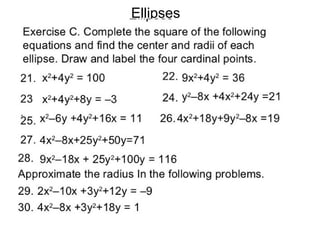
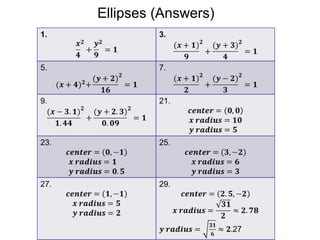
Ellipses
Ellipses
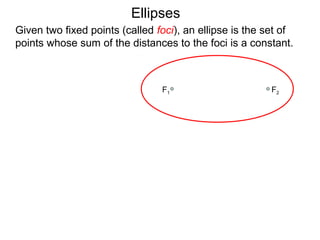
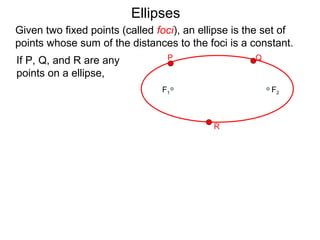
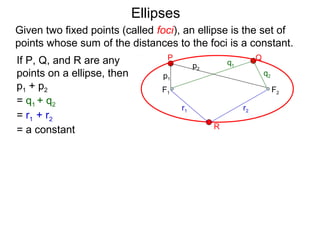
Given two fixed points (called foci), an ellipse is the set of
points whose sum of the distances to the foci is a constant.
F2F1
Ellipses
Given two fixed points (called foci), an ellipse is the set of
points whose sum of the distances to the foci is a constant.
F2F1
P Q
R
If P, Q, and R are any
points on a ellipse,
Ellipses
Given two fixed points (called foci), an ellipse is the set of
points whose sum of the distances to the foci is a constant.
F2F1
P Q
R
p1
p2
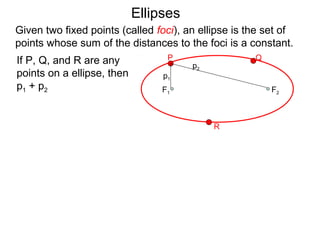
If P, Q, and R are any
points on a ellipse, then
p1 + p2
Ellipses
Given two fixed points (called foci), an ellipse is the set of
points whose sum of the distances to the foci is a constant.
F2F1
P Q
R
p1
p2
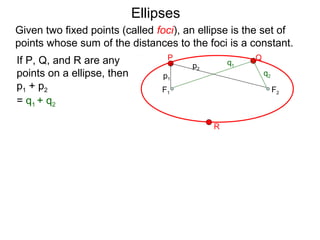
If P, Q, and R are any
points on a ellipse, then
p1 + p2
= q1 + q2
q1
q2
Ellipses
Given two fixed points (called foci), an ellipse is the set of
points whose sum of the distances to the foci is a constant.
F2F1
P Q
R
p1
p2
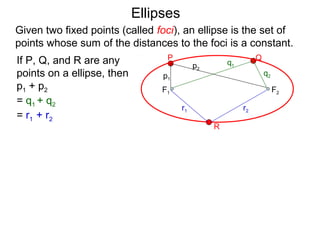
If P, Q, and R are any
points on a ellipse, then
p1 + p2
= q1 + q2
= r1 + r2
q1
q2
r2r1
Ellipses
Given two fixed points (called foci), an ellipse is the set of
points whose sum of the distances to the foci is a constant.
F2F1
P Q
R
p1
p2
If P, Q, and R are any
points on a ellipse, then
p1 + p2
= q1 + q2
= r1 + r2
= a constant
q1
q2
r2r1
Ellipses
Given two fixed points (called foci), an ellipse is the set of
points whose sum of the distances to the foci is a constant.
F2F1
P Q
R
p1
p2
If P, Q, and R are any
points on a ellipse, then
p1 + p2
= q1 + q2
= r1 + r2
= a constant
q1
q2
r2r1
Ellipses
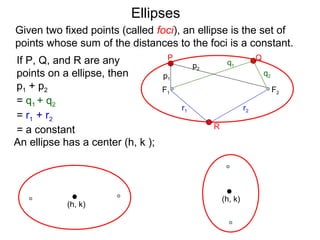
An ellipse has a center (h, k );
(h, k)
(h, k)
Given two fixed points (called foci), an ellipse is the set of
points whose sum of the distances to the foci is a constant.
F2F1
P Q
R
p1
p2
If P, Q, and R are any
points on a ellipse, then
p1 + p2
= q1 + q2
= r1 + r2
= a constant
q1
q2
r2r1
Ellipses
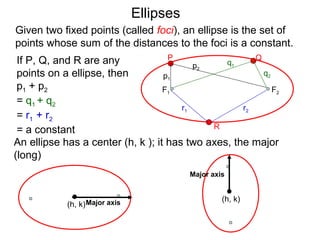
An ellipse has a center (h, k ); it has two axes, the major
(long)
(h, k)
(h, k)
Given two fixed points (called foci), an ellipse is the set of
points whose sum of the distances to the foci is a constant.
Major axis
Major axis
F2F1
P Q
R
p1
p2
If P, Q, and R are any
points on a ellipse, then
p1 + p2
= q1 + q2
= r1 + r2
= a constant
q1
q2
r2r1
Ellipses
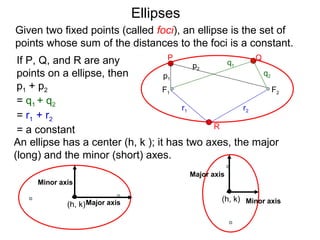
An ellipse has a center (h, k ); it has two axes, the major
(long) and the minor (short) axes.
(h, k)Major axis
Minor axis
(h, k)
Major axis
Minor axis
Given two fixed points (called foci), an ellipse is the set of
points whose sum of the distances to the foci is a constant.
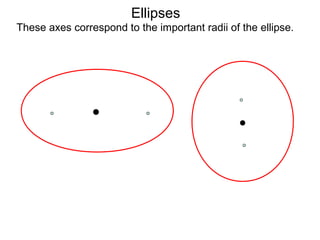
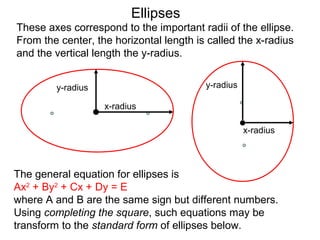
These axes correspond to the important radii of the ellipse.
Ellipses
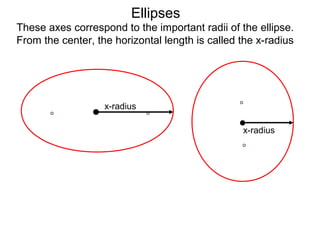
These axes correspond to the important radii of the ellipse.
From the center, the horizontal length is called the x-radius
Ellipses
x-radius
x-radius
y-radius
These axes correspond to the important radii of the ellipse.
From the center, the horizontal length is called the x-radius
and the vertical length the y-radius.
Ellipses
x-radius
x-radius
y-radius
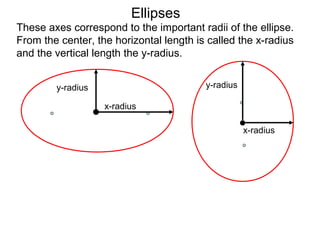
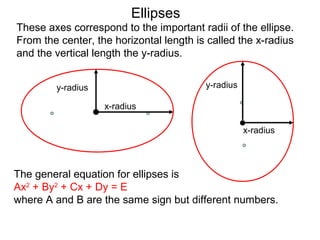
These axes correspond to the important radii of the ellipse.
From the center, the horizontal length is called the x-radius
and the vertical length the y-radius.
Ellipses
x-radius
The general equation for ellipses is
Ax2
+ By2
+ Cx + Dy = E
where A and B are the same sign but different numbers.
x-radius
y-radiusy-radius
These axes correspond to the important radii of the ellipse.
From the center, the horizontal length is called the x-radius
and the vertical length the y-radius.
Ellipses
x-radius
The general equation for ellipses is
Ax2
+ By2
+ Cx + Dy = E
where A and B are the same sign but different numbers.
Using completing the square, such equations may be
transform to the standard form of ellipses below.
x-radius
y-radiusy-radius
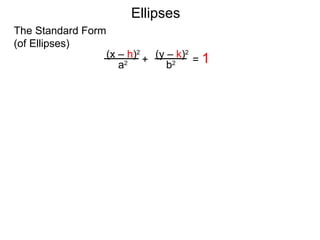
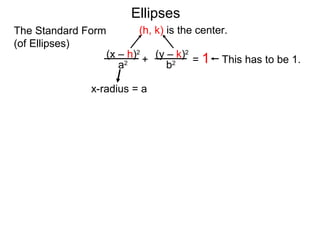
(x – h)2
(y – k)2
a2
b2
Ellipses
+ = 1
The Standard Form
(of Ellipses)
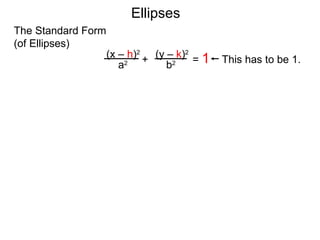
(x – h)2
(y – k)2
a2
b2
Ellipses
+ = 1 This has to be 1.
The Standard Form
(of Ellipses)
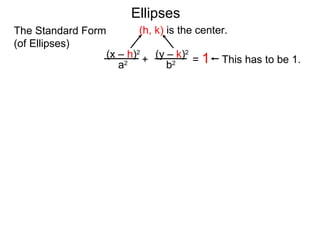
(x – h)2
(y – k)2
a2
b2
(h, k) is the center.
Ellipses
+ = 1 This has to be 1.
The Standard Form
(of Ellipses)
(x – h)2
(y – k)2
a2
b2
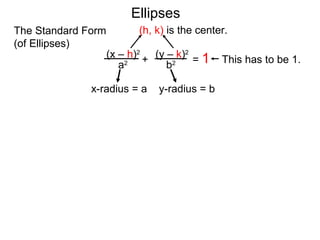
x-radius = a
(h, k) is the center.
Ellipses
+ = 1 This has to be 1.
The Standard Form
(of Ellipses)
(x – h)2
(y – k)2
a2
b2
x-radius = a y-radius = b
(h, k) is the center.
Ellipses
+ = 1 This has to be 1.
The Standard Form
(of Ellipses)
(x – h)2
(y – k)2
a2
b2
x-radius = a y-radius = b
(h, k) is the center.
Ellipses
+ = 1 This has to be 1.
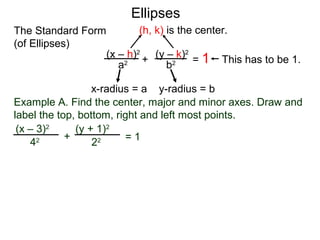
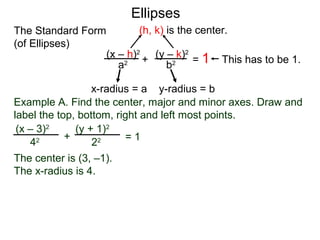
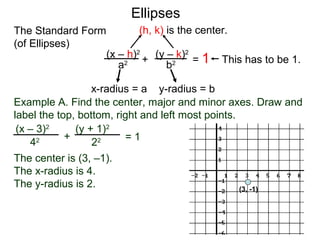
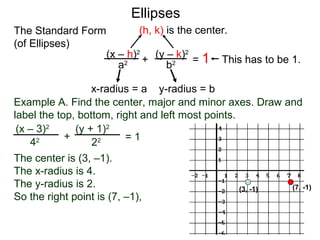
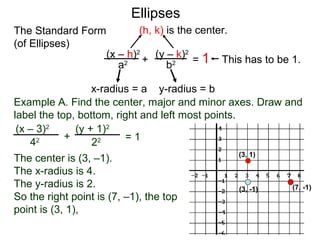
Example A. Find the center, major and minor axes. Draw and
label the top, bottom, right and left most points.
(x – 3)2
(y + 1)2
42
22+ = 1
The Standard Form
(of Ellipses)
(x – h)2
(y – k)2
a2
b2
x-radius = a y-radius = b
(h, k) is the center.
Ellipses
+ = 1 This has to be 1.
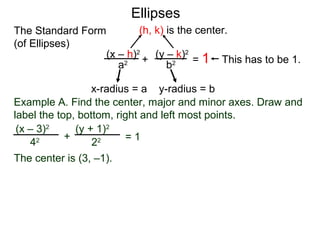
Example A. Find the center, major and minor axes. Draw and
label the top, bottom, right and left most points.
(x – 3)2
(y + 1)2
42
22+ = 1
The center is (3, –1).
The Standard Form
(of Ellipses)
(x – h)2
(y – k)2
a2
b2
x-radius = a y-radius = b
(h, k) is the center.
Ellipses
+ = 1 This has to be 1.
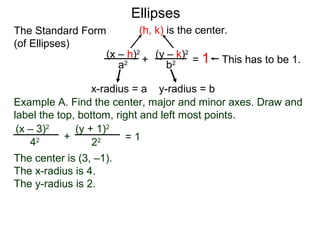
Example A. Find the center, major and minor axes. Draw and
label the top, bottom, right and left most points.
(x – 3)2
(y + 1)2
42
22+ = 1
The center is (3, –1).
The x-radius is 4.
The Standard Form
(of Ellipses)
(x – h)2
(y – k)2
a2
b2
x-radius = a y-radius = b
(h, k) is the center.
Ellipses
+ = 1 This has to be 1.
Example A. Find the center, major and minor axes. Draw and
label the top, bottom, right and left most points.
(x – 3)2
(y + 1)2
42
22+ = 1
The center is (3, –1).
The x-radius is 4.
The y-radius is 2.
The Standard Form
(of Ellipses)
(x – h)2
(y – k)2
a2
b2
x-radius = a y-radius = b
(h, k) is the center.
Ellipses
+ = 1 This has to be 1.
(3, -1)
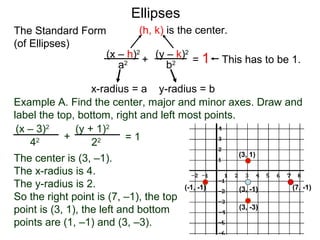
Example A. Find the center, major and minor axes. Draw and
label the top, bottom, right and left most points.
(x – 3)2
(y + 1)2
42
22+ = 1
The center is (3, –1).
The x-radius is 4.
The y-radius is 2.
The Standard Form
(of Ellipses)
(x – h)2
(y – k)2
a2
b2
x-radius = a y-radius = b
(h, k) is the center.
Ellipses
+ = 1 This has to be 1.
(3, -1) (7, -1)
Example A. Find the center, major and minor axes. Draw and
label the top, bottom, right and left most points.
(x – 3)2
(y + 1)2
42
22+ = 1
The center is (3, –1).
The x-radius is 4.
The y-radius is 2.
So the right point is (7, –1),
The Standard Form
(of Ellipses)
(x – h)2
(y – k)2
a2
b2
x-radius = a y-radius = b
(h, k) is the center.
Ellipses
+ = 1 This has to be 1.
(3, -1) (7, -1)
(3, 1)
Example A. Find the center, major and minor axes. Draw and
label the top, bottom, right and left most points.
(x – 3)2
(y + 1)2
42
22+ = 1
The center is (3, –1).
The x-radius is 4.
The y-radius is 2.
So the right point is (7, –1), the top
point is (3, 1),
The Standard Form
(of Ellipses)
(x – h)2
(y – k)2
a2
b2
x-radius = a y-radius = b
(h, k) is the center.
Ellipses
+ = 1 This has to be 1.
(3, -1) (7, -1)(-1, -1)
(3, -3)
(3, 1)
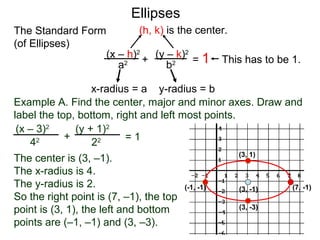
Example A. Find the center, major and minor axes. Draw and
label the top, bottom, right and left most points.
(x – 3)2
(y + 1)2
42
22+ = 1
The center is (3, –1).
The x-radius is 4.
The y-radius is 2.
So the right point is (7, –1), the top
point is (3, 1), the left and bottom
points are (1, –1) and (3, –3).
The Standard Form
(of Ellipses)
(x – h)2
(y – k)2
a2
b2
x-radius = a y-radius = b
(h, k) is the center.
Ellipses
+ = 1 This has to be 1.
(3, -1) (7, -1)(-1, -1)
(3, -3)
(3, 1)
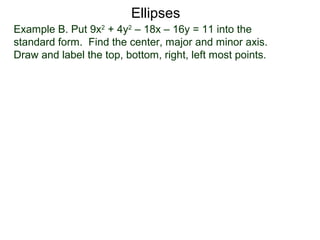
Example A. Find the center, major and minor axes. Draw and
label the top, bottom, right and left most points.
(x – 3)2
(y + 1)2
42
22+ = 1
The center is (3, –1).
The x-radius is 4.
The y-radius is 2.
So the right point is (7, –1), the top
point is (3, 1), the left and bottom
points are (–1, –1) and (3, –3).
The Standard Form
(of Ellipses)
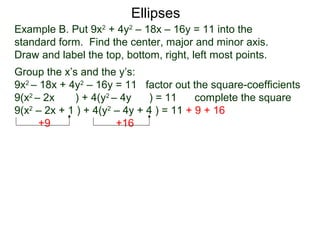
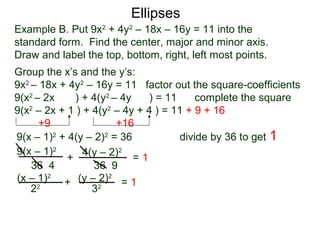
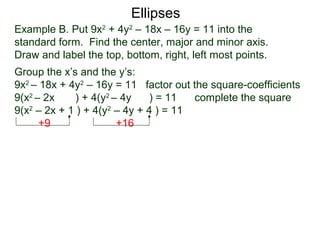
Example B. Put 9x2
+ 4y2
– 18x – 16y = 11 into the
standard form. Find the center, major and minor axis.
Draw and label the top, bottom, right, left most points.
Ellipses
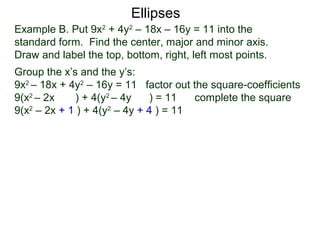
Example B. Put 9x2
+ 4y2
– 18x – 16y = 11 into the
standard form. Find the center, major and minor axis.
Draw and label the top, bottom, right, left most points.
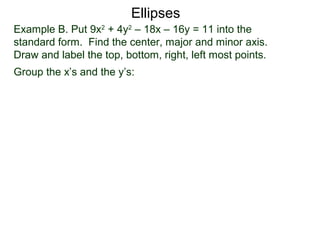
Group the x’s and the y’s:
Ellipses
Example B. Put 9x2
+ 4y2
– 18x – 16y = 11 into the
standard form. Find the center, major and minor axis.
Draw and label the top, bottom, right, left most points.
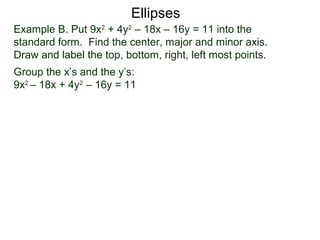
Group the x’s and the y’s:
9x2
– 18x + 4y2
– 16y = 11
Ellipses
Example B. Put 9x2
+ 4y2
– 18x – 16y = 11 into the
standard form. Find the center, major and minor axis.
Draw and label the top, bottom, right, left most points.
Group the x’s and the y’s:
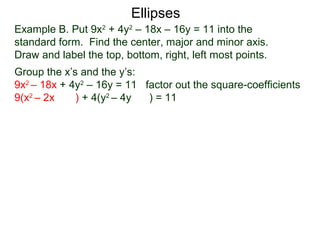
9x2
– 18x + 4y2
– 16y = 11 factor out the square-coefficients
9(x2
– 2x ) + 4(y2
– 4y ) = 11
Ellipses
Example B. Put 9x2
+ 4y2
– 18x – 16y = 11 into the
standard form. Find the center, major and minor axis.
Draw and label the top, bottom, right, left most points.
Group the x’s and the y’s:
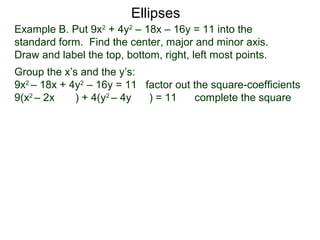
9x2
– 18x + 4y2
– 16y = 11 factor out the square-coefficients
9(x2
– 2x ) + 4(y2
– 4y ) = 11 complete the square
Ellipses
Example B. Put 9x2
+ 4y2
– 18x – 16y = 11 into the
standard form. Find the center, major and minor axis.
Draw and label the top, bottom, right, left most points.
Group the x’s and the y’s:
9x2
– 18x + 4y2
– 16y = 11 factor out the square-coefficients
9(x2
– 2x ) + 4(y2
– 4y ) = 11 complete the square
9(x2
– 2x + 1 ) + 4(y2
– 4y + 4 ) = 11
Ellipses
Example B. Put 9x2
+ 4y2
– 18x – 16y = 11 into the
standard form. Find the center, major and minor axis.
Draw and label the top, bottom, right, left most points.
Group the x’s and the y’s:
9x2
– 18x + 4y2
– 16y = 11 factor out the square-coefficients
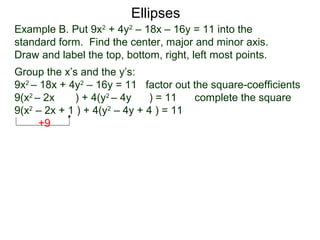
9(x2
– 2x ) + 4(y2
– 4y ) = 11 complete the square
9(x2
– 2x + 1 ) + 4(y2
– 4y + 4 ) = 11
+9
Ellipses
Example B. Put 9x2
+ 4y2
– 18x – 16y = 11 into the
standard form. Find the center, major and minor axis.
Draw and label the top, bottom, right, left most points.
Group the x’s and the y’s:
9x2
– 18x + 4y2
– 16y = 11 factor out the square-coefficients
9(x2
– 2x ) + 4(y2
– 4y ) = 11 complete the square
9(x2
– 2x + 1 ) + 4(y2
– 4y + 4 ) = 11
+9 +16
Ellipses
Example B. Put 9x2
+ 4y2
– 18x – 16y = 11 into the
standard form. Find the center, major and minor axis.
Draw and label the top, bottom, right, left most points.
Group the x’s and the y’s:
9x2
– 18x + 4y2
– 16y = 11 factor out the square-coefficients
9(x2
– 2x ) + 4(y2
– 4y ) = 11 complete the square
9(x2
– 2x + 1 ) + 4(y2
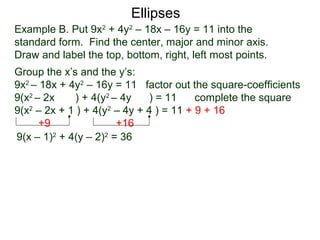
– 4y + 4 ) = 11 + 9 + 16
+9 +16
Ellipses
Example B. Put 9x2
+ 4y2
– 18x – 16y = 11 into the
standard form. Find the center, major and minor axis.
Draw and label the top, bottom, right, left most points.
Group the x’s and the y’s:
9x2
– 18x + 4y2
– 16y = 11 factor out the square-coefficients
9(x2
– 2x ) + 4(y2
– 4y ) = 11 complete the square
9(x2
– 2x + 1 ) + 4(y2
– 4y + 4 ) = 11 + 9 + 16
+9 +16
Ellipses
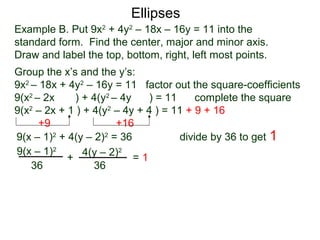
9(x – 1)2
+ 4(y – 2)2
= 36
9(x – 1)2
4(y – 2)2
36 36
Example B. Put 9x2
+ 4y2
– 18x – 16y = 11 into the
standard form. Find the center, major and minor axis.
Draw and label the top, bottom, right, left most points.
Group the x’s and the y’s:
9x2
– 18x + 4y2
– 16y = 11 factor out the square-coefficients
9(x2
– 2x ) + 4(y2
– 4y ) = 11 complete the square
9(x2
– 2x + 1 ) + 4(y2
– 4y + 4 ) = 11 + 9 + 16
+9 +16
+ = 1
Ellipses
9(x – 1)2
+ 4(y – 2)2
= 36 divide by 36 to get 1
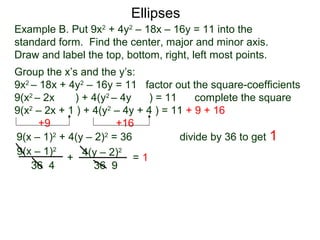
9(x – 1)2
4(y – 2)2
36 4 36 9
Example B. Put 9x2
+ 4y2
– 18x – 16y = 11 into the
standard form. Find the center, major and minor axis.
Draw and label the top, bottom, right, left most points.
Group the x’s and the y’s:
9x2
– 18x + 4y2
– 16y = 11 factor out the square-coefficients
9(x2
– 2x ) + 4(y2
– 4y ) = 11 complete the square
9(x2
– 2x + 1 ) + 4(y2
– 4y + 4 ) = 11 + 9 + 16
+9 +16
+ = 1
Ellipses
9(x – 1)2
+ 4(y – 2)2
= 36 divide by 36 to get 1
9(x – 1)2
4(y – 2)2
36 4 36 9
Example B. Put 9x2
+ 4y2
– 18x – 16y = 11 into the
standard form. Find the center, major and minor axis.
Draw and label the top, bottom, right, left most points.
Group the x’s and the y’s:
9x2
– 18x + 4y2
– 16y = 11 factor out the square-coefficients
9(x2
– 2x ) + 4(y2
– 4y ) = 11 complete the square
9(x2
– 2x + 1 ) + 4(y2
– 4y + 4 ) = 11 + 9 + 16
+9 +16
+ = 1
(x – 1)2
(y – 2)2
22
32
+ = 1
Ellipses
9(x – 1)2
+ 4(y – 2)2
= 36 divide by 36 to get 1
9(x – 1)2
4(y – 2)2
36 4 36 9
Example B. Put 9x2
+ 4y2
– 18x – 16y = 11 into the
standard form. Find the center, major and minor axis.
Draw and label the top, bottom, right, left most points.
Group the x’s and the y’s:
9x2
– 18x + 4y2
– 16y = 11 factor out the square-coefficients
9(x2
– 2x ) + 4(y2
– 4y ) = 11 complete the square
9(x2
– 2x + 1 ) + 4(y2
– 4y + 4 ) = 11 + 9 + 16
+9 +16
+ = 1
(x – 1)2
(y – 2)2
22
32
+ = 1
Ellipses
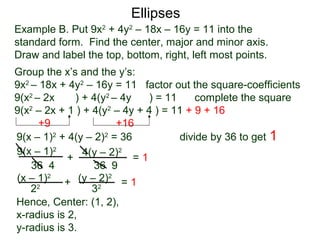
9(x – 1)2
+ 4(y – 2)2
= 36 divide by 36 to get 1
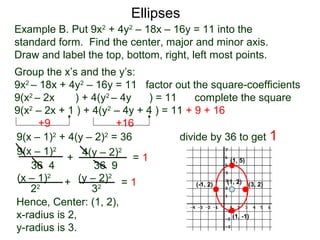
Hence, Center: (1, 2),
x-radius is 2,
y-radius is 3.
9(x – 1)2
4(y – 2)2
36 4 36 9
Example B. Put 9x2
+ 4y2
– 18x – 16y = 11 into the
standard form. Find the center, major and minor axis.
Draw and label the top, bottom, right, left most points.
Group the x’s and the y’s:
9x2
– 18x + 4y2
– 16y = 11 factor out the square-coefficients
9(x2
– 2x ) + 4(y2
– 4y ) = 11 complete the square
9(x2
– 2x + 1 ) + 4(y2
– 4y + 4 ) = 11 + 9 + 16
+9 +16
+ = 1
(x – 1)2
(y – 2)2
22
32
+ = 1
Ellipses
9(x – 1)2
+ 4(y – 2)2
= 36 divide by 36 to get 1
Hence, Center: (1, 2),
x-radius is 2,
y-radius is 3.
(-1, 2) (3, 2)
(1, 5)
(1, -1)
(1, 2)
Ellipses
Ellipses
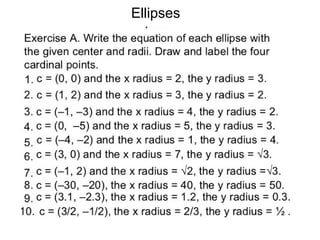
Ellipses (Answers)

3.4 ellipses

  • 1.
  • 2.
    Ellipses Given two fixedpoints (called foci), an ellipse is the set of points whose sum of the distances to the foci is a constant.
  • 3.
    F2F1 Ellipses Given two fixedpoints (called foci), an ellipse is the set of points whose sum of the distances to the foci is a constant.
  • 4.
    F2F1 P Q R If P,Q, and R are any points on a ellipse, Ellipses Given two fixed points (called foci), an ellipse is the set of points whose sum of the distances to the foci is a constant.
  • 5.
    F2F1 P Q R p1 p2 If P,Q, and R are any points on a ellipse, then p1 + p2 Ellipses Given two fixed points (called foci), an ellipse is the set of points whose sum of the distances to the foci is a constant.
  • 6.
    F2F1 P Q R p1 p2 If P,Q, and R are any points on a ellipse, then p1 + p2 = q1 + q2 q1 q2 Ellipses Given two fixed points (called foci), an ellipse is the set of points whose sum of the distances to the foci is a constant.
  • 7.
    F2F1 P Q R p1 p2 If P,Q, and R are any points on a ellipse, then p1 + p2 = q1 + q2 = r1 + r2 q1 q2 r2r1 Ellipses Given two fixed points (called foci), an ellipse is the set of points whose sum of the distances to the foci is a constant.
  • 8.
    F2F1 P Q R p1 p2 If P,Q, and R are any points on a ellipse, then p1 + p2 = q1 + q2 = r1 + r2 = a constant q1 q2 r2r1 Ellipses Given two fixed points (called foci), an ellipse is the set of points whose sum of the distances to the foci is a constant.
  • 9.
    F2F1 P Q R p1 p2 If P,Q, and R are any points on a ellipse, then p1 + p2 = q1 + q2 = r1 + r2 = a constant q1 q2 r2r1 Ellipses An ellipse has a center (h, k ); (h, k) (h, k) Given two fixed points (called foci), an ellipse is the set of points whose sum of the distances to the foci is a constant.
  • 10.
    F2F1 P Q R p1 p2 If P,Q, and R are any points on a ellipse, then p1 + p2 = q1 + q2 = r1 + r2 = a constant q1 q2 r2r1 Ellipses An ellipse has a center (h, k ); it has two axes, the major (long) (h, k) (h, k) Given two fixed points (called foci), an ellipse is the set of points whose sum of the distances to the foci is a constant. Major axis Major axis
  • 11.
    F2F1 P Q R p1 p2 If P,Q, and R are any points on a ellipse, then p1 + p2 = q1 + q2 = r1 + r2 = a constant q1 q2 r2r1 Ellipses An ellipse has a center (h, k ); it has two axes, the major (long) and the minor (short) axes. (h, k)Major axis Minor axis (h, k) Major axis Minor axis Given two fixed points (called foci), an ellipse is the set of points whose sum of the distances to the foci is a constant.
  • 12.
    These axes correspondto the important radii of the ellipse. Ellipses
  • 13.
    These axes correspondto the important radii of the ellipse. From the center, the horizontal length is called the x-radius Ellipses x-radius x-radius
  • 14.
    y-radius These axes correspondto the important radii of the ellipse. From the center, the horizontal length is called the x-radius and the vertical length the y-radius. Ellipses x-radius x-radius y-radius
  • 15.
    These axes correspondto the important radii of the ellipse. From the center, the horizontal length is called the x-radius and the vertical length the y-radius. Ellipses x-radius The general equation for ellipses is Ax2 + By2 + Cx + Dy = E where A and B are the same sign but different numbers. x-radius y-radiusy-radius
  • 16.
    These axes correspondto the important radii of the ellipse. From the center, the horizontal length is called the x-radius and the vertical length the y-radius. Ellipses x-radius The general equation for ellipses is Ax2 + By2 + Cx + Dy = E where A and B are the same sign but different numbers. Using completing the square, such equations may be transform to the standard form of ellipses below. x-radius y-radiusy-radius
  • 17.
    (x – h)2 (y– k)2 a2 b2 Ellipses + = 1 The Standard Form (of Ellipses)
  • 18.
    (x – h)2 (y– k)2 a2 b2 Ellipses + = 1 This has to be 1. The Standard Form (of Ellipses)
  • 19.
    (x – h)2 (y– k)2 a2 b2 (h, k) is the center. Ellipses + = 1 This has to be 1. The Standard Form (of Ellipses)
  • 20.
    (x – h)2 (y– k)2 a2 b2 x-radius = a (h, k) is the center. Ellipses + = 1 This has to be 1. The Standard Form (of Ellipses)
  • 21.
    (x – h)2 (y– k)2 a2 b2 x-radius = a y-radius = b (h, k) is the center. Ellipses + = 1 This has to be 1. The Standard Form (of Ellipses)
  • 22.
    (x – h)2 (y– k)2 a2 b2 x-radius = a y-radius = b (h, k) is the center. Ellipses + = 1 This has to be 1. Example A. Find the center, major and minor axes. Draw and label the top, bottom, right and left most points. (x – 3)2 (y + 1)2 42 22+ = 1 The Standard Form (of Ellipses)
  • 23.
    (x – h)2 (y– k)2 a2 b2 x-radius = a y-radius = b (h, k) is the center. Ellipses + = 1 This has to be 1. Example A. Find the center, major and minor axes. Draw and label the top, bottom, right and left most points. (x – 3)2 (y + 1)2 42 22+ = 1 The center is (3, –1). The Standard Form (of Ellipses)
  • 24.
    (x – h)2 (y– k)2 a2 b2 x-radius = a y-radius = b (h, k) is the center. Ellipses + = 1 This has to be 1. Example A. Find the center, major and minor axes. Draw and label the top, bottom, right and left most points. (x – 3)2 (y + 1)2 42 22+ = 1 The center is (3, –1). The x-radius is 4. The Standard Form (of Ellipses)
  • 25.
    (x – h)2 (y– k)2 a2 b2 x-radius = a y-radius = b (h, k) is the center. Ellipses + = 1 This has to be 1. Example A. Find the center, major and minor axes. Draw and label the top, bottom, right and left most points. (x – 3)2 (y + 1)2 42 22+ = 1 The center is (3, –1). The x-radius is 4. The y-radius is 2. The Standard Form (of Ellipses)
  • 26.
    (x – h)2 (y– k)2 a2 b2 x-radius = a y-radius = b (h, k) is the center. Ellipses + = 1 This has to be 1. (3, -1) Example A. Find the center, major and minor axes. Draw and label the top, bottom, right and left most points. (x – 3)2 (y + 1)2 42 22+ = 1 The center is (3, –1). The x-radius is 4. The y-radius is 2. The Standard Form (of Ellipses)
  • 27.
    (x – h)2 (y– k)2 a2 b2 x-radius = a y-radius = b (h, k) is the center. Ellipses + = 1 This has to be 1. (3, -1) (7, -1) Example A. Find the center, major and minor axes. Draw and label the top, bottom, right and left most points. (x – 3)2 (y + 1)2 42 22+ = 1 The center is (3, –1). The x-radius is 4. The y-radius is 2. So the right point is (7, –1), The Standard Form (of Ellipses)
  • 28.
    (x – h)2 (y– k)2 a2 b2 x-radius = a y-radius = b (h, k) is the center. Ellipses + = 1 This has to be 1. (3, -1) (7, -1) (3, 1) Example A. Find the center, major and minor axes. Draw and label the top, bottom, right and left most points. (x – 3)2 (y + 1)2 42 22+ = 1 The center is (3, –1). The x-radius is 4. The y-radius is 2. So the right point is (7, –1), the top point is (3, 1), The Standard Form (of Ellipses)
  • 29.
    (x – h)2 (y– k)2 a2 b2 x-radius = a y-radius = b (h, k) is the center. Ellipses + = 1 This has to be 1. (3, -1) (7, -1)(-1, -1) (3, -3) (3, 1) Example A. Find the center, major and minor axes. Draw and label the top, bottom, right and left most points. (x – 3)2 (y + 1)2 42 22+ = 1 The center is (3, –1). The x-radius is 4. The y-radius is 2. So the right point is (7, –1), the top point is (3, 1), the left and bottom points are (1, –1) and (3, –3). The Standard Form (of Ellipses)
  • 30.
    (x – h)2 (y– k)2 a2 b2 x-radius = a y-radius = b (h, k) is the center. Ellipses + = 1 This has to be 1. (3, -1) (7, -1)(-1, -1) (3, -3) (3, 1) Example A. Find the center, major and minor axes. Draw and label the top, bottom, right and left most points. (x – 3)2 (y + 1)2 42 22+ = 1 The center is (3, –1). The x-radius is 4. The y-radius is 2. So the right point is (7, –1), the top point is (3, 1), the left and bottom points are (–1, –1) and (3, –3). The Standard Form (of Ellipses)
  • 31.
    Example B. Put9x2 + 4y2 – 18x – 16y = 11 into the standard form. Find the center, major and minor axis. Draw and label the top, bottom, right, left most points. Ellipses
  • 32.
    Example B. Put9x2 + 4y2 – 18x – 16y = 11 into the standard form. Find the center, major and minor axis. Draw and label the top, bottom, right, left most points. Group the x’s and the y’s: Ellipses
  • 33.
    Example B. Put9x2 + 4y2 – 18x – 16y = 11 into the standard form. Find the center, major and minor axis. Draw and label the top, bottom, right, left most points. Group the x’s and the y’s: 9x2 – 18x + 4y2 – 16y = 11 Ellipses
  • 34.
    Example B. Put9x2 + 4y2 – 18x – 16y = 11 into the standard form. Find the center, major and minor axis. Draw and label the top, bottom, right, left most points. Group the x’s and the y’s: 9x2 – 18x + 4y2 – 16y = 11 factor out the square-coefficients 9(x2 – 2x ) + 4(y2 – 4y ) = 11 Ellipses
  • 35.
    Example B. Put9x2 + 4y2 – 18x – 16y = 11 into the standard form. Find the center, major and minor axis. Draw and label the top, bottom, right, left most points. Group the x’s and the y’s: 9x2 – 18x + 4y2 – 16y = 11 factor out the square-coefficients 9(x2 – 2x ) + 4(y2 – 4y ) = 11 complete the square Ellipses
  • 36.
    Example B. Put9x2 + 4y2 – 18x – 16y = 11 into the standard form. Find the center, major and minor axis. Draw and label the top, bottom, right, left most points. Group the x’s and the y’s: 9x2 – 18x + 4y2 – 16y = 11 factor out the square-coefficients 9(x2 – 2x ) + 4(y2 – 4y ) = 11 complete the square 9(x2 – 2x + 1 ) + 4(y2 – 4y + 4 ) = 11 Ellipses
  • 37.
    Example B. Put9x2 + 4y2 – 18x – 16y = 11 into the standard form. Find the center, major and minor axis. Draw and label the top, bottom, right, left most points. Group the x’s and the y’s: 9x2 – 18x + 4y2 – 16y = 11 factor out the square-coefficients 9(x2 – 2x ) + 4(y2 – 4y ) = 11 complete the square 9(x2 – 2x + 1 ) + 4(y2 – 4y + 4 ) = 11 +9 Ellipses
  • 38.
    Example B. Put9x2 + 4y2 – 18x – 16y = 11 into the standard form. Find the center, major and minor axis. Draw and label the top, bottom, right, left most points. Group the x’s and the y’s: 9x2 – 18x + 4y2 – 16y = 11 factor out the square-coefficients 9(x2 – 2x ) + 4(y2 – 4y ) = 11 complete the square 9(x2 – 2x + 1 ) + 4(y2 – 4y + 4 ) = 11 +9 +16 Ellipses
  • 39.
    Example B. Put9x2 + 4y2 – 18x – 16y = 11 into the standard form. Find the center, major and minor axis. Draw and label the top, bottom, right, left most points. Group the x’s and the y’s: 9x2 – 18x + 4y2 – 16y = 11 factor out the square-coefficients 9(x2 – 2x ) + 4(y2 – 4y ) = 11 complete the square 9(x2 – 2x + 1 ) + 4(y2 – 4y + 4 ) = 11 + 9 + 16 +9 +16 Ellipses
  • 40.
    Example B. Put9x2 + 4y2 – 18x – 16y = 11 into the standard form. Find the center, major and minor axis. Draw and label the top, bottom, right, left most points. Group the x’s and the y’s: 9x2 – 18x + 4y2 – 16y = 11 factor out the square-coefficients 9(x2 – 2x ) + 4(y2 – 4y ) = 11 complete the square 9(x2 – 2x + 1 ) + 4(y2 – 4y + 4 ) = 11 + 9 + 16 +9 +16 Ellipses 9(x – 1)2 + 4(y – 2)2 = 36
  • 41.
    9(x – 1)2 4(y– 2)2 36 36 Example B. Put 9x2 + 4y2 – 18x – 16y = 11 into the standard form. Find the center, major and minor axis. Draw and label the top, bottom, right, left most points. Group the x’s and the y’s: 9x2 – 18x + 4y2 – 16y = 11 factor out the square-coefficients 9(x2 – 2x ) + 4(y2 – 4y ) = 11 complete the square 9(x2 – 2x + 1 ) + 4(y2 – 4y + 4 ) = 11 + 9 + 16 +9 +16 + = 1 Ellipses 9(x – 1)2 + 4(y – 2)2 = 36 divide by 36 to get 1
  • 42.
    9(x – 1)2 4(y– 2)2 36 4 36 9 Example B. Put 9x2 + 4y2 – 18x – 16y = 11 into the standard form. Find the center, major and minor axis. Draw and label the top, bottom, right, left most points. Group the x’s and the y’s: 9x2 – 18x + 4y2 – 16y = 11 factor out the square-coefficients 9(x2 – 2x ) + 4(y2 – 4y ) = 11 complete the square 9(x2 – 2x + 1 ) + 4(y2 – 4y + 4 ) = 11 + 9 + 16 +9 +16 + = 1 Ellipses 9(x – 1)2 + 4(y – 2)2 = 36 divide by 36 to get 1
  • 43.
    9(x – 1)2 4(y– 2)2 36 4 36 9 Example B. Put 9x2 + 4y2 – 18x – 16y = 11 into the standard form. Find the center, major and minor axis. Draw and label the top, bottom, right, left most points. Group the x’s and the y’s: 9x2 – 18x + 4y2 – 16y = 11 factor out the square-coefficients 9(x2 – 2x ) + 4(y2 – 4y ) = 11 complete the square 9(x2 – 2x + 1 ) + 4(y2 – 4y + 4 ) = 11 + 9 + 16 +9 +16 + = 1 (x – 1)2 (y – 2)2 22 32 + = 1 Ellipses 9(x – 1)2 + 4(y – 2)2 = 36 divide by 36 to get 1
  • 44.
    9(x – 1)2 4(y– 2)2 36 4 36 9 Example B. Put 9x2 + 4y2 – 18x – 16y = 11 into the standard form. Find the center, major and minor axis. Draw and label the top, bottom, right, left most points. Group the x’s and the y’s: 9x2 – 18x + 4y2 – 16y = 11 factor out the square-coefficients 9(x2 – 2x ) + 4(y2 – 4y ) = 11 complete the square 9(x2 – 2x + 1 ) + 4(y2 – 4y + 4 ) = 11 + 9 + 16 +9 +16 + = 1 (x – 1)2 (y – 2)2 22 32 + = 1 Ellipses 9(x – 1)2 + 4(y – 2)2 = 36 divide by 36 to get 1 Hence, Center: (1, 2), x-radius is 2, y-radius is 3.
  • 45.
    9(x – 1)2 4(y– 2)2 36 4 36 9 Example B. Put 9x2 + 4y2 – 18x – 16y = 11 into the standard form. Find the center, major and minor axis. Draw and label the top, bottom, right, left most points. Group the x’s and the y’s: 9x2 – 18x + 4y2 – 16y = 11 factor out the square-coefficients 9(x2 – 2x ) + 4(y2 – 4y ) = 11 complete the square 9(x2 – 2x + 1 ) + 4(y2 – 4y + 4 ) = 11 + 9 + 16 +9 +16 + = 1 (x – 1)2 (y – 2)2 22 32 + = 1 Ellipses 9(x – 1)2 + 4(y – 2)2 = 36 divide by 36 to get 1 Hence, Center: (1, 2), x-radius is 2, y-radius is 3. (-1, 2) (3, 2) (1, 5) (1, -1) (1, 2)
  • 46.
  • 47.
  • 48.