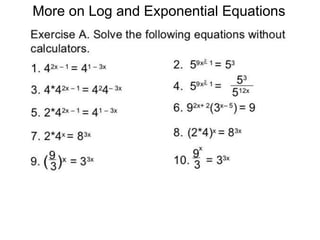
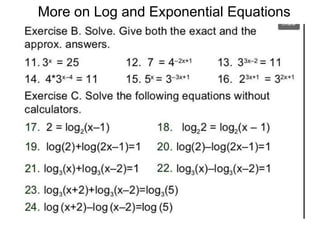
More on Log and Exponential Equations
http://www.lahc.edu/math/precalculus/math_260a.html
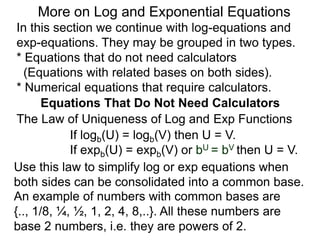
In this section we continue with log-equations and
exp-equations.
More on Log and Exponential Equations
In this section we continue with log-equations and
exp-equations. They may be grouped in two types.
More on Log and Exponential Equations
In this section we continue with log-equations and
exp-equations. They may be grouped in two types.
* Equations that do not need calculators
(Equations with related bases on both sides).
More on Log and Exponential Equations
In this section we continue with log-equations and
exp-equations. They may be grouped in two types.
* Equations that do not need calculators
(Equations with related bases on both sides).
* Numerical equations that require calculators.
More on Log and Exponential Equations
In this section we continue with log-equations and
exp-equations. They may be grouped in two types.
* Equations that do not need calculators
(Equations with related bases on both sides).
* Numerical equations that require calculators.
More on Log and Exponential Equations
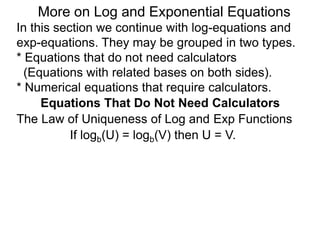
Equations That Do Not Need Calculators
In this section we continue with log-equations and
exp-equations. They may be grouped in two types.
* Equations that do not need calculators
(Equations with related bases on both sides).
* Numerical equations that require calculators.
More on Log and Exponential Equations
Equations That Do Not Need Calculators
The Law of Uniqueness of Log and Exp Functions:
In this section we continue with log-equations and
exp-equations. They may be grouped in two types.
* Equations that do not need calculators
(Equations with related bases on both sides).
* Numerical equations that require calculators.
More on Log and Exponential Equations
Equations That Do Not Need Calculators
If logb(U) = logb(V) then U = V.
The Law of Uniqueness of Log and Exp Functions
In this section we continue with log-equations and
exp-equations. They may be grouped in two types.
* Equations that do not need calculators
(Equations with related bases on both sides).
* Numerical equations that require calculators.
More on Log and Exponential Equations
Equations That Do Not Need Calculators
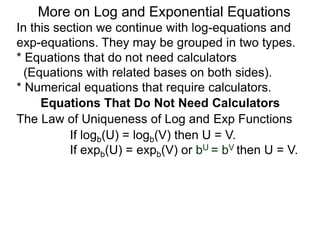
If logb(U) = logb(V) then U = V.
If expb(U) = expb(V) or bU = bV then U = V.
The Law of Uniqueness of Log and Exp Functions
In this section we continue with log-equations and
exp-equations. They may be grouped in two types.
* Equations that do not need calculators
(Equations with related bases on both sides).
* Numerical equations that require calculators.
More on Log and Exponential Equations
Equations That Do Not Need Calculators
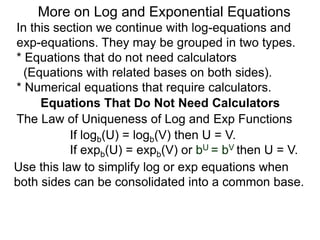
Use this law to simplify log or exp equations when
both sides can be consolidated into a common base.
The Law of Uniqueness of Log and Exp Functions
If logb(U) = logb(V) then U = V.
If expb(U) = expb(V) or bU = bV then U = V.
In this section we continue with log-equations and
exp-equations. They may be grouped in two types.
* Equations that do not need calculators
(Equations with related bases on both sides).
* Numerical equations that require calculators.
More on Log and Exponential Equations
Equations That Do Not Need Calculators
Use this law to simplify log or exp equations when
both sides can be consolidated into a common base.
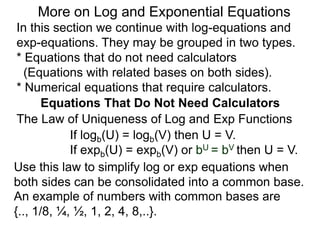
An example of numbers with common bases are
{.., 1/8, ¼, ½, 1, 2, 4, 8,..}.
The Law of Uniqueness of Log and Exp Functions
If logb(U) = logb(V) then U = V.
If expb(U) = expb(V) or bU = bV then U = V.
In this section we continue with log-equations and
exp-equations. They may be grouped in two types.
* Equations that do not need calculators
(Equations with related bases on both sides).
* Numerical equations that require calculators.
More on Log and Exponential Equations
Equations That Do Not Need Calculators
Use this law to simplify log or exp equations when
both sides can be consolidated into a common base.
An example of numbers with common bases are
{.., 1/8, ¼, ½, 1, 2, 4, 8,..}. All these numbers are
base 2 numbers, i.e. they are powers of 2.
The Law of Uniqueness of Log and Exp Functions
If logb(U) = logb(V) then U = V.
If expb(U) = expb(V) or bU = bV then U = V.
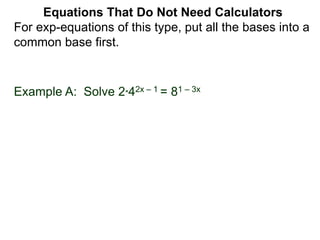
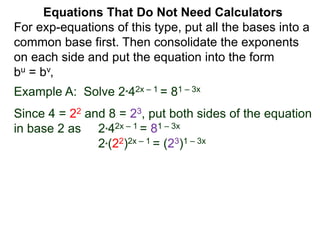
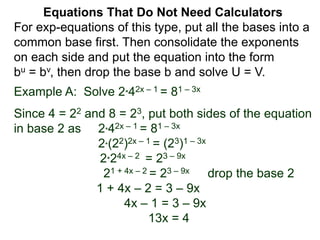
Example A: Solve 2*42x – 1 = 81 – 3x
Equations That Do Not Need Calculators
For exp-equations of this type, put all the bases into a
common base first.
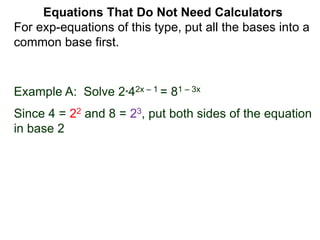
Example A: Solve 2*42x – 1 = 81 – 3x
Since 4 = 22 and 8 = 23, put both sides of the equation
in base 2
Equations That Do Not Need Calculators
For exp-equations of this type, put all the bases into a
common base first.
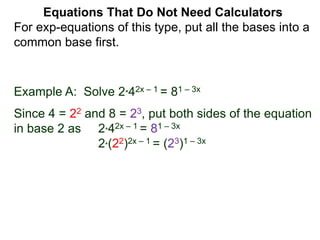
Example A: Solve 2*42x – 1 = 81 – 3x
Since 4 = 22 and 8 = 23, put both sides of the equation
in base 2 as 2*42x – 1 = 81 – 3x
2*(22)2x – 1 = (23)1 – 3x
Equations That Do Not Need Calculators
For exp-equations of this type, put all the bases into a
common base first.
Example A: Solve 2*42x – 1 = 81 – 3x
Since 4 = 22 and 8 = 23, put both sides of the equation
in base 2 as 2*42x – 1 = 81 – 3x
2*(22)2x – 1 = (23)1 – 3x
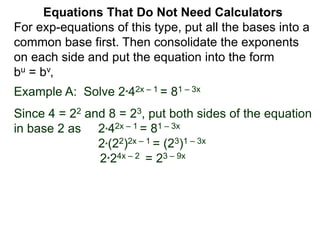
Equations That Do Not Need Calculators
For exp-equations of this type, put all the bases into a
common base first. Then consolidate the exponents
on each side and put the equation into the form
bu = bv,
Example A: Solve 2*42x – 1 = 81 – 3x
Since 4 = 22 and 8 = 23, put both sides of the equation
in base 2 as 2*42x – 1 = 81 – 3x
2*(22)2x – 1 = (23)1 – 3x
2*24x – 2 = 23 – 9x
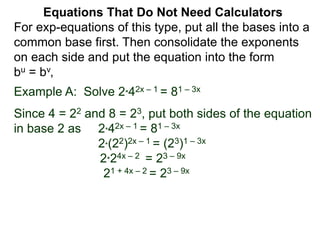
Equations That Do Not Need Calculators
For exp-equations of this type, put all the bases into a
common base first. Then consolidate the exponents
on each side and put the equation into the form
bu = bv,
Example A: Solve 2*42x – 1 = 81 – 3x
Since 4 = 22 and 8 = 23, put both sides of the equation
in base 2 as 2*42x – 1 = 81 – 3x
2*(22)2x – 1 = (23)1 – 3x
2*24x – 2 = 23 – 9x
21 + 4x – 2 = 23 – 9x
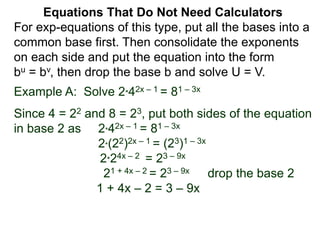
Equations That Do Not Need Calculators
For exp-equations of this type, put all the bases into a
common base first. Then consolidate the exponents
on each side and put the equation into the form
bu = bv,
Example A: Solve 2*42x – 1 = 81 – 3x
Since 4 = 22 and 8 = 23, put both sides of the equation
in base 2 as 2*42x – 1 = 81 – 3x
2*(22)2x – 1 = (23)1 – 3x
2*24x – 2 = 23 – 9x
21 + 4x – 2 = 23 – 9x drop the base 2
1 + 4x – 2 = 3 – 9x
Equations That Do Not Need Calculators
For exp-equations of this type, put all the bases into a
common base first. Then consolidate the exponents
on each side and put the equation into the form
bu = bv, then drop the base b and solve U = V.
Example A: Solve 2*42x – 1 = 81 – 3x
Since 4 = 22 and 8 = 23, put both sides of the equation
in base 2 as 2*42x – 1 = 81 – 3x
2*(22)2x – 1 = (23)1 – 3x
2*24x – 2 = 23 – 9x
21 + 4x – 2 = 23 – 9x drop the base 2
1 + 4x – 2 = 3 – 9x
4x – 1 = 3 – 9x
13x = 4
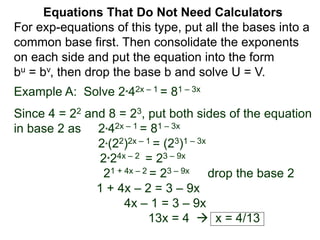
Equations That Do Not Need Calculators
For exp-equations of this type, put all the bases into a
common base first. Then consolidate the exponents
on each side and put the equation into the form
bu = bv, then drop the base b and solve U = V.
Example A: Solve 2*42x – 1 = 81 – 3x
Since 4 = 22 and 8 = 23, put both sides of the equation
in base 2 as 2*42x – 1 = 81 – 3x
2*(22)2x – 1 = (23)1 – 3x
2*24x – 2 = 23 – 9x
21 + 4x – 2 = 23 – 9x drop the base 2
1 + 4x – 2 = 3 – 9x
4x – 1 = 3 – 9x
13x = 4  x = 4/13
Equations That Do Not Need Calculators
For exp-equations of this type, put all the bases into a
common base first. Then consolidate the exponents
on each side and put the equation into the form
bu = bv, then drop the base b and solve U = V.
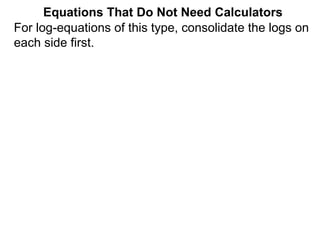
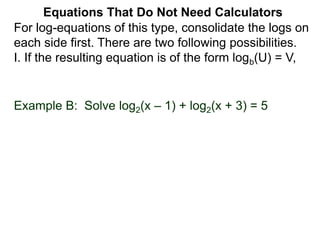
For log-equations of this type, consolidate the logs on
each side first.
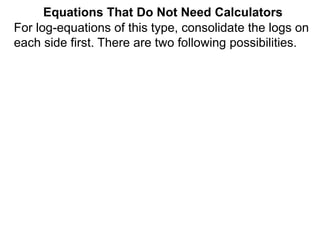
Equations That Do Not Need Calculators
For log-equations of this type, consolidate the logs on
each side first. There are two following possibilities.
Equations That Do Not Need Calculators
For log-equations of this type, consolidate the logs on
each side first. There are two following possibilities.
I. If the resulting equation is of the form logb(U) = V,
Equations That Do Not Need Calculators
Example B: Solve log2(x – 1) + log2(x + 3) = 5
Combine the log using product rule:
log2[(x – 1)(x + 3)] = 5
Equations That Do Not Need Calculators
For log-equations of this type, consolidate the logs on
each side first. There are two following possibilities.
I. If the resulting equation is of the form logb(U) = V,
Example B: Solve log2(x – 1) + log2(x + 3) = 5
Combine the log using product rule:
log2[(x – 1)(x + 3)] = 5
Equations That Do Not Need Calculators
For log-equations of this type, consolidate the logs on
each side first. There are two following possibilities.
I. If the resulting equation is of the form logb(U) = V,
drop the log by writing it in the exponential form
U = eV.
Example B: Solve log2(x – 1) + log2(x + 3) = 5
Combine the log using product rule:
log2[(x – 1)(x + 3)] = 5
Write it in exp-form: (x – 1)(x + 3) = exp2(5) = 25
Equations That Do Not Need Calculators
For log-equations of this type, consolidate the logs on
each side first. There are two following possibilities.
I. If the resulting equation is of the form logb(U) = V,
drop the log by writing it in the exponential form
U = eV.
Example B: Solve log2(x – 1) + log2(x + 3) = 5
Combine the log using product rule:
log2[(x – 1)(x + 3)] = 5
Write it in exp-form: (x – 1)(x + 3) = exp2(5) = 25
x2 + 2x – 3 = 32
Equations That Do Not Need Calculators
For log-equations of this type, consolidate the logs on
each side first. There are two following possibilities.
I. If the resulting equation is of the form logb(U) = V,
drop the log by writing it in the exponential form
U = eV.
Example B: Solve log2(x – 1) + log2(x + 3) = 5
Combine the log using product rule:
log2[(x – 1)(x + 3)] = 5
Write it in exp-form: (x – 1)(x + 3) = exp2(5) = 25
x2 + 2x – 3 = 32
x2 + 2x – 35 = 0
Equations That Do Not Need Calculators
For log-equations of this type, consolidate the logs on
each side first. There are two following possibilities.
I. If the resulting equation is of the form logb(U) = V,
drop the log by writing it in the exponential form
U = eV.
Example B: Solve log2(x – 1) + log2(x + 3) = 5
Combine the log using product rule:
log2[(x – 1)(x + 3)] = 5
Write it in exp-form: (x – 1)(x + 3) = exp2(5) = 25
x2 + 2x – 3 = 32
x2 + 2x – 35 = 0
(x + 7)(x – 5) = 0
Equations That Do Not Need Calculators
For log-equations of this type, consolidate the logs on
each side first. There are two following possibilities.
I. If the resulting equation is of the form logb(U) = V,
drop the log by writing it in the exponential form
U = eV.
Example B: Solve log2(x – 1) + log2(x + 3) = 5
Combine the log using product rule:
log2[(x – 1)(x + 3)] = 5
Write it in exp-form: (x – 1)(x + 3) = exp2(5) = 25
x2 + 2x – 3 = 32
x2 + 2x – 35 = 0
(x + 7)(x – 5) = 0
x = -7, x = 5
Equations That Do Not Need Calculators
For log-equations of this type, consolidate the logs on
each side first. There are two following possibilities.
I. If the resulting equation is of the form logb(U) = V,
drop the log by writing it in the exponential form
U = eV.
Example B: Solve log2(x – 1) + log2(x + 3) = 5
Combine the log using product rule:
log2[(x – 1)(x + 3)] = 5
Write it in exp-form: (x – 1)(x + 3) = exp2(5) = 25
x2 + 2x – 3 = 32
x2 + 2x – 35 = 0
(x + 7)(x – 5) = 0
x = -7, x = 5
Equations That Do Not Need Calculators
For log-equations of this type, consolidate the logs on
each side first. There are two following possibilities.
I. If the resulting equation is of the form logb(U) = V,
drop the log by writing it in the exponential form
U = eV.
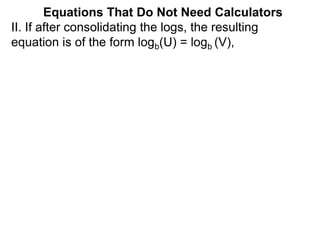
II. If after consolidating the logs, the resulting
equation is of the form logb(U) = logb (V),
Equations That Do Not Need Calculators
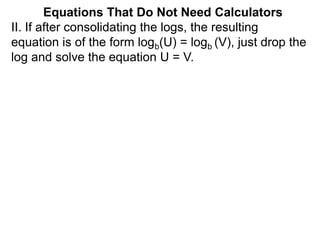
II. If after consolidating the logs, the resulting
equation is of the form logb(U) = logb (V), just drop the
log and solve the equation U = V.
Equations That Do Not Need Calculators
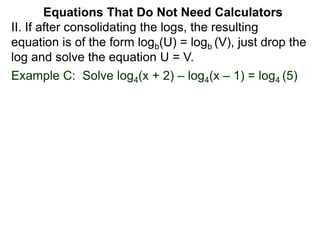
Example C: Solve log4(x + 2) – log4(x – 1) = log4 (5)
II. If after consolidating the logs, the resulting
equation is of the form logb(U) = logb (V), just drop the
log and solve the equation U = V.
Equations That Do Not Need Calculators
Example C: Solve log4(x + 2) – log4(x – 1) = log4 (5)
Combine the logs using quotient rule:
log4[ ] = log4(5)
(x + 2)
(x – 1)
II. If after consolidating the logs, the resulting
equation is of the form logb(U) = logb (V), just drop the
log and solve the equation U = V.
Equations That Do Not Need Calculators
Example C: Solve log4(x + 2) – log4(x – 1) = log4 (5)
Combine the logs using quotient rule:
log4[ ] = log4(5)
Drop the logs on both sides to get
(x + 2)
(x – 1)
(x + 2)
(x – 1)
= 5
II. If after consolidating the logs, the resulting
equation is of the form logb(U) = logb (V), just drop the
log and solve the equation U = V.
Equations That Do Not Need Calculators
Example C: Solve log4(x + 2) – log4(x – 1) = log4 (5)
Combine the logs using quotient rule:
log4[ ] = log4(5)
Drop the logs on both sides to get
x + 2 = 5(x – 1)
(x + 2)
(x – 1)
(x + 2)
(x – 1)
= 5
II. If after consolidating the logs, the resulting
equation is of the form logb(U) = logb (V), just drop the
log and solve the equation U = V.
Equations That Do Not Need Calculators
Example C: Solve log4(x + 2) – log4(x – 1) = log4 (5)
Combine the logs using quotient rule:
log4[ ] = log4(5)
Drop the logs on both sides to get
x + 2 = 5(x – 1)
x + 2 = 5x – 5
(x + 2)
(x – 1)
(x + 2)
(x – 1)
= 5
II. If after consolidating the logs, the resulting
equation is of the form logb(U) = logb (V), just drop the
log and solve the equation U = V.
Equations That Do Not Need Calculators
Example C: Solve log4(x + 2) – log4(x – 1) = log4 (5)
Combine the logs using quotient rule:
log4[ ] = log4(5)
Drop the logs on both sides to get
x + 2 = 5(x – 1)
x + 2 = 5x – 5
7 = 4x
7/4 = x
(x + 2)
(x – 1)
(x + 2)
(x – 1)
= 5
II. If after consolidating the logs, the resulting
equation is of the form logb(U) = logb (V), just drop the
log and solve the equation U = V.
Equations That Do Not Need Calculators
Numerical Equations That Require Calculators
With numerical equations we seek both the exact
and approximate answers with calculators.
Numerical Equations That Require Calculators
With numerical equations we seek both the exact
and approximate answers with calculators.
We have seen some examples in the last section.
Numerical Equations That Require Calculators
With numerical equations we seek both the exact
and approximate answers with calculators.
We have seen some examples in the last section.
In this section, we tackle the equations that contain
bases that are different from e and 10.
Numerical Equations That Require Calculators
With numerical equations we seek both the exact
and approximate answers with calculators.
We have seen some examples in the last section.
In this section, we tackle the equations that contain
bases that are different from e and 10. We do this by
changing the calculation into base e with the
following formula.
Numerical Equations That Require Calculators
With numerical equations we seek both the exact
and approximate answers with calculators.
We have seen some examples in the last section.
In this section, we tackle the equations that contain
bases that are different from e and 10. We do this by
changing the calculation into base e with the
following formula.
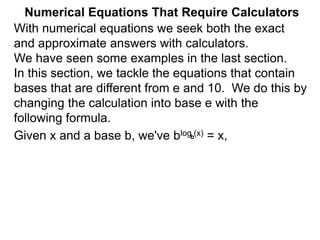
Given x and a base b, we've blog (x) = x,
b
Numerical Equations That Require Calculators
With numerical equations we seek both the exact
and approximate answers with calculators.
We have seen some examples in the last section.
In this section, we tackle the equations that contain
bases that are different from e and 10. We do this by
changing the calculation into base e with the
following formula.
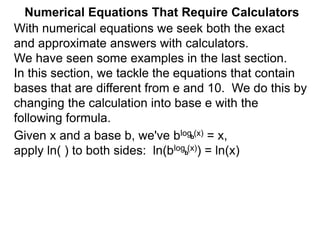
Given x and a base b, we've blog (x) = x,
apply ln( ) to both sides: ln(blog (x)) = ln(x)
b
b
Numerical Equations That Require Calculators
With numerical equations we seek both the exact
and approximate answers with calculators.
We have seen some examples in the last section.
In this section, we tackle the equations that contain
bases that are different from e and 10. We do this by
changing the calculation into base e with the
following formula.
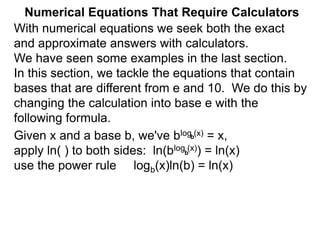
Given x and a base b, we've blog (x) = x,
apply ln( ) to both sides: ln(blog (x)) = ln(x)
use the power rule logb(x)ln(b) = ln(x)
b
b
Numerical Equations That Require Calculators
With numerical equations we seek both the exact
and approximate answers with calculators.
We have seen some examples in the last section.
In this section, we tackle the equations that contain
bases that are different from e and 10. We do this by
changing the calculation into base e with the
following formula.
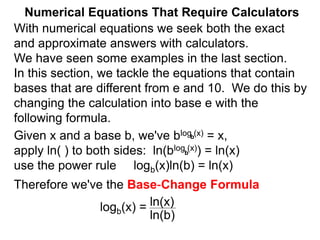
Given x and a base b, we've blog (x) = x,
apply ln( ) to both sides: ln(blog (x)) = ln(x)
use the power rule logb(x)ln(b) = ln(x)
Therefore we've the Base-Change Formula
logb(x) =
b
b
ln(x)
ln(b)
Numerical Equations That Require Calculators
To solve equations in bases different from e,
Numerical Equations That Require Calculators
To solve equations in bases different from e, we
obtain the exact solution in the given base first,
Numerical Equations That Require Calculators
To solve equations in bases different from e, we
obtain the exact solution in the given base first, then
use the change of bases formula to obtain the
approximate solutions.
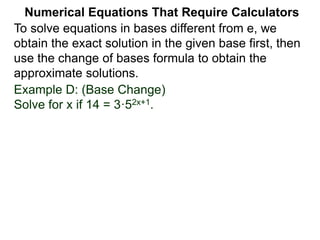
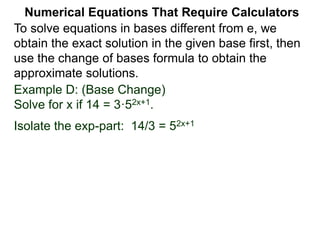
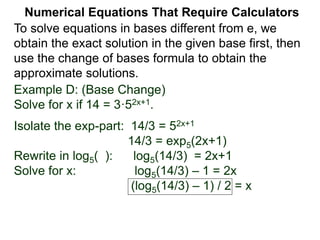
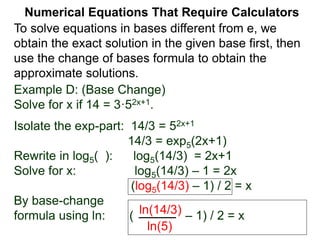
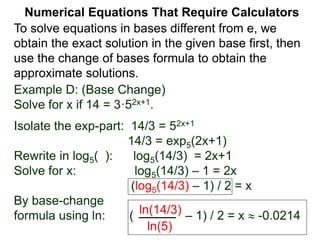
Example D: (Base Change)
Solve for x if 14 = 3·52x+1.
Numerical Equations That Require Calculators
To solve equations in bases different from e, we
obtain the exact solution in the given base first, then
use the change of bases formula to obtain the
approximate solutions.
Example D: (Base Change)
Solve for x if 14 = 3·52x+1.
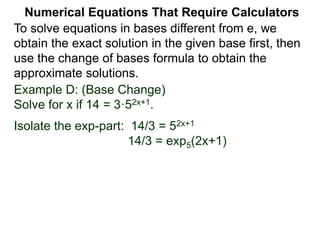
Isolate the exp-part: 14/3 = 52x+1
Numerical Equations That Require Calculators
To solve equations in bases different from e, we
obtain the exact solution in the given base first, then
use the change of bases formula to obtain the
approximate solutions.
Example D: (Base Change)
Solve for x if 14 = 3·52x+1.
Isolate the exp-part: 14/3 = 52x+1
14/3 = exp5(2x+1)
Numerical Equations That Require Calculators
To solve equations in bases different from e, we
obtain the exact solution in the given base first, then
use the change of bases formula to obtain the
approximate solutions.
Example D: (Base Change)
Solve for x if 14 = 3·52x+1.
Isolate the exp-part: 14/3 = 52x+1
14/3 = exp5(2x+1)
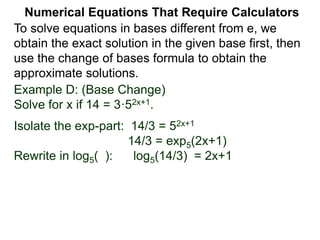
Rewrite in log5( ): log5(14/3) = 2x+1
Numerical Equations That Require Calculators
To solve equations in bases different from e, we
obtain the exact solution in the given base first, then
use the change of bases formula to obtain the
approximate solutions.
Example D: (Base Change)
Solve for x if 14 = 3·52x+1.
Isolate the exp-part: 14/3 = 52x+1
14/3 = exp5(2x+1)
Rewrite in log5( ): log5(14/3) = 2x+1
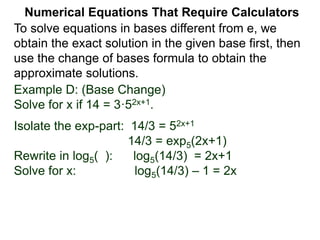
Solve for x: log5(14/3) – 1 = 2x
Numerical Equations That Require Calculators
To solve equations in bases different from e, we
obtain the exact solution in the given base first, then
use the change of bases formula to obtain the
approximate solutions.
Example D: (Base Change)
Solve for x if 14 = 3·52x+1.
Isolate the exp-part: 14/3 = 52x+1
14/3 = exp5(2x+1)
Rewrite in log5( ): log5(14/3) = 2x+1
Solve for x: log5(14/3) – 1 = 2x
(log5(14/3) – 1) / 2 = x
Numerical Equations That Require Calculators
To solve equations in bases different from e, we
obtain the exact solution in the given base first, then
use the change of bases formula to obtain the
approximate solutions.
Example D: (Base Change)
Solve for x if 14 = 3·52x+1.
Isolate the exp-part: 14/3 = 52x+1
14/3 = exp5(2x+1)
Rewrite in log5( ): log5(14/3) = 2x+1
Solve for x: log5(14/3) – 1 = 2x
(log5(14/3) – 1) / 2 = x
By base-change
formula using ln: ( – 1) / 2 = x
ln(14/3)
ln(5)
Numerical Equations That Require Calculators
To solve equations in bases different from e, we
obtain the exact solution in the given base first, then
use the change of bases formula to obtain the
approximate solutions.
Example D: (Base Change)
Solve for x if 14 = 3·52x+1.
Isolate the exp-part: 14/3 = 52x+1
14/3 = exp5(2x+1)
Rewrite in log5( ): log5(14/3) = 2x+1
Solve for x: log5(14/3) – 1 = 2x
(log5(14/3) – 1) / 2 = x
By base-change
formula using ln: ( – 1) / 2 = x  -0.0214
ln(14/3)
ln(5)
Numerical Equations That Require Calculators
To solve equations in bases different from e, we
obtain the exact solution in the given base first, then
use the change of bases formula to obtain the
approximate solutions.
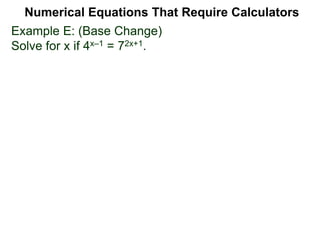
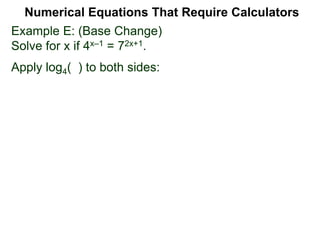
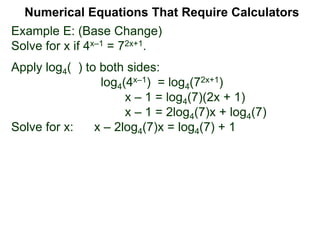
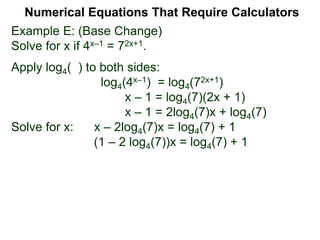
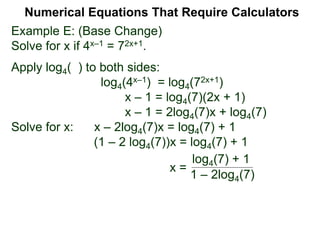
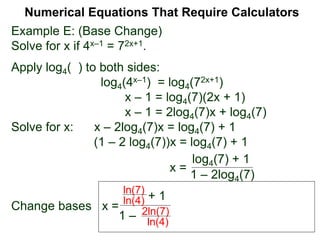
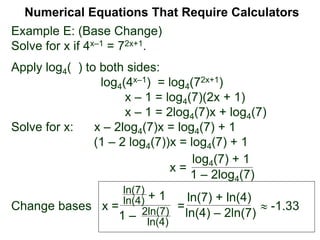
Example E: (Base Change)
Solve for x if 4x–1 = 72x+1.
Numerical Equations That Require Calculators
Example E: (Base Change)
Solve for x if 4x–1 = 72x+1.
Apply log4( ) to both sides:
Numerical Equations That Require Calculators
Example E: (Base Change)
Solve for x if 4x–1 = 72x+1.
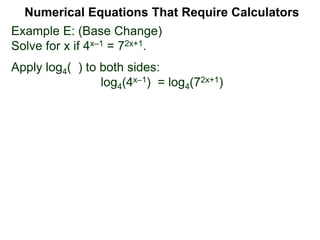
Apply log4( ) to both sides:
log4(4x–1) = log4(72x+1)
Numerical Equations That Require Calculators
Example E: (Base Change)
Solve for x if 4x–1 = 72x+1.
Apply log4( ) to both sides:
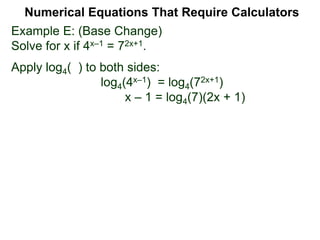
log4(4x–1) = log4(72x+1)
x – 1 = log4(7)(2x + 1)
Numerical Equations That Require Calculators
Example E: (Base Change)
Solve for x if 4x–1 = 72x+1.
Apply log4( ) to both sides:
log4(4x–1) = log4(72x+1)
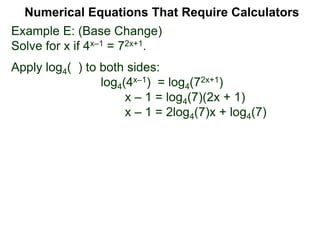
x – 1 = log4(7)(2x + 1)
x – 1 = 2log4(7)x + log4(7)
Numerical Equations That Require Calculators
Example E: (Base Change)
Solve for x if 4x–1 = 72x+1.
Apply log4( ) to both sides:
log4(4x–1) = log4(72x+1)
x – 1 = log4(7)(2x + 1)
x – 1 = 2log4(7)x + log4(7)
Solve for x: x – 2log4(7)x = log4(7) + 1
Numerical Equations That Require Calculators
Example E: (Base Change)
Solve for x if 4x–1 = 72x+1.
Apply log4( ) to both sides:
log4(4x–1) = log4(72x+1)
x – 1 = log4(7)(2x + 1)
x – 1 = 2log4(7)x + log4(7)
Solve for x: x – 2log4(7)x = log4(7) + 1
(1 – 2 log4(7))x = log4(7) + 1
Numerical Equations That Require Calculators
Example E: (Base Change)
Solve for x if 4x–1 = 72x+1.
Apply log4( ) to both sides:
log4(4x–1) = log4(72x+1)
x – 1 = log4(7)(2x + 1)
x – 1 = 2log4(7)x + log4(7)
Solve for x: x – 2log4(7)x = log4(7) + 1
(1 – 2 log4(7))x = log4(7) + 1
x =
Numerical Equations That Require Calculators
log4(7) + 1
1 – 2log4(7)
Example E: (Base Change)
Solve for x if 4x–1 = 72x+1.
Apply log4( ) to both sides:
log4(4x–1) = log4(72x+1)
x – 1 = log4(7)(2x + 1)
x – 1 = 2log4(7)x + log4(7)
Solve for x: x – 2log4(7)x = log4(7) + 1
(1 – 2 log4(7))x = log4(7) + 1
x =
Change bases x =
Numerical Equations That Require Calculators
+ 1
1 –
ln(7)
ln(4)
2ln(7)
ln(4)
log4(7) + 1
1 – 2log4(7)
Example E: (Base Change)
Solve for x if 4x–1 = 72x+1.
Apply log4( ) to both sides:
log4(4x–1) = log4(72x+1)
x – 1 = log4(7)(2x + 1)
x – 1 = 2log4(7)x + log4(7)
Solve for x: x – 2log4(7)x = log4(7) + 1
(1 – 2 log4(7))x = log4(7) + 1
x =
Change bases x = =  -1.33
Numerical Equations That Require Calculators
+ 1
1 –
ln(7)
ln(4)
2ln(7)
ln(4)
log4(7) + 1
1 – 2log4(7)
ln(7) + ln(4)
ln(4) – 2ln(7)
More on Log and Exponential Equations
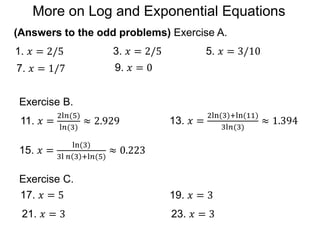
(Answers to the odd problems) Exercise A.
1. 𝑥 = 2/5 3. 𝑥 = 2/5 5. 𝑥 = 3/10
7. 𝑥 = 1/7 9. 𝑥 = 0
Exercise B.
11. 𝑥 =
2l𝑛(5)
l𝑛(3)
≈ 2.929 13. 𝑥 =
2ln(3)+ln(11)
3l𝑛(3)
≈ 1.394
Exercise C.
17. 𝑥 = 5 19. 𝑥 = 3
21. 𝑥 = 3 23. 𝑥 = 3
15. 𝑥 =
ln(3)
3l 𝑛 3 +l𝑛(5)
≈ 0.223
More on Log and Exponential Equations

28 more on log and exponential equations x

  • 1.
    More on Logand Exponential Equations http://www.lahc.edu/math/precalculus/math_260a.html
  • 2.
    In this sectionwe continue with log-equations and exp-equations. More on Log and Exponential Equations
  • 3.
    In this sectionwe continue with log-equations and exp-equations. They may be grouped in two types. More on Log and Exponential Equations
  • 4.
    In this sectionwe continue with log-equations and exp-equations. They may be grouped in two types. * Equations that do not need calculators (Equations with related bases on both sides). More on Log and Exponential Equations
  • 5.
    In this sectionwe continue with log-equations and exp-equations. They may be grouped in two types. * Equations that do not need calculators (Equations with related bases on both sides). * Numerical equations that require calculators. More on Log and Exponential Equations
  • 6.
    In this sectionwe continue with log-equations and exp-equations. They may be grouped in two types. * Equations that do not need calculators (Equations with related bases on both sides). * Numerical equations that require calculators. More on Log and Exponential Equations Equations That Do Not Need Calculators
  • 7.
    In this sectionwe continue with log-equations and exp-equations. They may be grouped in two types. * Equations that do not need calculators (Equations with related bases on both sides). * Numerical equations that require calculators. More on Log and Exponential Equations Equations That Do Not Need Calculators The Law of Uniqueness of Log and Exp Functions:
  • 8.
    In this sectionwe continue with log-equations and exp-equations. They may be grouped in two types. * Equations that do not need calculators (Equations with related bases on both sides). * Numerical equations that require calculators. More on Log and Exponential Equations Equations That Do Not Need Calculators If logb(U) = logb(V) then U = V. The Law of Uniqueness of Log and Exp Functions
  • 9.
    In this sectionwe continue with log-equations and exp-equations. They may be grouped in two types. * Equations that do not need calculators (Equations with related bases on both sides). * Numerical equations that require calculators. More on Log and Exponential Equations Equations That Do Not Need Calculators If logb(U) = logb(V) then U = V. If expb(U) = expb(V) or bU = bV then U = V. The Law of Uniqueness of Log and Exp Functions
  • 10.
    In this sectionwe continue with log-equations and exp-equations. They may be grouped in two types. * Equations that do not need calculators (Equations with related bases on both sides). * Numerical equations that require calculators. More on Log and Exponential Equations Equations That Do Not Need Calculators Use this law to simplify log or exp equations when both sides can be consolidated into a common base. The Law of Uniqueness of Log and Exp Functions If logb(U) = logb(V) then U = V. If expb(U) = expb(V) or bU = bV then U = V.
  • 11.
    In this sectionwe continue with log-equations and exp-equations. They may be grouped in two types. * Equations that do not need calculators (Equations with related bases on both sides). * Numerical equations that require calculators. More on Log and Exponential Equations Equations That Do Not Need Calculators Use this law to simplify log or exp equations when both sides can be consolidated into a common base. An example of numbers with common bases are {.., 1/8, ¼, ½, 1, 2, 4, 8,..}. The Law of Uniqueness of Log and Exp Functions If logb(U) = logb(V) then U = V. If expb(U) = expb(V) or bU = bV then U = V.
  • 12.
    In this sectionwe continue with log-equations and exp-equations. They may be grouped in two types. * Equations that do not need calculators (Equations with related bases on both sides). * Numerical equations that require calculators. More on Log and Exponential Equations Equations That Do Not Need Calculators Use this law to simplify log or exp equations when both sides can be consolidated into a common base. An example of numbers with common bases are {.., 1/8, ¼, ½, 1, 2, 4, 8,..}. All these numbers are base 2 numbers, i.e. they are powers of 2. The Law of Uniqueness of Log and Exp Functions If logb(U) = logb(V) then U = V. If expb(U) = expb(V) or bU = bV then U = V.
  • 13.
    Example A: Solve2*42x – 1 = 81 – 3x Equations That Do Not Need Calculators For exp-equations of this type, put all the bases into a common base first.
  • 14.
    Example A: Solve2*42x – 1 = 81 – 3x Since 4 = 22 and 8 = 23, put both sides of the equation in base 2 Equations That Do Not Need Calculators For exp-equations of this type, put all the bases into a common base first.
  • 15.
    Example A: Solve2*42x – 1 = 81 – 3x Since 4 = 22 and 8 = 23, put both sides of the equation in base 2 as 2*42x – 1 = 81 – 3x 2*(22)2x – 1 = (23)1 – 3x Equations That Do Not Need Calculators For exp-equations of this type, put all the bases into a common base first.
  • 16.
    Example A: Solve2*42x – 1 = 81 – 3x Since 4 = 22 and 8 = 23, put both sides of the equation in base 2 as 2*42x – 1 = 81 – 3x 2*(22)2x – 1 = (23)1 – 3x Equations That Do Not Need Calculators For exp-equations of this type, put all the bases into a common base first. Then consolidate the exponents on each side and put the equation into the form bu = bv,
  • 17.
    Example A: Solve2*42x – 1 = 81 – 3x Since 4 = 22 and 8 = 23, put both sides of the equation in base 2 as 2*42x – 1 = 81 – 3x 2*(22)2x – 1 = (23)1 – 3x 2*24x – 2 = 23 – 9x Equations That Do Not Need Calculators For exp-equations of this type, put all the bases into a common base first. Then consolidate the exponents on each side and put the equation into the form bu = bv,
  • 18.
    Example A: Solve2*42x – 1 = 81 – 3x Since 4 = 22 and 8 = 23, put both sides of the equation in base 2 as 2*42x – 1 = 81 – 3x 2*(22)2x – 1 = (23)1 – 3x 2*24x – 2 = 23 – 9x 21 + 4x – 2 = 23 – 9x Equations That Do Not Need Calculators For exp-equations of this type, put all the bases into a common base first. Then consolidate the exponents on each side and put the equation into the form bu = bv,
  • 19.
    Example A: Solve2*42x – 1 = 81 – 3x Since 4 = 22 and 8 = 23, put both sides of the equation in base 2 as 2*42x – 1 = 81 – 3x 2*(22)2x – 1 = (23)1 – 3x 2*24x – 2 = 23 – 9x 21 + 4x – 2 = 23 – 9x drop the base 2 1 + 4x – 2 = 3 – 9x Equations That Do Not Need Calculators For exp-equations of this type, put all the bases into a common base first. Then consolidate the exponents on each side and put the equation into the form bu = bv, then drop the base b and solve U = V.
  • 20.
    Example A: Solve2*42x – 1 = 81 – 3x Since 4 = 22 and 8 = 23, put both sides of the equation in base 2 as 2*42x – 1 = 81 – 3x 2*(22)2x – 1 = (23)1 – 3x 2*24x – 2 = 23 – 9x 21 + 4x – 2 = 23 – 9x drop the base 2 1 + 4x – 2 = 3 – 9x 4x – 1 = 3 – 9x 13x = 4 Equations That Do Not Need Calculators For exp-equations of this type, put all the bases into a common base first. Then consolidate the exponents on each side and put the equation into the form bu = bv, then drop the base b and solve U = V.
  • 21.
    Example A: Solve2*42x – 1 = 81 – 3x Since 4 = 22 and 8 = 23, put both sides of the equation in base 2 as 2*42x – 1 = 81 – 3x 2*(22)2x – 1 = (23)1 – 3x 2*24x – 2 = 23 – 9x 21 + 4x – 2 = 23 – 9x drop the base 2 1 + 4x – 2 = 3 – 9x 4x – 1 = 3 – 9x 13x = 4  x = 4/13 Equations That Do Not Need Calculators For exp-equations of this type, put all the bases into a common base first. Then consolidate the exponents on each side and put the equation into the form bu = bv, then drop the base b and solve U = V.
  • 22.
    For log-equations ofthis type, consolidate the logs on each side first. Equations That Do Not Need Calculators
  • 23.
    For log-equations ofthis type, consolidate the logs on each side first. There are two following possibilities. Equations That Do Not Need Calculators
  • 24.
    For log-equations ofthis type, consolidate the logs on each side first. There are two following possibilities. I. If the resulting equation is of the form logb(U) = V, Equations That Do Not Need Calculators Example B: Solve log2(x – 1) + log2(x + 3) = 5
  • 25.
    Example B: Solvelog2(x – 1) + log2(x + 3) = 5 Combine the log using product rule: log2[(x – 1)(x + 3)] = 5 Equations That Do Not Need Calculators For log-equations of this type, consolidate the logs on each side first. There are two following possibilities. I. If the resulting equation is of the form logb(U) = V,
  • 26.
    Example B: Solvelog2(x – 1) + log2(x + 3) = 5 Combine the log using product rule: log2[(x – 1)(x + 3)] = 5 Equations That Do Not Need Calculators For log-equations of this type, consolidate the logs on each side first. There are two following possibilities. I. If the resulting equation is of the form logb(U) = V, drop the log by writing it in the exponential form U = eV.
  • 27.
    Example B: Solvelog2(x – 1) + log2(x + 3) = 5 Combine the log using product rule: log2[(x – 1)(x + 3)] = 5 Write it in exp-form: (x – 1)(x + 3) = exp2(5) = 25 Equations That Do Not Need Calculators For log-equations of this type, consolidate the logs on each side first. There are two following possibilities. I. If the resulting equation is of the form logb(U) = V, drop the log by writing it in the exponential form U = eV.
  • 28.
    Example B: Solvelog2(x – 1) + log2(x + 3) = 5 Combine the log using product rule: log2[(x – 1)(x + 3)] = 5 Write it in exp-form: (x – 1)(x + 3) = exp2(5) = 25 x2 + 2x – 3 = 32 Equations That Do Not Need Calculators For log-equations of this type, consolidate the logs on each side first. There are two following possibilities. I. If the resulting equation is of the form logb(U) = V, drop the log by writing it in the exponential form U = eV.
  • 29.
    Example B: Solvelog2(x – 1) + log2(x + 3) = 5 Combine the log using product rule: log2[(x – 1)(x + 3)] = 5 Write it in exp-form: (x – 1)(x + 3) = exp2(5) = 25 x2 + 2x – 3 = 32 x2 + 2x – 35 = 0 Equations That Do Not Need Calculators For log-equations of this type, consolidate the logs on each side first. There are two following possibilities. I. If the resulting equation is of the form logb(U) = V, drop the log by writing it in the exponential form U = eV.
  • 30.
    Example B: Solvelog2(x – 1) + log2(x + 3) = 5 Combine the log using product rule: log2[(x – 1)(x + 3)] = 5 Write it in exp-form: (x – 1)(x + 3) = exp2(5) = 25 x2 + 2x – 3 = 32 x2 + 2x – 35 = 0 (x + 7)(x – 5) = 0 Equations That Do Not Need Calculators For log-equations of this type, consolidate the logs on each side first. There are two following possibilities. I. If the resulting equation is of the form logb(U) = V, drop the log by writing it in the exponential form U = eV.
  • 31.
    Example B: Solvelog2(x – 1) + log2(x + 3) = 5 Combine the log using product rule: log2[(x – 1)(x + 3)] = 5 Write it in exp-form: (x – 1)(x + 3) = exp2(5) = 25 x2 + 2x – 3 = 32 x2 + 2x – 35 = 0 (x + 7)(x – 5) = 0 x = -7, x = 5 Equations That Do Not Need Calculators For log-equations of this type, consolidate the logs on each side first. There are two following possibilities. I. If the resulting equation is of the form logb(U) = V, drop the log by writing it in the exponential form U = eV.
  • 32.
    Example B: Solvelog2(x – 1) + log2(x + 3) = 5 Combine the log using product rule: log2[(x – 1)(x + 3)] = 5 Write it in exp-form: (x – 1)(x + 3) = exp2(5) = 25 x2 + 2x – 3 = 32 x2 + 2x – 35 = 0 (x + 7)(x – 5) = 0 x = -7, x = 5 Equations That Do Not Need Calculators For log-equations of this type, consolidate the logs on each side first. There are two following possibilities. I. If the resulting equation is of the form logb(U) = V, drop the log by writing it in the exponential form U = eV.
  • 33.
    II. If afterconsolidating the logs, the resulting equation is of the form logb(U) = logb (V), Equations That Do Not Need Calculators
  • 34.
    II. If afterconsolidating the logs, the resulting equation is of the form logb(U) = logb (V), just drop the log and solve the equation U = V. Equations That Do Not Need Calculators
  • 35.
    Example C: Solvelog4(x + 2) – log4(x – 1) = log4 (5) II. If after consolidating the logs, the resulting equation is of the form logb(U) = logb (V), just drop the log and solve the equation U = V. Equations That Do Not Need Calculators
  • 36.
    Example C: Solvelog4(x + 2) – log4(x – 1) = log4 (5) Combine the logs using quotient rule: log4[ ] = log4(5) (x + 2) (x – 1) II. If after consolidating the logs, the resulting equation is of the form logb(U) = logb (V), just drop the log and solve the equation U = V. Equations That Do Not Need Calculators
  • 37.
    Example C: Solvelog4(x + 2) – log4(x – 1) = log4 (5) Combine the logs using quotient rule: log4[ ] = log4(5) Drop the logs on both sides to get (x + 2) (x – 1) (x + 2) (x – 1) = 5 II. If after consolidating the logs, the resulting equation is of the form logb(U) = logb (V), just drop the log and solve the equation U = V. Equations That Do Not Need Calculators
  • 38.
    Example C: Solvelog4(x + 2) – log4(x – 1) = log4 (5) Combine the logs using quotient rule: log4[ ] = log4(5) Drop the logs on both sides to get x + 2 = 5(x – 1) (x + 2) (x – 1) (x + 2) (x – 1) = 5 II. If after consolidating the logs, the resulting equation is of the form logb(U) = logb (V), just drop the log and solve the equation U = V. Equations That Do Not Need Calculators
  • 39.
    Example C: Solvelog4(x + 2) – log4(x – 1) = log4 (5) Combine the logs using quotient rule: log4[ ] = log4(5) Drop the logs on both sides to get x + 2 = 5(x – 1) x + 2 = 5x – 5 (x + 2) (x – 1) (x + 2) (x – 1) = 5 II. If after consolidating the logs, the resulting equation is of the form logb(U) = logb (V), just drop the log and solve the equation U = V. Equations That Do Not Need Calculators
  • 40.
    Example C: Solvelog4(x + 2) – log4(x – 1) = log4 (5) Combine the logs using quotient rule: log4[ ] = log4(5) Drop the logs on both sides to get x + 2 = 5(x – 1) x + 2 = 5x – 5 7 = 4x 7/4 = x (x + 2) (x – 1) (x + 2) (x – 1) = 5 II. If after consolidating the logs, the resulting equation is of the form logb(U) = logb (V), just drop the log and solve the equation U = V. Equations That Do Not Need Calculators
  • 41.
    Numerical Equations ThatRequire Calculators With numerical equations we seek both the exact and approximate answers with calculators.
  • 42.
    Numerical Equations ThatRequire Calculators With numerical equations we seek both the exact and approximate answers with calculators. We have seen some examples in the last section.
  • 43.
    Numerical Equations ThatRequire Calculators With numerical equations we seek both the exact and approximate answers with calculators. We have seen some examples in the last section. In this section, we tackle the equations that contain bases that are different from e and 10.
  • 44.
    Numerical Equations ThatRequire Calculators With numerical equations we seek both the exact and approximate answers with calculators. We have seen some examples in the last section. In this section, we tackle the equations that contain bases that are different from e and 10. We do this by changing the calculation into base e with the following formula.
  • 45.
    Numerical Equations ThatRequire Calculators With numerical equations we seek both the exact and approximate answers with calculators. We have seen some examples in the last section. In this section, we tackle the equations that contain bases that are different from e and 10. We do this by changing the calculation into base e with the following formula. Given x and a base b, we've blog (x) = x, b
  • 46.
    Numerical Equations ThatRequire Calculators With numerical equations we seek both the exact and approximate answers with calculators. We have seen some examples in the last section. In this section, we tackle the equations that contain bases that are different from e and 10. We do this by changing the calculation into base e with the following formula. Given x and a base b, we've blog (x) = x, apply ln( ) to both sides: ln(blog (x)) = ln(x) b b
  • 47.
    Numerical Equations ThatRequire Calculators With numerical equations we seek both the exact and approximate answers with calculators. We have seen some examples in the last section. In this section, we tackle the equations that contain bases that are different from e and 10. We do this by changing the calculation into base e with the following formula. Given x and a base b, we've blog (x) = x, apply ln( ) to both sides: ln(blog (x)) = ln(x) use the power rule logb(x)ln(b) = ln(x) b b
  • 48.
    Numerical Equations ThatRequire Calculators With numerical equations we seek both the exact and approximate answers with calculators. We have seen some examples in the last section. In this section, we tackle the equations that contain bases that are different from e and 10. We do this by changing the calculation into base e with the following formula. Given x and a base b, we've blog (x) = x, apply ln( ) to both sides: ln(blog (x)) = ln(x) use the power rule logb(x)ln(b) = ln(x) Therefore we've the Base-Change Formula logb(x) = b b ln(x) ln(b)
  • 49.
    Numerical Equations ThatRequire Calculators To solve equations in bases different from e,
  • 50.
    Numerical Equations ThatRequire Calculators To solve equations in bases different from e, we obtain the exact solution in the given base first,
  • 51.
    Numerical Equations ThatRequire Calculators To solve equations in bases different from e, we obtain the exact solution in the given base first, then use the change of bases formula to obtain the approximate solutions.
  • 52.
    Example D: (BaseChange) Solve for x if 14 = 3·52x+1. Numerical Equations That Require Calculators To solve equations in bases different from e, we obtain the exact solution in the given base first, then use the change of bases formula to obtain the approximate solutions.
  • 53.
    Example D: (BaseChange) Solve for x if 14 = 3·52x+1. Isolate the exp-part: 14/3 = 52x+1 Numerical Equations That Require Calculators To solve equations in bases different from e, we obtain the exact solution in the given base first, then use the change of bases formula to obtain the approximate solutions.
  • 54.
    Example D: (BaseChange) Solve for x if 14 = 3·52x+1. Isolate the exp-part: 14/3 = 52x+1 14/3 = exp5(2x+1) Numerical Equations That Require Calculators To solve equations in bases different from e, we obtain the exact solution in the given base first, then use the change of bases formula to obtain the approximate solutions.
  • 55.
    Example D: (BaseChange) Solve for x if 14 = 3·52x+1. Isolate the exp-part: 14/3 = 52x+1 14/3 = exp5(2x+1) Rewrite in log5( ): log5(14/3) = 2x+1 Numerical Equations That Require Calculators To solve equations in bases different from e, we obtain the exact solution in the given base first, then use the change of bases formula to obtain the approximate solutions.
  • 56.
    Example D: (BaseChange) Solve for x if 14 = 3·52x+1. Isolate the exp-part: 14/3 = 52x+1 14/3 = exp5(2x+1) Rewrite in log5( ): log5(14/3) = 2x+1 Solve for x: log5(14/3) – 1 = 2x Numerical Equations That Require Calculators To solve equations in bases different from e, we obtain the exact solution in the given base first, then use the change of bases formula to obtain the approximate solutions.
  • 57.
    Example D: (BaseChange) Solve for x if 14 = 3·52x+1. Isolate the exp-part: 14/3 = 52x+1 14/3 = exp5(2x+1) Rewrite in log5( ): log5(14/3) = 2x+1 Solve for x: log5(14/3) – 1 = 2x (log5(14/3) – 1) / 2 = x Numerical Equations That Require Calculators To solve equations in bases different from e, we obtain the exact solution in the given base first, then use the change of bases formula to obtain the approximate solutions.
  • 58.
    Example D: (BaseChange) Solve for x if 14 = 3·52x+1. Isolate the exp-part: 14/3 = 52x+1 14/3 = exp5(2x+1) Rewrite in log5( ): log5(14/3) = 2x+1 Solve for x: log5(14/3) – 1 = 2x (log5(14/3) – 1) / 2 = x By base-change formula using ln: ( – 1) / 2 = x ln(14/3) ln(5) Numerical Equations That Require Calculators To solve equations in bases different from e, we obtain the exact solution in the given base first, then use the change of bases formula to obtain the approximate solutions.
  • 59.
    Example D: (BaseChange) Solve for x if 14 = 3·52x+1. Isolate the exp-part: 14/3 = 52x+1 14/3 = exp5(2x+1) Rewrite in log5( ): log5(14/3) = 2x+1 Solve for x: log5(14/3) – 1 = 2x (log5(14/3) – 1) / 2 = x By base-change formula using ln: ( – 1) / 2 = x  -0.0214 ln(14/3) ln(5) Numerical Equations That Require Calculators To solve equations in bases different from e, we obtain the exact solution in the given base first, then use the change of bases formula to obtain the approximate solutions.
  • 60.
    Example E: (BaseChange) Solve for x if 4x–1 = 72x+1. Numerical Equations That Require Calculators
  • 61.
    Example E: (BaseChange) Solve for x if 4x–1 = 72x+1. Apply log4( ) to both sides: Numerical Equations That Require Calculators
  • 62.
    Example E: (BaseChange) Solve for x if 4x–1 = 72x+1. Apply log4( ) to both sides: log4(4x–1) = log4(72x+1) Numerical Equations That Require Calculators
  • 63.
    Example E: (BaseChange) Solve for x if 4x–1 = 72x+1. Apply log4( ) to both sides: log4(4x–1) = log4(72x+1) x – 1 = log4(7)(2x + 1) Numerical Equations That Require Calculators
  • 64.
    Example E: (BaseChange) Solve for x if 4x–1 = 72x+1. Apply log4( ) to both sides: log4(4x–1) = log4(72x+1) x – 1 = log4(7)(2x + 1) x – 1 = 2log4(7)x + log4(7) Numerical Equations That Require Calculators
  • 65.
    Example E: (BaseChange) Solve for x if 4x–1 = 72x+1. Apply log4( ) to both sides: log4(4x–1) = log4(72x+1) x – 1 = log4(7)(2x + 1) x – 1 = 2log4(7)x + log4(7) Solve for x: x – 2log4(7)x = log4(7) + 1 Numerical Equations That Require Calculators
  • 66.
    Example E: (BaseChange) Solve for x if 4x–1 = 72x+1. Apply log4( ) to both sides: log4(4x–1) = log4(72x+1) x – 1 = log4(7)(2x + 1) x – 1 = 2log4(7)x + log4(7) Solve for x: x – 2log4(7)x = log4(7) + 1 (1 – 2 log4(7))x = log4(7) + 1 Numerical Equations That Require Calculators
  • 67.
    Example E: (BaseChange) Solve for x if 4x–1 = 72x+1. Apply log4( ) to both sides: log4(4x–1) = log4(72x+1) x – 1 = log4(7)(2x + 1) x – 1 = 2log4(7)x + log4(7) Solve for x: x – 2log4(7)x = log4(7) + 1 (1 – 2 log4(7))x = log4(7) + 1 x = Numerical Equations That Require Calculators log4(7) + 1 1 – 2log4(7)
  • 68.
    Example E: (BaseChange) Solve for x if 4x–1 = 72x+1. Apply log4( ) to both sides: log4(4x–1) = log4(72x+1) x – 1 = log4(7)(2x + 1) x – 1 = 2log4(7)x + log4(7) Solve for x: x – 2log4(7)x = log4(7) + 1 (1 – 2 log4(7))x = log4(7) + 1 x = Change bases x = Numerical Equations That Require Calculators + 1 1 – ln(7) ln(4) 2ln(7) ln(4) log4(7) + 1 1 – 2log4(7)
  • 69.
    Example E: (BaseChange) Solve for x if 4x–1 = 72x+1. Apply log4( ) to both sides: log4(4x–1) = log4(72x+1) x – 1 = log4(7)(2x + 1) x – 1 = 2log4(7)x + log4(7) Solve for x: x – 2log4(7)x = log4(7) + 1 (1 – 2 log4(7))x = log4(7) + 1 x = Change bases x = =  -1.33 Numerical Equations That Require Calculators + 1 1 – ln(7) ln(4) 2ln(7) ln(4) log4(7) + 1 1 – 2log4(7) ln(7) + ln(4) ln(4) – 2ln(7)
  • 70.
    More on Logand Exponential Equations
  • 71.
    More on Logand Exponential Equations
  • 72.
    (Answers to theodd problems) Exercise A. 1. 𝑥 = 2/5 3. 𝑥 = 2/5 5. 𝑥 = 3/10 7. 𝑥 = 1/7 9. 𝑥 = 0 Exercise B. 11. 𝑥 = 2l𝑛(5) l𝑛(3) ≈ 2.929 13. 𝑥 = 2ln(3)+ln(11) 3l𝑛(3) ≈ 1.394 Exercise C. 17. 𝑥 = 5 19. 𝑥 = 3 21. 𝑥 = 3 23. 𝑥 = 3 15. 𝑥 = ln(3) 3l 𝑛 3 +l𝑛(5) ≈ 0.223 More on Log and Exponential Equations