5.4: Common & Natural
Logarithmic Functions
© 2008 Roy L. Gover(www.mrgover.com)
Learning Goals:
•Evaluate common and
natural logarithms
•Solve logarithmic
equations
Definition
logay x=
if and
only if
y=log
base a of x
y
a x=
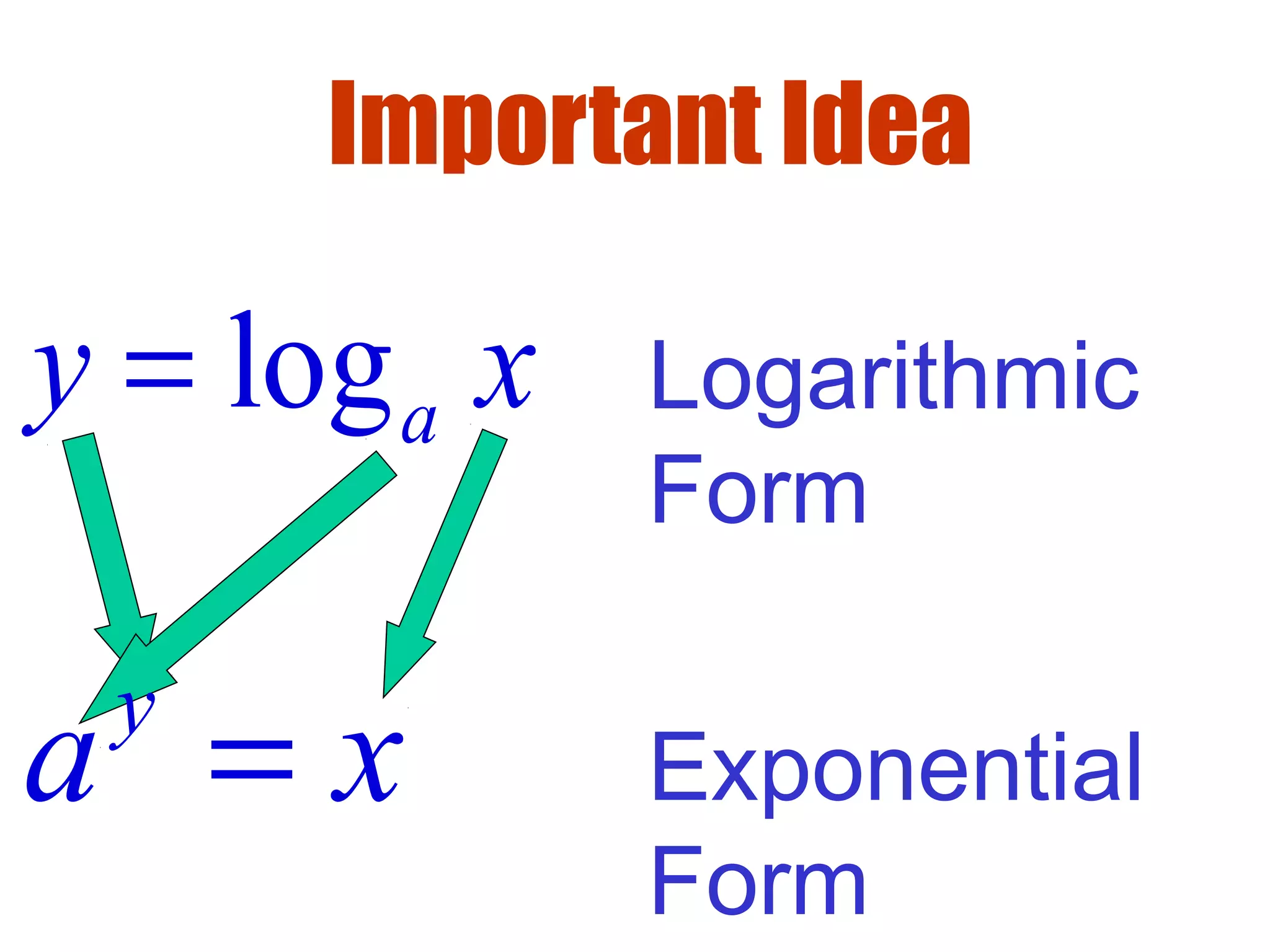
Important Idea
logay x= Logarithmic
Form
Exponential
Form
y
a x=
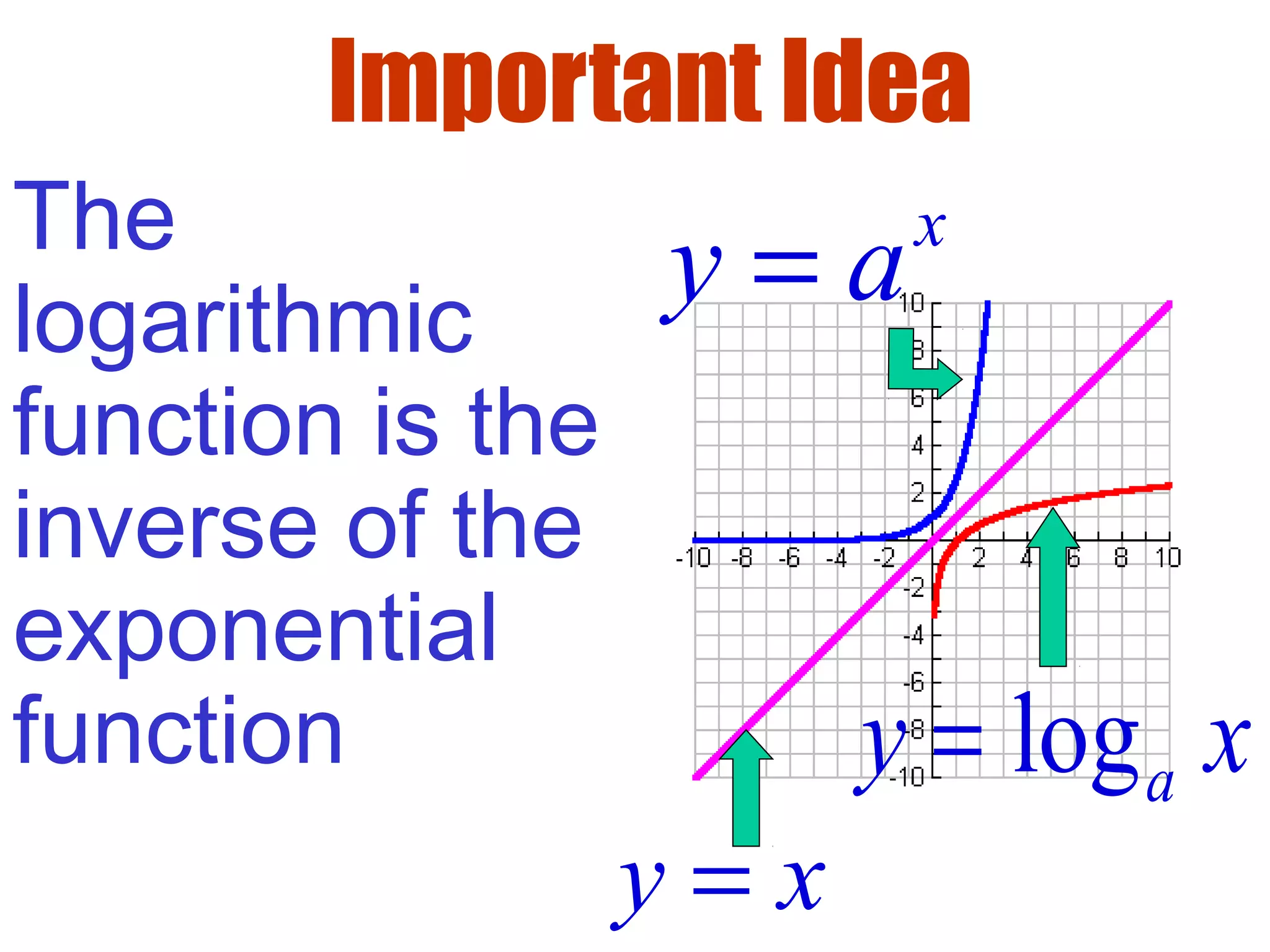
The
logarithmic
function is the
inverse of the
exponential
function
y x=
Important Idea
x
y a=
logay x=
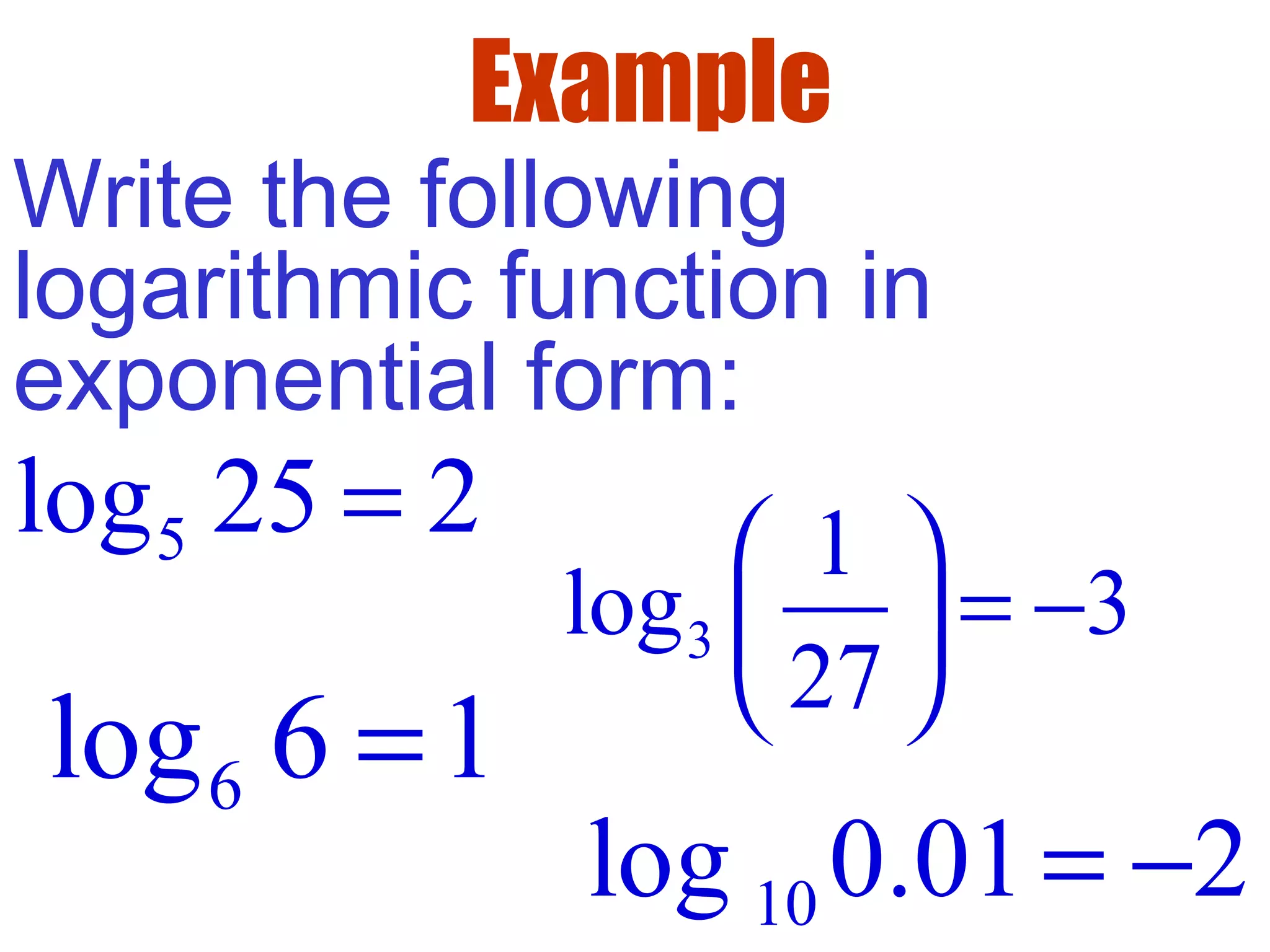
Example
Write the following
logarithmic function in
exponential form:
10log 0.01 2= −
5log 25 2=
3
1
log 3
27
 
= − 
 
6log 6 1=
Try This
Write the following
logarithmic function in
exponential form:
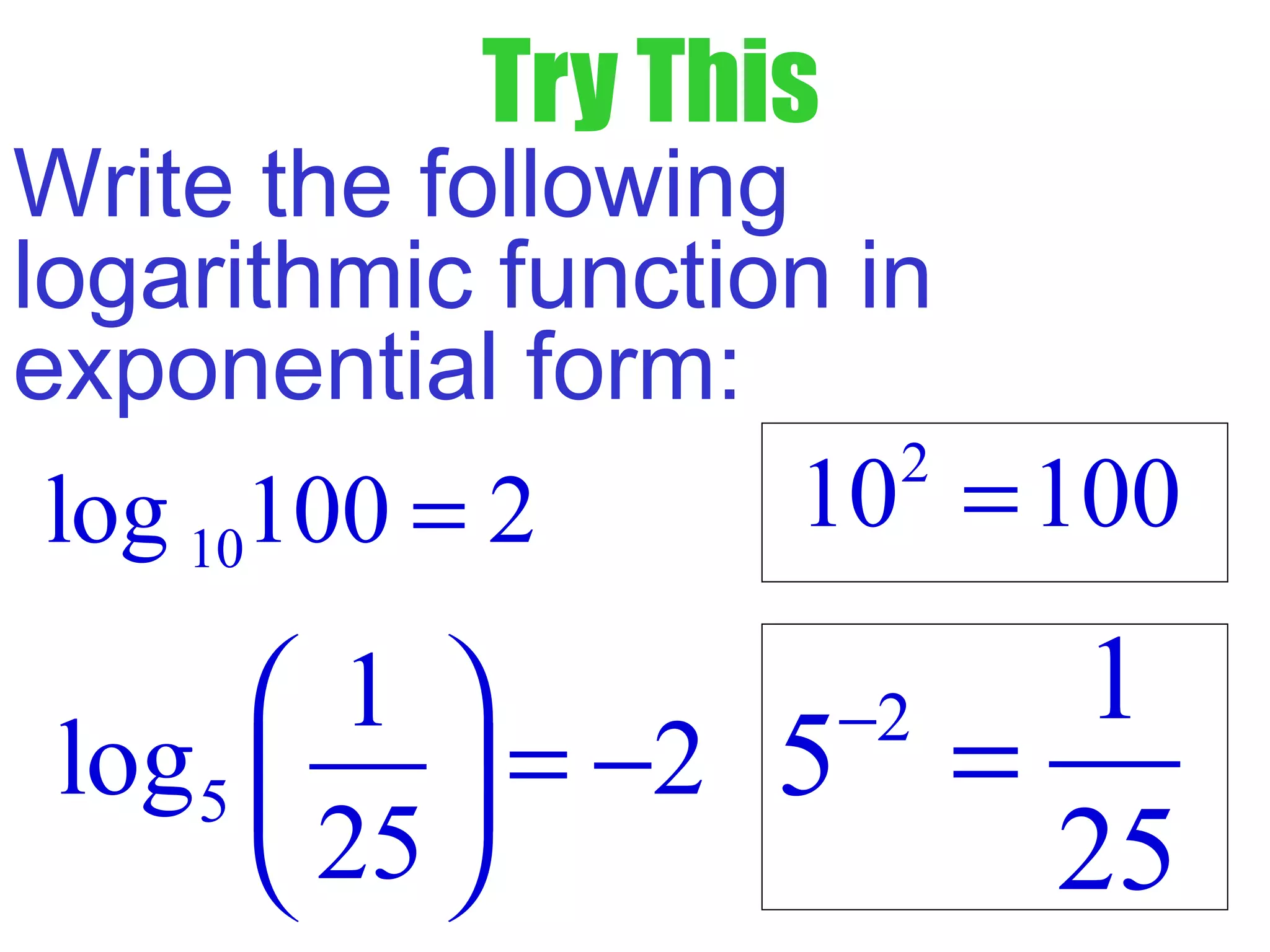
2
10 100=10log 100 2=
2 1
5
25
−
=5
1
log 2
25
 
= − 
 
Important Idea
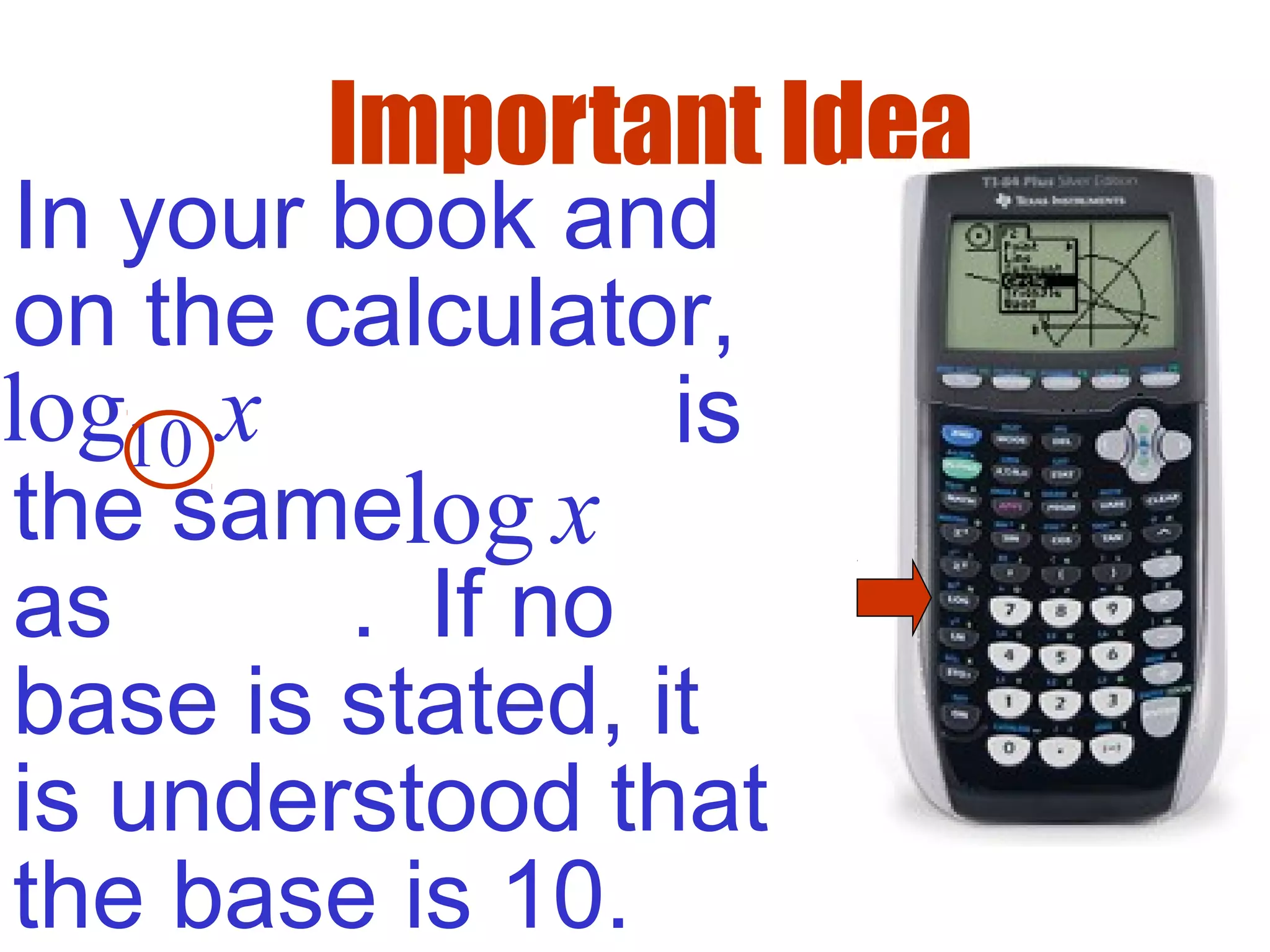
In your book and
on the calculator,
is
the same
as . If no
base is stated, it
is understood that
the base is 10.
10log x
log x
Example
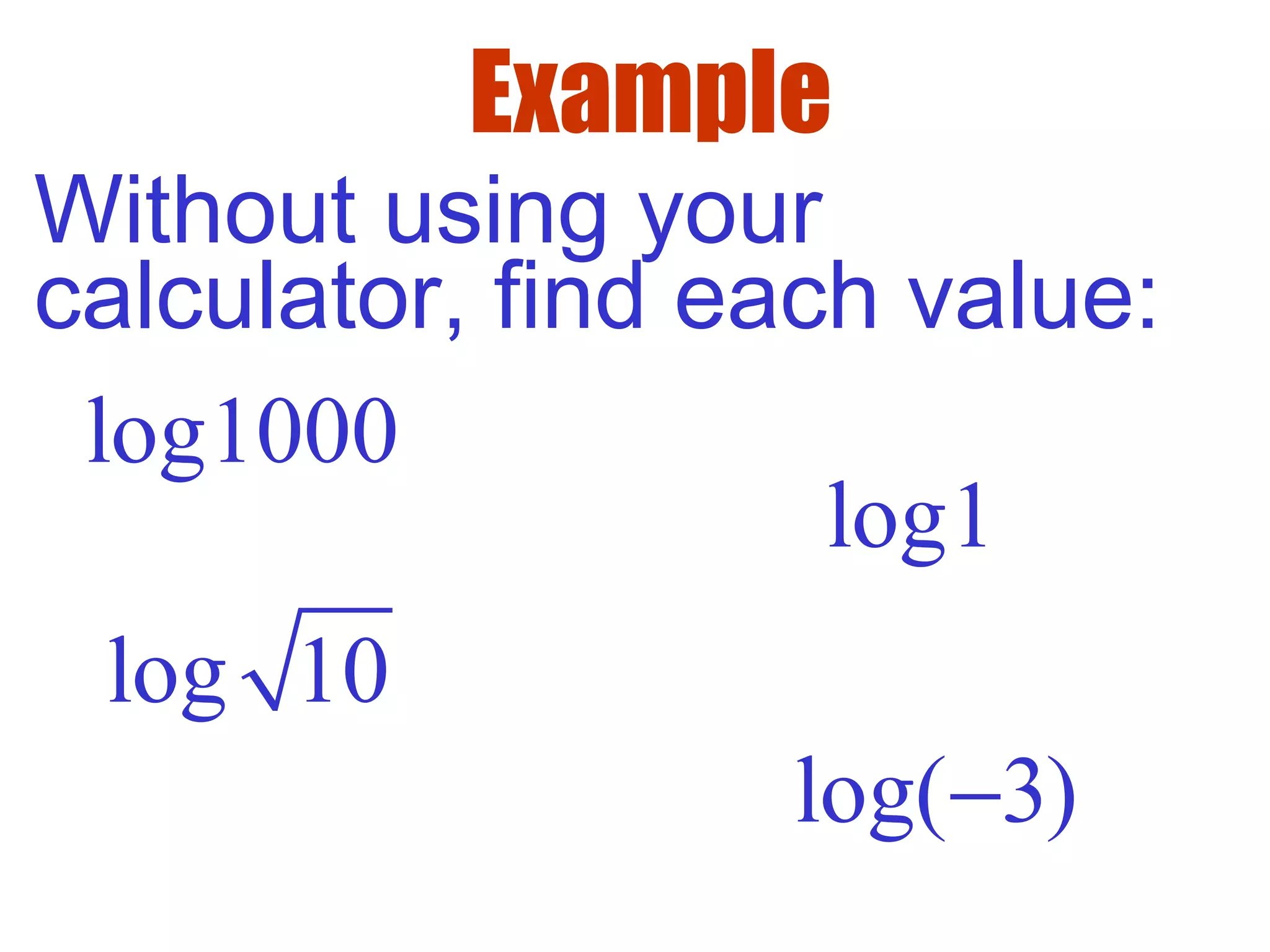
Without using your
calculator, find each value:
log1000
log1
log 10
log( 3)−
Try This
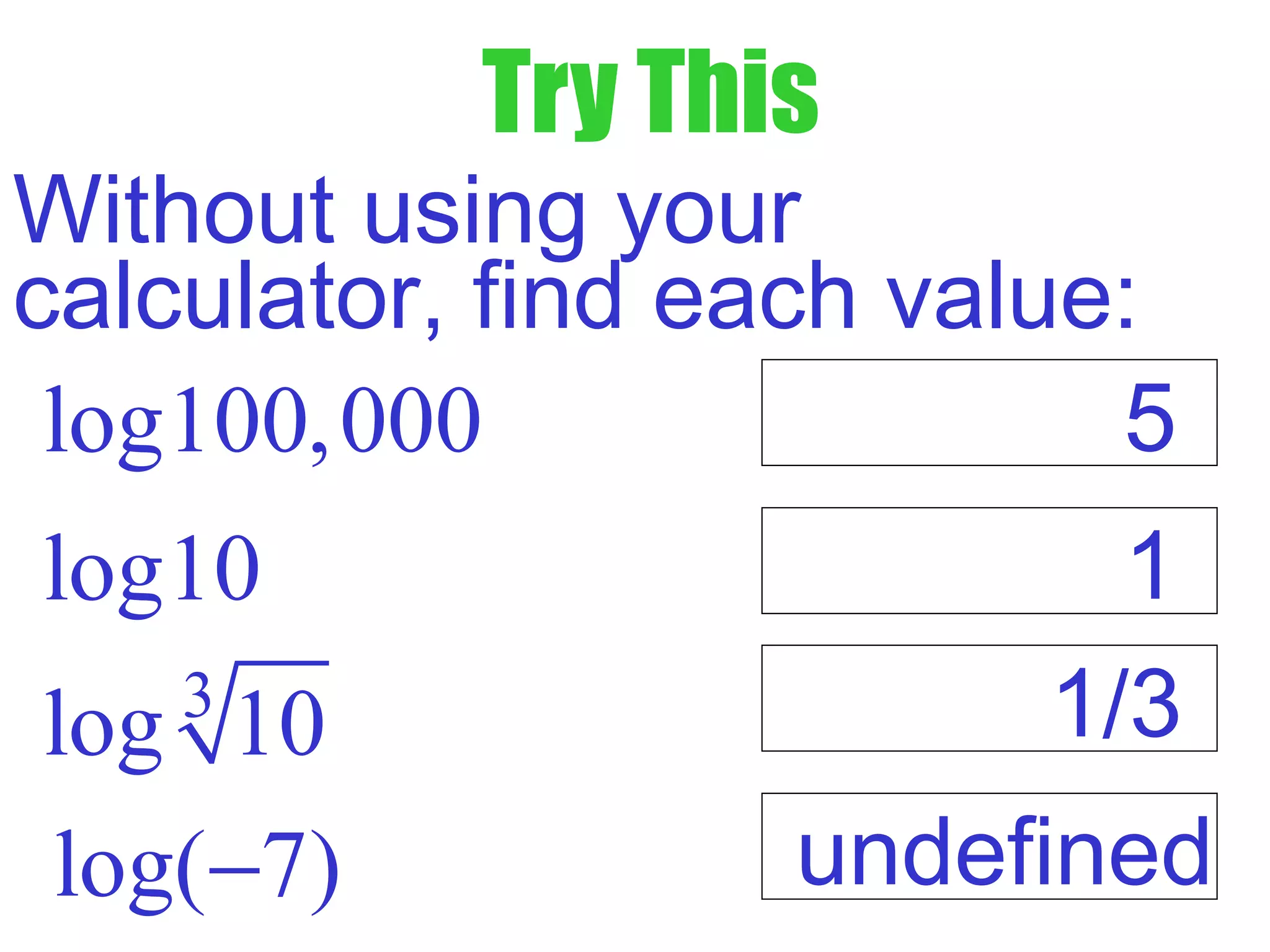
Without using your
calculator, find each value:
log100,000
log10
3
log 10
log( 7)−
5
1
1/3
undefined
Example
Solve each equation by using
an equivalent statement:
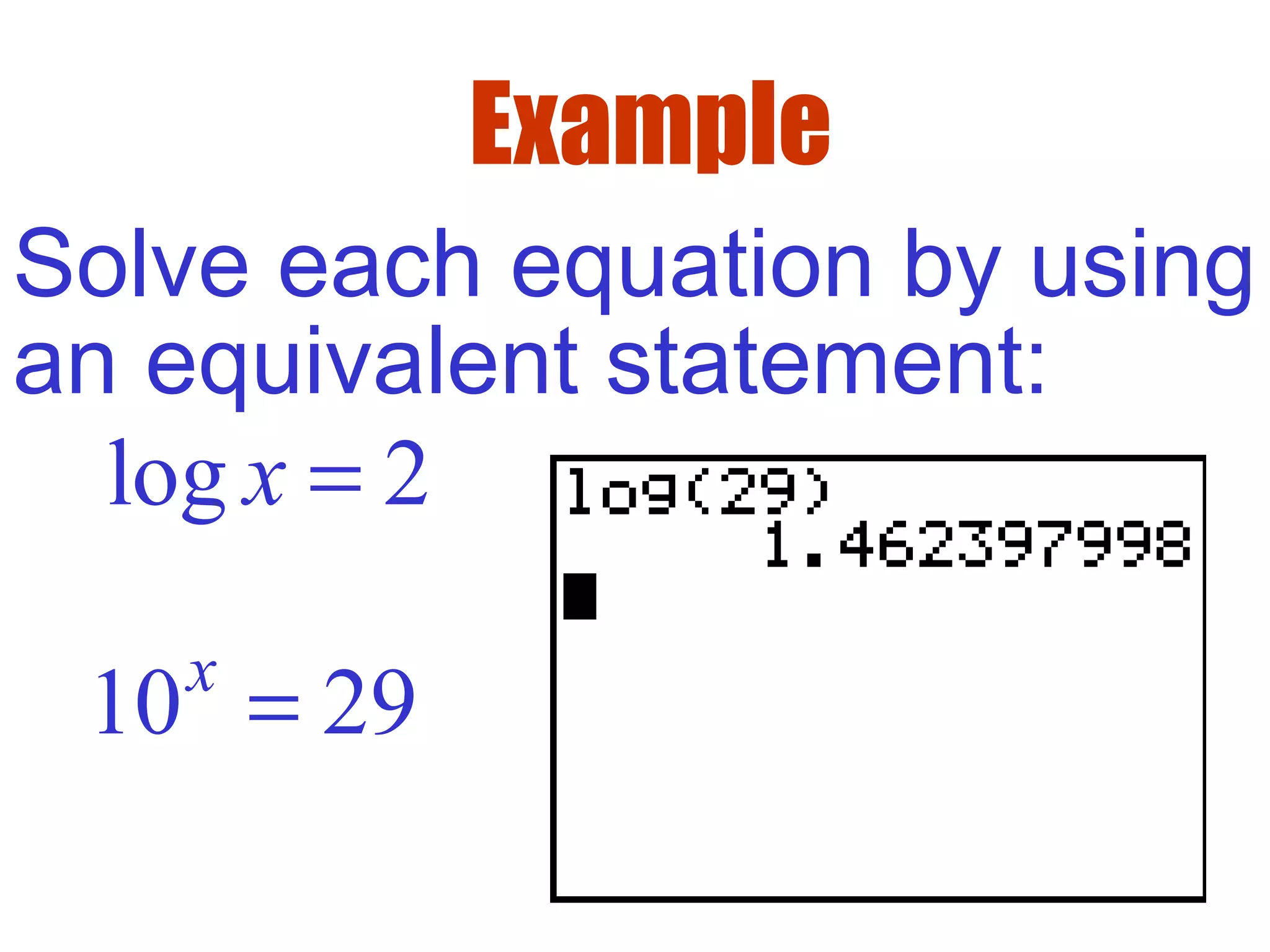
log 2x =
10 29x
=
Try This
Solve each equation by using
an equivalent statement:
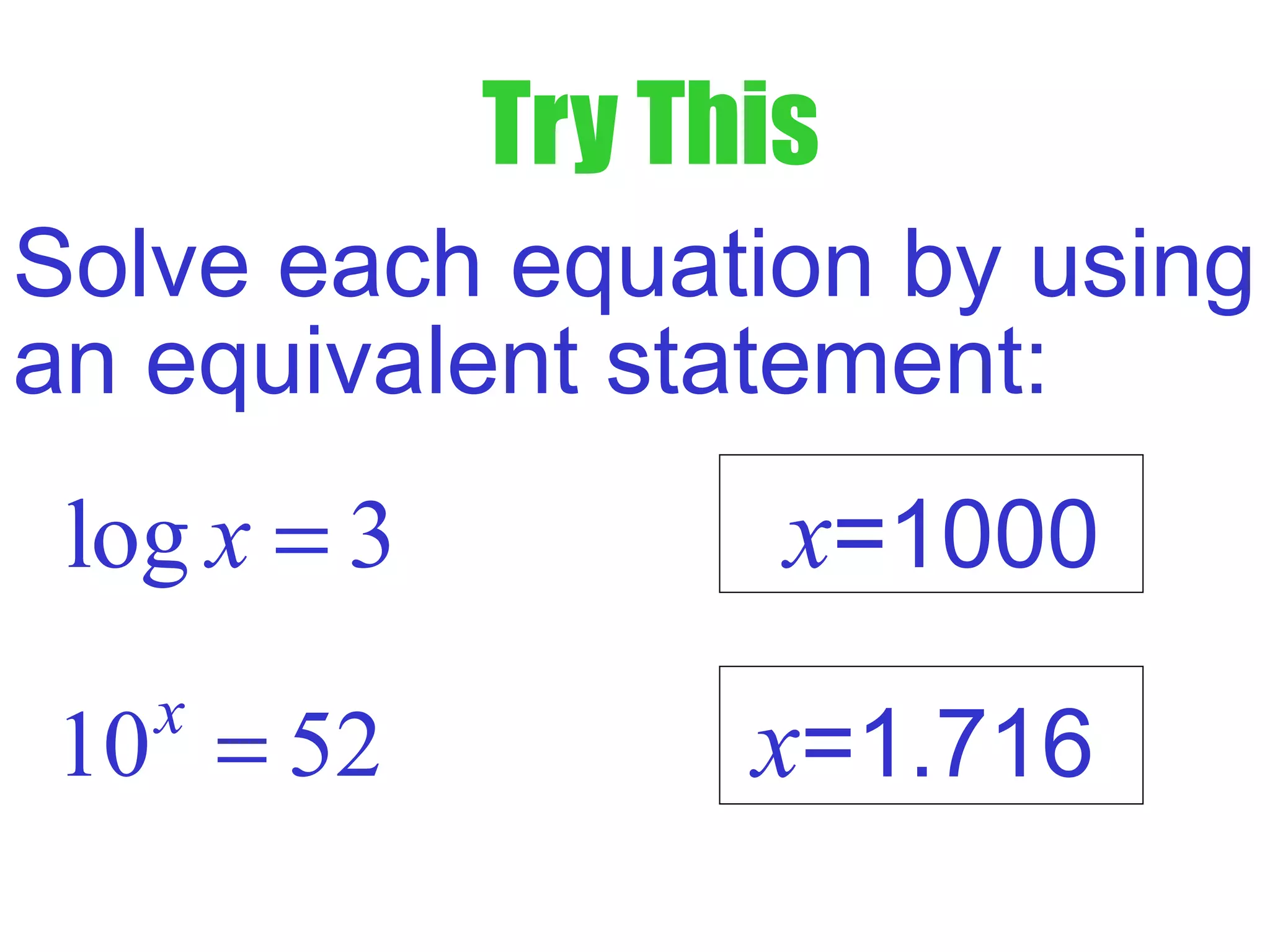
log 3x =
10 52x
=
x=1000
x=1.716
Definition
A second type of logarithm
exists, called the natural
logarithm and written ln x,
that uses the number e as a
base instead of the number
10. The natural logarithm is
very useful in science and
engineering.
Important Idea
Like , the
number e is a
very important
number in
mathematics.
π
Important Idea
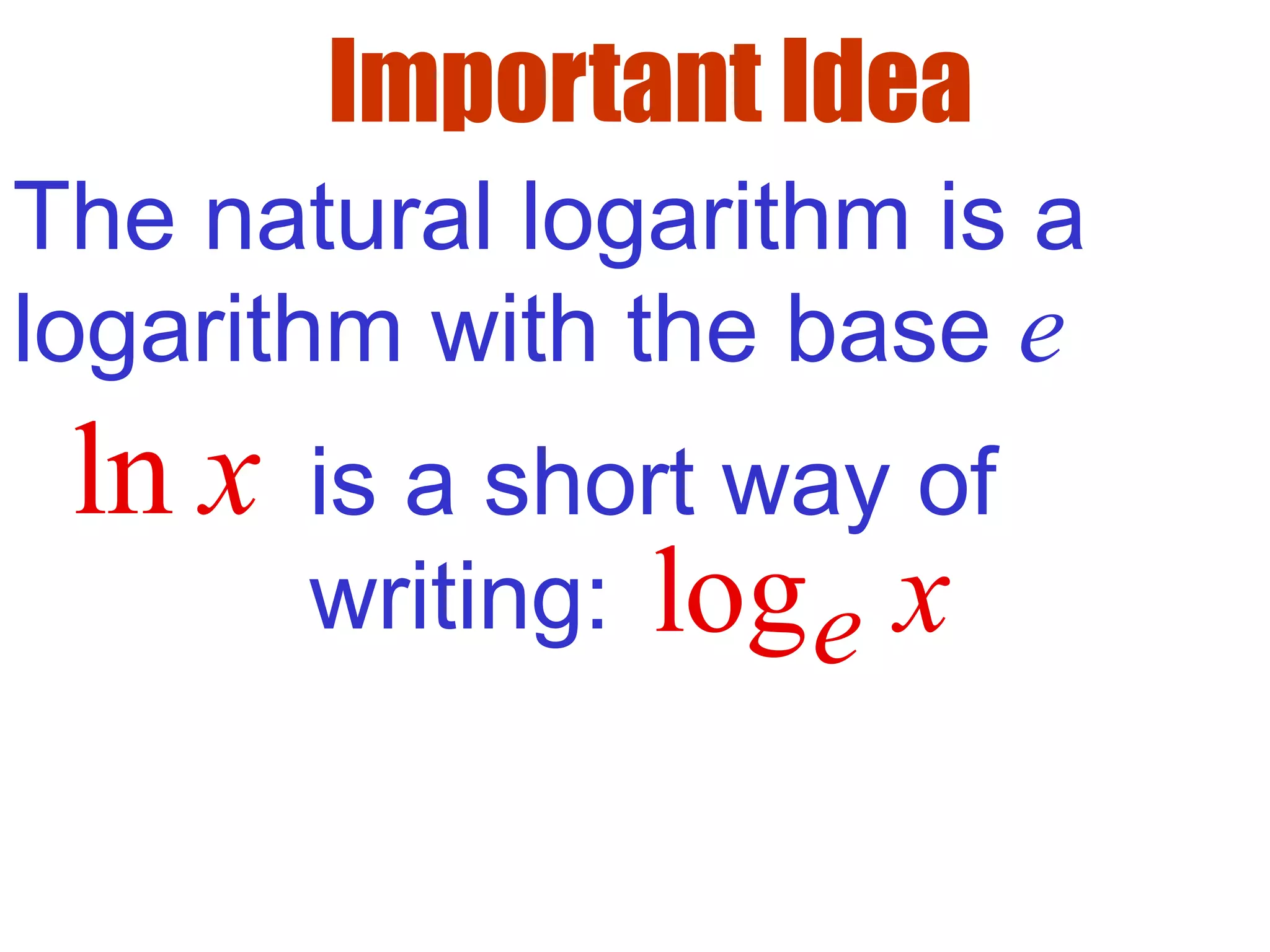
ln x
The natural logarithm is a
logarithm with the base e
is a short way of
writing: loge x
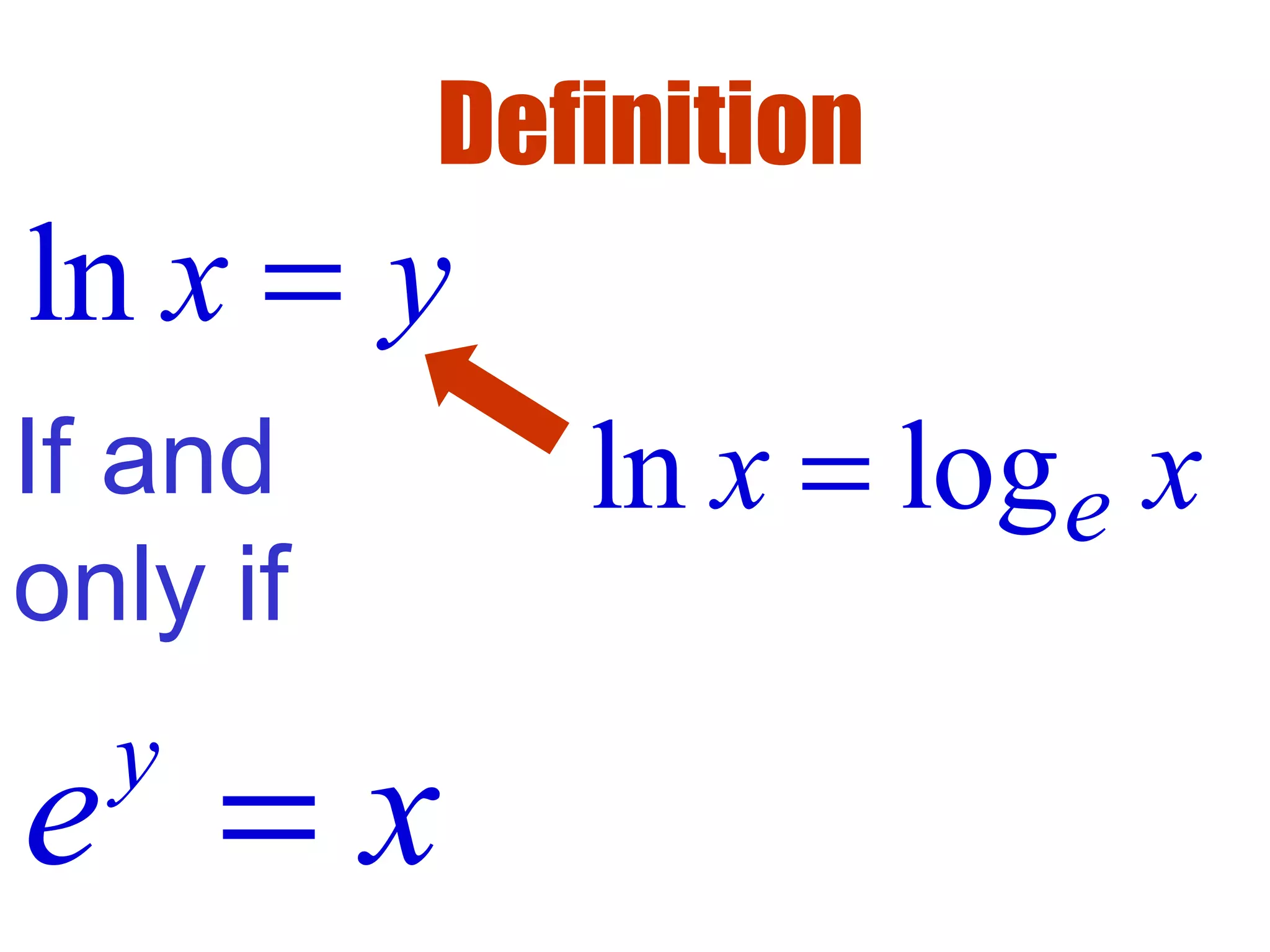
Definition
ln x y=
y
e x=
If and
only if
ln logex x=
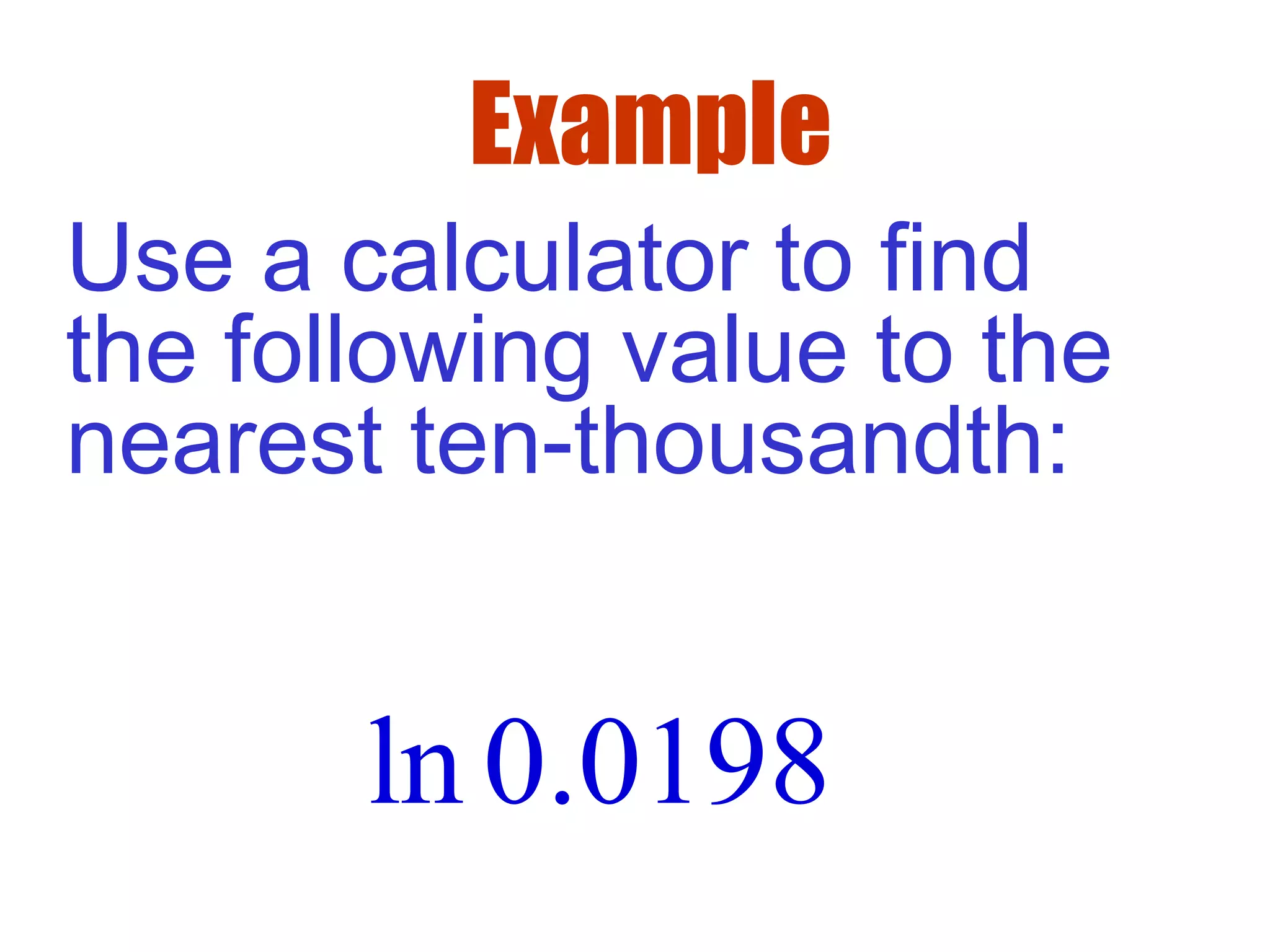
Example
ln 0.0198
Use a calculator to find
the following value to the
nearest ten-thousandth:
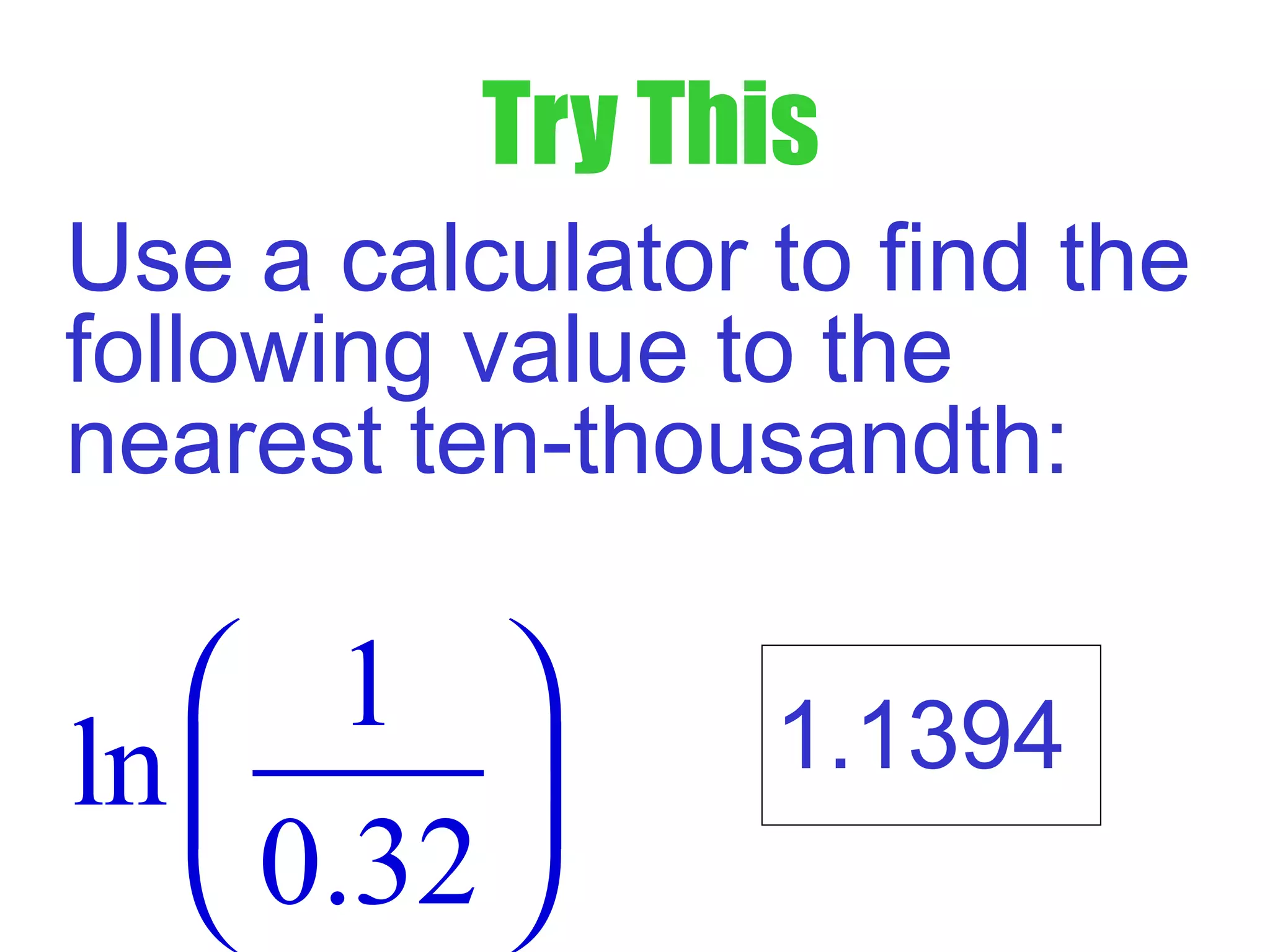
Try This
1
ln
0.32
 
 
 
Use a calculator to find the
following value to the
nearest ten-thousandth:
1.1394
Example
Solve each equation by using
an equivalent statement:
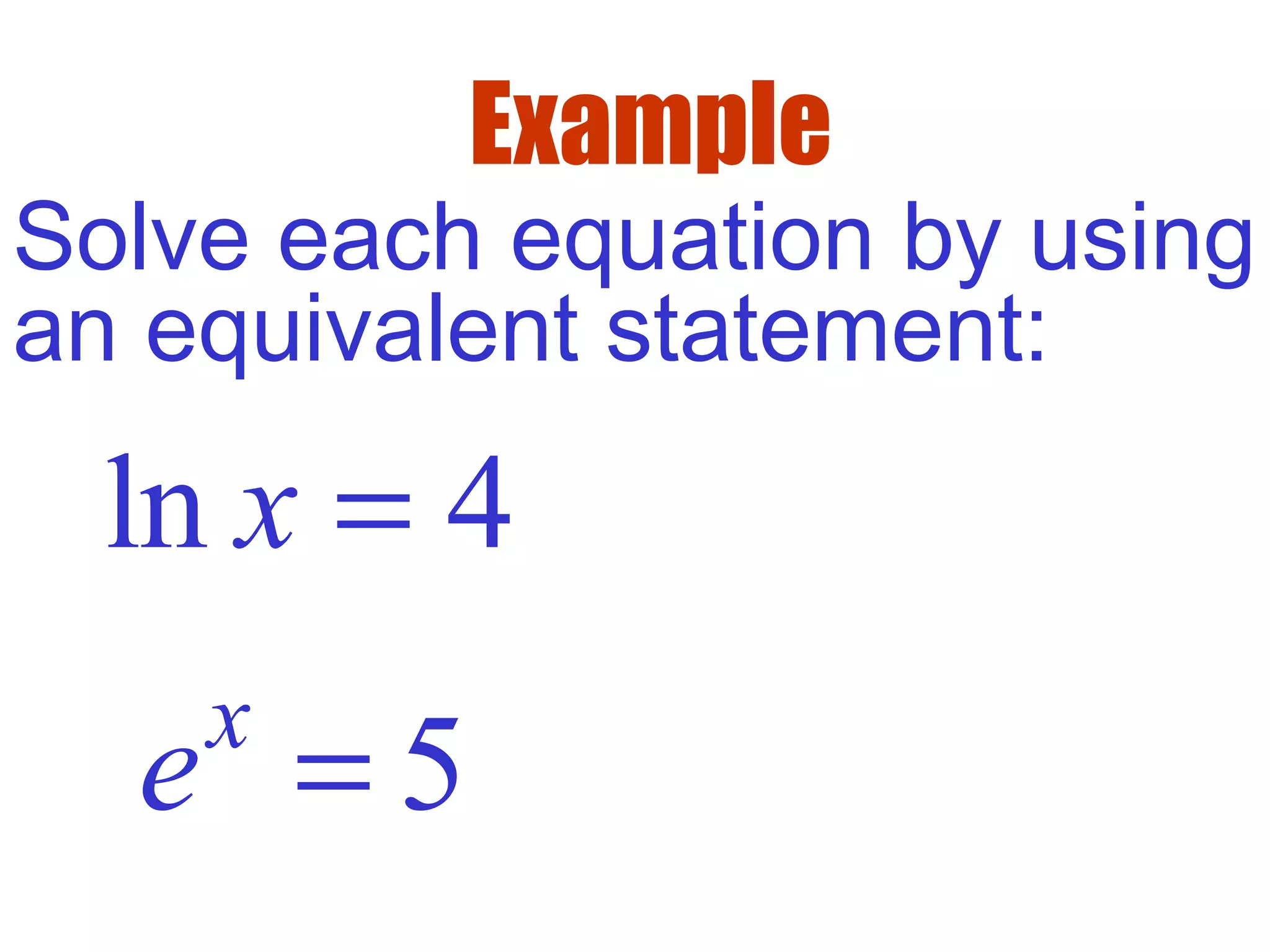
ln 4x =
5x
e =
Try This
Solve each equation by using
an equivalent statement:
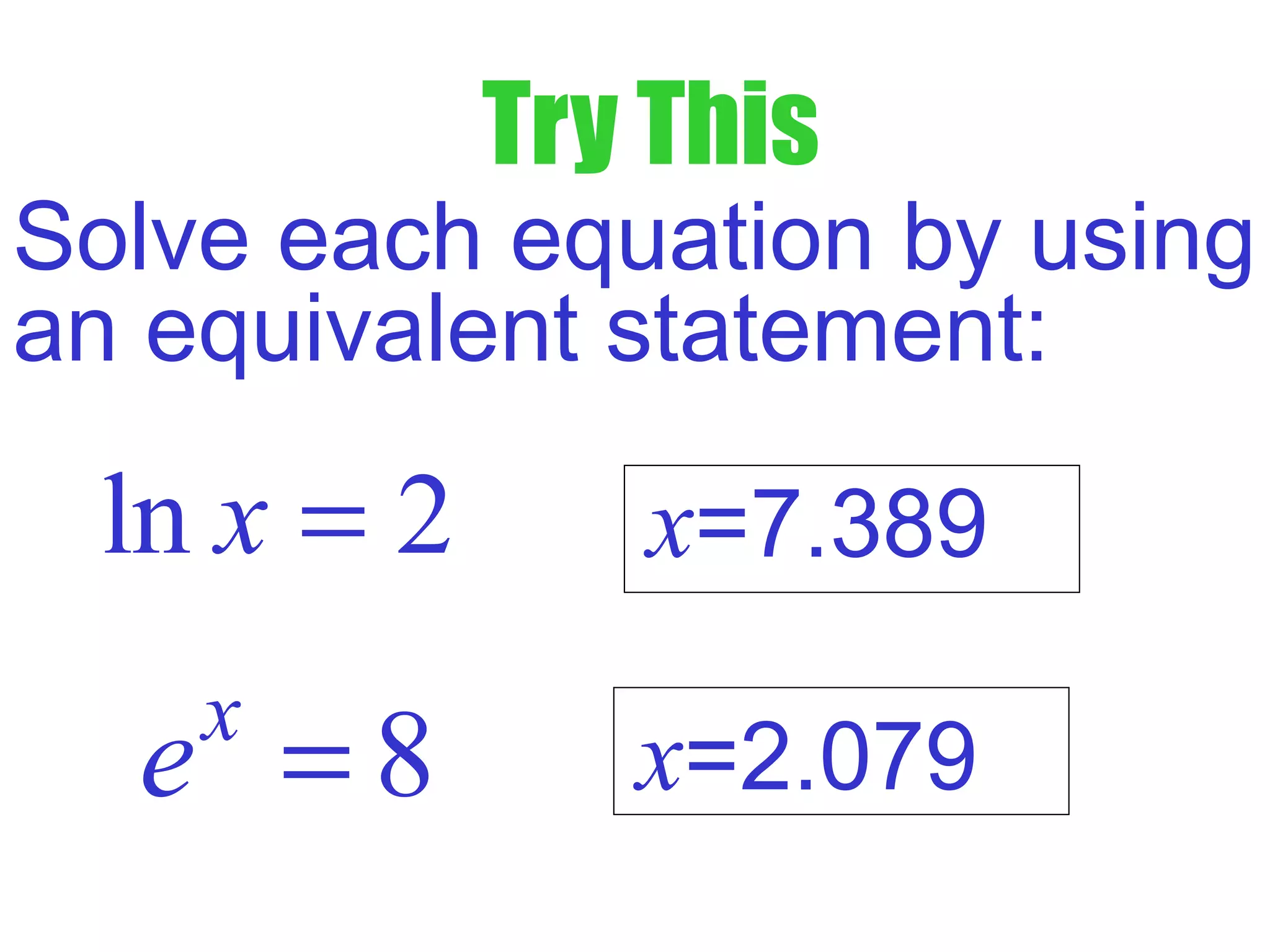
ln 2x = x=7.389
x=2.0798x
e =
Example
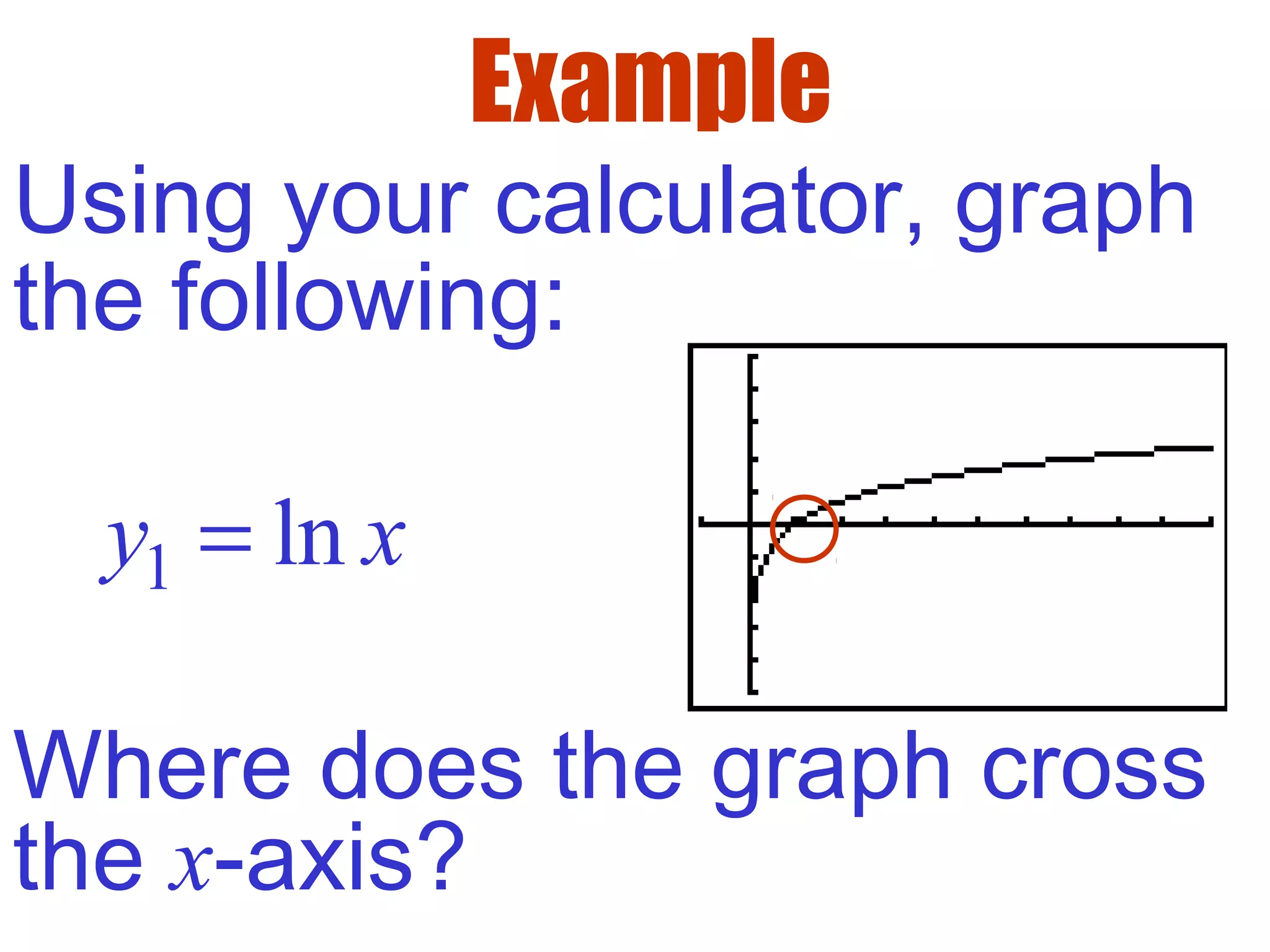
Using your calculator, graph
the following:
1 lny x=
Where does the graph cross
the x-axis?
Example
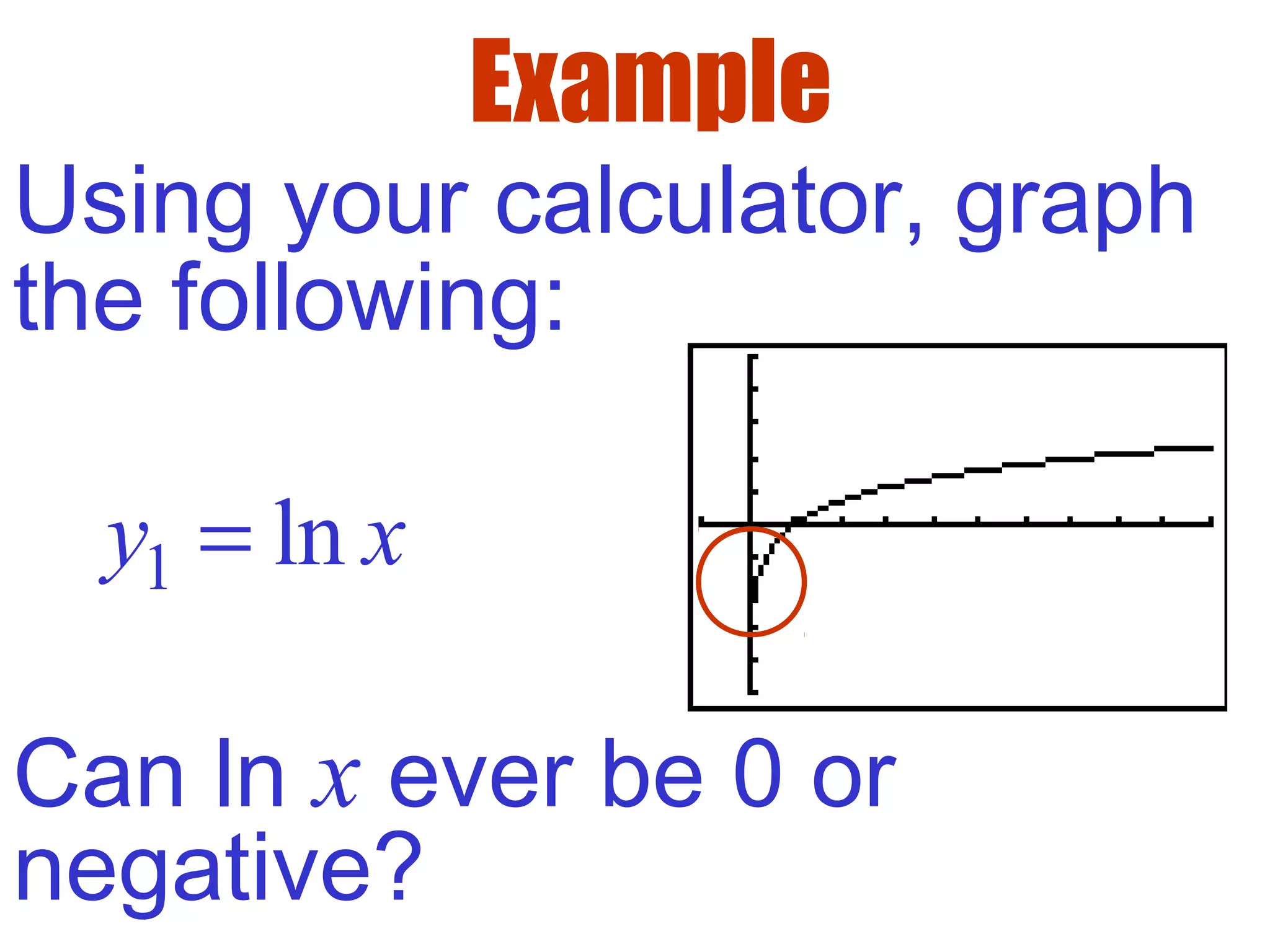
Using your calculator, graph
the following:
1 lny x=
Can ln x ever be 0 or
negative?
Example
Using your calculator, graph
the following:
1 lny x=
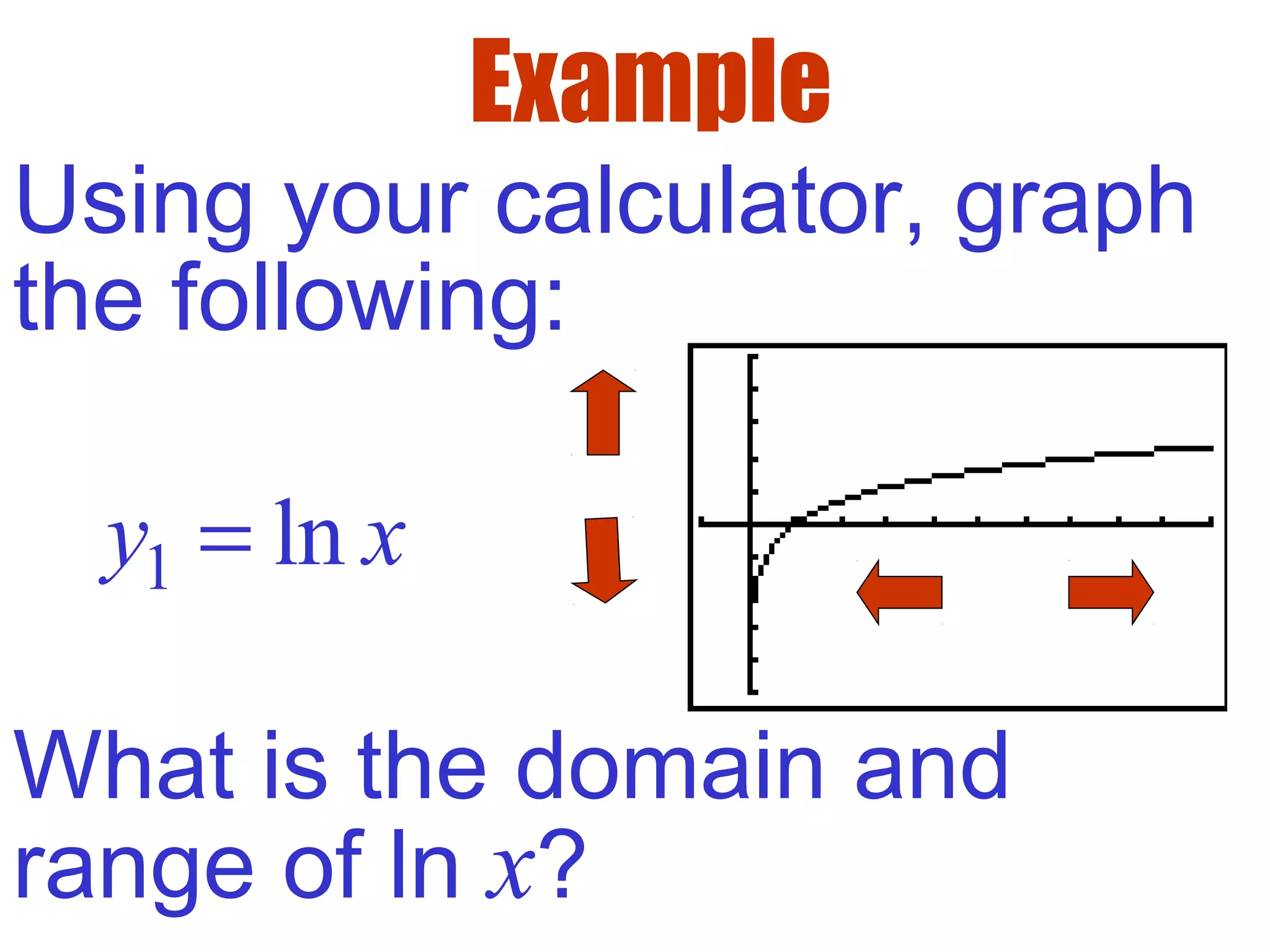
What is the domain and
range of ln x?
Example
Using your calculator, graph
the following:
1 lny x=
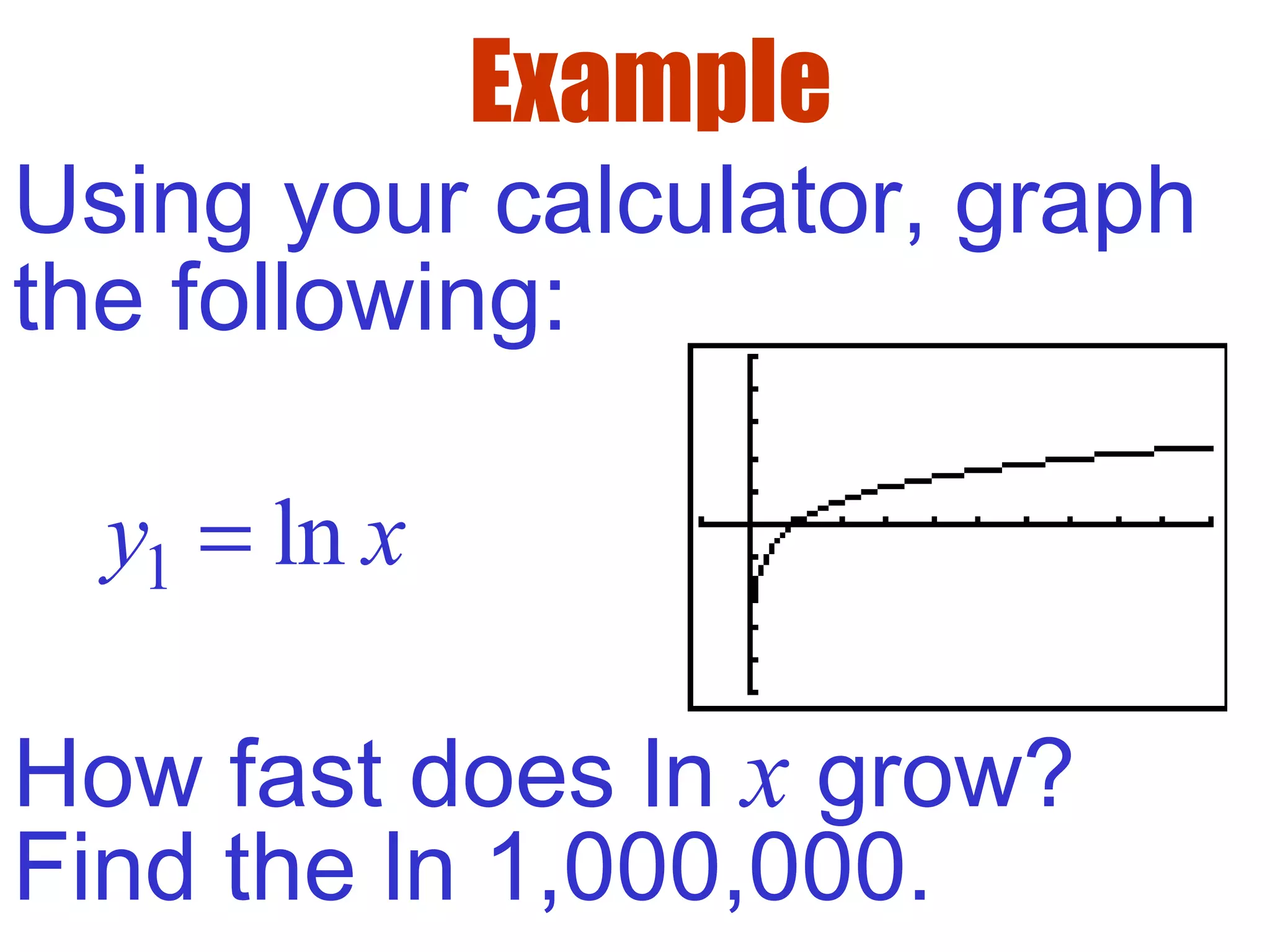
How fast does ln x grow?
Find the ln 1,000,000.
Try This
Using your calculator, graph:
1 lny x=
2 ln( 3)y x= −
3 ln( 3) 5y x= − +
Describe the differences.
How does the domain and
range change?
Lesson Close
A logarithm is an
exponent. Illustrate with
an example why this is
so.

Hprec5 4