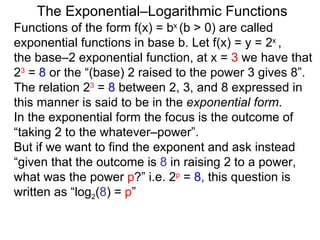
The Exponential–Logarithmic Functions Functions of the form f(x) = b x  (b > 0) are called exponential functions in base b.
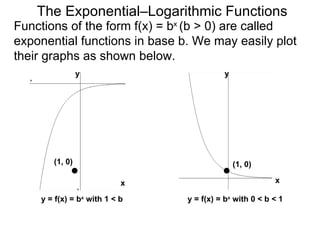
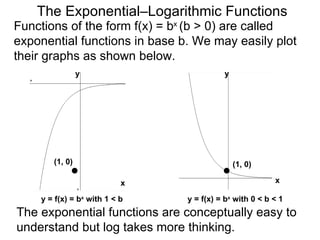
The Exponential–Logarithmic Functions Functions of the form f(x) = b x  (b > 0) are called exponential functions in base b. We may easily plot their graphs as shown below.
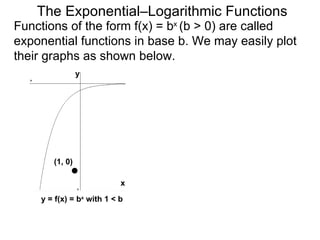
The Exponential–Logarithmic Functions Functions of the form f(x) = b x  (b > 0) are called exponential functions in base b. We may easily plot their graphs as shown below.  x y y = f(x) = b x  with 1 < b   (1, 0)
The Exponential–Logarithmic Functions Functions of the form f(x) = b x  (b > 0) are called exponential functions in base b. We may easily plot their graphs as shown below.  x y x y y = f(x) = b x  with 1 < b   y = f(x) = b x  with 0 < b < 1   (1, 0) (1, 0)
The Exponential–Logarithmic Functions Functions of the form f(x) = b x  (b > 0) are called exponential functions in base b. We may easily plot their graphs as shown below.  x y x y y = f(x) = b x  with 1 < b   y = f(x) = b x  with 0 < b < 1   (1, 0) (1, 0) The exponential functions are conceptually easy to understand but log takes more thinking.
The Exponential–Logarithmic Functions Functions of the form f(x) = b x  (b > 0) are called exponential functions in base b.
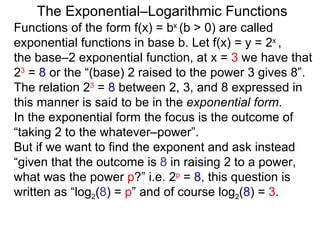
The Exponential–Logarithmic Functions Functions of the form f(x) = b x  (b > 0) are called exponential functions in base b. Let f(x) = y = 2 x  ,  the base–2 exponential function, at x =  3  we have that  2 3  =  8
The Exponential–Logarithmic Functions Functions of the form f(x) = b x  (b > 0) are called exponential functions in base b. Let f(x) = y = 2 x  ,  the base–2 exponential function, at x =  3  we have that  2 3  =  8  or the “(base) 2 raised to the power 3 gives 8”.
The Exponential–Logarithmic Functions Functions of the form f(x) = b x  (b > 0) are called exponential functions in base b. Let f(x) = y = 2 x  ,  the base–2 exponential function, at x =  3  we have that  2 3  =  8  or the “(base) 2 raised to the power 3 gives 8”. The relation 2 3  =  8  between 2, 3, and 8 expressed in this manner is said to be in the  exponential form .
The Exponential–Logarithmic Functions Functions of the form f(x) = b x  (b > 0) are called exponential functions in base b. Let f(x) = y = 2 x  ,  the base–2 exponential function, at x =  3  we have that  2 3  =  8  or the “(base) 2 raised to the power 3 gives 8”. The relation 2 3  =  8  between 2, 3, and 8 expressed in this manner is said to be in the  exponential form .  In the exponential form the focus is the outcome of “taking 2 to the whatever–power”.
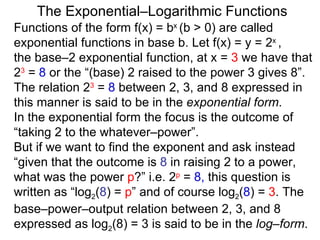
The Exponential–Logarithmic Functions Functions of the form f(x) = b x  (b > 0) are called exponential functions in base b. Let f(x) = y = 2 x  ,  the base–2 exponential function, at x =  3  we have that  2 3  =  8  or the “(base) 2 raised to the power 3 gives 8”. The relation 2 3  =  8  between 2, 3, and 8 expressed in this manner is said to be in the  exponential form .  In the exponential form the focus is the outcome of “taking 2 to the whatever–power”.  But if we want to find the exponent and ask instead “given that the outcome is  8  in raising 2 to a power, what was the power  p ?” i.e.  2 p  =  8,
The Exponential–Logarithmic Functions Functions of the form f(x) = b x  (b > 0) are called exponential functions in base b. Let f(x) = y = 2 x  ,  the base–2 exponential function, at x =  3  we have that  2 3  =  8  or the “(base) 2 raised to the power 3 gives 8”. The relation 2 3  =  8  between 2, 3, and 8 expressed in this manner is said to be in the  exponential form .  In the exponential form the focus is the outcome of “taking 2 to the whatever–power”.  But if we want to find the exponent and ask instead “given that the outcome is  8  in raising 2 to a power, what was the power  p ?” i.e.  2 p  =  8,  this question is written as “log 2 ( 8 ) =  p ”
The Exponential–Logarithmic Functions Functions of the form f(x) = b x  (b > 0) are called exponential functions in base b. Let f(x) = y = 2 x  ,  the base–2 exponential function, at x =  3  we have that  2 3  =  8  or the “(base) 2 raised to the power 3 gives 8”. The relation 2 3  =  8  between 2, 3, and 8 expressed in this manner is said to be in the  exponential form .  In the exponential form the focus is the outcome of “taking 2 to the whatever–power”.  But if we want to find the exponent and ask instead “given that the outcome is  8  in raising 2 to a power, what was the power  p ?” i.e.  2 p  =  8,  this question is written as “log 2 ( 8 ) =  p ” and of course log 2 ( 8 ) =  3 .
The Exponential–Logarithmic Functions Functions of the form f(x) = b x  (b > 0) are called exponential functions in base b. Let f(x) = y = 2 x  ,  the base–2 exponential function, at x =  3  we have that  2 3  =  8  or the “(base) 2 raised to the power 3 gives 8”. The relation 2 3  =  8  between 2, 3, and 8 expressed in this manner is said to be in the  exponential form .  In the exponential form the focus is the outcome of “taking 2 to the whatever–power”.  But if we want to find the exponent and ask instead “given that the outcome is  8  in raising 2 to a power, what was the power  p ?” i.e.  2 p  =  8,  this question is written as “log 2 ( 8 ) =  p ” and of course log 2 ( 8 ) =  3 . The base–power–output relation between 2, 3, and 8 expressed as log 2 (8) = 3   is said to be in the  log–form .
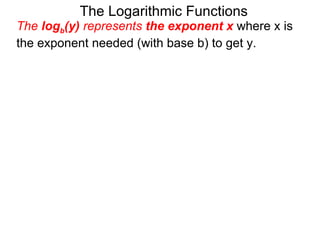
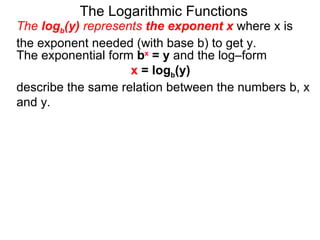
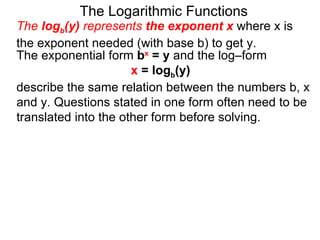
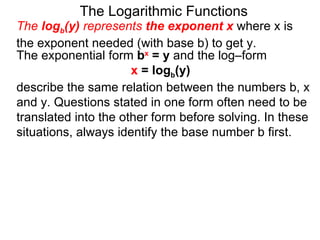
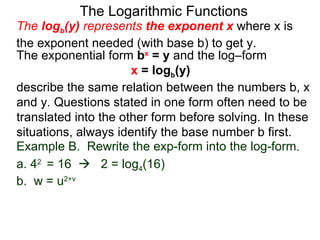
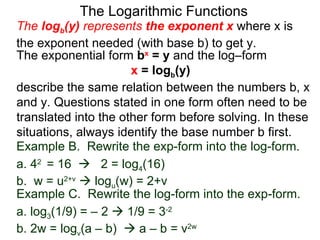
The Logarithmic Functions The  log b (y)  represents  the exponent x   where x is the exponent needed (with base b) to get y.
The Logarithmic Functions The  log b (y)  represents  the exponent x   where x is the exponent needed (with base b) to get y.  The exponential form  b x  = y  and the log–form  x  = log b (y)   describe the same relation between the numbers b, x and y.
The Logarithmic Functions The  log b (y)  represents  the exponent x   where x is the exponent needed (with base b) to get y.  The exponential form  b x  = y  and the log–form  x  = log b (y)   describe the same relation between the numbers b, x and y. Questions stated in one form often need to be translated into the other form before solving.
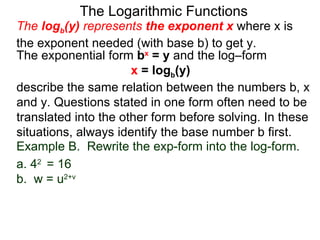
The Logarithmic Functions The  log b (y)  represents  the exponent x   where x is the exponent needed (with base b) to get y.  The exponential form  b x  = y  and the log–form  x  = log b (y)   describe the same relation between the numbers b, x and y. Questions stated in one form often need to be translated into the other form before solving. In these situations, always identify the base number b first.
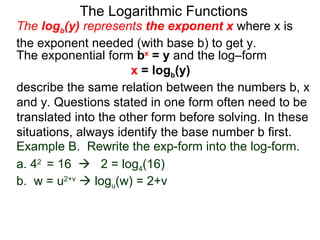
The Logarithmic Functions The  log b (y)  represents  the exponent x   where x is the exponent needed (with base b) to get y.  The exponential form  b x  = y  and the log–form  x  = log b (y)   describe the same relation between the numbers b, x and y. Questions stated in one form often need to be translated into the other form before solving. In these situations, always identify the base number b first. Example B.  Rewrite the exp-form into the log-form. a. 4 2  = 16 b.  w = u 2+v
The Logarithmic Functions The  log b (y)  represents  the exponent x   where x is the exponent needed (with base b) to get y.  The exponential form  b x  = y  and the log–form  x  = log b (y)   describe the same relation between the numbers b, x and y. Questions stated in one form often need to be translated into the other form before solving. In these situations, always identify the base number b first. Example B.  Rewrite the exp-form into the log-form. a. 4 2  = 16     2 = log 4 (16) b.  w = u 2+v
The Logarithmic Functions The  log b (y)  represents  the exponent x   where x is the exponent needed (with base b) to get y.  The exponential form  b x  = y  and the log–form  x  = log b (y)   describe the same relation between the numbers b, x and y. Questions stated in one form often need to be translated into the other form before solving. In these situations, always identify the base number b first. Example B.  Rewrite the exp-form into the log-form. a. 4 2  = 16     2 = log 4 (16) b.  w = u 2+v     log u (w) = 2+v
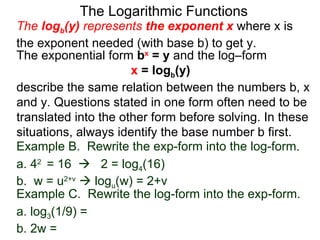
The Logarithmic Functions The  log b (y)  represents  the exponent x   where x is the exponent needed (with base b) to get y.  The exponential form  b x  = y  and the log–form  x  = log b (y)   describe the same relation between the numbers b, x and y. Questions stated in one form often need to be translated into the other form before solving. In these situations, always identify the base number b first. Example C.  Rewrite the log-form into the exp-form. a. log 3 (1/9) = b. 2w = Example B.  Rewrite the exp-form into the log-form. a. 4 2  = 16     2 = log 4 (16) b.  w = u 2+v     log u (w) = 2+v
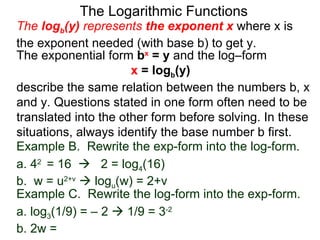
The Logarithmic Functions The  log b (y)  represents  the exponent x   where x is the exponent needed (with base b) to get y.  The exponential form  b x  = y  and the log–form  x  = log b (y)   describe the same relation between the numbers b, x and y. Questions stated in one form often need to be translated into the other form before solving. In these situations, always identify the base number b first. Example C.  Rewrite the log-form into the exp-form. a. log 3 (1/9) = – 2    1/9 = 3 -2   b. 2w = Example B.  Rewrite the exp-form into the log-form. a. 4 2  = 16     2 = log 4 (16) b.  w = u 2+v     log u (w) = 2+v
The Logarithmic Functions The  log b (y)  represents  the exponent x   where x is the exponent needed (with base b) to get y.  The exponential form  b x  = y  and the log–form  x  = log b (y)   describe the same relation between the numbers b, x and y. Questions stated in one form often need to be translated into the other form before solving. In these situations, always identify the base number b first. Example C.  Rewrite the log-form into the exp-form. a. log 3 (1/9) = – 2    1/9 = 3 -2   b. 2w = log v (a – b)    a – b = v 2w Example B.  Rewrite the exp-form into the log-form. a. 4 2  = 16     2 = log 4 (16) b.  w = u 2+v     log u (w) = 2+v
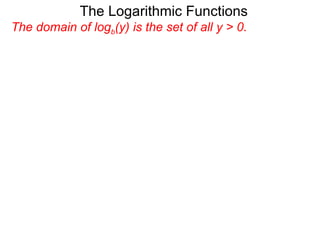
The domain of log b (y) is the set of all y > 0.  The Logarithmic Functions
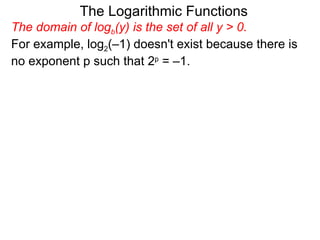
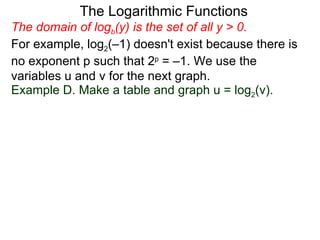
The domain of log b (y) is the set of all y > 0.  For example, log 2 (–1) doesn't exist because there is no exponent p such that 2 p  = –1.  The Logarithmic Functions
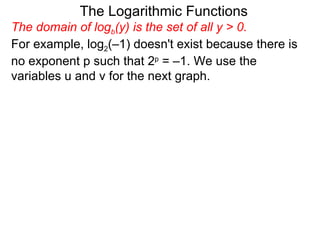
The domain of log b (y) is the set of all y > 0.  For example, log 2 (–1) doesn't exist because there is no exponent p such that 2 p  = –1. We use the variables u and v for the next graph. The Logarithmic Functions
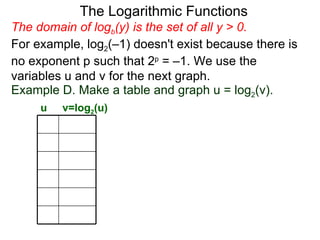
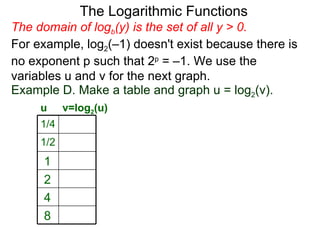
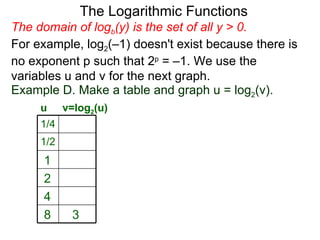
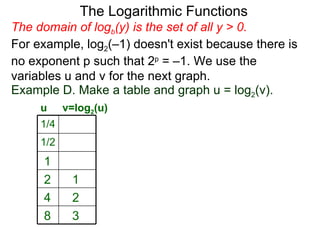
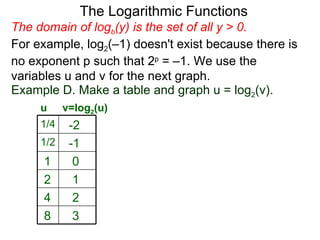
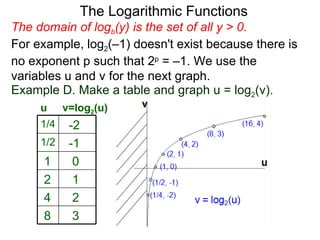
The domain of log b (y) is the set of all y > 0.  For example, log 2 (–1) doesn't exist because there is no exponent p such that 2 p  = –1. We use the variables u and v for the next graph. The Logarithmic Functions Example D. Make a table and graph u = log 2 (v).
The domain of log b (y) is the set of all y > 0.  For example, log 2 (–1) doesn't exist because there is no exponent p such that 2 p  = –1. We use the variables u and v for the next graph. The Logarithmic Functions u v=log 2 (u) Example D. Make a table and graph u = log 2 (v).
The domain of log b (y) is the set of all y > 0.  For example, log 2 (–1) doesn't exist because there is no exponent p such that 2 p  = –1. We use the variables u and v for the next graph. The Logarithmic Functions u v=log 2 (u) Example D. Make a table and graph u = log 2 (v).  1/4 1/2 1 2 4 8
The domain of log b (y) is the set of all y > 0.  For example, log 2 (–1) doesn't exist because there is no exponent p such that 2 p  = –1. We use the variables u and v for the next graph. The Logarithmic Functions u v=log 2 (u) Example D. Make a table and graph u = log 2 (v).  1/4 1/2 1 2 4 8 3
The domain of log b (y) is the set of all y > 0.  For example, log 2 (–1) doesn't exist because there is no exponent p such that 2 p  = –1. We use the variables u and v for the next graph. The Logarithmic Functions u v=log 2 (u) Example D. Make a table and graph u = log 2 (v).  1/4 1/2 1 2 1 4 2 8 3
The domain of log b (y) is the set of all y > 0.  For example, log 2 (–1) doesn't exist because there is no exponent p such that 2 p  = –1. We use the variables u and v for the next graph. The Logarithmic Functions u v=log 2 (u) Example D. Make a table and graph u = log 2 (v).  1/4 -2 1/2 -1 1 0 2 1 4 2 8 3
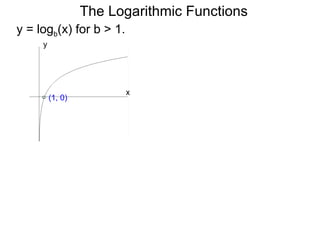
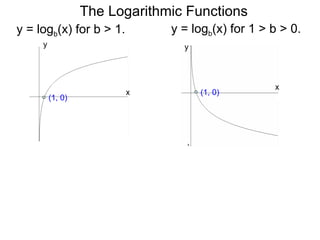
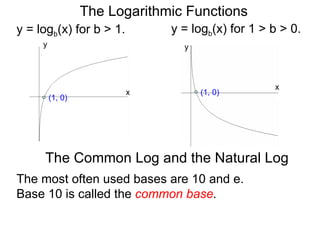
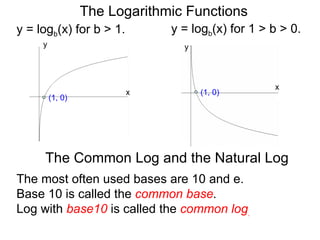
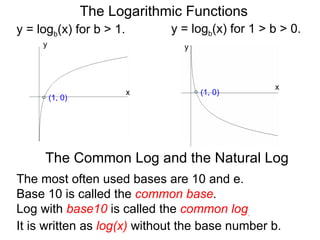
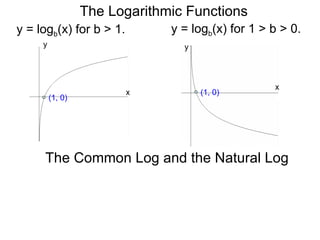
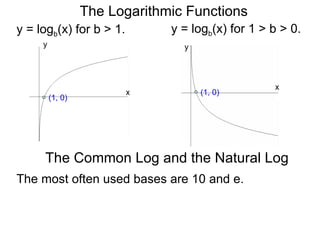
y = log b (x) for b > 1.  The Logarithmic Functions y x (1, 0)
y = log b (x) for b > 1.  The Logarithmic Functions y = log b (x) for 1 > b > 0.  y x x y (1, 0) (1, 0)
y = log b (x) for b > 1.  The Logarithmic Functions y = log b (x) for 1 > b > 0.  y x x y (1, 0) (1, 0) The Common Log and the Natural Log
y = log b (x) for b > 1.  The Logarithmic Functions y = log b (x) for 1 > b > 0.  y x x y (1, 0) (1, 0) The most often used bases are 10 and e. The Common Log and the Natural Log
y = log b (x) for b > 1.  The Logarithmic Functions y = log b (x) for 1 > b > 0.  y x x y (1, 0) (1, 0) The most often used bases are 10 and e. Base 10 is called the  common base . The Common Log and the Natural Log
y = log b (x) for b > 1.  The Logarithmic Functions y = log b (x) for 1 > b > 0.  y x x y (1, 0) (1, 0) The most often used bases are 10 and e. Base 10 is called the  common base . Log with  base10  is called the  common log . The Common Log and the Natural Log
y = log b (x) for b > 1.  The Logarithmic Functions y = log b (x) for 1 > b > 0.  y x x y (1, 0) (1, 0) The most often used bases are 10 and e. Base 10 is called the  common base . Log with  base10  is called the  common log . It is written as  log(x)  without the base number b.  The Common Log and the Natural Log
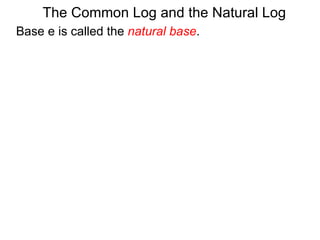
Base e is called the  natural base .  The Common Log and the Natural Log
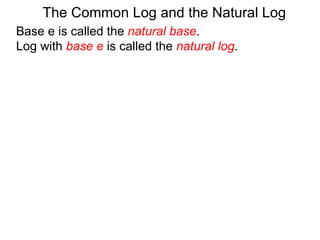
Base e is called the  natural base .  Log with  base e  is called the  natural log . The Common Log and the Natural Log
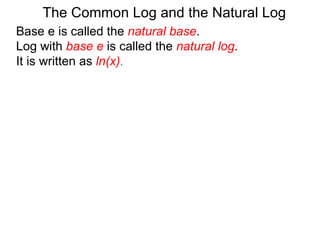
Base e is called the  natural base .  Log with  base e  is called the  natural log . It is written as  ln(x) . The Common Log and the Natural Log
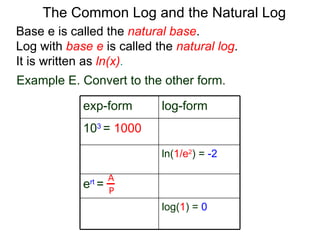
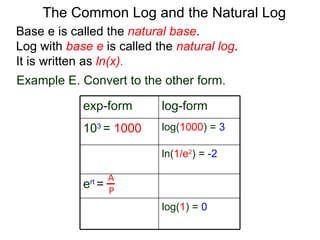
Base e is called the  natural base .  Log with  base e  is called the  natural log . It is written as  ln(x) . The Common Log and the Natural Log Example E. Convert to the other form.  A P exp-form log-form 10 3  =   1000 ln( 1/e 2 ) =   -2 e rt  = l og ( 1 ) =   0
Base e is called the  natural base .  Log with  base e  is called the  natural log . It is written as  ln(x) . The Common Log and the Natural Log Example E. Convert to the other form.  A P exp-form log-form 10 3  =   1000 log( 1000 ) =  3 ln( 1/e 2 ) =   -2 e rt  = l og ( 1 ) =   0
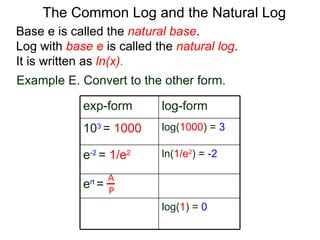
Base e is called the  natural base .  Log with  base e  is called the  natural log . It is written as  ln(x) . The Common Log and the Natural Log Example E. Convert to the other form.  A P exp-form log-form 10 3  =   1000 log( 1000 ) =  3 e -2  =   1/e 2 ln( 1/e 2 ) =   -2 e rt  = l og ( 1 ) =   0
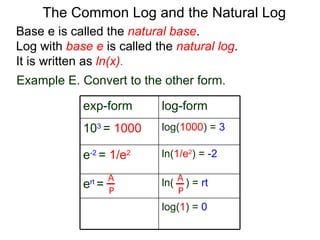
Base e is called the  natural base .  Log with  base e  is called the  natural log . It is written as  ln(x) . The Common Log and the Natural Log Example E. Convert to the other form.  A P A P exp-form log-form 10 3  =   1000 log( 1000 ) =  3 e -2  =   1/e 2 ln( 1/e 2 ) =   -2 e rt  = ln(  ) =   rt l og ( 1 ) =   0
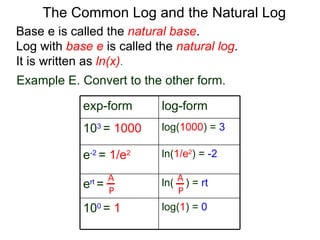
Base e is called the  natural base .  Log with  base e  is called the  natural log . It is written as  ln(x) . The Common Log and the Natural Log Example E. Convert to the other form.  A P A P exp-form log-form 10 3  =   1000 log( 1000 ) =  3 e -2  =   1/e 2 ln( 1/e 2 ) =   -2 e rt  = ln(  ) =   rt 10 0  =   1 l og ( 1 ) =   0
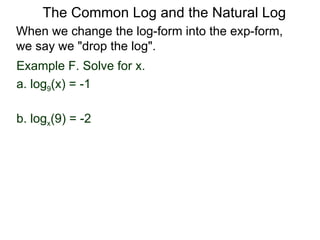
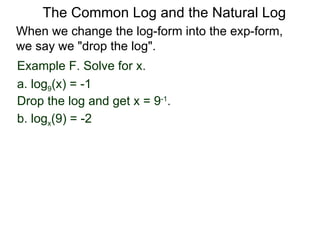
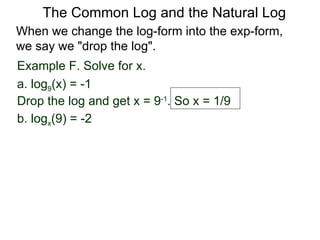
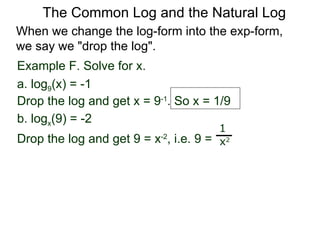
When we change the log-form into the exp-form,  we say we &quot;drop the log&quot;.  The Common Log and the Natural Log
Example F. Solve for x. a. log 9 (x) = -1 b. log x (9) = -2  When we change the log-form into the exp-form,  we say we &quot;drop the log&quot;.  The Common Log and the Natural Log
Example F. Solve for x. a. log 9 (x) = -1 Drop the log and get x = 9 -1 .  b. log x (9) = -2  When we change the log-form into the exp-form,  we say we &quot;drop the log&quot;.  The Common Log and the Natural Log
Example F. Solve for x. a. log 9 (x) = -1 Drop the log and get x = 9 -1 . So x = 1/9 b. log x (9) = -2  When we change the log-form into the exp-form,  we say we &quot;drop the log&quot;.  The Common Log and the Natural Log
Example F. Solve for x. a. log 9 (x) = -1 Drop the log and get x = 9 -1 . So x = 1/9 b. log x (9) = -2  Drop the log and get 9 = x -2 , i.e. 9 =  1 x 2 When we change the log-form into the exp-form,  we say we &quot;drop the log&quot;.  The Common Log and the Natural Log
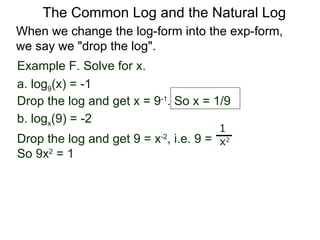
Example F. Solve for x. a. log 9 (x) = -1 Drop the log and get x = 9 -1 . So x = 1/9 b. log x (9) = -2  Drop the log and get 9 = x -2 , i.e. 9 =  So 9x 2  = 1  1 x 2 When we change the log-form into the exp-form,  we say we &quot;drop the log&quot;.  The Common Log and the Natural Log
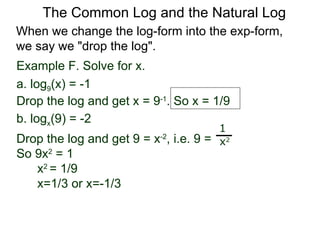
Example F. Solve for x. a. log 9 (x) = -1 Drop the log and get x = 9 -1 . So x = 1/9 b. log x (9) = -2  Drop the log and get 9 = x -2 , i.e. 9 =  So 9x 2  = 1  x 2  = 1/9  x=1/3 or x=-1/3 1 x 2 When we change the log-form into the exp-form,  we say we &quot;drop the log&quot;.  The Common Log and the Natural Log
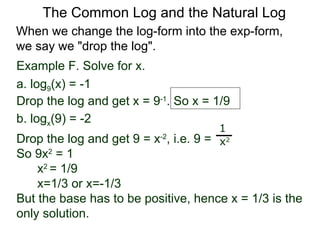
Example F. Solve for x. a. log 9 (x) = -1 Drop the log and get x = 9 -1 . So x = 1/9 b. log x (9) = -2  Drop the log and get 9 = x -2 , i.e. 9 =  So 9x 2  = 1  x 2  = 1/9  x=1/3 or x=-1/3 But the base has to be positive, hence x = 1/3 is the only solution. 1 x 2 When we change the log-form into the exp-form,  we say we &quot;drop the log&quot;.  The Common Log and the Natural Log
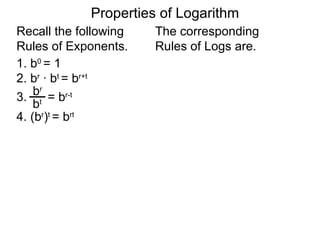
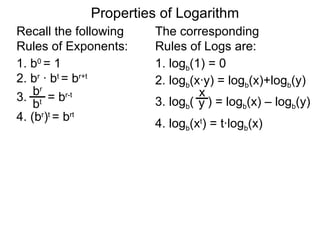
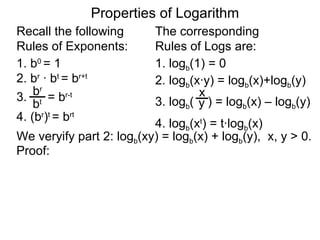
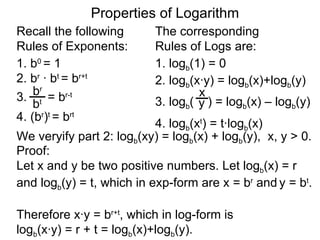
1. b 0  = 1 2. b r   ·  b t  = b r+t 3.  = b r-t 4. (b r ) t  = b rt b t b r Properties of Logarithm Recall the following  Rules of Exponents.  The corresponding  Rules of Logs are.
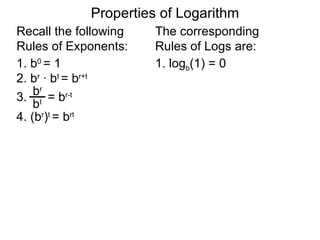
1. log b (1) = 0 1. b 0  = 1 2. b r   ·  b t  = b r+t 3.  = b r-t 4. (b r ) t  = b rt b t b r Properties of Logarithm Recall the following  Rules of Exponents:  The corresponding  Rules of Logs are:
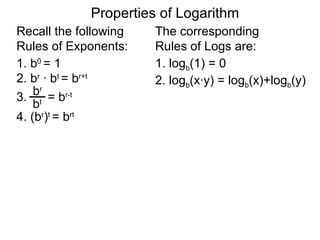
1. log b (1) = 0 2.  log b (x·y) = log b (x)+log b (y) 1. b 0  = 1 2. b r   ·  b t  = b r+t 3.  = b r-t 4. (b r ) t  = b rt b t b r Properties of Logarithm Recall the following  Rules of Exponents:  The corresponding  Rules of Logs are:
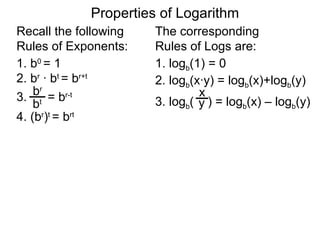
1. log b (1) = 0 2.  log b (x·y) = log b (x)+log b (y)  3. log b (  ) = log b (x) – log b (y) x y 1. b 0  = 1 2. b r   ·  b t  = b r+t 3.  = b r-t 4. (b r ) t  = b rt b t b r Properties of Logarithm Recall the following  Rules of Exponents:  The corresponding  Rules of Logs are:
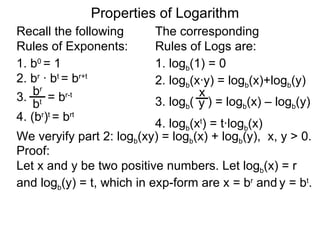
1. log b (1) = 0 2.  log b (x·y) = log b (x)+log b (y)  3. log b (  ) = log b (x) – log b (y) 4. log b (x t ) = t·log b (x) x y 1. b 0  = 1 2. b r   ·  b t  = b r+t 3.  = b r-t 4. (b r ) t  = b rt b t b r Properties of Logarithm Recall the following  Rules of Exponents:  The corresponding  Rules of Logs are:
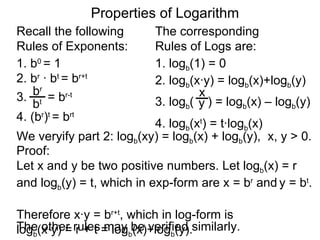
1. log b (1) = 0 2.  log b (x·y) = log b (x)+log b (y)  3. log b (  ) = log b (x) – log b (y) 4. log b (x t ) = t·log b (x) x y 1. b 0  = 1 2. b r   ·  b t  = b r+t 3.  = b r-t 4. (b r ) t  = b rt b t b r Properties of Logarithm Recall the following  Rules of Exponents:  The corresponding  Rules of Logs are: We veryify part 2: log b (xy) = log b (x) + log b (y),  x, y > 0.  Proof:
1. log b (1) = 0 2.  log b (x·y) = log b (x)+log b (y)  3. log b (  ) = log b (x) – log b (y) 4. log b (x t ) = t·log b (x) x y 1. b 0  = 1 2. b r   ·  b t  = b r+t 3.  = b r-t 4. (b r ) t  = b rt b t b r Properties of Logarithm Recall the following  Rules of Exponents:  The corresponding  Rules of Logs are: We veryify part 2: log b (xy) = log b (x) + log b (y),  x, y > 0.  Proof: Let x and y be two positive numbers.
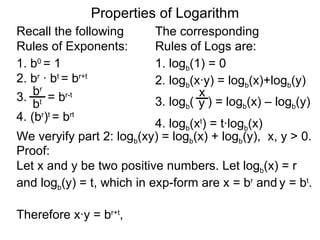
1. log b (1) = 0 2.  log b (x·y) = log b (x)+log b (y)  3. log b (  ) = log b (x) – log b (y) 4. log b (x t ) = t·log b (x) x y 1. b 0  = 1 2. b r   ·  b t  = b r+t 3.  = b r-t 4. (b r ) t  = b rt b t b r Properties of Logarithm Recall the following  Rules of Exponents:  The corresponding  Rules of Logs are: We veryify part 2: log b (xy) = log b (x) + log b (y),  x, y > 0.  Proof: Let x and y be two positive numbers. Let log b (x) = r  and log b (y) = t, which in exp-form are x = b r  and   y = b t .
1. log b (1) = 0 2.  log b (x·y) = log b (x)+log b (y)  3. log b (  ) = log b (x) – log b (y) 4. log b (x t ) = t·log b (x) x y 1. b 0  = 1 2. b r   ·  b t  = b r+t 3.  = b r-t 4. (b r ) t  = b rt b t b r Properties of Logarithm Recall the following  Rules of Exponents:  The corresponding  Rules of Logs are: We veryify part 2: log b (xy) = log b (x) + log b (y),  x, y > 0.  Proof: Let x and y be two positive numbers. Let log b (x) = r  and log b (y) = t, which in exp-form are x = b r  and   y = b t .  Therefore x·y = b r+t ,
1. log b (1) = 0 2.  log b (x·y) = log b (x)+log b (y)  3. log b (  ) = log b (x) – log b (y) 4. log b (x t ) = t·log b (x) x y 1. b 0  = 1 2. b r   ·  b t  = b r+t 3.  = b r-t 4. (b r ) t  = b rt b t b r Properties of Logarithm Recall the following  Rules of Exponents:  The corresponding  Rules of Logs are: We veryify part 2: log b (xy) = log b (x) + log b (y),  x, y > 0.  Proof: Let x and y be two positive numbers. Let log b (x) = r  and log b (y) = t, which in exp-form are x = b r  and   y = b t .  Therefore x·y = b r+t , which in log-form is   log b (x·y) = r + t = log b (x)+log b (y).
1. log b (1) = 0 2.  log b (x·y) = log b (x)+log b (y)  3. log b (  ) = log b (x) – log b (y) 4. log b (x t ) = t·log b (x) x y 1. b 0  = 1 2. b r   ·  b t  = b r+t 3.  = b r-t 4. (b r ) t  = b rt b t b r Properties of Logarithm Recall the following  Rules of Exponents:  The corresponding  Rules of Logs are: We veryify part 2: log b (xy) = log b (x) + log b (y),  x, y > 0.  Proof: Let x and y be two positive numbers. Let log b (x) = r  and log b (y) = t, which in exp-form are x = b r  and   y = b t .  Therefore x·y = b r+t , which in log-form is   log b (x·y) = r + t = log b (x)+log b (y).  The other rules may be verified similarly.
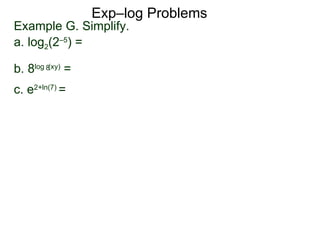
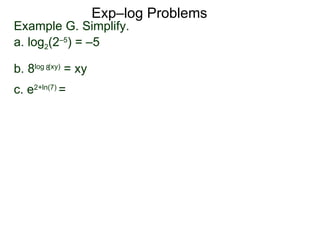
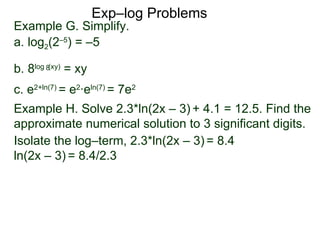
Exp–log Problems Example G. Simplify.  a. log 2 (2 –5 ) = b. 8 log  (xy)  = c. e 2 + ln(7)  = 8
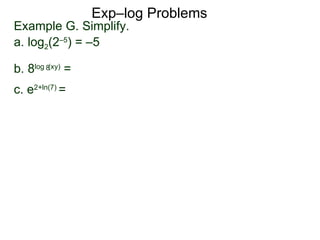
Exp–log Problems Example G. Simplify.  a. log 2 (2 –5 ) = –5 b. 8 log  (xy)  = c. e 2 + ln(7)  = 8
Exp–log Problems Example G. Simplify.  a. log 2 (2 –5 ) = –5 b. 8 log  (xy)  = xy c. e 2 + ln(7)  = 8
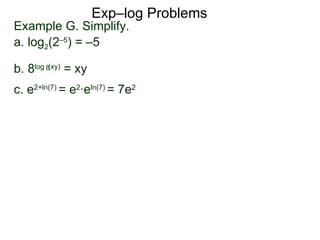
Exp–log Problems Example G. Simplify.  a. log 2 (2 –5 ) = –5 b. 8 log  (xy)  = xy c. e 2 + ln(7)  = e 2 ·e ln(7)  = 7e 2 8
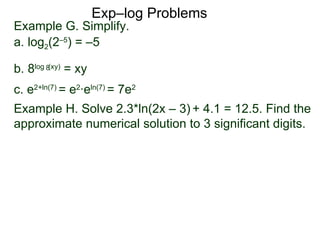
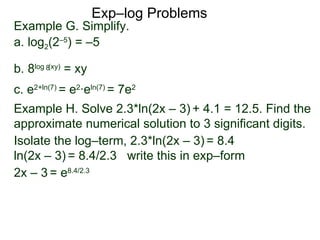
Exp–log Problems Example G. Simplify.  a. log 2 (2 –5 ) = –5 b. 8 log  (xy)  = xy c. e 2 + ln(7)  = e 2 ·e ln(7)  = 7e 2 Example H. Solve 2.3*ln(2x – 3)   + 4.1 = 12.5. Find the approximate numerical solution to 3 significant digits.  8
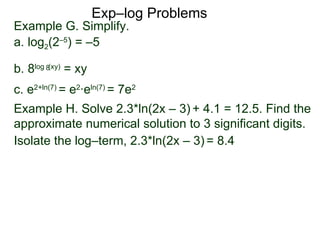
Exp–log Problems Example G. Simplify.  a. log 2 (2 –5 ) = –5 b. 8 log  (xy)  = xy c. e 2 + ln(7)  = e 2 ·e ln(7)  = 7e 2 Example H. Solve 2.3*ln(2x – 3)   + 4.1 = 12.5. Find the approximate numerical solution to 3 significant digits.  Isolate the log–term, 2.3*ln(2x – 3)   = 8.4 8
Exp–log Problems Example G. Simplify.  a. log 2 (2 –5 ) = –5 b. 8 log  (xy)  = xy c. e 2 + ln(7)  = e 2 ·e ln(7)  = 7e 2 Example H. Solve 2.3*ln(2x – 3)   + 4.1 = 12.5. Find the approximate numerical solution to 3 significant digits.  Isolate the log–term, 2.3*ln(2x – 3)   = 8.4 ln(2x – 3)   = 8.4/2.3 8
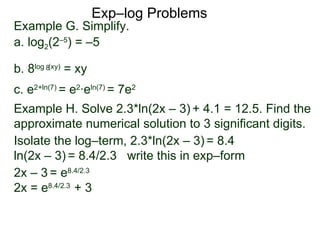
Exp–log Problems Example G. Simplify.  a. log 2 (2 –5 ) = –5 b. 8 log  (xy)  = xy c. e 2 + ln(7)  = e 2 ·e ln(7)  = 7e 2 Example H. Solve 2.3*ln(2x – 3)   + 4.1 = 12.5. Find the approximate numerical solution to 3 significant digits.  Isolate the log–term, 2.3*ln(2x – 3)   = 8.4 ln(2x – 3)   = 8.4/2.3  write this in exp–form  2x – 3   = e 8.4/2.3 8
Exp–log Problems Example G. Simplify.  a. log 2 (2 –5 ) = –5 b. 8 log  (xy)  = xy c. e 2 + ln(7)  = e 2 ·e ln(7)  = 7e 2 Example H. Solve 2.3*ln(2x – 3)   + 4.1 = 12.5. Find the approximate numerical solution to 3 significant digits.  Isolate the log–term, 2.3*ln(2x – 3)   = 8.4 ln(2x – 3)   = 8.4/2.3  write this in exp–form  2x – 3   = e 8.4/2.3 2x = e 8.4/2.3  + 3 8
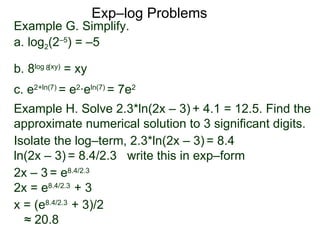
Exp–log Problems Example G. Simplify.  a. log 2 (2 –5 ) = –5 b. 8 log  (xy)  = xy c. e 2 + ln(7)  = e 2 ·e ln(7)  = 7e 2 Example H. Solve 2.3*ln(2x – 3)   + 4.1 = 12.5. Find the approximate numerical solution to 3 significant digits.  Isolate the log–term, 2.3*ln(2x – 3)   = 8.4 ln(2x – 3)   = 8.4/2.3  write this in exp–form  2x – 3   = e 8.4/2.3 2x = e 8.4/2.3  + 3 x = (e 8.4/2.3  + 3)/2  ≈  20.8 8
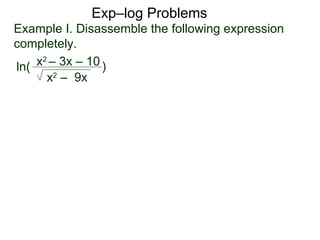
Exp–log Problems ln( Example I. Disassemble the following expression completely. x 2  – 3x – 10 x 2  –  9x )
Exp–log Problems ln( Example I. Disassemble the following expression completely. x 2  – 3x – 10 x 2  –  9x ) ln[ (x   – 5)(x + 2) x(x – 9) ] =
Exp–log Problems ln( Example I. Disassemble the following expression completely. x 2  – 3x – 10 x 2  –  9x ) ln[ (x   – 5)(x + 2) x(x – 9) ] = ln[(x – 5)(x + 2)] – ½ ln[x(x – 9)] =
Exp–log Problems ln( Example I. Disassemble the following expression completely. x 2  – 3x – 10 x 2  –  9x ) ln[ (x   – 5)(x + 2) x(x – 9) ] = ln(x – 5) + ln(x + 2) – ln(x)/2 – ln(x – 9)/2  = ln[(x – 5)(x + 2)] – ½ ln[x(x – 9)] =

1.4 review on log exp-functions

  • 1.
    The Exponential–Logarithmic FunctionsFunctions of the form f(x) = b x (b > 0) are called exponential functions in base b.
  • 2.
    The Exponential–Logarithmic FunctionsFunctions of the form f(x) = b x (b > 0) are called exponential functions in base b. We may easily plot their graphs as shown below.
  • 3.
    The Exponential–Logarithmic FunctionsFunctions of the form f(x) = b x (b > 0) are called exponential functions in base b. We may easily plot their graphs as shown below. x y y = f(x) = b x with 1 < b (1, 0)
  • 4.
    The Exponential–Logarithmic FunctionsFunctions of the form f(x) = b x (b > 0) are called exponential functions in base b. We may easily plot their graphs as shown below. x y x y y = f(x) = b x with 1 < b y = f(x) = b x with 0 < b < 1 (1, 0) (1, 0)
  • 5.
    The Exponential–Logarithmic FunctionsFunctions of the form f(x) = b x (b > 0) are called exponential functions in base b. We may easily plot their graphs as shown below. x y x y y = f(x) = b x with 1 < b y = f(x) = b x with 0 < b < 1 (1, 0) (1, 0) The exponential functions are conceptually easy to understand but log takes more thinking.
  • 6.
    The Exponential–Logarithmic FunctionsFunctions of the form f(x) = b x (b > 0) are called exponential functions in base b.
  • 7.
    The Exponential–Logarithmic FunctionsFunctions of the form f(x) = b x (b > 0) are called exponential functions in base b. Let f(x) = y = 2 x , the base–2 exponential function, at x = 3 we have that 2 3 = 8
  • 8.
    The Exponential–Logarithmic FunctionsFunctions of the form f(x) = b x (b > 0) are called exponential functions in base b. Let f(x) = y = 2 x , the base–2 exponential function, at x = 3 we have that 2 3 = 8 or the “(base) 2 raised to the power 3 gives 8”.
  • 9.
    The Exponential–Logarithmic FunctionsFunctions of the form f(x) = b x (b > 0) are called exponential functions in base b. Let f(x) = y = 2 x , the base–2 exponential function, at x = 3 we have that 2 3 = 8 or the “(base) 2 raised to the power 3 gives 8”. The relation 2 3 = 8 between 2, 3, and 8 expressed in this manner is said to be in the exponential form .
  • 10.
    The Exponential–Logarithmic FunctionsFunctions of the form f(x) = b x (b > 0) are called exponential functions in base b. Let f(x) = y = 2 x , the base–2 exponential function, at x = 3 we have that 2 3 = 8 or the “(base) 2 raised to the power 3 gives 8”. The relation 2 3 = 8 between 2, 3, and 8 expressed in this manner is said to be in the exponential form . In the exponential form the focus is the outcome of “taking 2 to the whatever–power”.
  • 11.
    The Exponential–Logarithmic FunctionsFunctions of the form f(x) = b x (b > 0) are called exponential functions in base b. Let f(x) = y = 2 x , the base–2 exponential function, at x = 3 we have that 2 3 = 8 or the “(base) 2 raised to the power 3 gives 8”. The relation 2 3 = 8 between 2, 3, and 8 expressed in this manner is said to be in the exponential form . In the exponential form the focus is the outcome of “taking 2 to the whatever–power”. But if we want to find the exponent and ask instead “given that the outcome is 8 in raising 2 to a power, what was the power p ?” i.e. 2 p = 8,
  • 12.
    The Exponential–Logarithmic FunctionsFunctions of the form f(x) = b x (b > 0) are called exponential functions in base b. Let f(x) = y = 2 x , the base–2 exponential function, at x = 3 we have that 2 3 = 8 or the “(base) 2 raised to the power 3 gives 8”. The relation 2 3 = 8 between 2, 3, and 8 expressed in this manner is said to be in the exponential form . In the exponential form the focus is the outcome of “taking 2 to the whatever–power”. But if we want to find the exponent and ask instead “given that the outcome is 8 in raising 2 to a power, what was the power p ?” i.e. 2 p = 8, this question is written as “log 2 ( 8 ) = p ”
  • 13.
    The Exponential–Logarithmic FunctionsFunctions of the form f(x) = b x (b > 0) are called exponential functions in base b. Let f(x) = y = 2 x , the base–2 exponential function, at x = 3 we have that 2 3 = 8 or the “(base) 2 raised to the power 3 gives 8”. The relation 2 3 = 8 between 2, 3, and 8 expressed in this manner is said to be in the exponential form . In the exponential form the focus is the outcome of “taking 2 to the whatever–power”. But if we want to find the exponent and ask instead “given that the outcome is 8 in raising 2 to a power, what was the power p ?” i.e. 2 p = 8, this question is written as “log 2 ( 8 ) = p ” and of course log 2 ( 8 ) = 3 .
  • 14.
    The Exponential–Logarithmic FunctionsFunctions of the form f(x) = b x (b > 0) are called exponential functions in base b. Let f(x) = y = 2 x , the base–2 exponential function, at x = 3 we have that 2 3 = 8 or the “(base) 2 raised to the power 3 gives 8”. The relation 2 3 = 8 between 2, 3, and 8 expressed in this manner is said to be in the exponential form . In the exponential form the focus is the outcome of “taking 2 to the whatever–power”. But if we want to find the exponent and ask instead “given that the outcome is 8 in raising 2 to a power, what was the power p ?” i.e. 2 p = 8, this question is written as “log 2 ( 8 ) = p ” and of course log 2 ( 8 ) = 3 . The base–power–output relation between 2, 3, and 8 expressed as log 2 (8) = 3 is said to be in the log–form .
  • 15.
    The Logarithmic FunctionsThe log b (y) represents the exponent x where x is the exponent needed (with base b) to get y.
  • 16.
    The Logarithmic FunctionsThe log b (y) represents the exponent x where x is the exponent needed (with base b) to get y. The exponential form b x = y and the log–form x = log b (y) describe the same relation between the numbers b, x and y.
  • 17.
    The Logarithmic FunctionsThe log b (y) represents the exponent x where x is the exponent needed (with base b) to get y. The exponential form b x = y and the log–form x = log b (y) describe the same relation between the numbers b, x and y. Questions stated in one form often need to be translated into the other form before solving.
  • 18.
    The Logarithmic FunctionsThe log b (y) represents the exponent x where x is the exponent needed (with base b) to get y. The exponential form b x = y and the log–form x = log b (y) describe the same relation between the numbers b, x and y. Questions stated in one form often need to be translated into the other form before solving. In these situations, always identify the base number b first.
  • 19.
    The Logarithmic FunctionsThe log b (y) represents the exponent x where x is the exponent needed (with base b) to get y. The exponential form b x = y and the log–form x = log b (y) describe the same relation between the numbers b, x and y. Questions stated in one form often need to be translated into the other form before solving. In these situations, always identify the base number b first. Example B. Rewrite the exp-form into the log-form. a. 4 2 = 16 b. w = u 2+v
  • 20.
    The Logarithmic FunctionsThe log b (y) represents the exponent x where x is the exponent needed (with base b) to get y. The exponential form b x = y and the log–form x = log b (y) describe the same relation between the numbers b, x and y. Questions stated in one form often need to be translated into the other form before solving. In these situations, always identify the base number b first. Example B. Rewrite the exp-form into the log-form. a. 4 2 = 16  2 = log 4 (16) b. w = u 2+v
  • 21.
    The Logarithmic FunctionsThe log b (y) represents the exponent x where x is the exponent needed (with base b) to get y. The exponential form b x = y and the log–form x = log b (y) describe the same relation between the numbers b, x and y. Questions stated in one form often need to be translated into the other form before solving. In these situations, always identify the base number b first. Example B. Rewrite the exp-form into the log-form. a. 4 2 = 16  2 = log 4 (16) b. w = u 2+v  log u (w) = 2+v
  • 22.
    The Logarithmic FunctionsThe log b (y) represents the exponent x where x is the exponent needed (with base b) to get y. The exponential form b x = y and the log–form x = log b (y) describe the same relation between the numbers b, x and y. Questions stated in one form often need to be translated into the other form before solving. In these situations, always identify the base number b first. Example C. Rewrite the log-form into the exp-form. a. log 3 (1/9) = b. 2w = Example B. Rewrite the exp-form into the log-form. a. 4 2 = 16  2 = log 4 (16) b. w = u 2+v  log u (w) = 2+v
  • 23.
    The Logarithmic FunctionsThe log b (y) represents the exponent x where x is the exponent needed (with base b) to get y. The exponential form b x = y and the log–form x = log b (y) describe the same relation between the numbers b, x and y. Questions stated in one form often need to be translated into the other form before solving. In these situations, always identify the base number b first. Example C. Rewrite the log-form into the exp-form. a. log 3 (1/9) = – 2  1/9 = 3 -2 b. 2w = Example B. Rewrite the exp-form into the log-form. a. 4 2 = 16  2 = log 4 (16) b. w = u 2+v  log u (w) = 2+v
  • 24.
    The Logarithmic FunctionsThe log b (y) represents the exponent x where x is the exponent needed (with base b) to get y. The exponential form b x = y and the log–form x = log b (y) describe the same relation between the numbers b, x and y. Questions stated in one form often need to be translated into the other form before solving. In these situations, always identify the base number b first. Example C. Rewrite the log-form into the exp-form. a. log 3 (1/9) = – 2  1/9 = 3 -2 b. 2w = log v (a – b)  a – b = v 2w Example B. Rewrite the exp-form into the log-form. a. 4 2 = 16  2 = log 4 (16) b. w = u 2+v  log u (w) = 2+v
  • 25.
    The domain oflog b (y) is the set of all y > 0. The Logarithmic Functions
  • 26.
    The domain oflog b (y) is the set of all y > 0. For example, log 2 (–1) doesn't exist because there is no exponent p such that 2 p = –1. The Logarithmic Functions
  • 27.
    The domain oflog b (y) is the set of all y > 0. For example, log 2 (–1) doesn't exist because there is no exponent p such that 2 p = –1. We use the variables u and v for the next graph. The Logarithmic Functions
  • 28.
    The domain oflog b (y) is the set of all y > 0. For example, log 2 (–1) doesn't exist because there is no exponent p such that 2 p = –1. We use the variables u and v for the next graph. The Logarithmic Functions Example D. Make a table and graph u = log 2 (v).
  • 29.
    The domain oflog b (y) is the set of all y > 0. For example, log 2 (–1) doesn't exist because there is no exponent p such that 2 p = –1. We use the variables u and v for the next graph. The Logarithmic Functions u v=log 2 (u) Example D. Make a table and graph u = log 2 (v).
  • 30.
    The domain oflog b (y) is the set of all y > 0. For example, log 2 (–1) doesn't exist because there is no exponent p such that 2 p = –1. We use the variables u and v for the next graph. The Logarithmic Functions u v=log 2 (u) Example D. Make a table and graph u = log 2 (v). 1/4 1/2 1 2 4 8
  • 31.
    The domain oflog b (y) is the set of all y > 0. For example, log 2 (–1) doesn't exist because there is no exponent p such that 2 p = –1. We use the variables u and v for the next graph. The Logarithmic Functions u v=log 2 (u) Example D. Make a table and graph u = log 2 (v). 1/4 1/2 1 2 4 8 3
  • 32.
    The domain oflog b (y) is the set of all y > 0. For example, log 2 (–1) doesn't exist because there is no exponent p such that 2 p = –1. We use the variables u and v for the next graph. The Logarithmic Functions u v=log 2 (u) Example D. Make a table and graph u = log 2 (v). 1/4 1/2 1 2 1 4 2 8 3
  • 33.
    The domain oflog b (y) is the set of all y > 0. For example, log 2 (–1) doesn't exist because there is no exponent p such that 2 p = –1. We use the variables u and v for the next graph. The Logarithmic Functions u v=log 2 (u) Example D. Make a table and graph u = log 2 (v). 1/4 -2 1/2 -1 1 0 2 1 4 2 8 3
  • 34.
    The domain oflog b (y) is the set of all y > 0. For example, log 2 (–1) doesn't exist because there is no exponent p such that 2 p = –1. We use the variables u and v for the next graph. The Logarithmic Functions u v=log 2 (u) Example D. Make a table and graph u = log 2 (v). 1/4 -2 1/2 -1 1 0 2 1 4 2 8 3
  • 35.
    y = logb (x) for b > 1. The Logarithmic Functions y x (1, 0)
  • 36.
    y = logb (x) for b > 1. The Logarithmic Functions y = log b (x) for 1 > b > 0. y x x y (1, 0) (1, 0)
  • 37.
    y = logb (x) for b > 1. The Logarithmic Functions y = log b (x) for 1 > b > 0. y x x y (1, 0) (1, 0) The Common Log and the Natural Log
  • 38.
    y = logb (x) for b > 1. The Logarithmic Functions y = log b (x) for 1 > b > 0. y x x y (1, 0) (1, 0) The most often used bases are 10 and e. The Common Log and the Natural Log
  • 39.
    y = logb (x) for b > 1. The Logarithmic Functions y = log b (x) for 1 > b > 0. y x x y (1, 0) (1, 0) The most often used bases are 10 and e. Base 10 is called the common base . The Common Log and the Natural Log
  • 40.
    y = logb (x) for b > 1. The Logarithmic Functions y = log b (x) for 1 > b > 0. y x x y (1, 0) (1, 0) The most often used bases are 10 and e. Base 10 is called the common base . Log with base10 is called the common log . The Common Log and the Natural Log
  • 41.
    y = logb (x) for b > 1. The Logarithmic Functions y = log b (x) for 1 > b > 0. y x x y (1, 0) (1, 0) The most often used bases are 10 and e. Base 10 is called the common base . Log with base10 is called the common log . It is written as log(x) without the base number b. The Common Log and the Natural Log
  • 42.
    Base e iscalled the natural base . The Common Log and the Natural Log
  • 43.
    Base e iscalled the natural base . Log with base e is called the natural log . The Common Log and the Natural Log
  • 44.
    Base e iscalled the natural base . Log with base e is called the natural log . It is written as ln(x) . The Common Log and the Natural Log
  • 45.
    Base e iscalled the natural base . Log with base e is called the natural log . It is written as ln(x) . The Common Log and the Natural Log Example E. Convert to the other form. A P exp-form log-form 10 3 = 1000 ln( 1/e 2 ) = -2 e rt = l og ( 1 ) = 0
  • 46.
    Base e iscalled the natural base . Log with base e is called the natural log . It is written as ln(x) . The Common Log and the Natural Log Example E. Convert to the other form. A P exp-form log-form 10 3 = 1000 log( 1000 ) = 3 ln( 1/e 2 ) = -2 e rt = l og ( 1 ) = 0
  • 47.
    Base e iscalled the natural base . Log with base e is called the natural log . It is written as ln(x) . The Common Log and the Natural Log Example E. Convert to the other form. A P exp-form log-form 10 3 = 1000 log( 1000 ) = 3 e -2 = 1/e 2 ln( 1/e 2 ) = -2 e rt = l og ( 1 ) = 0
  • 48.
    Base e iscalled the natural base . Log with base e is called the natural log . It is written as ln(x) . The Common Log and the Natural Log Example E. Convert to the other form. A P A P exp-form log-form 10 3 = 1000 log( 1000 ) = 3 e -2 = 1/e 2 ln( 1/e 2 ) = -2 e rt = ln( ) = rt l og ( 1 ) = 0
  • 49.
    Base e iscalled the natural base . Log with base e is called the natural log . It is written as ln(x) . The Common Log and the Natural Log Example E. Convert to the other form. A P A P exp-form log-form 10 3 = 1000 log( 1000 ) = 3 e -2 = 1/e 2 ln( 1/e 2 ) = -2 e rt = ln( ) = rt 10 0 = 1 l og ( 1 ) = 0
  • 50.
    When we changethe log-form into the exp-form, we say we &quot;drop the log&quot;. The Common Log and the Natural Log
  • 51.
    Example F. Solvefor x. a. log 9 (x) = -1 b. log x (9) = -2 When we change the log-form into the exp-form, we say we &quot;drop the log&quot;. The Common Log and the Natural Log
  • 52.
    Example F. Solvefor x. a. log 9 (x) = -1 Drop the log and get x = 9 -1 . b. log x (9) = -2 When we change the log-form into the exp-form, we say we &quot;drop the log&quot;. The Common Log and the Natural Log
  • 53.
    Example F. Solvefor x. a. log 9 (x) = -1 Drop the log and get x = 9 -1 . So x = 1/9 b. log x (9) = -2 When we change the log-form into the exp-form, we say we &quot;drop the log&quot;. The Common Log and the Natural Log
  • 54.
    Example F. Solvefor x. a. log 9 (x) = -1 Drop the log and get x = 9 -1 . So x = 1/9 b. log x (9) = -2 Drop the log and get 9 = x -2 , i.e. 9 = 1 x 2 When we change the log-form into the exp-form, we say we &quot;drop the log&quot;. The Common Log and the Natural Log
  • 55.
    Example F. Solvefor x. a. log 9 (x) = -1 Drop the log and get x = 9 -1 . So x = 1/9 b. log x (9) = -2 Drop the log and get 9 = x -2 , i.e. 9 = So 9x 2 = 1 1 x 2 When we change the log-form into the exp-form, we say we &quot;drop the log&quot;. The Common Log and the Natural Log
  • 56.
    Example F. Solvefor x. a. log 9 (x) = -1 Drop the log and get x = 9 -1 . So x = 1/9 b. log x (9) = -2 Drop the log and get 9 = x -2 , i.e. 9 = So 9x 2 = 1 x 2 = 1/9 x=1/3 or x=-1/3 1 x 2 When we change the log-form into the exp-form, we say we &quot;drop the log&quot;. The Common Log and the Natural Log
  • 57.
    Example F. Solvefor x. a. log 9 (x) = -1 Drop the log and get x = 9 -1 . So x = 1/9 b. log x (9) = -2 Drop the log and get 9 = x -2 , i.e. 9 = So 9x 2 = 1 x 2 = 1/9 x=1/3 or x=-1/3 But the base has to be positive, hence x = 1/3 is the only solution. 1 x 2 When we change the log-form into the exp-form, we say we &quot;drop the log&quot;. The Common Log and the Natural Log
  • 58.
    1. b 0 = 1 2. b r · b t = b r+t 3. = b r-t 4. (b r ) t = b rt b t b r Properties of Logarithm Recall the following Rules of Exponents. The corresponding Rules of Logs are.
  • 59.
    1. log b(1) = 0 1. b 0 = 1 2. b r · b t = b r+t 3. = b r-t 4. (b r ) t = b rt b t b r Properties of Logarithm Recall the following Rules of Exponents: The corresponding Rules of Logs are:
  • 60.
    1. log b(1) = 0 2. log b (x·y) = log b (x)+log b (y) 1. b 0 = 1 2. b r · b t = b r+t 3. = b r-t 4. (b r ) t = b rt b t b r Properties of Logarithm Recall the following Rules of Exponents: The corresponding Rules of Logs are:
  • 61.
    1. log b(1) = 0 2. log b (x·y) = log b (x)+log b (y) 3. log b ( ) = log b (x) – log b (y) x y 1. b 0 = 1 2. b r · b t = b r+t 3. = b r-t 4. (b r ) t = b rt b t b r Properties of Logarithm Recall the following Rules of Exponents: The corresponding Rules of Logs are:
  • 62.
    1. log b(1) = 0 2. log b (x·y) = log b (x)+log b (y) 3. log b ( ) = log b (x) – log b (y) 4. log b (x t ) = t·log b (x) x y 1. b 0 = 1 2. b r · b t = b r+t 3. = b r-t 4. (b r ) t = b rt b t b r Properties of Logarithm Recall the following Rules of Exponents: The corresponding Rules of Logs are:
  • 63.
    1. log b(1) = 0 2. log b (x·y) = log b (x)+log b (y) 3. log b ( ) = log b (x) – log b (y) 4. log b (x t ) = t·log b (x) x y 1. b 0 = 1 2. b r · b t = b r+t 3. = b r-t 4. (b r ) t = b rt b t b r Properties of Logarithm Recall the following Rules of Exponents: The corresponding Rules of Logs are: We veryify part 2: log b (xy) = log b (x) + log b (y), x, y > 0. Proof:
  • 64.
    1. log b(1) = 0 2. log b (x·y) = log b (x)+log b (y) 3. log b ( ) = log b (x) – log b (y) 4. log b (x t ) = t·log b (x) x y 1. b 0 = 1 2. b r · b t = b r+t 3. = b r-t 4. (b r ) t = b rt b t b r Properties of Logarithm Recall the following Rules of Exponents: The corresponding Rules of Logs are: We veryify part 2: log b (xy) = log b (x) + log b (y), x, y > 0. Proof: Let x and y be two positive numbers.
  • 65.
    1. log b(1) = 0 2. log b (x·y) = log b (x)+log b (y) 3. log b ( ) = log b (x) – log b (y) 4. log b (x t ) = t·log b (x) x y 1. b 0 = 1 2. b r · b t = b r+t 3. = b r-t 4. (b r ) t = b rt b t b r Properties of Logarithm Recall the following Rules of Exponents: The corresponding Rules of Logs are: We veryify part 2: log b (xy) = log b (x) + log b (y), x, y > 0. Proof: Let x and y be two positive numbers. Let log b (x) = r and log b (y) = t, which in exp-form are x = b r and y = b t .
  • 66.
    1. log b(1) = 0 2. log b (x·y) = log b (x)+log b (y) 3. log b ( ) = log b (x) – log b (y) 4. log b (x t ) = t·log b (x) x y 1. b 0 = 1 2. b r · b t = b r+t 3. = b r-t 4. (b r ) t = b rt b t b r Properties of Logarithm Recall the following Rules of Exponents: The corresponding Rules of Logs are: We veryify part 2: log b (xy) = log b (x) + log b (y), x, y > 0. Proof: Let x and y be two positive numbers. Let log b (x) = r and log b (y) = t, which in exp-form are x = b r and y = b t . Therefore x·y = b r+t ,
  • 67.
    1. log b(1) = 0 2. log b (x·y) = log b (x)+log b (y) 3. log b ( ) = log b (x) – log b (y) 4. log b (x t ) = t·log b (x) x y 1. b 0 = 1 2. b r · b t = b r+t 3. = b r-t 4. (b r ) t = b rt b t b r Properties of Logarithm Recall the following Rules of Exponents: The corresponding Rules of Logs are: We veryify part 2: log b (xy) = log b (x) + log b (y), x, y > 0. Proof: Let x and y be two positive numbers. Let log b (x) = r and log b (y) = t, which in exp-form are x = b r and y = b t . Therefore x·y = b r+t , which in log-form is log b (x·y) = r + t = log b (x)+log b (y).
  • 68.
    1. log b(1) = 0 2. log b (x·y) = log b (x)+log b (y) 3. log b ( ) = log b (x) – log b (y) 4. log b (x t ) = t·log b (x) x y 1. b 0 = 1 2. b r · b t = b r+t 3. = b r-t 4. (b r ) t = b rt b t b r Properties of Logarithm Recall the following Rules of Exponents: The corresponding Rules of Logs are: We veryify part 2: log b (xy) = log b (x) + log b (y), x, y > 0. Proof: Let x and y be two positive numbers. Let log b (x) = r and log b (y) = t, which in exp-form are x = b r and y = b t . Therefore x·y = b r+t , which in log-form is log b (x·y) = r + t = log b (x)+log b (y). The other rules may be verified similarly.
  • 69.
    Exp–log Problems ExampleG. Simplify. a. log 2 (2 –5 ) = b. 8 log (xy) = c. e 2 + ln(7) = 8
  • 70.
    Exp–log Problems ExampleG. Simplify. a. log 2 (2 –5 ) = –5 b. 8 log (xy) = c. e 2 + ln(7) = 8
  • 71.
    Exp–log Problems ExampleG. Simplify. a. log 2 (2 –5 ) = –5 b. 8 log (xy) = xy c. e 2 + ln(7) = 8
  • 72.
    Exp–log Problems ExampleG. Simplify. a. log 2 (2 –5 ) = –5 b. 8 log (xy) = xy c. e 2 + ln(7) = e 2 ·e ln(7) = 7e 2 8
  • 73.
    Exp–log Problems ExampleG. Simplify. a. log 2 (2 –5 ) = –5 b. 8 log (xy) = xy c. e 2 + ln(7) = e 2 ·e ln(7) = 7e 2 Example H. Solve 2.3*ln(2x – 3) + 4.1 = 12.5. Find the approximate numerical solution to 3 significant digits. 8
  • 74.
    Exp–log Problems ExampleG. Simplify. a. log 2 (2 –5 ) = –5 b. 8 log (xy) = xy c. e 2 + ln(7) = e 2 ·e ln(7) = 7e 2 Example H. Solve 2.3*ln(2x – 3) + 4.1 = 12.5. Find the approximate numerical solution to 3 significant digits. Isolate the log–term, 2.3*ln(2x – 3) = 8.4 8
  • 75.
    Exp–log Problems ExampleG. Simplify. a. log 2 (2 –5 ) = –5 b. 8 log (xy) = xy c. e 2 + ln(7) = e 2 ·e ln(7) = 7e 2 Example H. Solve 2.3*ln(2x – 3) + 4.1 = 12.5. Find the approximate numerical solution to 3 significant digits. Isolate the log–term, 2.3*ln(2x – 3) = 8.4 ln(2x – 3) = 8.4/2.3 8
  • 76.
    Exp–log Problems ExampleG. Simplify. a. log 2 (2 –5 ) = –5 b. 8 log (xy) = xy c. e 2 + ln(7) = e 2 ·e ln(7) = 7e 2 Example H. Solve 2.3*ln(2x – 3) + 4.1 = 12.5. Find the approximate numerical solution to 3 significant digits. Isolate the log–term, 2.3*ln(2x – 3) = 8.4 ln(2x – 3) = 8.4/2.3 write this in exp–form 2x – 3 = e 8.4/2.3 8
  • 77.
    Exp–log Problems ExampleG. Simplify. a. log 2 (2 –5 ) = –5 b. 8 log (xy) = xy c. e 2 + ln(7) = e 2 ·e ln(7) = 7e 2 Example H. Solve 2.3*ln(2x – 3) + 4.1 = 12.5. Find the approximate numerical solution to 3 significant digits. Isolate the log–term, 2.3*ln(2x – 3) = 8.4 ln(2x – 3) = 8.4/2.3 write this in exp–form 2x – 3 = e 8.4/2.3 2x = e 8.4/2.3 + 3 8
  • 78.
    Exp–log Problems ExampleG. Simplify. a. log 2 (2 –5 ) = –5 b. 8 log (xy) = xy c. e 2 + ln(7) = e 2 ·e ln(7) = 7e 2 Example H. Solve 2.3*ln(2x – 3) + 4.1 = 12.5. Find the approximate numerical solution to 3 significant digits. Isolate the log–term, 2.3*ln(2x – 3) = 8.4 ln(2x – 3) = 8.4/2.3 write this in exp–form 2x – 3 = e 8.4/2.3 2x = e 8.4/2.3 + 3 x = (e 8.4/2.3 + 3)/2 ≈ 20.8 8
  • 79.
    Exp–log Problems ln(Example I. Disassemble the following expression completely. x 2 – 3x – 10 x 2 – 9x )
  • 80.
    Exp–log Problems ln(Example I. Disassemble the following expression completely. x 2 – 3x – 10 x 2 – 9x ) ln[ (x – 5)(x + 2) x(x – 9) ] =
  • 81.
    Exp–log Problems ln(Example I. Disassemble the following expression completely. x 2 – 3x – 10 x 2 – 9x ) ln[ (x – 5)(x + 2) x(x – 9) ] = ln[(x – 5)(x + 2)] – ½ ln[x(x – 9)] =
  • 82.
    Exp–log Problems ln(Example I. Disassemble the following expression completely. x 2 – 3x – 10 x 2 – 9x ) ln[ (x – 5)(x + 2) x(x – 9) ] = ln(x – 5) + ln(x + 2) – ln(x)/2 – ln(x – 9)/2 = ln[(x – 5)(x + 2)] – ½ ln[x(x – 9)] =