POLYGON MESH
Advance Computer Graphics
Farah Al-Tufaili
Kufa university – College of computer science and
mathematics
Definition
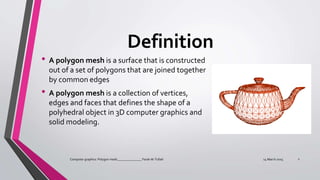
• A polygon mesh is a surface that is constructed
out of a set of polygons that are joined together
by common edges
• A polygon mesh is a collection of vertices,
edges and faces that defines the shape of a
polyhedral object in 3D computer graphics and
solid modeling.
14 March 2015 2Computer graphics: Polygon mesh_______________ Farah Al-Tufaili
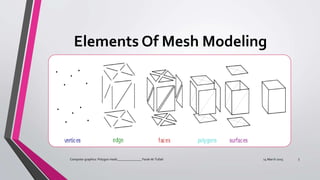
Elements Of Mesh Modeling
14 March 2015 3Computer graphics: Polygon mesh_______________ Farah Al-Tufaili
Vertex and FaceTables
Each face lists vertex
references
• Shared vertices
• Still no topology
information
14 March 2015 4Computer graphics: Polygon mesh_______________ Farah Al-Tufaili
Construction Of Polygonal Meshes
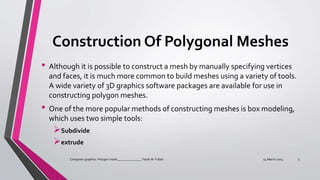
• Although it is possible to construct a mesh by manually specifying vertices
and faces, it is much more common to build meshes using a variety of tools.
A wide variety of 3D graphics software packages are available for use in
constructing polygon meshes.
• One of the more popular methods of constructing meshes is box modeling,
which uses two simple tools:
Subdivide
extrude
14 March 2015 5Computer graphics: Polygon mesh_______________ Farah Al-Tufaili
One of the more popular methods of constructing meshes is box
modeling, which uses two simple tools
• The subdivide tool splits faces and edges into smaller pieces by adding new
vertices. For example, a square would be subdivided by adding one vertex in
the center and one on each edge, creating four smaller squares.
• The extrude tool is applied to a face or a group of faces. It creates a new face
of the same size and shape which is connected to each of the existing edges
by a face.Thus, performing the extrude operation on a square face would
create a cube connected to the surface at the location of the face.
14 March 2015 6Computer graphics: Polygon mesh_______________ Farah Al-Tufaili
Construction Of Polygonal Meshes
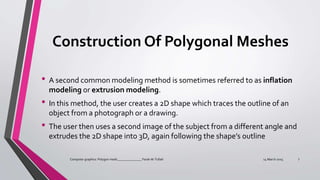
• A second common modeling method is sometimes referred to as inflation
modeling or extrusion modeling.
• In this method, the user creates a 2D shape which traces the outline of an
object from a photograph or a drawing.
• The user then uses a second image of the subject from a different angle and
extrudes the 2D shape into 3D, again following the shape’s outline
14 March 2015 7Computer graphics: Polygon mesh_______________ Farah Al-Tufaili
Extrusion modeling
• This method is especially
common for creating faces and
heads. In general, the artist will
model half of the head and then
duplicate the vertices, invert
their location relative to some
plane, and connect the two
pieces together.This ensures
that the model will be
symmetrical.
14 March 2015 8Computer graphics: Polygon mesh_______________ Farah Al-Tufaili
Construction Of Polygonal Meshes
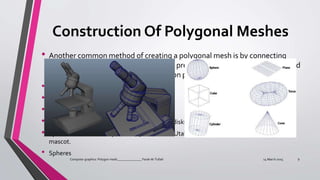
• Another common method of creating a polygonal mesh is by connecting
together various primitives, which are predefined polygonal meshes created
by the modeling environment. Common primitives include:
• Cubes
• Pyramids
• Cylinders
• 2D primitives, such as squares, triangles, and disks
• Specialized or esoteric primitives, such as the UtahTeapot or Suzanne, Blender's monkey
mascot.
• Spheres
14 March 2015 9Computer graphics: Polygon mesh_______________ Farah Al-Tufaili
polygon meshes representation
Polygon meshes may be represented in a variety of ways, using
different methods to store the vertex, edge and face data.
These include:
1. Vertex-vertex meshes
2.Face-vertex meshes
3. Winged-edge meshes
4.Render dynamic meshes
14 March 2015 10Computer graphics: Polygon mesh_______________ Farah Al-Tufaili
1- Vertex-vertex meshes
• Represent an object as a set of
vertices connected to other vertices.
This is the simplest representation,
but not widely used since the face
and edge information is implicit.
Thus, it is necessary to traverse the
data in order to generate a list of
faces for rendering. In addition,
operations on edges and faces are
not easily accomplished.
14 March 2015 11Computer graphics: Polygon mesh_______________ Farah Al-Tufaili
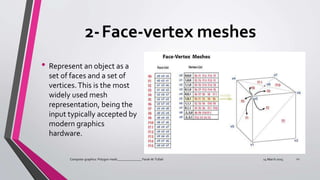
2-Face-vertex meshes
• Represent an object as a
set of faces and a set of
vertices.This is the most
widely used mesh
representation, being the
input typically accepted by
modern graphics
hardware.
14 March 2015 12Computer graphics: Polygon mesh_______________ Farah Al-Tufaili
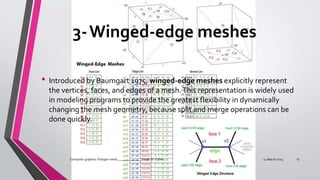
• Introduced by Baumgart 1975, winged-edge meshes explicitly represent
the vertices, faces, and edges of a mesh.This representation is widely used
in modeling programs to provide the greatest flexibility in dynamically
changing the mesh geometry, because split and merge operations can be
done quickly.
14 March 2015 13
3-Winged-edge meshes
Computer graphics: Polygon mesh_______________ Farah Al-Tufaili
4- Render dynamic meshes
• Winged-edge meshes are not the only representation which allows for
dynamic changes to geometry. A new representation which combines
winged-edge meshes and face-vertex meshes is the render dynamic mesh,
which explicitly stores both, the vertices of a face and faces of a vertex (like
FaceVertics meshes), and the faces and vertices of an edge (like winged-
edge).
14 March 2015 14Computer graphics: Polygon mesh_______________ Farah Al-Tufaili
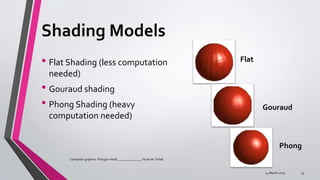
Shading Models
• Flat Shading (less computation
needed)
• Gouraud shading
• Phong Shading (heavy
computation needed)
14 March 2015 15
Flat
Gouraud
Phong
Computer graphics: Polygon mesh_______________ Farah Al-Tufaili
How to compute the normal
vectors?
• The mesh is a set of polygons
• We can compute the normal vectors for each polygon (triangle)
• We can color the whole polygon using the same normal
• vector (flat shading)
14 March 2015 16Computer graphics: Polygon mesh_______________ Farah Al-Tufaili
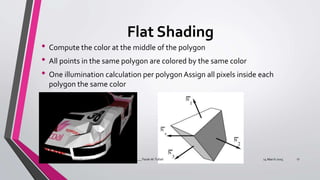
Flat Shading
• Compute the color at the middle of the polygon
• All points in the same polygon are colored by the same color
• One illumination calculation per polygon Assign all pixels inside each
polygon the same color
14 March 2015 17Computer graphics: Polygon mesh_______________ Farah Al-Tufaili
Flat Shading
• A fast and simple method.
• Gives reasonable result only if all of the following assumptions
are valid:The object is really a polyhedron.
• Light source is far away from the surface so that N•L is constant over each
polygon.
• Viewing position is far away from the surface so thatV•R is constant over
each polygon.
14 March 2015 18Computer graphics: Polygon mesh_______________ Farah Al-Tufaili
Flat Shading
• Objects look like they are composed of polygons
• OK for polyhedral objects
• Not so good for ones with smooth surfaces
14 March 2015 19Computer graphics: Polygon mesh_______________ Farah Al-Tufaili
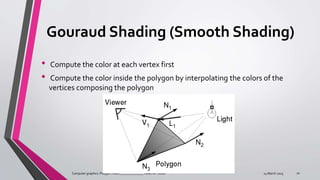
Gouraud Shading (Smooth Shading)
• Compute the color at each vertex first
• Compute the color inside the polygon by interpolating the colors of the
vertices composing the polygon
14 March 2015 20Computer graphics: Polygon mesh_______________ Farah Al-Tufaili
• Produces smoothly shaded polygonal mesh Piecewise linear approximation
• Need fine mesh to capture subtle lighting effects
14 March 2015 21
Gouraud Shading (Smooth Shading)
Computer graphics: Polygon mesh_______________ Farah Al-Tufaili
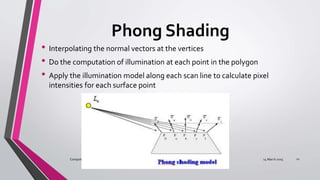
Phong Shading
• Interpolating the normal vectors at the vertices
• Do the computation of illumination at each point in the polygon
• Apply the illumination model along each scan line to calculate pixel
intensities for each surface point
14 March 2015 22Computer graphics: Polygon mesh_______________ Farah Al-Tufaili
Phong Shading
• One lighting calculation per
pixel.
• Approximate surface normals
for points inside polygons by
bilinear interpolation of
normals from vertices
14 March 2015 23Computer graphics: Polygon mesh_______________ Farah Al-Tufaili
What’s Bad About Polygons?
•What are some disadvantages of polygonal
representations?
14 March 2015 24Computer graphics: Polygon mesh_______________ Farah Al-Tufaili
Polygons Aren’t Great
• They are always an approximation to curved surfaces
• But can be as good as you want, if you are willing to pay in size
• Normal vectors are approximate
• They throw away information
• Most real-world surfaces are curved, particularly natural surfaces
• They can be very unstructured
• It is difficult to perform many geometric operations
• Results can be unduly complex, for instance
14 March 2015 25Computer graphics: Polygon mesh_______________ Farah Al-Tufaili
Thank you
for
listening
14 March 2015 26Computer graphics: Polygon mesh_______________ Farah Al-Tufaili

Polygon mesh

  • 1.
    POLYGON MESH Advance ComputerGraphics Farah Al-Tufaili Kufa university – College of computer science and mathematics
  • 2.
    Definition • A polygonmesh is a surface that is constructed out of a set of polygons that are joined together by common edges • A polygon mesh is a collection of vertices, edges and faces that defines the shape of a polyhedral object in 3D computer graphics and solid modeling. 14 March 2015 2Computer graphics: Polygon mesh_______________ Farah Al-Tufaili
  • 3.
    Elements Of MeshModeling 14 March 2015 3Computer graphics: Polygon mesh_______________ Farah Al-Tufaili
  • 4.
    Vertex and FaceTables Eachface lists vertex references • Shared vertices • Still no topology information 14 March 2015 4Computer graphics: Polygon mesh_______________ Farah Al-Tufaili
  • 5.
    Construction Of PolygonalMeshes • Although it is possible to construct a mesh by manually specifying vertices and faces, it is much more common to build meshes using a variety of tools. A wide variety of 3D graphics software packages are available for use in constructing polygon meshes. • One of the more popular methods of constructing meshes is box modeling, which uses two simple tools: Subdivide extrude 14 March 2015 5Computer graphics: Polygon mesh_______________ Farah Al-Tufaili
  • 6.
    One of themore popular methods of constructing meshes is box modeling, which uses two simple tools • The subdivide tool splits faces and edges into smaller pieces by adding new vertices. For example, a square would be subdivided by adding one vertex in the center and one on each edge, creating four smaller squares. • The extrude tool is applied to a face or a group of faces. It creates a new face of the same size and shape which is connected to each of the existing edges by a face.Thus, performing the extrude operation on a square face would create a cube connected to the surface at the location of the face. 14 March 2015 6Computer graphics: Polygon mesh_______________ Farah Al-Tufaili
  • 7.
    Construction Of PolygonalMeshes • A second common modeling method is sometimes referred to as inflation modeling or extrusion modeling. • In this method, the user creates a 2D shape which traces the outline of an object from a photograph or a drawing. • The user then uses a second image of the subject from a different angle and extrudes the 2D shape into 3D, again following the shape’s outline 14 March 2015 7Computer graphics: Polygon mesh_______________ Farah Al-Tufaili
  • 8.
    Extrusion modeling • Thismethod is especially common for creating faces and heads. In general, the artist will model half of the head and then duplicate the vertices, invert their location relative to some plane, and connect the two pieces together.This ensures that the model will be symmetrical. 14 March 2015 8Computer graphics: Polygon mesh_______________ Farah Al-Tufaili
  • 9.
    Construction Of PolygonalMeshes • Another common method of creating a polygonal mesh is by connecting together various primitives, which are predefined polygonal meshes created by the modeling environment. Common primitives include: • Cubes • Pyramids • Cylinders • 2D primitives, such as squares, triangles, and disks • Specialized or esoteric primitives, such as the UtahTeapot or Suzanne, Blender's monkey mascot. • Spheres 14 March 2015 9Computer graphics: Polygon mesh_______________ Farah Al-Tufaili
  • 10.
    polygon meshes representation Polygonmeshes may be represented in a variety of ways, using different methods to store the vertex, edge and face data. These include: 1. Vertex-vertex meshes 2.Face-vertex meshes 3. Winged-edge meshes 4.Render dynamic meshes 14 March 2015 10Computer graphics: Polygon mesh_______________ Farah Al-Tufaili
  • 11.
    1- Vertex-vertex meshes •Represent an object as a set of vertices connected to other vertices. This is the simplest representation, but not widely used since the face and edge information is implicit. Thus, it is necessary to traverse the data in order to generate a list of faces for rendering. In addition, operations on edges and faces are not easily accomplished. 14 March 2015 11Computer graphics: Polygon mesh_______________ Farah Al-Tufaili
  • 12.
    2-Face-vertex meshes • Representan object as a set of faces and a set of vertices.This is the most widely used mesh representation, being the input typically accepted by modern graphics hardware. 14 March 2015 12Computer graphics: Polygon mesh_______________ Farah Al-Tufaili
  • 13.
    • Introduced byBaumgart 1975, winged-edge meshes explicitly represent the vertices, faces, and edges of a mesh.This representation is widely used in modeling programs to provide the greatest flexibility in dynamically changing the mesh geometry, because split and merge operations can be done quickly. 14 March 2015 13 3-Winged-edge meshes Computer graphics: Polygon mesh_______________ Farah Al-Tufaili
  • 14.
    4- Render dynamicmeshes • Winged-edge meshes are not the only representation which allows for dynamic changes to geometry. A new representation which combines winged-edge meshes and face-vertex meshes is the render dynamic mesh, which explicitly stores both, the vertices of a face and faces of a vertex (like FaceVertics meshes), and the faces and vertices of an edge (like winged- edge). 14 March 2015 14Computer graphics: Polygon mesh_______________ Farah Al-Tufaili
  • 15.
    Shading Models • FlatShading (less computation needed) • Gouraud shading • Phong Shading (heavy computation needed) 14 March 2015 15 Flat Gouraud Phong Computer graphics: Polygon mesh_______________ Farah Al-Tufaili
  • 16.
    How to computethe normal vectors? • The mesh is a set of polygons • We can compute the normal vectors for each polygon (triangle) • We can color the whole polygon using the same normal • vector (flat shading) 14 March 2015 16Computer graphics: Polygon mesh_______________ Farah Al-Tufaili
  • 17.
    Flat Shading • Computethe color at the middle of the polygon • All points in the same polygon are colored by the same color • One illumination calculation per polygon Assign all pixels inside each polygon the same color 14 March 2015 17Computer graphics: Polygon mesh_______________ Farah Al-Tufaili
  • 18.
    Flat Shading • Afast and simple method. • Gives reasonable result only if all of the following assumptions are valid:The object is really a polyhedron. • Light source is far away from the surface so that N•L is constant over each polygon. • Viewing position is far away from the surface so thatV•R is constant over each polygon. 14 March 2015 18Computer graphics: Polygon mesh_______________ Farah Al-Tufaili
  • 19.
    Flat Shading • Objectslook like they are composed of polygons • OK for polyhedral objects • Not so good for ones with smooth surfaces 14 March 2015 19Computer graphics: Polygon mesh_______________ Farah Al-Tufaili
  • 20.
    Gouraud Shading (SmoothShading) • Compute the color at each vertex first • Compute the color inside the polygon by interpolating the colors of the vertices composing the polygon 14 March 2015 20Computer graphics: Polygon mesh_______________ Farah Al-Tufaili
  • 21.
    • Produces smoothlyshaded polygonal mesh Piecewise linear approximation • Need fine mesh to capture subtle lighting effects 14 March 2015 21 Gouraud Shading (Smooth Shading) Computer graphics: Polygon mesh_______________ Farah Al-Tufaili
  • 22.
    Phong Shading • Interpolatingthe normal vectors at the vertices • Do the computation of illumination at each point in the polygon • Apply the illumination model along each scan line to calculate pixel intensities for each surface point 14 March 2015 22Computer graphics: Polygon mesh_______________ Farah Al-Tufaili
  • 23.
    Phong Shading • Onelighting calculation per pixel. • Approximate surface normals for points inside polygons by bilinear interpolation of normals from vertices 14 March 2015 23Computer graphics: Polygon mesh_______________ Farah Al-Tufaili
  • 24.
    What’s Bad AboutPolygons? •What are some disadvantages of polygonal representations? 14 March 2015 24Computer graphics: Polygon mesh_______________ Farah Al-Tufaili
  • 25.
    Polygons Aren’t Great •They are always an approximation to curved surfaces • But can be as good as you want, if you are willing to pay in size • Normal vectors are approximate • They throw away information • Most real-world surfaces are curved, particularly natural surfaces • They can be very unstructured • It is difficult to perform many geometric operations • Results can be unduly complex, for instance 14 March 2015 25Computer graphics: Polygon mesh_______________ Farah Al-Tufaili
  • 26.
    Thank you for listening 14 March2015 26Computer graphics: Polygon mesh_______________ Farah Al-Tufaili

Editor's Notes

  • #3 . We assume that no edge belongs to more than two polygons. If an edge belongs to one polygon only, then the edge is on the boundary of the surface; if an edge belongs to two polygons then the edge lies in the interior of the surface.
  • #6 The subdivide tool splits faces and edges into smaller pieces by adding new vertices. For example, a square would be subdivided by adding one vertex in the center and one on each edge, creating four smaller squares. The extrude tool is applied to a face or a group of faces. It creates a new face of the same size and shape which is connected to each of the existing edges by a face. Thus, performing the extrude operation on a square face would create a cube connected to the surface at the location of the face.
  • #8 . This method is especially common for creating faces and heads. In general, the artist will model half of the head and then duplicate the vertices, invert their location relative to some plane, and connect the two pieces together. This ensures that the model will be symmetrical.