Computer GraphicsBresenham Circle GenerationAlgorithmTaher S.Vijay Computer AcademyTaher S. Vijay Computer Academy
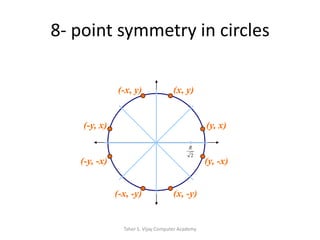
8- point symmetry in circles(x, y)(-x, y)(y, x)(-y, x)(y, -x)(-y, -x)(x, -y)(-x, -y)Taher S. Vijay Computer Academy
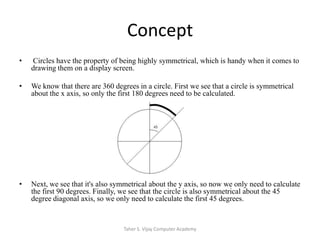
ConceptCircles have the property of being highly symmetrical, which is handy when it comes to drawing them on a display screen.We know that there are 360 degrees in a circle. First we see that a circle is symmetrical about the x axis, so only the first 180 degrees need to be calculated. Next, we see that it's also symmetrical about the y axis, so now we only need to calculate the first 90 degrees. Finally, we see that the circle is also symmetrical about the 45 degree diagonal axis, so we only need to calculate the first 45 degrees.Taher S. Vijay Computer Academy
InterpolationBresenham'scircle algorithm calculates the locations of the pixels in the first 45 degrees. It assumes that the circle is centered on the origin shifting the original center coordinates (centerx,centery). So for every pixel (x,y) it calculates, we draw a pixel in each of the 8 octants of the circle :putpixel(centerx + x, center y + y)putpixel(centerx + x, center y - y) putpixel(centerx - x, center y + y)putpixel(centerx - x, center y - y)putpixel(centerx + y, center y + x)putpixel(centerx + y, center y - x)putpixel(centerx - y, center y + x)putpixel(centerx - y, center y - x)Taher S. Vijay Computer Academy
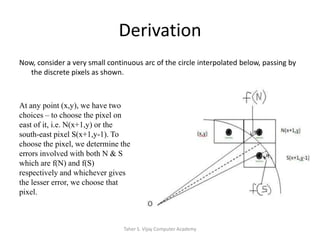
DerivationNow, consider a very small continuous arc of the circle interpolated below, passing by the discrete pixels as shown.At any point (x,y), we have two choices – to choose the pixel on east of it, i.e. N(x+1,y) or the south-east pixel S(x+1,y-1). To choose the pixel, we determine the errors involved with both N & S which are f(N) and f(S) respectively and whichever gives the lesser error, we choose that pixel.Taher S. Vijay Computer Academy
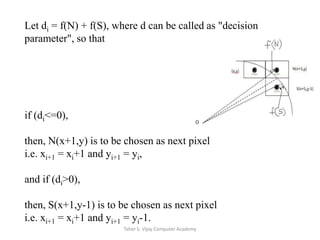
Let di = f(N) + f(S), where d can be called as "decision parameter", so that if (di<=0),then, N(x+1,y) is to be chosen as next pixel i.e. xi+1 = xi+1 and yi+1 = yi,and if (di>0),then, S(x+1,y-1) is to be chosen as next pixel i.e. xi+1 = xi+1 and yi+1 = yi-1.Taher S. Vijay Computer Academy
We know that for a circle,                            x2 + y2 = r2, where r represents the radius of the circle, an input to the algorithm.Errors can be represented asf(N) = (xi + 1)2 + yi2 - r2,        -(1)f(S) = (xi + 1)2 + (yi - 1)2 - r2        -(2)As di = f(N) + f(S),di = 2(xi+1)2 + yi2 + (yi-1)2 – 2r2        -(3)Taher S. Vijay Computer Academy
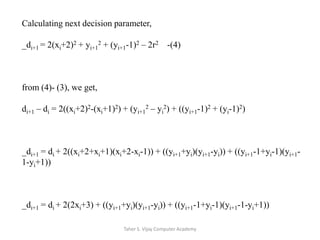
Calculating next decision parameter,_di+1 = 2(xi+2)2 + yi+12 + (yi+1-1)2 – 2r2    -(4)from (4)- (3), we get,di+1 – di = 2((xi+2)2-(xi+1)2) + (yi+12 – yi2) + ((yi+1-1)2 + (yi-1)2)_di+1 = di + 2((xi+2+xi+1)(xi+2-xi-1)) + ((yi+1+yi)(yi+1-yi)) + ((yi+1-1+yi-1)(yi+1-1-yi+1))_di+1 = di + 2(2xi+3) + ((yi+1+yi)(yi+1-yi)) + ((yi+1-1+yi-1)(yi+1-1-yi+1))Taher S. Vijay Computer Academy
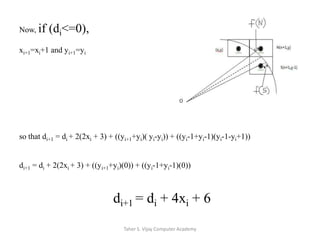
Now, if (di<=0),xi+1=xi+1 and yi+1=yiso that di+1 = di + 2(2xi + 3) + ((yi+1+yi)( yi-yi)) + ((yi-1+yi-1)(yi-1-yi+1))di+1 = di + 2(2xi + 3) + ((yi+1+yi)(0)) + ((yi-1+yi-1)(0))di+1 = di + 4xi + 6Taher S. Vijay Computer Academy
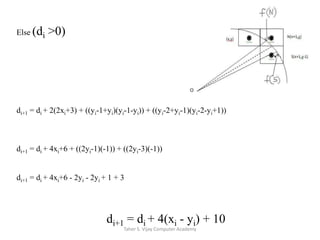
Else (di >0) di+1 = di + 2(2xi+3) + ((yi-1+yi)(yi-1-yi)) + ((yi-2+yi-1)(yi-2-yi+1))di+1 = di + 4xi+6 + ((2yi-1)(-1)) + ((2yi-3)(-1))di+1 = di + 4xi+6 - 2yi - 2yi + 1 + 3di+1 = di + 4(xi - yi) + 10Taher S. Vijay Computer Academy
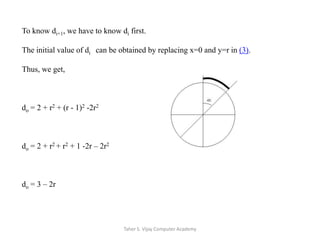
To know di+1, we have to know di first. The initial value of di  can be obtained by replacing x=0 and y=r in (3). Thus, we get,do = 2 + r2 + (r - 1)2 -2r2do = 2 + r2 + r2 + 1 -2r – 2r2do = 3 – 2rTaher S. Vijay Computer Academy
                                 BRESENHAM’S CIRCLE ALGORITHMBresenham Circle ( Xc, Yc, R):Description: Here Xc and Yc denote the x – coordinate and y –coordinate of the center of the circle. R is the radius.1. Set X = 0 and Y = R2. Set D = 3 – 2R3. Repeat While (X < Y)4.	 Call Draw Circle(Xc, Yc, X, Y)5.	 Set X = X + 16. 	If (D < 0) Then7. 		D = D + 4X + 68. 	Else9. 		Set Y = Y – 110.		 D = D + 4(X – Y) + 10	[End of If] Call Draw Circle(Xc, Yc, X, Y)		X++	[End of While]11. ExitTaher S. Vijay Computer Academy
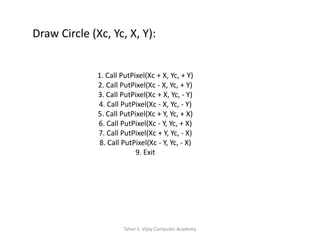
Draw Circle (Xc, Yc, X, Y):1. Call PutPixel(Xc + X, Yc, + Y)2. Call PutPixel(Xc - X, Yc, + Y)3. Call PutPixel(Xc + X, Yc, - Y)4. Call PutPixel(Xc - X, Yc, - Y)5. Call PutPixel(Xc + Y, Yc, + X)6. Call PutPixel(Xc - Y, Yc, + X)7. Call PutPixel(Xc + Y, Yc, - X)8. Call PutPixel(Xc - Y, Yc, - X)9. ExitTaher S. Vijay Computer Academy

Bresenham circle

  • 1.
    Computer GraphicsBresenham CircleGenerationAlgorithmTaher S.Vijay Computer AcademyTaher S. Vijay Computer Academy
  • 2.
    8- point symmetryin circles(x, y)(-x, y)(y, x)(-y, x)(y, -x)(-y, -x)(x, -y)(-x, -y)Taher S. Vijay Computer Academy
  • 3.
    ConceptCircles have theproperty of being highly symmetrical, which is handy when it comes to drawing them on a display screen.We know that there are 360 degrees in a circle. First we see that a circle is symmetrical about the x axis, so only the first 180 degrees need to be calculated. Next, we see that it's also symmetrical about the y axis, so now we only need to calculate the first 90 degrees. Finally, we see that the circle is also symmetrical about the 45 degree diagonal axis, so we only need to calculate the first 45 degrees.Taher S. Vijay Computer Academy
  • 4.
    InterpolationBresenham'scircle algorithm calculatesthe locations of the pixels in the first 45 degrees. It assumes that the circle is centered on the origin shifting the original center coordinates (centerx,centery). So for every pixel (x,y) it calculates, we draw a pixel in each of the 8 octants of the circle :putpixel(centerx + x, center y + y)putpixel(centerx + x, center y - y) putpixel(centerx - x, center y + y)putpixel(centerx - x, center y - y)putpixel(centerx + y, center y + x)putpixel(centerx + y, center y - x)putpixel(centerx - y, center y + x)putpixel(centerx - y, center y - x)Taher S. Vijay Computer Academy
  • 5.
    DerivationNow, consider avery small continuous arc of the circle interpolated below, passing by the discrete pixels as shown.At any point (x,y), we have two choices – to choose the pixel on east of it, i.e. N(x+1,y) or the south-east pixel S(x+1,y-1). To choose the pixel, we determine the errors involved with both N & S which are f(N) and f(S) respectively and whichever gives the lesser error, we choose that pixel.Taher S. Vijay Computer Academy
  • 6.
    Let di = f(N) +f(S), where d can be called as "decision parameter", so that if (di<=0),then, N(x+1,y) is to be chosen as next pixel i.e. xi+1 = xi+1 and yi+1 = yi,and if (di>0),then, S(x+1,y-1) is to be chosen as next pixel i.e. xi+1 = xi+1 and yi+1 = yi-1.Taher S. Vijay Computer Academy
  • 7.
    We know thatfor a circle, x2 + y2 = r2, where r represents the radius of the circle, an input to the algorithm.Errors can be represented asf(N) = (xi + 1)2 + yi2 - r2,        -(1)f(S) = (xi + 1)2 + (yi - 1)2 - r2        -(2)As di = f(N) + f(S),di = 2(xi+1)2 + yi2 + (yi-1)2 – 2r2        -(3)Taher S. Vijay Computer Academy
  • 8.
    Calculating next decisionparameter,_di+1 = 2(xi+2)2 + yi+12 + (yi+1-1)2 – 2r2    -(4)from (4)- (3), we get,di+1 – di = 2((xi+2)2-(xi+1)2) + (yi+12 – yi2) + ((yi+1-1)2 + (yi-1)2)_di+1 = di + 2((xi+2+xi+1)(xi+2-xi-1)) + ((yi+1+yi)(yi+1-yi)) + ((yi+1-1+yi-1)(yi+1-1-yi+1))_di+1 = di + 2(2xi+3) + ((yi+1+yi)(yi+1-yi)) + ((yi+1-1+yi-1)(yi+1-1-yi+1))Taher S. Vijay Computer Academy
  • 9.
    Now, if (di<=0),xi+1=xi+1 andyi+1=yiso that di+1 = di + 2(2xi + 3) + ((yi+1+yi)( yi-yi)) + ((yi-1+yi-1)(yi-1-yi+1))di+1 = di + 2(2xi + 3) + ((yi+1+yi)(0)) + ((yi-1+yi-1)(0))di+1 = di + 4xi + 6Taher S. Vijay Computer Academy
  • 10.
    Else (di >0)di+1 = di + 2(2xi+3) + ((yi-1+yi)(yi-1-yi)) + ((yi-2+yi-1)(yi-2-yi+1))di+1 = di + 4xi+6 + ((2yi-1)(-1)) + ((2yi-3)(-1))di+1 = di + 4xi+6 - 2yi - 2yi + 1 + 3di+1 = di + 4(xi - yi) + 10Taher S. Vijay Computer Academy
  • 11.
    To know di+1, wehave to know di first. The initial value of di can be obtained by replacing x=0 and y=r in (3). Thus, we get,do = 2 + r2 + (r - 1)2 -2r2do = 2 + r2 + r2 + 1 -2r – 2r2do = 3 – 2rTaher S. Vijay Computer Academy
  • 12.
    BRESENHAM’S CIRCLE ALGORITHMBresenham Circle ( Xc, Yc, R):Description: Here Xc and Yc denote the x – coordinate and y –coordinate of the center of the circle. R is the radius.1. Set X = 0 and Y = R2. Set D = 3 – 2R3. Repeat While (X < Y)4. Call Draw Circle(Xc, Yc, X, Y)5. Set X = X + 16. If (D < 0) Then7. D = D + 4X + 68. Else9. Set Y = Y – 110. D = D + 4(X – Y) + 10 [End of If] Call Draw Circle(Xc, Yc, X, Y) X++ [End of While]11. ExitTaher S. Vijay Computer Academy
  • 13.
    Draw Circle (Xc,Yc, X, Y):1. Call PutPixel(Xc + X, Yc, + Y)2. Call PutPixel(Xc - X, Yc, + Y)3. Call PutPixel(Xc + X, Yc, - Y)4. Call PutPixel(Xc - X, Yc, - Y)5. Call PutPixel(Xc + Y, Yc, + X)6. Call PutPixel(Xc - Y, Yc, + X)7. Call PutPixel(Xc + Y, Yc, - X)8. Call PutPixel(Xc - Y, Yc, - X)9. ExitTaher S. Vijay Computer Academy