Problem Solving Introduction
How to Solve Problems You can try to solve a problem just by thinking about it But …  by trying some planned methods you can help the process
An Overall Process Does it sound familiar? These are general problem solving strategies (6 steps) … See how much of it sounds like project cycle management
Define the Problem What stops you from reaching your goal?  You may need to say the problem in general terms since the exact problem may not be obvious. you may lack information to define it  you can confuse effects with causes (this is where a problem tree is good) Prepare a statement of the problem and find someone you trust to talk it over with.  Review it with your team, manager, or the appropriate committee or resource.
Gather Information Stakeholders Individuals, groups, organizations that are affected by the problem, or its solution.  (Stakeholder Analysis) Facts & data Research  Results from surveys and studies  Interviews of "experts" and trusted sources  E vents, past or present, either seen or reported (past projects, lessons learned)
Gather Information Limits The boundaries or constraints of the situation are difficult to change.  They include lack of funds or other resources.  If a solution is surrounded by too many constraints, the constraints themselves may be the problem.
Gather Information Opinions and Assumptions Opinions of decision makers, committees, or other powerful groups will be important to the success of your decision.  It is important to recognize truth,  bias, or prejudice in the opinion. Assumptions can save time and work since is often difficult to get "all the facts." Recognize that some things are accepted on faith.  Assumptions also have risks, must be recognized for what they are, and should be discarded if they are proven wrong.
Develop alternatives Look at your problems in different ways; find a new perspective that you haven't thought of before. Brainstorming, or quickly writing of alternatives no matter how silly, is an excellent discovery process. Once you have listed or mapped alternatives, be open to their possibilities.  Make notes on those that:  need more information  are new solutions  can be combined or eliminated  will meet opposition  seem promising or exciting
Weigh Alternatives After listing possible alternatives, evaluate them without prejudice, no matter how appealing or distasteful  Consider all criteria While one solution may solve the problem, it may not work if resources aren't available, if people won't accept it, or if it causes new problems
Develop a plan for implementation. Step-by-step process or actions for solving the problem  Communications strategy for notifying stakeholders Inform those who care or will be affected by the change.  Prepare them as necessary about your decision. Resource identification/allocation  Timeline for implementation
Monitor progress Your implementation will only be successful if you are monitoring your solution, the effects of it on resources and stakeholders, your timeline, and your progress.  As you monitor your progress, if results are not what you expect, review your options and alternatives. Whether or not you achieved your goals, it is important to consider what you have learned from your experience:  about yourself, about what you consider important.
About Thinking How do we think?
“Unordered” Thinking Emotional – what you feel Habitual – what you always do Ideas may not be connected or connected for reasons not clear Solutions may come from outside – government rules, religious ideologies
Logical Thinking ‘Think in straight lines’ If this happens, then this will happen, then this … … Links together cause and effect. Makes relationships between facts.
Lateral Thinking Coming up with ideas that are not obvious at the start Coming up with ideas that do not come from step by step logic
Lateral Thinking … 1. Recognise dominant ideas that decide how you look at a problem 2. Search for different ways of looking at things, 3. Relax the rigid control of thinking 4. Use chance to encourage other ideas
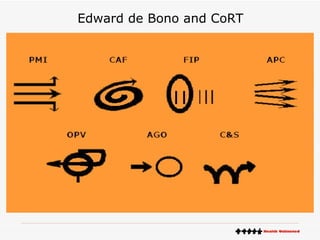
Edward de Bono and CoRT
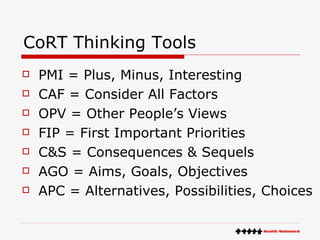
CoRT Thinking Tools PMI = Plus, Minus, Interesting  CAF = Consider All Factors  OPV = Other People’s Views  FIP = First Important Priorities  C&S = Consequences & Sequels  AGO = Aims, Goals, Objectives  APC = Alternatives, Possibilities, Choices
Some Specific Methods There are some different ways of looking at problems and decisions In PCM we have already looked at problem trees, stakeholder analysis, objectives, alternatives and strategies analysis
5 Whys The 5 Whys is a simple problem-solving technique that helps users to get to the root of the problem quickly. Made popular in the 1970s by the Toyota Production System. The 5 Whys strategy involves looking at any problem and asking: "Why?" and "What caused this problem?" Very often, the answer to the first "why" will prompt another "why" and the answer to the second "why" will prompt another and so on.
5 Whys  Example The Villagers are unhappy.  Why? Because we did not deliver our services when we said we would.  Why? The start up took much longer than we thought it would. Why? Because we had no staff at the planned start date.  Why? Because our work plan did not have time specifically for recruitment. Why? Because those who wrote the plan don’t know Ratanakiri’s recruitment problems.  We need to review our proposal writing (time estimation and work plan) procedures.
Exercise Pick a problem Ask 5 whys
Take a break 10 minutes Back here on time!!
SWOT Look at your organisation’s Strengths Weaknesses Opportunities Threats
Strengths: What advantages does HU have?  What do you do better than anyone else?  What unique or lowest-cost resources do you have access to?  What do people in your sector see as your strengths?  What factors mean that you "get the grant"?
Strengths: Consider this from inside HU, and from the point of view of your customers and people in the sector. (If you are having any difficulty with this, try writing down a list of your characteristics. Some of these will hopefully be strengths!) In looking at your strengths, think about them in relation to your competitors - for example, if all NGOs provide links to the Governor, then this relationship is not a strength, it is a necessity.
Weaknesses: What could we improve?  What should we avoid?  What are people in your sector likely to see as weaknesses?  What factors lose us projects?  Again, consider this from internal and external sides: Do other people seem to see weaknesses that you do not see? Are others doing any better? It is best to be realistic, and face any unpleasant truths as soon as possible.
Opportunities: Where are the good opportunities?  What are the interesting trends?  Useful opportunities can come from such things as:  Changes in technology and markets on both a broad and narrow scale  Changes in government policy related to your field  Changes in social patterns, population profiles, lifestyles, etc.  Local events  A useful way to look at opportunities is to look at your strengths and ask yourself whether these open up any opportunities. Or, look at your weaknesses and ask yourself whether you could create opportunities by fixing them.
Threats: What obstacles do you face?  What are others doing that you should be worried about?  Are the required specifications for your job, projects or services changing?  Is changing technology or policy threatening your position?  Do you have bad management problems?  Could any of your weaknesses seriously threaten your organisation?
Thankyou
Produced by Tony Hobbs Health Unlimited,  Ratanakiri, Cambodia www.healthunlimited.org © 2009 HU. Use with Acknowledgement

11 Problem Solving

  • 1.
  • 2.
    How to SolveProblems You can try to solve a problem just by thinking about it But … by trying some planned methods you can help the process
  • 3.
    An Overall ProcessDoes it sound familiar? These are general problem solving strategies (6 steps) … See how much of it sounds like project cycle management
  • 4.
    Define the ProblemWhat stops you from reaching your goal? You may need to say the problem in general terms since the exact problem may not be obvious. you may lack information to define it you can confuse effects with causes (this is where a problem tree is good) Prepare a statement of the problem and find someone you trust to talk it over with. Review it with your team, manager, or the appropriate committee or resource.
  • 5.
    Gather Information StakeholdersIndividuals, groups, organizations that are affected by the problem, or its solution. (Stakeholder Analysis) Facts & data Research Results from surveys and studies Interviews of "experts" and trusted sources E vents, past or present, either seen or reported (past projects, lessons learned)
  • 6.
    Gather Information LimitsThe boundaries or constraints of the situation are difficult to change.  They include lack of funds or other resources.  If a solution is surrounded by too many constraints, the constraints themselves may be the problem.
  • 7.
    Gather Information Opinionsand Assumptions Opinions of decision makers, committees, or other powerful groups will be important to the success of your decision.  It is important to recognize truth, bias, or prejudice in the opinion. Assumptions can save time and work since is often difficult to get "all the facts." Recognize that some things are accepted on faith.  Assumptions also have risks, must be recognized for what they are, and should be discarded if they are proven wrong.
  • 8.
    Develop alternatives Lookat your problems in different ways; find a new perspective that you haven't thought of before. Brainstorming, or quickly writing of alternatives no matter how silly, is an excellent discovery process. Once you have listed or mapped alternatives, be open to their possibilities. Make notes on those that: need more information are new solutions can be combined or eliminated will meet opposition seem promising or exciting
  • 9.
    Weigh Alternatives Afterlisting possible alternatives, evaluate them without prejudice, no matter how appealing or distasteful Consider all criteria While one solution may solve the problem, it may not work if resources aren't available, if people won't accept it, or if it causes new problems
  • 10.
    Develop a planfor implementation. Step-by-step process or actions for solving the problem Communications strategy for notifying stakeholders Inform those who care or will be affected by the change. Prepare them as necessary about your decision. Resource identification/allocation Timeline for implementation
  • 11.
    Monitor progress Yourimplementation will only be successful if you are monitoring your solution, the effects of it on resources and stakeholders, your timeline, and your progress. As you monitor your progress, if results are not what you expect, review your options and alternatives. Whether or not you achieved your goals, it is important to consider what you have learned from your experience: about yourself, about what you consider important.
  • 12.
    About Thinking Howdo we think?
  • 13.
    “Unordered” Thinking Emotional– what you feel Habitual – what you always do Ideas may not be connected or connected for reasons not clear Solutions may come from outside – government rules, religious ideologies
  • 14.
    Logical Thinking ‘Thinkin straight lines’ If this happens, then this will happen, then this … … Links together cause and effect. Makes relationships between facts.
  • 15.
    Lateral Thinking Comingup with ideas that are not obvious at the start Coming up with ideas that do not come from step by step logic
  • 16.
    Lateral Thinking …1. Recognise dominant ideas that decide how you look at a problem 2. Search for different ways of looking at things, 3. Relax the rigid control of thinking 4. Use chance to encourage other ideas
  • 17.
  • 18.
    CoRT Thinking ToolsPMI = Plus, Minus, Interesting CAF = Consider All Factors OPV = Other People’s Views FIP = First Important Priorities C&S = Consequences & Sequels AGO = Aims, Goals, Objectives APC = Alternatives, Possibilities, Choices
  • 19.
    Some Specific MethodsThere are some different ways of looking at problems and decisions In PCM we have already looked at problem trees, stakeholder analysis, objectives, alternatives and strategies analysis
  • 20.
    5 Whys The5 Whys is a simple problem-solving technique that helps users to get to the root of the problem quickly. Made popular in the 1970s by the Toyota Production System. The 5 Whys strategy involves looking at any problem and asking: "Why?" and "What caused this problem?" Very often, the answer to the first "why" will prompt another "why" and the answer to the second "why" will prompt another and so on.
  • 21.
    5 Whys Example The Villagers are unhappy. Why? Because we did not deliver our services when we said we would. Why? The start up took much longer than we thought it would. Why? Because we had no staff at the planned start date. Why? Because our work plan did not have time specifically for recruitment. Why? Because those who wrote the plan don’t know Ratanakiri’s recruitment problems. We need to review our proposal writing (time estimation and work plan) procedures.
  • 22.
    Exercise Pick aproblem Ask 5 whys
  • 23.
    Take a break10 minutes Back here on time!!
  • 24.
    SWOT Look atyour organisation’s Strengths Weaknesses Opportunities Threats
  • 25.
    Strengths: What advantagesdoes HU have? What do you do better than anyone else? What unique or lowest-cost resources do you have access to? What do people in your sector see as your strengths? What factors mean that you "get the grant"?
  • 26.
    Strengths: Consider thisfrom inside HU, and from the point of view of your customers and people in the sector. (If you are having any difficulty with this, try writing down a list of your characteristics. Some of these will hopefully be strengths!) In looking at your strengths, think about them in relation to your competitors - for example, if all NGOs provide links to the Governor, then this relationship is not a strength, it is a necessity.
  • 27.
    Weaknesses: What couldwe improve? What should we avoid? What are people in your sector likely to see as weaknesses? What factors lose us projects? Again, consider this from internal and external sides: Do other people seem to see weaknesses that you do not see? Are others doing any better? It is best to be realistic, and face any unpleasant truths as soon as possible.
  • 28.
    Opportunities: Where arethe good opportunities? What are the interesting trends? Useful opportunities can come from such things as: Changes in technology and markets on both a broad and narrow scale Changes in government policy related to your field Changes in social patterns, population profiles, lifestyles, etc. Local events A useful way to look at opportunities is to look at your strengths and ask yourself whether these open up any opportunities. Or, look at your weaknesses and ask yourself whether you could create opportunities by fixing them.
  • 29.
    Threats: What obstaclesdo you face? What are others doing that you should be worried about? Are the required specifications for your job, projects or services changing? Is changing technology or policy threatening your position? Do you have bad management problems? Could any of your weaknesses seriously threaten your organisation?
  • 30.
  • 31.
    Produced by TonyHobbs Health Unlimited, Ratanakiri, Cambodia www.healthunlimited.org © 2009 HU. Use with Acknowledgement

Editor's Notes

  • #2 Notes, SWOT Worksheet
  • #18 Plus Minus Interesting, Consider All Factors, First Important Priorities, Alternatives Possibilities Choices , Other Peoples Views, Aims Goals Objectives, Consequences and Sequels